Solutions to Chapter 18
Long-Term Financial Planning
1. a. False. Financial planning is a process of deciding which risks to take.
b. False. Financial planning is concerned with possible surprises as well as the most
c. True. Financial planning considers both the financing and investment decisions.
2. Some of the dangers and disadvantages of using a financial model are:
Most models are accounting-based and do not recognize firm value maximization as
Often the relationships among variables specified by the model are somewhat
18-1
Copyright © 2018 McGraw-Hill Education. All rights reserved. No reproduction or distribution without the prior written consent of
McGraw-Hill Education.
3. The ability to meet or exceed the targets embodied in a financial plan is obviously a
reassuring indicator of management talent and motivation. Moreover, the financial plan
focuses attention on the specific targets that top management deems most important.
There are, however, several dangers:
Financial plans are usually accounting-based and thus are subject to the biases
Managers may sacrifice the firm’s best long-term interests in order to meet the plan’s
4. Neither the growth rate of earnings nor the growth rate of sales translates generally into
value-maximizing policies for the firm; in this sense, a focus on these variables is not an
5. Percentage of sales models assume that most variables vary in direct proportion to sales.
In practice, however, the firm can increase sales without increasing fixed assets, by
running plants at higher percentages of capacity or by paying employees overtime. In this
18-2
Copyright © 2018 McGraw-Hill Education. All rights reserved. No reproduction or distribution without the prior written consent of
McGraw-Hill Education.
6. If the firm reduces prices, sales revenue will increase less than proportionally to output,
7. Possible balancing items are dividends, borrowing, or equity issues. Firms tend to prefer
to keep dividends steady, so in practice this is not the best choice for a balancing item.
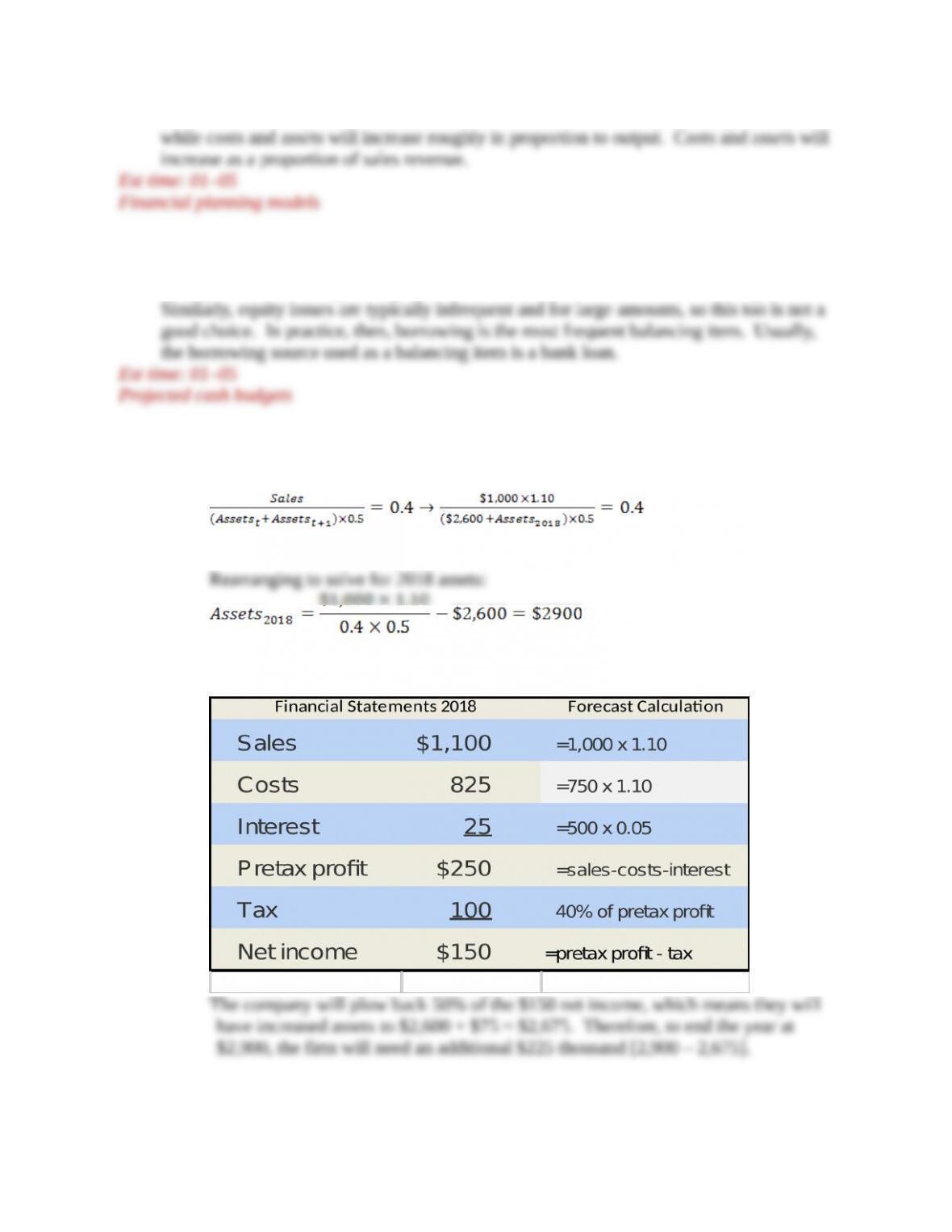
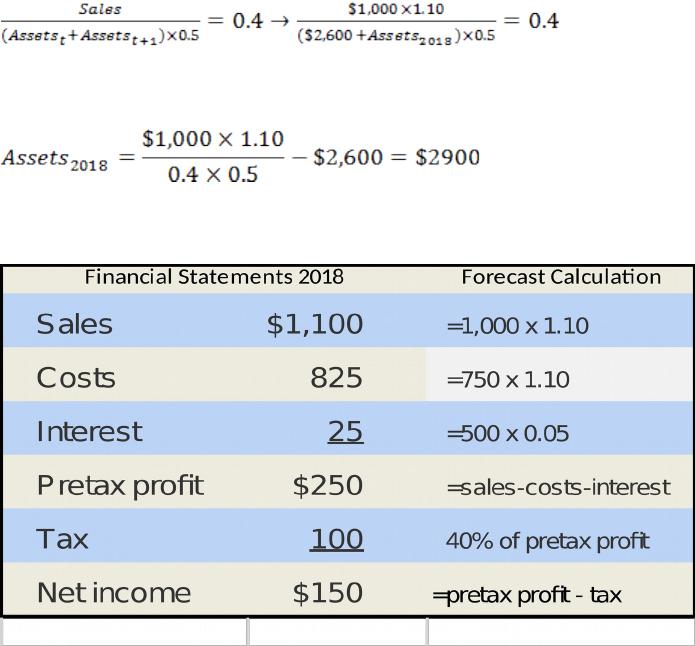
8. a. To find the ending assets forecast for 2018, start with the assumptions that average
assets between two consecutive years will remain pegged to sales and that sales will
grow by 10%. Then calculate the value of 2018’s year-end assets through algebra:
b. To estimate capital needs in 2018, we need to forecast the firm’s 2018 income
statement:
18-3
Copyright © 2018 McGraw-Hill Education. All rights reserved. No reproduction or distribution without the prior written consent of
McGraw-Hill Education.
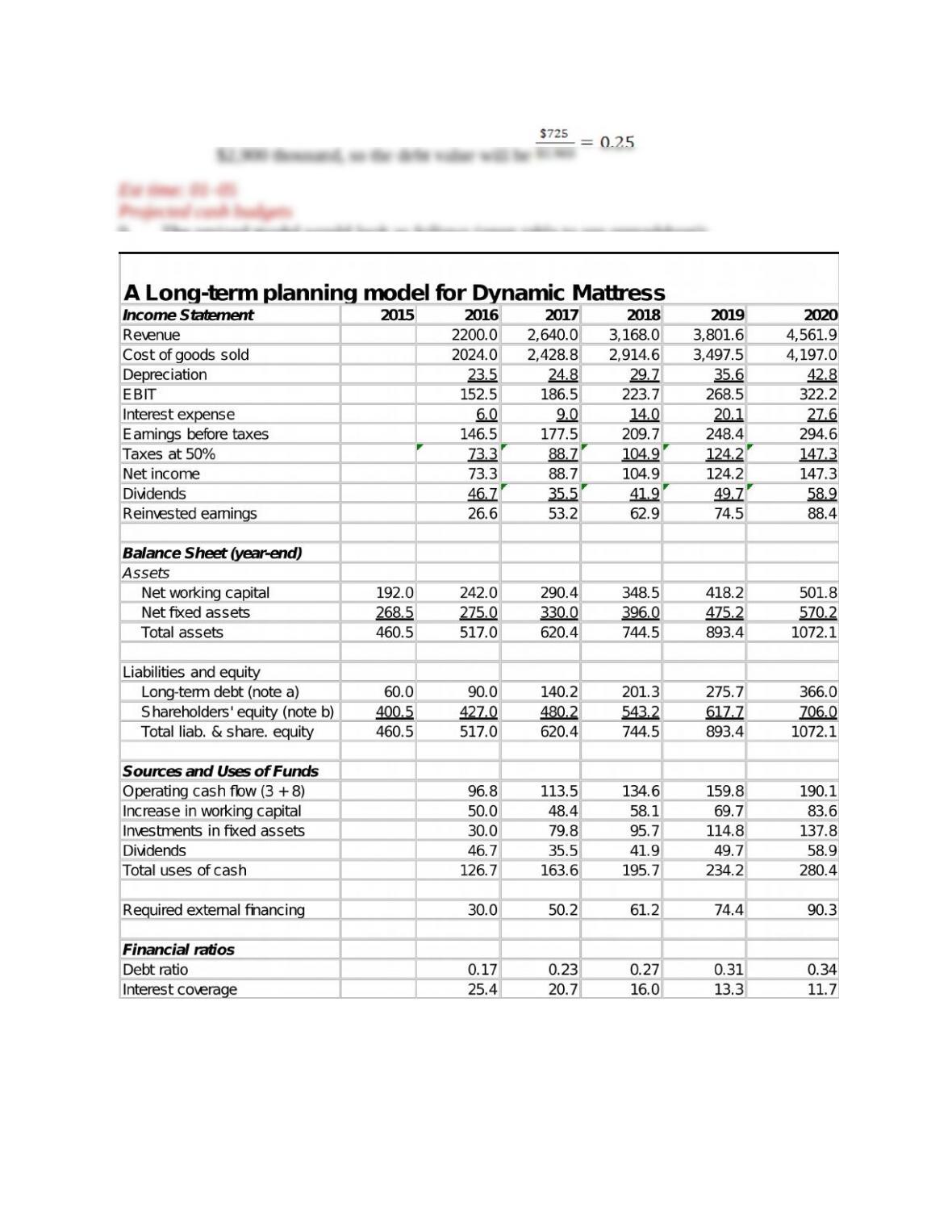
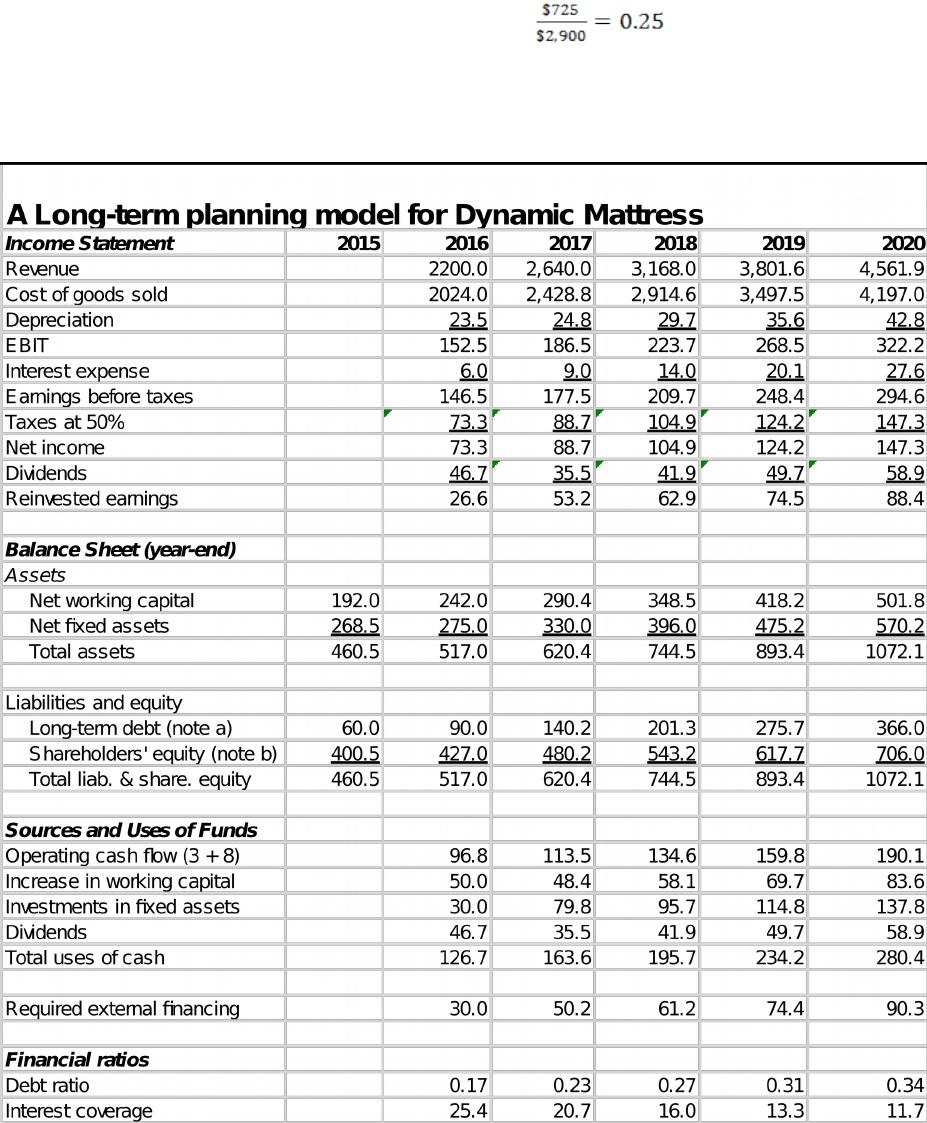
c. Debt will become $725 [500 + 225] thousand and the companies total value will be
9. The revised model would look as follows (open table to see spreadsheet):
..
10. a. In 2018, assets will increase by 20% of $3,000, or $600. Therefore, debt and equity
each must increase by 20%. Equity will increase to $2,400, and debt will increase to
$1,200. Net income will increase to $600. The balancing item is dividends. If net
18-4
Copyright © 2018 McGraw-Hill Education. All rights reserved. No reproduction or distribution without the prior written consent of
McGraw-Hill Education.

11. a. The first year of the 3 year pro forma is describe below. Net fixed assets grow by
$200, which is 25% of the current value of $800. Therefore, for the ratio of revenues
to total assets to remain constant, revenues also must grow by 25%.
Pro-Forma Income Statement, 2018 Comment
Revenue $2,250 25% higher
Fixed costs 56 Unchanged
Variable costs 1,800 80% of revenue
Depreciation 80 10% of 2016 fixed assets
Balance Sheet, Year-End 2018
Assets
Net working capital $ 500 50% of fixed assets
Liabilities & Shareholders’ Equity
Debt $ 375 25% of total capital
shareholders’ equity
Notice that required external financing is:
b. If debt is the balancing item, all external financing will come from new debt issues.
Therefore, the right-hand side of the balance sheet will now be:
Debt $ 542 Increases by $242
18-5
Copyright © 2018 McGraw-Hill Education. All rights reserved. No reproduction or distribution without the prior written consent of
McGraw-Hill Education.

c. The debt ratio increases from 0.25 to
.361.0
500,1
542
12. a. Net income in 2018 will increase by 15% from its current value of $500 to a new
External financing in 2018: $277.50
b. Since dividend policy is fixed and no equity will be issued, debt must be the
c. Debt issued must be $277.50.
13.
18-6
Copyright © 2018 McGraw-Hill Education. All rights reserved. No reproduction or distribution without the prior written consent of
McGraw-Hill Education.
..
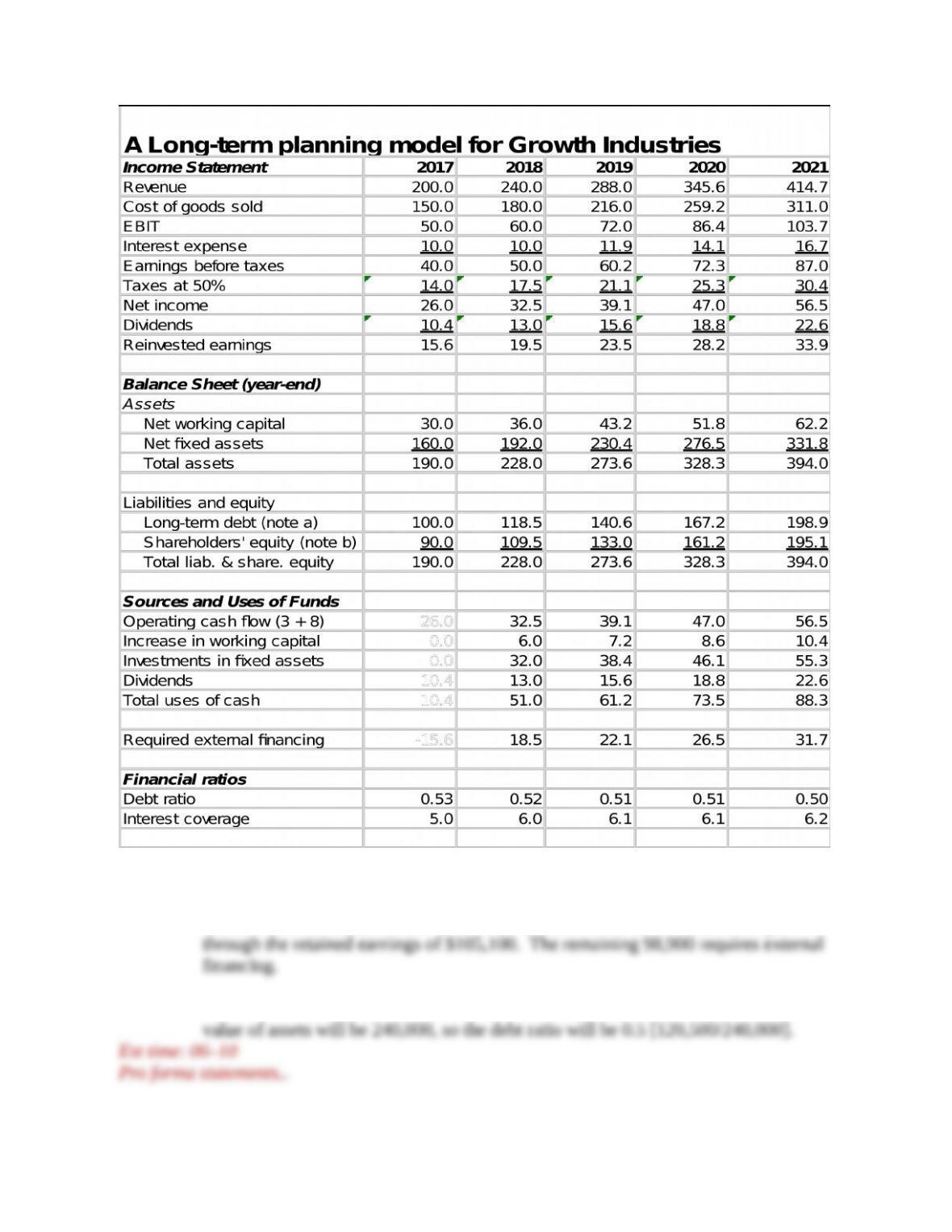
a.If all assets grow by 20%, then total assets (adjusted for Net Working Capital) will
increase from $190,000 to $394,000. The $204,000 increase is financed in part
b. At the end of 2018, the new debt will be 120,500 [100,000 +20,500] and the new
18-7
Copyright © 2018 McGraw-Hill Education. All rights reserved. No reproduction or distribution without the prior written consent of
McGraw-Hill Education.
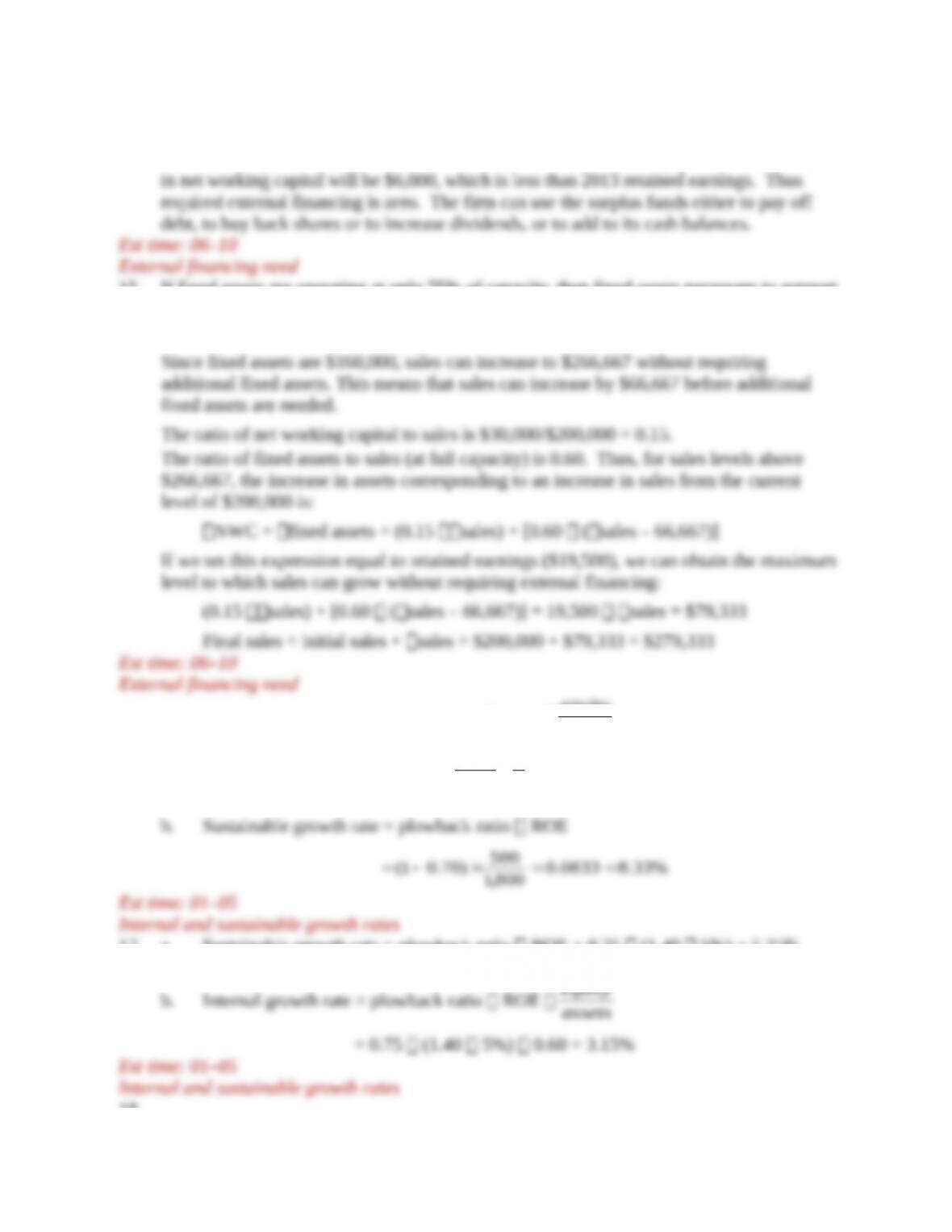

14. Even if sales increase by 20%, the firm still has more than enough fixed assets to meet
production. Only working capital will increase. Net working capital of the firm in 2012
was $30,000 ($40,000 of current assets minus $10,000 of accounts payable). The increase
15. If fixed assets are operating at only 75% of capacity, then fixed assets necessary to support
current production levels would be only 0.75 $160,000 = $120,000.
Thus, at full capacity, the ratio of fixed assets to sales is $120,000/$200,000 = 0.6.
16. a. Internal growth rate = plowback ratio ROE
assets
equity
%56.50556.0
3
2
800,1
500
)70.01(
17. a. Sustainable growth rate = plowback ratio ROE = 0.75 (1.40 5%) = 5.25%
18.
18-8
Copyright © 2018 McGraw-Hill Education. All rights reserved. No reproduction or distribution without the prior written consent of
McGraw-Hill Education.
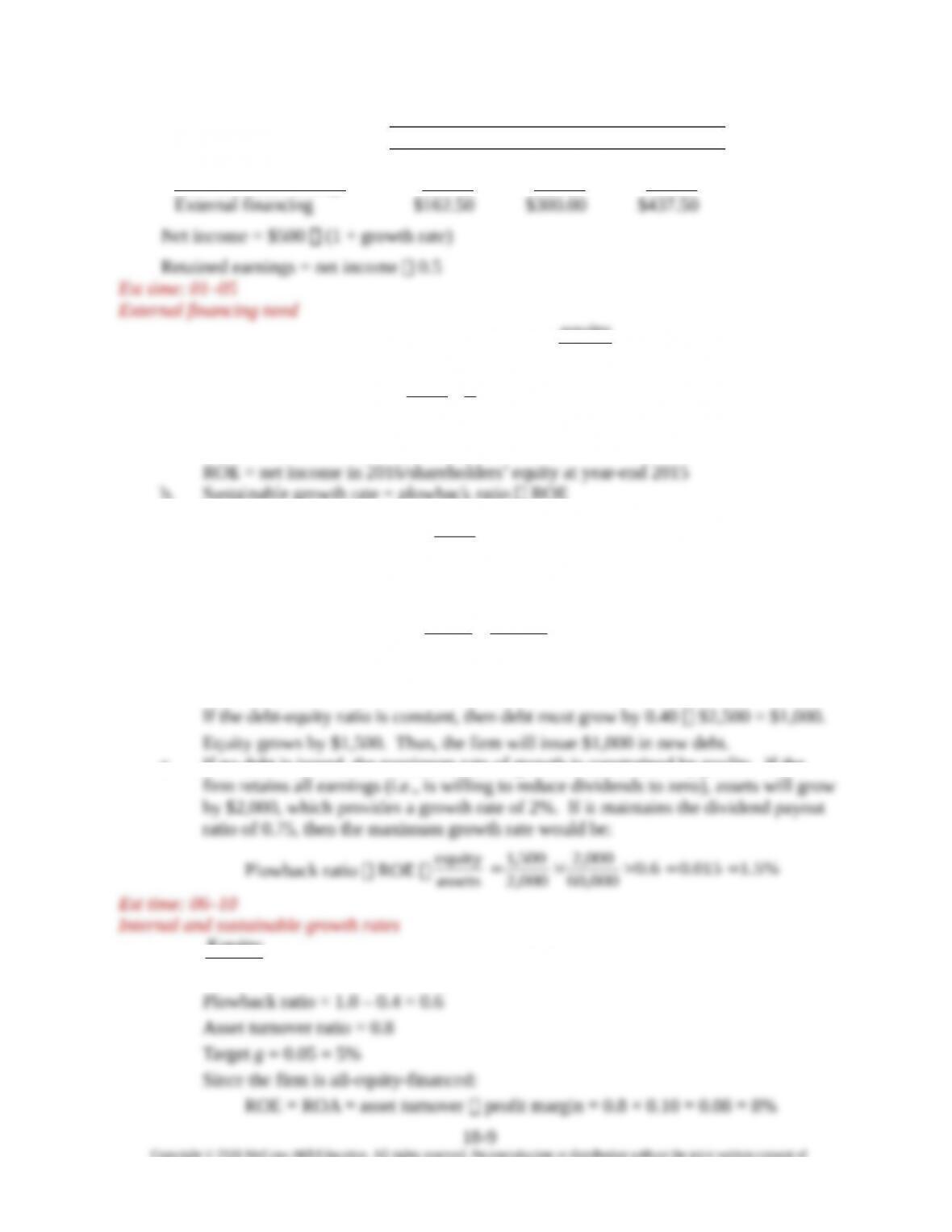

a) b) c)
15% 20% 25%
Growth in assets $450.00 $600.00 $750.00
less: Retained earnings 287.50 300.00 312.50
19. a. Internal growth rate = plowback ratio ROE
assets
equity
%1010.0
3
2
b. Sustainable growth rate = plowback ratio ROE
%1515.0
Est time: 01–05
Internal and sustainable growth rates
20. a. g = plowback ratio ROE
025.0
000,60
000,2
000,2
500,1
= 2.5%
b. If g = 0.025, assets will grow by 0.025 $100,000 = $2,500.
c. If no debt is issued, the maximum rate of growth is constrained by profits. If the
21. a.
0.1
Assets
Equity
Copyright © 2018 McGraw-Hill Education. All rights reserved. No reproduction or distribution without the prior written consent of
McGraw-Hill Education.
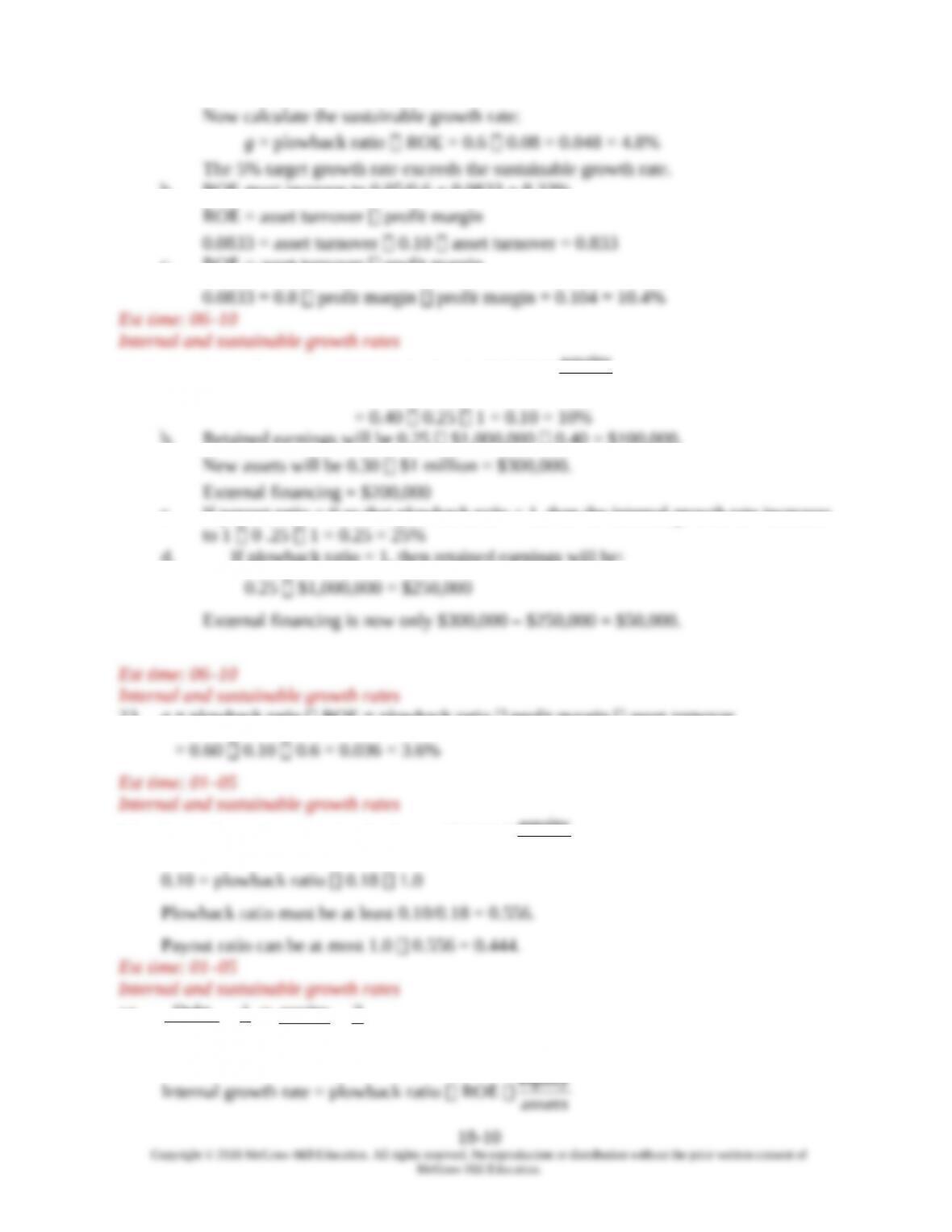

b. ROE must increase to 0.05/0.6 = 0.0833 = 8.33%
c. ROE = asset turnover profit margin
22. a. Internal growth rate = plowback ratio ROE
assets
equity
b. Retained earnings will be 0.25 $1,000,000 0.40 = $100,000.
c. If payout ratio = 0 so that plowback ratio = 1, then the internal growth rate increases
d. If plowback ratio = 1, then retained earnings will be:
23. g = plowback ratio ROE = plowback ratio profit margin asset turnover
24. Internal growth rate = plowback ratio ROE
assets
25.
3
1
Equity
Debt
4
3
assets
equity
assets
18-10
Copyright © 2018 McGraw-Hill Education. All rights reserved. No reproduction or distribution without the prior written consent of
McGraw-Hill Education.
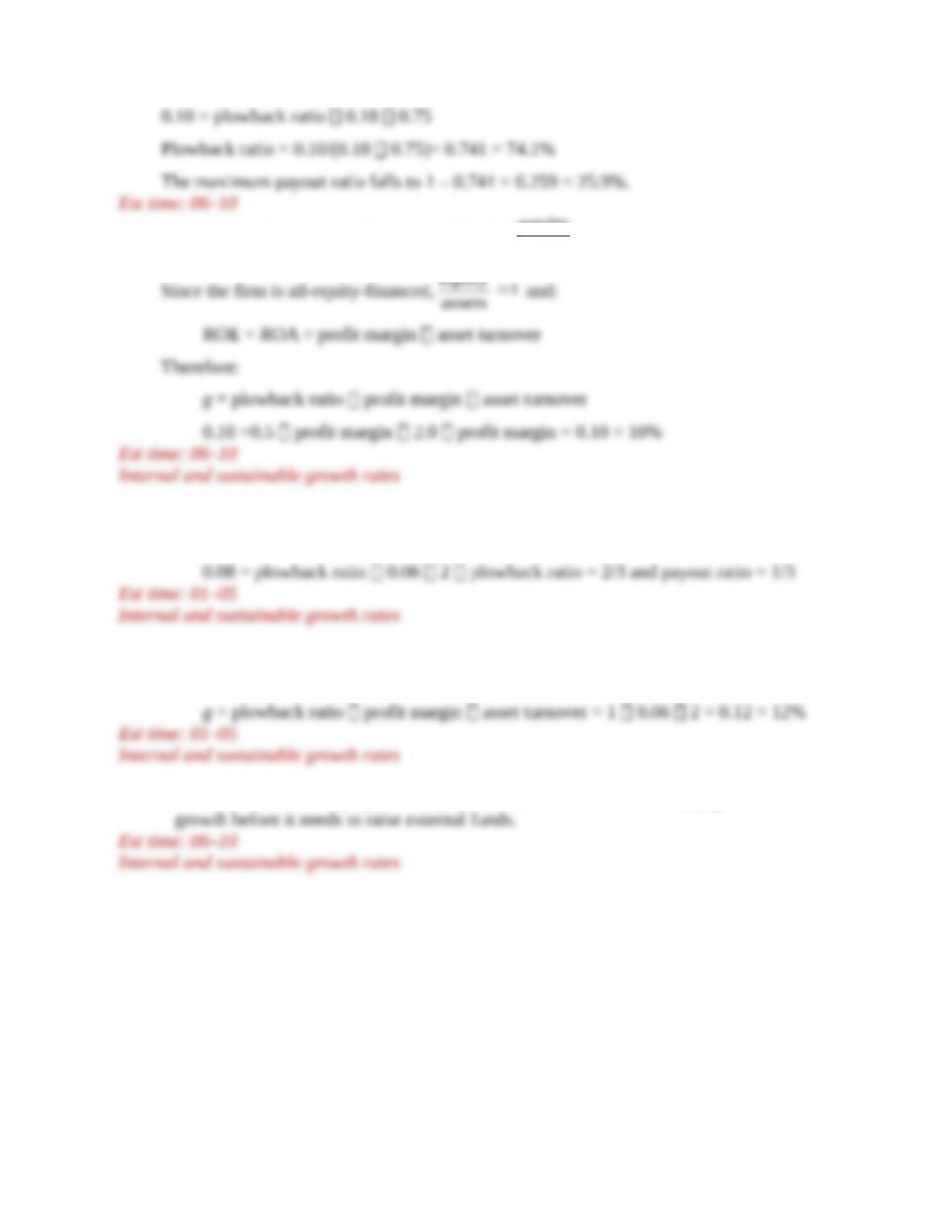

26 Internal growth rate = plowback ratio ROE
assets
equity
27. If profit margin = 0.06, then:
28. Set plowback ratio equal to 1.0 so that:
29. If assets rise less than proportionally with sales, then the firm can enjoy greater sales
18-11
Copyright © 2018 McGraw-Hill Education. All rights reserved. No reproduction or distribution without the prior written consent of
McGraw-Hill Education.