Solutions to Chapter 16
Debt Policy
1. a. True.
b. False. As financial leverage increases, the expected rate of return on equity rises by
c. False. The sensitivity of equity returns to business risk, and therefore the cost of
2. b. By issuing debt, the company has created financial leverage for the investor. This
creates more volatility in returns. By raising money and investing in the debt, the
3. Number of shares = 75,000
Price per share = $10
State of the Economy
Slump Normal Boom
Operating income
$75,000
$125,000
$175,000
Interest $25,000 $25,000 $25,000
16-5
Copyright © 2018 McGraw-Hill Education. All rights reserved. No reproduction or distribution without the prior written consent of
McGraw-Hill Education.
4. a. Share price = $10
With no leverage, there are 100,000 shares outstanding:
b. With leverage, there are 75,000 shares outstanding:
5.
a. Rosencrantz can recreate the returns to Stock A by buying Stock B with all of his capital
2
b. Guildenstern can recreate the returns to Stock B by buying Stock A with
7
9=¿
9=¿
2
b. Moderate borrowing does not significantly affect the probability of financial distress,
c. If the opportunity were the firm’s only asset, this would be a good deal. Stockholders
d. This is not an important reason for conservative debt levels. As long as MM’s
proposition holds, the company’s overall cost of capital is unchanged despite increasing
7.
a. The price of the stock should remain at $10 per share—all else equal.
160,000,000
Copyright © 2018 McGraw-Hill Education. All rights reserved. No reproduction or distribution without the prior written consent of
McGraw-Hill Education.
a. Market value of the firm is $100 10,000 = $1,000,000.
b. Low-debt plan:
EBIT $110,000
c. With the high-debt plan, equity falls by $400,000, so:
9. Expected return on assets is:
10.
16-5
Copyright © 2018 McGraw-Hill Education. All rights reserved. No reproduction or distribution without the prior written consent of
McGraw-Hill Education.
a
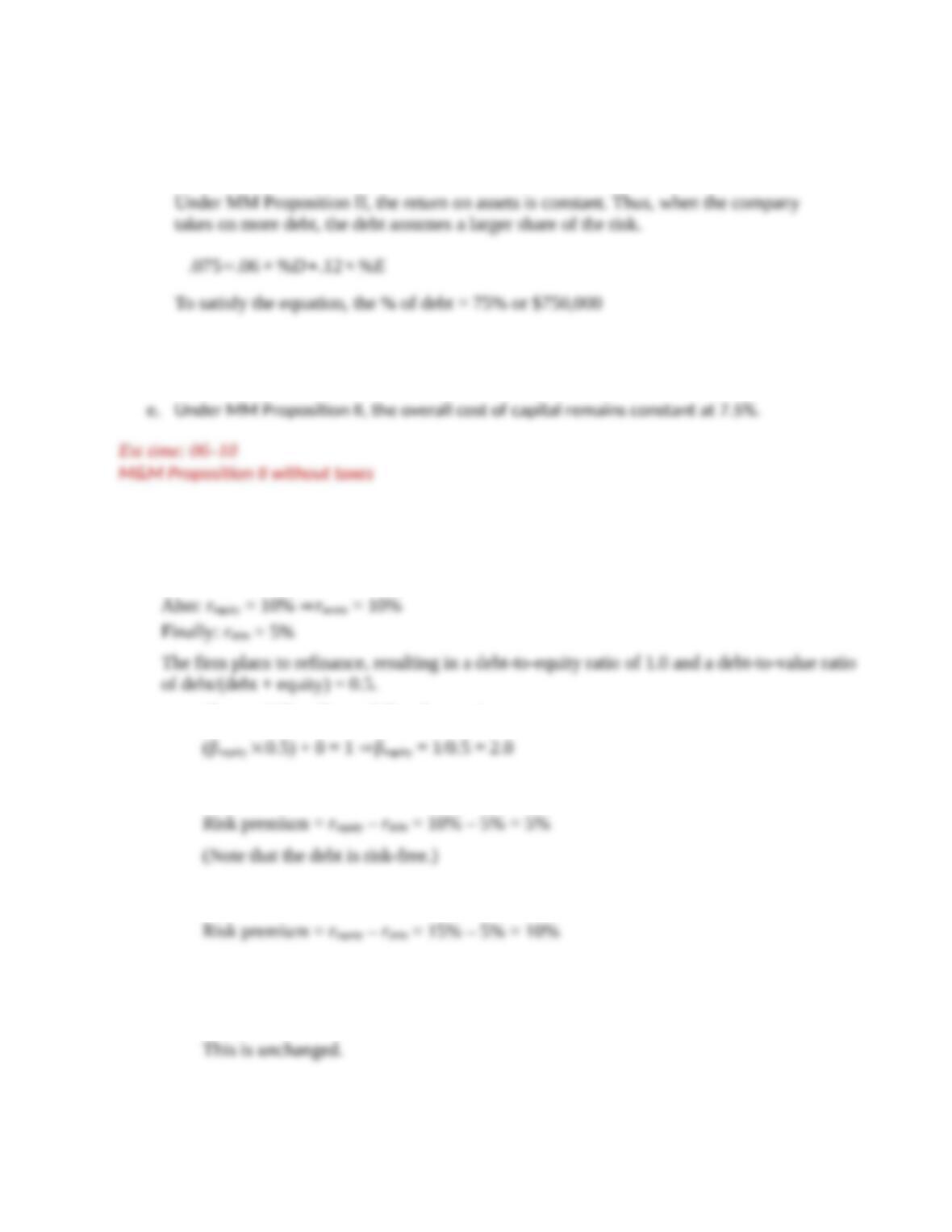
rassets =.05×.5+.10 ×.5=.075∨7.5
d. The percentage of equity is now 25% and the value of equity is $250,000
11. Currently, with no outstanding debt, equity = 1.0.
Therefore: assets = 1.0
a. (equity 0.5) + (debt 0.5) = assets = 1
b. requity = rassets = 10%
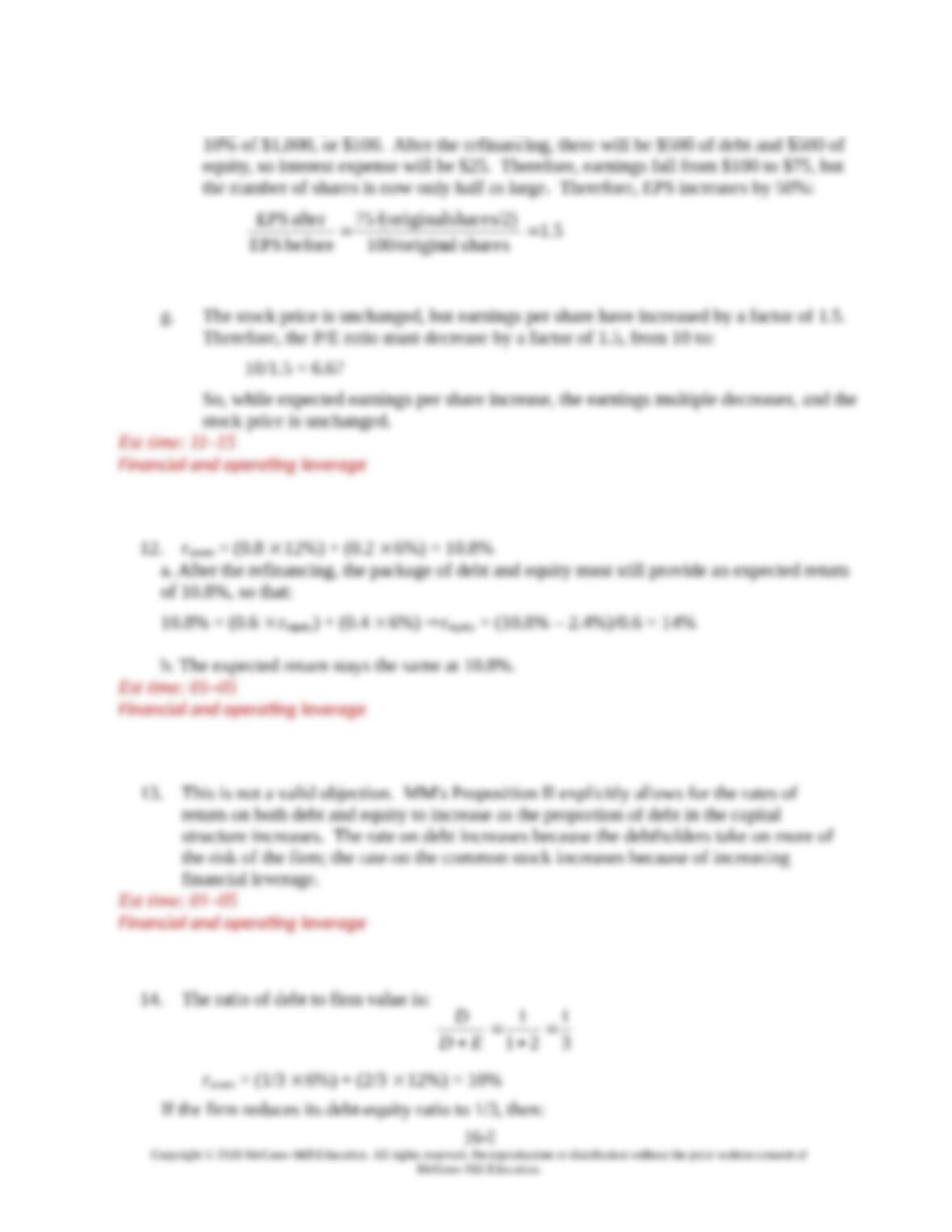
c. requity = rassets + [D/E (rassets – rdebt)] = 10% + [1 (10% – 5%)] = 15%
d. 5%
e. rassets = (0.5 requity) + (0.5 rdebt) = (0.5 15%) + (0.5 5%) = 10%
16-5
Copyright © 2018 McGraw-Hill Education. All rights reserved. No reproduction or distribution without the prior written consent of
McGraw-Hill Education.
f. Suppose total equity before the refinancing was $1,000. Then expected earnings were
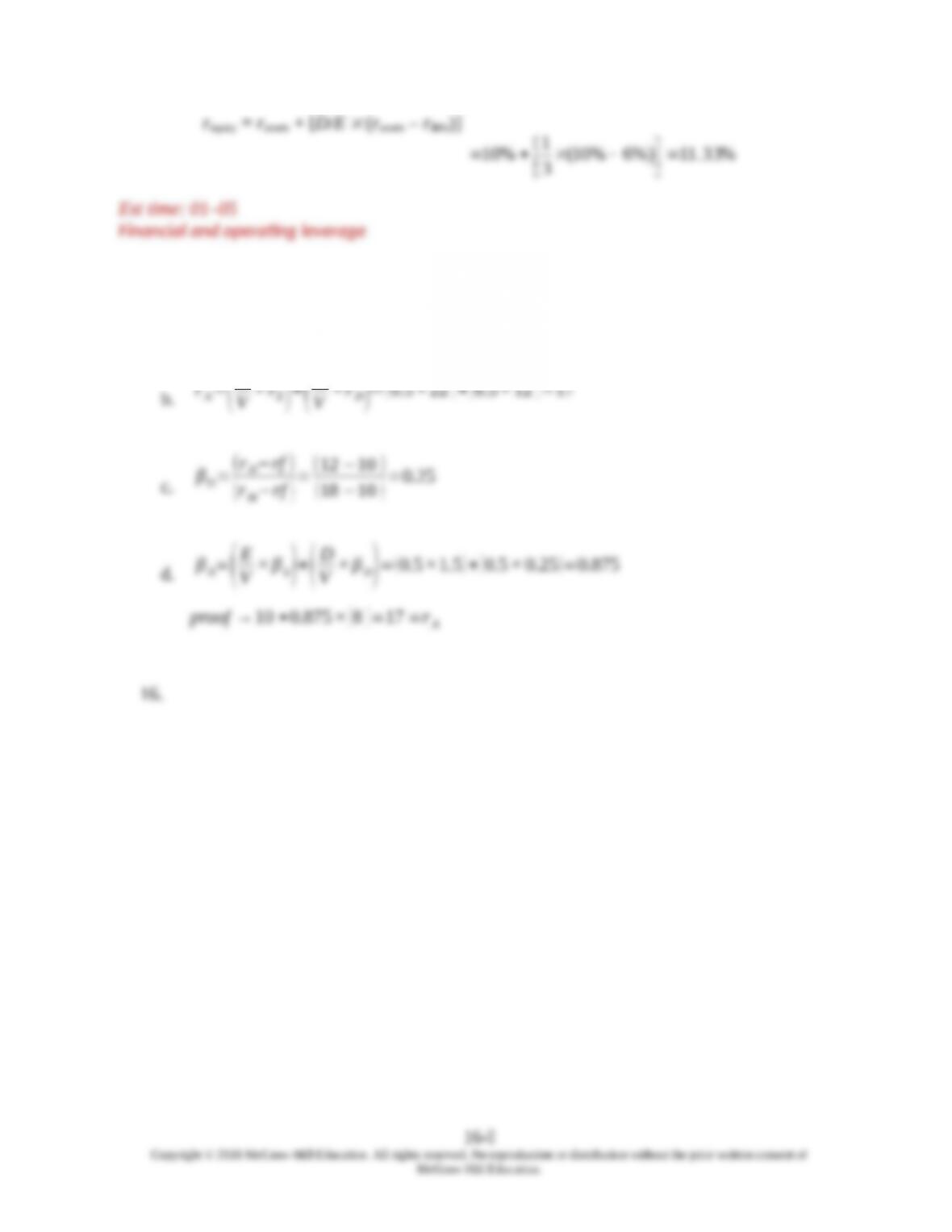
15.
a.
rE=rf +β ×
(
rM−rf
)
=10 +1.5 ×
(
8
)
=22
rA=
E
+
D
=
(
0.5×22
)
+
(
0.5×12
)
=17
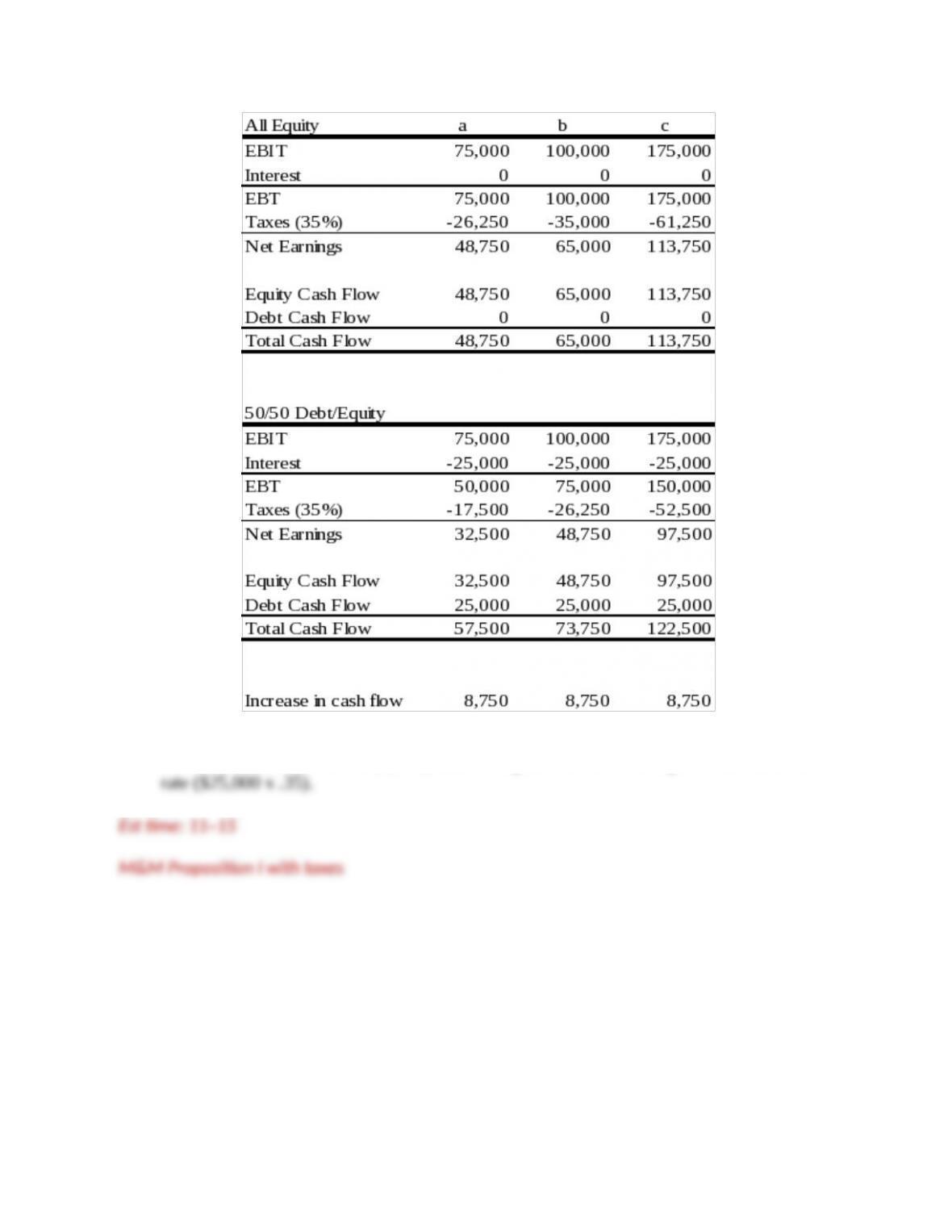
The increase in cash flow is $8,750, which is equal to the interest expense times the tax
17.
a.
PV tax shield=$800 mil× .35=$280 million
b.
Annual tax shield=$800 mil ×.076 ×.35=$21.28 million
16-5
Copyright © 2018 McGraw-Hill Education. All rights reserved. No reproduction or distribution without the prior written consent of
McGraw-Hill Education.
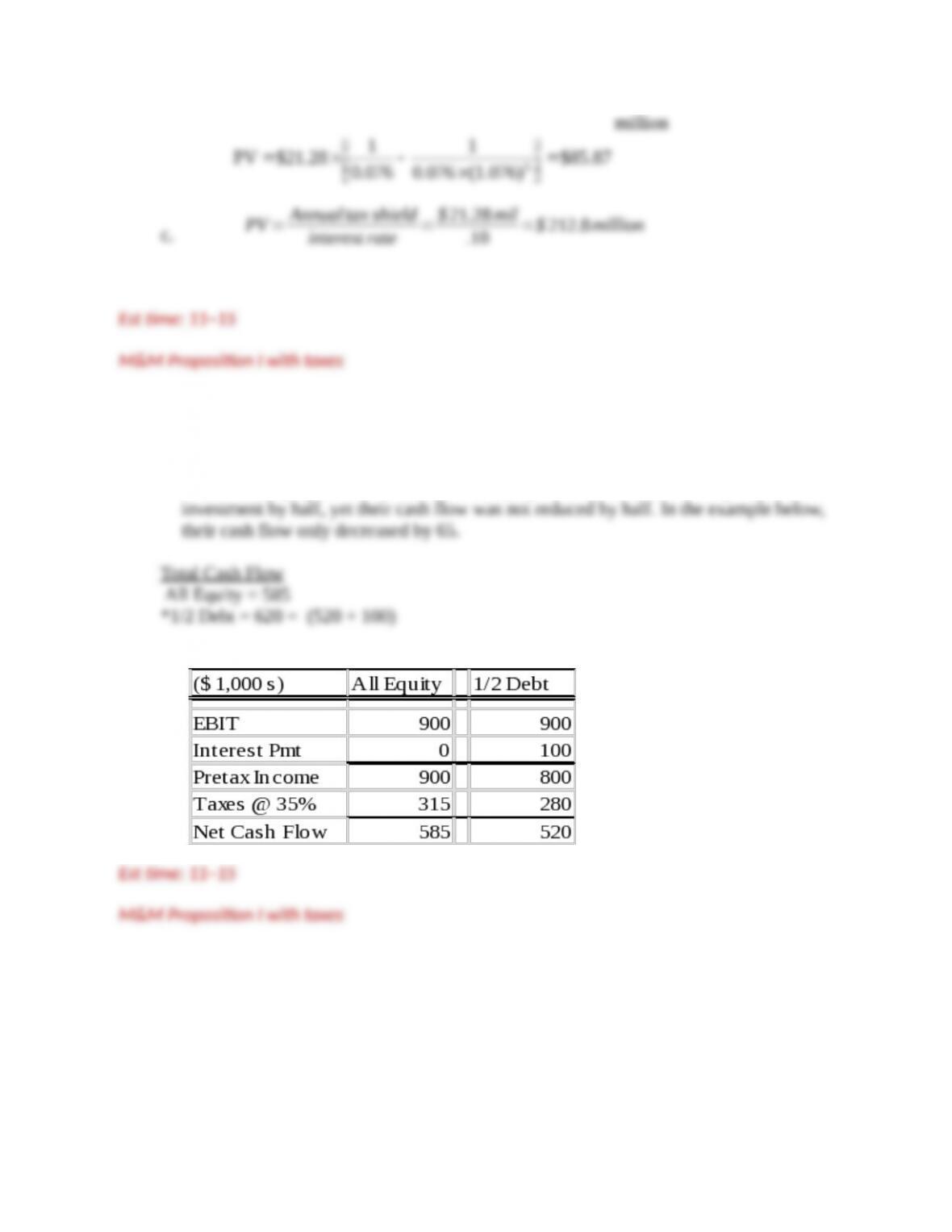
18. The interest tax shield represents a tax savings based upon the tax deductibility of
interest. If an all equity company replaces half its equity with debt, the total cash flow
to debt and equity holders increases. The equity holders benefit since they reduced their
19.
a.
1206.15.7.)35.01(08.3. WACC
or 12.06%
16-5
Copyright © 2018 McGraw-Hill Education. All rights reserved. No reproduction or distribution without the prior written consent of
McGraw-Hill Education.

b.
1290.15.7.08.3. WACC
or 12.90%
Est time: 01–05
Weighted average cost of capital
16-5
Copyright © 2018 McGraw-Hill Education. All rights reserved. No reproduction or distribution without the prior written consent of
McGraw-Hill Education.