Solutions to Chapter 15
How Corporations Raise Venture Capital and Issue Securities
1
a At $0.40 per share, it will take
500,000
0.40 =1,250,000
shares to raise the $500,000 in
b You own 1,000,000 shares, and the VC owns 1,250,000, so you now own:
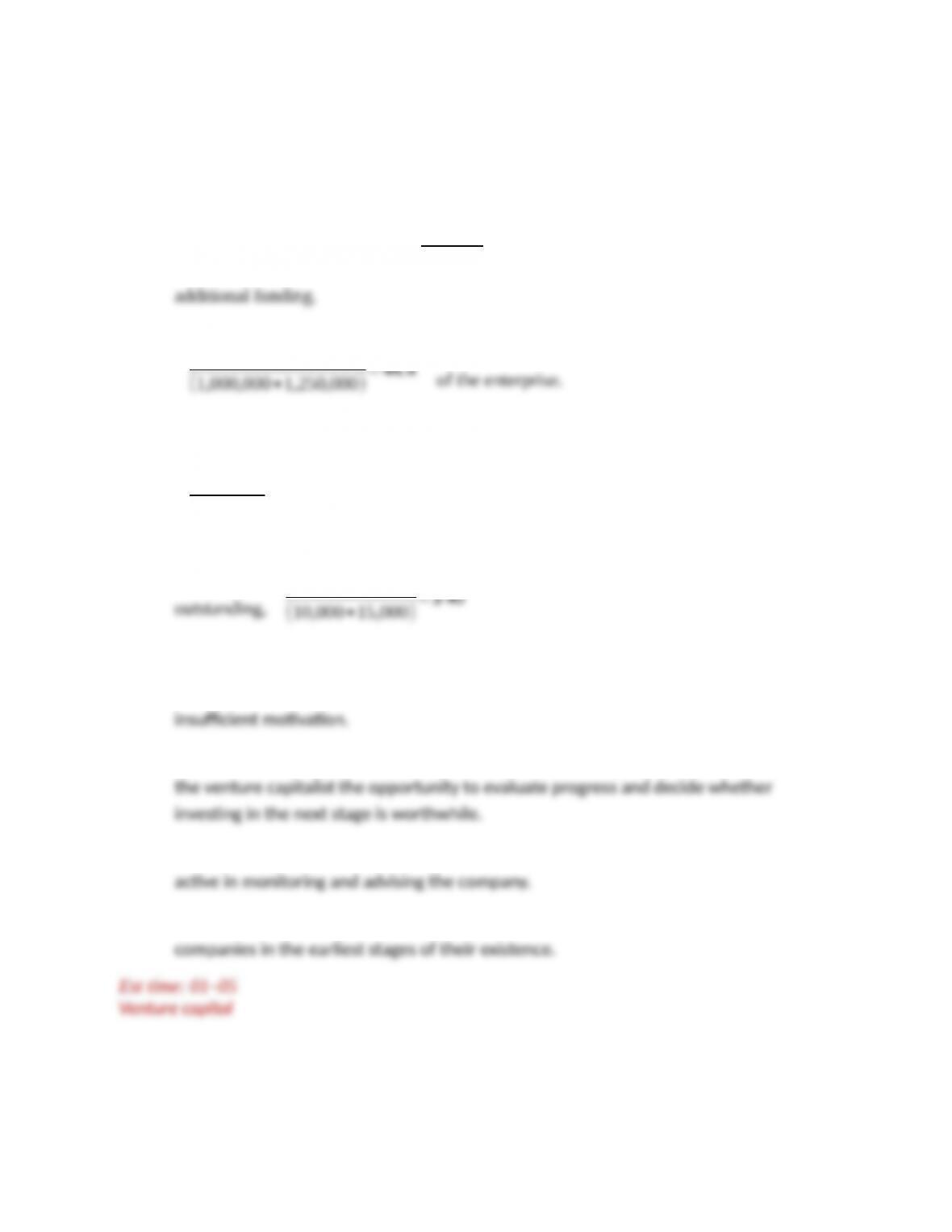
1,000,000
(1,000,000+1,250,000)=44.4
of the enterprise.
2
a The VC is buying 40% of the firm for $400,000, so the new valuation of the equity is:
$400,000
.4 =$1,000,000
b The value per share is the market capitalization divided by the number of shares
$1million
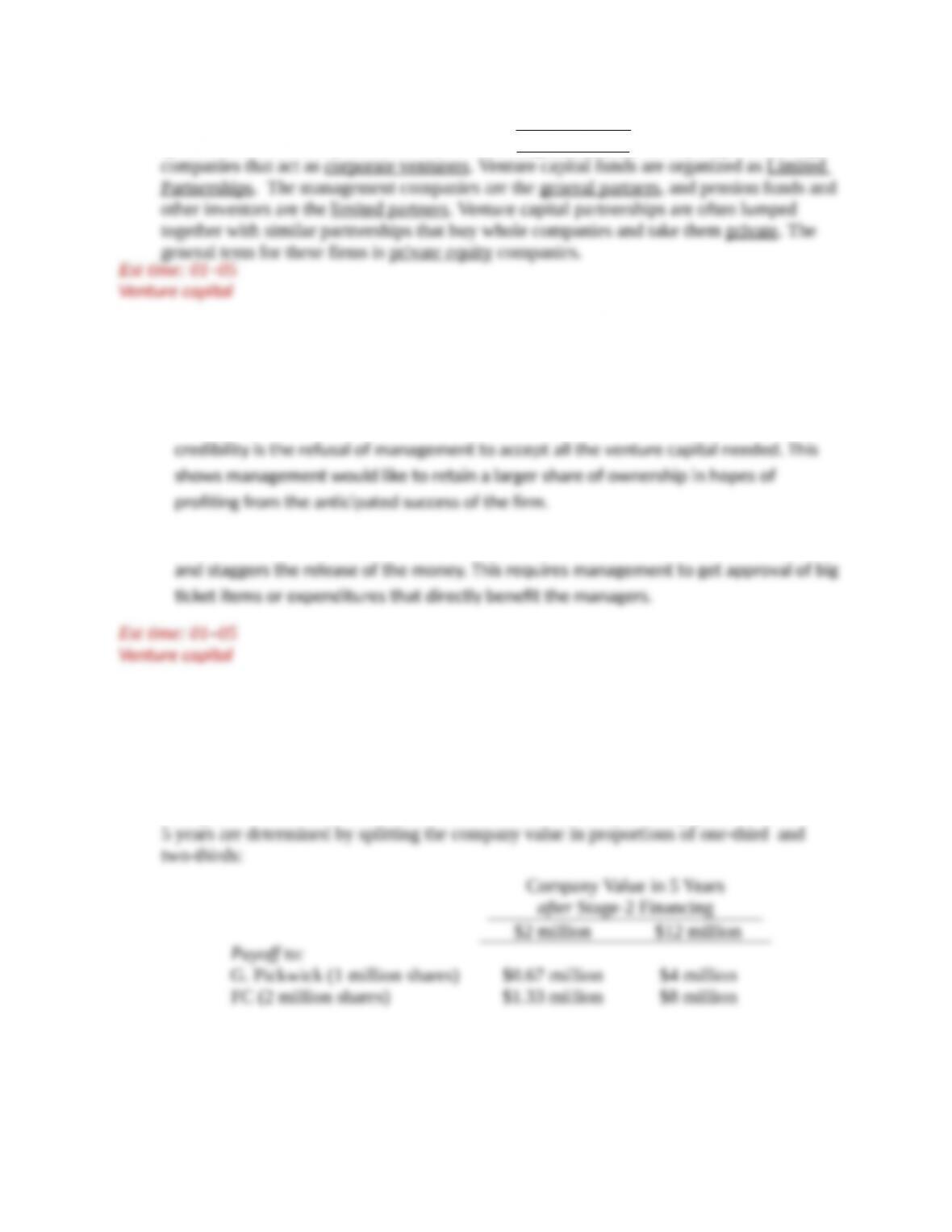
Equity capital in young businesses is known as venture capital, and it is provided by
specialist firms, wealthy individuals (known as angel investors), and by large technology
5
a When management is willing to invest their personal wealth in a company, it sends a
signal the investment is a legitimate and worthy investment. A further signal of
e Venture capital financing usually puts restrictions on how the financing could be used
6 The payoffs in year 5 to George Pickwick and First Cookham Venture Partners (FC) are
as follows:
a. FC buys 2 million shares at $1.
This gives FC two-thirds of Pickwick Electronics. Thus the possible payoffs at the end of
b. FC buys 1 million shares now and invests an additional $1 million in shares in
year 5.
15-+
Copyright © 2018 McGraw-Hill Education. All rights reserved. No reproduction or distribution without the prior written consent of
McGraw-Hill Education.
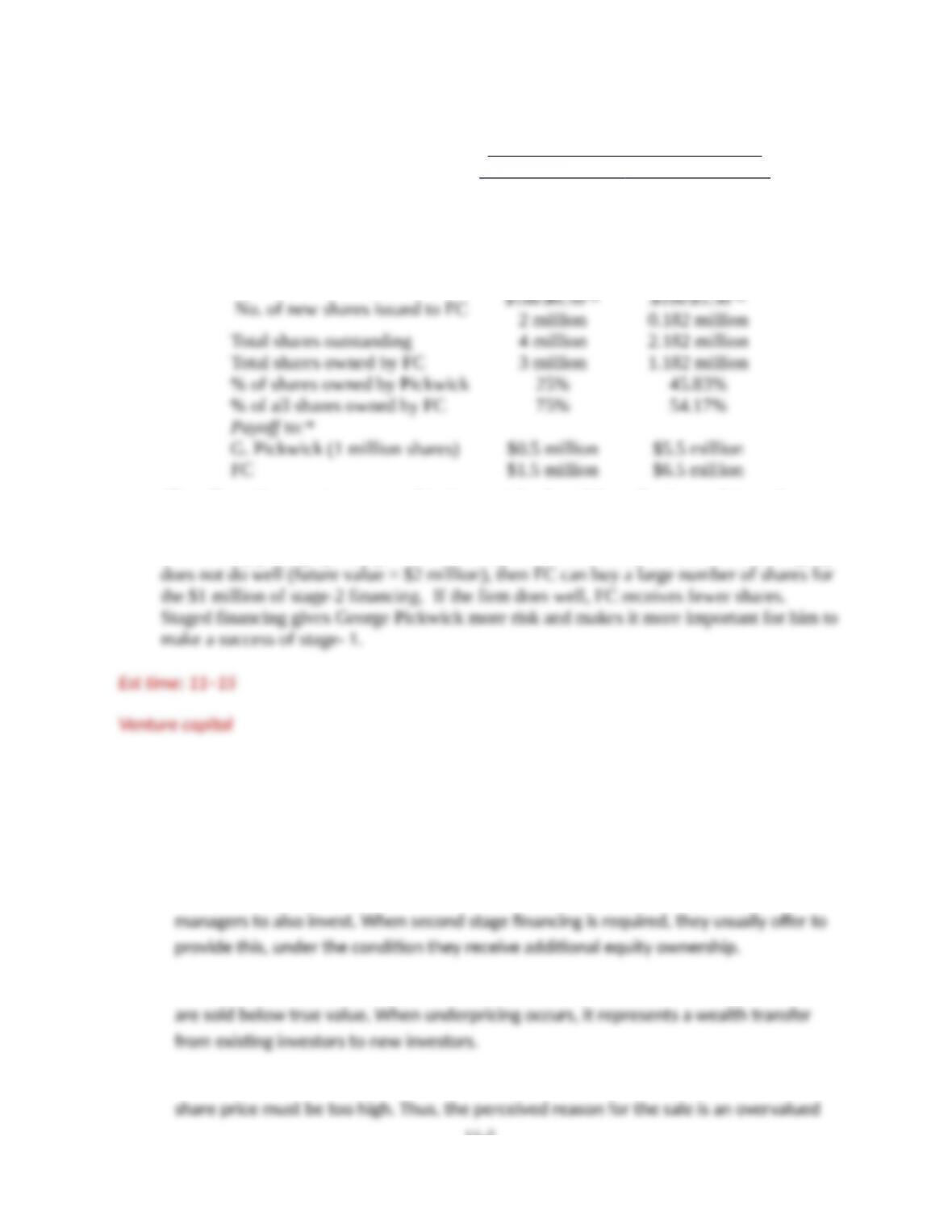
Company Value in 5 Years
after Stage-2 Financing
$2 million $12 million
Company value in 5 years
before issue of $1 million
in stage-2 financing $1 million $11 million
Price per share
(price = value/2 million shares) $0.50 $5.50
$1m/$5.50 =
*Payoff equals percentage ownership times total value of firm after issue of stage-2
financing.
Note that by putting up only part of the money now, FC takes on less risk. If the company
7
a False. Venture capitalists will usually invest a portion of the operating costs and require
f False. Even when not divesting their ownership, original investors su&er when shares
g True. The adage “buy low, sell high” rings true. The signal sent to the market is that the
15-+
Copyright © 2018 McGraw-Hill Education. All rights reserved. No reproduction or distribution without the prior written consent of
McGraw-Hill Education.
8
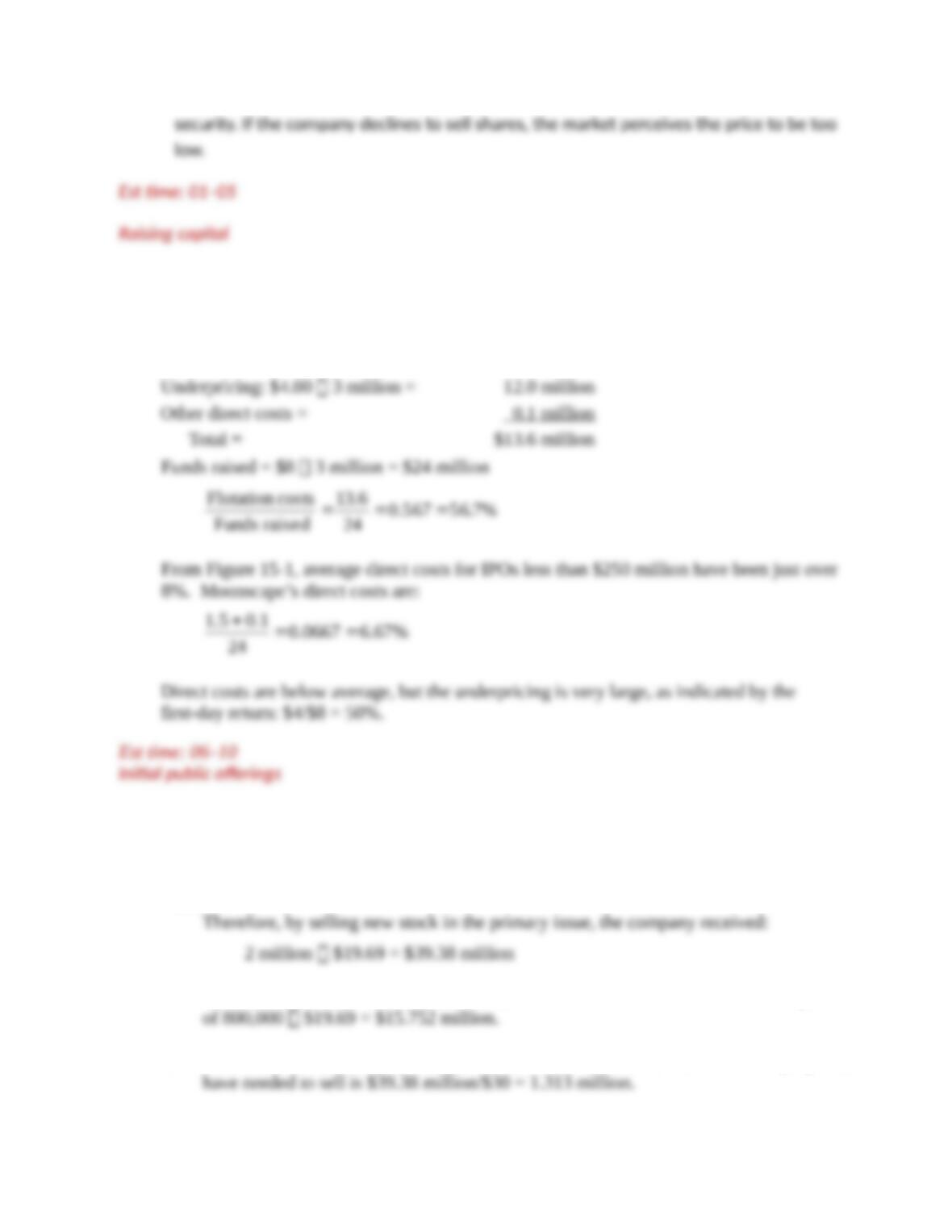
Underwriting costs for Moonscape:
Underwriting spread: $0.50 3 million = $ 1.5 million
9 a. The price of each share, net of the underwriting spread, was $21 $1.31 =
$19.69.
b. The existing shareholders sold their 800,000 shares to the underwriters for total proceeds
c. If the underwriters had paid $30 per share, the number of new shares the company would
15-+
Copyright © 2018 McGraw-Hill Education. All rights reserved. No reproduction or distribution without the prior written consent of
McGraw-Hill Education.
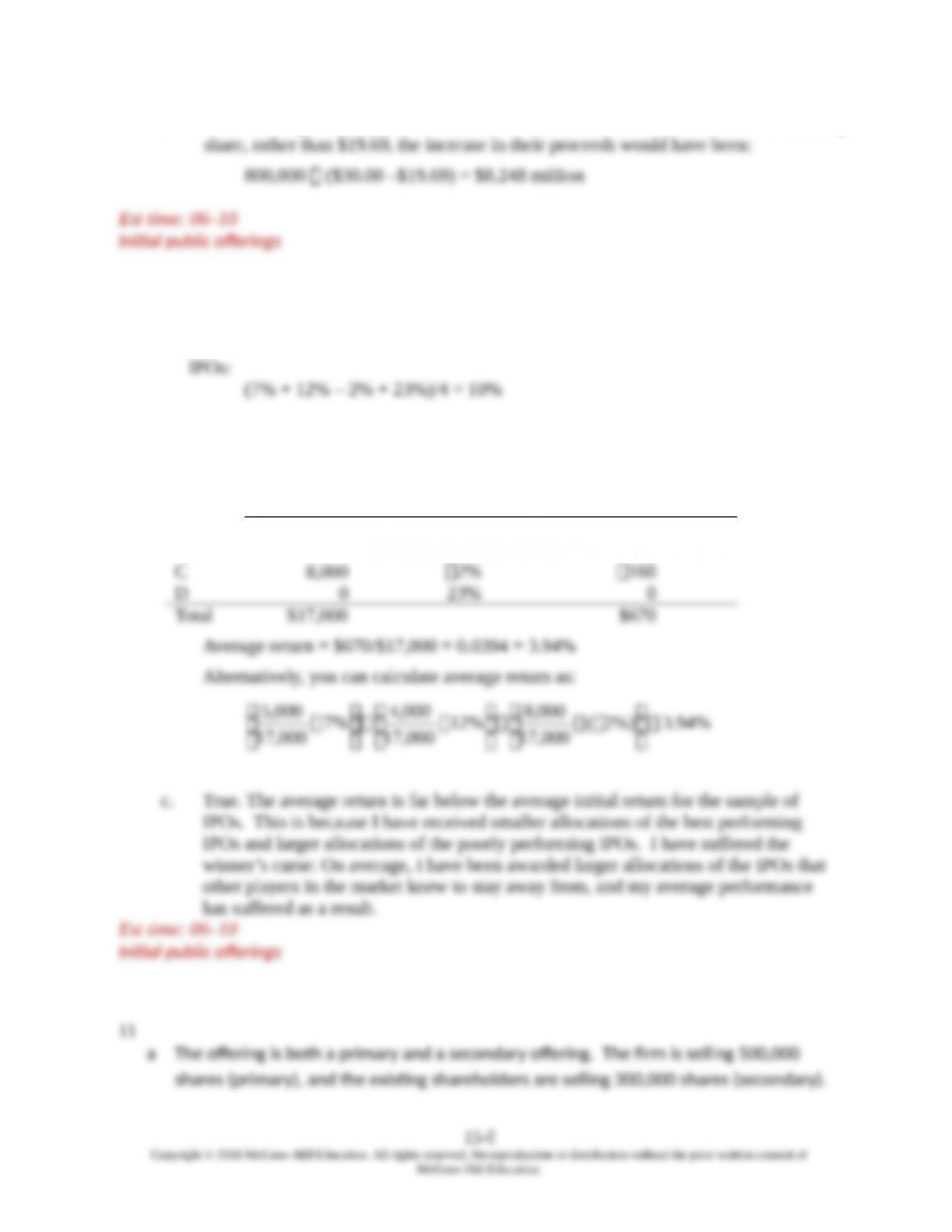
d. If the existing shareholders had sold their 800,000 shares to the underwriters for $30 per
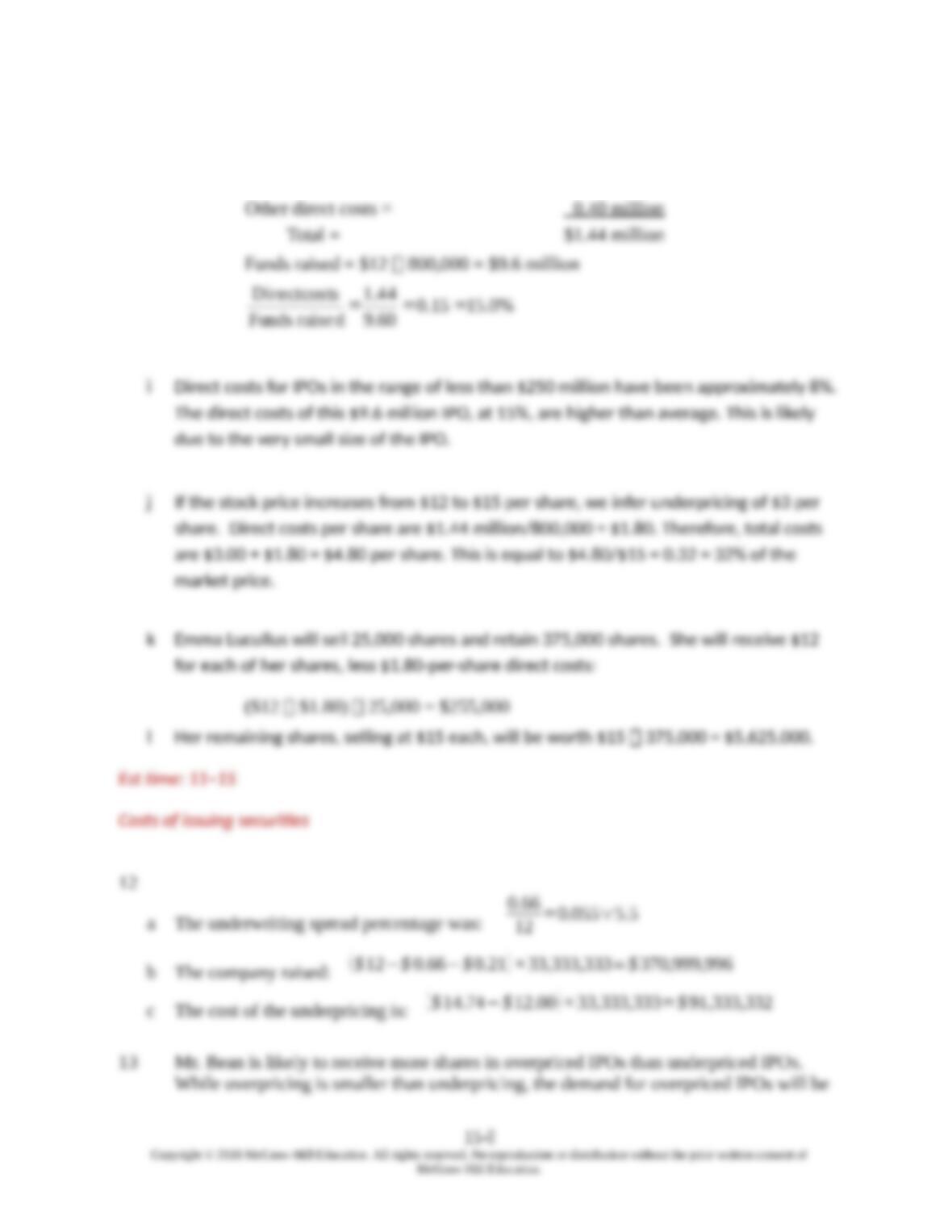
10 a. Average underpricing can be estimated as the average initial return on the
sample of
b The average initial return, weighted by the amount invested in each issue, is calculated as
follows:
Investment
(shares price) Initial Return Profit
(% return investment)
A
$ 5,000
7%
$350
B 4,000 12% 480
$17,000
$670
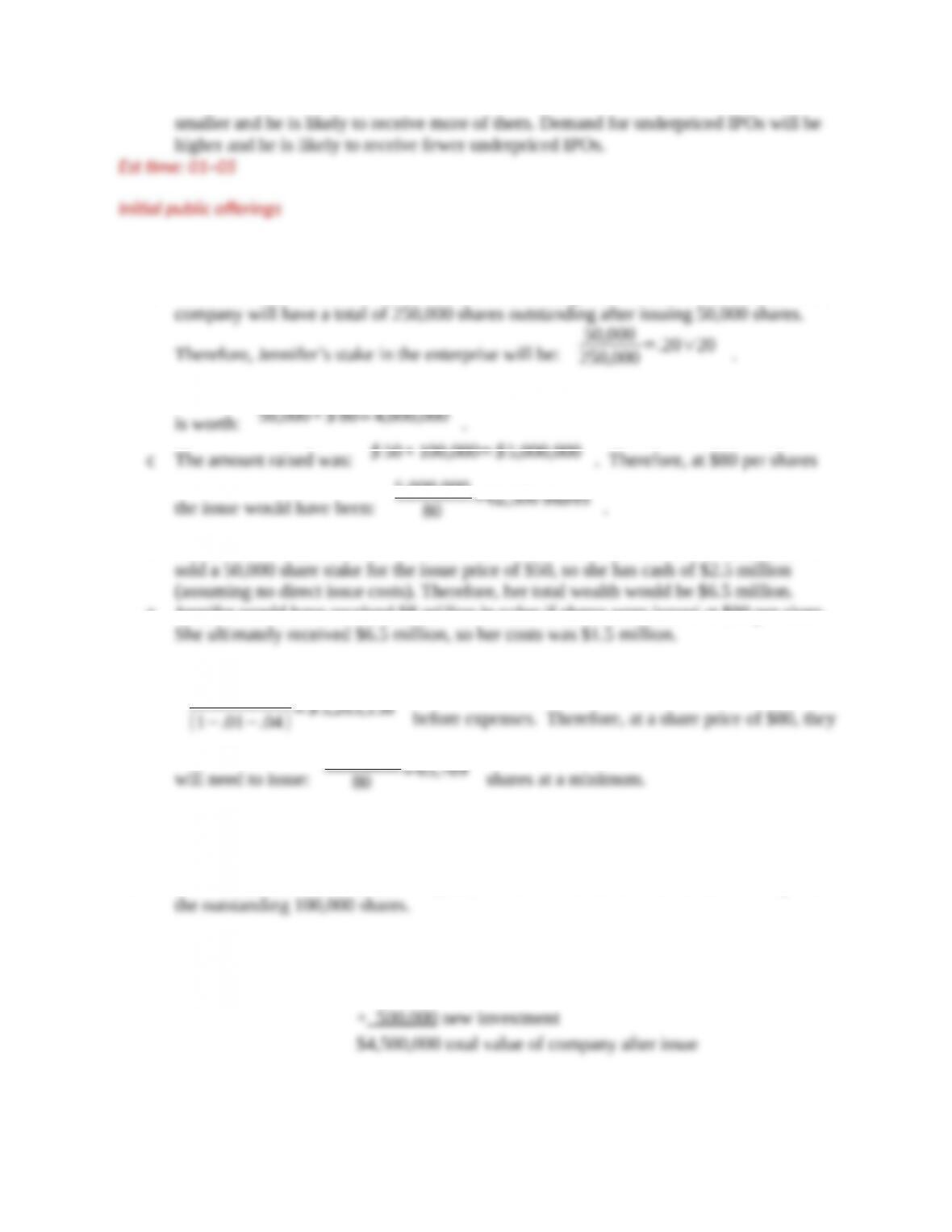
h Direct costs are as follows:
Underwriting spread: $1.30 800,000 = $1.04 million
14
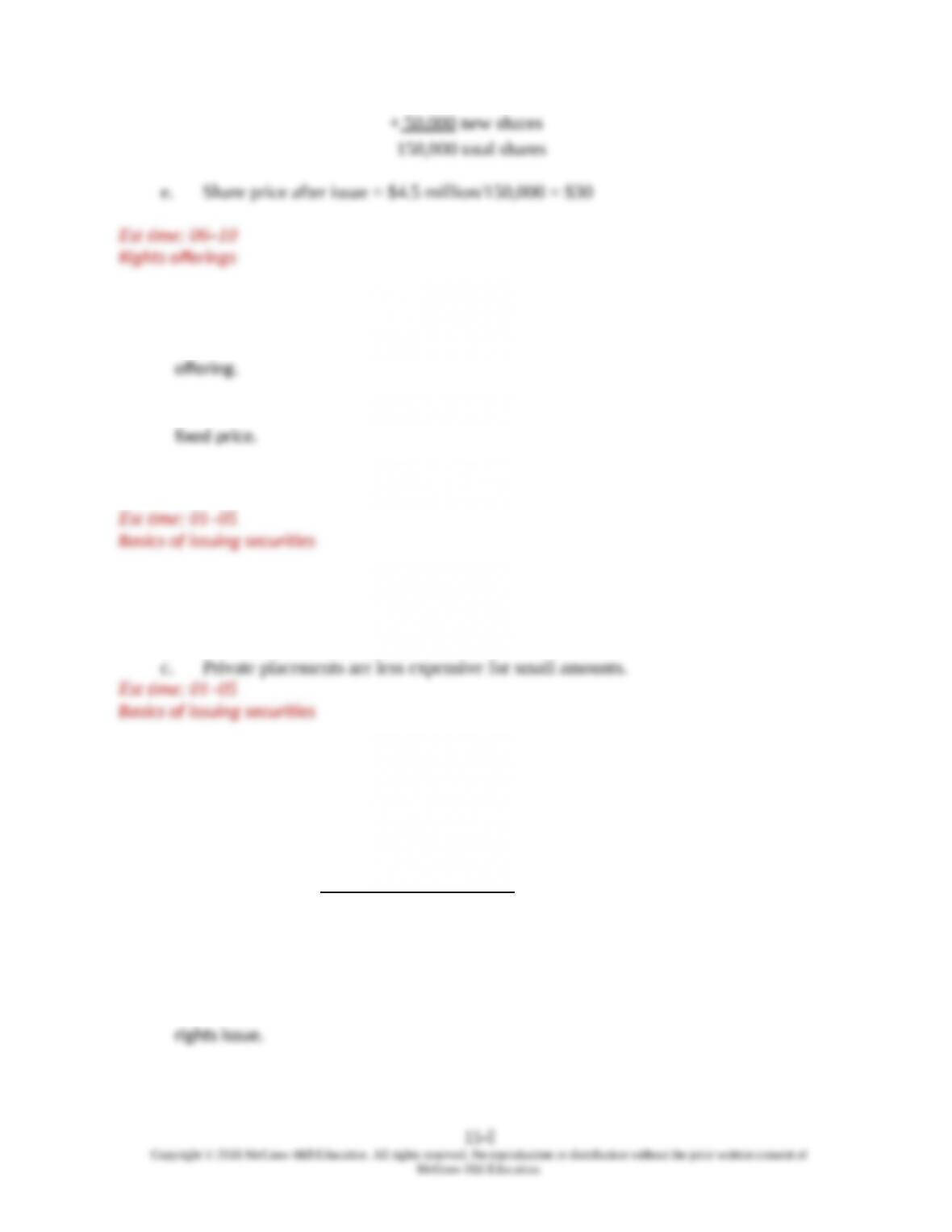
a Jennifer will have 50,000 shares left after contributing 50,000 to the 100,000 issue. The
b The stock price will be $80 by end of day and Jennifer owns 50,000 shares, so her stake
50,000× $ 80=4,000,000
17
a Private placement- Sales of securities to a limited number of investors without a public
m Firm commitment – The underwriter agrees to buy the issue from the company at a
n Rights issue- The company o&ers to sell stock to existing shareholders.
18 a. A large issue involves proportionately lower costs due to economies of scale.
b. A bond issue is less expensive.
19
a New shares = 10 mil / 5 = 2 million new shares
b
Price per share=
(
10 mil× $ 6
)
+(2mil× $5)
10 mil+2mil
= $5.8333 per share
o The price per share is dropping by $0.167, which is 2.78% = (.167/6.00). The value
would have to drop by this much in order to dissuade owners from participating in the
rights issue.
15-+
Copyright © 2018 McGraw-Hill Education. All rights reserved. No reproduction or distribution without the prior written consent of
McGraw-Hill Education.
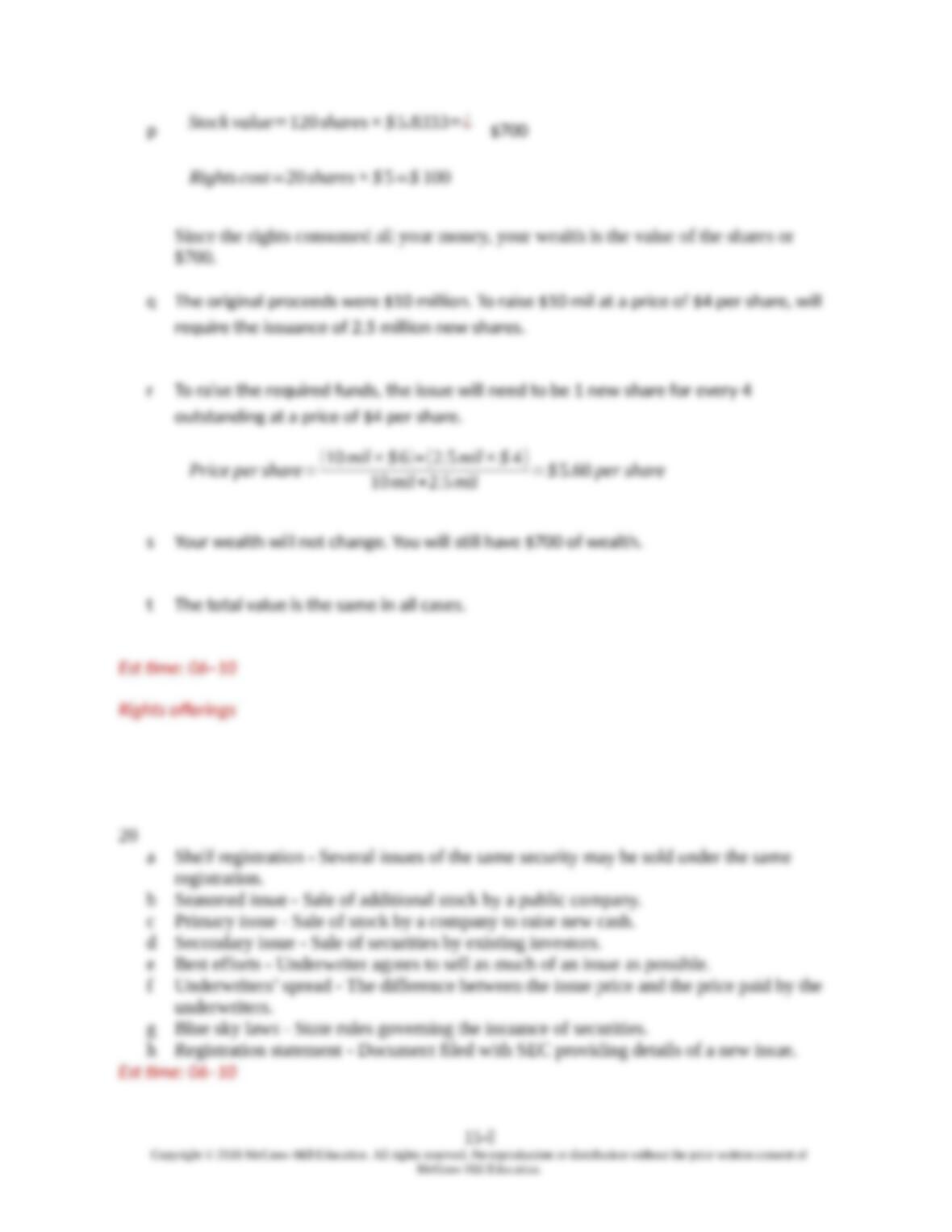
p
Stock value=120 shares × $ 5.8333=¿
$700
Rights cost=20 shares × $ 5=$100
Since the rights consumed all your money, your wealth is the value of the shares or
$700.
q The original proceeds were $10 million. To raise $10 mil at a price of $4 per share, will
require the issuance of 2.5 million new shares.
r To raise the required funds, the issue will need to be 1 new share for every 4
outstanding at a price of $4 per share.
Price per share=
(
10 mil× $ 6
)
+(2.5 mil× $ 4)
10 mil+2.5 mil =$5.60 per share
s Your wealth will not change. You will still have $700 of wealth.
t The total value is the same in all cases.
Est time: 06–10
Rights offerings
20
a Shelf registration – Several issues of the same security may be sold under the same
registration.
b Seasoned issue – Sale of additional stock by a public company.
15-+
Copyright © 2018 McGraw-Hill Education. All rights reserved. No reproduction or distribution without the prior written consent of
McGraw-Hill Education.
21
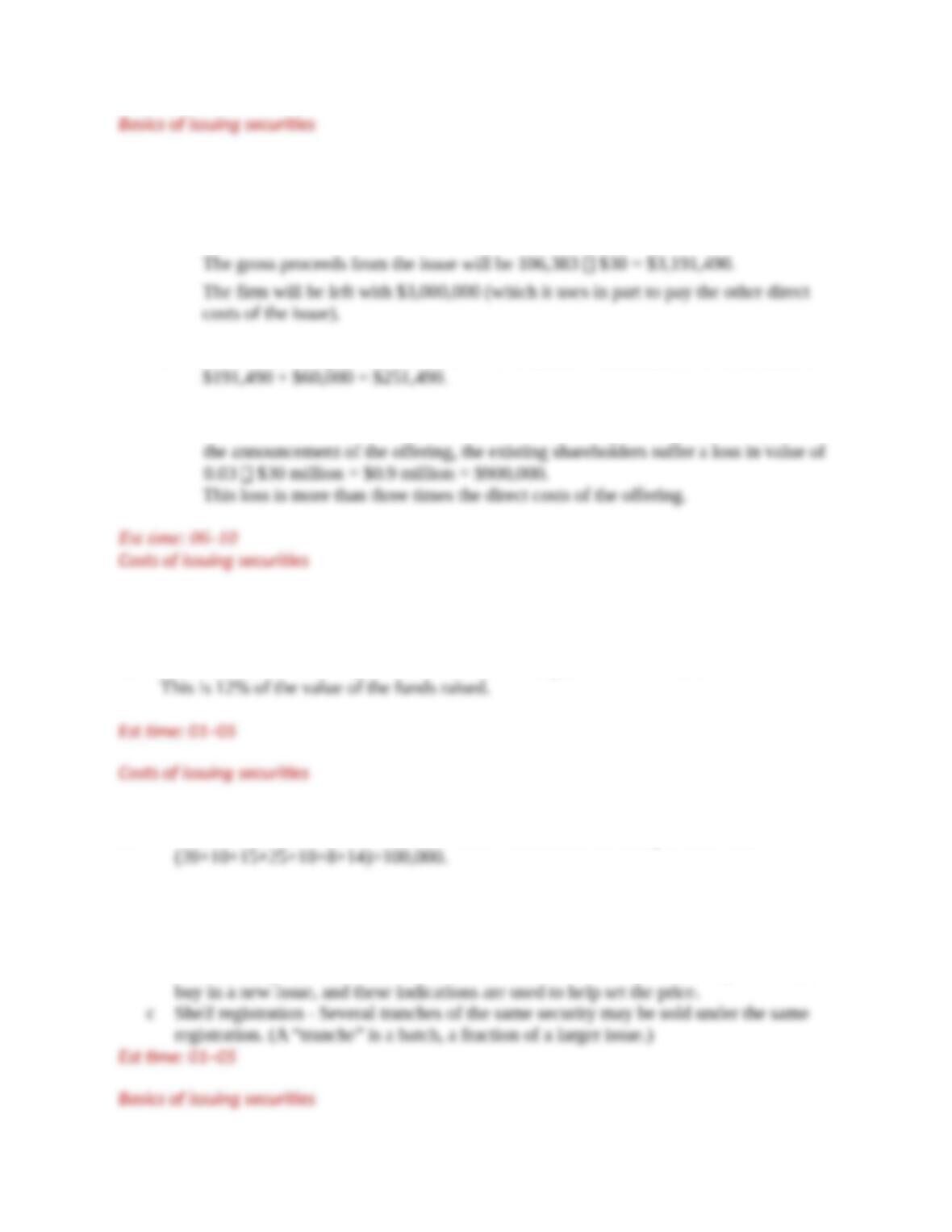
a The firm will receive $30 (1 – 0.06) = $28.20 per share.
The firm will need to issue $3,000,000/$28.20 = 106,383 shares.
b The underwriting spread costs the firm $191,490. Therefore, total direct costs are
c The total market value of the stock is $30 million. If the share price falls by 3% on
22 The lost value to the original shareholders is 0.02 $600 million = $12 million.
23 To achieve 100,000 shares issued, the firm would reach the $66 per share bid,
24
a Best efforts – The underwriter accepts responsibility only to try to sell the issue.
b Bookbuilding – Investors indicate to the underwriter how many shares they would like to
15-+
Copyright © 2018 McGraw-Hill Education. All rights reserved. No reproduction or distribution without the prior written consent of
McGraw-Hill Education.
25
a Rights issue – Further sale of already publicly traded stock. The rights issue is o&ered to
u Private placement- Bond issue by an industrial company. The lack of SEC paperwork
associated with a private placement is aIractive to companies borrowing money.
v Shelf registration- Initial public o&ering. The first step in doing an IPO is registering the
26
a Seasoned o&erings are security issues by firms that are already publicly traded. Publicly
traded firms usually $nd it advantageous to sell new shares in a public o&ering because
w A rights issue can be used for subsequent issues of stock. A rights issue requires that
x Shelf registration is more likely to be used for bonds issued by a large industrial
15-+
Copyright © 2018 McGraw-Hill Education. All rights reserved. No reproduction or distribution without the prior written consent of
McGraw-Hill Education.
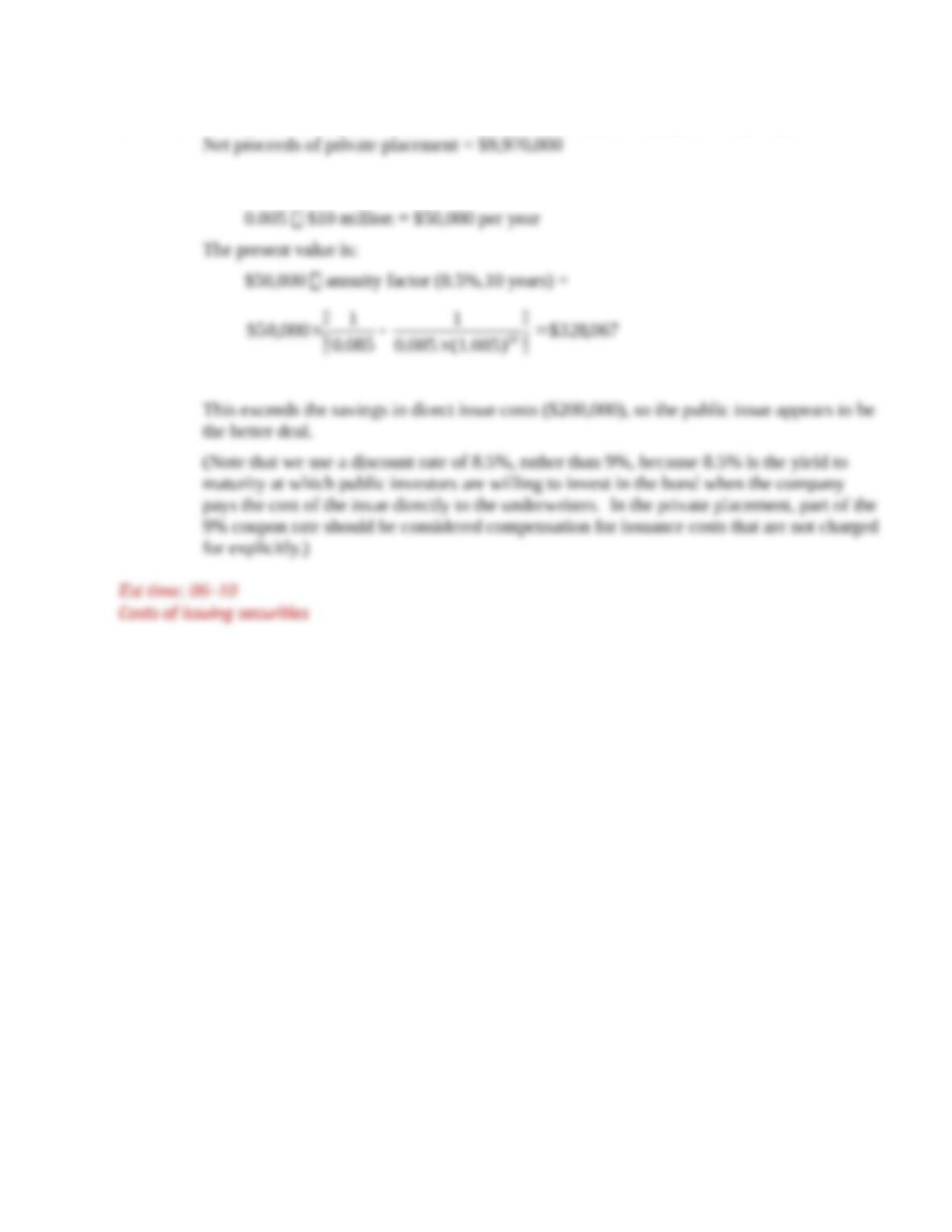
27 a. Net proceeds of public issue = $10,000,000 – $150,000 – $80,000 = $9,770,000
b The extra interest paid on the private placement is:
15-+
Copyright © 2018 McGraw-Hill Education. All rights reserved. No reproduction or distribution without the prior written consent of
McGraw-Hill Education.