Solutions to Chapter 13
The Weighted-Average Cost of Capital and Company Valuation
1. a. If Big Oil does not pay taxes, then the after-tax and before-tax costs of debt are identical.
WACC would then become:
equityde bt )1(WACC r
V
E
Tr
V
D
C
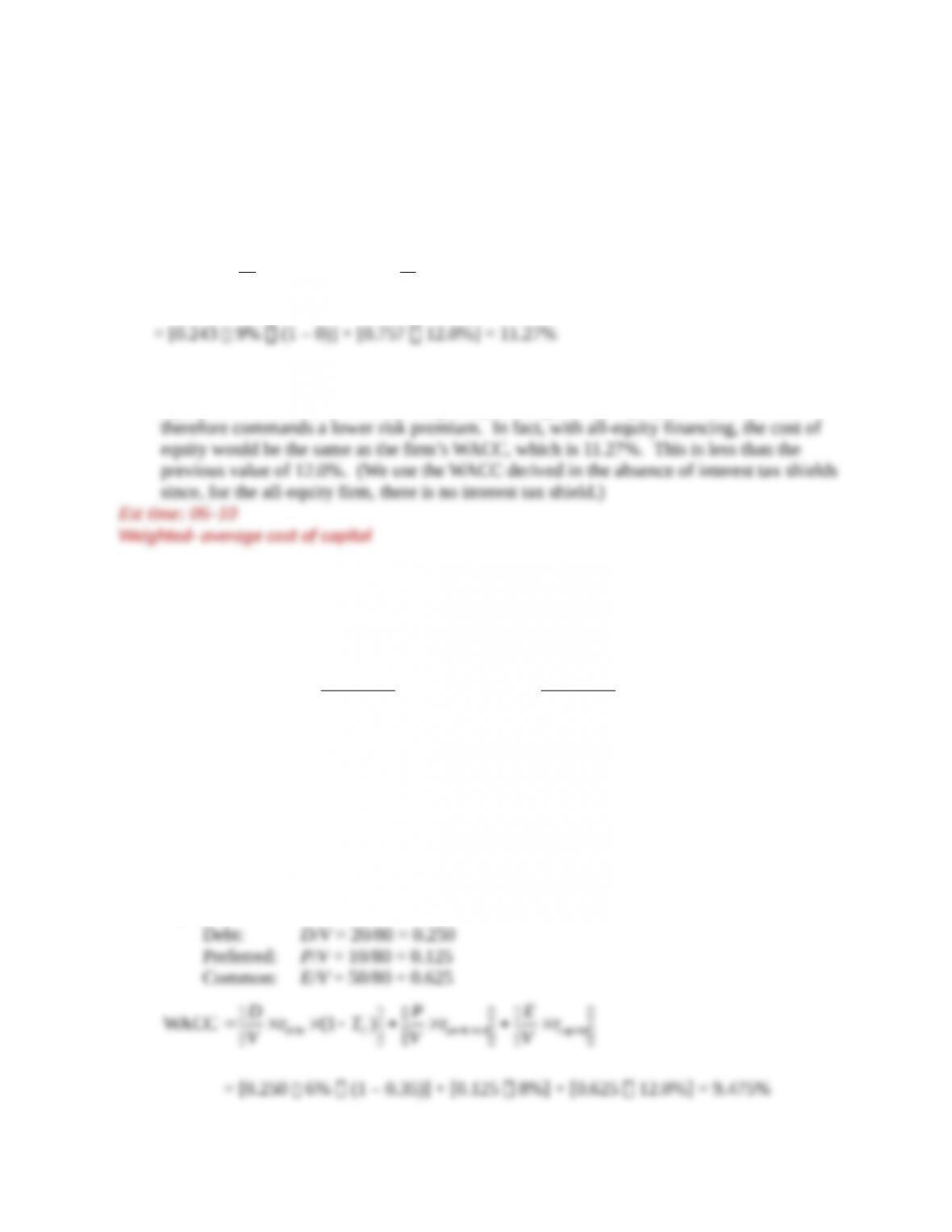
b. If Big Oil issues new equity and uses the proceeds to pay off all of its debt, the cost of
equity will decrease. There is no longer any leverage, so the equity becomes safer and
2.
requity=.04 +1.2×.075=.13
rdebt =.06
0845.13.
880880
880
)35.1(06.
880880
880
WACC
WACC = 8.45%
Est me: 01–05
Weighted- average cost of capital
3. The total value of the firm is $80 million. The weights for each security class are as
follows:
13-<
Copyright © 2018 McGraw-Hill Education. All rights reserved. No reproduction or distribution without the prior written consent of
McGraw-Hill Education.
4.
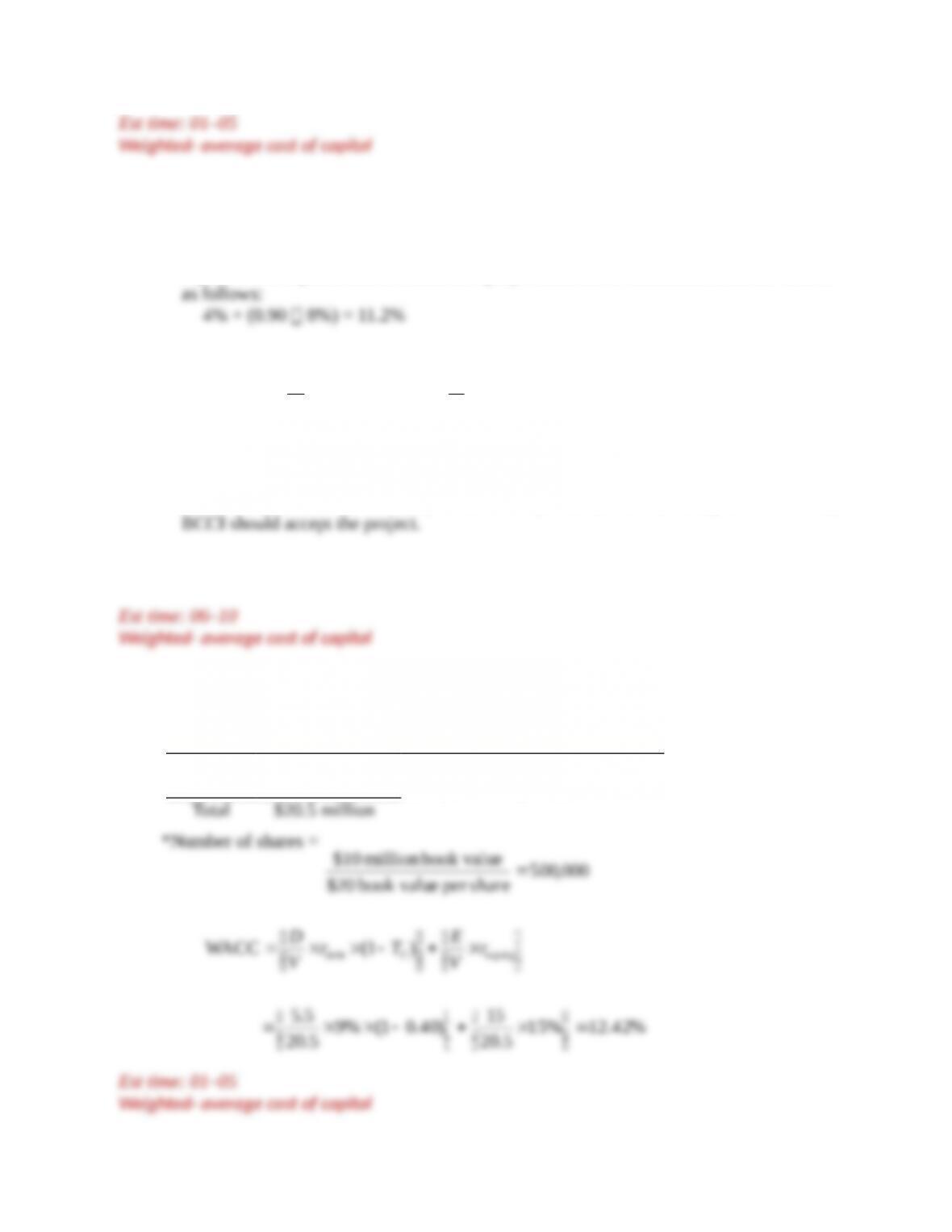
a. The rate on Buildwell’s debt is 5%. The cost of equity
capital is the required rate of return on equity, which can be calculated from the CAPM
b. The weighted-average cost of capital, with a tax rate of 40%, is:
equityde bt
)1(WACC r
V
E
Tr
V
D
C
= [0.30 5% (1 – 0.40)] + [0.70 11.2%] = 8.74%
c. The internal rate of return, which is 12%, exceeds the cost of capital. Therefore,
5.
Security Market Value Explanation
Debt $ 5.5 million 1.10 par value of $5 million
Equity $15.0 million $30 per share 500,000 shares*
E
D
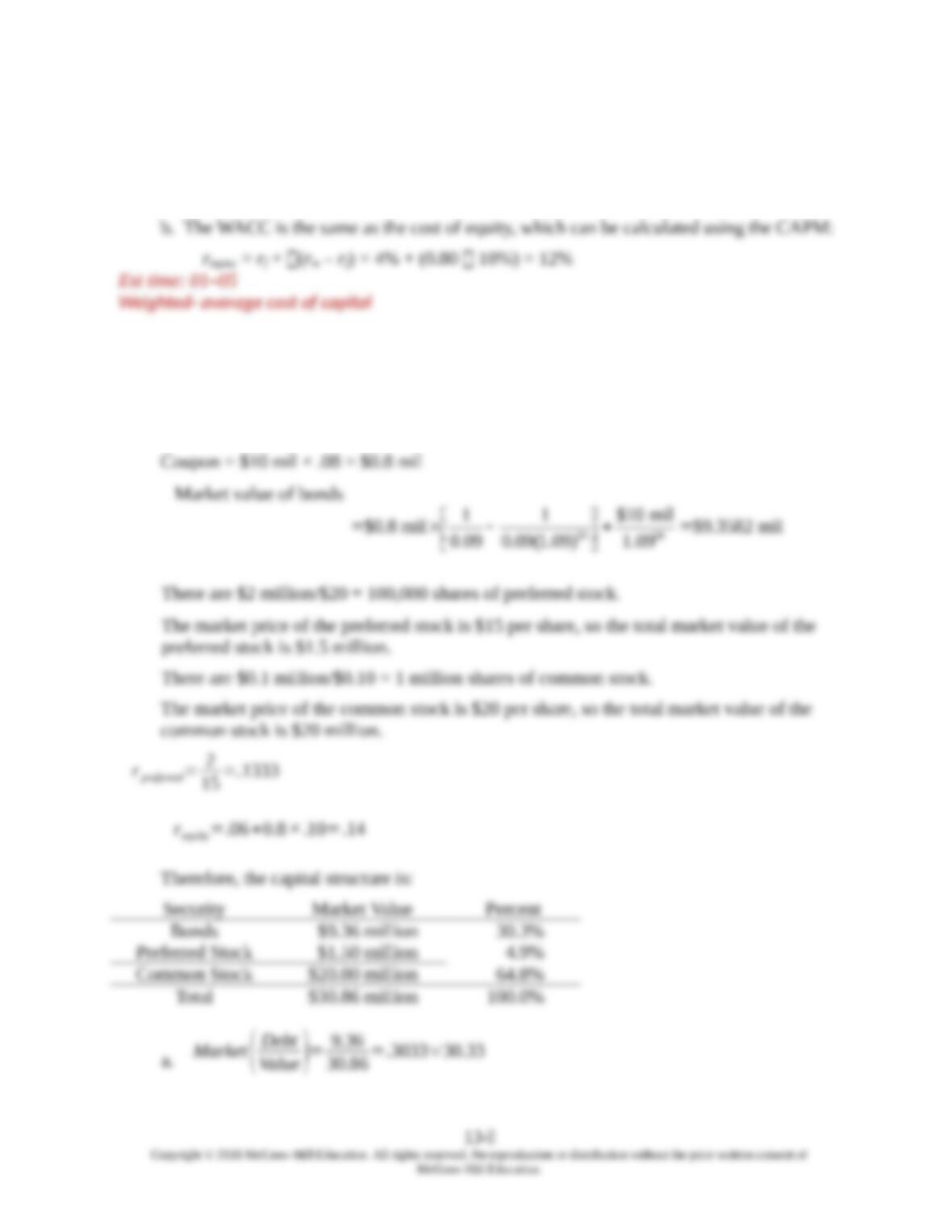
6. a. Since the firm is all-equity financed, asset beta = equity beta = 0.8.
7. The bonds are selling below par value because the yield to maturity is greater than the
coupon rate.
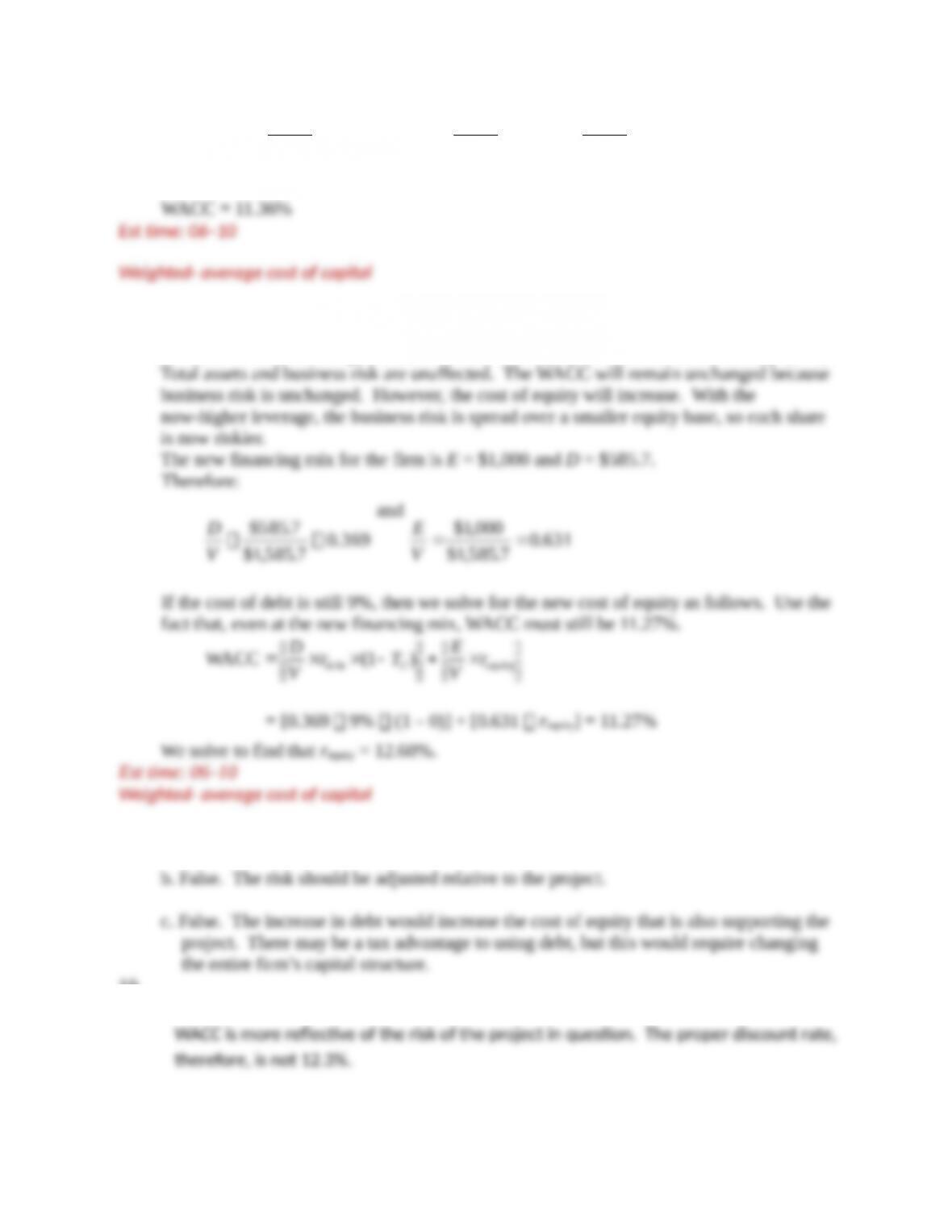
b.
WACC=
(
9.36
30.86
)
×.09 ×
(
1−.40
)
+
(
1.50
30.86
)
×.1333+
(
20
30.86
)
×.14=.1136
8. The net effect of Big Oil’s transaction is to leave the firm with $200 million more debt
(because of the borrowing) and $200 million less equity (because of the dividend payout).
9. a. True. The WACC is an average of all projects the company undertakes.
10.
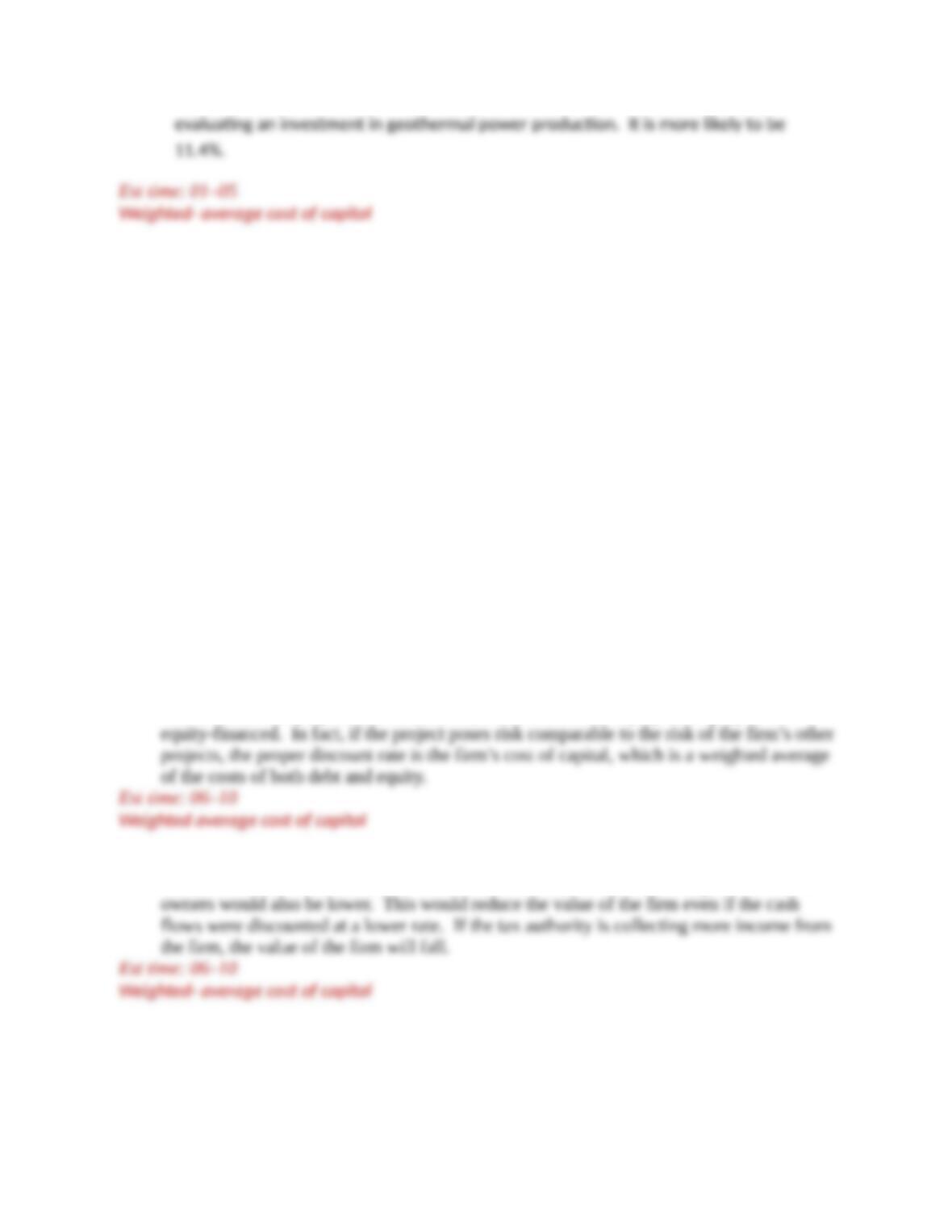
a The risk of the project determines the discount rate, and in this case Geothermal’s
a. Executive Fruit should use the WACC of Geothermal, not its own WACC, when
13-<
Copyright © 2018 McGraw-Hill Education. All rights reserved. No reproduction or distribution without the prior written consent of
McGraw-Hill Education.
11.
br = rf + (rm – rf) r = 4% + (1.2 10%) = 16%
c
equityde bt
)1(WACC r
V
E
Tr
V
D
C
= [0.4 4% (1 – 0.4)] + [0.6 16%] = 10.56%
b. If the company plans to expand its present business, then the WACC is a reasonable
estimate of the discount rate since the risk of the proposed project is similar to the risk
of the existing projects. Use a discount rate of 10.56%.
c. The WACC of optical projects should be based on the risk of those projects. Using a
beta of 1.4, the discount rate for the new venture is:
r = 4% + (1.4 10%) = 18%
Est time: 06–10
Weighted- average cost of capital
12. This reasoning is faulty in that it implicitly treats the discount rate for the project as the
cost of debt if the project is debt-financed, and as the cost of equity if the project is
13. Even if the WACC were lower when the firm’s tax rate is higher, this does not imply that
the firm would be worth more. The after-tax cash flows the firm would generate for its
14.
a.
WACC=
(
.4
)
×.06 ×
(
1−.40
)
+
(
.6
)
×.12=.0864∨8.64
13-<
Copyright © 2018 McGraw-Hill Education. All rights reserved. No reproduction or distribution without the prior written consent of
McGraw-Hill Education.
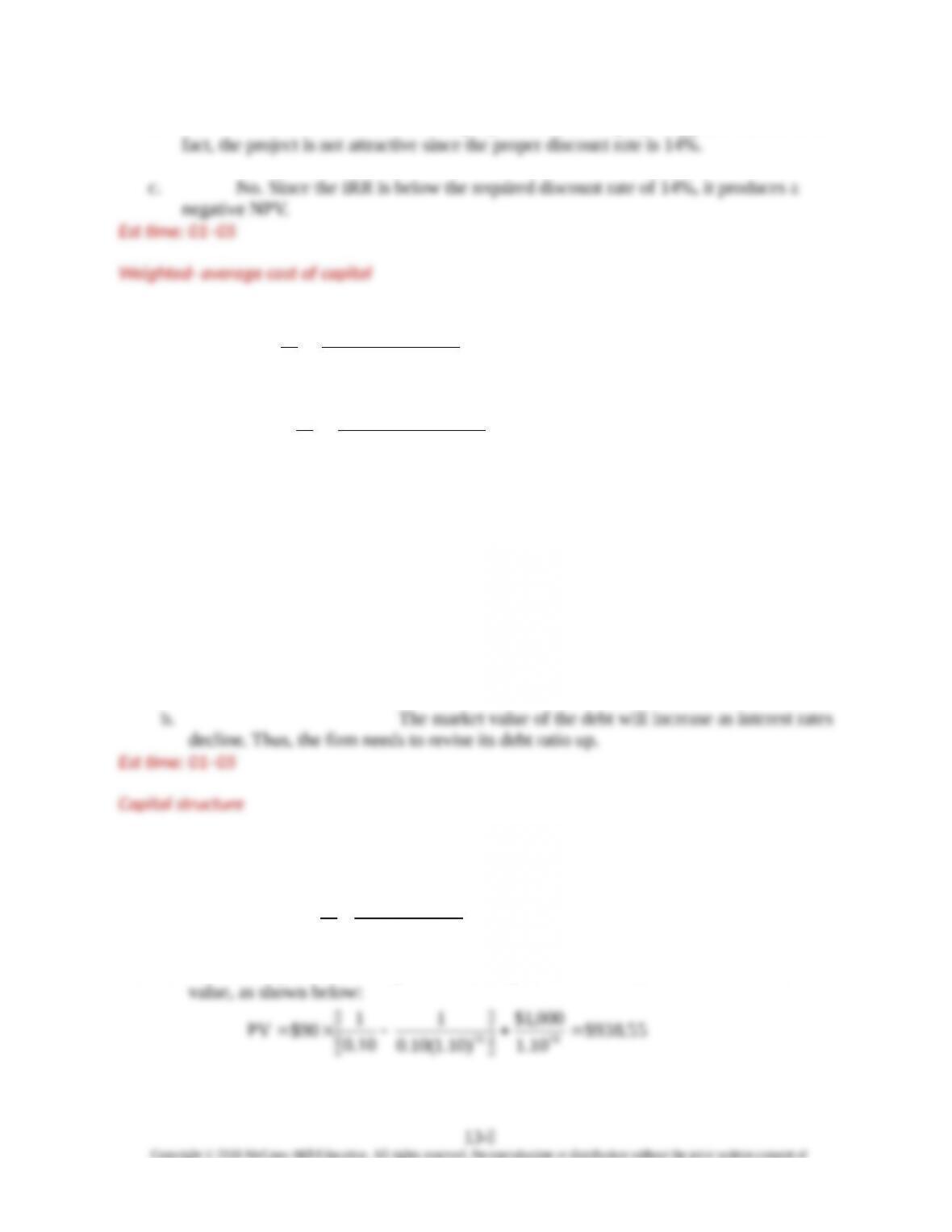
b. No. The IRR is above the company WACC, so the project appears attractive. In
15.
d.
Book Value
(
D
V
)
=25.2
(
27.3 ×.582
)
+25.2 =.61
e.
Market Value
(
D
V
)
=25.2
(
71.50 ×.582
)
+25.2=.38
f. Market value is the proper measure, as it is determined by cash flows and forecasts,
rather than accounting rules.
Est time: 01–05
Capital structure
16.
a. WACC usually excludes current liabilities. Thus, the
proper debt figure is $65 mil.
17. Binomial Tree Farm should make sure to use market values only when calculating the debt
ratio on their securities:
Market debt ratio=D
V=5+6
(5+6+18 ×.5)=0.45
18. a. The 9% coupon bond has a yield to maturity of 10% and sells for 93.86% of face
Copyright © 2018 McGraw-Hill Education. All rights reserved. No reproduction or distribution without the prior written consent of
McGraw-Hill Education.
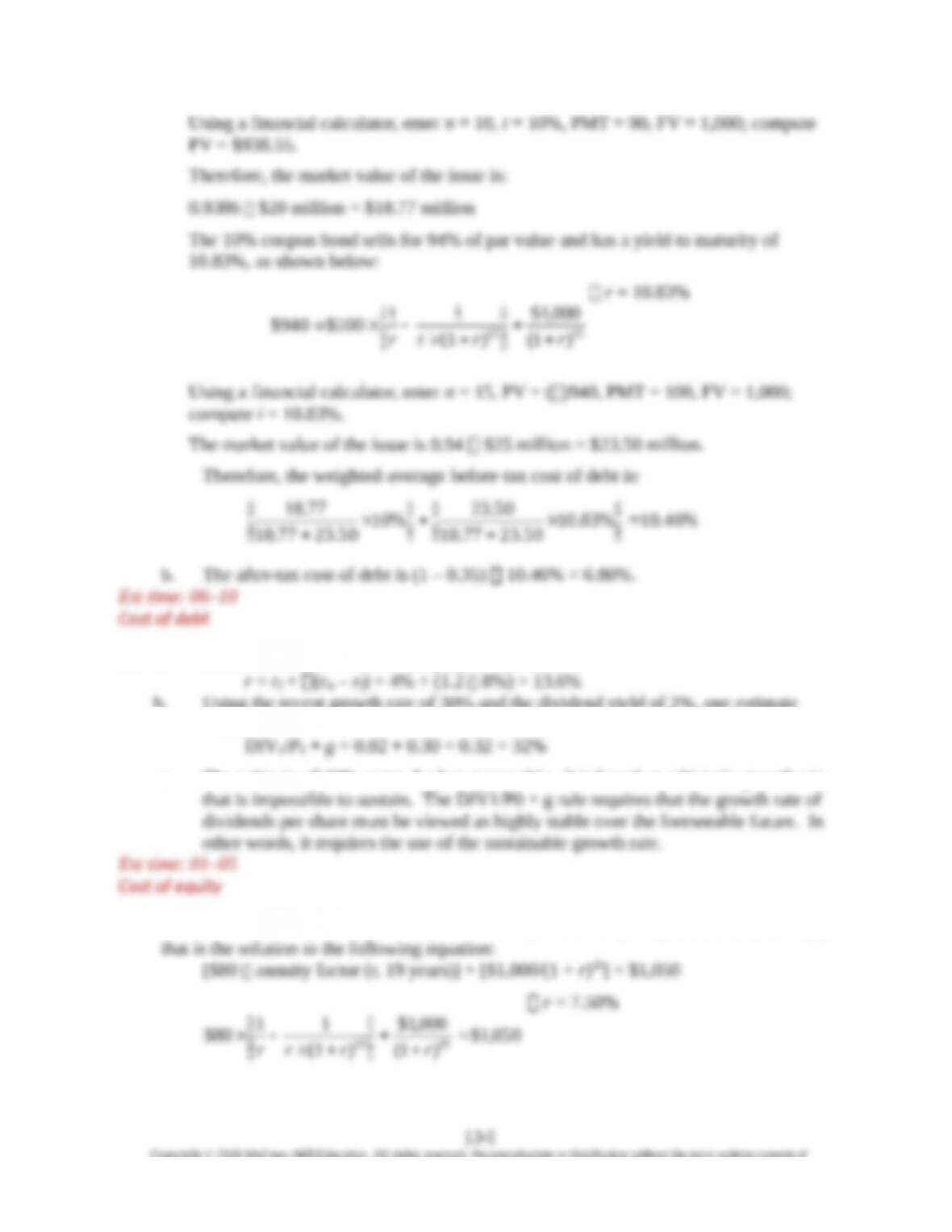
19. a. Based on the CAPM, cost of equity would be:
b. Using the recent growth rate of 30% and the dividend yield of 2%, one estimate
would be:
c. The estimate of 32% seems far less reasonable. It is based on a historic growth rate
20. The yield to maturity for the bonds (since maturity is now 19 years) is the interest rate (r)
Copyright © 2018 McGraw-Hill Education. All rights reserved. No reproduction or distribution without the prior written consent of
McGraw-Hill Education.
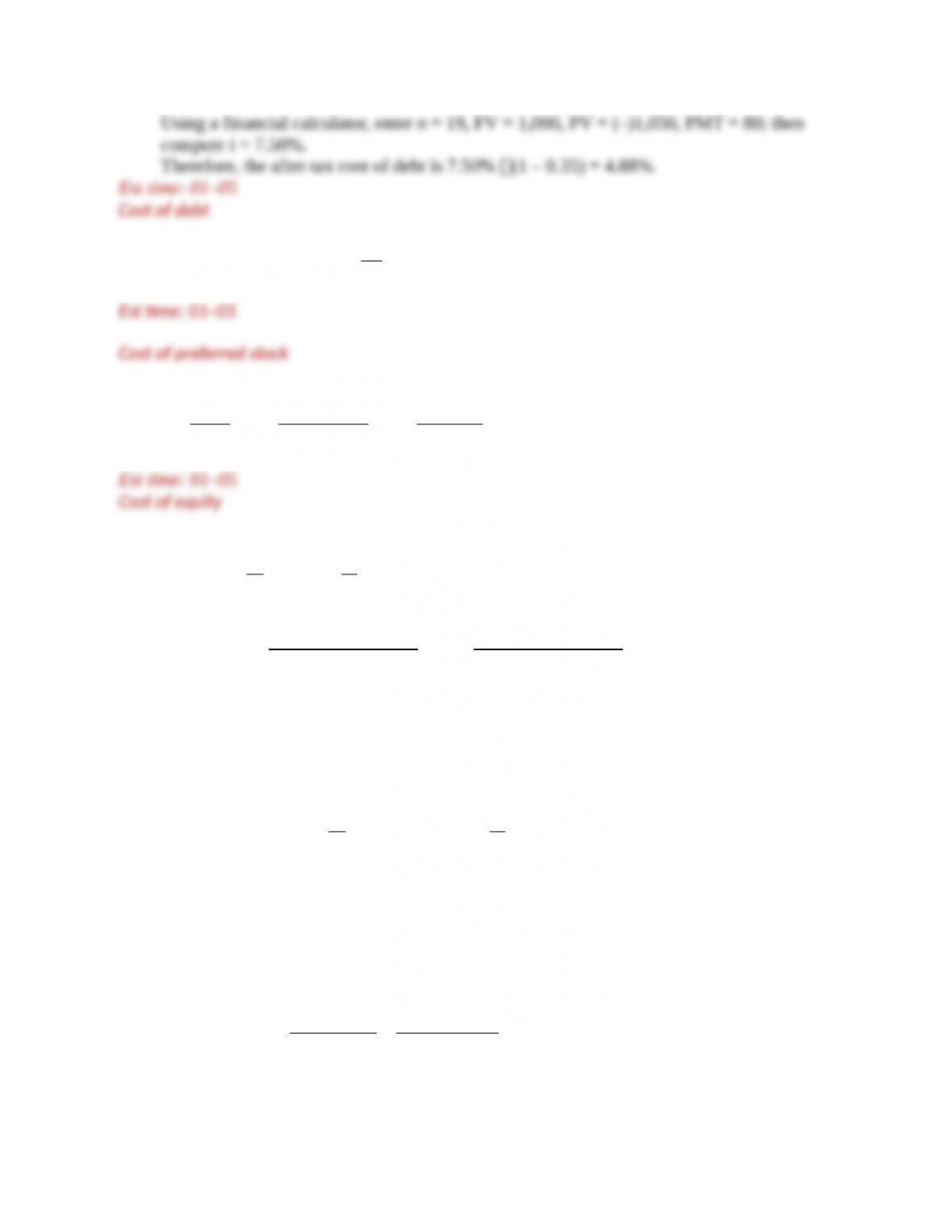
21.
Cost of preferred stock=4
40 =.10∨10
22.
%75.131375.005.0
60$
05.15$)1(DIVDIV
0
0
0
1
g
P
g
g
P
r
23.
equitydebt
WACC r
V
E
r
V
D
WACCGFF=
[
300,000
(300,000+500,000)×8
]
+
[
500,000
(300,000+500,000)×15
]
=12.38
Est me: 01–05
Weighted- average cost of capital
24. a. The weighted-average cost of capital, with a tax rate of 40%, is:
equityde bt
)1(WACC r
V
E
Tr
V
D
C
= [0.30 6% (1 – 0.40)] + [0.70 11%] = 8.78%
Free cash flow next year is $68 million – $30 million = $38 million.
Since the cash flows are in the form of a growing perpetuity, with a growth rate of
4%, the total value of Icarus is:
795$
04.00.0878
million 38$million 38$
PV
gr
million
13-<
Copyright © 2018 McGraw-Hill Education. All rights reserved. No reproduction or distribution without the prior written consent of
McGraw-Hill Education.
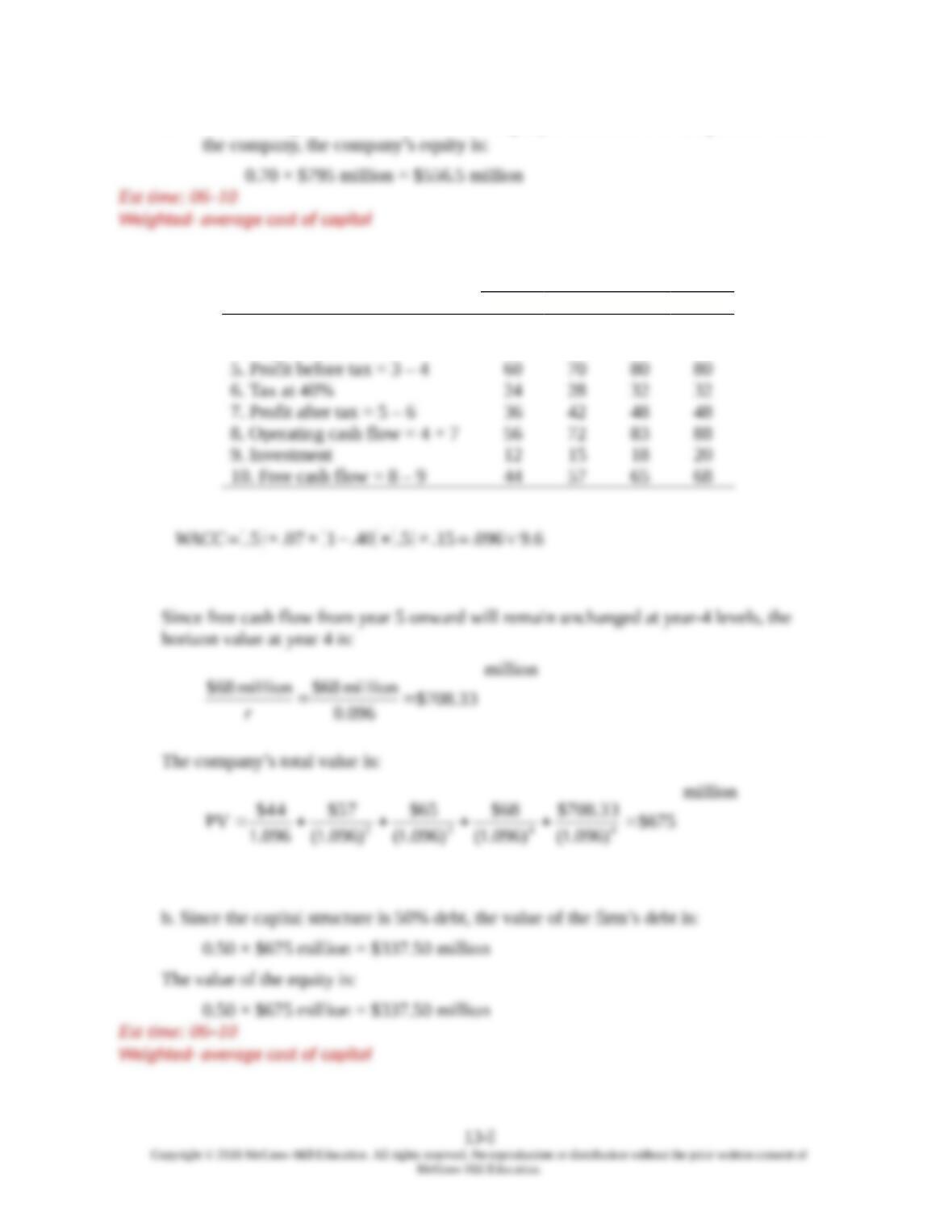
b. Since management will maintain the company’s debt at 30% of the present value of
25. a. Line numbers in the table below are from the text:
Year
1 2 3 4
3. EBITDA 80 100 115 120
4. Depreciation 20 30 35 40
13-<
Copyright © 2018 McGraw-Hill Education. All rights reserved. No reproduction or distribution without the prior written consent of
McGraw-Hill Education.