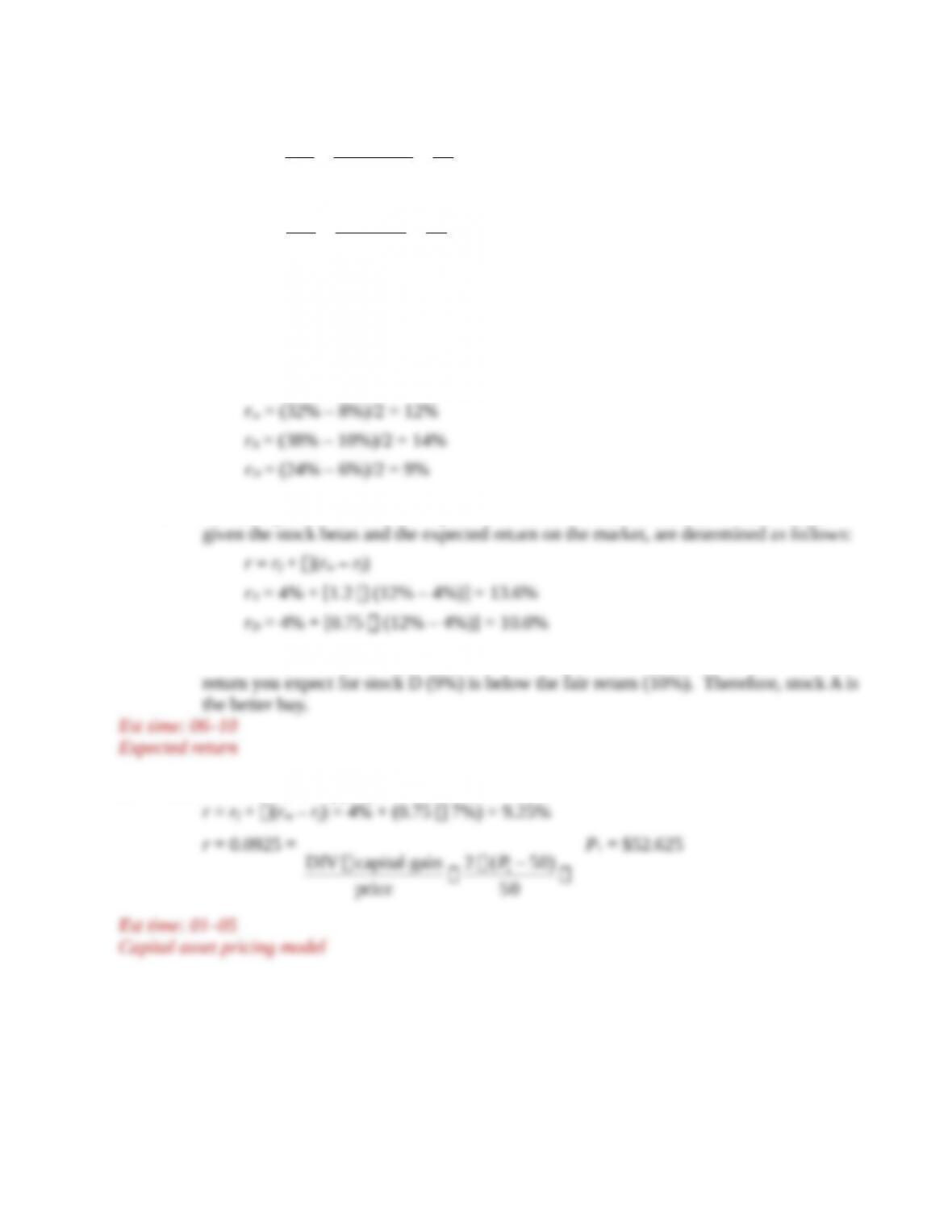
1. a. Beta is the responsiveness of each stock’s return to changes in the market return. Then:
2.1
40
48
)8(32
)10(38
Δ
Δ
β
m
A
A
r
r
75.0
40
30
)8(32
)6(24
m
D
D
r
r
Stock D is considered a more defensive stock than stock A because the return of stock D
is less sensitive to the return of the overall market. In a recession, stock D will usually
outperform both stock A and the market portfolio.
b. We take an average of returns in each scenario to obtain the expected return:
c. According to the CAPM, the expected returns investors will demand of each stock,
d. The return you actually expect for stock A (14%) is above the fair return (13.6%). The
2. From the CAPM, the appropriate discount rate is:
3.
a If investors believe the year-end stock price will be $52, then the expected return on the
stock is:
12-@
Copyright © 2018 McGraw-Hill Education. All rights reserved. No reproduction or distribution without the prior written consent of
McGraw-Hill Education.
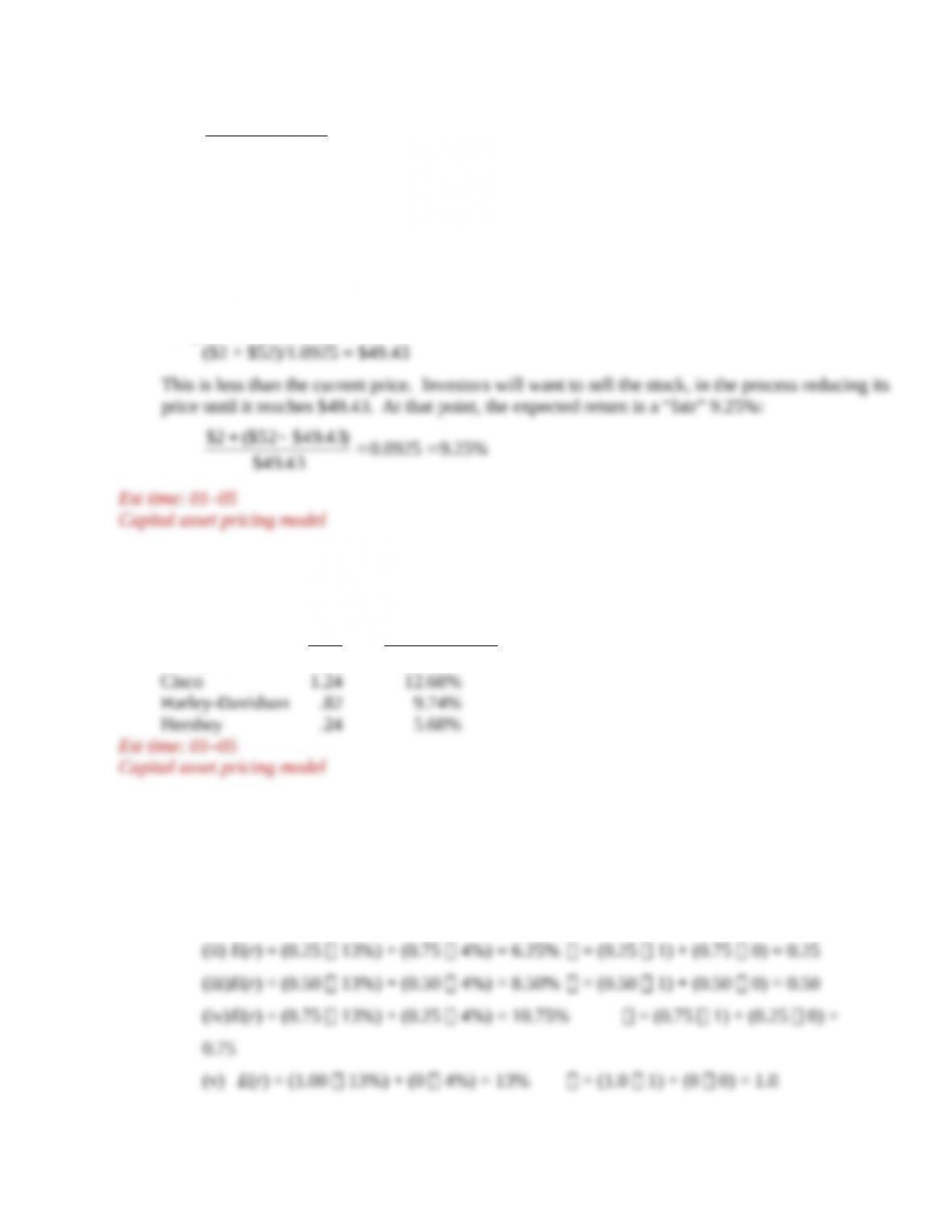
%0.808.0
50$
)50$52($2$
The opportunity cost of capital is r = rf + (rm – rf) = 4% + (.75 7%) = 9.25%
8.0% is less than the opportunity cost of capital. This is not a good yield and investors will
not invest.
a. Alternatively, the “fair” price of the stock (that is, the present value of the investor’s
expected cash flows) is:
4. We can use the CAPM to derive the cost of capital for these firms:
r = rf + (rm – rf) = 4% + ( 7%)
Beta Cost of Capital
Caterpillar 1.63 15.41%
5. a. The expected return of the portfolio is equal to the weighted average of the returns
on the S&P 500 and T-bills. Similarly, the beta of the portfolio is equal to the
weighted average of the beta of the S&P (which is 1.0) and the beta of T-bills (which
is zero):
(i) E(r) = (0 13%) + (1.0 4%) = 4% = (0 1) + (1 0) = 0
12-@
Copyright © 2018 McGraw-Hill Education. All rights reserved. No reproduction or distribution without the prior written consent of
McGraw-Hill Education.
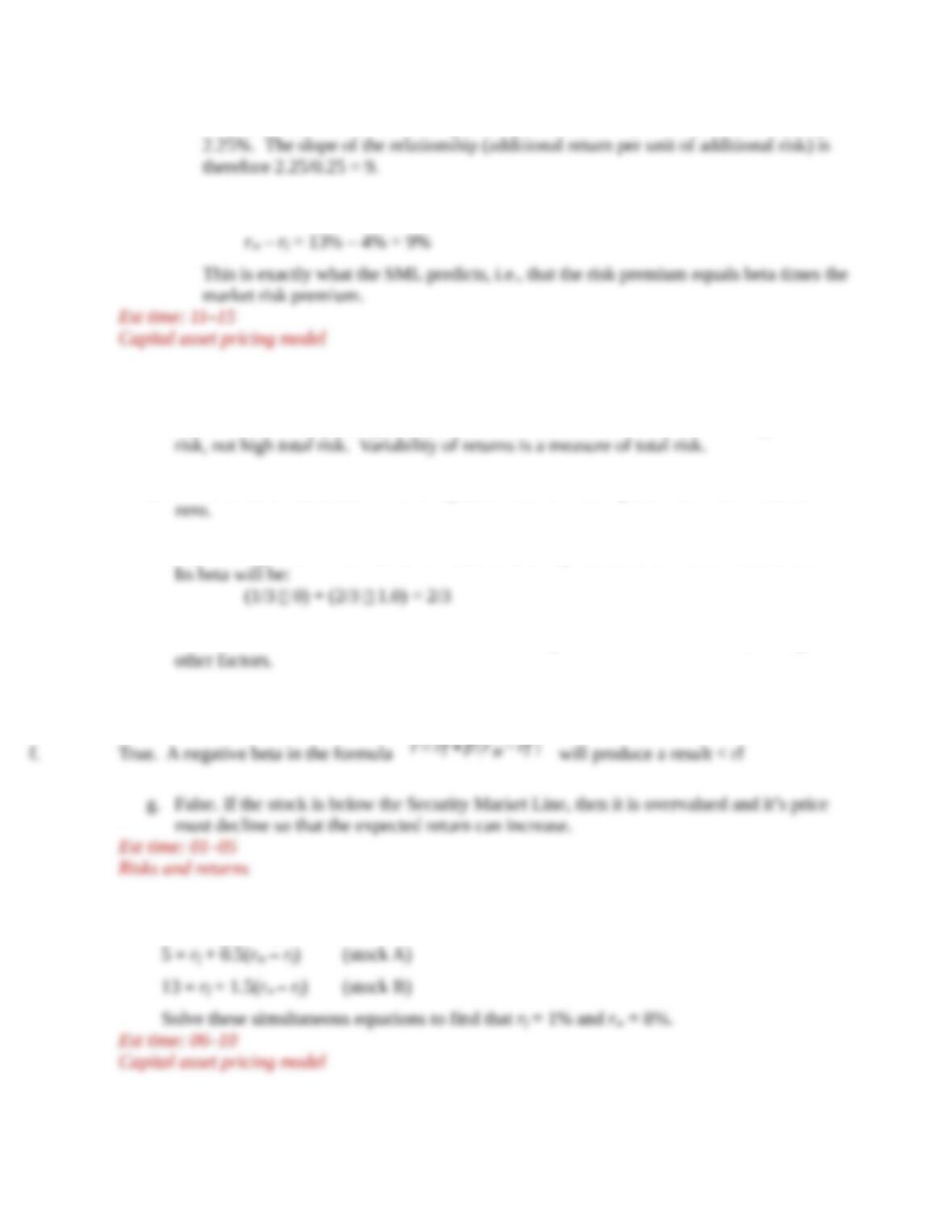
b. For every increase of 0.25 in the of the portfolio, the expected return increases by
c. The slope of the return per unit of risk relationship is the market risk premium:
6.
a False. Investors require higher expected rates of return on investments with high market
b. False. If beta = 0, then the asset’s expected return should equal the risk-free rate, not
c. False. The portfolio is invested one-third in Treasury bills and two-thirds in the market.
d. True. The asset’s beta is a function of its sensitivity to macroeconomic risks, among
e. True. This is exactly what beta measures.
r=rf +β(rM−rf )
7. r = rf + (rm – rf)
12-@
Copyright © 2018 McGraw-Hill Education. All rights reserved. No reproduction or distribution without the prior written consent of
McGraw-Hill Education.
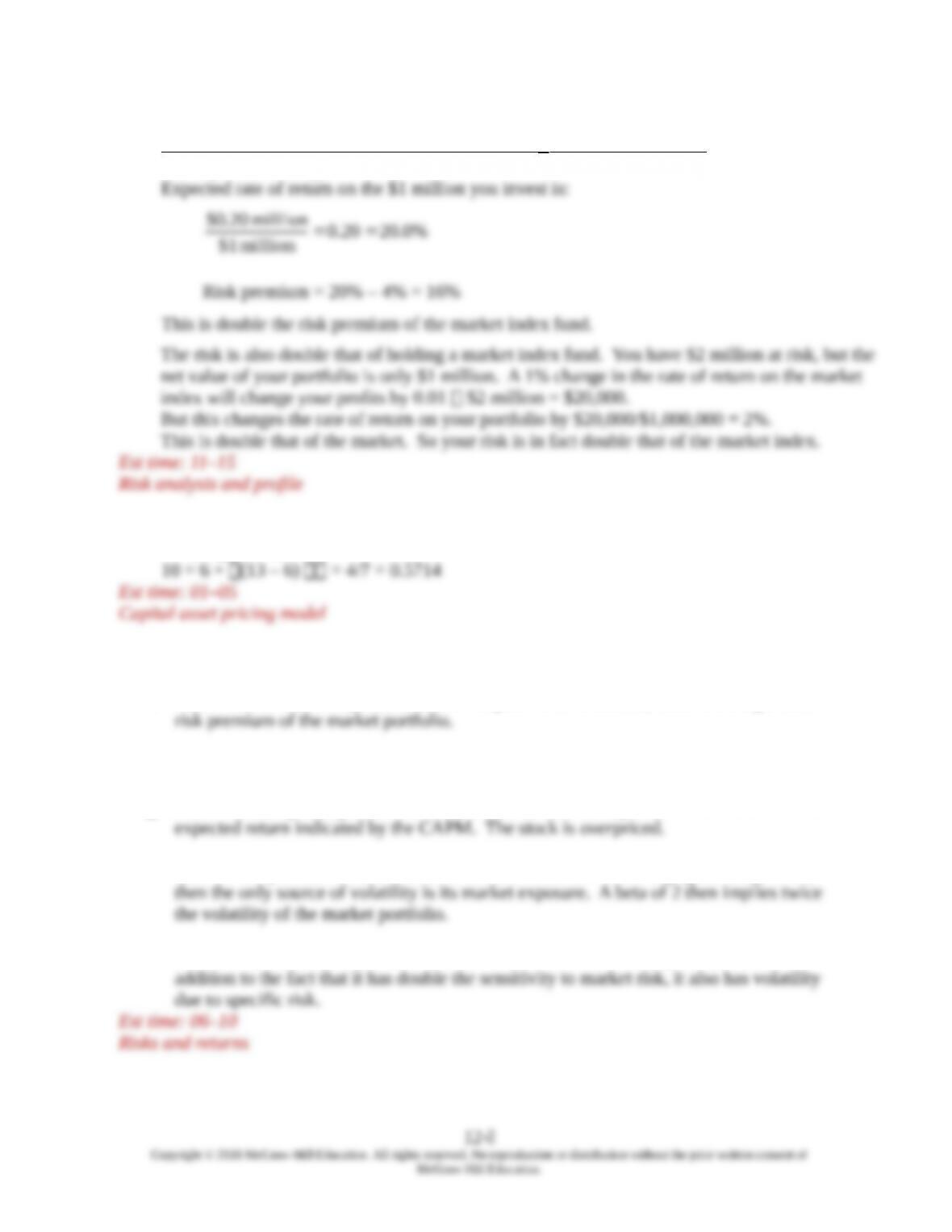
8. Expected income on stock fund: $2 million 0.12 = $0.24 million
Interest on borrowed funds: $1 million 0.04 = $0.04 million
Net expected earnings: $0.20 million
9. r = rf + (rm – rf)
10.
a False. The stock’s risk premium, not its expected rate of return, is twice as high as the
f. True. The stock’s specific risk does not affect its contribution to portfolio risk.
g. False. A stock plotting below the SML offers too low an expected return relative to the
h. True. If the portfolio is diversified to such an extent that it has negligible unique risk,
i. False. An undiversified portfolio has more than twice the volatility of the market. In
12-@
Copyright © 2018 McGraw-Hill Education. All rights reserved. No reproduction or distribution without the prior written consent of
McGraw-Hill Education.
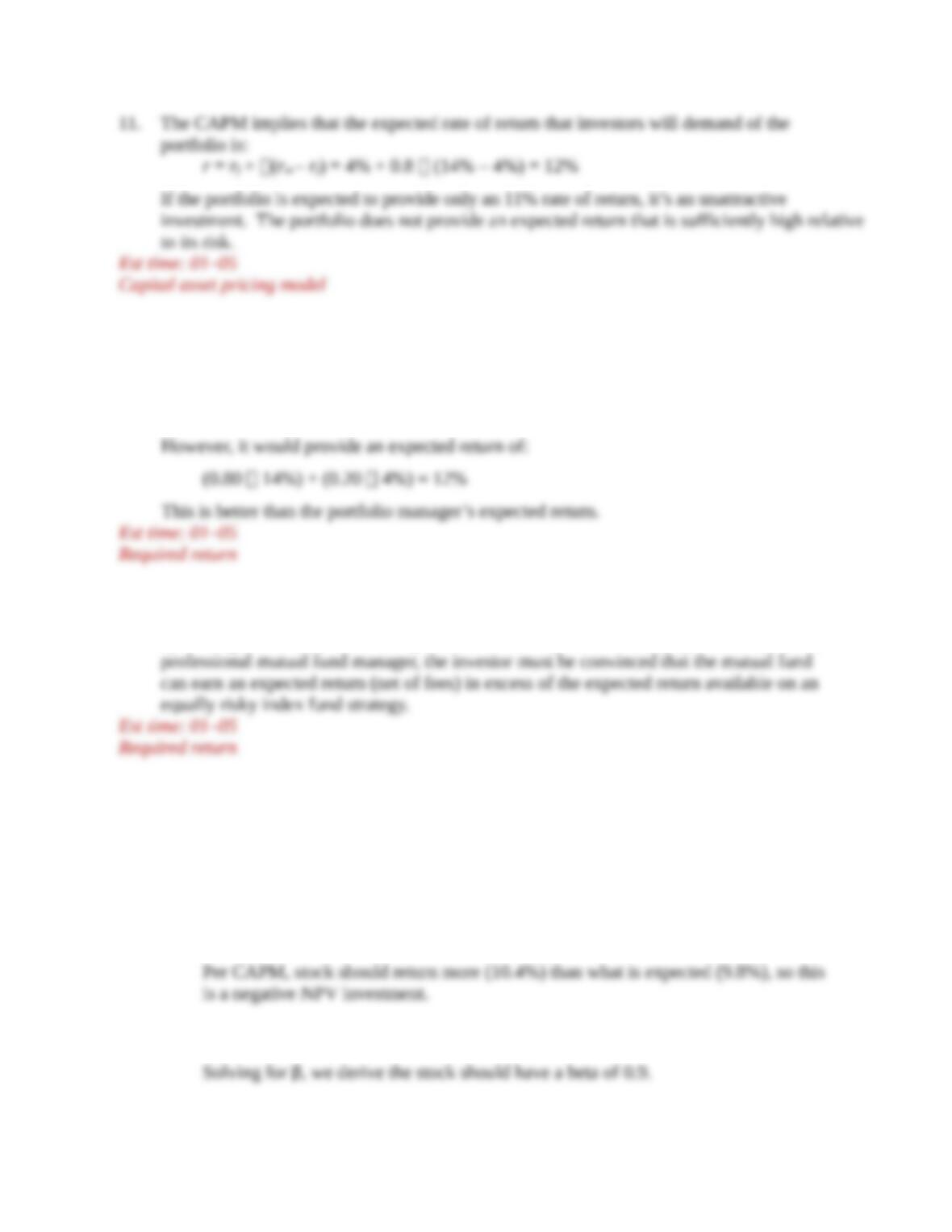
11. The CAPM implies that the expected rate of return that investors will demand of the
portfolio is:
12. A portfolio that is invested 80% in a stock index mutual fund (with a beta of 1.0) and 20%
in a money market mutual fund (with a beta of zero) would have the same beta as this
manager’s portfolio:
= (0.80 1.0) + (0.20 0) = 0.80
13. The security market line provides a benchmark expected return that an investor can earn
by mixing index funds with money market funds. Before an investor places funds with a
14. a.
Market risk premium( MRP )=expected return on market −rf rate
Market risk premium=12 −4=8
b.
CAPM=rf +β
(
MRP
)
=4+1.5 ×
(
8
)
=16
c.
CAPM=4+0.8×
(
8
)
=10.4 >9.8
d.
CAPM=rf +β
(
MRP
)
=4+β ×
(
8
)
=11.2
12-@
Copyright © 2018 McGraw-Hill Education. All rights reserved. No reproduction or distribution without the prior written consent of
McGraw-Hill Education.
15. a. r = rf + (rm – rf) = 5% + [(–0.2) (15% – 5%)] = 3%
16.
a. Required return = rf + (rm – rf) = 4% + [0.6 (14% – 4%)] = 10%
b. If beta = 1.6, then required return increases to:
17.
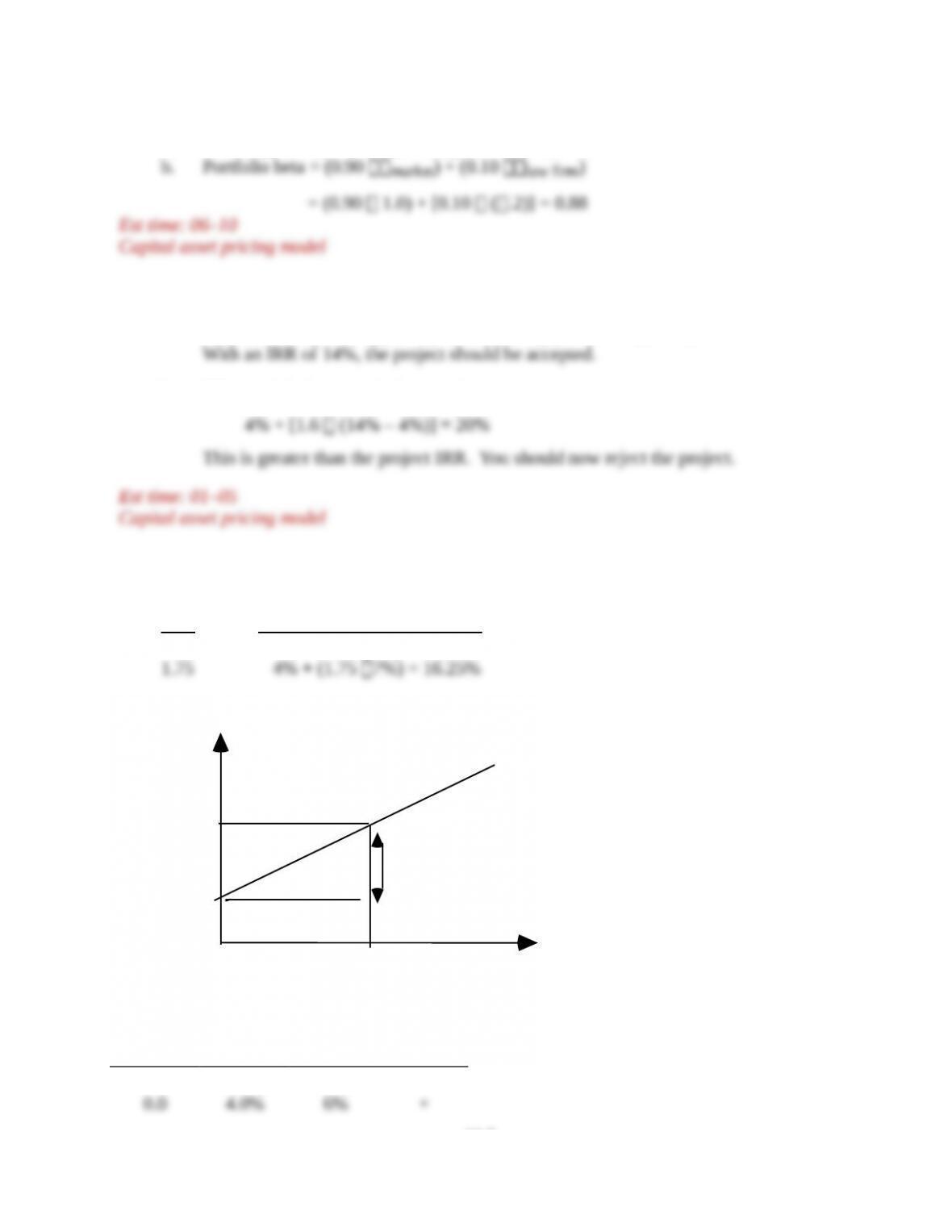
a. Figure shown below.
Beta Cost of Capital (from CAPM)
0.75 4% + (0.75 7%) = 9.25%
beta
r
1.0
4%
11%
7% = market risk
premium
SML
0
b.
Beta Cost of
Capital IRR NPV
1.0 11.0% 14% +
12-@
Copyright © 2018 McGraw-Hill Education. All rights reserved. No reproduction or distribution without the prior written consent of
McGraw-Hill Education.
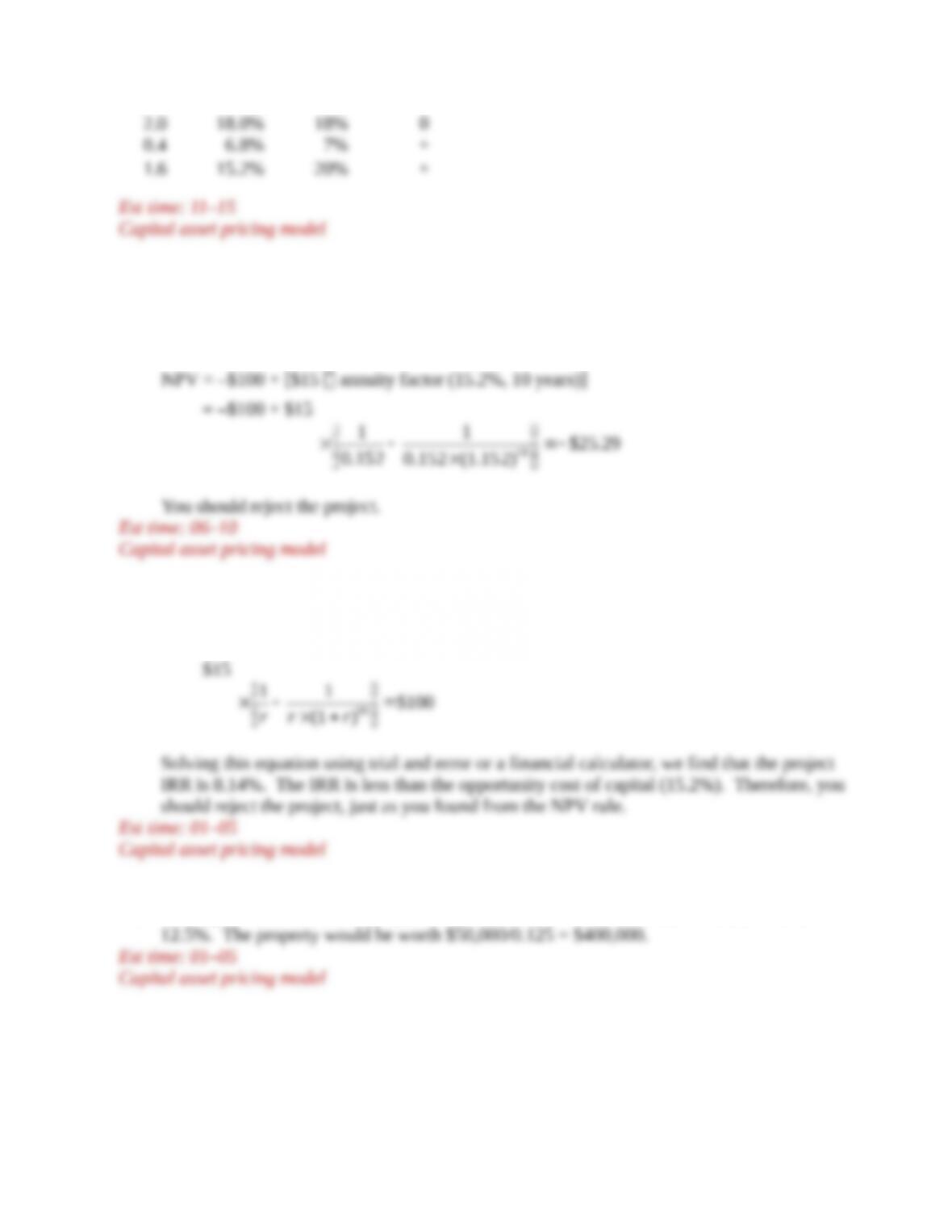
18. The appropriate discount rate for the project is:
r = rf + (rm – rf) = 4% + 1.4 (12% – 4%) = 15.2%
Therefore:
19. Find the discount rate (r) at which:
$15 annuity factor (r, 10 years) = 100
20. If the systematic risk were comparable to that of the market, the discount rate would be
21.
Required return = rf + (rm – rf) = 5% + [0.39 7% ] = 7.73%
12-@
Copyright © 2018 McGraw-Hill Education. All rights reserved. No reproduction or distribution without the prior written consent of
McGraw-Hill Education.

Cisco should use the beta of Hershey (which is 0.39) to find that the required rate of return
12-@
Copyright © 2018 McGraw-Hill Education. All rights reserved. No reproduction or distribution without the prior written consent of
McGraw-Hill Education.