CHAPTER 9 MANAGEMENT OF ECONOMIC EXPOSURE
ANSWERS & SOLUTIONS TO END OF CHAPTER QUESTIONS AND PROBLEMS
QUESTIONS
1. How would you define economic exposure to exchange risk?
Answer: Economic exposure can be defined as the possibility that the firm’s cash flows and
thus its market value may be affected by the unexpected exchange rate changes.
2. Explain the following statement: “Exposure is the regression coefficient.”
Answer: Exposure to currency risk can be appropriately measured by the sensitivity of the
3. Suppose that your company has an equity position in a French firm. Discuss the condition
under which the dollar/euro exchange rate uncertainty does not constitute exchange exposure
for your company.
Answer: Mere changes in exchange rates do not necessarily constitute currency exposure. If
4. Explain the competitive and conversion effects of exchange rate changes on the firm’s
operating cash flow.
Answer: The competitive effect: exchange rate changes may affect operating cash flows by
altering the firm’s competitive position.
5. Discuss the determinants of operating exposure.
Answer: The main determinants of a firm’s operating exposure are (i) the structure of the
markets in which the firm sources its inputs, such as labor and materials, and sells its products,
6. Discuss the implications of purchasing power parity for operating exposure.
Answer: If the exchange rate changes are matched by the inflation rate differential between
7. General Motors exports cars to Spain but the strong dollar against the euro hurts sales of
GM cars in Spain. In the Spanish market, GM faces competition from the Italian and French car
makers, such as Fiat and Renault, whose operating currencies are the euro. What kind of
measures would you recommend so that GM can maintain its market share in Spain.
8. What are the advantages and disadvantages of financial hedging of the firm’s operating
exposure vis-à-vis operational hedges (such as relocating manufacturing site)?
9. Discuss the advantages and disadvantages of maintaining multiple manufacturing sites as a
hedge against exchange rate exposure.
10. Evaluate the following statement: “A firm can reduce its currency exposure by diversifying
across different business lines.”
11. The exchange rate uncertainty may not necessarily mean that firms face exchange risk
exposure. Explain why this may be the case.
PROBLEMS
1. Suppose that you hold a piece of land in the City of London that you may want to sell in one
year. As a U.S. resident, you are concerned with the dollar value of the land. Assume that, if the
British economy booms in the future, the land will be worth £2,000 and one British pound will be
worth $1.40. If the British economy slows down, on the other hand, the land will be worth less,
i.e., £1,500, but the pound will be stronger, i.e., $1.50/£. You feel that the British economy will
experience a boom with a 60% probability and a slow-down with a 40% probability.
(a) Estimate your exposure b to the exchange risk.
(b) Compute the variance of the dollar value of your property that is attributable to the exchange
rate uncertainty.
(c) Discuss how you can hedge your exchange risk exposure and also examine the
consequences of hedging.

You have a negative exposure! As the pound gets stronger (weaker) against the dollar, the
dollar value of your British holding goes down (up).
2. A U.S. firm holds an asset in France and faces the following scenario:
State 1
State 2
State 3
State 4
Probability
25%
25%
25%
25%
Spot rate
$1.20/€
$1.10/€
$1.00/€
$0.90/€
P*
€1500
€1400
€1300
€1200
P
$1,800
$1,540
$1,300
$1,080
In the above table, P* is the euro price of the asset held by the U.S. firm and P is the dollar price
of the asset.
(a) Compute the exchange exposure faced by the U.S. firm.
(b) What is the variance of the dollar price of this asset if the U.S. firm remains unhedged
against this exposure?
(c) If the U.S. firm hedges against this exposure using the forward contract, what is the variance
of the dollar value of the hedged position?
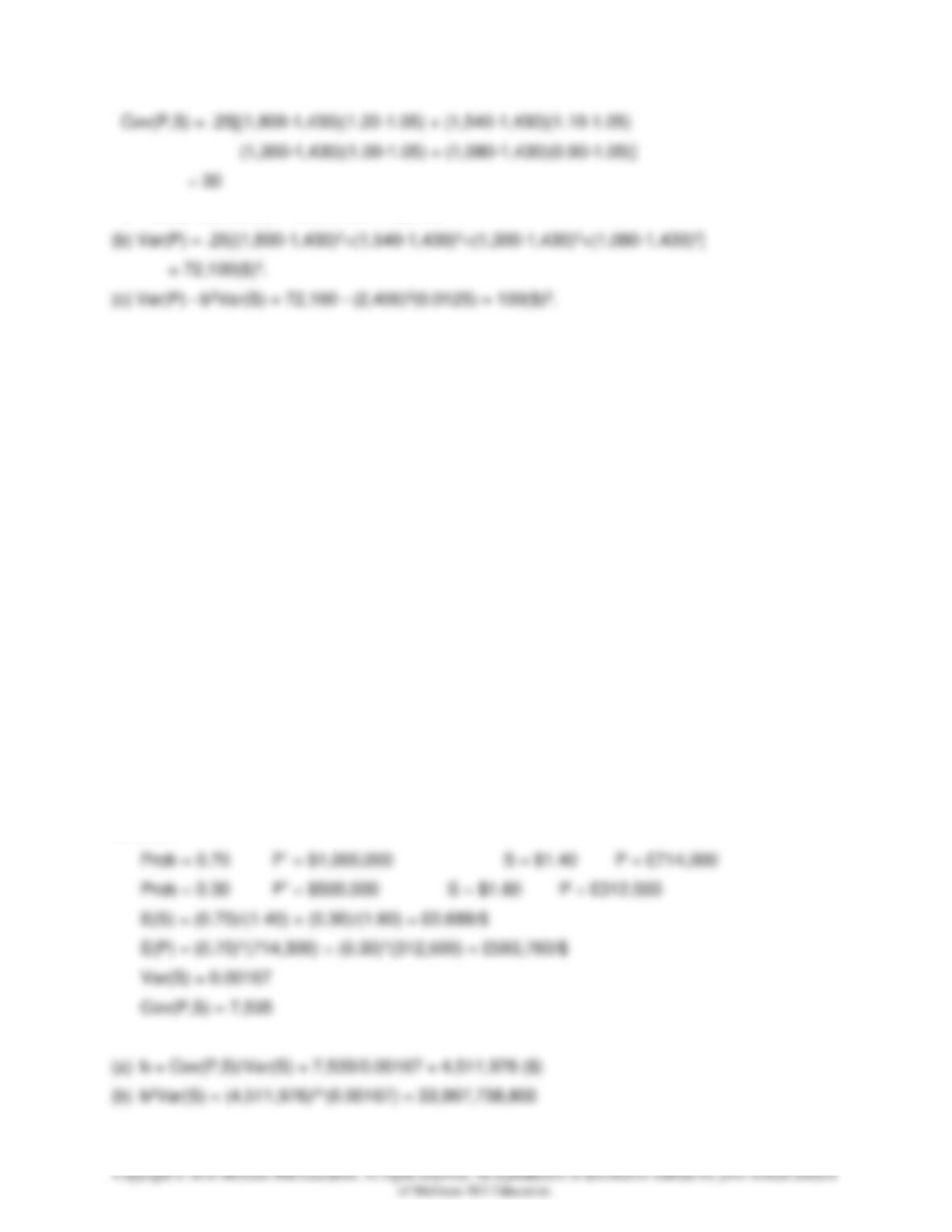
b = Cov(P,S)/Var(S) = 30/0.0125 = €2,400.
This means that most of the volatility of the dollar value of the French asset can be removed by
hedging exchange risk. The hedging can be achieved by selling €2,400 forward.
3. Suppose you are a British venture capitalist holding a major stake in an e-commerce start-up
in Silicon Valley. As a British resident, you are concerned with the pound value of your U.S.
equity position. Assume that if the American economy booms in the future, your equity stake will
be worth $1,000,000, and the exchange rate will be $1.40/£. If the American economy
experiences a recession, on the other hand, your American equity stake will be worth $500,000,
and the exchange rate will be $1.60/£. You assess that the American economy will experience a
boom with a 70 percent probability and a recession with a 30 percent probability.
(a) Estimate your exposure to the exchange risk.
(b) Compute the variance of the pound value of your American equity position that is attributable
to the exchange rate uncertainty.
(c) How would you hedge this exposure? If you hedge, what is the variance of the pound value
of the hedged position?
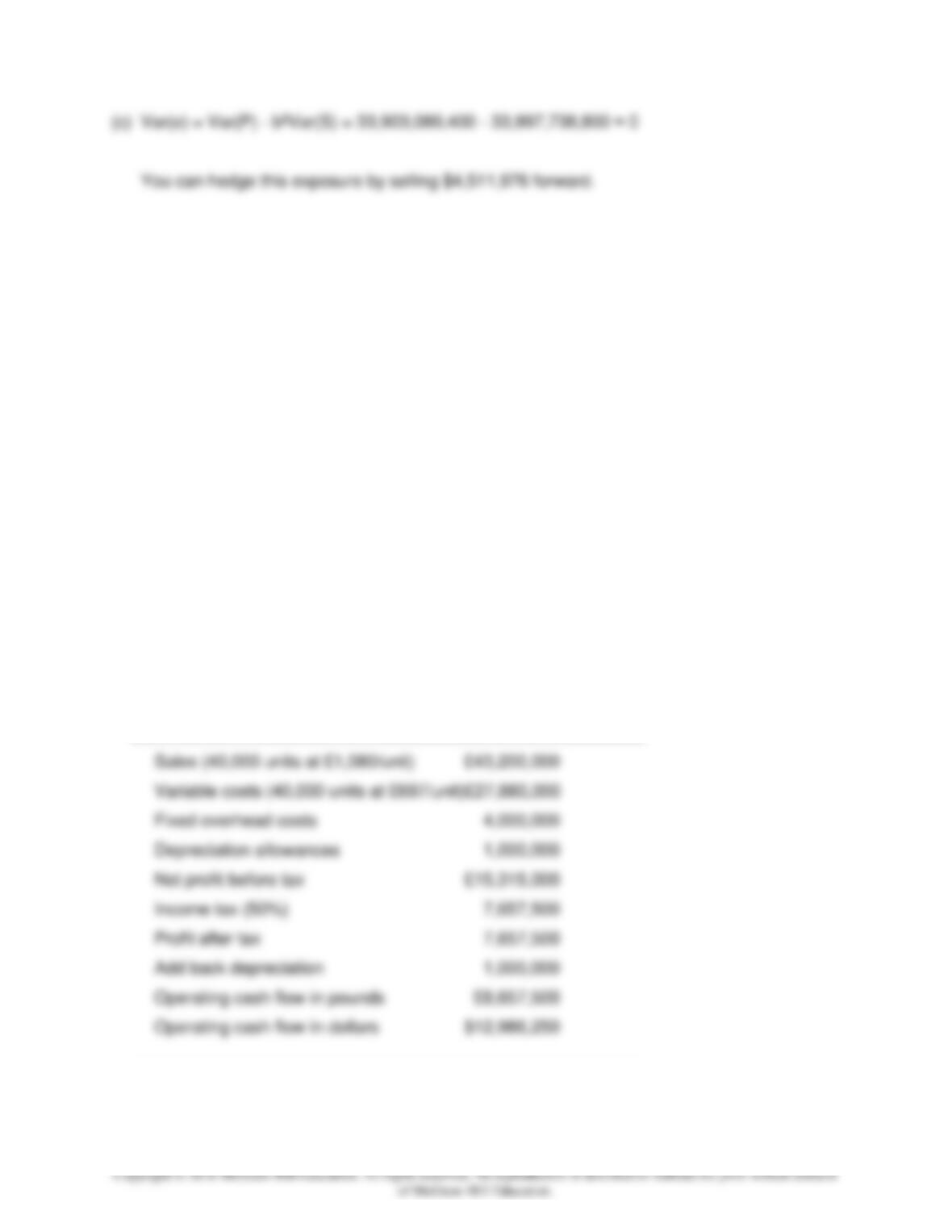
Solution:
MINI CASE: ECONOMIC EXPOSURE OF ALBION COMPUTERS PLC
Consider Case 3 of Albion Computers PLC discussed in the chapter. Now, assume that
the pound is expected to depreciate to $1.50 from the current level of $1.60 per pound. This
implies that the pound cost of the imported part, i.e., Intel’s microprocessors, is £341
(=$512/$1.50). Other variables, such as the unit sales volume and the U.K. inflation rate,
remain the same as in Case 3.
(a) Compute the projected annual cash flow in dollars.
(b) Compute the projected operating gains/losses over the four-year horizon as the discounted
present value of change in cash flows, which is due to the pound depreciation, from the
benchmark case presented in Exhibit 12.4.
(c) What actions, if any, can Albion take to mitigate the projected operating losses due to the
pound depreciation?
Suggested Solution to Economic Exposure of Albion Computers PLC
a) The projected annual cash flow can be computed as follows:
______________________________________________________
______________________________________________________
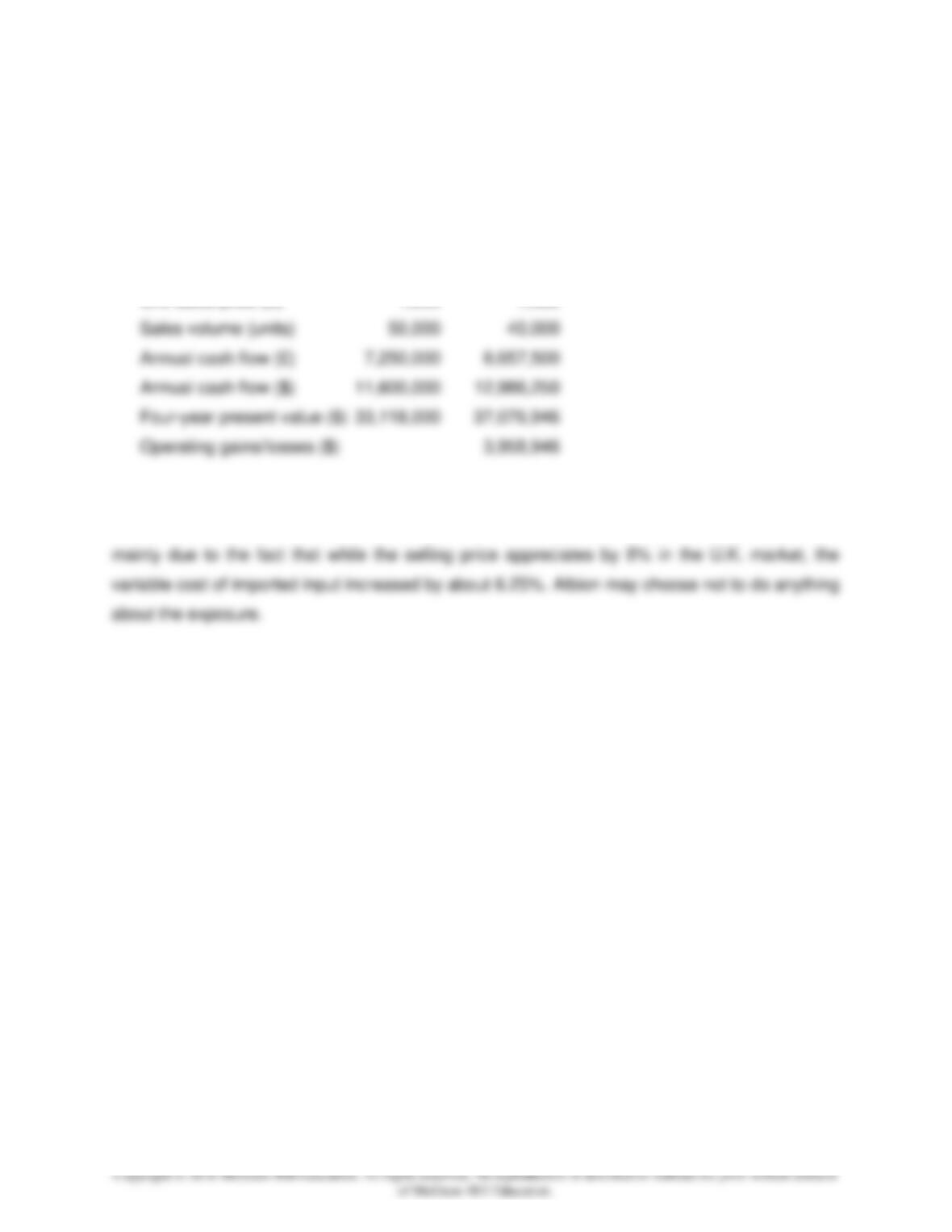
b) ______________________________________________________
Benchmark Current
Variables Case Case
______________________________________________________
Exchange rate ($/£) 1.60 1.50
Unit variable cost (£) 650 697
Unit sales price (£) 1,000 1,080
______________________________________________________
c) In this case, Albion actually can expect to realize exchange gains, rather than losses. This is