CHAPTER 5 THE MARKET FOR FOREIGN EXCHANGE
ANSWERS & SOLUTIONS TO END-OF-CHAPTER QUESTIONS AND PROBLEMS
QUESTIONS
1. Give a full definition of the market for foreign exchange.
Answer: Broadly defined, the foreign exchange (FX) market encompasses the conversion of
2. What is the difference between the retail or client market and the wholesale or interbank
market for foreign exchange?
Answer: The market for foreign exchange can be viewed as a two-tier market. One tier is the
3. Who are the market participants in the foreign exchange market?
Answer: The market participants that comprise the FX market can be categorized into five
funds, whose size and frequency of trades make it cost– effective to establish their own dealing
rooms to trade directly in the interbank market for their foreign exchange needs.
Central banks sometimes intervene in the foreign exchange market in an attempt to
influence the price of its currency against that of a major trading partner, or a country that it
“fixes” or “pegs” its currency against. Intervention is the process of using foreign currency
reserves to buy one’s own currency in order to decrease its supply and thus increase its value in
the foreign exchange market, or alternatively, selling one’s own currency for foreign currency in
order to increase its supply and lower its price.
4. How are foreign exchange transactions between international banks settled?
Answer: The interbank market is a network of correspondent banking relationships, with large
commercial banks maintaining demand deposit accounts with one another, called correspondent
bank accounts. The correspondent bank account network allows for the efficient functioning of
5. What is meant by a currency trading at a discount or at a premium in the forward market?
Copyright © 2018 McGraw-Hill Education. All rights reserved. No reproduction or distribution without the prior written consent
of McGraw-Hill Education.
premium) or lower (at a discount) than the spot price.
6. Why does most interbank currency trading worldwide involve the U.S. dollar?
Answer: Trading in currencies worldwide is against a common currency that has international
7. Banks find it necessary to accommodate their clients’ needs to buy or sell FX forward, in
many instances for hedging purposes. How can the bank eliminate the currency exposure it has
created for itself by accommodating a client’s forward transaction?
Answer: Swap transactions provide a means for the bank to mitigate the currency exposure in a
forward trade. A swap transaction is the simultaneous sale (or purchase) of spot foreign
exchange against a forward purchase (or sale) of an approximately equal amount of the foreign
8. A CAD/$ bank trader is currently quoting a small figure bid-ask of 35-40, when the rest of the
market is trading at CAD1.3436-CAD1.3441. What is implied about the trader’s beliefs by his
prices?
Answer: The trader must think the Canadian dollar is going to appreciate against the U.S. dollar
9. What is triangular arbitrage? What is a condition that will give rise to a triangular arbitrage
opportunity?
Answer: Triangular arbitrage is the process of trading out of the U.S. dollar into a second
currency, then trading it for a third currency, which is in turn traded for U.S. dollars. The purpose
10. Over the past five years, the exchange rate between British pound and U.S. dollar, $/£, has
changed from about 1.90 to about 1.45. Would you agree that over this five-year period that
British goods have become cheaper for buyers in the United States?
CFA Guideline Answer:
PROBLEMS
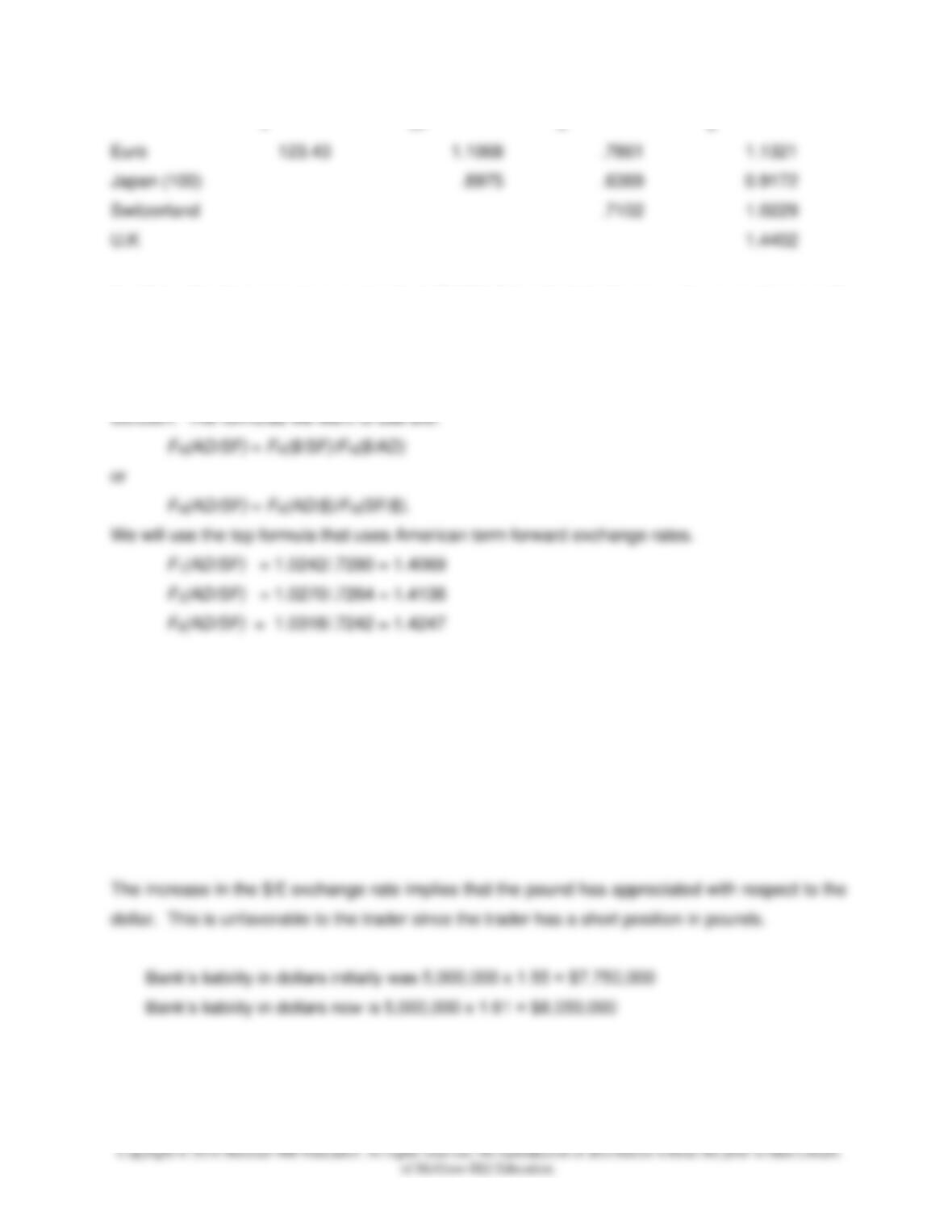
1. Using the American term quotes from Exhibit 5.4, calculate a cross-rate matrix for the euro,
Swiss franc, Japanese yen, and the British pound so that the resulting triangular matrix is similar
to the portion above the diagonal in Exhibit 5.6.
¥
SF
£
$
Euro
123.43
1.1068
.7861
1.1321
Japan (100)
.8975
.6369
0.9172
Switzerland
.7102
1.0229
U.K
1.4402
2. Using the American term quotes from Exhibit 5.4, calculate the one-, three-, and six-month
forward cross-exchange rates between the Australian dollar and the Swiss franc. State the
forward cross-rates in “Australian” terms.
3. A foreign exchange trader with a U.S. bank took a short position of £5,000,000 when the $/£
exchange rate was 1.55. Subsequently, the exchange rate has changed to 1.61. Is this
movement in the exchange rate good from the point of view of the position taken by the trader?
By how much has the bank’s liability changed because of the change in the exchange rate?
CFA Guideline Answer:
4. Restate the following one-, three-, and six-month outright forward European term bid-ask
quotes in forward points.
Spot 1.3431–1.3436
One-Month 1.3432–1.3442
Three-Month 1.3448–1.3463
Six-Month 1.3488–1.3508
Solution:
5. Using the spot and outright forward quotes in problem 4, determine the corresponding bid-ask
spreads in points.
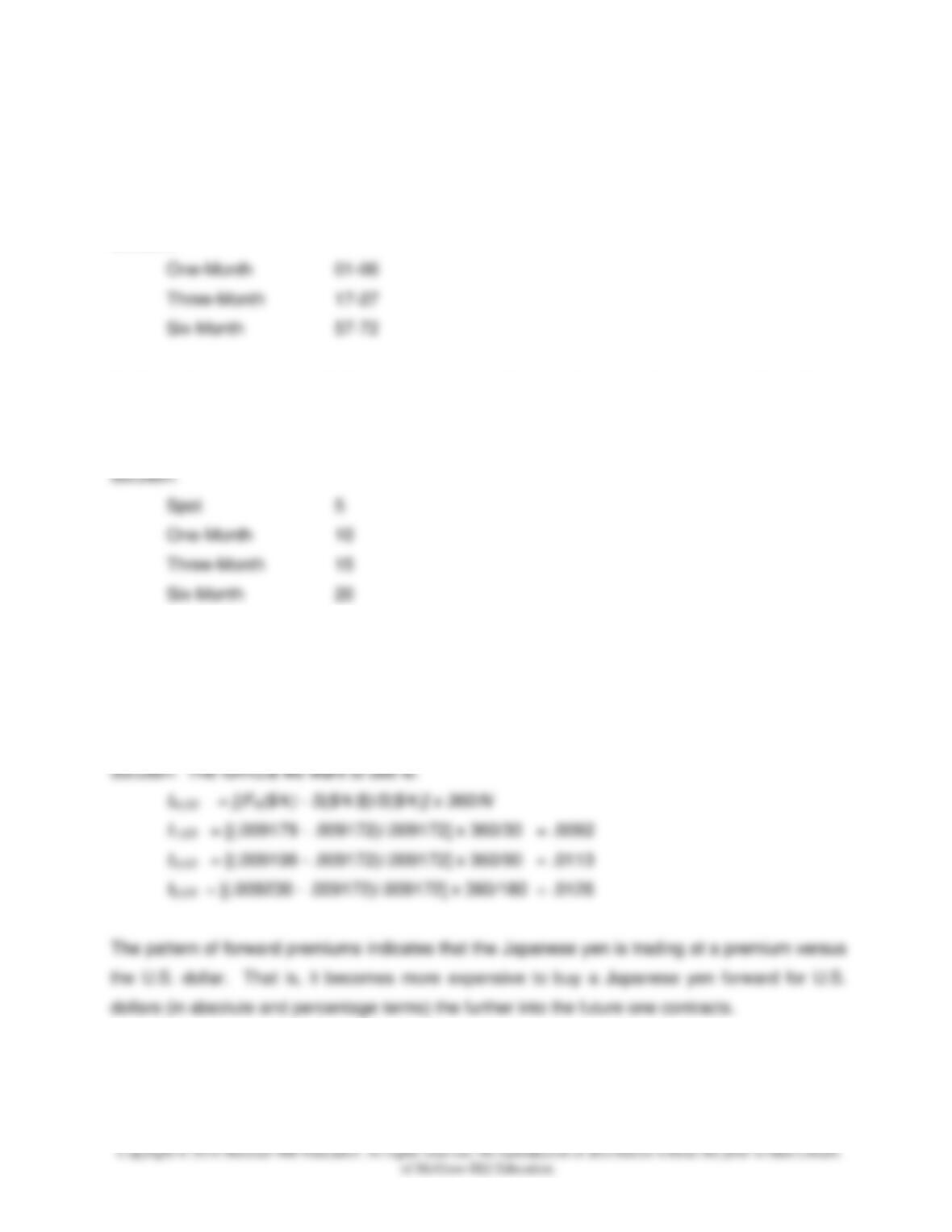
6. Using Exhibit 5.4, calculate the one-, three-, and six-month forward premium or discount for
the Japanese yen versus the U.S. dollar using American term quotations. For simplicity, assume
each month has 30 days. What is the interpretation of your results?
7. Using Exhibit 5.4, calculate the one-, three-, and six-month forward premium or discount for
the U.S. dollar versus the British pound using European term quotations. For simplicity, assume
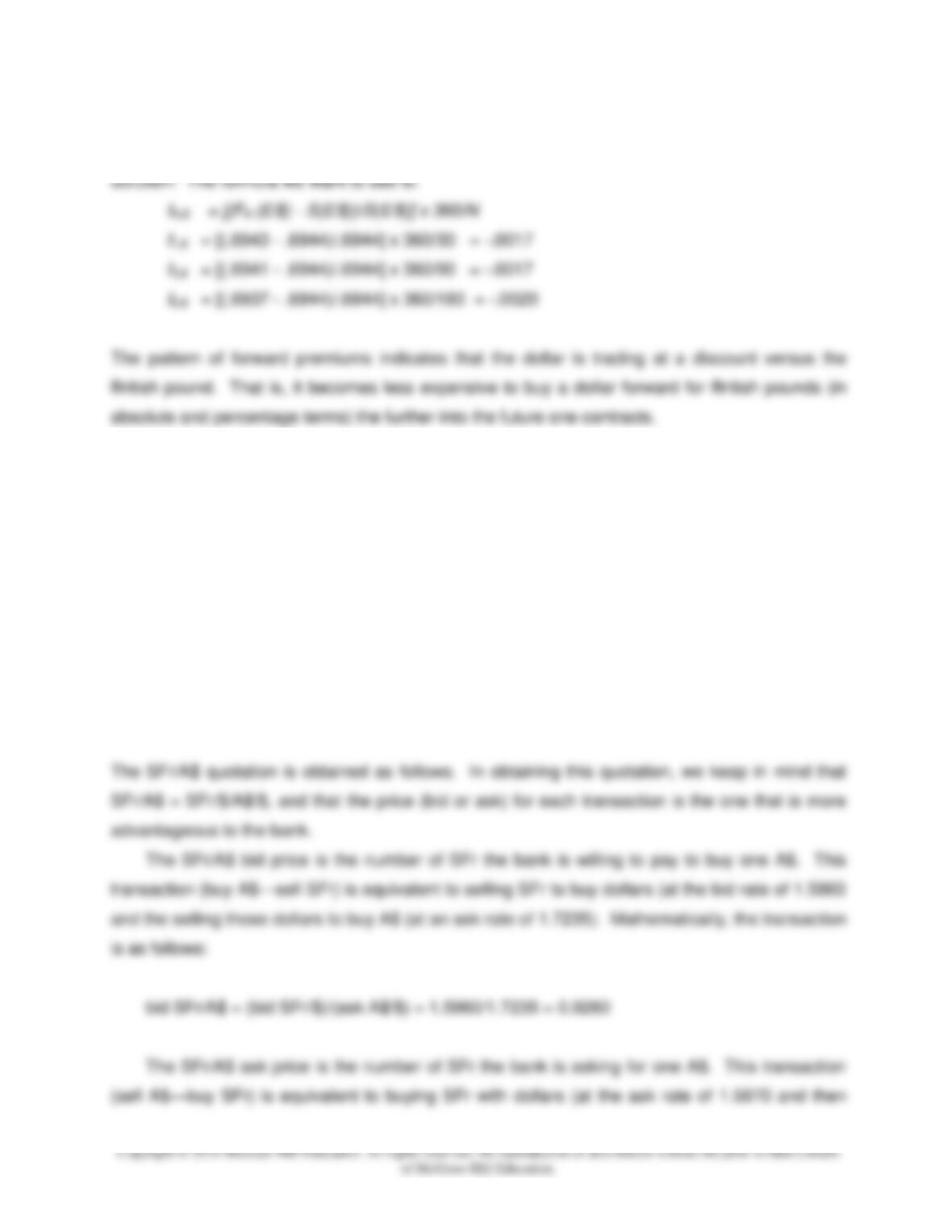
each month has 30 days. What is the interpretation of your results?
8. A bank is quoting the following exchange rates against the dollar for the Swiss franc and the
Australian dollar:
SFr/$ = 1.5960—70
A$/$ = 1.7225—35
An Australian firm asks the bank for an A$/SFr quote. What cross-rate would the bank
quote?
CFA Guideline Answer:
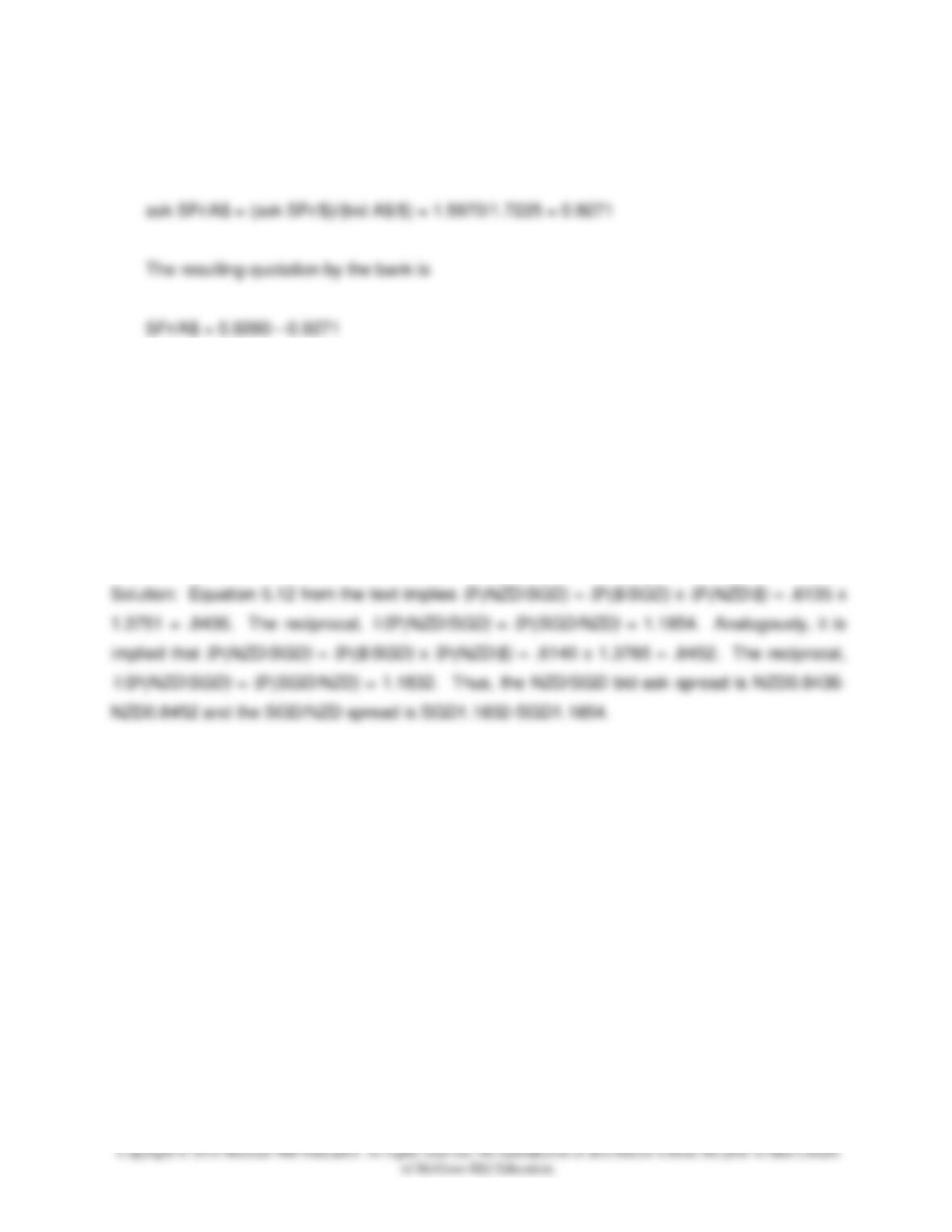
simultaneously purchasing these dollars against A$ (at a bid rate of 1.7225). This may be
expressed as follows:
9. Given the following information, what are the NZD/SGD currency against currency bid-ask
quotations?
American Terms European Terms
Bank Quotations Bid Ask Bid Ask
New Zealand dollar .7265 .7272 1.3751 1.3765
Singapore dollar .6135 .6140 1.6287 1.6300
10. Doug Bernard specializes in cross-rate arbitrage. He notices the following quotes:
Swiss franc/dollar = SFr1.5971?$
Australian dollar/U.S. dollar = A$1.8215/$
Australian dollar/Swiss franc = A$1.1440/SFr
Ignoring transaction costs, does Doug Bernard have an arbitrage opportunity based on
these quotes? If there is an arbitrage opportunity, what steps would he take to make an
arbitrage profit, and how would he profit if he has $1,000,000 available for this purpose.
CFA Guideline Answer:
Copyright © 2018 McGraw-Hill Education. All rights reserved. No reproduction or distribution without the prior written consent
of McGraw-Hill Education.
A. The implicit cross-rate between Australian dollars and Swiss franc is A$/SFr = A$/$ x $/SFr
= (A$/$)/(SFr/$) = 1.8215/1.5971 = 1.1405. However, the quoted cross-rate is higher at
A$1.1.1440/SFr. So, triangular arbitrage is possible.
B. In the quoted cross-rate of A$1.1440/SFr, one Swiss franc is worth A$1.1440, whereas the
cross-rate based on the direct rates implies that one Swiss franc is worth A$1.1405. Thus, the
Swiss franc is overvalued relative to the A$ in the quoted cross-rate, and Doug Bernard’s
strategy for triangular arbitrage should be based on selling Swiss francs to buy A$ as per the
quoted cross-rate. Accordingly, the steps Doug Bernard would take for an arbitrage profit is as
follows:
i. Sell dollars to get Swiss francs: Sell $1,000,000 to get $1,000,000 x SFr1.5971/$ =
SFr1,597,100.
ii. Sell Swiss francs to buy Australian dollars: Sell SFr1,597,100 to buy SFr1,597,100 x
A$1.1440/SFr = A$1,827,082.40.
iii. Sell Australian dollars for dollars: Sell A$1,827,082.40 for
A$1,827,082.40/A$1.8215/$ = $1,003,064.73.
Thus, your arbitrage profit is $1,003,064.73 – $1,000,000 = $3,064.73.
11. Assume you are a trader with Deutsche Bank. From the quote screen on your computer
terminal, you notice that Dresdner Bank is quoting €0.7627/$1.00 and Credit Suisse is offering
SF1.1806/$1.00. You learn that UBS is making a direct market between the Swiss franc and the
euro, with a current €/SF quote of .6395. Show how you can make a triangular arbitrage profit by
trading at these prices. (Ignore bid-ask spreads for this problem.) Assume you have $5,000,000
with which to conduct the arbitrage. What happens if you initially sell dollars for Swiss francs?
What €/SF price will eliminate triangular arbitrage?
Solution: To make a triangular arbitrage profit the Deutsche Bank trader would sell $5,000,000
Copyright © 2018 McGraw-Hill Education. All rights reserved. No reproduction or distribution without the prior written consent
of McGraw-Hill Education.
Bank for $4,949,481 = €3,774,969/.7627, or a loss of $50,519. Thus, it is necessary to conduct
the triangular arbitrage in the correct order.
The S(€/SF) cross exchange rate should be .7627/1.1806 = .6460. This is an equilibrium
rate at which a triangular arbitrage profit will not exist. (The student can determine this for
himself.) A profit results from the triangular arbitrage when dollars are first sold for euros
because Swiss francs are purchased for euros at too low a rate in comparison to the equilibrium
cross-rate, i.e., Swiss francs are purchased for only €0.6395/SF1.00 instead of the no-arbitrage
12. The current spot exchange rate is $1.95/£ and the three-month forward rate is $1.90/£.
Based on your analysis of the exchange rate, you are pretty confident that the spot exchange
rate will be $1.92/£ in three months. Assume that you would like to buy or sell £1,000,000.
a. What actions do you need to take to speculate in the forward market? What is the expected
dollar profit from speculation?
b. What would be your speculative profit in dollar terms if the spot exchange rate actually turns
out to be $1.86/£.
Solution:
13. Omni Advisors, an international pension fund manager, plans to sell equities denominated in
Swiss Francs (CHF) and purchase an equivalent amount of equities denominated in South
African rands (ZAR).
Omni will realize net proceeds of 3 million CHF at the end of 30 days and wants to eliminate the
risk that the ZAR will appreciate relative to the CHF during this 30-day period. The following
exhibit shows current exchange rates between the ZAR, CHF, and the U.S. dollar (USD).
Currency Exchange Rates
ZAR/US
D
ZAR/US
D
CHF/US
D
CHF/US
D
Maturit
y
Bid
Ask
Bid
Ask
Spot
6.2681
6.2789
1.5282
1.5343
30–day
6.2538
6.2641
1.5226
1.5285
90–day
6.2104
6.2200
1.5058
1.5115
a. Describe the currency transaction that Omni should undertake to eliminate
currency risk over the 30-day period.
b. Calculate the following:
• The CHF/ZAR cross-currency rate Omni would use in valuing the Swiss equity
portfolio.
• The current value of Omni’s Swiss equity portfolio in ZAR.
• The annualized forward premium or discount at which the ZAR is trading versus
the CHF.
CFA Guideline Answer:
MINI CASE: SHREWSBURY HERBAL PRODUCTS, LTD.
Shrewsbury Herbal Products, located in central England close to the Welsh border, is an
old-line producer of herbal teas, seasonings, and medicines. Its products are marketed all over
the United Kingdom and in many parts of continental Europe as well.
Shrewsbury Herbal generally invoices in British pound sterling when it sells to foreign
customers in order to guard against adverse exchange rate changes. Nevertheless, it has just
received an order from a large wholesaler in central France for £320,000 of its products,
conditional upon delivery being made in three months’ time and the order invoiced in euros.
Shrewsbury’s controller, Elton Peters, is concerned with whether the pound will appreciate
versus the euro over the next three months, thus eliminating all or most of the profit when the
euro receivable is paid. He thinks this is an unlikely possibility, but he decides to contact the
firm’s banker for suggestions about hedging the exchange rate exposure.
Mr. Peters learns from the banker that the current spot exchange rate is €/£ is €1.4537, thus
the invoice amount should be €465,184. Mr. Peters also learns that the three-month forward
rates for the pound and the euro versus the U.S. dollar are $1.8990/£1.00 and $1.3154/€1.00,
respectively. The banker offers to set up a forward hedge for selling the euro receivable for
pound sterling based on the €/£ forward cross-exchange rate implicit in the forward rates against
the dollar.
What would you do if you were Mr. Peters?
Suggested Solution to Shrewsbury Herbal Products, Ltd.
(Note to Instructor: This elementary case provides an intuitive look at hedging exchange
rate exposure. Students should not have difficulty with it even though hedging will not be
formally discussed until Chapter 8. The case is consistent with the discussion that accompanies
Exhibit 5.9 of the text. Professor of Finance, Banikanta Mishra, of Xavier Institute of
Management – Bhubaneswar, India contributed to this solution.)
Copyright © 2018 McGraw-Hill Education. All rights reserved. No reproduction or distribution without the prior written consent
of McGraw-Hill Education.
month accounts receivable period if it could invoice in £. That, however, is not acceptable to the
French wholesaler. When invoicing in euros, Shrewsbury could establish the euro invoice
amount by use of the forward exchange rate instead of the current spot rate. The invoice amount
in that case would be €461,984 = £320,000 x 1.4437. Shrewsbury can now lock-in a receipt of
£320,000 if it simultaneously hedges its euro exposure by selling €461,984 at the forward rate of
1.4437. That is, £320,000 = €461,984/1.4437.