CHAPTER 11 INTERNATIONAL BANKING AND MONEY MARKET
ANSWERS & SOLUTIONS TO END-OF-CHAPTER QUESTIONS AND PROBLEMS
QUESTIONS
1. Briefly discuss some of the services that international banks provide their customers and the
market place.
Answer: International banks can be characterized by the types of services they provide that
distinguish them from domestic banks. Foremost, international banks facilitate the imports and
Two major features that distinguish international banks from domestic banks are the types of
deposits they accept and the loans and investments they make. Large international banks both
2. Briefly discuss the various types of international banking offices.
Answer: The services and operations which an international bank undertakes is a function of
Copyright © 2018 McGraw-Hill Education. All rights reserved. No reproduction or distribution without the prior written consent
of McGraw-Hill Education.
contacts.
A representative office is a small service facility staffed by parent bank personnel that is
designed to assist MNC clients of the parent bank in its dealings with the bank’s
correspondents. It is a way for the parent bank to provide its MNC clients with a level of service
greater than that provided through merely a correspondent relationship.
A foreign branch bank operates like a local bank, but legally it is a part of the parent bank.
As such, a branch bank is subject to the banking regulations of its home country and the country
in which it operates. The primary reason a parent bank would establish a foreign branch is that
it can provide a much fuller range of services for its MNC customers through a branch office
than it can through a representative office.
Edge Act banks are federally chartered subsidiaries of U.S. banks which are physically
located in the United States that are allowed to engage in a full range of international banking
activities. A 1919 amendment to Section 25 of the Federal Reserve Act created Edge Act
banks. The purpose of the amendment was to allow U.S. banks to be competitive with the
services foreign banks could supply their customers. Federal Reserve Regulation K allows
Edge Act banks to accept foreign deposits, extend trade credit, finance foreign projects abroad,
trade foreign currencies, and engage in investment banking activities with U.S. citizens involving
foreign securities. As such, Edge Act banks do not compete directly with the services provided
by U.S. commercial banks. Edge Act banks are not prohibited from owning equity in business
Copyright © 2018 McGraw-Hill Education. All rights reserved. No reproduction or distribution without the prior written consent
of McGraw-Hill Education.
In 1981, the Federal Reserve authorized the establishment of International Banking
Facilities (IBF). An IBF is a separate set of asset and liability accounts that are segregated on
the parent bank’s books; it is not a unique physical or legal entity. IBFs operate as foreign
banks in the U.S. IBFs were established largely as a result of the success of offshore banking.
The Federal Reserve desired to return a large share of the deposit and loan business of U.S.
branches and subsidiaries to the U.S.
3. How does the deposit-loan rate spread in the Eurodollar market compare with the deposit–
loan rate spread in the domestic U.S. banking system? Why?
Answer: Competition has driven the deposit-loan spread in the domestic U.S. banking system
4. What is the difference between the Euronote market and the Eurocommercial paper market?
Answer: Euronotes are short-term notes underwritten by a group of international investment or
commercial banks called a “facility.” A client-borrower makes an agreement with a facility to
5. Briefly discuss the cause and the solution(s) to the international bank crisis involving less-
developed countries.
their bank loans. At the height of the crisis, Third World countries owed $1.2 trillion!
OPEC deposited billions in Eurodollar deposits; by 1976 the deposits amounted to nearly
$100 billion. Eurobanks were faced with a huge problem of lending these funds in order to
generate interest income to pay the interest on the deposits. Third World countries were only
too eager to assist the equally eager Eurobankers in accepting Eurodollar loans that could be
used for economic development and for payment of oil imports. The high oil prices were
accompanied by high interest rates, high inflation, and high unemployment during the 1979–
1981 period. Soon, thereafter, oil prices collapsed and the crisis was on.
Treasury Secretary Brady’s solution was to offer creditor banks one of three alternatives:
(1) convert their loans to marketable bonds with a face value equal to 65 percent of the original
loan amount; (2) convert the loans into collateralized bonds with a reduced interest rate of 6.5
6. What were the weaknesses Basel II that became apparent during the global financial crisis
that began in mid–2007?
Answer: The crisis illustrated how quickly and severely liquidity risks can crystallize and certain
sources of funding can evaporate, compounding concern related the valuation of assets and
7. Discuss the regulatory and macroeconomic factors that contributed to the credit crunch of
2007–2008.
Answer: The origin of the credit crunch can be traced back to three key contributing factors:
liberalization of banking and securities regulation, a global savings glut, and the low interest rate
environment created by the Federal Reserve Bank in the early part of this decade.
The Fed Funds target rate fell from 6 ½ percent set on May 16, 2000 to 1.0 percent on
June 25, 2003, and stayed below 3.0 percent until May 3, 2005. The decrease in the Fed
8. How did the credit crunch become a global financial Crisis?
Answer: As the credit crunch escalated, many CDOs found themselves stuck with various
tranches of MBS debt, especially the highest risk tranches, which they had not yet placed or
were unable to place as subprime foreclosure rates around the country escalated. Commercial
and investment banks were forced to write down billions of subprime debt. As the U.S.
economy slipped into recession, banks also started to set aside billions for credit-card debt and
9. What is a mortgage backed security?
Answer: A mortgage-backed security is a derivative security because its value is derived from
10. What is a structured investment vehicle and what effect did they have on the credit crunch?
Answer: A structured investment vehicle (SIV) is a virtual bank, frequently operated by a
commercial bank or an investment bank, but which operates off balance sheet. Typically, an
SIV raises short term funds in the commercial paper market to finance longer-term investment in
To cool the growth of the economy, the Fed steadily increased the Fed Funds target rate
at meetings of the Federal Open Market Committee, from a low of 1.0 percent on June 25, 2003
to 5 ¼ percent on June 29, 2006. In turn, mortgage rates increased and home prices stopped
increasing, thus stalling new housing starts and precluding mortgage refinancing to draw out
Copyright © 2018 McGraw-Hill Education. All rights reserved. No reproduction or distribution without the prior written consent
of McGraw-Hill Education.
that many banks that did not hold mortgage debt directly, held it indirectly through MBS in SIVs
they sponsored. To make matters worse, the diversification that investors in MBS and SIVs
thought they had was only illusory. Diversification of credit risk only works when a portfolio is
diversified over a broad set of asset classes. MBS and SIVs were diversified over a single
asset class—poor quality residential mortgages! When subprime debtors began defaulting on
their mortgages, commercial paper investors were unwilling to finance SIVs and trading in the
interbank Eurocurrency market essentially ceased as traders became fearful of the counterparty
risk of placing funds with even the strongest international banks. Liquidity worldwide essentially
dried up, creating the credit crunch.
11. What is a collateralized debt obligation and what effect did they have on the credit crunch?
Answer: A collateralized debt obligation (CDO) is a corporate entity constructed to hold a
portfolio of fixed-income assets as collateral. The portfolio of fixed-income assets is divided into
different tranches, each representing a different risk class: AAA, AA-BB, or unrated. CDOs
serve as an important funding source for fixed-income securities. An investor in a CDO is taking
a position in the cash flows of a particular tranche, not in the fixed-income securities directly.
The investment is dependent on the metrics used to define the risk and reward of the tranche.
PROBLEMS
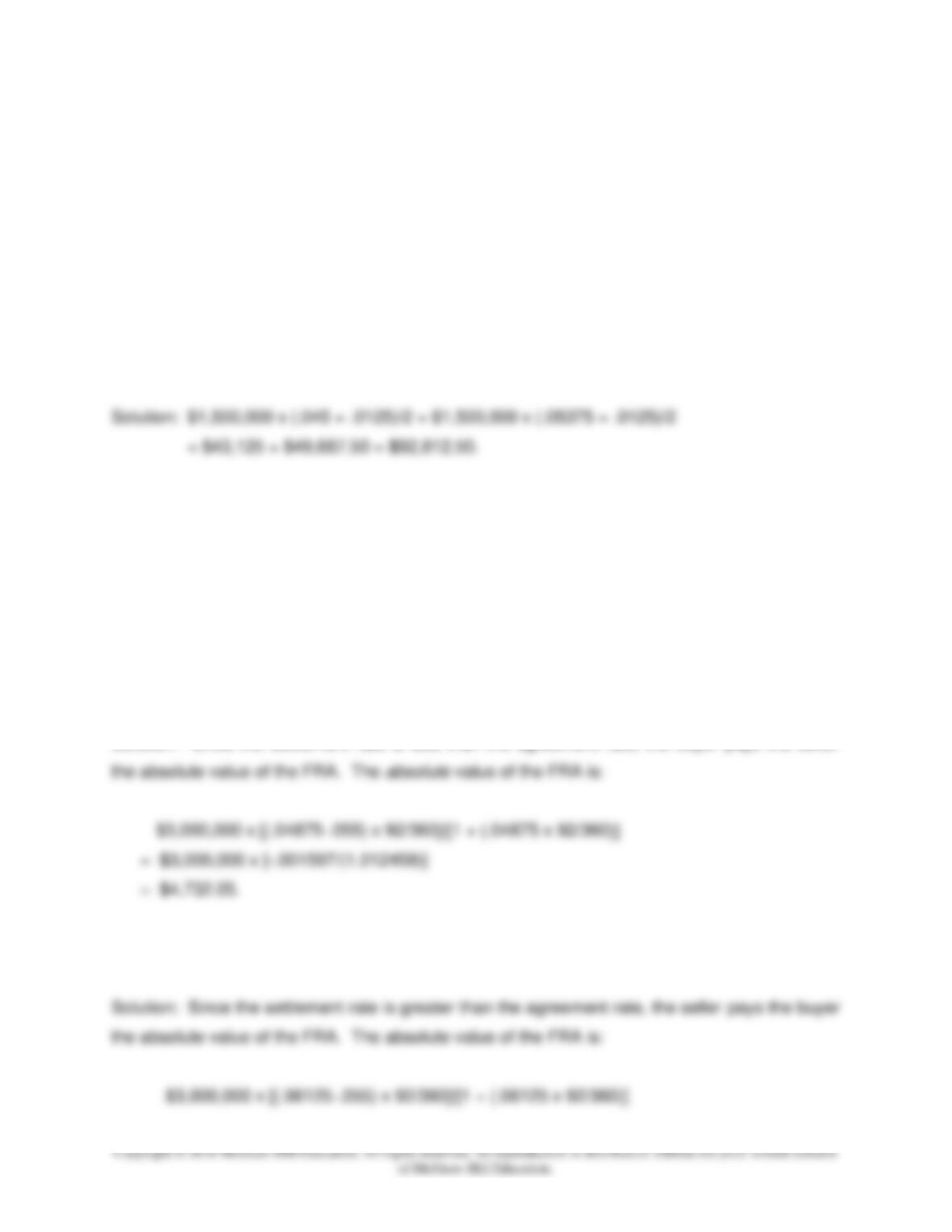
1. Grecian Tile Manufacturing of Athens, Georgia, borrows $1,500,000 at LIBOR plus a lending
margin of 1.25 percent per annum on a six-month rollover basis from a London bank. If six–
month LIBOR is 4.50 percent over the first six-month interval and 5.375 percent over the second
six-month interval, how much will Grecian Tile pay in interest over the first year of its Eurodollar
loan?
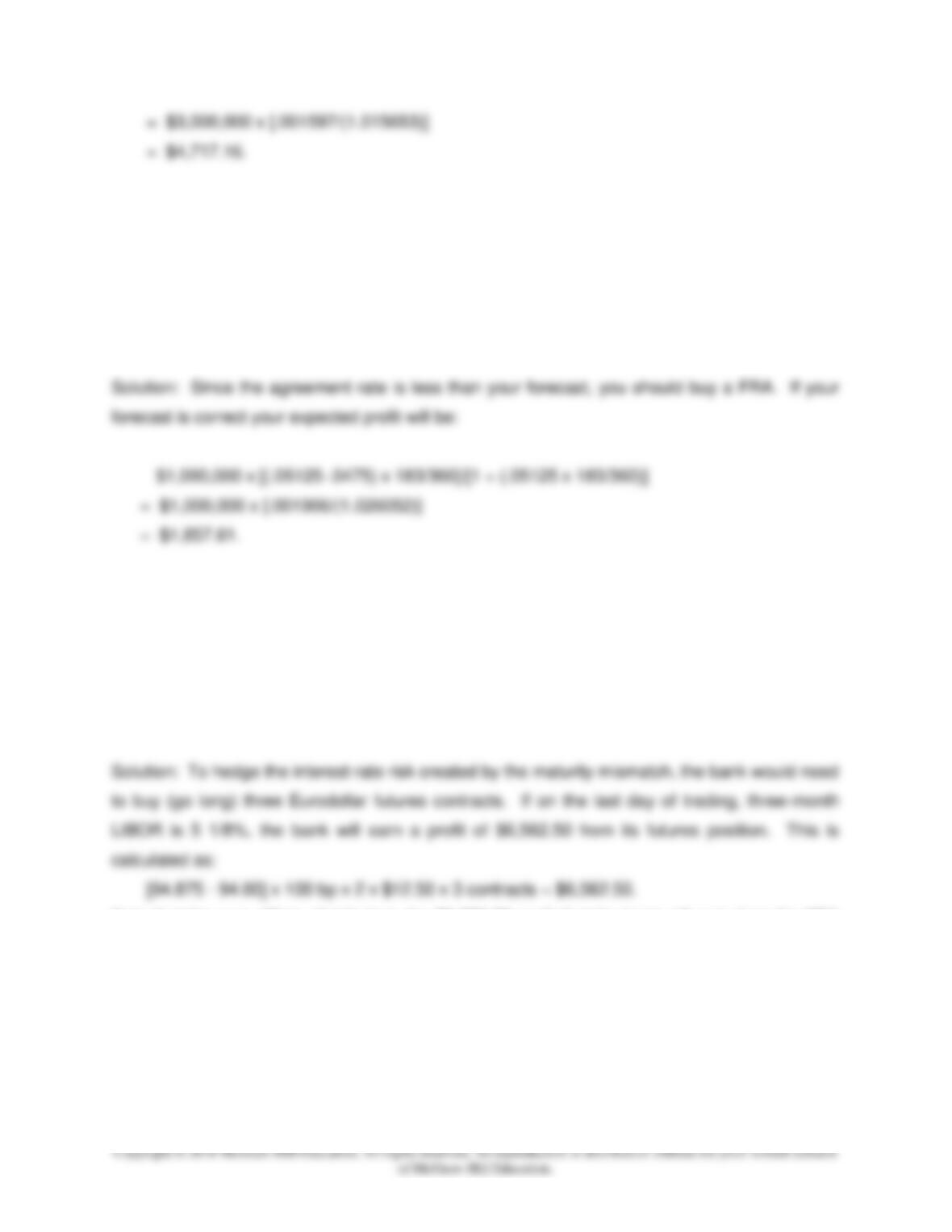
2. A bank sells a “three against six” $3,000,000 FRA for a three-month period beginning three
months from today and ending six months from today. The purpose of the FRA is to cover the
interest rate risk caused by the maturity mismatch from having made a three-month Eurodollar
loan and having accepted a six-month Eurodollar deposit. The agreement rate with the buyer is
5.50 percent. There are actually 92 days in the three-month FRA period. Assume that three
months from today the settlement rate is 4.875 percent. Determine how much the FRA is worth
and who pays who—the buyer pays the seller or the seller pays the buyer.
Solution: Since the settlement rate is less than the agreement rate, the buyer pays the seller
3. Assume the settlement rate in problem 2 is 6.125 percent. What is the solution now?
Copyright © 2018 McGraw-Hill Education. All rights reserved. No reproduction or distribution without the prior written consent
of McGraw-Hill Education.
= $3,000,000 x [.001597/(1.015653)]
= $4,717.16.
4. A “three-against–nine” FRA has an agreement rate of 4.75 percent. You believe six-month
LIBOR in three months will be 5.125 percent. You decide to take a speculative position in a
FRA with a $1,000,000 notional value. There are 183 days in the FRA period. Determine
whether you should buy or sell the FRA and what your expected profit will be if your forecast is
correct about the six-month LIBOR rate.
5. Recall the FRA problem presented as Example 11.2. Show how the bank can alternatively
use a position in Eurodollar futures contracts (Chapter 7) to hedge the interest rate risk created
by the maturity mismatch it has with the $3,000,000 six-month Eurodollar deposit and rollover
Eurocredit position indexed to three-month LIBOR. Assume that the bank can take a position in
Eurodollar futures contracts that mature in three months and have a futures price of 94.00.
Note that this sum differs slightly from the $6,550.59 profit that the bank will earn from the FRA
for two reasons. First, the Eurodollar futures contract assumes an arbitrary 90 days in a three–
month period, whereas the FRA recognizes that the actual number of days in the specific three–
month period is 91 days. Second, the Eurodollar futures contract pays off in future value terms,
or as of the end of the three-month period, whereas the FRA pays off in present value terms, or
as of the beginning of the three-month period.

6. The Fisher effect (Chapter 6) suggests that nominal interest rates differ between countries
because of differences in the respective rates of inflation. According to the Fisher effect and
your examination of the one-year Eurocurrency interest rates presented in Exhibit 11.3, order
the currencies from the eight countries from highest to lowest in terms of the size of the inflation
premium embedded in the nominal ask interest rates for May 20, 2016.
7. George Johnson is considering a possible six-month $100 million LIBOR-based, floating-rate
bank loan to fund a project at terms shown in the table below. Johnson fears a possible rise in
the LIBOR rate by December and wants to use the December Eurodollar futures contract to
hedge this risk. The contract expires December 20, 2009, has a US$ 1 million contract size,
and a discount yield of 7.3 percent.
Johnson will ignore the cash flow implications of marking to market, initial margin requirements,
and any timing mismatch between exchange-traded futures contract cash flows and the interest
payments due in March.
Loan Terms
September 20, 2009 December 20, 2009 March 20, 2010
• Borrow $100 million at • Pay interest for first three • Pay back principal
September 20 LIBOR + 200 months plus interest
basis points (bps) • Roll loan over at
• September 20 LIBOR = 7% December 20 LIBOR +
200 bps

Loan First loan payment (9%) Second payment
initiated and futures contract expires and principal
• • •
9/20/09 12/20/09 3/20/10
a. Formulate Johnson’s September 20 floating–to-fixed-rate strategy using the Eurodollar future
contracts discussed in the text above. Show that this strategy would result in a fixed-rate loan,
assuming an increase in the LIBOR rate to 7.8 percent by December 20, which remains at 7.8
percent through March 20. Show all calculations.
Johnson is considering a 12-month loan as an alternative. This approach will result in two
additional uncertain cash flows, as follows:
Loan First Second Third Fourth
initiated payment (9%) payment payment payment
and
principal
• • • • •
9/20/09 12/20/09 3/20/10 6/20/10 9/20/10
b. Describe the strip hedge that Johnson could use and explain how it hedges the 12-month
loan (specify number of contracts). No calculations are needed.
CFA Guideline Answer

Copyright © 2018 McGraw-Hill Education. All rights reserved. No reproduction or distribution without the prior written consent
of McGraw-Hill Education.
= ($1 million) x (90 / 360) x (.0001)
= $25
The number of contract, N, can be found by:
N = (BPV spot) / (BPV futures)
= ($2,500) / ($25)
= 100
OR
N = (value of spot position) / (face value of each futures contract)
= ($100 million) / ($1 million)
= 100
OR
N = (value of spot position) / (value of futures position)
= ($100,000,000) / ($981,750)
where value of futures position = $1,000,000 x [1 – (0.073 / 4)]
102 contracts
Therefore on September 20, Johnson would sell 100 (or 102) December Eurodollar futures
contracts at the 7.3 percent yield. The implied LIBOR rate in December is 7.3 percent as
indicated by the December Eurofutures discount yield of 7.3 percent. Thus a borrowing rate of
9.3 percent (7.3 percent + 200 basis points) can be locked in if the hedge is correctly
implemented.
A rise in the rate to 7.8 percent represents a 50 basis point (bp) increase over the implied
LIBOR rate. For a 50 basis point increase in LIBOR, the cash flow on the short futures position
However, the cash flow on the floating rate liability is:

Copyright © 2018 McGraw-Hill Education. All rights reserved. No reproduction or distribution without the prior written consent
of McGraw-Hill Education.
= ($2,325,000 x 4) / $100,000,000 = 0.093
This is precisely the implied borrowing rate that Johnson locked in on September 20.
Regardless of the LIBOR rate on December 20, the net cash outflow will be $2,325,000, which
translates into an annualized rate of 9.3 percent. Consequently, the floating rate liability has
been converted to a fixed rate liability in the sense that the interest rate uncertainty associated
with the March 20 payment (using the December 20 contract) has been removed as of
September 20.
b. In a strip hedge, Johnson would sell 100 December futures (for the March payment), 100
March futures (for the June payment), and 100 June futures (for the September payment). The
objective is to hedge each interest rate payment separately using the appropriate number of
contracts. The problem is the same as in Part A except here three cash flows are subject to
rising rates and a strip of futures is used to hedge this interest rate risk. This problem is
simplified somewhat because the cash flow mismatch between the futures and the loan
payment is ignored. Therefore, in order to hedge each cash flow, Johnson simply sells 100
contracts for each payment. The strip hedge transforms the floating rate loan into a strip of
8. Jacob Bower has a liability that:
• has a principal balance of $100 million on June 30, 2008,
• accrues interest quarterly starting on June 30, 2008,
• pays interest quarterly,
• has a one-year term to maturity, and
• calculates interest due based on 90-day LIBOR (the London Interbank Offered
Rate).
Bower wishes to hedge his remaining interest payments against changes in interest rates.
Bower has correctly calculated that he needs to sell (short) 300 Eurodollar futures contracts to
accomplish the hedge. He is considering the alternative hedging strategies outlined in the
following table.

Initial Position (6/30/08) in
90-Day LIBOR Eurodollar Contracts
Strategy A Strategy B
Contract Month (contracts) (contracts)
September 2008 300 100
December 2008 0 100
March 2009 0 100
a. Explain why strategy B is a more effective hedge than strategy A when the yield curve
undergoes an instantaneous nonparallel shift.
b. Discuss an interest rate scenario in which strategy A would be superior to strategy B.
CFA Guideline Answer
a. Strategy B’s Superiority
b. Scenario in Which Strategy A is Superior
Strategy A is a stack hedge strategy that initially involves selling (shorting) 300 September
contracts. Strategy A is rarely better than Strategy B as a hedging or risk–reduction strategy.
MINI CASE: DETROIT MOTORS’ LATIN AMERICAN EXPANSION
It is September 1990 and Detroit Motors of Detroit, Michigan, is considering establishing an
assembly plant in Latin America for a new utility vehicle it has just designed. The cost of the
capital expenditures has been estimated at $65,000,000. There is not much of a sales market
in Latin America, and virtually all output would be exported to the United States for sale.
Nevertheless, an assembly plant in Latin America is attractive for at least two reasons. First,
labor costs are expected to be half what Detroit Motors would have to pay in the United States
to union workers. Since the assembly plant will be a new facility for a newly designed vehicle,
Detroit Motors expects minimal resistance from its U.S. union in establishing the plant in Latin
America. Secondly, the chief financial officer (CFO) of Detroit Motors believes that a debt–for–
equity swap can be arranged with at least one of the Latin American countries that has not been
able to meet its debt service on its sovereign debt with some of the major U.S. banks.

The September 10, 1990, issue of Barron’s indicated the following prices (cents on the
dollar) on Latin American bank debt:
Brazil
21.75
Mexico
43.12
Argentina
14.25
Venezuela
46.25
Chile
70.25
The CFO is not comfortable with the level of political risk in Brazil and Argentina, and has
decided to eliminate them from consideration. After some preliminary discussions with the
central banks of Mexico, Venezuela, and Chile, the CFO has learned that all three countries
would be interested in hearing a detailed presentation about the type of facility Detroit Motors
would construct, how long it would take, the number of locals that would be employed, and the
number of units that would be manufactured per year. Since it is time-consuming to prepare
and make these presentations, the CFO would like to approach the most attractive candidate
first. He has learned that the central bank of Mexico will redeem its debt at 80 percent of face
value in a debt-for-equity swap, Venezuela at 75 percent, and Chile 100 percent. As a first step,
the CFO decides an analysis based purely on financial considerations is necessary to determine
which country looks like the most viable candidate. You are asked to assist in the analysis.
What do you advise?
Suggested Solution for Detroit Motors’ Latin American Expansion
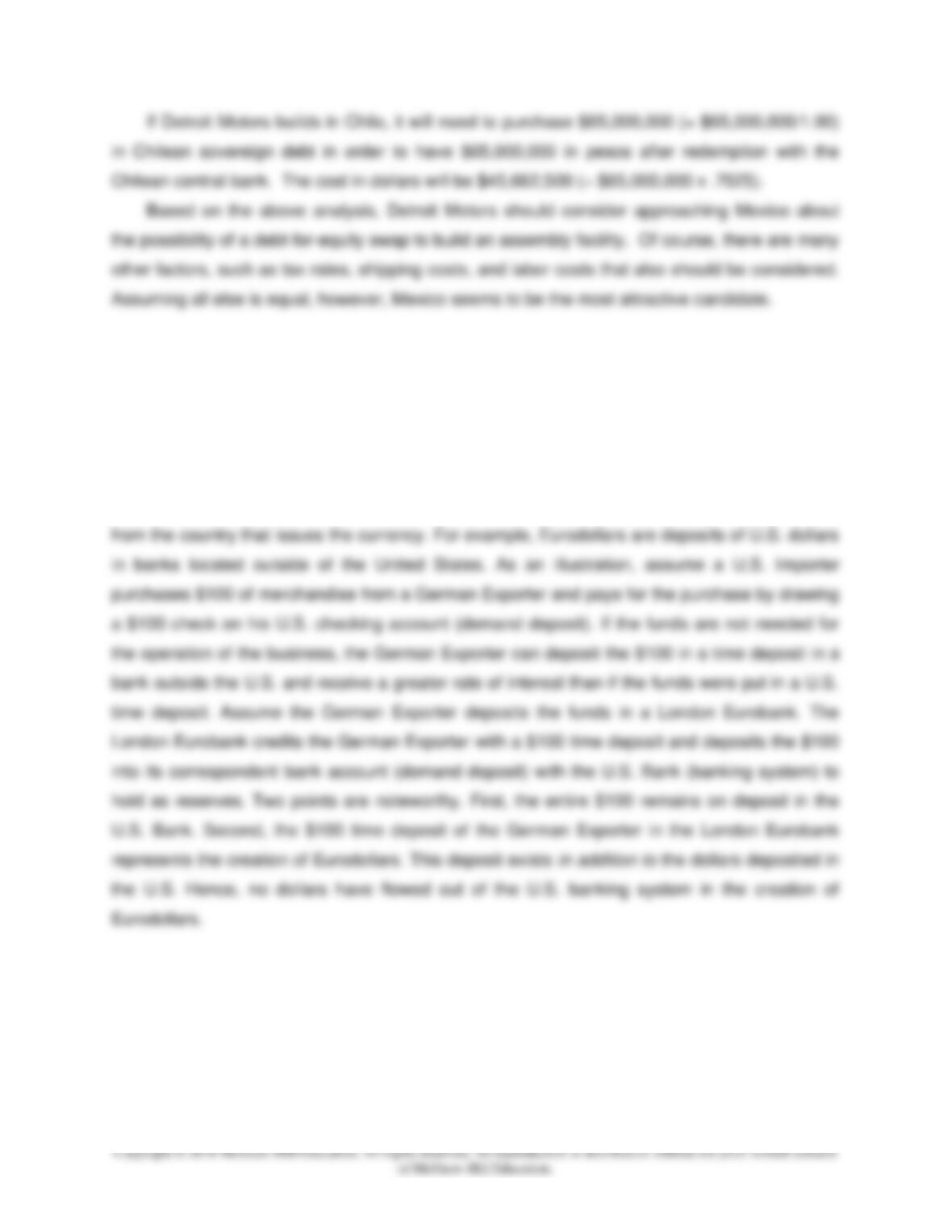
Regardless in which LDC Detroit Motors establishes the new facility, it will need
Copyright © 2018 McGraw-Hill Education. All rights reserved. No reproduction or distribution without the prior written consent
of McGraw-Hill Education.
If Detroit Motors builds in Chile, it will need to purchase $65,000,000 (= $65,000,000/1.00)
in Chilean sovereign debt in order to have $65,000,000 in pesos after redemption with the
Chilean central bank. The cost in dollars will be $45,662,500 (= $65,000,000 x .7025).
Based on the above analysis, Detroit Motors should consider approaching Mexico about
the possibility of a debt-for-equity swap to build an assembly facility. Of course, there are many
other factors, such as tax rates, shipping costs, and labor costs that also should be considered.
Assuming all else is equal, however, Mexico seems to be the most attractive candidate.
APPENDIX 11A QUESTION
1. Explain how Eurocurrency is created.
Answer: The core of the international money market is the Eurocurrency market. A
Eurocurrency is a time deposit of money in an international bank located in a country different