CHAPTER 9 –
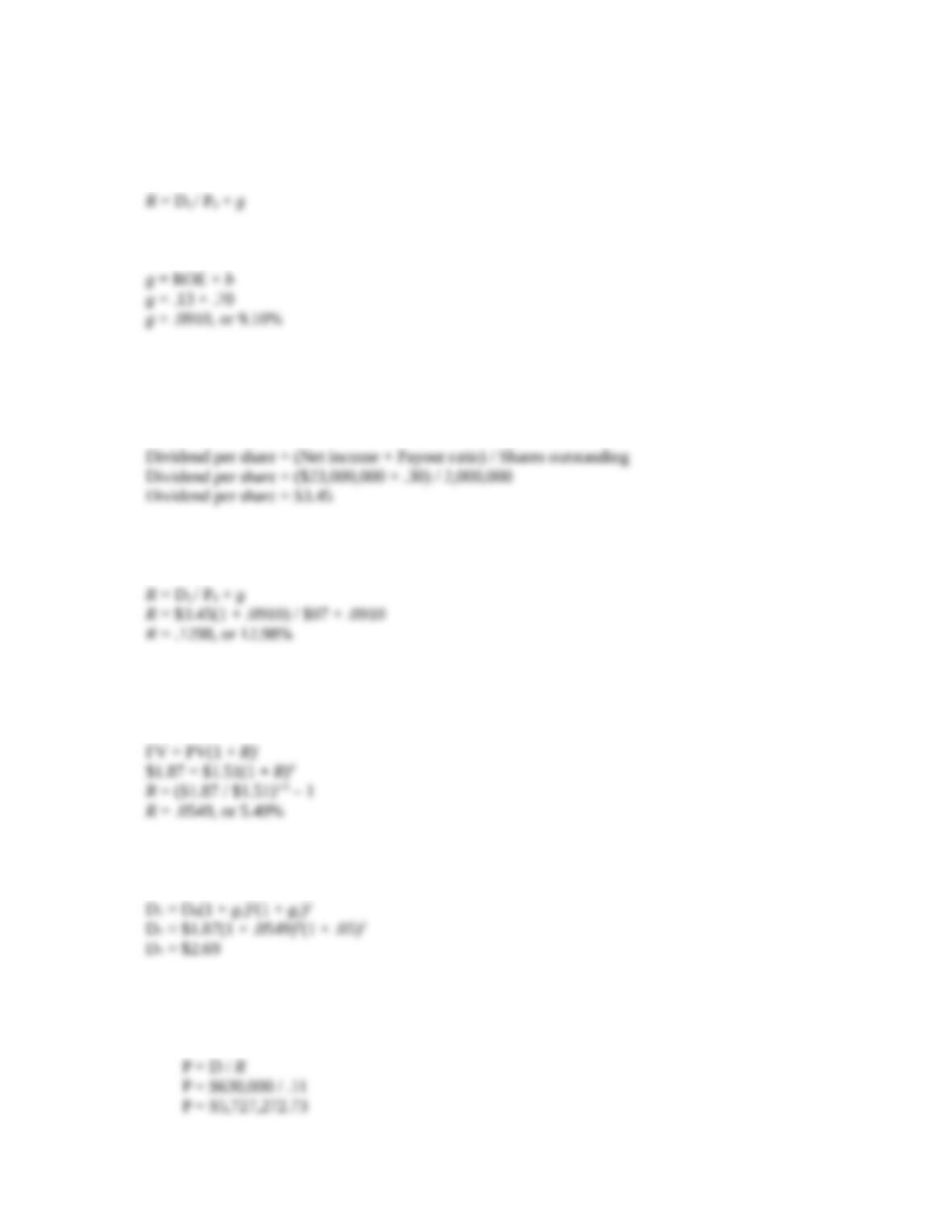
23. The required return of a stock consists of two components, the capital gains yield and the dividend
yield. In the constant dividend growth model (growing perpetuity equation), the capital gains yield is
the same as the dividend growth rate, or algebraically:
We can find the dividend growth rate by the growth rate equation, or:
This is also the growth rate in dividends. To find the current dividend, we can use the information
provided about the net income, shares outstanding, and payout ratio. The total dividends paid is the
net income times the payout ratio. To find the dividend per share, we can divide the total dividends
paid by the number of shares outstanding. So:
Now we can use the initial equation for the required return. We must remember that the equation
uses the dividend in one year, so:
24. First, we need to find the annual dividend growth rate over the past four years. To do this, we can use
the future value of a lump sum equation, and solve for the interest rate. Doing so, we find the
dividend growth rate over the past four years was:
We know the dividend will grow at this rate for five years before slowing to a constant rate
indefinitely. So, the dividend amount in seven years will be:
25. a. We can find the price of all the outstanding company stock by using the dividends the same
way we would value an individual share. Since earnings are equal to dividends, and there is no
growth, the value of the company’s stock today is the present value of a perpetuity, so:
1
CHAPTER 9 –
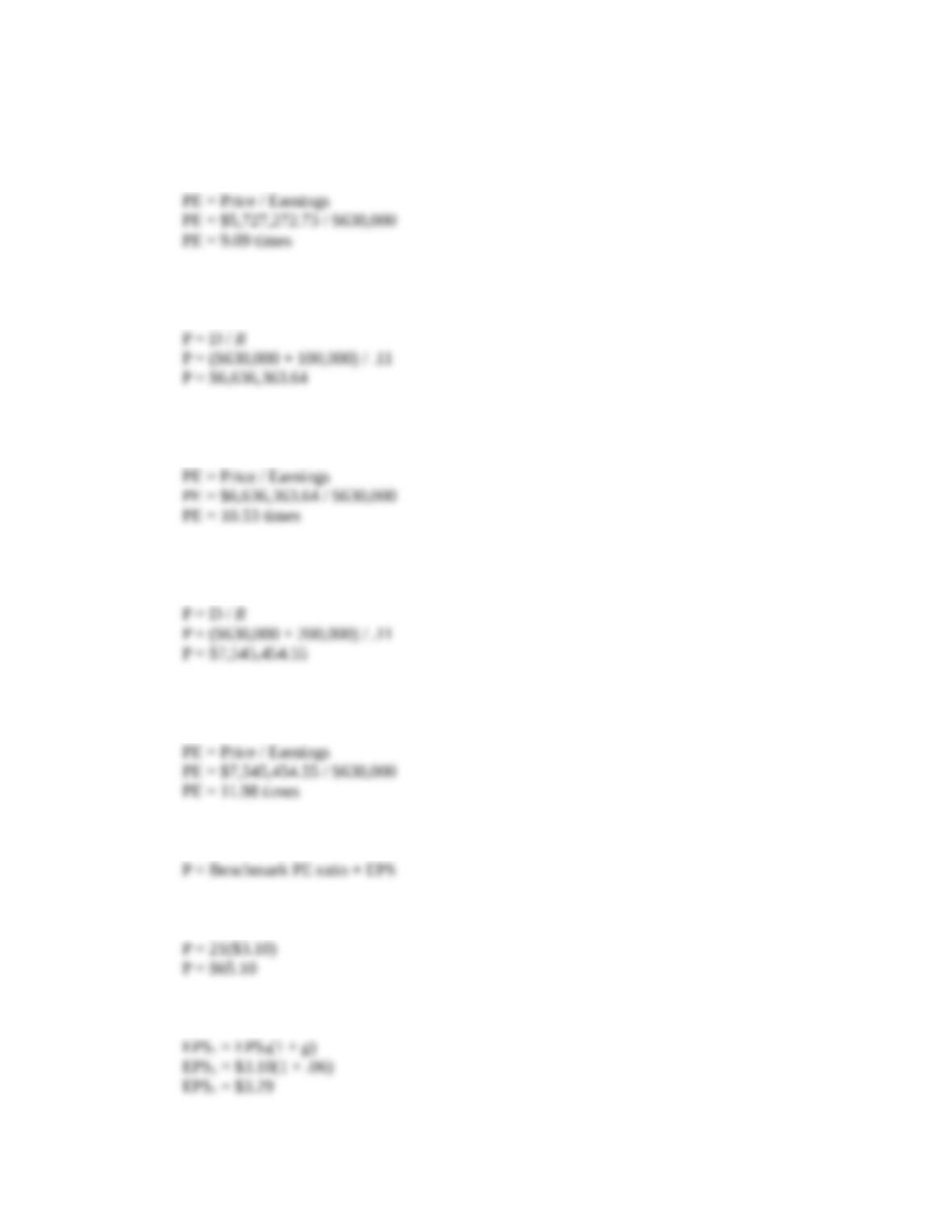
The price-earnings ratio is the stock price divided by the current earnings, so the price–earnings
ratio of each company with no growth is:
b. Since the earnings have increased, the price of the stock will increase. The new price of the
outstanding company stock is:
The price–earnings ratio is the stock price divided by the current earnings, so the price–
earnings with the increased earnings is:
c. Since the earnings have increased, the price of the stock will increase. The new price of the
outstanding company stock is:
The price–earnings ratio is the stock price divided by the current earnings, so the price–
earnings with the increased earnings is:
26. a. Using the equation to calculate the price of a share of stock with the PE ratio:
So, with a PE ratio of 21, we find:
b. First, we need to find the earnings per share next year, which will be:
2
CHAPTER 9 –
Using the equation to calculate the price of a share of stock with the PE ratio:
c. To find the implied return over the next year, we calculate the return as:
Notice that the return is the same as the growth rate in earnings. Assuming a stock pays no
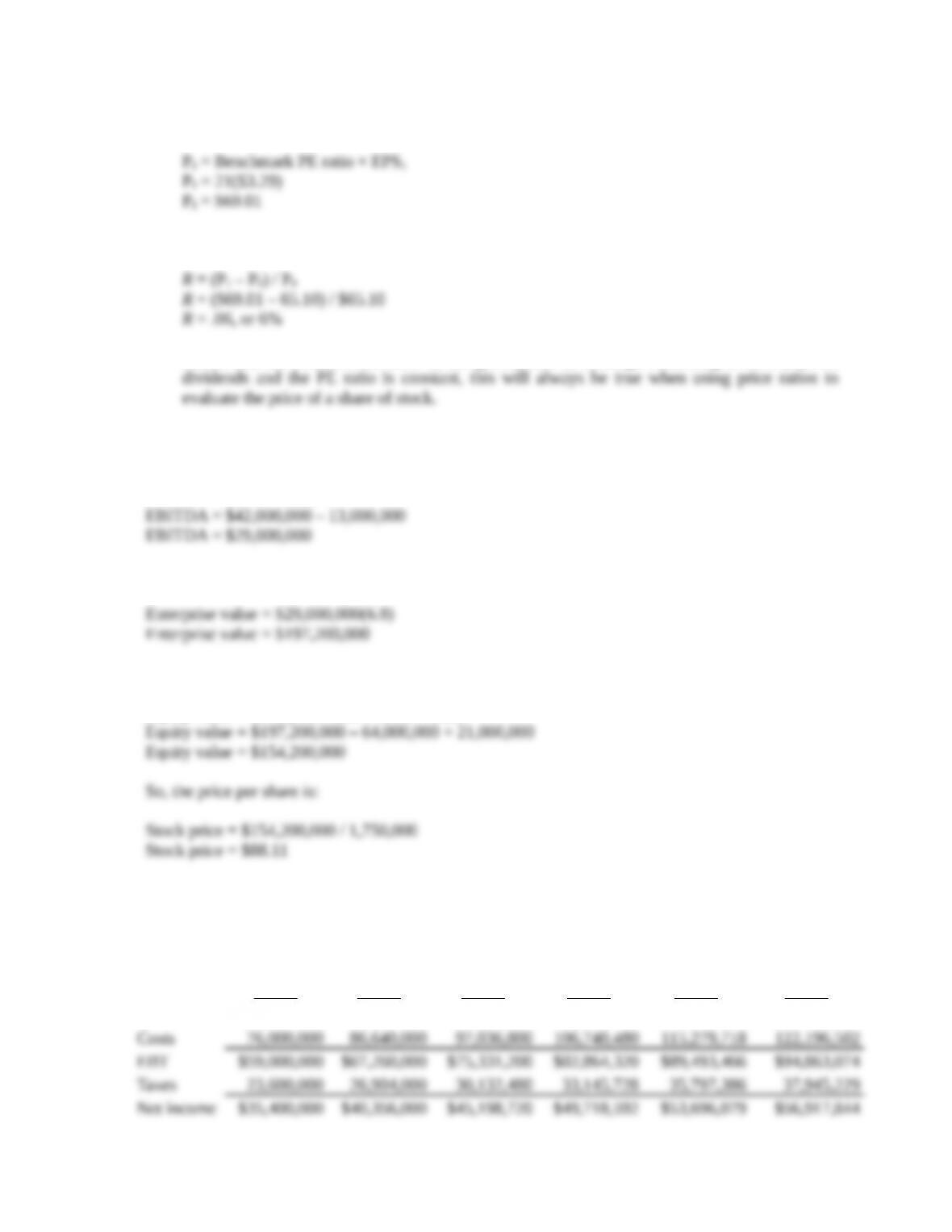
27. We need to find the enterprise value of the company. We can calculate EBITDA as sales minus costs,
so:
EBITDA = Sales – Costs
Solving the EV/EBITDA multiple for enterprise value, we find:
The total value of equity is the enterprise value minus any outstanding debt, plus cash, so:
Equity value = Enterprise value – Debt + Cash
28. a. To value the stock today, we first need to calculate the cash flows for the next 6 years. The
sales, costs, and net investment all grow by the same rate, namely 14 percent, 12 percent, 10
percent, and 8 percent, respectively, for the following 4 years, then 6 percent indefinitely. So,
the cash flows for each year will be:
Year 1 Year 2 Year 3 Year 4 Year 5 Year 6
Sales $135,000,000 $153,900,000 $172,368,000 $189,604,800 $204,773,184 $217,059,575
3
CHAPTER 9 –
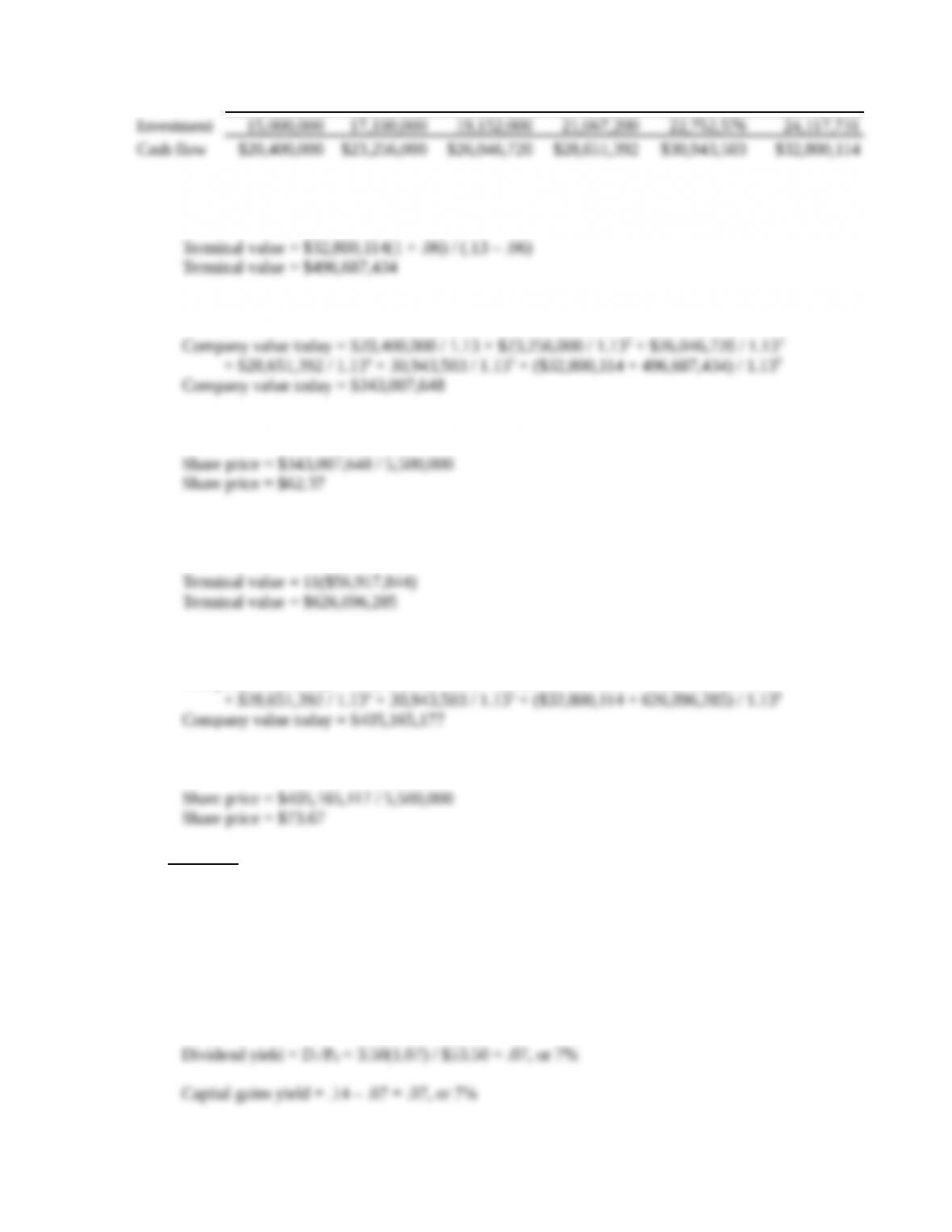
To find the terminal value of the company in Year 6, we can discount the Year 7 cash flows as a
growing perpetuity, which will be:
So, the value of the company today is:
Dividing the company value by the shares outstanding to get the share price, we get:
b. In this case, we are going to use the PE multiple to find the terminal value. All of the cash flows
from part a will remain the same. So, the terminal value in Year 6 is:
Under this assumption for the terminal value, the value of the company today is:
Company value today = $20,400,000 / 1.13 + $23,256,000 / 1.132 + $26,046,720 / 1.133
Dividing the company value by the shares outstanding to get the share price, we get:
Challenge
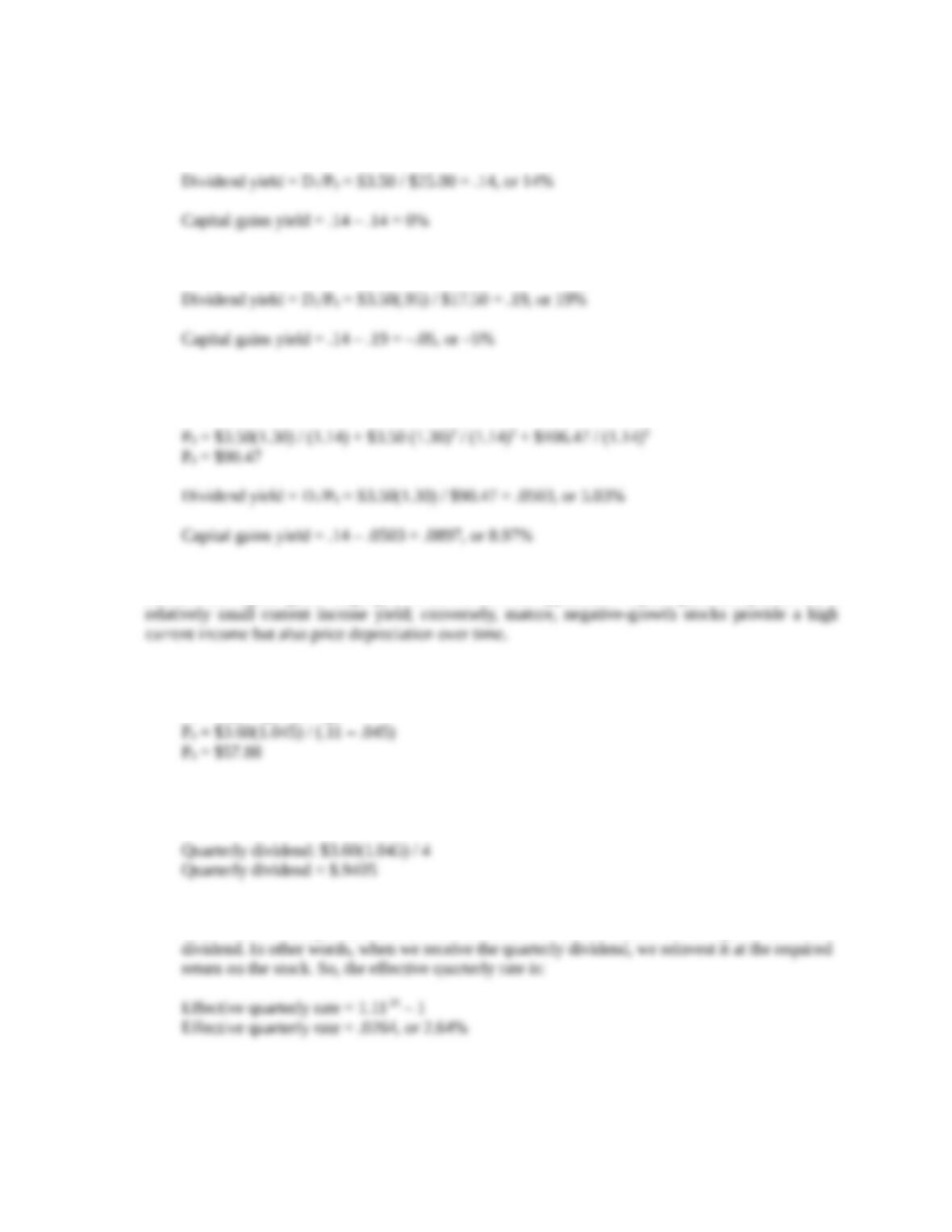
29. We are asked to find the dividend yield and capital gains yield for each of the stocks. All of the
stocks have a 14 percent required return, which is the sum of the dividend yield and the capital gains
yield. To find the components of the total return, we need to find the stock price for each stock.
Using this stock price and the dividend, we can calculate the dividend yield. The capital gains yield
for the stock will be the total return (required return) minus the dividend yield.
W: P0 = D0(1 + g) / (R – g) = $3.50(1.07) / (.14 – .07) = $53.50
4
CHAPTER 9 –
X: P0 = D0(1 + g) / (R – g) = $3.50 / (.14 – 0) = $25.00
Y: P0 = D0(1 + g) / (R – g) = $3.50(1 – .05) / (.14 + .05) = $17.50
Z: P2 = D2(1 + g) / (R – g) = D0(1 + g1)2(1 + g2) / (R – g2) = $3.50(1.30)2(1.08) / (.14 – .08)
P2 = $106.47
In all cases, the required return is 14 percent, but the return is distributed differently between current
income and capital gains. High-growth stocks have an appreciable capital gains component but a
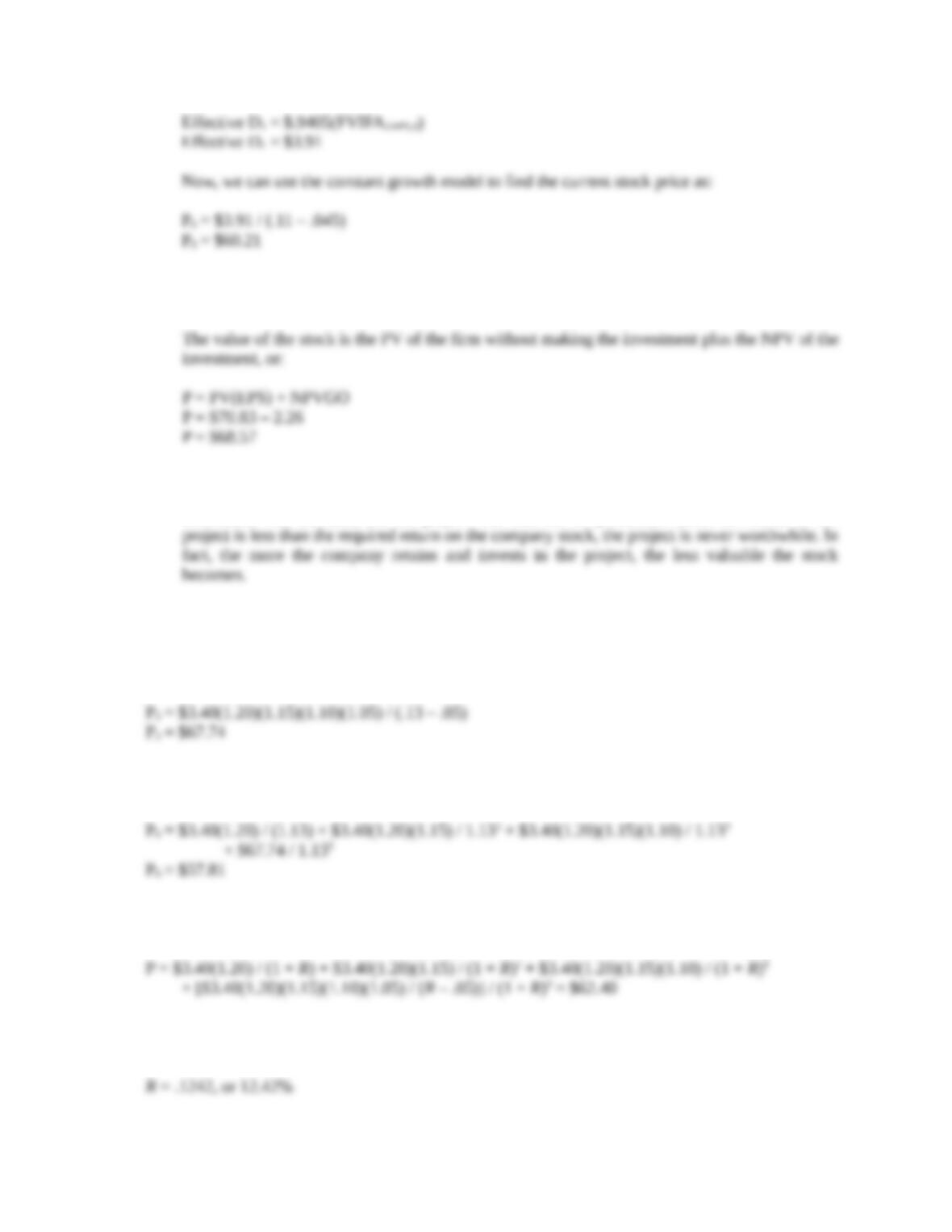
30. a. Using the constant growth model, the price of the stock paying annual dividends will be:
P0 = D0(1 + g) / (R – g)
b. If the company pays quarterly dividends instead of annual dividends, the quarterly dividend
will be one-fourth of the annual dividend, or:
To find the equivalent annual dividend, we must assume that the quarterly dividends are
reinvested at the required return. We can then use this interest rate to find the equivalent annual
The effective annual dividend will be the FVA of the quarterly dividend payments at the
effective quarterly required return. In this case, the effective annual dividend will be:
5
CHAPTER 9 –
Note that we cannot find the quarterly effective required return and growth rate to find the
value of the stock. This would assume the dividends increased each quarter, not each year.
c. Zero percent! There is no retention ratio which would make the project profitable for the
company. If the company retains more earnings, the growth rate of the earnings on the
investment will increase, but the project will still not be profitable. Since the return of the
31. Here we have a stock with differential growth, but the dividend growth changes every year for the
first four years. We can find the price of the stock in Year 3 since the dividend growth rate is constant
after the third dividend. The price of the stock in Year 3 will be the dividend in Year 4, divided by the
required return minus the constant dividend growth rate. So, the price in Year 3 will be:
The price of the stock today will be the PV of the first three dividends, plus the PV of the stock price
in Year 3, so:
32. Here we want to find the required return that makes the PV of the dividends equal to the current
stock price. The equation for the stock price is:
We need to find the roots of this equation. Using a spreadsheet, trial and error, or a calculator with a
root solving function, we find that:
6
CHAPTER 9 –
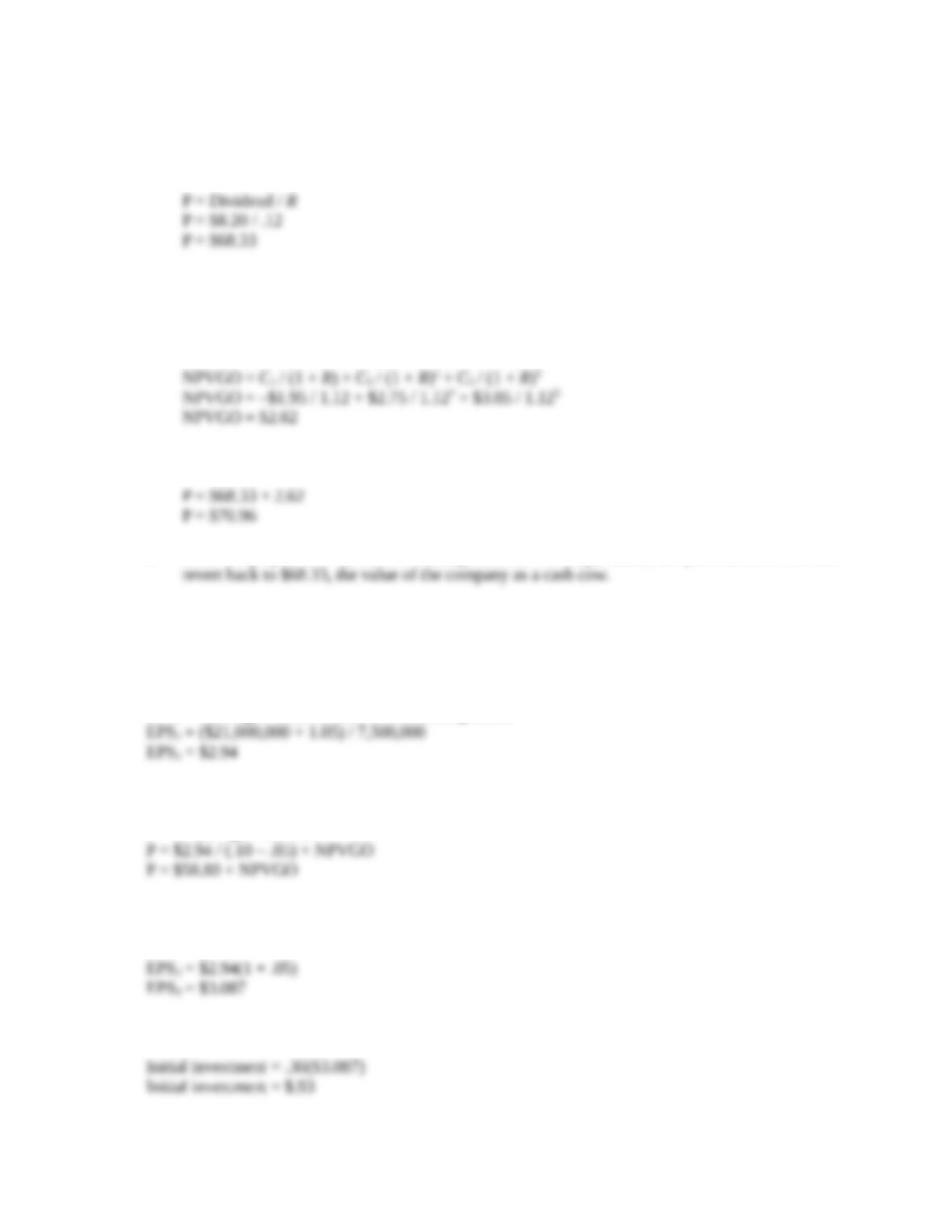
33. a. If the company does not make any new investments, the stock price will be the present value of
the constant perpetual dividends. In this case, all earnings are paid as dividends, so, applying
the perpetuity equation, we get:
b. The investment is a one-time investment that creates an increase in EPS for two years. To
calculate the new stock price, we need the cash cow price plus the NPVGO. In this case, the
NPVGO is the present value of the investment plus the present value of the increases in EPS.
So, the NPVGO will be:
So, the price of the stock if the company undertakes the investment opportunity will be:
c. After the project is over, and the earnings increase no longer exists, the price of the stock will
34. In this problem, growth is occurring from two different sources: The learning curve and the new
project. We need to separately compute the value from the two different sources. First, we will
compute the value from the learning curve, which will increase at 5 percent. All earnings are paid
out as dividends, so we find the earnings per share are:
EPS1 = Earnings / Total number of outstanding shares
From the NPVGO model:
P = E / (R – g) + NPVGO
Now we can compute the NPVGO of the new project to be launched two years from now. The
earnings per share two years from now will be:
Therefore, the initial investment in the new project will be:
7
CHAPTER 9 –
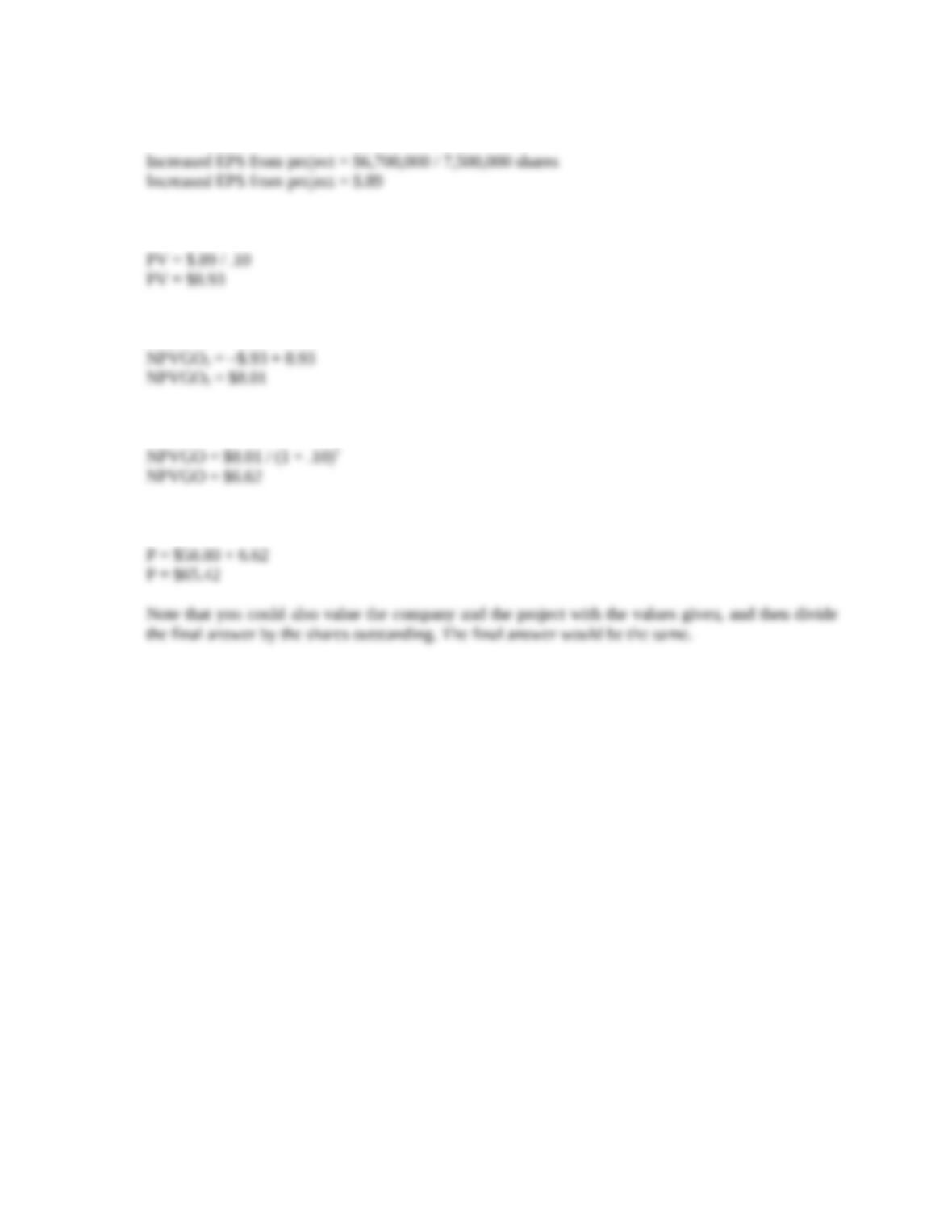
The earnings per share of the new project are a perpetuity, with an annual cash flow of:
So, the value of all future earnings in Year 2, one year before the company realizes the earnings, is:
Now, we can find the NPVGO per share of the investment opportunity in Year 2, which will be:
The value of the NPVGO today will be:
Plugging in the NPVGO model we get:
8