42. The time line is:
0 3
PV $135,000
The profit the firm earns is just the PV of the sales price minus the cost to produce the asset. We find
the PV of the sales price as the PV of a lump sum:
To find the interest rate at which the firm will break even, we need to find the interest rate using the
PV (or FV) of a lump sum. Using the PV equation for a lump sum, we get:
0 3
–$89,000 $135,000
43. The time line is:
0 1
…
5 6 …25
$7,500 $7,500 $7,500 $7,500
We want to find the value of the cash flows today, so we will find the PV of the annuity, and then
bring the lump sum PV back to today. The annuity has 20 payments, so the PV of the annuity is:
44. The time line for the annuity is:
0 1
…
180
$1,75
0
$1,75
0
$1,75
0
$1,75
0
$1,75
0
$1,75
0
$1,75
0
$1,75
0
$1,750
This question is asking for the present value of an annuity, but the interest rate changes during the
life of the annuity. We need to find the present value of the cash flows for the last eight years first.
The PV of these cash flows is:
45. The time line for the annuity is:
0 1
…
180
$1,300 $1,300 $1,300 $1,300 $1,300 $1,300 $1,300 $1,300 $1,300
FV
Here, we are trying to find the dollar amount invested today that will equal the FVA with a known
interest rate and payments. First, we need to determine how much we would have in the annuity
account. Finding the FV of the annuity, we get:
46. The time line is:
0 1
…
7
…
14 15
…
∞
PV $2,150 $2,150 $2,150 $2,150
To find the value of the perpetuity at T = 7, we first need to use the PV of a perpetuity equation.
Using this equation we find:
0 1 …7…14
Remember that the PV of a perpetuity (and annuity) equation gives the PV one period before the first
payment, so, this is the value of the perpetuity at t = 14. To find the value at t = 7, we find the PV of
this lump sum as:
47. The time line is:
0 1
…
12
–
$23,00
0
$2,242.
50
$2,242.5
0
$2,242.5
0
$2,242.5
0
$2,242.5
0
$2,242.5
0
$2,242.5
0
$2,242.5
0
$2,242.
50
To find the APR and EAR, we need to use the actual cash flows of the loan. In other words, the
interest rate quoted in the problem is only relevant to determine the total interest under the terms
given. The interest rate for the cash flows of the loan is:
48. The time line is:
0 1
… …
18 19
…
28
$6,175 $6,175 $6,175 $6,175
The cash flows in this problem are semiannual, so we need the effective semiannual rate. The
interest rate given is the APR, so the monthly interest rate is:
Monthly rate = .11 / 12 = .0092
To get the semiannual interest rate, we can use the EAR equation, but instead of using 12 months as
the exponent, we will use 6 months. The effective semiannual rate is:
Note that this is the value one period (six months) before the first payment, so it is the value at t = 9.
So, the value at the various times the question asked for uses this value 9 years from now.
PV @ t = 5: $46,261.30 / 1.05638 = $29,853.74
Note that you can also calculate this present value (as well as the remaining present values) using the
number of years. To do this, you need the EAR. The EAR is:
49. a. The time line for the ordinary annuity is:
0 1 2 3 4 5
PV $16,2
50
$16,2
50
$16,2
50
$16,2
50
$16,2
50
If the payments are in the form of an ordinary annuity, the present value will be:
The time line for the annuity due is:
0 1 2 3 4 5
PV
$16,250 $16,2
50
$16,2
50
$16,2
50
$16,2
50
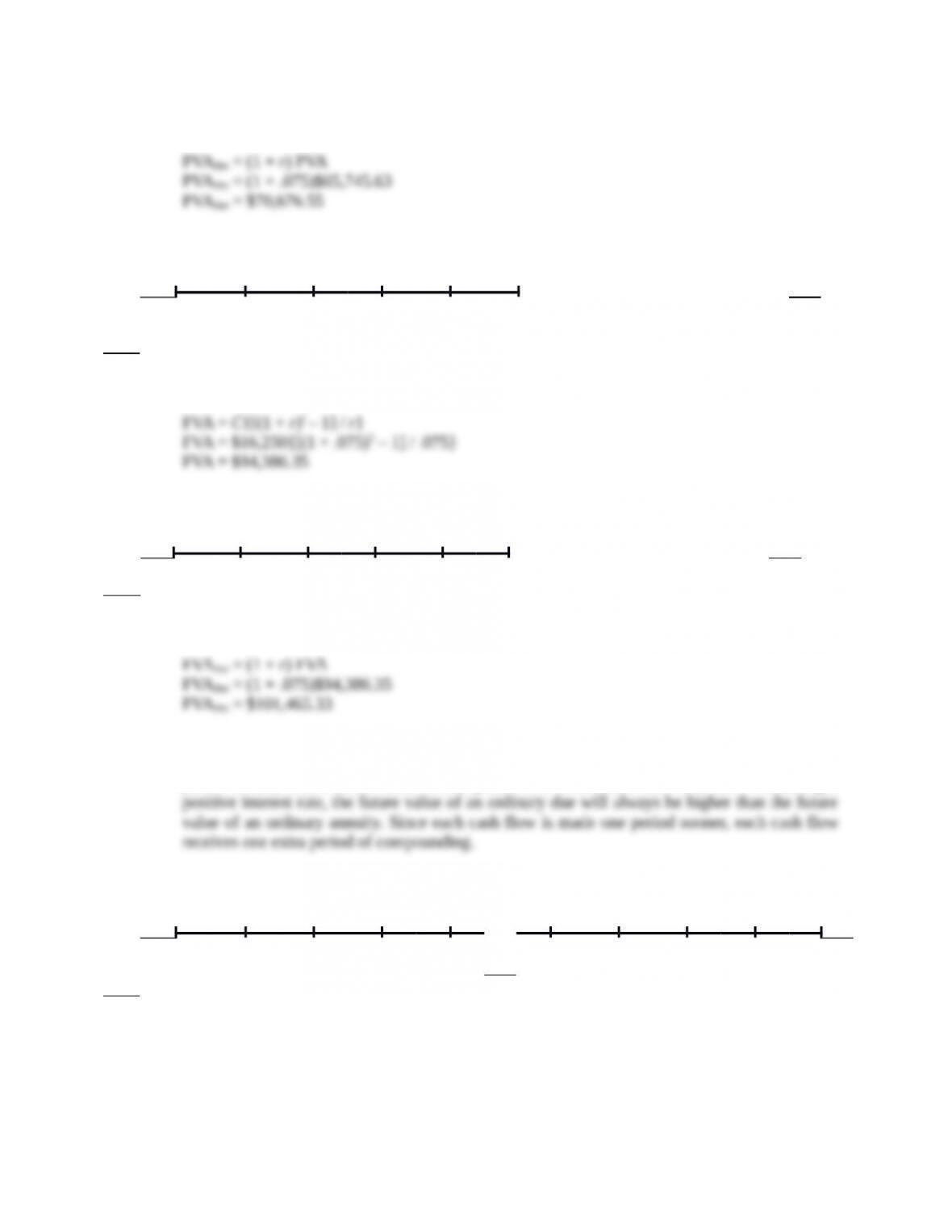
If the payments are an annuity due, the present value will be:
b. The time line for the ordinary annuity is:
0 1 2 3 4 5
FV
$16,2
50
$16,2
50
$16,2
50
$16,2
50
$16,2
50
We can find the future value of the ordinary annuity as:
The time line for the annuity due is:
0 1 2 3 4 5
$16,250 $16,2
50
$16,2
50
$16,2
50
$16,2
50
FV
If the payments are an annuity due, the future value will be:
c. Assuming a positive interest rate, the present value of an annuity due will always be larger than
the present value of an ordinary annuity. Each cash flow in an annuity due is received one
period earlier, which means there is one period less to discount each cash flow. Assuming a
50. The time line is:
0 1
…
59 60
–
$64,000
C C C C C C C C C
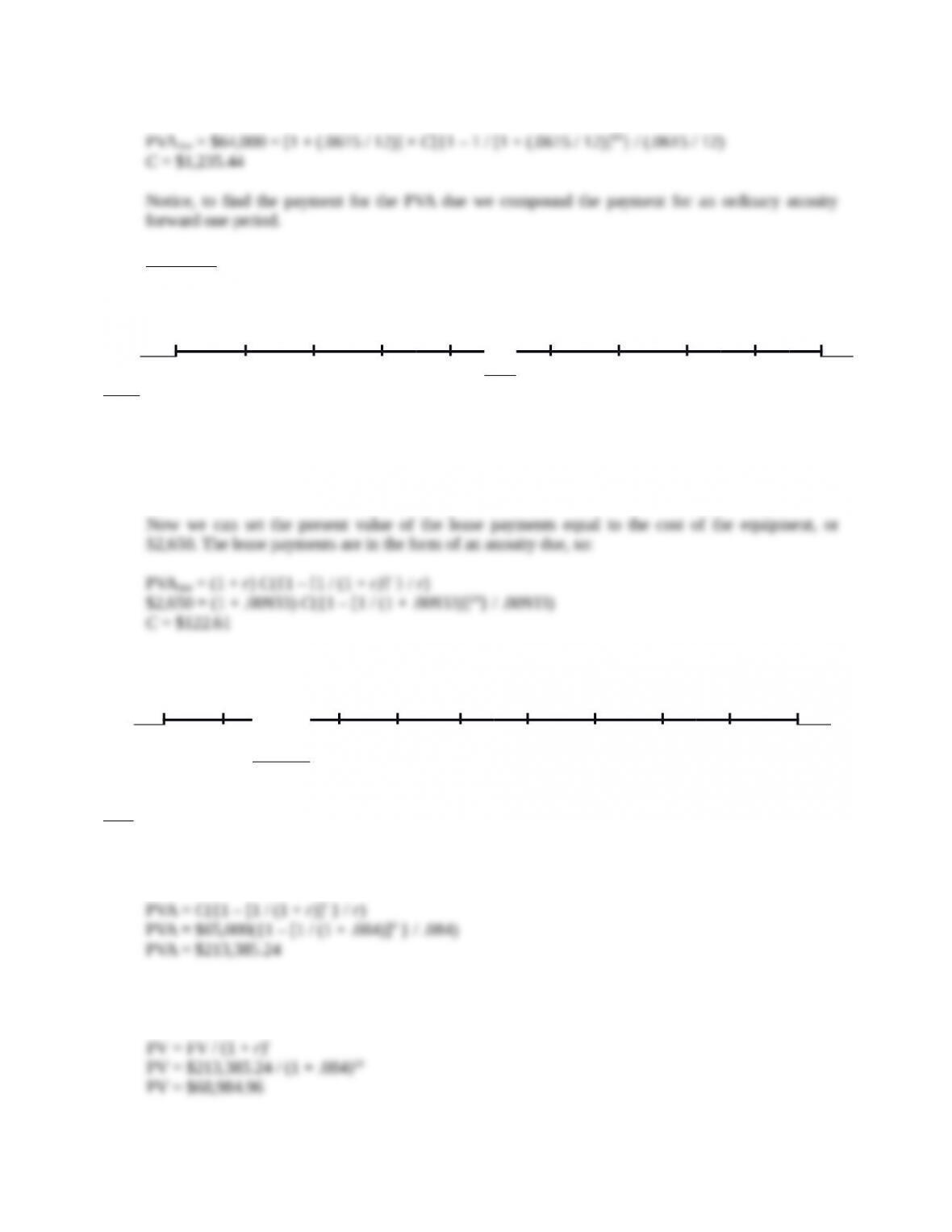
We need to use the PVA due equation, that is:
PVAdue = (1 + r)PVA
Using this equation:
Challenge
51. The time line is:
0 1
…
23 24
–$2,650
C C C C C C C C C
The monthly interest rate is the annual interest rate divided by 12, or:
Monthly interest rate = .112 / 12
Monthly interest rate = .00933
52. The time line is:
0 1
…
15 16 17 18 19 20
$65,0
00
$65,0
00
$65,0
00
$65,0
00
$65,0
00
$65,0
00
$65,0
00
$65,000
C C C C
First, we will calculate the present value of the college expenses for each child. The expenses are an
annuity, so the present value of the college expenses is:
This is the cost of each child’s college expenses one year before they enter college. So, the cost of
the oldest child’s college expenses today will be:
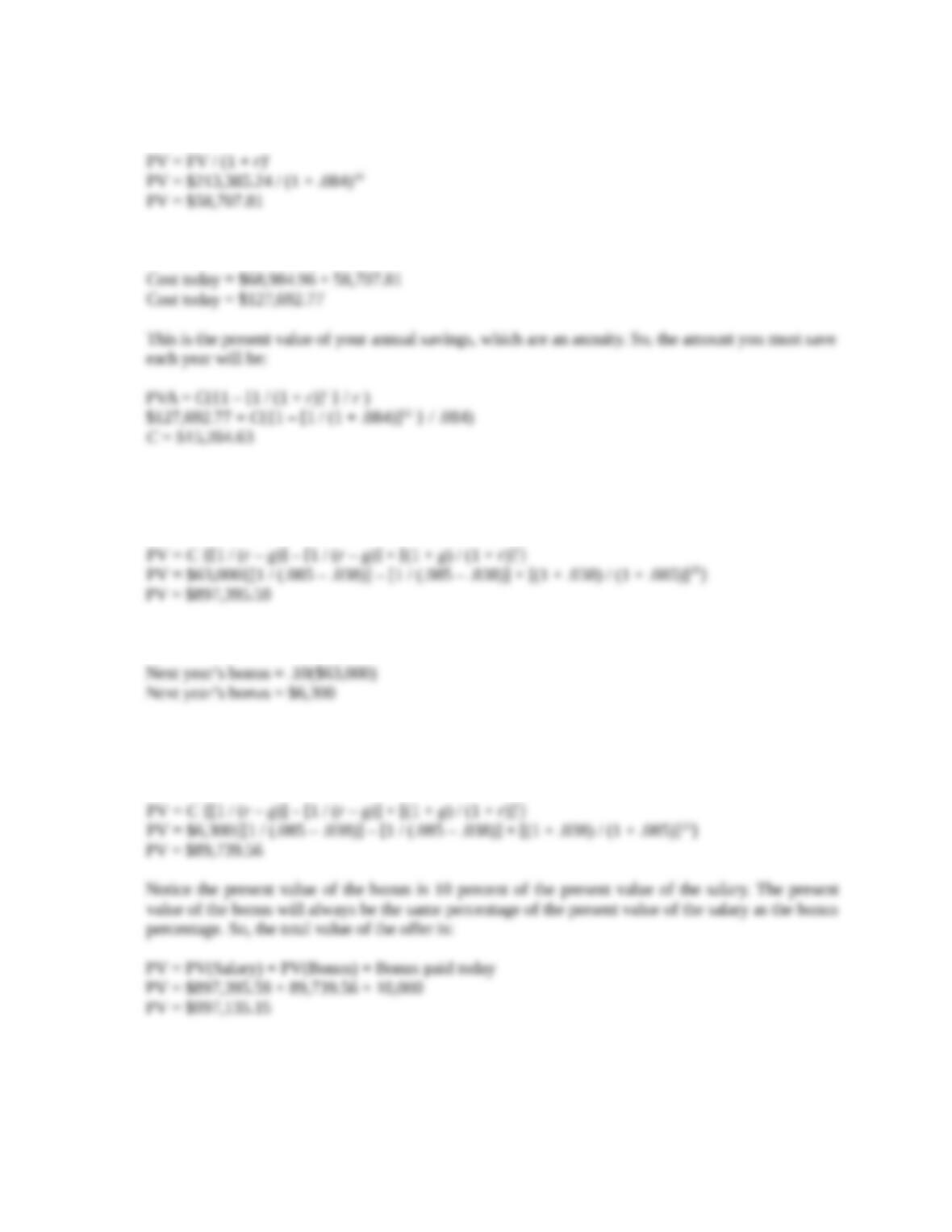
And the cost of the youngest child’s college expenses today will be:
Therefore, the total cost today of your children’s college expenses is:
53. The salary is a growing annuity, so we use the equation for the present value of a growing annuity.
The salary growth rate is 3.8 percent and the discount rate is 8.5 percent, so the value of the salary
offer today is:
The yearly bonuses are 10 percent of the annual salary. This means that next year’s bonus will be:
Since the salary grows at 3.8 percent, the bonus will grow at 3.8 percent as well. Using the growing
annuity equation, with a 3.8 percent growth rate and an 8.5 percent discount rate, the present value
of the annual bonuses is:
54. Here, we need to compare two options. In order to do so, we must get the value of the two cash flow
streams to the same time, so we will find the value of each today. We must also make sure to use the
aftertax cash flows, since it is more relevant. For Option A, the aftertax cash flows are:
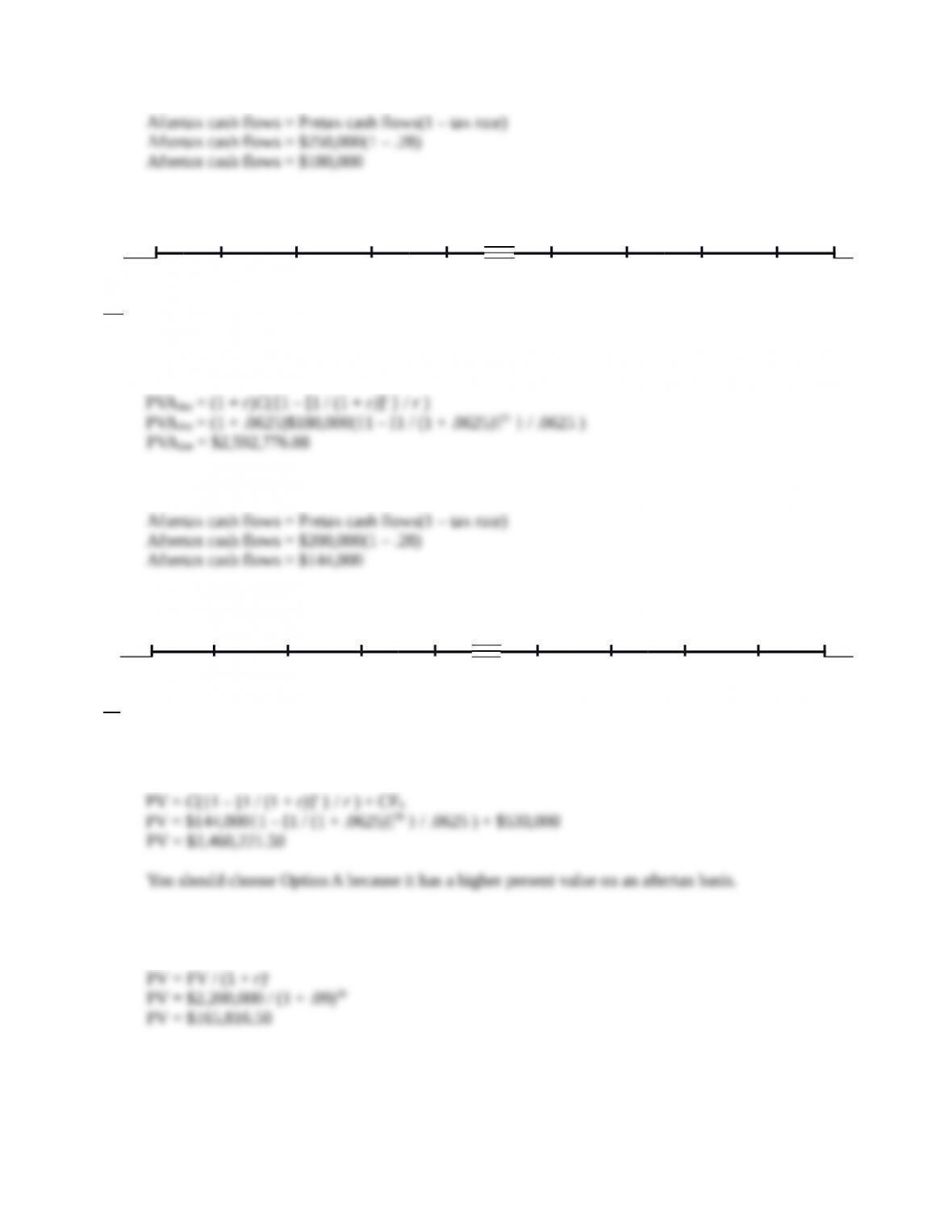
So, the cash flows are:
0 1 …30 31
PV
$180,0
00
$180,0
00
$180,0
00
$180,0
00
$180,0
00
$180,0
00
$180,0
00
$180,0
00
$180,0
00
The aftertax cash flows from Option A are in the form of an annuity due, so the present value of the
cash flow today is:
For Option B, the aftertax cash flows are:
The cash flows are:
0 1 …29 30
PV
$530,0
00
$144,0
00
$144,0
00
$144,0
00
$144,0
00
$144,0
00
$144,0
00
$144,0
00
$144,0
00
$144,0
00
The aftertax cash flows from Option B are an ordinary annuity, plus the cash flow today, so the
present value is:
55. We need to find the first payment into the retirement account. The present value of the desired
amount at retirement is:
This is the value today. Since the savings are in the form of a growing annuity, we can use the
growing annuity equation and solve for the payment. Doing so, we get:
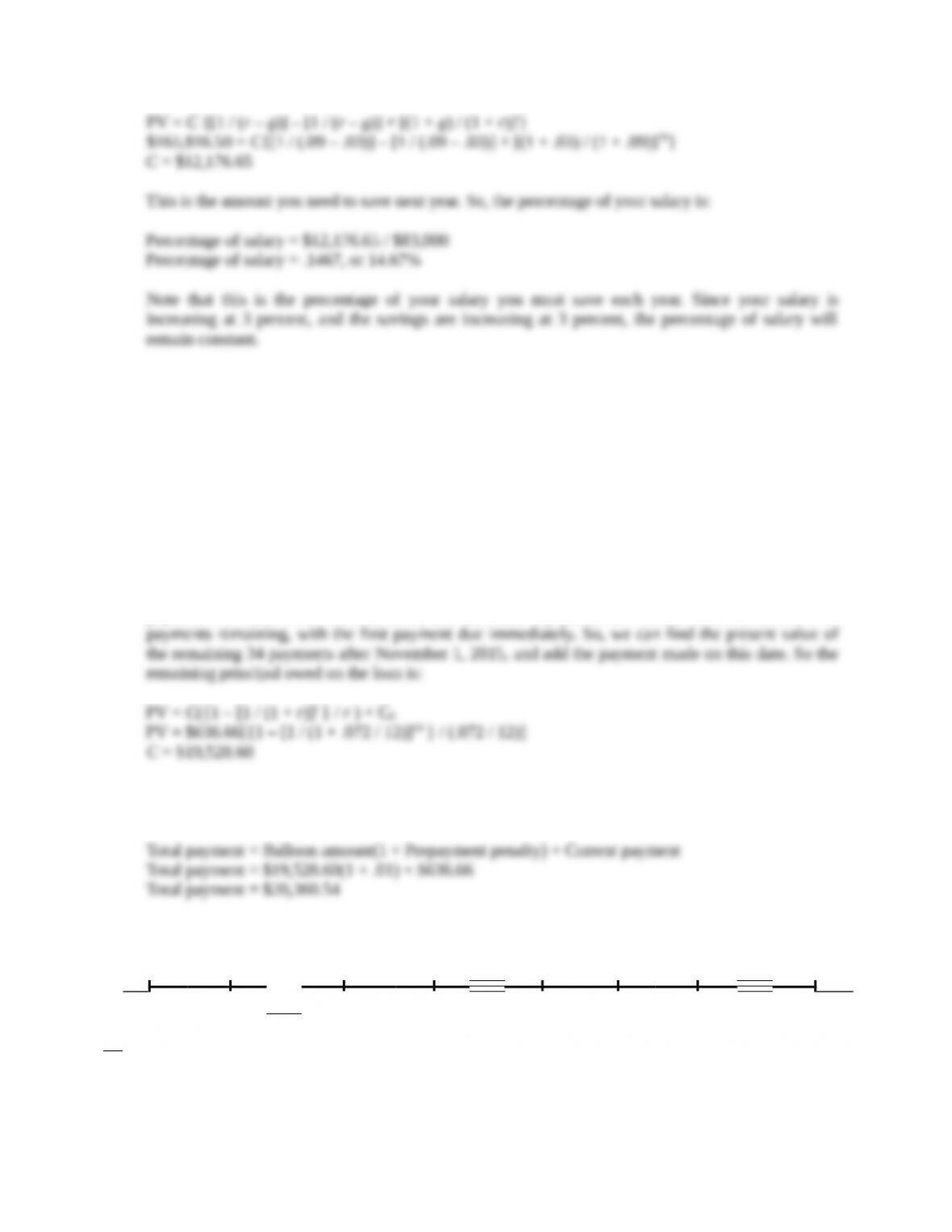
56. Since she put $2,000 down, the amount borrowed will be:
Amount borrowed = $34,000 – 2,000
Amount borrowed = $32,000
So, the monthly payments will be:
PVA = C({1 – [1 / (1 + r)]t } / r )
$32,000 = C[{1 – [1 / (1 + .072 / 12)]60 } / (.072 / 12)]
C = $636.66
The amount remaining on the loan is the present value of the remaining payments. Since the first
payment was made on October 1, 2013, and she made a payment on October 1, 2015, there are 35
She must also pay a one percent prepayment penalty and the payment due on November 1, 2015, so
the total amount of the payment is:
57. The time line is:
0 1
…
120 …360 361 …600
–$2,100 –$2,100 $20,000 $20,000
$350,000 C C C $1,500,00
0
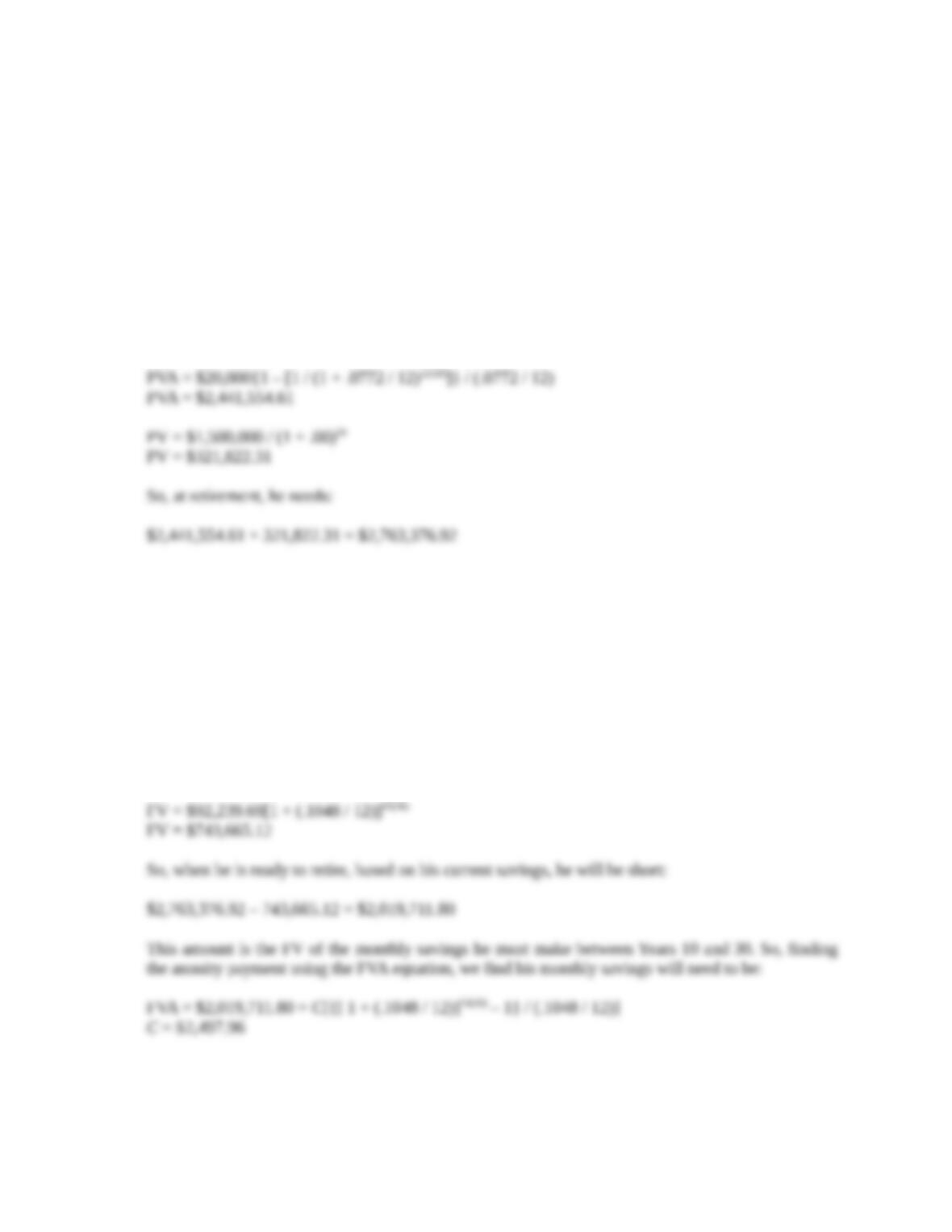
The cash flows for this problem occur monthly, and the interest rate given is the EAR. Since the cash
flows occur monthly, we must get the effective monthly rate. One way to do this is to find the APR
based on monthly compounding, and then divide by 12. So, the pre-retirement APR is:
EAR = .11 = [1 + (APR / 12)]12 – 1;APR = 12[(1.11)1/12 – 1] = 10.48%
And the post-retirement APR is:
EAR = .08 = [1 + (APR / 12)]12 – 1; APR = 12[(1.08)1/12 – 1] = 7.72%
First, we will calculate how much he needs at retirement. The amount needed at retirement is the PV
of the monthly spending plus the PV of the inheritance. The PV of these two cash flows is:
He will be saving $2,100 per month for the next 10 years until he purchases the cabin. The value of
his savings after 10 years will be:
FVA = $2,100[{[ 1 + (.1048 / 12)]12(10) – 1} / (.1048 / 12)]
FVA = $442,239.69
After he purchases the cabin, the amount he will have left is:
$442,239.69 – 350,000 = $92,239.69
He still has 20 years until retirement. When he is ready to retire, this amount will have grown to: