CHAPTER 29 –
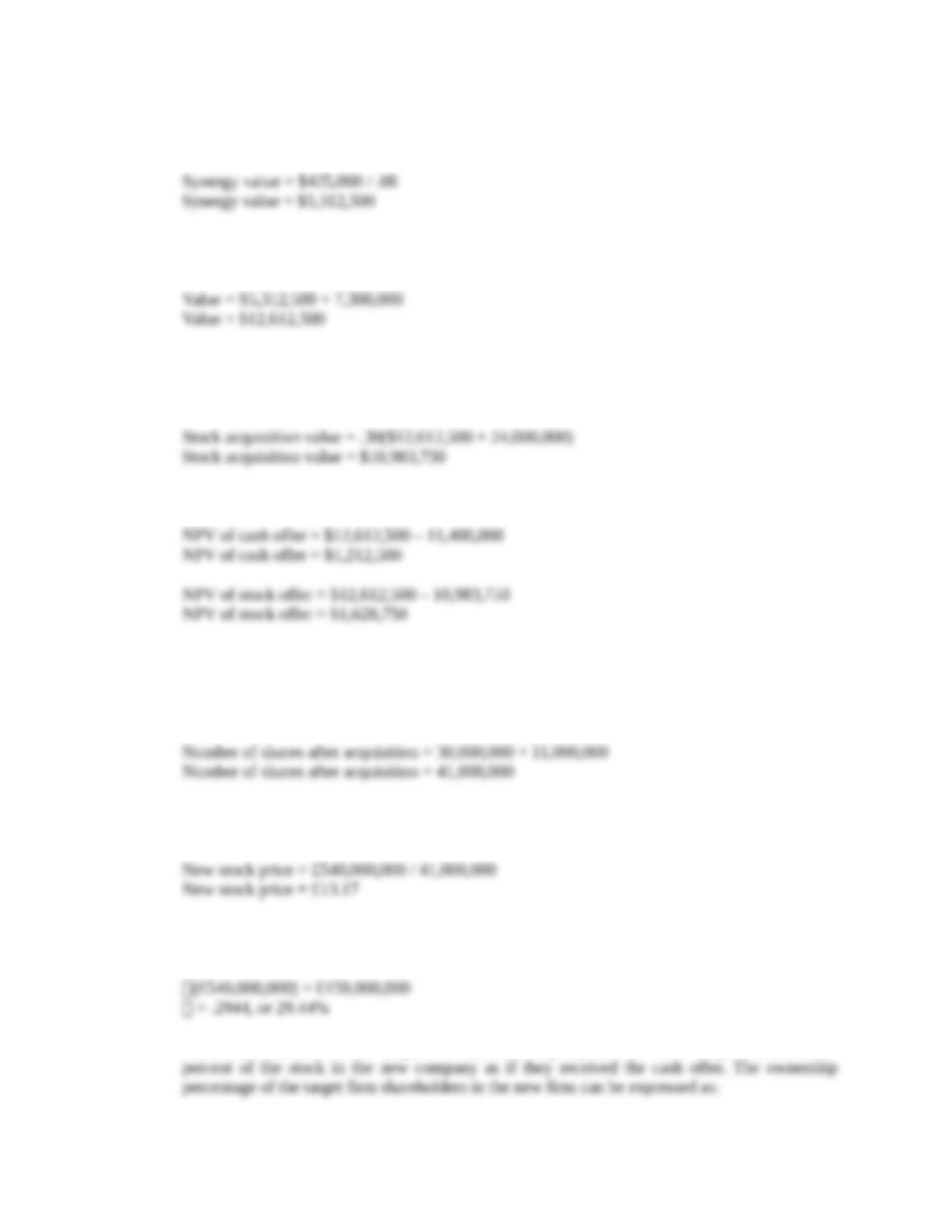
12. a. The synergy will be the present value of the incremental cash flows of the proposed purchase.
Since the cash flows are perpetual, the synergy value is:
b. The value of Flash-in-the-Pan to Fly-by-Night is the synergy plus the current market value of
Flash-in-the-Pan, which is:
c. The value of the cash option is the amount of cash paid, or $11.4 million. The value of the stock
acquisition is the percentage of ownership in the merged company, times the value of the
merged company, so:
d. The NPV is the value of the acquisition minus the cost, so the NPV of each alternative is:
e. The acquirer should make the stock offer since its NPV is greater.
13. a. The number of shares after the acquisition will be the current number of shares outstanding for
the acquiring firm, plus the number of new shares created for the acquisition, which is:
And the share price will be the value of the combined company divided by the shares
outstanding, which will be:
b. Let
a
equal the fraction of ownership for the target shareholders in the new firm. We can set the
percentage of ownership in the new firm equal to the value of the cash offer, so:
So, the shareholders of the target firm would be equally as well off if they received 29.44
1
CHAPTER 29 –
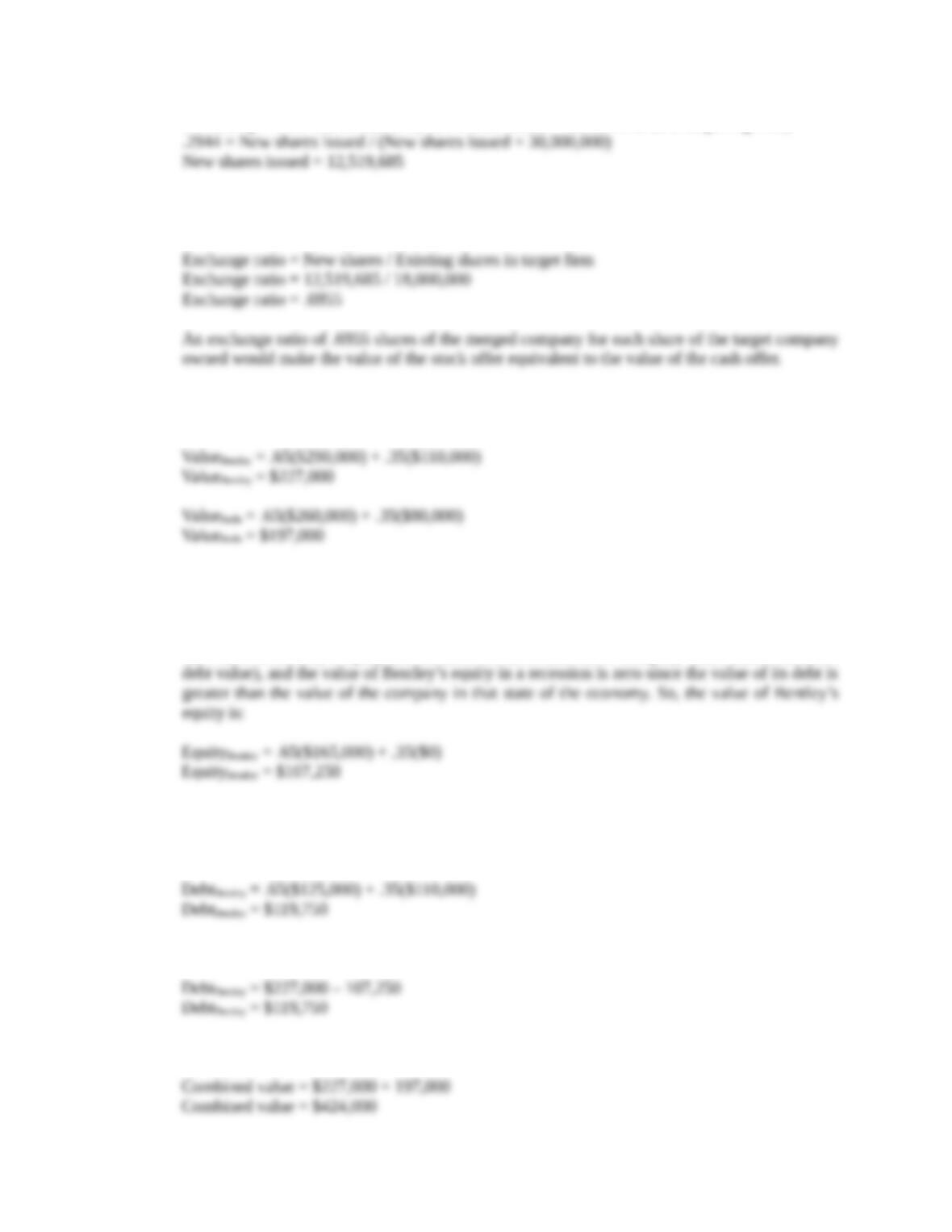
Ownership = New shares issued / (New shares issued + Current shares of acquiring firm)
To find the exchange ratio, we divide the new shares issued to the shareholders of the target
firm by the existing number of shares in the target firm, so:
14. a. The value of each company is the sum of the probability of each state of the economy times the
value of the company in that state of the economy, so:
b. The value of each company’s equity is sum of the probability of each state of the economy
times the value of the equity in that state of the economy. The value of equity in each state of
the economy is the maximum of total company value minus the value of debt, or zero. Since
Rolls is an all equity company, the value of its equity is the total value of the firm, or $197,000.
The value of Bentley’s equity in a boom is $165,000 ($290,000 company value minus $125,000
The value of Bentley’s debt in a boom is the full face value of $125,000. In a recession, the
value of the company’s debt is $110,000 since the value of the debt cannot exceed the value of
the company. So, the value of Bentley’s debt today is:
Note, this is also the value of the company minus the value of the equity, or:
c. The combined value of the companies, the combined equity value, and combined debt value is:
2
CHAPTER 29 –
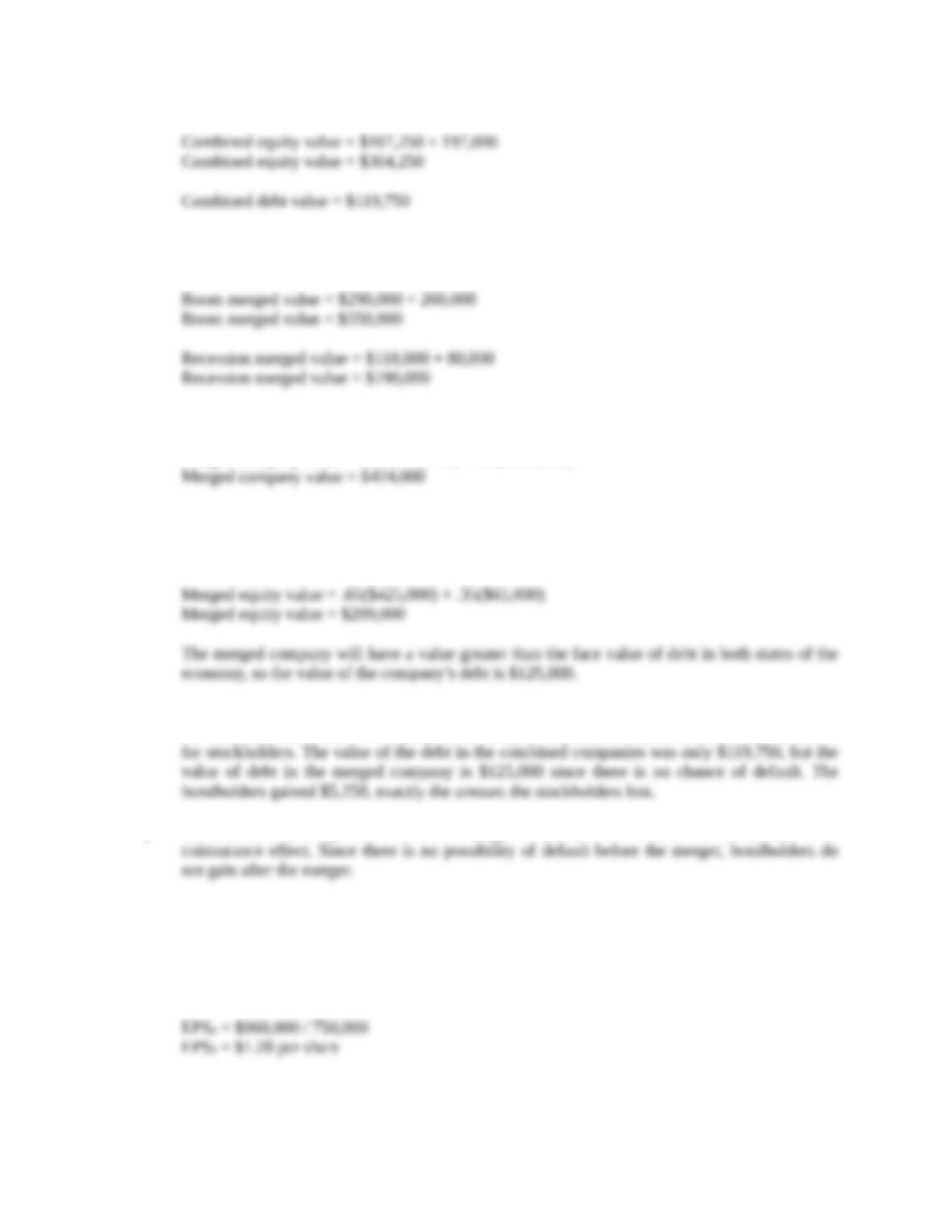
d. To find the value of the merged company, we need to find the value of the merged company in
each state of the economy, which is:
So, the value of the merged company today is:
Merged company value = .65($550,000) + .35($190,000)
Since the merged company will still have $125,000 in debt, the value of the equity in a boom is
$425,000, and the value of equity in a recession is $65,000. So, the value of the merged
company’s equity is:
e. There is a wealth transfer in this case. The combined equity value before the merger was
$304,250, but the value of the equity in the merged company is only $299,000, a loss of $5,250
f. If the value of Bentley’s debt before the merger is less than the lowest firm value, there is no
Challenge
15. a. To find the value of the target to the acquirer, we need to find the share price with the new
growth rate. We begin by finding the required return for shareholders of the target firm. The
earnings per share of the target are:
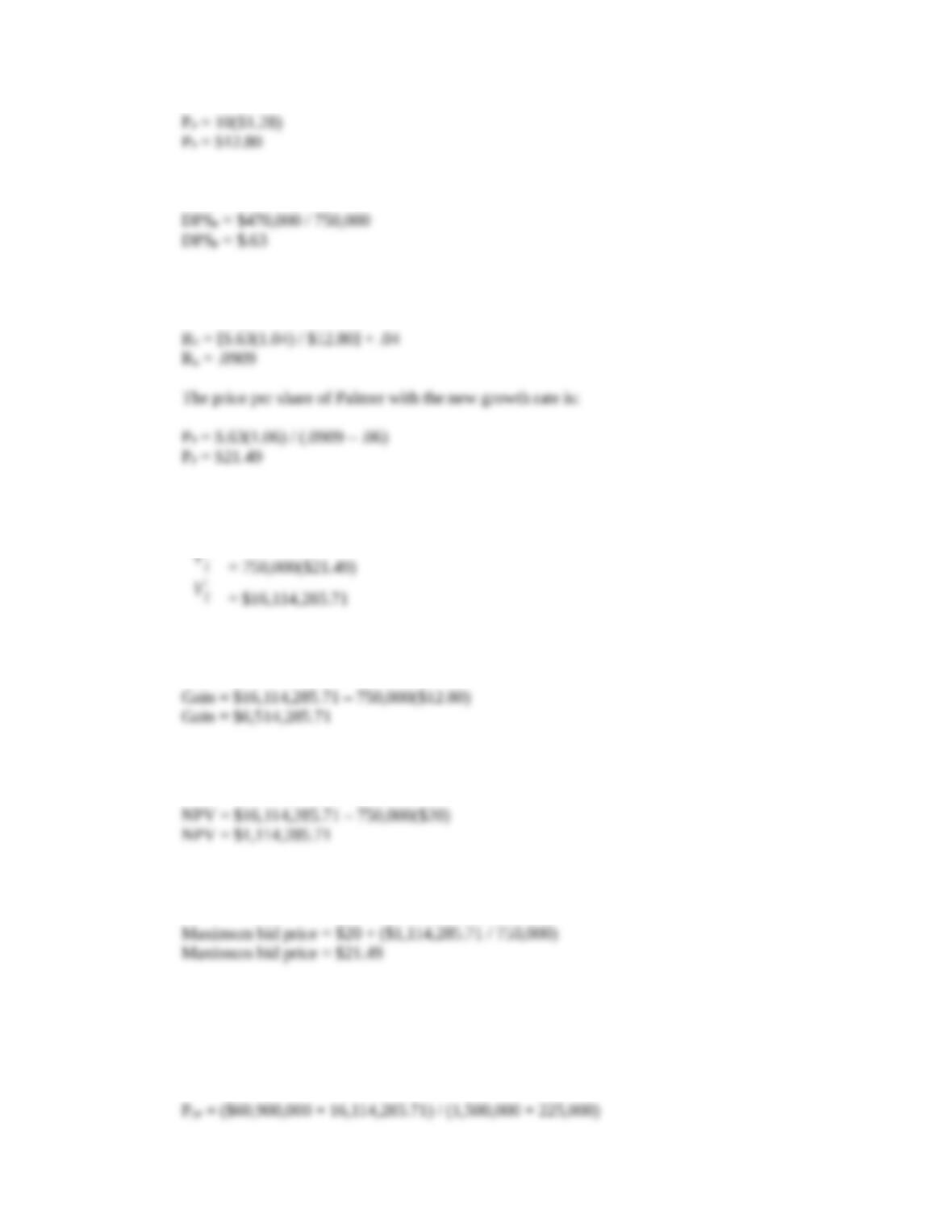
The price per share is:
3
CHAPTER 29 –
And the dividends per share are:
The current required return for Palmer shareholders, which incorporates the risk of the
company, is:
The value of the target firm to the acquiring firm is the number of shares outstanding times the
price per share under the new growth rate assumptions, so:
VT
¿
VT
¿
b. The gain to the acquiring firm will be the value of the target firm to the acquiring firm minus
the market value of the target, so:
c. The NPV of the acquisition is the value of the target firm to the acquiring firm minus the cost of
the acquisition, so:
d. The most the acquiring firm should be willing to pay per share is the offer price per share plus
the NPV per share, so:
Notice that this is the same value we calculated earlier in part a as the value of the target to the
acquirer.
e. The price of the stock in the merged firm would be the market value of the acquiring firm plus
the value of the target to the acquirer, divided by the number of shares in the merged firm, so:
4
CHAPTER 29 –
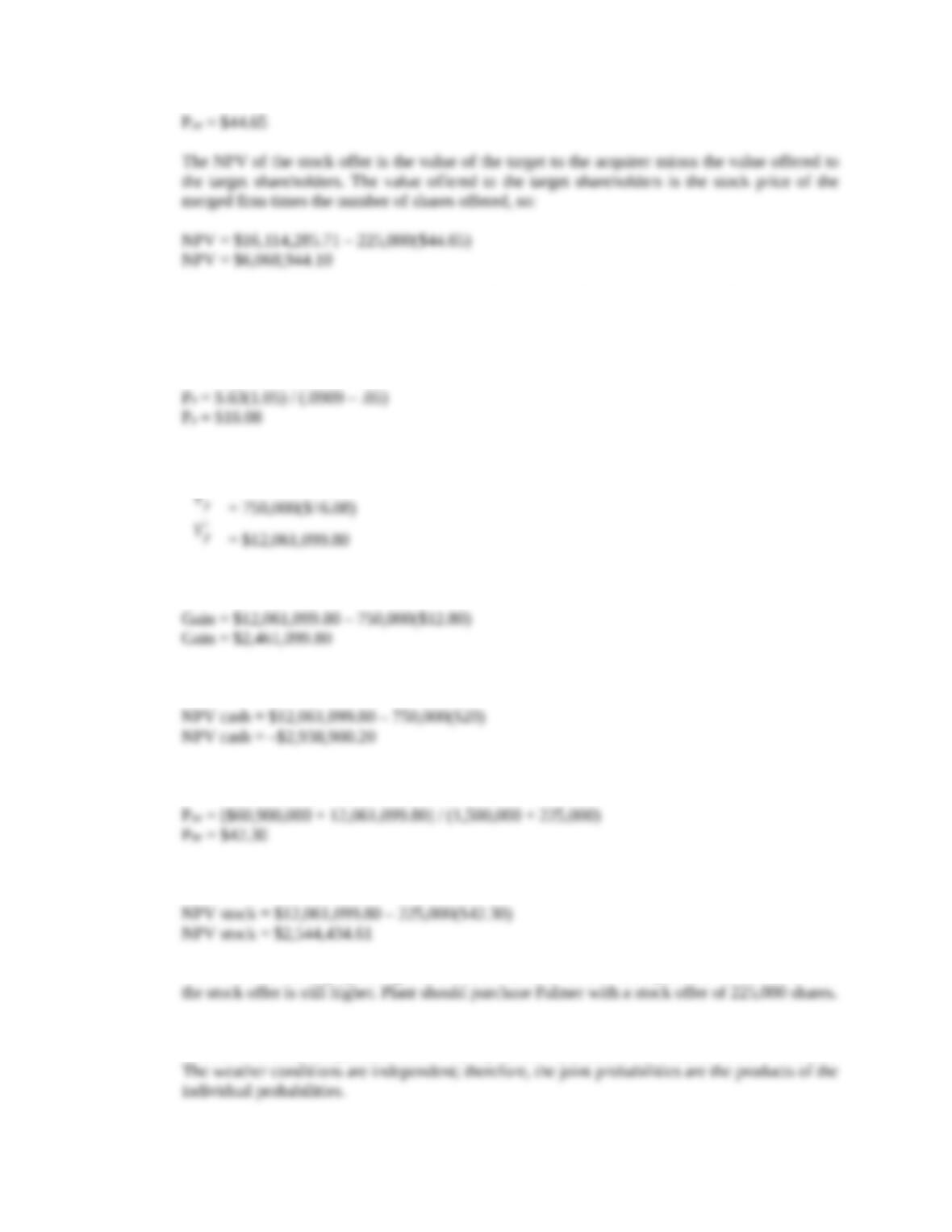
f. Yes, the acquisition should go forward, and Plant should offer shares since the NPV is higher.
g. Using the new growth rate in the dividend growth model, along with the dividend and required
return we calculated earlier, the price of the target under these assumptions is:
And the value of the target firm to the acquiring firm is:
VP
¿
The gain to the acquiring firm will be:
The NPV of the cash offer is now:
And the new price per share of the merged firm will be:
And the NPV of the stock offer under the new assumption will be:
Even with the lower projected growth rate, the stock offer still has a positive NPV. The NPV of
16. a. To find the distribution of joint values, we first must find the joint probabilities. To do this, we
need to find the joint probabilities for each possible combination of weather in the two towns.
5

CHAPTER 29 –
Possible states Joint probability
Rain-Rain .1(.1) = .01
Rain-Warm .1(.4) = .04
Rain-Hot .1(.5) = .05
Next, note that the revenue when rainy is the same regardless of which town. So, since the state
“Rain-Warm” has the same outcome (revenue) as “Warm-Rain”, their probabilities can be
added. The same is true of “Rain-Hot” / “Hot-Rain” and “Warm-Hot” / “Hot-Warm”. Thus the
joint probabilities are:
Possible states Joint probability
Rain-Rain .01
Finally, the joint values are the sums of the values of the two companies for the particular state.
Possible states Joint value
Rain-Rain $230,000 + 230,000 = $460,000
Rain-Warm $230,000 + 450,000 = 680,000
Rain-Hot $230,000 + 905,000 = 1,135,000
b. Recall that if a firm cannot service its debt, the bondholders receive the value of the assets.
Thus, the value of the debt is reduced to the value of the company if the face value of the debt
is greater than the value of the company. If the value of the company is greater than the value of
the debt, the value of the debt is its face value. Here, the value of the common stock is always
the residual value of the firm over the value of the debt. So, the value of the debt and the value
of the stock in each state is:
Possible
stat
es
Joint Prob. Joint Value Debt Value Stock Value
Rain-Rain .01 $460,000 $460,000 $0
Rain-Warm .08 680,000 680,000 0
6
CHAPTER 29 –
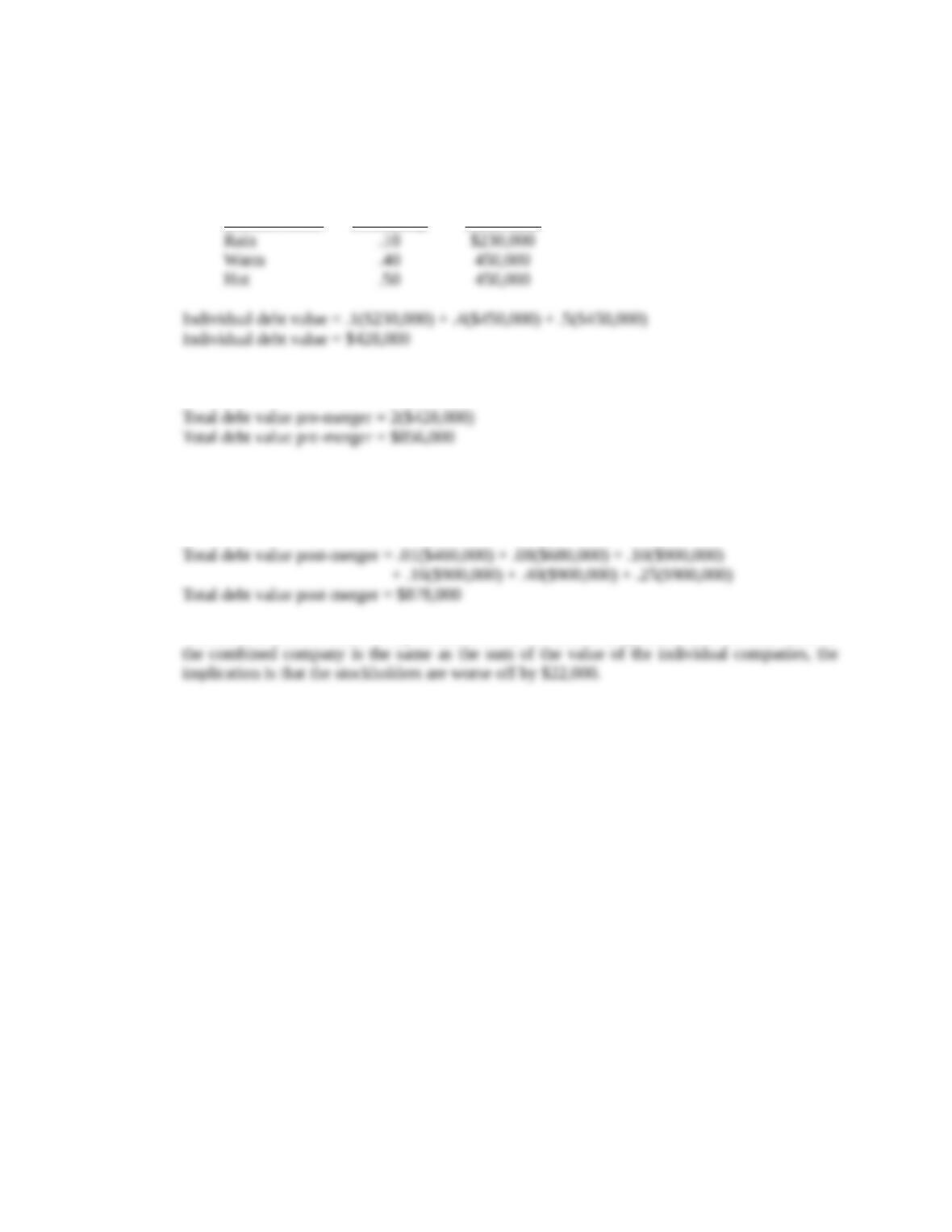
c. The bondholders are better off if the value of the debt after the merger is greater than the value
of the debt before the merger. The value of the debt is the smaller of the debt value or the
company value. So, the value of the debt of each individual company before the merger in each
state is:
Possible states Probability Debt Value
This means the total value of the debt for both companies pre-merger must be:
To get the expected debt value, post-merger, we can use the joint probabilities for each possible
state and the debt values corresponding to each state we found in part c. Using this information
to find the value of the debt in the post-merger firm, we get:
The bondholders are better off by $22,000. Since we have already shown that the total value of
7