CHAPTER 12 B-
8. To determine which investment an investor would prefer, you must compute the variance of
portfolios created by many stocks from either market. Because you know that diversification is good,
it is reasonable to assume that once an investor has chosen the market in which she will invest, she
will buy many stocks in that market.
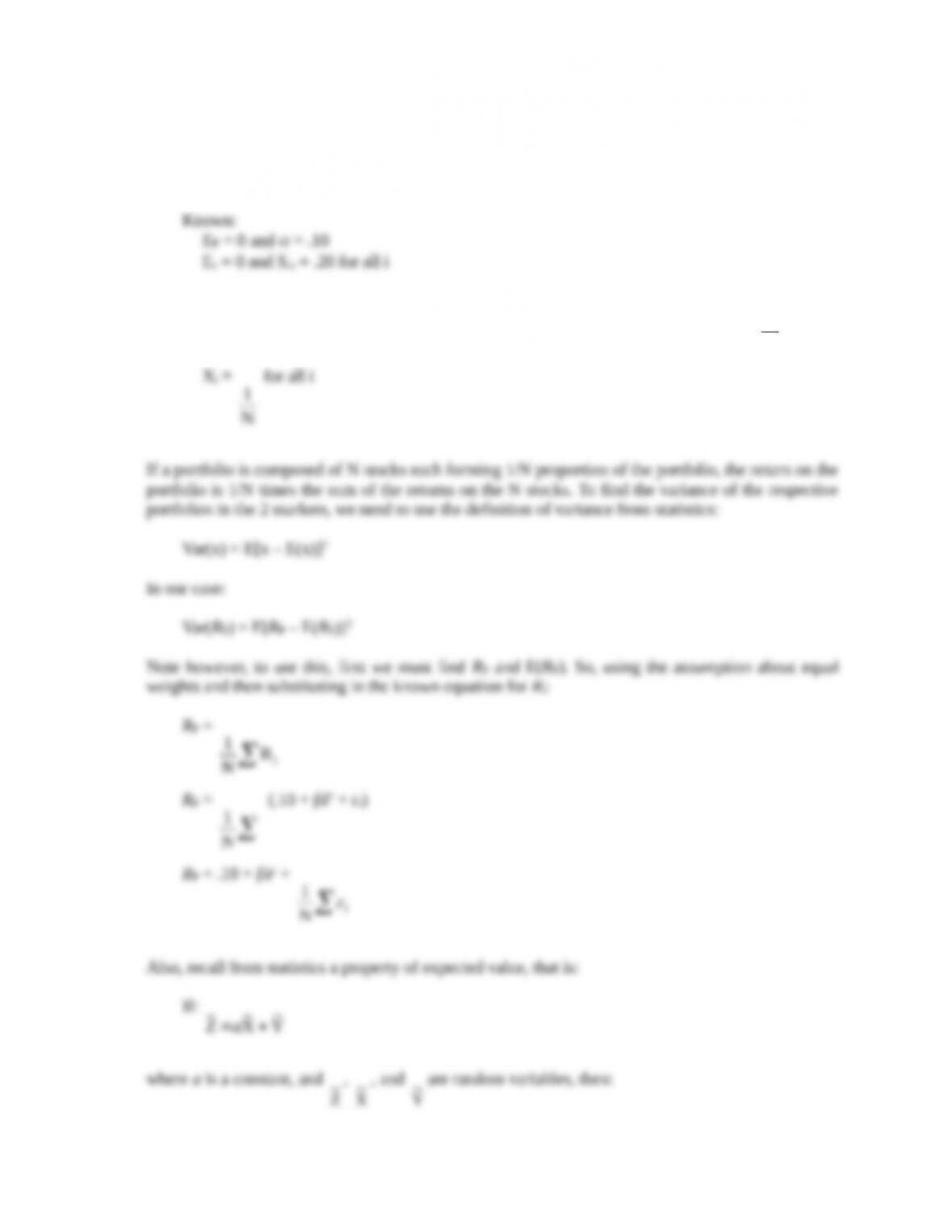
If we assume the stocks in the portfolio are equally-weighted, the weight of each stock is
N
1
, that is:
N
1
CHAPTER 12 B-
)YE( )X)E(E( )ZE( ~~
a
~
and
E(a) = a
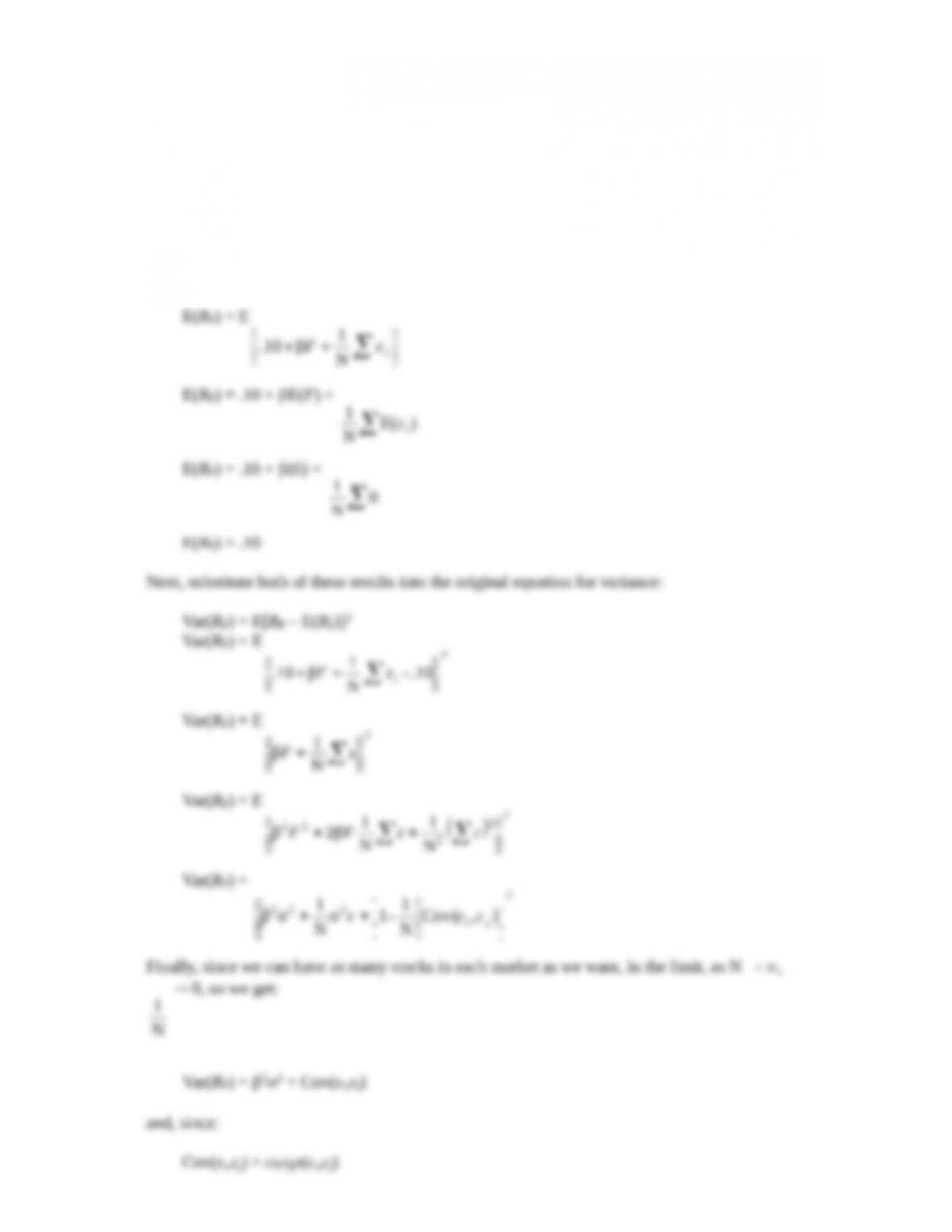
Now use the above to find E(RP):
2
CHAPTER 12 B-
and the problem states that 1 = 2 = .10, so:
So now, to summarize what we have so far:
R1i = .10 + 1.5F + 1i
R2i = .10 + .5F + 2i
Finally we can begin answering the questions a, b, & c for various values of the correlations:
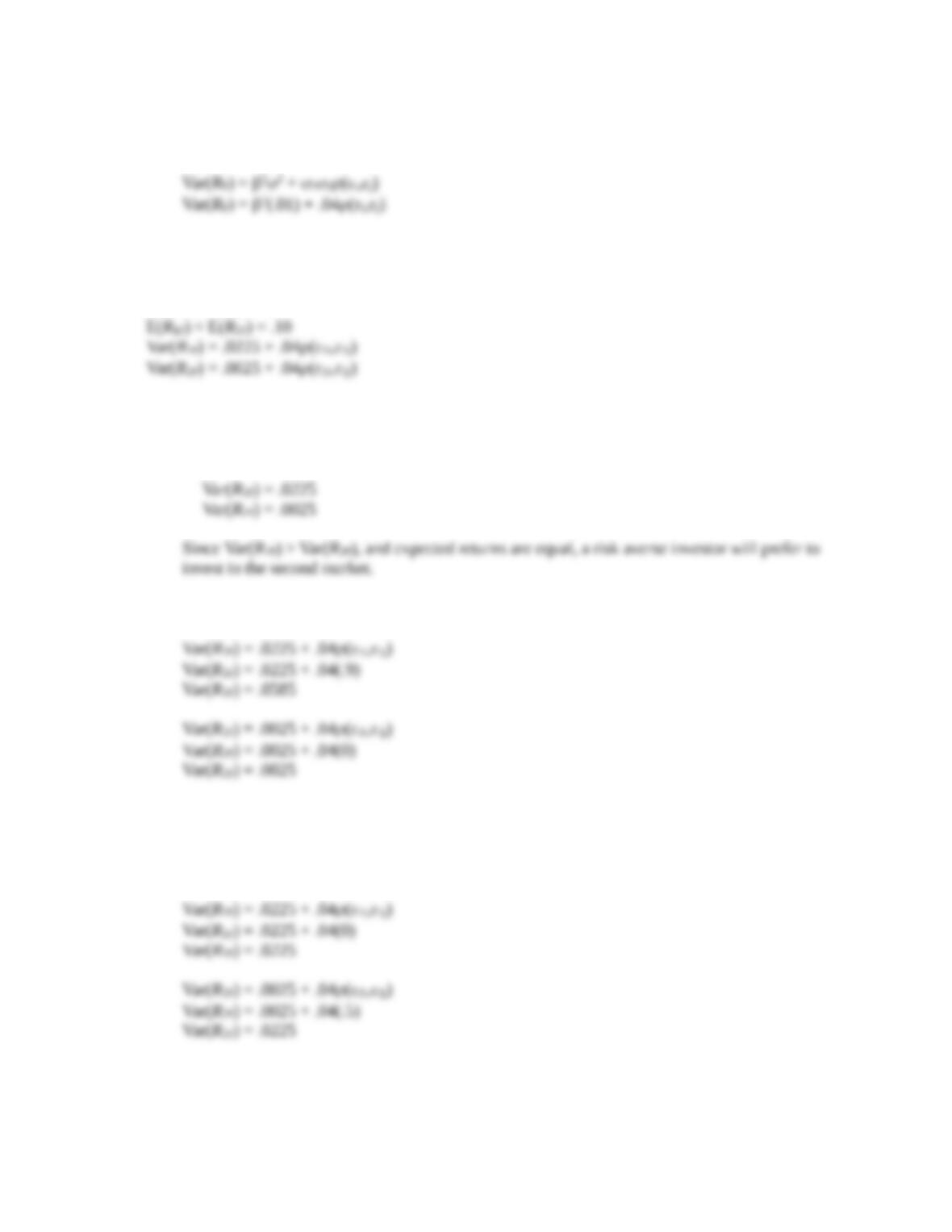
a. Substitute (1i,1j) = (2i,2j) = 0 into the respective variance formulas:
b. If we assume (1i,1j) = .9, and (2i,2j) = 0, the variance of each portfolio is:
Since Var(R1P) > Var(R2P), and expected returns are equal, a risk averse investor will prefer to
invest in the second market.
c. If we assume (1i,1j) = 0, and (2i,2j) = .5, the variance of each portfolio is:
Since Var(R1P) = Var(R2P), and expected returns are equal, a risk averse investor will be
indifferent between the two markets.
3
CHAPTER 12 B-
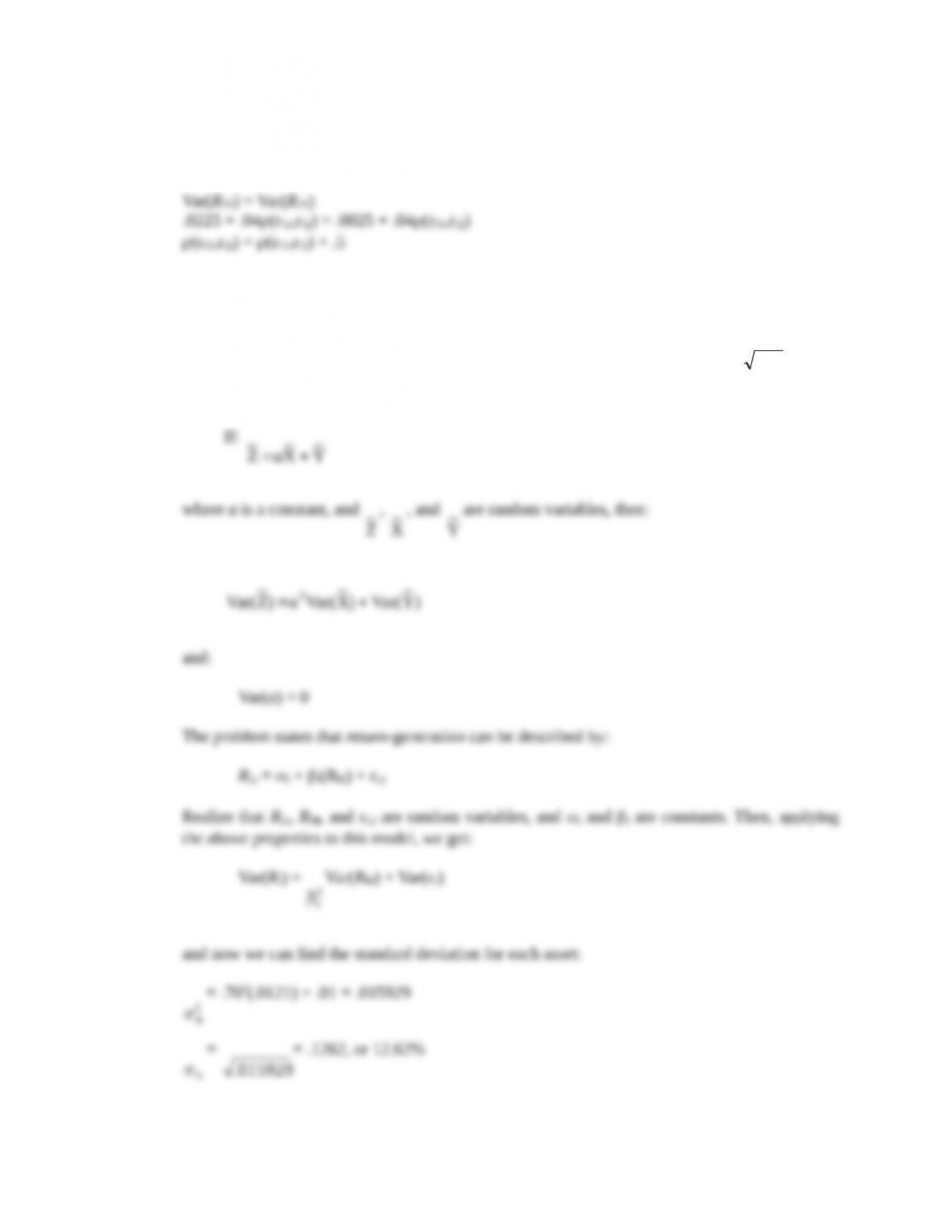
d. Since the expected returns are equal, indifference implies that the variances of the portfolios in
the two markets are also equal. So, set the variance equations equal, and solve for the
correlation of one market in terms of the other:
Therefore, for any set of correlations that have this relationship (as found in part c), a risk
adverse investor will be indifferent between the two markets.
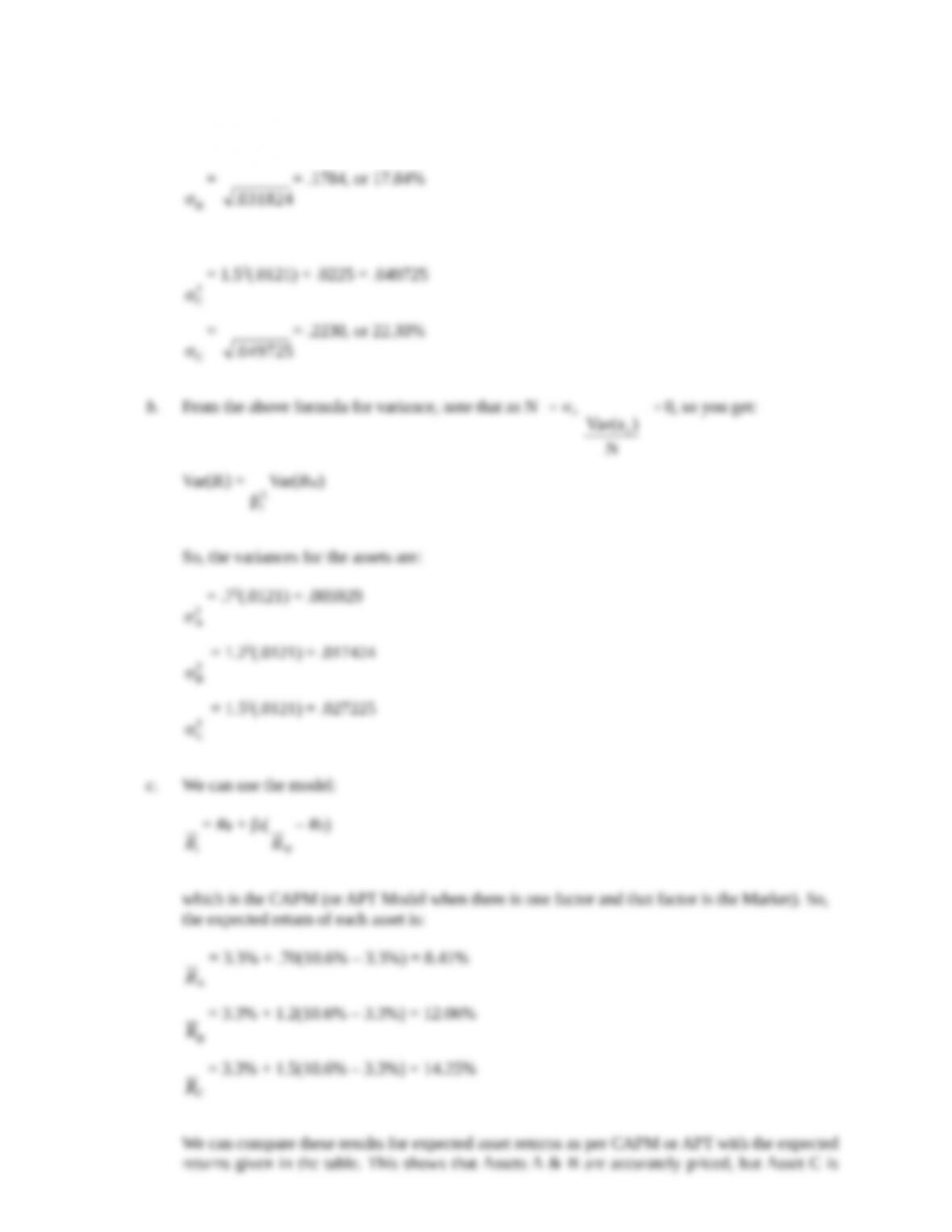
9. a. In order to find standard deviation, , you must first find the variance, since =
Var
. Recall
from statistics a property of variance:
4
CHAPTER 12 B-
2
B
σ
= 1.22(.0121) + .0144 = .031824
B
σ
=
.031824
= .1784, or 17.84%
2
C
σ
= 1.52(.0121) + .0225 = .049725
C
σ
.049725
b. From the above formula for variance, note that as N ,
N
)Var(εi
0, so you get:
Var(Ri) =
2
βi
Var(RM)
So, the variances for the assets are:
2
A
σ
2
B
σ
2
C
σ
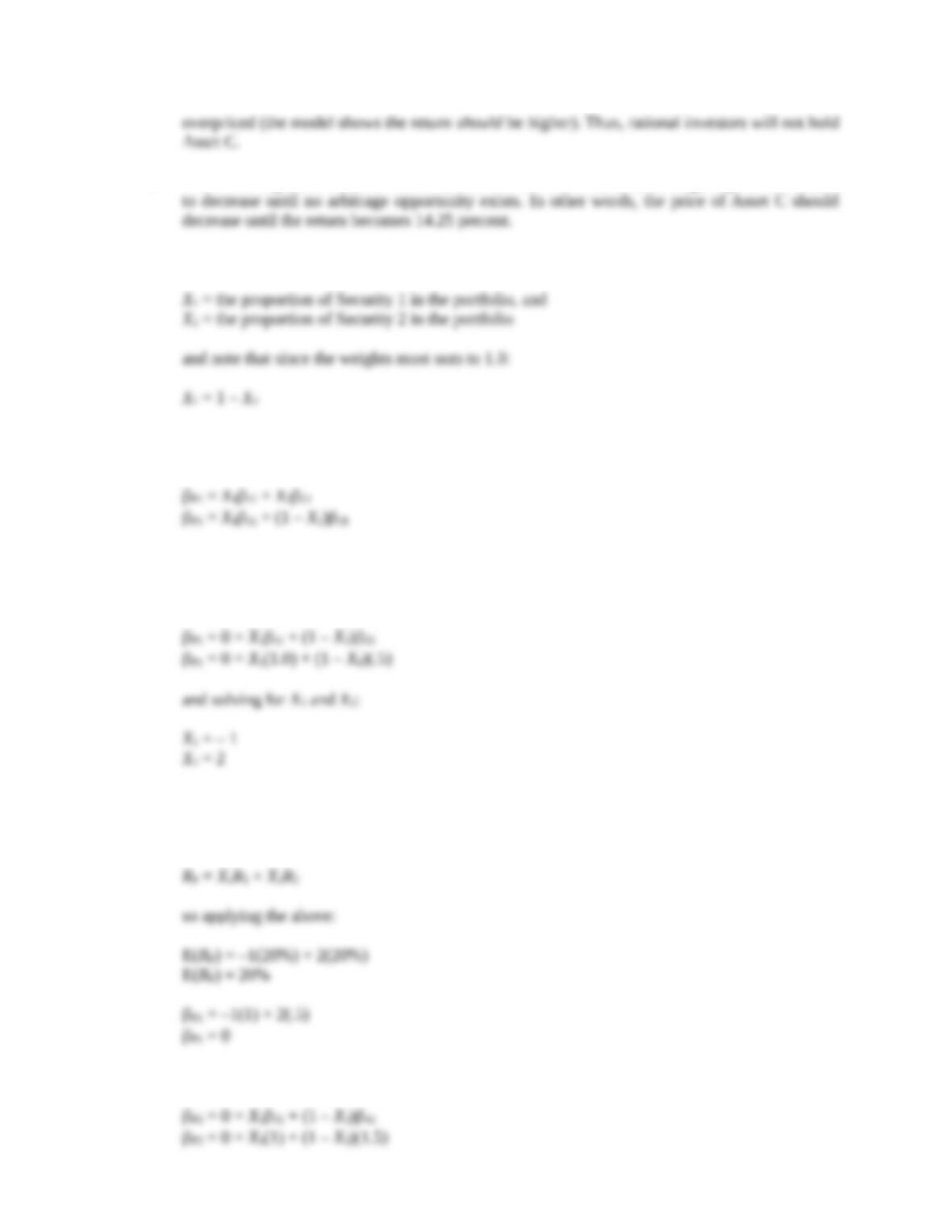
c. We can use the model:
i
R
M
R
which is the CAPM (or APT Model when there is one factor and that factor is the Market). So,
the expected return of each asset is:
A
R
= 3.3% + .70(10.6% – 3.3%) = 8.41%
B
R
C
R
We can compare these results for expected asset returns as per CAPM or APT with the expected
returns given in the table. This shows that Assets A & B are accurately priced, but Asset C is
5
CHAPTER 12 B-
d. If short selling is allowed, rational investors will sell short Asset C, causing the price of Asset C
10. a. Let:
Recall from Chapter 11 that the beta for a portfolio (or in this case the beta for a factor) is the
weighted average of the security betas, so
Now, apply the condition given in the hint that the return of the portfolio does not depend on F1.
This means that the portfolio beta for that factor will be 0, so:
Thus, sell short Security 1 and buy Security 2.
To find the expected return on that portfolio, use
b. Following the same logic as in part a, we have
6
CHAPTER 12 B-
and
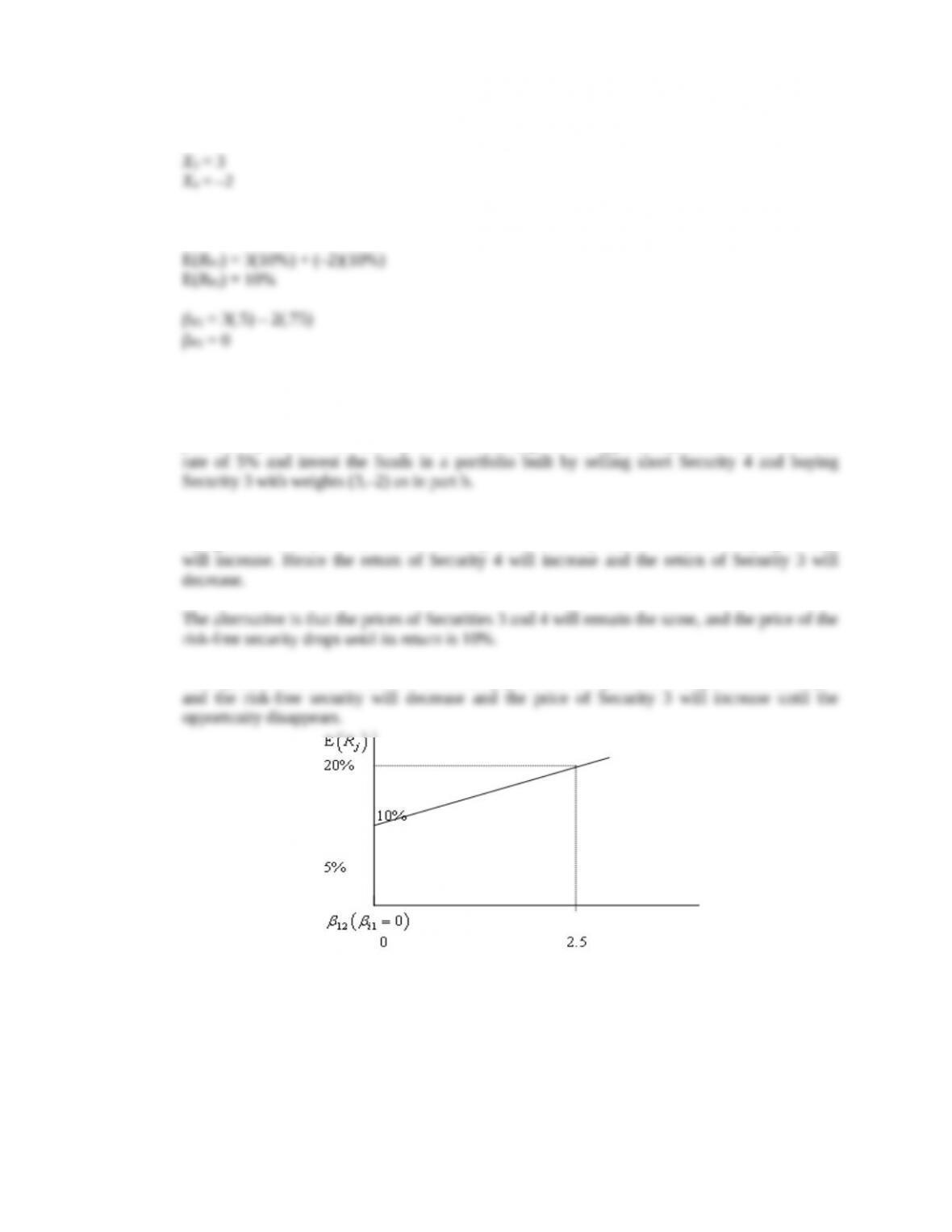
Thus, sell short Security 4 and buy Security 3. Then,
Note that since both P1 and P2 are 0, this is a risk free portfolio!
c. The portfolio in part b provides a risk free return of 10%, which is higher than the 5% return
provided by the risk free security. To take advantage of this opportunity, borrow at the risk free
d. First assume that the risk free security will not change. The price of Security 4 (that everyone is
trying to sell short) will decrease, and the price of Security 3 (that everyone is trying to buy)
Finally, a combined movement of all security prices is also possible. The prices of Security 4
7