Chapter 2 – Developing Marketing Strategies and a Marketing Plan Marketing 6th
Copyright © 2018 McGraw-Hill Education. All rights reserved. No reproduction or distribution without the prior written consent of
McGraw-Hill Education.
1
Chapter 2
Developing Marketing Strategies and a Marketing Plan
Tools for Instructors
• Brief Chapter Outline
• Learning Objectives
• Extended Chapter Outline with Teaching Tips
• Answers to End of Chapter Learning Aids
• Chapter Case Study
• Additional Teaching Tips
• Connect Activities
Brief Chapter Outline
What Is a Marketing Strategy?
The Marketing Plan
Growth Strategies
End of Chapter Learning Aids
Chapter Case Study: The Coffee Wars
Learning Objectives
LO2-1 Define a marketing strategy.
A marketing strategy identifies (1) a firm’s target markets(s), (2) a related marketing mix (its four Ps), and
(3) the bases on which the firm plans to build a sustainable competitive advantage. Firms use four macro
LO2-2 Describe the elements of a marketing plan.
A marketing plan is composed of an analysis of the current marketing situation, opportunities and threats
for the firm, marketing objectives and strategy specified in terms of the four Ps, action programs, and
appropriate financial statements. A marketing plan represents the output of a three-phase process:
Chapter 2 – Developing Marketing Strategies and a Marketing Plan Marketing 6th
Copyright © 2018 McGraw-Hill Education. All rights reserved. No reproduction or distribution without the prior written consent of
McGraw-Hill Education.
2
LO2-3 Analyze a marketing situation using SWOT analyses.
SWOT stands for strengths, weaknesses, opportunities, and threats. A SWOT analysis occurs during the
second step in the strategic planning process, the situation analysis. By analyzing what the firm is good at
LO2-4 Describe how a firm chooses which consumer group(s) to pursue with its marketing efforts.
Once a firm identifies different marketing opportunities, it must determine which to pursue. To accomplish
this task, marketers go through a segmentation, targeting, and positioning (STP) process. Firms segment
various markets by dividing the total market into those groups of customers with different needs, wants, or
characteristics who therefore might appreciate products or services geared especially toward them. After
LO2-5 Outline the implementation of the marketing mix as a means to increase customer value.
The marketing mix consists of the four Ps—product, price, promotion, and place—and each P contributes
to customer value. To provide value, the firm must offer a mix of products and services at prices their
target markets will view as indicating good value. Thus, firms make trade–offs between the first two Ps,
LO2-6 Summarize portfolio analysis and its use to evaluate marketing performance.
Portfolio analysis is a management tool used to evaluate the firm’s various products and businesses—its
“portfolio”—and allocate resources according to which products are expected to be the most profitable for
the firm in the future. A popular portfolio analysis tool developed by the Boston Consulting Group
classifies all products into four categories. The first, stars, are in high-growth markets, and have high
LO2-7 Describe how firms grow their business.
Firms use four basic growth strategies: market penetration, market development, product development,
and diversification. A market penetration strategy directs the firm’s efforts toward existing customers and
uses the present marketing mix. In other words, it attempts to get current customers to buy more. In a
market development strategy, the firm uses its current marketing mix to appeal to new market segments,
Chapter 2 – Developing Marketing Strategies and a Marketing Plan Marketing 6th
Copyright © 2018 McGraw-Hill Education. All rights reserved. No reproduction or distribution without the prior written consent of
McGraw-Hill Education.
3
Extended Chapter Outline with Teaching Tips
I. What Is a Marketing Strategy?
A. Customer Excellence
1. Retaining Loyal Customers
Progress Check: Several questions are offered for students to check their understanding of core
concepts.
1. What are the various components of a marketing strategy?
Answer: A marketing strategy includes a firm’s target market(s), a related marketing mix, and the
2. List the four macro strategies that can help a firm develop a sustainable competitive advantage.
Answer: The four macro strategies that can help a firm develop a sustainable competitive
II. The Marketing Plan
A. Step 1: Define the Business Mission
B. Step 2. Conduct a Situation Analysis
Chapter 2 – Developing Marketing Strategies and a Marketing Plan Marketing 6th
Copyright © 2018 McGraw-Hill Education. All rights reserved. No reproduction or distribution without the prior written consent of
McGraw-Hill Education.
5
Progress Check: Several questions are offered for students to check their understanding of core
concepts.
1. What are the four growth strategies?
Answer: Market penetration strategy, market development strategy, product development
2. What type of strategy is growing the business from existing customers?
Answer: The type of strategy that grows a business from existing customers is market penetration
3. Which strategy is the riskiest?
Answer: The diversification strategy is the riskiest, because unrelated diversifications do not
Answers to End of Chapter Learning Aids
Marketing Digitally
1. The mission statement for The Estee Lauder Companies is “’Bringing the best to everyone we
touch’. By ‘The best’, we mean the best products, the best people and the best ideas. These
three pillars have been the hallmarks of our Company since it was founded by Mrs. Estee
Lauder in 1946. They remain the foundation upon which we continue to build our success
today.” Harley-Davidson, Inc.’s mission statement is more straightforward: “We fulfill dreams
through the experience of motorcycling, by providing to motorcyclists and to the general
public an expanding line of motorcycles and branded products and services in selected
market segments.” (both statements taken from:
https://www.missionstatements.com/fortune_500_mission_statements.html) These different
perspectives also reflect the quite different positioning adopted by each company. Visit the
websites of each manufacturer and review the descriptions of the company, its mission, and
its values. Do you believe these two disparate mission statements reflect what the firms do
and how they are portrayed in the media? Justify your answer.
Students should discuss the difference between the two mission statements and how they relate to both
Estee Lauder’s and Harley-Davidson’s company’s official descriptions.
About Estee Lauder
Our culture is often described as a rare mix of family values with a high-performing public company. This
About Harley-Davidson
Fulfilling dreams of personal freedom is more than a phrase. It’s our purpose and our passion. We bring
Chapter 2 – Developing Marketing Strategies and a Marketing Plan Marketing 6th
Copyright © 2018 McGraw-Hill Education. All rights reserved. No reproduction or distribution without the prior written consent of
McGraw-Hill Education.
7
Marketing Applications
1. How have PepsiCo and Coca-Cola created sustainable competitive advantages for
themselves?
brand awareness through strategic sponsorships, unique advertising campaigns, and efficient operations.
2. Perform a SWOT analysis for the company that made your favorite shoes.
Students’ answers will vary. Each answer should include strengths and weaknesses that are internal to
the shoe manufacturer and opportunities and threats that are external to the manufacturer. Strengths for
3. How does Coca-Cola segment its market? Describe the primary target markets for Coca-Cola.
How does it position its various offerings so that it appeals to these different target markets?
Geographic segmentation
Coca-Cola has a countrywide network of product distribution but the company segments more in urban
and suburban areas as compared to rural areas in the United States and does the same in other
countries.
Demographic segmentation
suitable pack based on their family size.
Psychographics segmentation
4. How does Hertz add value for business customers through the implementation of the four Ps?
Hertz positions itself as a quality car and truck rental company that is top of mind for its target segments.
One of Hertz’s primary market segments is business customers. Hertz uses the four P’s to create value
for its business customers:
Chapter 2 – Developing Marketing Strategies and a Marketing Plan Marketing 6th
Copyright © 2018 McGraw-Hill Education. All rights reserved. No reproduction or distribution without the prior written consent of
McGraw-Hill Education.
8
• Promotion: Hertz uses marketing communications to tell their business customers that Hertz will help
them enjoy their journey and reduce their travel time.
• Place: Hertz makes it easy for business customers to rent cars on business travel. Business
customers are allowed to go through a separate line, or often bypass the lines altogether, to be on
their way faster.
5. Dyson successfully sells its fans and heaters for $150 to $400, whereas most conventional
fans sell for around $25. Explain what is the value it creates and how this affects the price it
can charge.
Dyson fans and fan heaters draw in and redirect surrounding air without potentially dangerous or fast
1900s.
6. Of the four growth strategies described in the chapter, which is the riskiest? Which is the
easiest to implement? Why?
Of the four growth strategies, diversification is the riskiest because it involves significant reallocation of
resources. Diversification requires firms to invest in both new products and new markets. Market
7. Choose three companies. You believe the first builds customer value through product
excellence, the second through operational excellence, and the third through customer
excellence. Justify your answer.
Customer excellence is achieved when a firm develops value-based strategies for retaining loyal
customers and provides outstanding customer service. Students may provide examples of local firms or
larger firms such as Nordstrom, Amazon.com, Zappos.com, and Ritz-Carlton. Firms that have a
8. You are in the job market and have received offers from three very different firms. Develop a
marketing plan to help market yourself to prospective employers.
Answers will vary based upon the three companies the student selects. The student should include
details in each of the following areas:
1. Executive summary
2. Company overview
Chapter 2 – Developing Marketing Strategies and a Marketing Plan Marketing 6th
Copyright © 2018 McGraw-Hill Education. All rights reserved. No reproduction or distribution without the prior written consent of
McGraw-Hill Education.
9
Quiz Yourself
1. After a firm has conducted a SWOT analysis, it would typically progress to the next step of marketing
planning, which is _______ and involves using STP (segmentation, targeting, and positioning).
a. defining the mission
b. conducting a situation analysis
c. identifying and evaluating opportunities
d. implementing the marketing mix
e. evaluating performance
2. Which of the following is a marketing metric that might be used to evaluate the performance of a
company’s implementation of its marketing plan?
a. Four Ps (price, product, promotion, place)
b. SWOT analysis (strengths, weaknesses, threats, opportunities)
c. STP (segmentation, targeting, positioning)
d. GM (gross margin)
e. SBU (strategic business unit)
Case Study: The Coffee Wars
1. Perform a SWOT analysis for Starbucks and Dunkin’ Donuts. Based on your analysis, in
which company would you invest? Justify your answer.
SWOT analysis: Starbucks
Positive
Negative
Internal
STRENGTHS
• Ubiquitous Stores
• Social Marketing Channels
WEAKNESSES
High Prices
External
OPPORTUNITIES
Growing Market
THREATS
New competitors (McDonald’s and
Taco Bell)
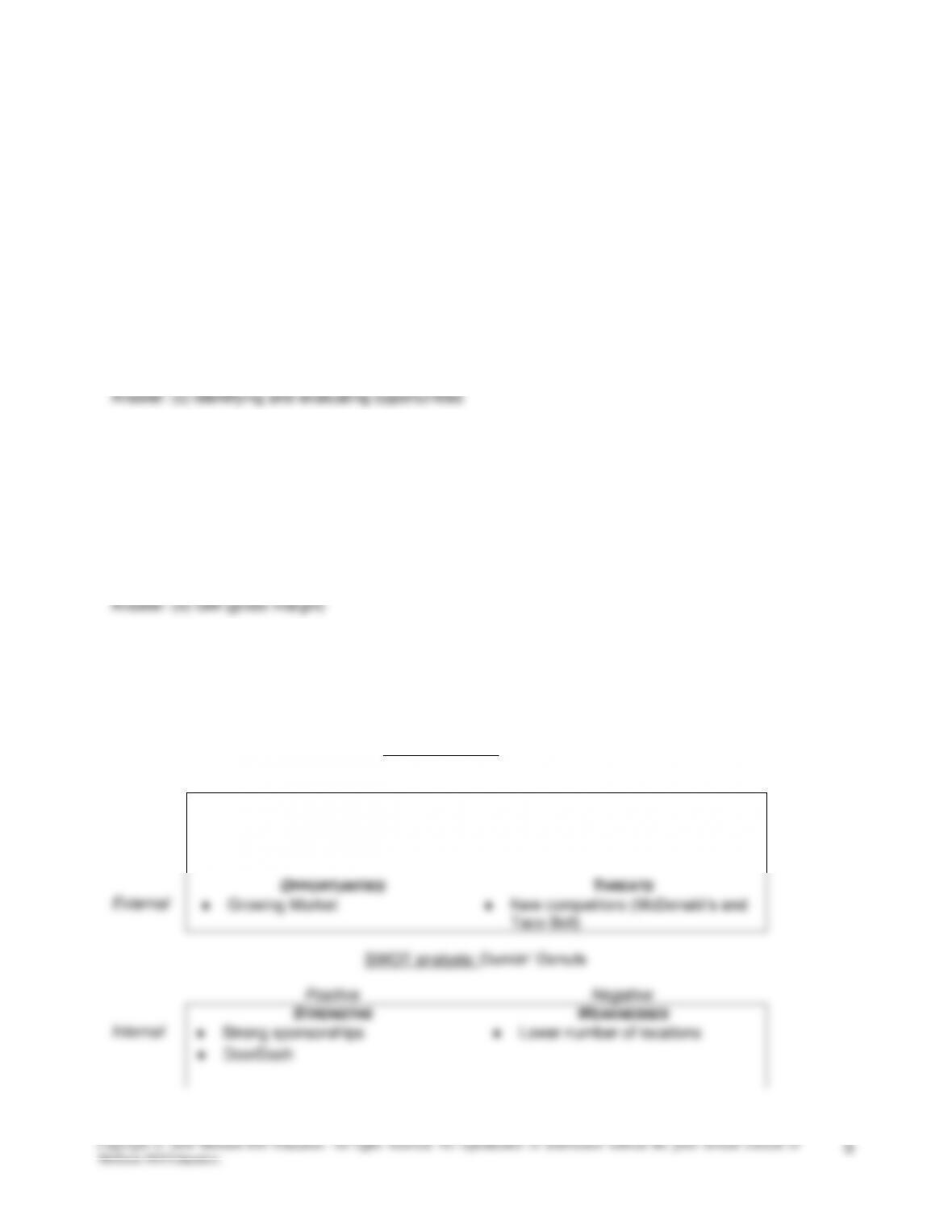
SWOT analysis: Dunkin’ Donuts
Positive
Negative
Internal
STRENGTHS
Strong sponsorships
DoorDash
WEAKNESSES
Lower number of locations