Chapter 18 – Integrated Marketing Communications Marketing 6th
Copyright © 2018 McGraw-Hill Education. All rights reserved. No reproduction or distribution without the prior written consent of
McGraw-Hill Education.
7
e. Reach divided by frequency
Answer: (c) Reach multiplied by frequency
Chapter Case Study: Taking IMC to The Max: Pepsi Max and Modern
Communications
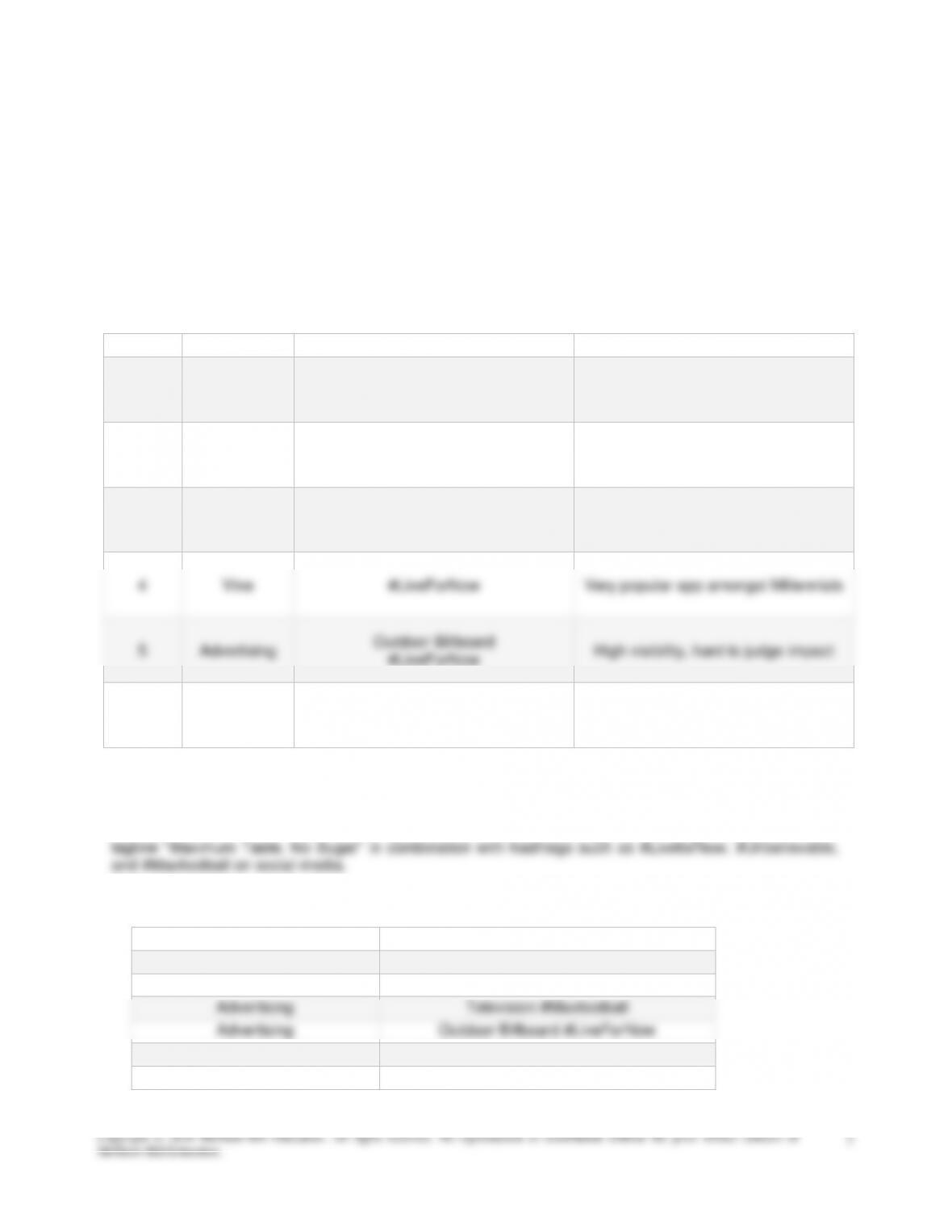
1 Which channels is Pepsi Max using to communicate its marketing messages? Rank order
your impression of how effective they are and justify your answer.
Ranking
Channel
Message
Rationale
1
YouTube
#LiveforNow
#Unbelievable
YouTube is the primary video website
and the cost per impression is free or
extremely low
2
Advertising
Television
#Maxfootball
Soccer is the largest sport globally
3
Mobile App
“Blue Card Experiences”
Millennials are the most mobile
generation
4
Vine
#LiveForNow
Very popular app amongst Millennials
5
Advertising
Outdoor Billboard
#LiveForNow
High visibility, hard to judge impact
6
Advertising
Outdoor Bus stops
“Augmented reality”
High visibility, hard to judge impact
2 How are those various channels integrated?
The very name of the product line provides the foundation for a consistent message. Every
communication is “to the max” as well—grander, louder, more exciting, more thrilling. PepsiCo uses the
3 Which IMC channels do these campaigns by Pepsi Max make use of?
Channel
Message
YouTube
#LiveforNow #Unbelievable
Vine
#LiveForNow
Advertising
Television #Maxfootball
Advertising
Outdoor Billboard #LiveForNow
Advertising
Outdoor Bustops “Augmented reality”
Mobile App
“Blue Card Experiences”

Chapter 18 – Integrated Marketing Communications Marketing 6th
Copyright © 2018 McGraw-Hill Education. All rights reserved. No reproduction or distribution without the prior written consent of
McGraw-Hill Education.
8
Additional Teaching Tips
This chapter focuses on the importance of the integrated marketing campaign effort. It is important for
students to understand that all elements of the promotional mix must come together to form one unique,
unified, marketing message or “big idea” for the product. A good understanding of AIDA in presenting
design elements is also critical and instructors should spend some time in class and through critical
thinking exercises to fully explore these elements.
This is a simple concept that can form basic marketing strategies in the marketing tools. Instructors
may want to divide the class in groups and have them develop an ad based on a candy bar on large
poster board. They should work as a group and incorporate the elements of ad design (a preview of the
next chapter on advertising design elements would need to be discussed) as well as the elements of
AIDA. Have students tape their group ad to the white board and have each group present their
advertisement and the AIDA concepts present. This critical thinking exercise is both creative and fun!
Online tip: Have students individually create an advertisement incorporating the advertising design
elements and AIDA. They can create the advertisement electronically, or hand-draw and scan to the
discussion board. Students are to write a paragraph on how AIDA is present in their ads. Have an
anonymous online vote and declare a winner!
Another important concept is the IMC effort. While students often understand that these components are
present, what should be emphasized is that they all must work together to deliver one, unified, unique
message to the target market. Thus, the brand logo should be present on advertisements but also used
in electronic media and direct marketing. The same “big idea” or slogan should be used in the personal
selling process, advertising, public relations efforts, etc. Remaining consistent with ONE message flowing
through the elements of the promotional mix will allow more opportunity for the message to break
through the “noise,” enabling for brand recognition of a logo, or slogan, or shape of a package to trigger
brand recall of your specific product when the consumer compares like brands.
Connect Activities
Activity
Type
Learning Objectives 18–
01
02
03
04
05
Scion and Its Innovative IMC Campaign
Case Analysis
X
X
The Communication Process
Click & Drag
X
Frito Lay: Integrated Marketing Communications
Video Case
X
HSN
Video Case
X
X
X
Taking IMC to the Max: Pepsi Max and Modern
Communications
Case Analysis
X
X
X
Scion and its Innovative IMC Campaign
▪ Activity Type: Case Analysis
▪ Learning Objectives: 18-01, 18-03
▪ Difficulty: Hard
▪ Activity Summary: This case describes Toyota’s campaign for its Scion line, targeted at younger
buyers. Students answer questions relating chapter concepts to the case.

Chapter 18 – Integrated Marketing Communications Marketing 6th
Copyright © 2018 McGraw-Hill Education. All rights reserved. No reproduction or distribution without the prior written consent of
McGraw-Hill Education.
9
Activity
▪ Introduction: This activity highlights Toyota’s innovative campaign for the Scion. Toyota had a very
specific objective in mind when it launched the Scion. The company was intent on winning over a
much younger demographic with the hope of building loyal, lifetime customers. To reach this goal,
Toyota launched an innovative integrated marketing communications (IMC) campaign.
▪ Concept Review: Integrated marketing communications (IMC) represents the promotion P of the
marketing mix. IMC encompasses a variety of communication disciplines—advertising, personal
selling, sales promotion, public relations, direct marketing, and electronic media—used in
combination to provide clarity, consistency, and maximum communicative impact. IMC programs
regard each of the firm’s marketing communications elements as part of a whole, each of which offers
a different means to connect with the target audience.
Follow-Up Activity
▪ Use this case in combination with the Ford Fiesta case in the Chapter 19 activities. Compare and
contrast the IMC efforts of the two companies. It is an interesting comparison given that they have
essentially the same target market.
The Communication Process
▪ Activity Type: Click & Drag
▪ Learning Objectives: 18–01
▪ Difficulty: Medium
▪ Activity Summary: Students read about activities that are part of the communication process and
are asked to match them to the step of the process they represent.
Activity
▪ Introduction: Target is a discount retailer that operates nearly 1,750 stores in 49 states. Target
differentiates itself from its competitors by offering more upscale, trend-forward merchandise at low
cost. The store is planning a Back–to-School sale aimed at moms with children going back to school.
These women make the majority of their household purchases. Read about the Target sale
announcement and then assemble the communication process model as instructed.
▪ Concept Review: As the number of communication media has increased, the task of understanding
how best to reach target consumers has become far more complex. The Communication Process
model describes how communications go from the firm to the consumer and the factors that affect the
way the consumer perceives the message.
Follow-Up Activity
▪ Discuss: In the activity, Target measures store traffic to evaluate the impact of the ad campaign. What
are some of the challenges of that kind of evaluation? This is an opportunity to expand on the
discussion in the chapter of the lagged effect, and also to talk about how other changes in the
environment can sometimes make it hard to see the impact of advertising.

Chapter 18 – Integrated Marketing Communications Marketing 6th
Copyright © 2018 McGraw-Hill Education. All rights reserved. No reproduction or distribution without the prior written consent of
McGraw-Hill Education.
10
Frito Lay: Integrated Marketing Communications
▪ Activity Type: Video Case
▪ Learning Objectives: 18–03
▪ Difficulty: Medium
▪ Activity Summary: This case discusses IMC efforts by Frito-Lay—on behalf of Doritos—to engage
their customers. After the video ends, students are asked questions about the video and related
course concepts.
Activity
▪ Introduction: There are three elements of any IMC strategy: the consumer, the channels through
which the message is communicated, and the evaluation of the results of the communication. This
video examines one of the communication channels that Frito-Lay uses as part of its IMC strategy.
▪ Concept Review: Integrated marketing communications (IMC) encompasses a variety of
communication disciplines in combination to provide clarity, consistency, and maximum
communicative impact. Instead of consisting of separate marketing communications elements with no
unified control, IMC programs regard each of the firm’s marketing communications elements as a part
of a whole, each of which offers a different means to connect with the target audience. This
integration of elements provides the firm with the best means to reach the target audience, and it
enhances the value story by offering a clear and consistent message.
▪ Video: The video is presented to the student below the introductory information. The video plays
embedded on the page, after which questions are presented.
Follow-Up Activity
▪ In class, visit the Doritos website and identify current interactive initiatives.
▪ View some past years’ “Crash the Super Bowl” ads (easy to find on YouTube). From 2009–2012,
Doritos ads created through the contest earned #1 spots in the USA Today AdMeter poll in three of
the four years.
HSN
▪ Activity Type: Video Case
▪ Learning Objectives: 18-01, 18-03, 18-05
▪ Difficulty: Medium
▪ Activity Summary: This case discusses HSN’s multichannel retailing and marketing communications
strategy. After the video ends, students are asked questions about the video and related course
concepts.

Chapter 18 – Integrated Marketing Communications Marketing 6th
Copyright © 2018 McGraw-Hill Education. All rights reserved. No reproduction or distribution without the prior written consent of
McGraw-Hill Education.
11
Activity
▪ Introduction: Started in 1982, HSN (Home Shopping Network) has become a $2.8 billion
multichannel retailer, using television, e-commerce, m-commerce, catalogs, and brick and mortar
stores. It has recently launched applications for all major smartphones. HSN reaches 90 million
homes, 24 hours a day, 7 days a week, 365 days a year. HSN has always been an innovator in its
use of integrated marketing communications.
▪ Concept Review: Promotion is the communication element of the 4 Ps. Marketers can use a variety
of communication disciplines. Doing so requires Integrated Marketing Communications (IMC). IMC
involves coordinating the use of these disciplines to provide message clarity, message consistency,
and maximum communication impact. Technology has expanded the channels marketers can use to
reach their target customers. Technology has also changed how an audience can interact with the
broadcast content. In this activity, you will be applying your knowledge of IMC to the specific case of
HSN.
▪ Video: The video is presented to the student below the introductory information. The video plays
embedded on the page, after which questions are presented.
Follow-Up Activity
▪ Discuss: Suppose that HSN is trying to separately evaluate the impact of its various communication
media. How can they do this in a multichannel world? For example, someone might see a product on
TV but then buy it online. (This is hard to do, and is one reason why multichannel strategies are
complex.)
Taking IMC to the Max: Pepsi Max and Modern Communications
▪ Activity Type: Case Analysis
▪ Learning Objectives: 18-01, 18-02, 18-03
▪ Difficulty: Medium
▪ Activity Summary: This case discusses innovative marketing communications efforts by PepsiCo on
behalf of Pepsi Max. Students read the case and are then asked to answer questions applying
chapter concepts to the case material.
Activity
▪ Introduction: Pepsi has developed an innovative, integrated campaign to support Pepsi Max. This
activity is important because integrated marketing communications is essential to a product’s—and a
firm’s—ability to effectively communicate value to potential customers. The goal of this exercise is to
test your understanding of integrated marketing communications by applying chapter concepts to
Pepsi’s activities.
Follow-Up Activity
Pepsi Max’s “Unbelievable” social media campaign won a 2015 Webby award for its creativity. In class,
review the campaign and evaluate it. For details, see:

Chapter 18 – Integrated Marketing Communications Marketing 6th
Copyright © 2018 McGraw-Hill Education. All rights reserved. No reproduction or distribution without the prior written consent of
McGraw-Hill Education.
12
http://webbyawards.com/winners/2015/online-film-video/branded-entertainment/integrated-
campaigns/pepsi-max-unbelievable-campaign/