7-21. (Continued)
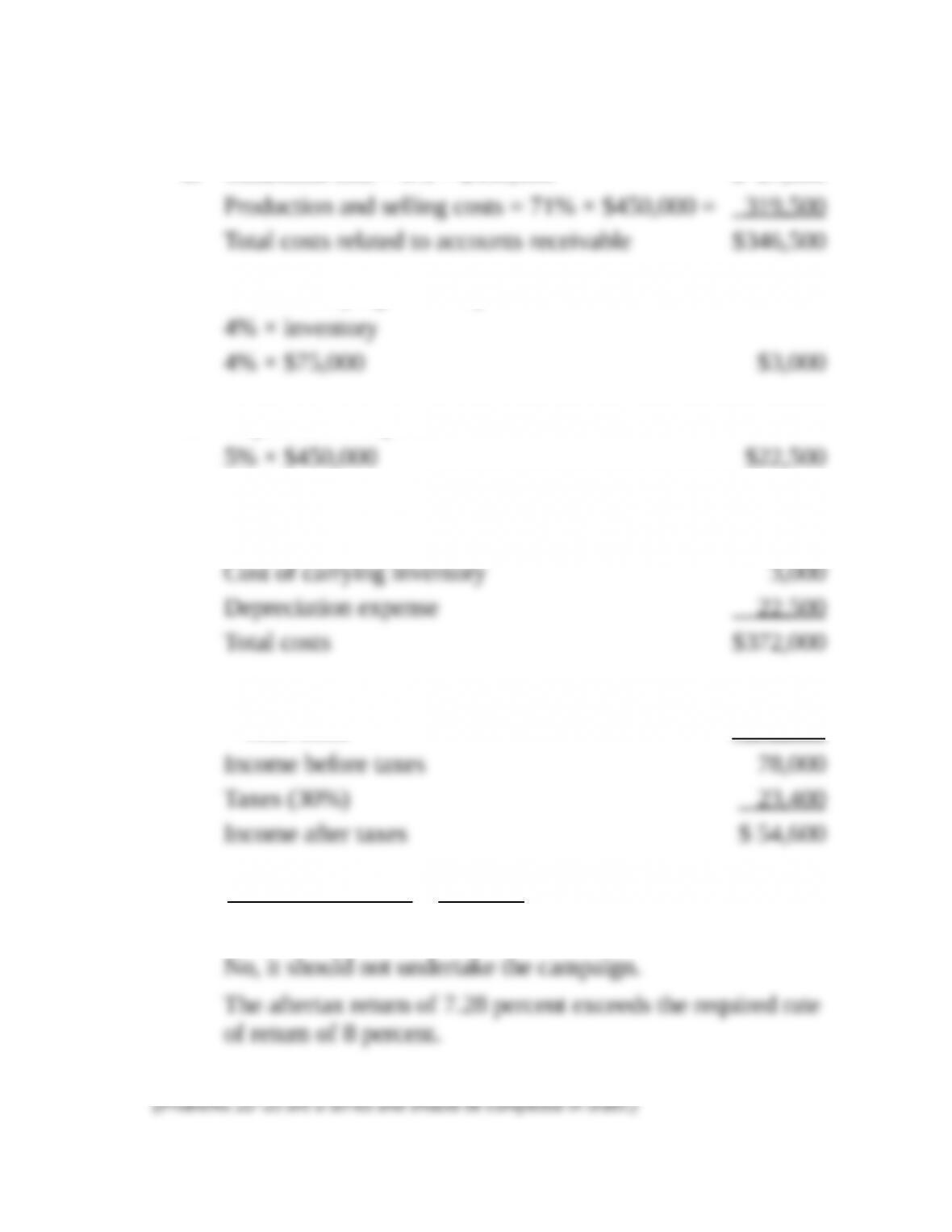
b. Collection cost = 6% × $450,000 $ 27,000
c. Cost of carrying inventory
d. Depreciation expense
e. Total costs related to accounts receivable
$346,500
f. Sales $450,000
– Total costs 372,000
g.
Income after taxes $54,600 7.28%
Total investment 750,000
= =
22. Credit policy decision with changing variables (LO4) Dome Metals has credit sales of
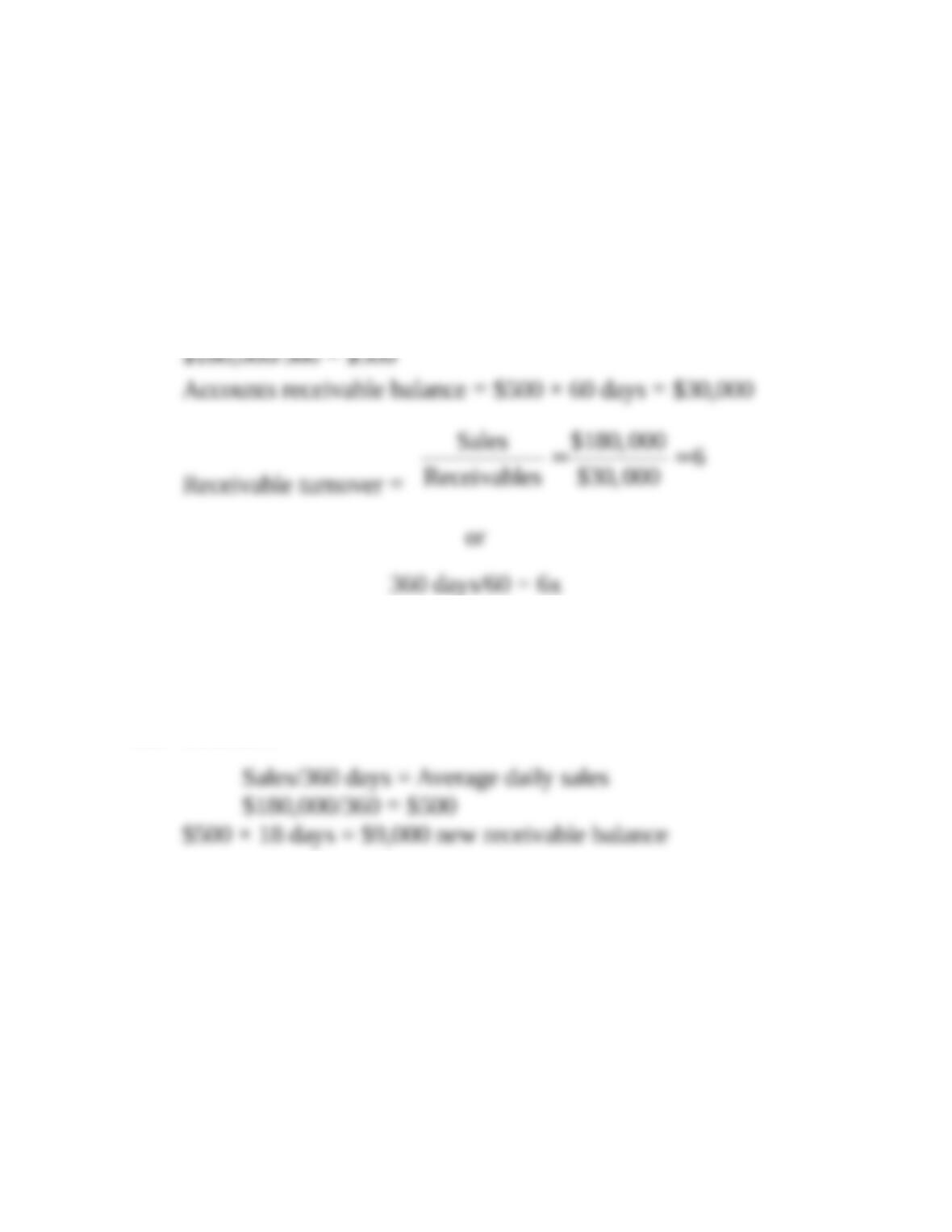
$180,000 yearly with credit terms of net 60 days, which is also the average collection
period. Dome does not offer a discount for early payment, so its customers take the full 60
days to pay. What is the average receivables balance? Receivables turnover?
7-22. Solution:
Dome Metals
Sales/360 days = Average daily sales
23. Dome Metals had credit sales of $180,000 yearly. Dome offered a 3 percent discount for
payment in 18 days. What would the average receivables balance be?
7-23. Solution:
24. Dome Metals had credit sales of $180,000 yearly with credit terms of net 60 days, which is
also the average collection period. If Dome offered a 3 percent discount for payment in 18
days and every customer took advantage of the new terms and reduced its bank loans,
which cost 12 percent, by the cash generated from its reduced receivables, what will be the
net gain or loss to the firm? Should it offer the discount?
7-24. Solution:
Sales / 360 days = Average daily sales

$180,000 / 360 = $500
Old receivable balance = $500 × 60 days = $30,000
25. Dome Metals has credit sales of $180,000 yearly with credit terms of net 60 days, which is
also the average collection period. Dome offered a 3 percent discount for payment in 18
days, and Dome reduced its bank loans, which cost 12 percent. Assume that the new trade
terms of 3/18, net 60 will increase sales by 15 percent because the discount makes the
Dome’s price competitive. If Dome earns 20 percent on sales before discounts, what will be
the net change in income? Should it offer the discount?
7-25. Solution:
New sales = $180,000 × 1.15 = $207,000
Change in sales = $207,000 – $180,000 = $ 27,000

COMPREHENSIVE PROBLEM
Logan Distributing Company (receivables and inventory policy) (LO4 and 5) Logan
Distributing Company of Atlanta sells fans and heaters to retail outlets throughout the Southeast.
Joe Logan, the president of the company, is thinking about changing the firm’s credit policy to
attract customers away from competitors. The present policy calls for a 1/10, net 30 cash
discount. The new policy would call for a 3/10, net 50 cash discount. Currently, 30 percent of
Logan customers are taking the discount, and it is anticipated that this number would go up to 50
percent with the new discount policy. It is further anticipated that annual sales would increase
from a level of $400,000 to $600,000 as a result of the change in the cash discount policy.
The increased sales would also affect the inventory level. The average inventory carried by
Logan is based on a determination of an EOQ. Assume sales of fans and heaters increase from
15,000 to 22,500 units. The ordering cost for each order is $200 and the carrying cost per unit is
$1.50 (these values will not change with the discount). The average inventory is based on
EOQ/2. Each unit in inventory has an average cost of $12.
Cost of goods sold is equal to 65 percent of net sales; general and administrative expenses are
15 percent of net sales, and interest payments of 14 percent will only be necessary for the
increase in the accounts receivable and inventory balances. Taxes will be 40 percent of before-
tax income.
a. Compute the accounts receivable balance before and after the change in the cash
discount policy. Use the net sales (total sales minus cash discounts) to determine the
average daily sales.
b. Determine EOQ before and after the change in the cash discount policy. Translate this
into average inventory (in units and dollars) before and after the change in the cash
discount policy.
c. Complete the following income statement.
Before Policy
Change
After Policy
Change
Net sales (Sales – Cash discounts)……..……..
Cost of goods sold………………………………..…
Gross profit……………………….….……….……...
General and administrative expense.............
Operating profit…………………………………..….
Interest on increase in accounts
receivable and inventory (14%)…….……....
Income before taxes………………..….…….…….
Taxes……………………………………….…….……..
Income after taxes…………………………….…….
d. Should the new cash discount policy be utilized? Briefly comment.
CP 7-1. Solution:
Logan Distributing Company
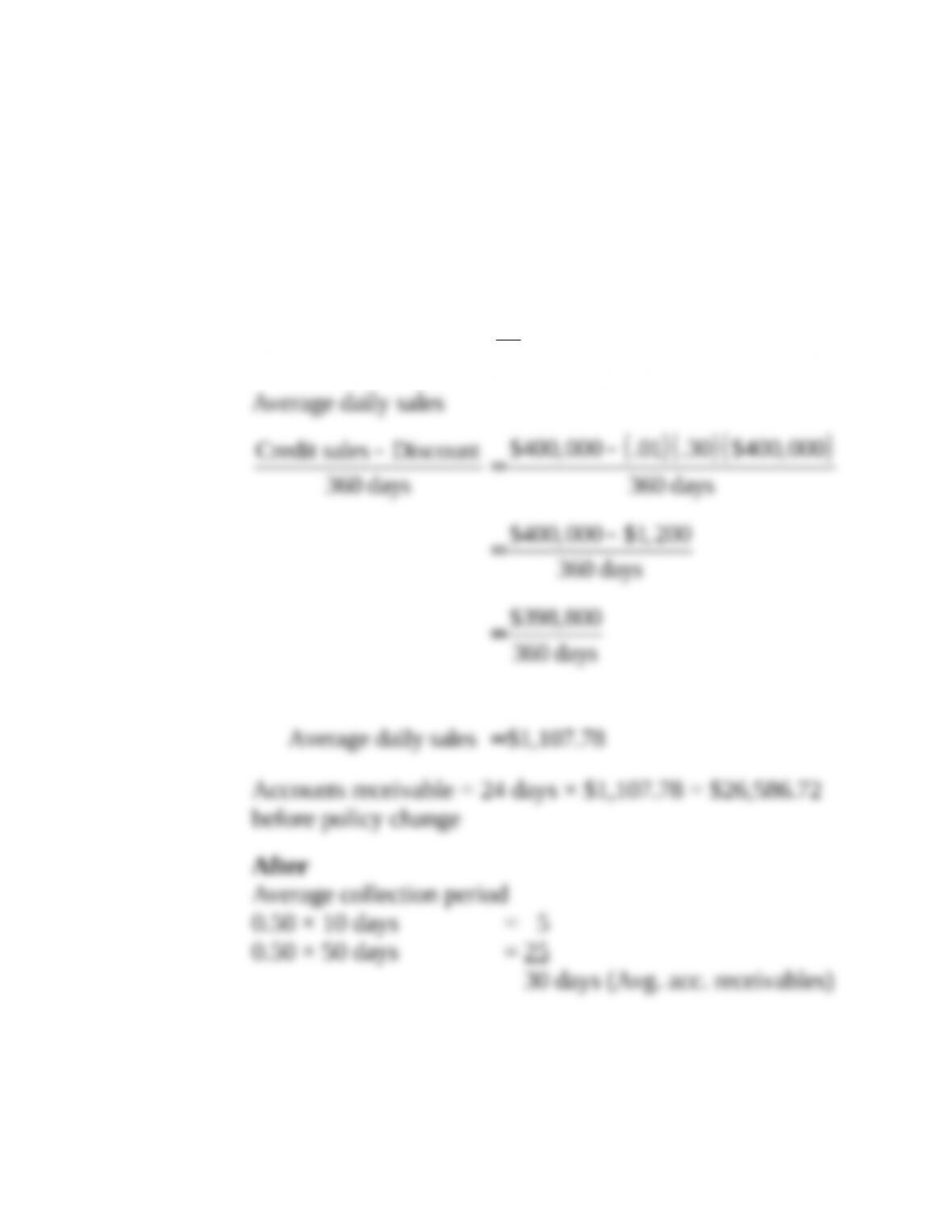
a. Accounts receivable = Average collection × Average daily
period sales
Before
Average collection period
0.30 × 10 days = 3
0.70 × 30 days = 21
24 days (Avg. acc. receivables)
CP 7-1. (Continued)
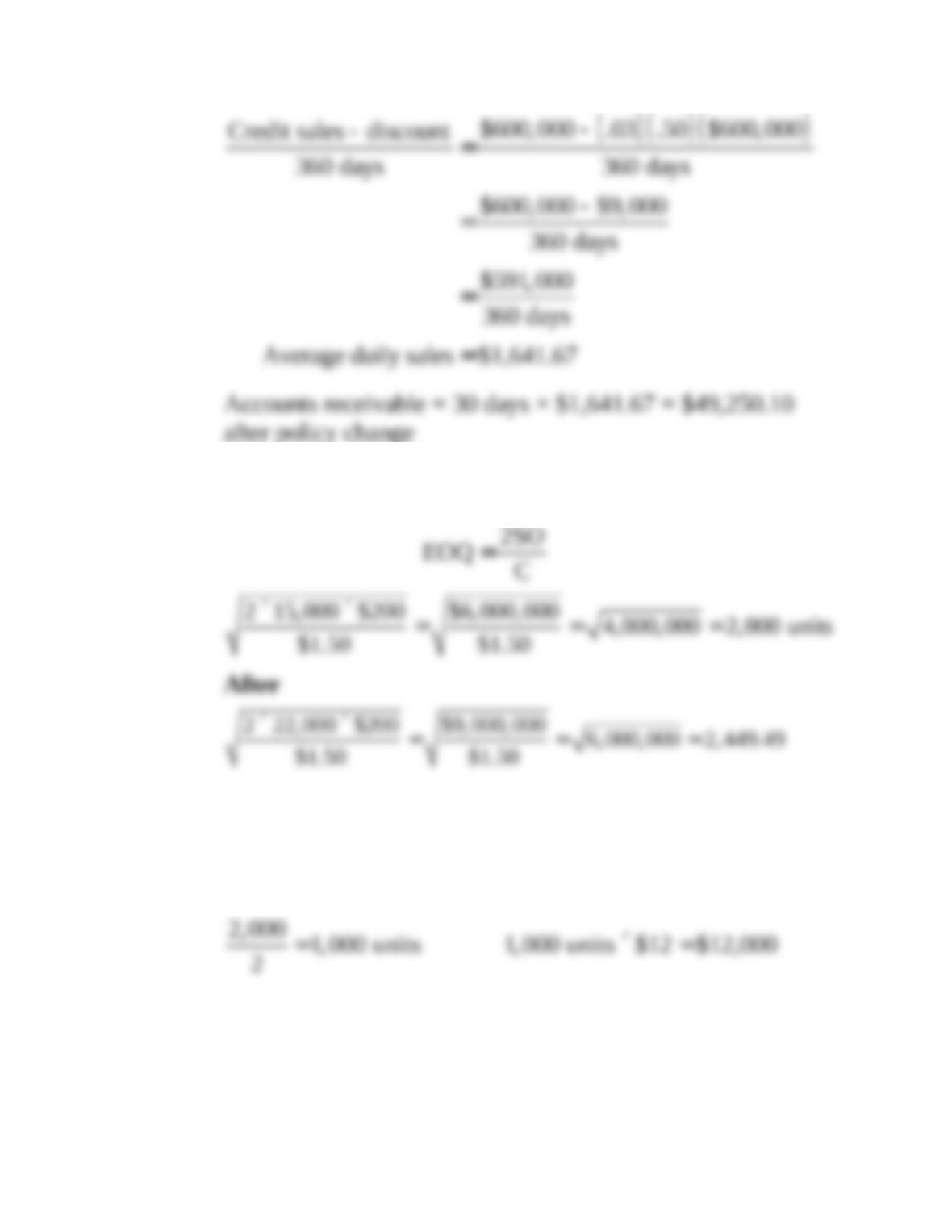
Average daily sales
( ) ( ) ( )
$600,000 .03 .50 $600,000
Credit sales discount
360 days 360 days
$600,000 $9,000
360 days
$591,000
360 days
Average daily sales $1,641.67
–
–=
–
=
=
=
Accounts receivable = 30 days × $1,641.67 = $49,250.10
after policy change
b. Before
2SO
EOQ C
=
2 15,000 $200 $6,000,000 4,000,000 2,000 units
$1.50 $1.50
´ ´ = = =
After
2 22,000 $200 $9,000,000 6,000,000 2,449.49
$1.50 $1.50
´ ´ = = =
Average inventory
Before
2,000 1,000 units 1,000 units $12 $12,000
2= ´ =
CP 7-1. (Continued)
After
1,224.75 units 1,224.75 units × $12 =
or 1,225 (rounded) $14,697 or $14,700
(rounded)
2,449.49
2=
c.
Before
Policy
Change
After
Policy
Change
Net sales (Sales – Cash discount) $398,800 $591,000
Cost of goods sold (65%) 259,220 384,150
Gross profit 139,580 206,850