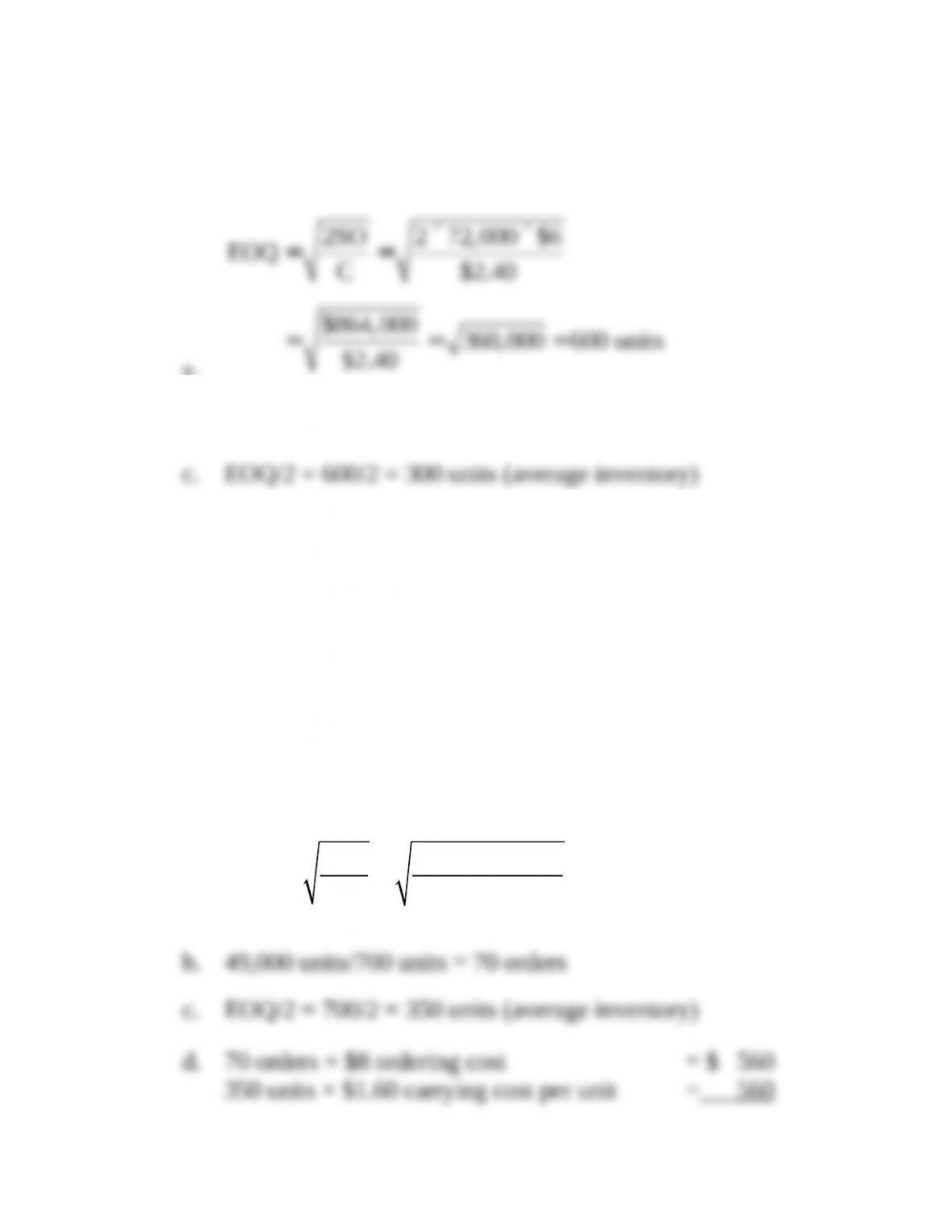
7-12. Solution:
Nowlin Pipe and Steel Company
2SO 2 72,000 $6
EOQ C $2.40
$864,000 360,000 600 units
$2.40
´ ´
= =
= = =
14. Economic ordering quantity (LO5) Fisk Corporation is trying to improve its inventory
control system and has installed an online computer at its retail stores. Fisk anticipates
sales of 49,000 units per year, an ordering cost of $2 per order, and carrying costs of $1.60
per unit.
a. What is the economic ordering quantity?
b. How many orders will be placed during the year?
c. What will the average inventory be?
d. What is the total cost of ordering and carrying inventory?
7-14. Solution:
Fisk Corp. (Continued)
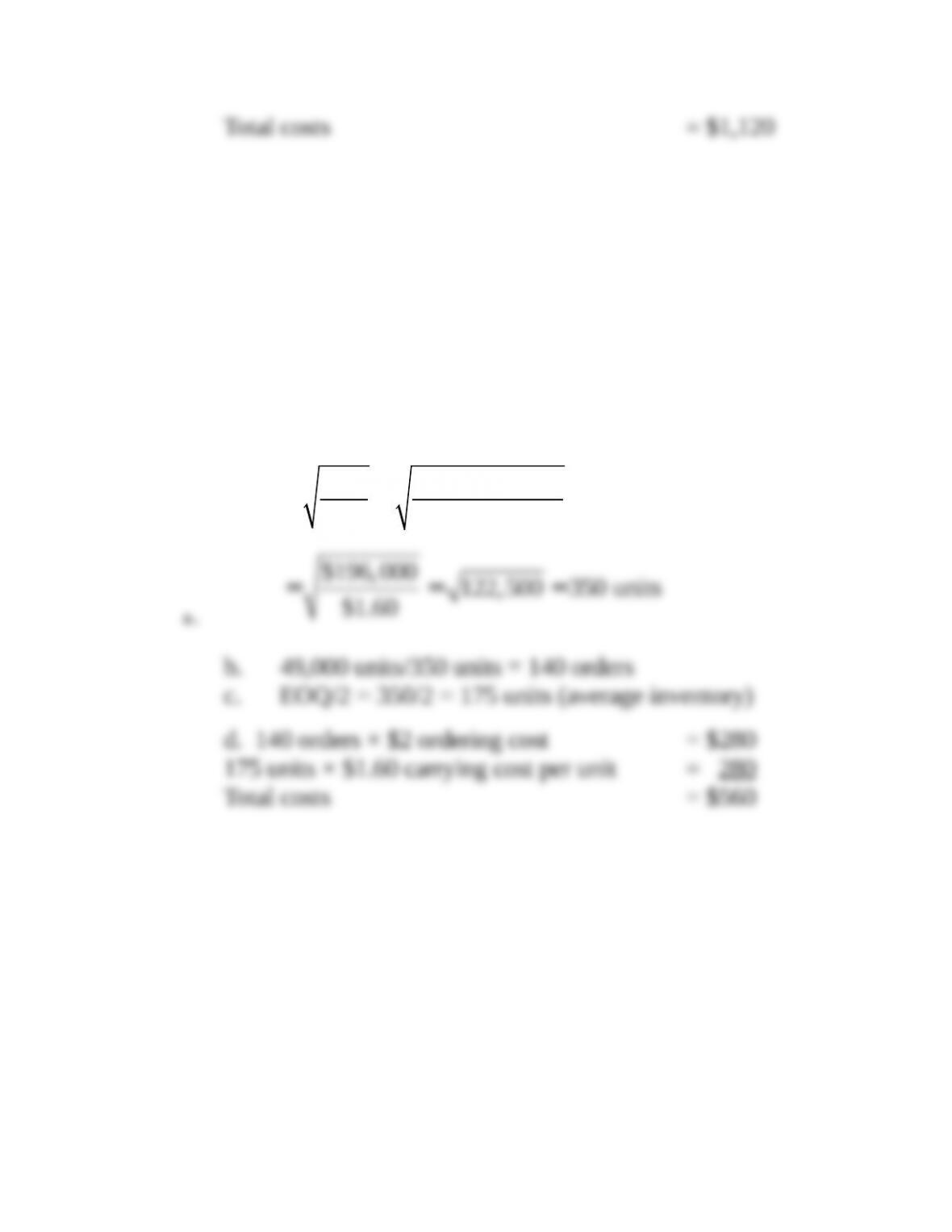
2SO 2 49,000 $2
EOQ C $1.60
$196,000 122,500 350 units
$1.60
´ ´
= =
= = =
b. 49,000 units/350 units = 140 orders
c. EOQ/2 = 350/2 = 175 units (average inventory)
d. 140 orders × $2 ordering cost = $280
175 units × $1.60 carrying cost per unit = 280
Total costs = $560
15. Economic ordering quantity with safety stock (LO5) Diagnostic Supplies has expected
sales of 84,100 units per year, carrying costs of $5 per unit, and an ordering cost of $10 per
order.
a. What is the economic order quantity?
b. What is the average inventory? What is the total carrying cost?
c. Assume an additional 80 units of inventory will be required as safety stock. What will
the new average inventory be? What will the new total carrying cost be?
7-15. Solution:
Diagnostic Supplies
a.
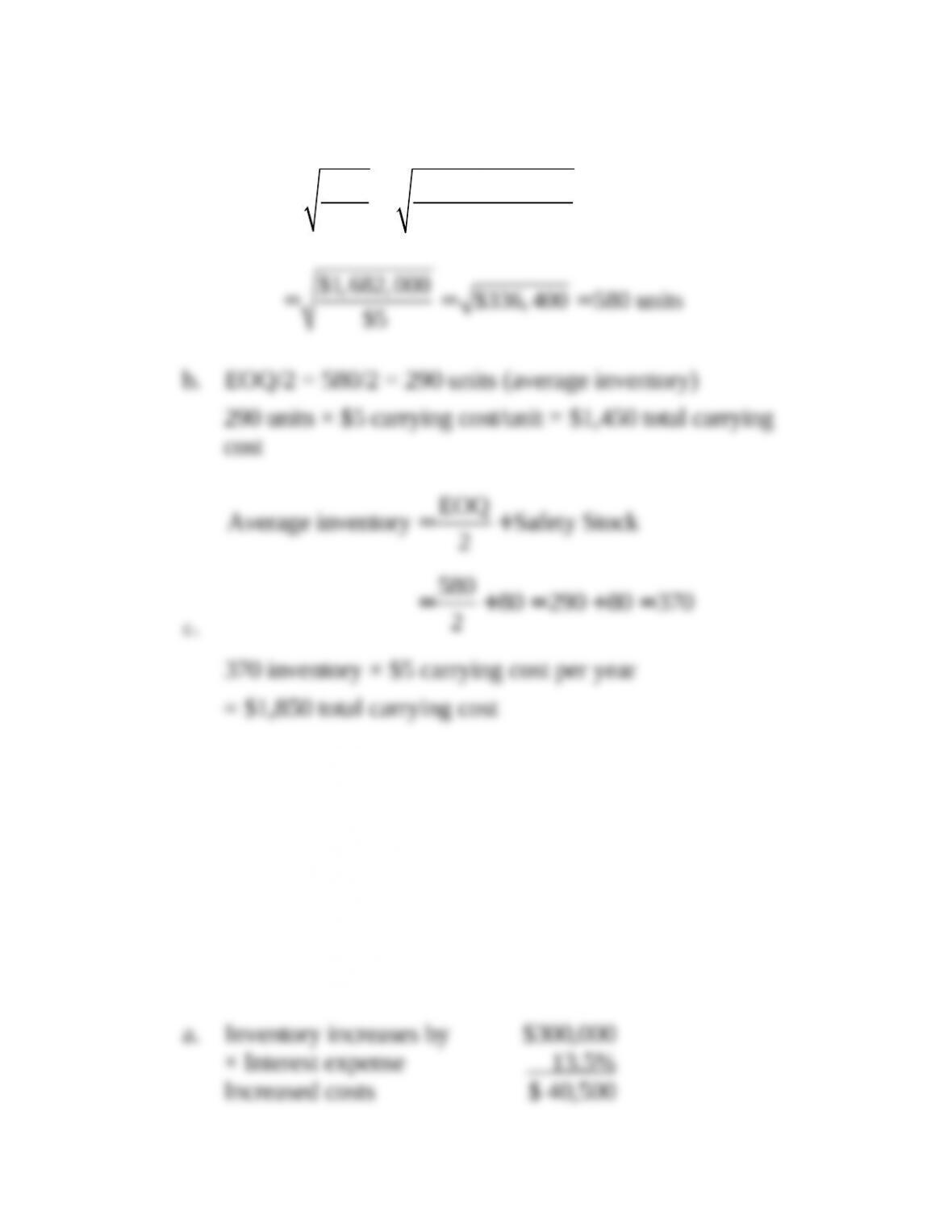
2SO 2 84,100 $10
EOQ C $5
´ ´
= =
$1,682,000 $336,400 580 units
$5
= = =
b. EOQ/2 = 580/2 = 290 units (average inventory)
290 units × $5 carrying cost/unit = $1,450 total carrying
cost
c.
EOQ
Average inventory Safety Stock
2
580 80 290 80 370
2
= +
= + = + =
370 inventory × $5 carrying cost per year
= $1,850 total carrying cost
16. Level versus seasonal production (LO5) Wisconsin Snowmobile Corp. is considering a
switch to level production. Cost efficiencies would occur under level production, and
aftertax costs would decline by $36,000, but inventory would increase by $300,000.
Wisconsin Snowmobile has to finance the extra inventory at a cost of 13.5 percent.
a. Determine the extra cost or savings of switching over to level production. Should the
company go ahead and switch to level production?
b. How low would interest rates need to fall before level production would be feasible?
7-16. Solution:
Wisconsin Snowmobile Corporation
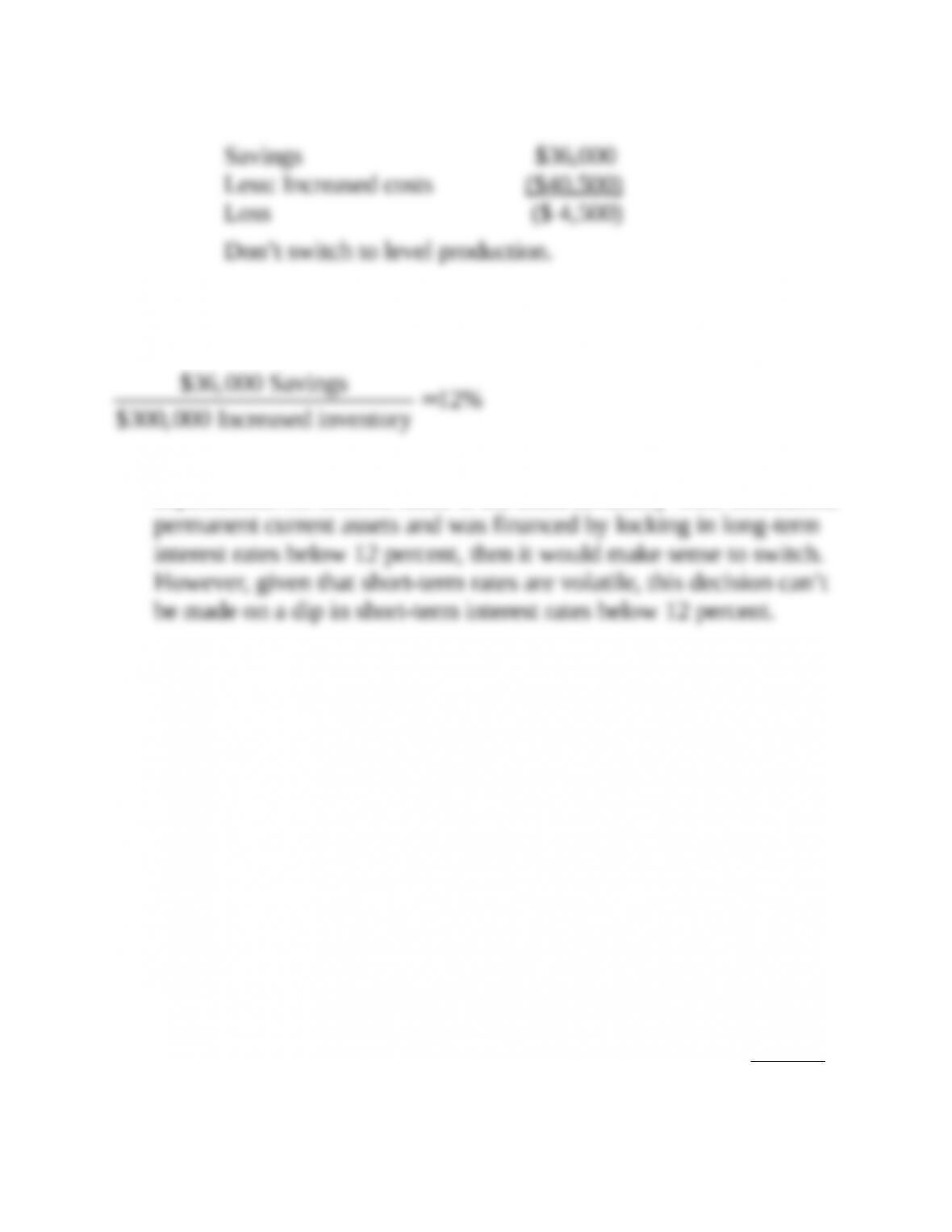
b. If interest rates fall to 12 percent or less, the switch would be
feasible.
$36,000 Savings 12%
$300,000 Increased inventory =
However, the decision is more complicated because it depends on
expectations for interest rates. If the extra inventory were considered
17. Credit policy decision (LO4) Johnson Electronics is considering extending trade credit to
some customers previously considered poor risks. Sales would increase by $150,000 if credit
is extended to these new customers. Of the new accounts receivable generated, 5 percent will
prove to be uncollectible. Additional collection costs will be 2 percent of sales, and production
and selling costs will be 74 percent of sales. The firm is in the 35 percent tax bracket.
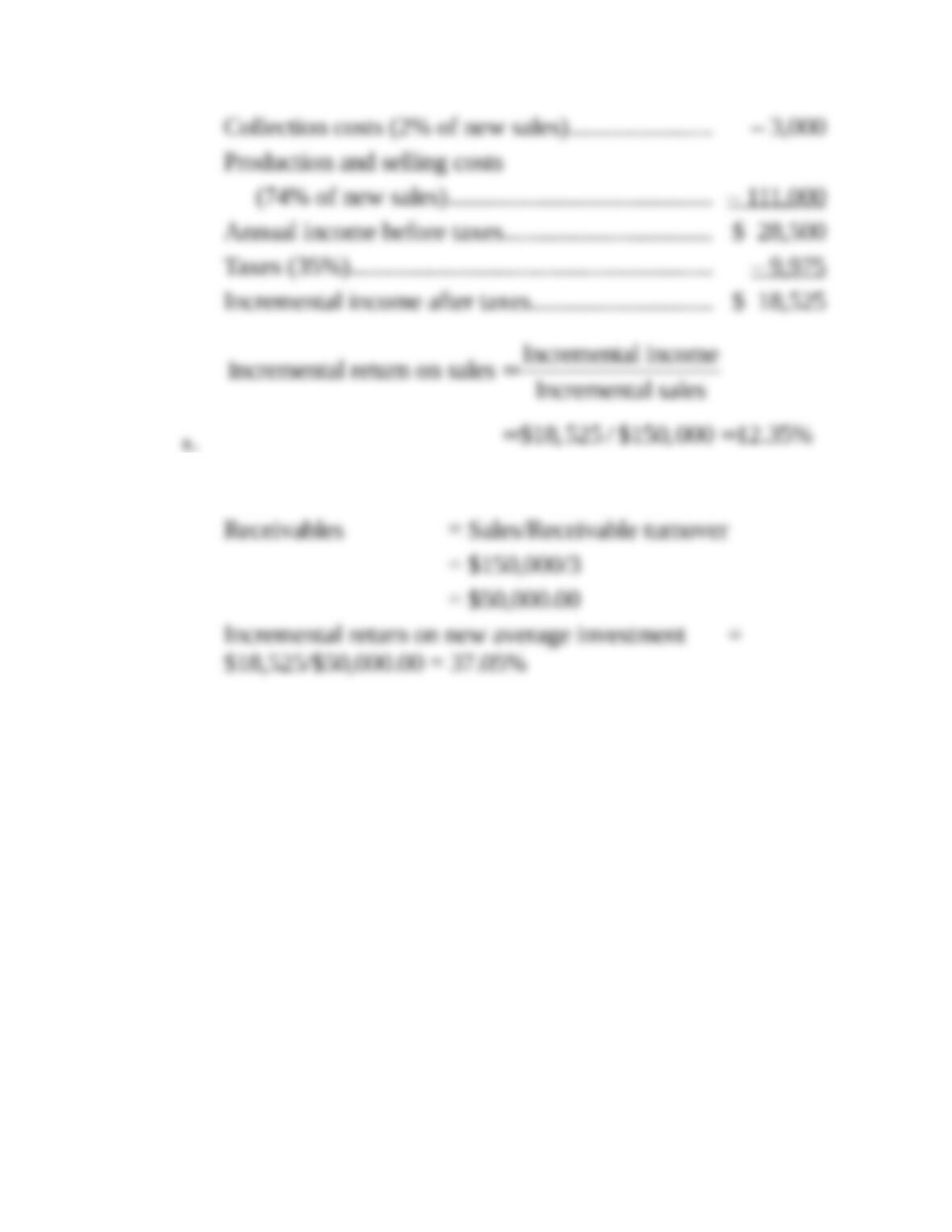
a. Compute the incremental income after taxes.
b. What will Johnson’s incremental return on sales be if these new credit customers are
accepted?
c. If the receivable turnover ratio is 3 to 1, and no other asset buildup is needed to serve
the new customers, what will Johnson’s incremental return on new average
investment be?
7-17. Solution:
Johnson Electronics
a. Additional sales………………………….….…..….….…. $150,000
Accounts uncollectible (5% of new sales)….…..… – 7,500
Annual incremental revenue……………..…..….….… $ 142,500
7-18. Solution:
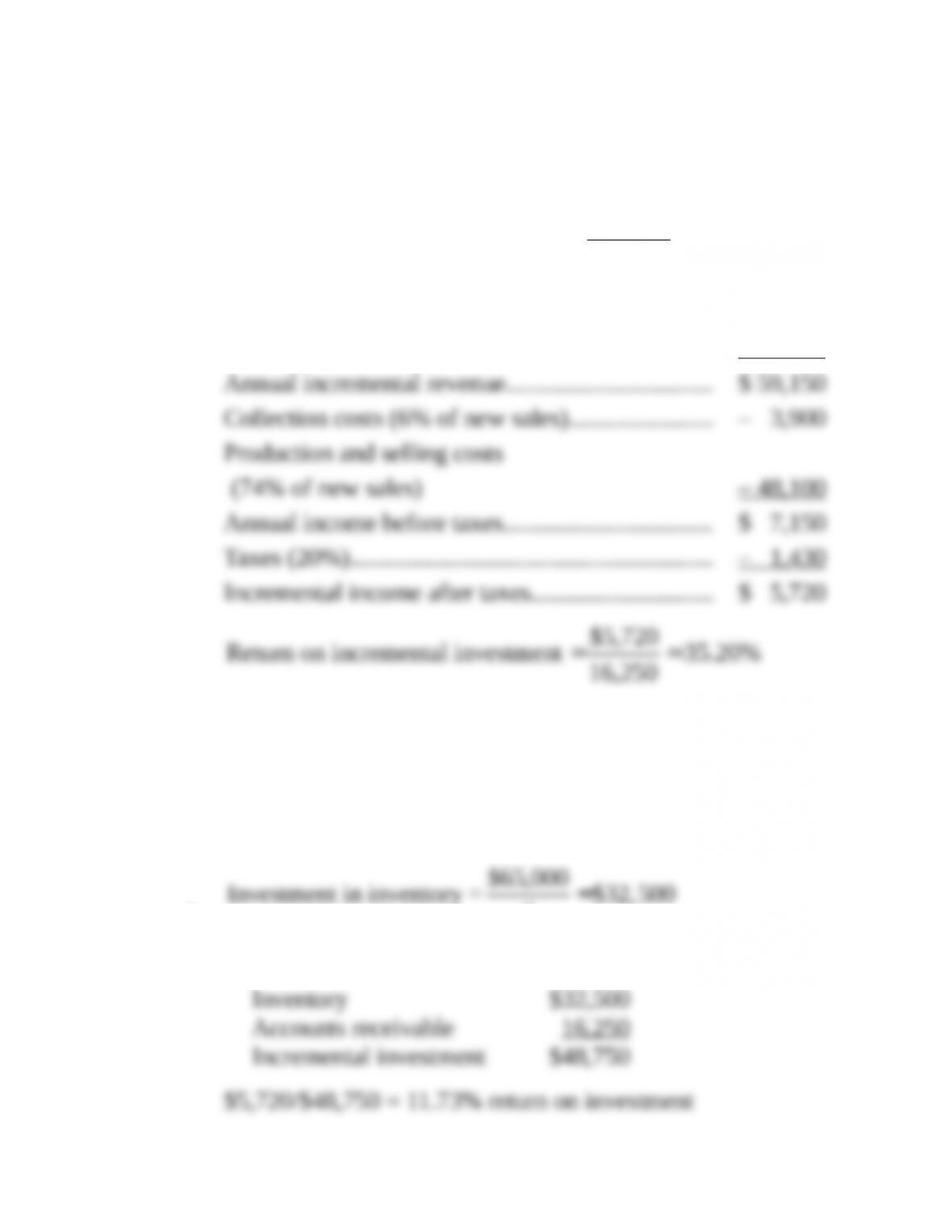
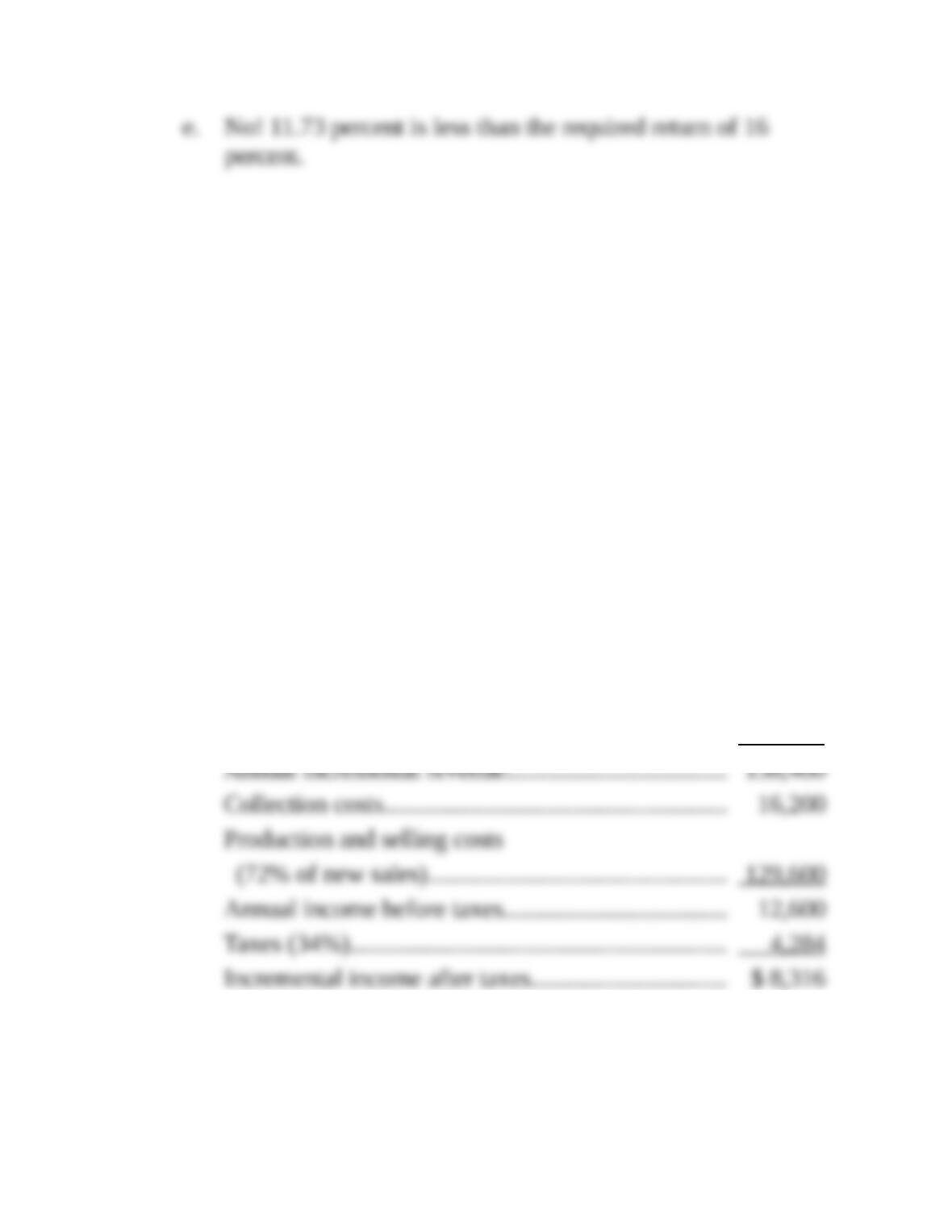
Henderson Office Supply
a.
$65,000
Investment in accounts receivable $16,250
4
= =
b. Added sales………………………………………………..… $ 65,000
Accounts uncollectible (9% of new sales)….…..… – 5,850
19. Credit policy decision with changing variables (LO4) Fast Turnstiles Co. is evaluating
the extension of credit to a new group of customers. Although these customers will provide
$180,000 in additional credit sales, 12 percent are likely to be uncollectible. The company
will also incur $16,200 in additional collection expense. Production and marketing costs
represent 72 percent of sales. The firm is in a 34 percent tax bracket and has a receivables
turnover of four times. No other asset buildup will be required to service the new
customers. The firm has a 10 percent desired return.
a. Calculate the incremental income after taxes and the return on incremental
investment. Should Fast Turnstiles Co. extend credit to these customers?
b. Calculate the incremental income after taxes and the return on incremental investment
if 15 percent of the new sales prove to be uncollectible. Should credit be extended if
15 percent of the new sales prove uncollectible?
c. Calculate the return on incremental investment if the receivables turnover drops to
1.6, and 12 percent of the accounts are uncollectible. Should credit be extended if the
receivables turnover drops to 1.6, and 12 percent of the accounts are uncollectible (as
in part a)?
7-19. Solution:
Fast Turnstiles Co.
a. Added sales…………………………………………….….….. $180,000
Accounts uncollectible (12% of new sales)..…....... 21,600
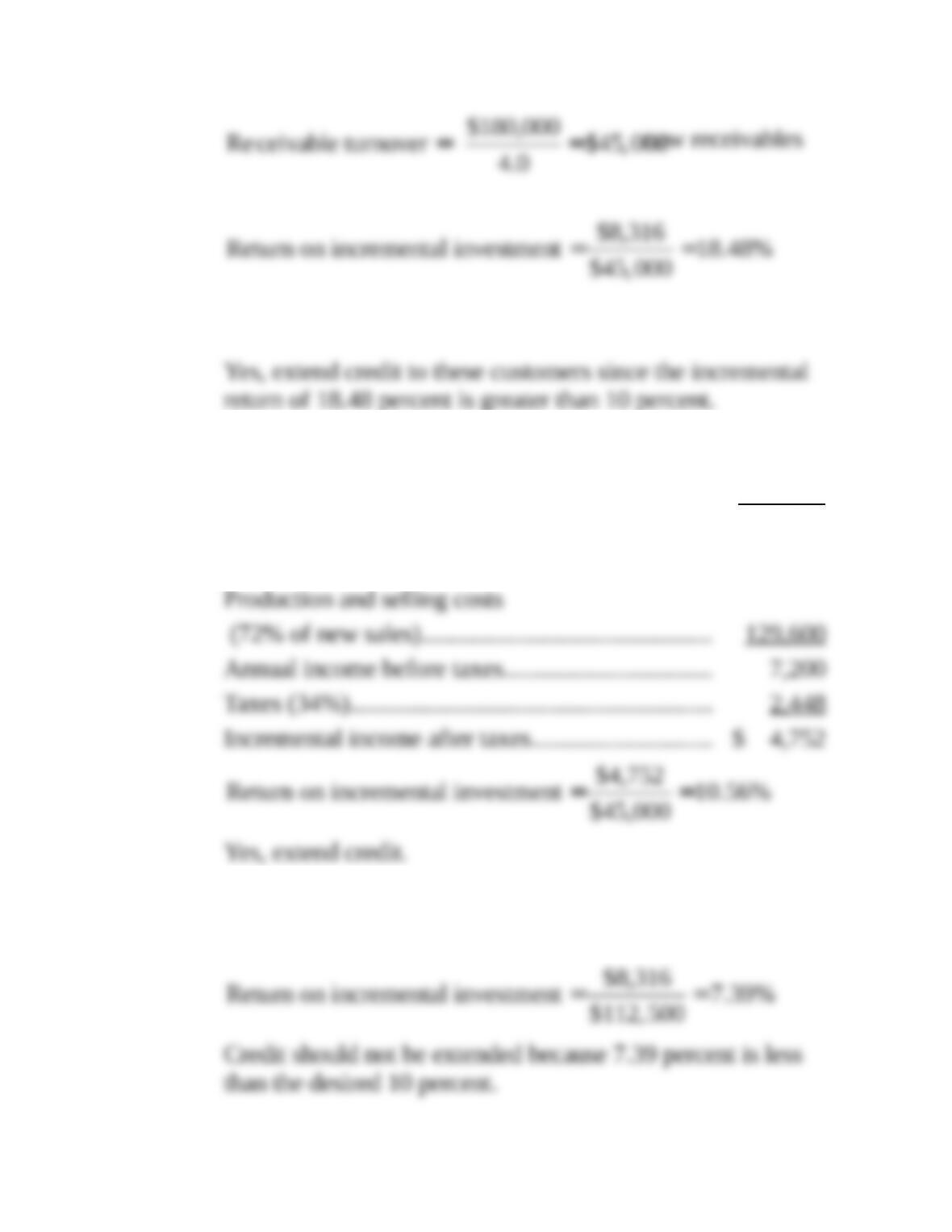
$180,000
Re ceivable turnover $45, 000
4.0
$8,316
Return on incremental investment 18.48%
$45, 000
= =
= =
Yes, extend credit to these customers since the incremental
return of 18.48 percent is greater than 10 percent.
b. Added sales………………………………………………..… $180,000
Accounts uncollectible (15% of new sales)..…..… 27,000
Annual incremental revenue……………..…..….….… $153,000
Collection costs…………………………………………….. 16,200
c. If receivable turnover drops to 1.6x, the investment in
accounts receivable would equal $180,000/1.6 = $112,500.
$8,316
Return on incremental investment 7.39%
$112,500
= =
Credit should not be extended because 7.39 percent is less
than the desired 10 percent.
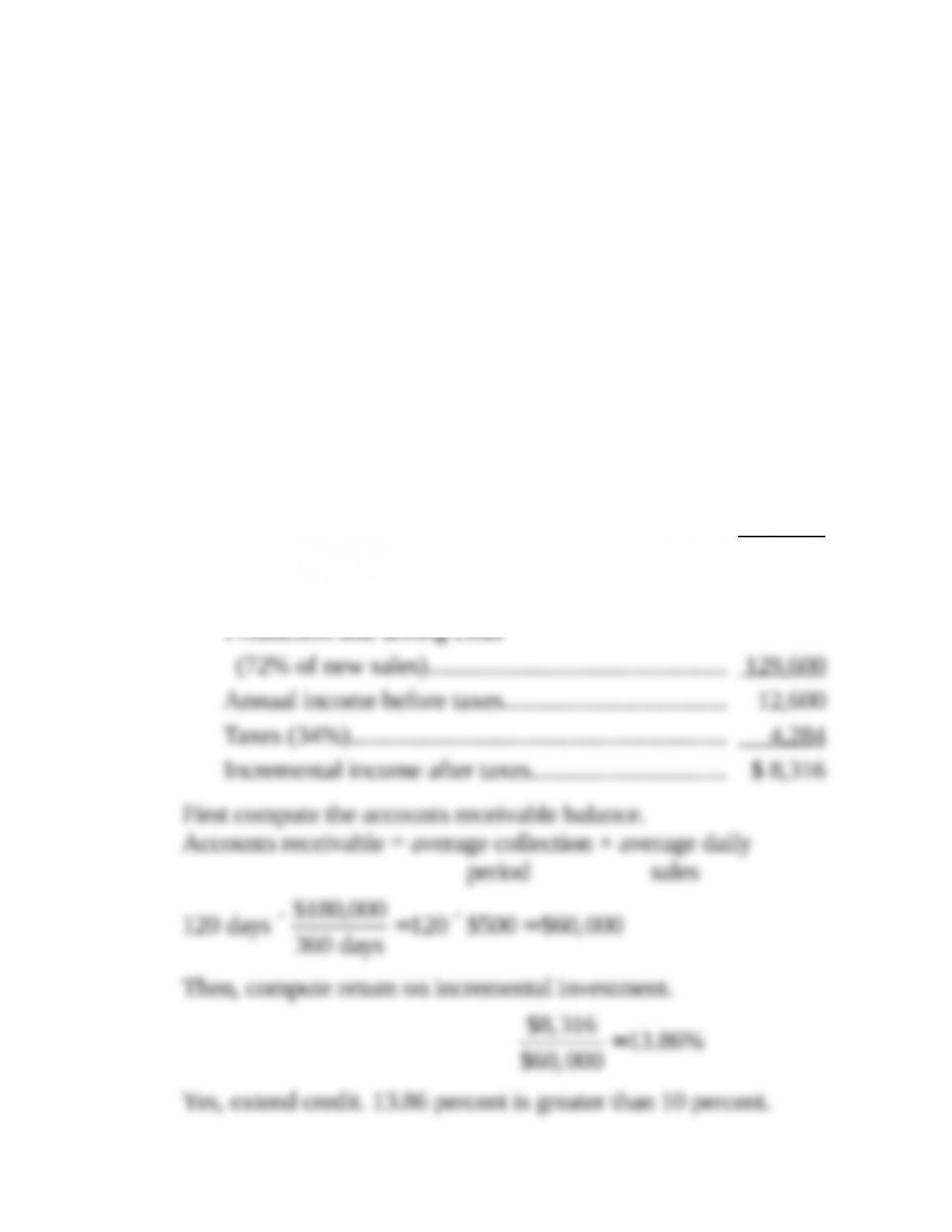
new receivables
20. Credit policy decision with changing variables (LO4) Slow Roll Drum Co. is evaluating
the extension of credit to a new group of customers. Although these customers will provide
$180,000 in additional credit sales, 12 percent are likely to be uncollectible. The company
will also incur $16,200 in additional collection expense. Production and marketing costs
represent 72 percent of sales. The firm is in a 34 percent tax bracket. No other asset buildup
will be required to service the new customers. The firm has a 10 percent desired return.
Assume the average collection period is 120 days.
a. Compute the return on incremental investment
b. Should credit be extended?
7-20. Solution:
Slow Roll Drum Co.
a. Added sales…………………………………………….….….. $180,000
Accounts uncollectible (12% of new sales)..…....... 21,600
Annual incremental revenue…………..….….….….….. 158,400
Collection costs…………………………………….….….…. 16,200
21. Credit policy and return on investment (LO4) Global Services is considering a
promotional campaign that will increase annual credit sales by $450,000. The company
will require investments in accounts receivable, inventory, and plant and equipment. The
turnover for each is as follows:
Accounts receivable……………….….….….….. 2x
Inventory……………………………….….….….…. 6x
Plant and equipment………………………..….… 1x
All $450,000 of the sales will be collectible. However, collection costs will be 6 percent of
sales, and production and selling costs will be 71 percent of sales. The cost to carry
inventory will be 4 percent of inventory. Depreciation expense on plant and equipment will
be 5 percent of plant and equipment. The tax rate is 30 percent.
a. Compute the investments in accounts receivable, inventory, and plant and equipment
based on the turnover ratios. Add the three together.
b. Compute the accounts receivable collection costs and production and selling costs
and then add the two figures together.
c. Compute the costs of carrying inventory.
d. Compute the depreciation expense on new plant and equipment.
e. Add together all the costs in parts b, c, and d.
f. Subtract the answer from part e from the sales figure of $450,000 to arrive at income
before taxes. Subtract taxes at a rate of 30 percent to arrive at income after taxes.
g. Divide the aftertax return figure in part f by the total investment figure in part a. If the
firm has a required return on investment of 8 percent, should it undertake the
promotional campaign described throughout this problem.
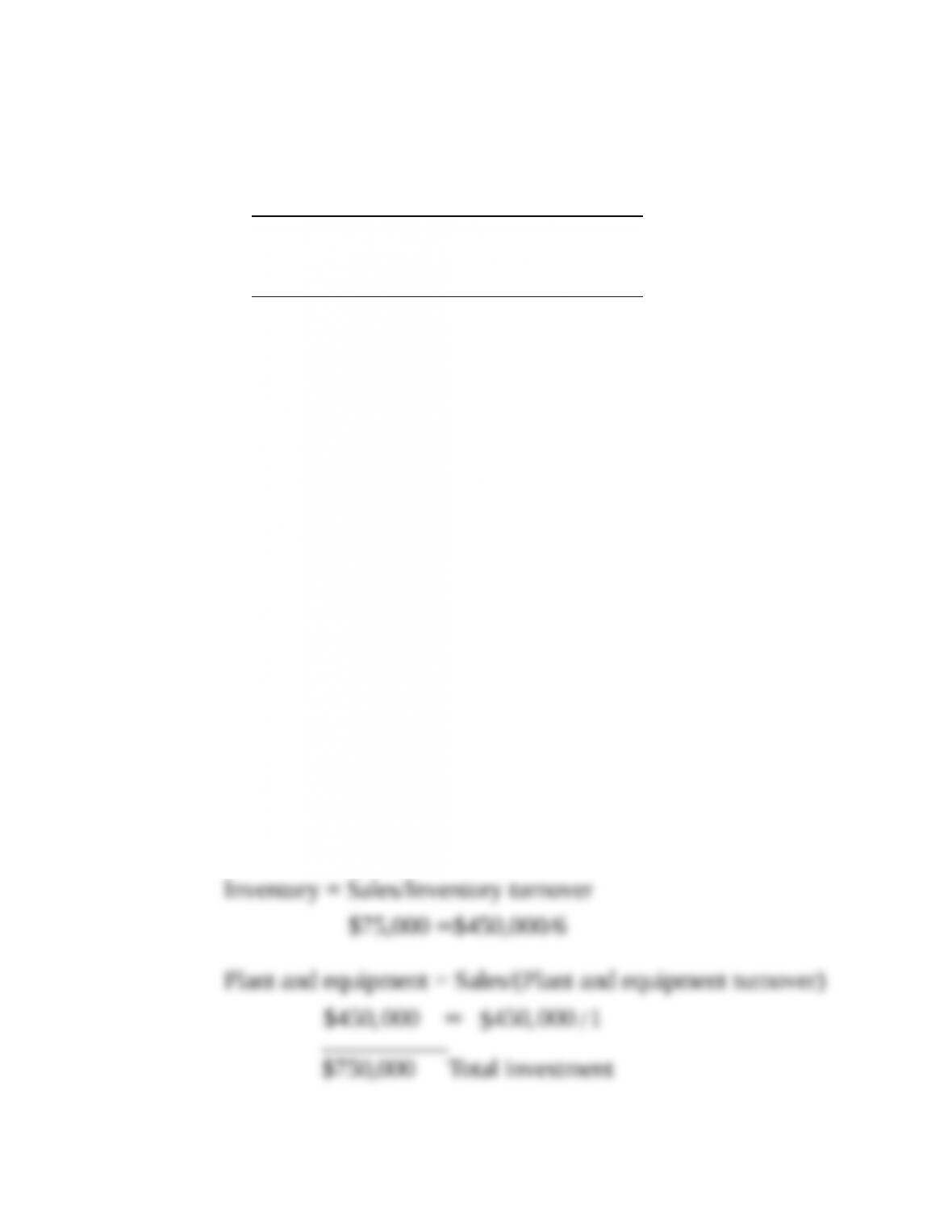
7-21. Solution:
Global Services
a. Accounts receivable = Sales/Accounts receivable turnover
$225,000 $450,000/2=