CP 5-1. Solution:
Ryan Boot Company
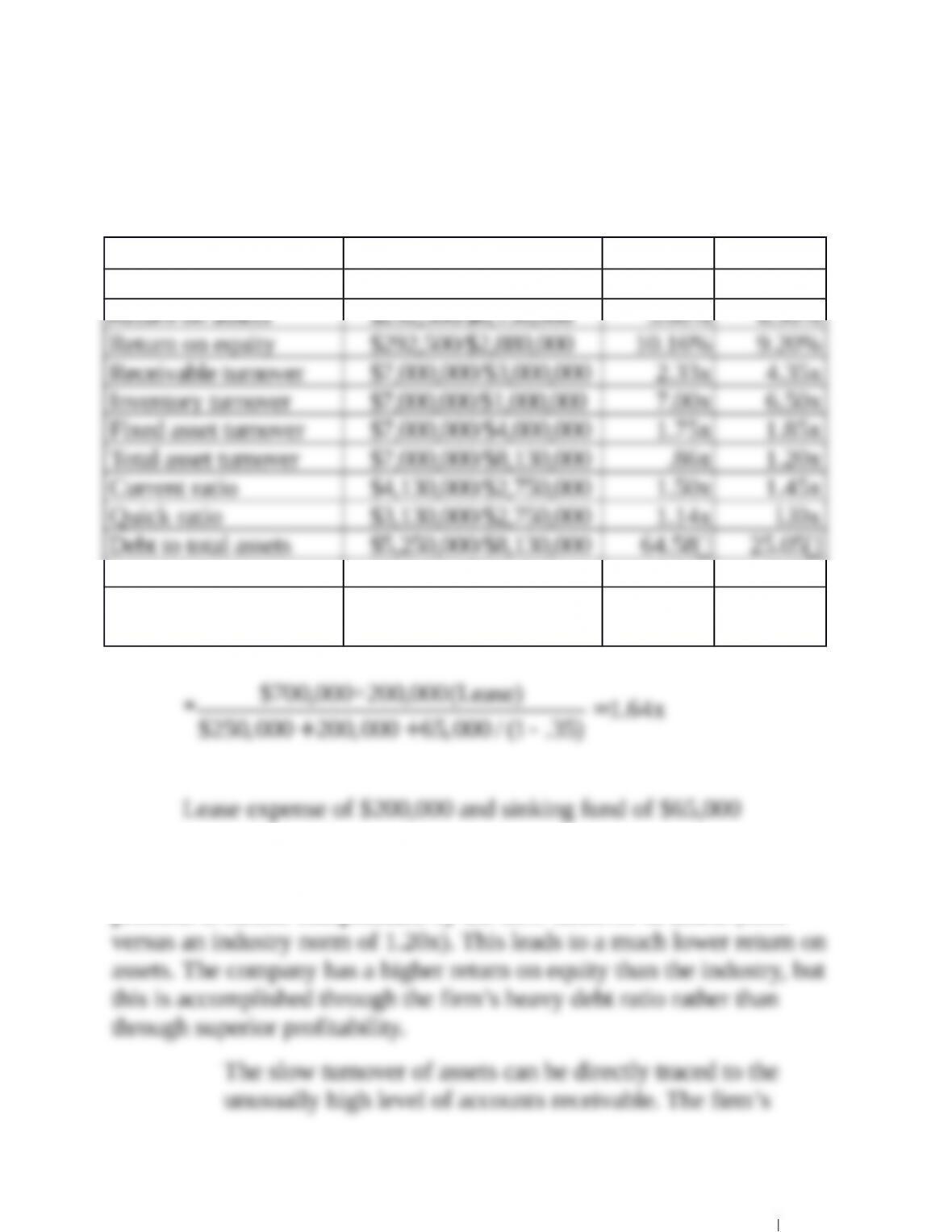
a. Ratio analysis Ryan Industry
Profit margin $292,500/$7,000,000 4.18% 5.75%
Return on assets
$292,500/$8,130,000
3.60%
6.90%
Return on equity
$292,500/$2,880,000
10.16%
9.20%
Receivable turnover
$7,000,000/$3,000,000
2.33x
4.35x
Inventory turnover
$7,000,000/$1,000,000
7.00x
6.50x
Fixed asset turnover
$7,000,000/$4,000,000
1.75x
1.85x
Total asset turnover
$7,000,000/$8,130,000
.86x
1.20x
Current ratio
$4,130,000/$2,750,000
1.50x
1.45x
Quick ratio
$3,130,000/$2,750,000
1.14x
l.l0x
Debt to total assets
$5,250,000/$8,130,000
64.58
25.05
Interest coverage
$700,000/$250,000
2.80x
5.35x
Fixed charge coverage See calculation below* 1.64x 4.62x
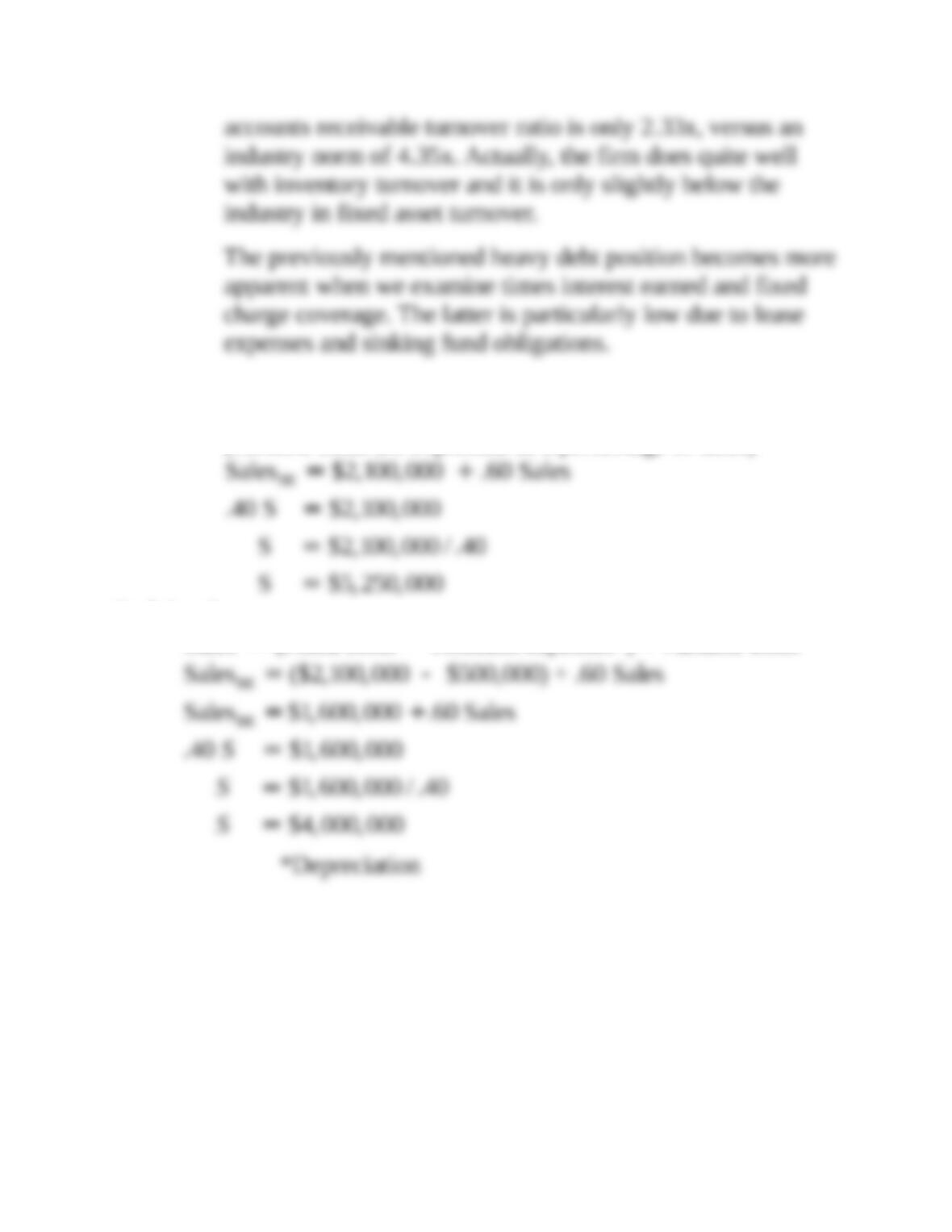
$700,000+200,000(Lease)
* 1.64x
$250,000 200,000 65,000 / (1 .35) =
+ + –
Lease expense of $200,000 and sinking fund of $65,000
a. The company has a lower profit margin than the industry and the
problem is further compounded by the slow turnover of assets (.86x
b. Break-even in sales
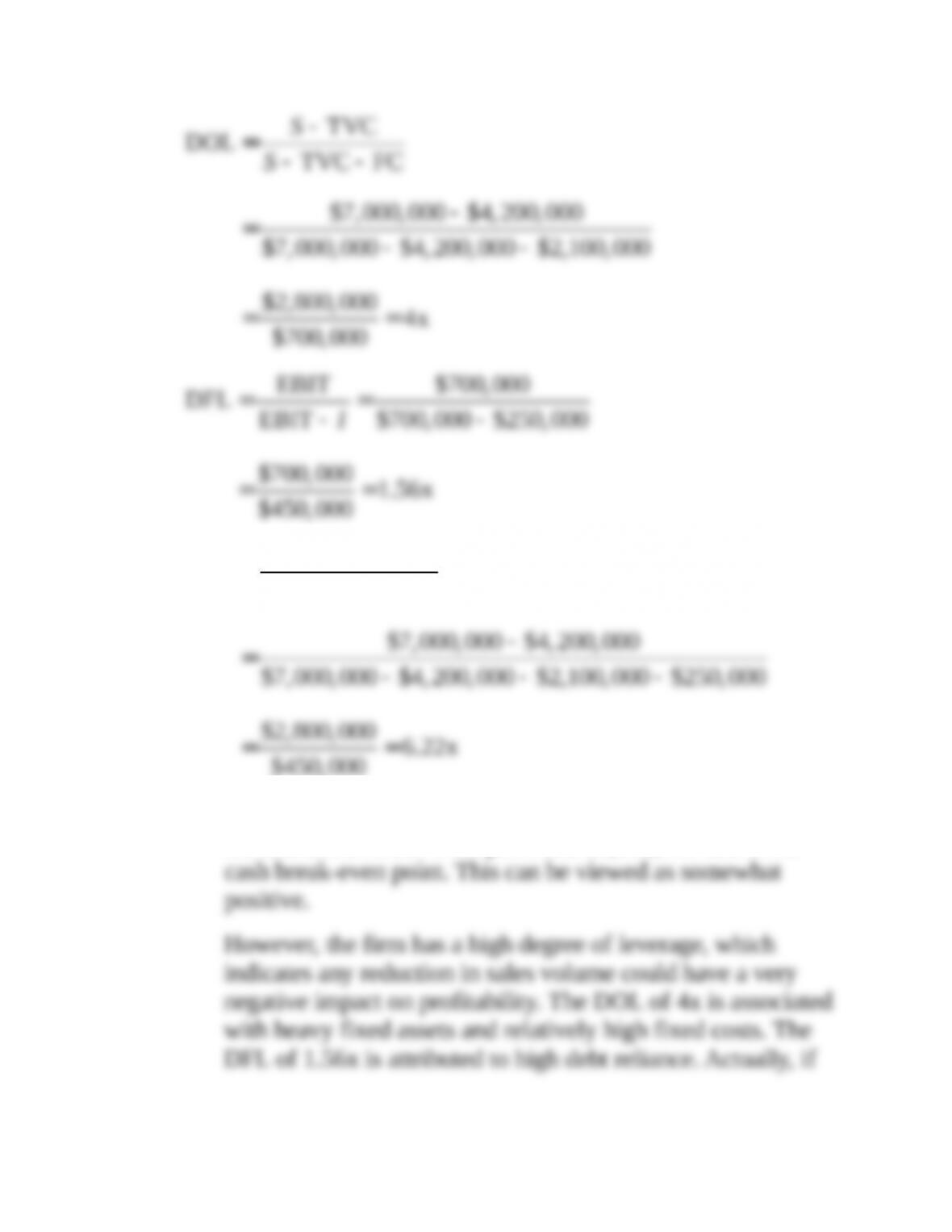
Sales Fixed costs Variable costs= +
(variable costs are expressed as a percentage of sales)
BE
Sales $2,100,000 .60 Sales
.40 S $2,100,000
S $2,100,000 / .40
S $5,250,000
= +
=
=
=
Cash break-even
Sales (Fixed costs Noncash expenses*) + Variable costs= –
BE
BE
Sales ($2,100,000 $500,000) + .60 Sales
Sales $1,600,000 .60 Sales
.40 $1,600,000
$1,600,000 / .40
$4,000,000
S
S
S
= –
= +
=
=
=
*Depreciation
TVC
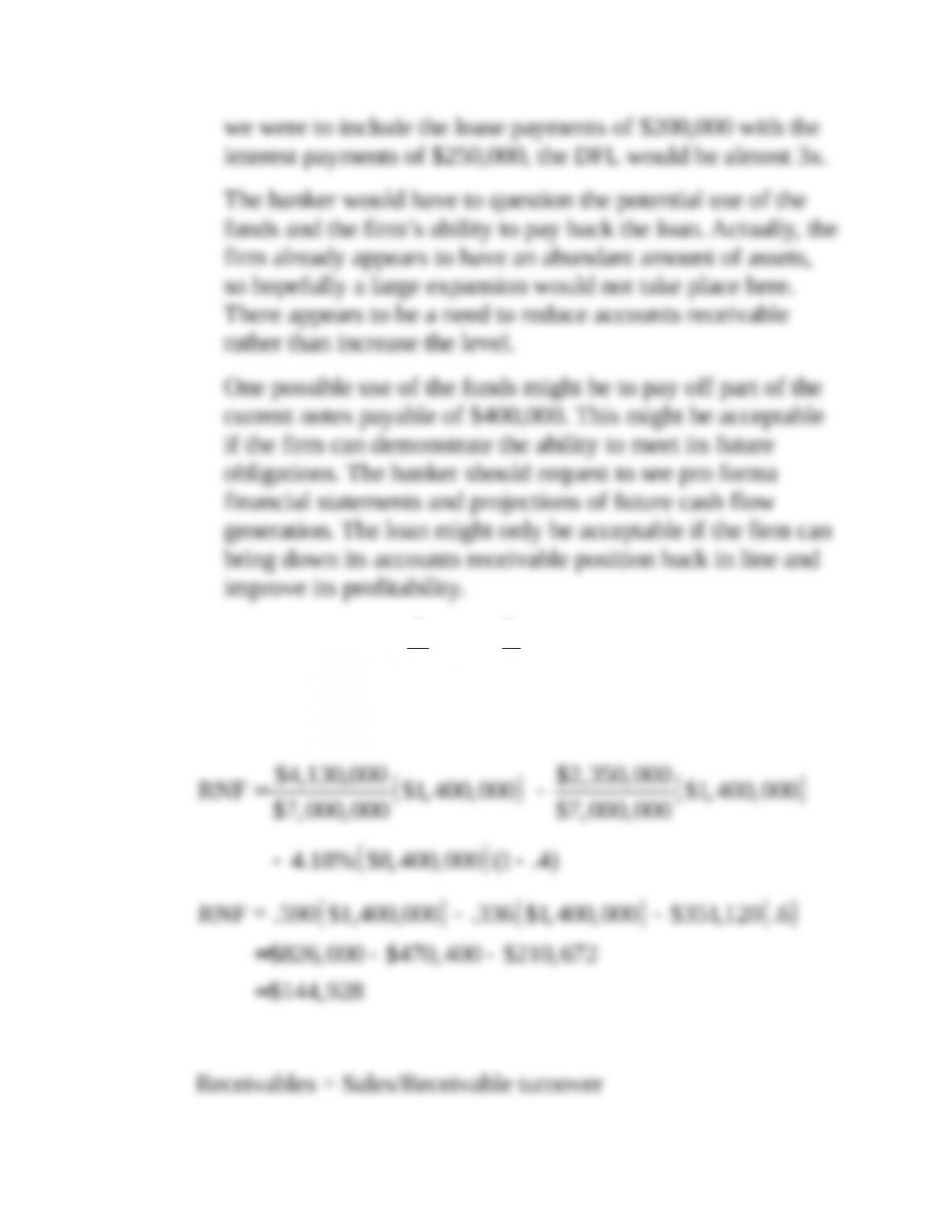
DOL TVC FC
$7,000,000 $4,200,000
$7,000,000 $4,200,000 $2,100,000
$2,800,000 4x
$700,000
S
S
–
=– –
–
=– –
= =
EBIT $700,000
DFL EBIT $700,000 $250,000
$700,000 1.56x
$450,000
I
= =
– –
= =
TVC
DCL TVC FC
$7,000,000 $4,200,000
$7,000,000 $4,200,000 $2,100,000 $250,000
$2,800,000 6.22x
$450,000
S
S I
–
=– – –
–
=– – –
= =
c. Ryan is operating at a sales volume that is $1,750,000 above
the traditional break-even point and $3,000,000 above the
d.
( ) ( ) ( )
2
A L
Required new funds= S S PS 1 D
S S
D – D – –
( ) ( )
( )
Change in Sales = 20% $7,000,000= $1,400,000
$4,130,000 $2,350,000
RNF $1,400,000 $1,400,000
$7,000,000 $7,000,000
4.18% $8,400,000 (1 .4)
´
= –
– –
( ) ( ) ( )
RNF = .590 $1,400,000 .336 $1,400,000 $351,120 .6
$826,000 $470,400 $210,672
$144,928
– –
= – –
=
e. Required funds if selected industry ratios were applied
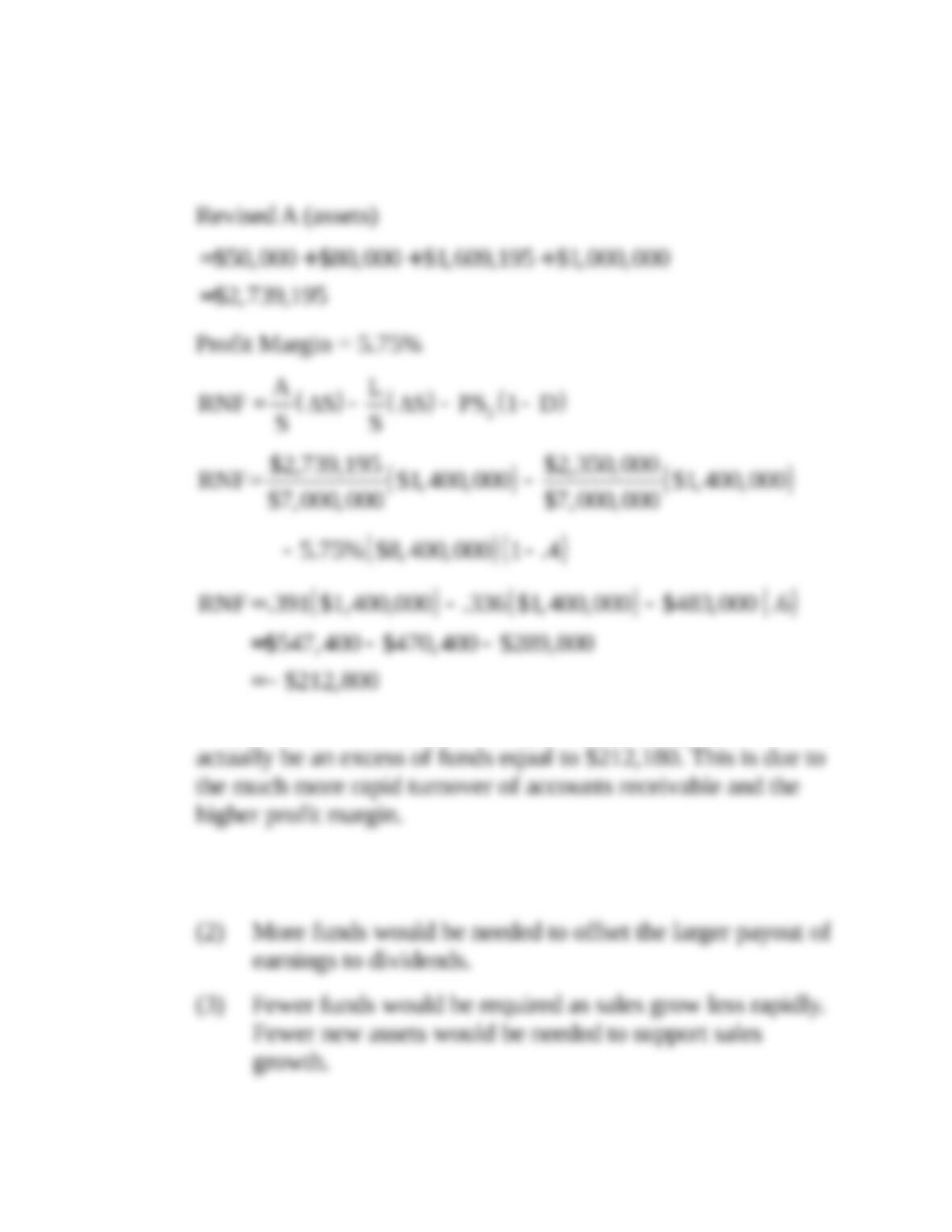
Receivables = $7,000,000/4.35
Receivables = $1,609,195

(4) As inflation increased, so would the cost of new assets,