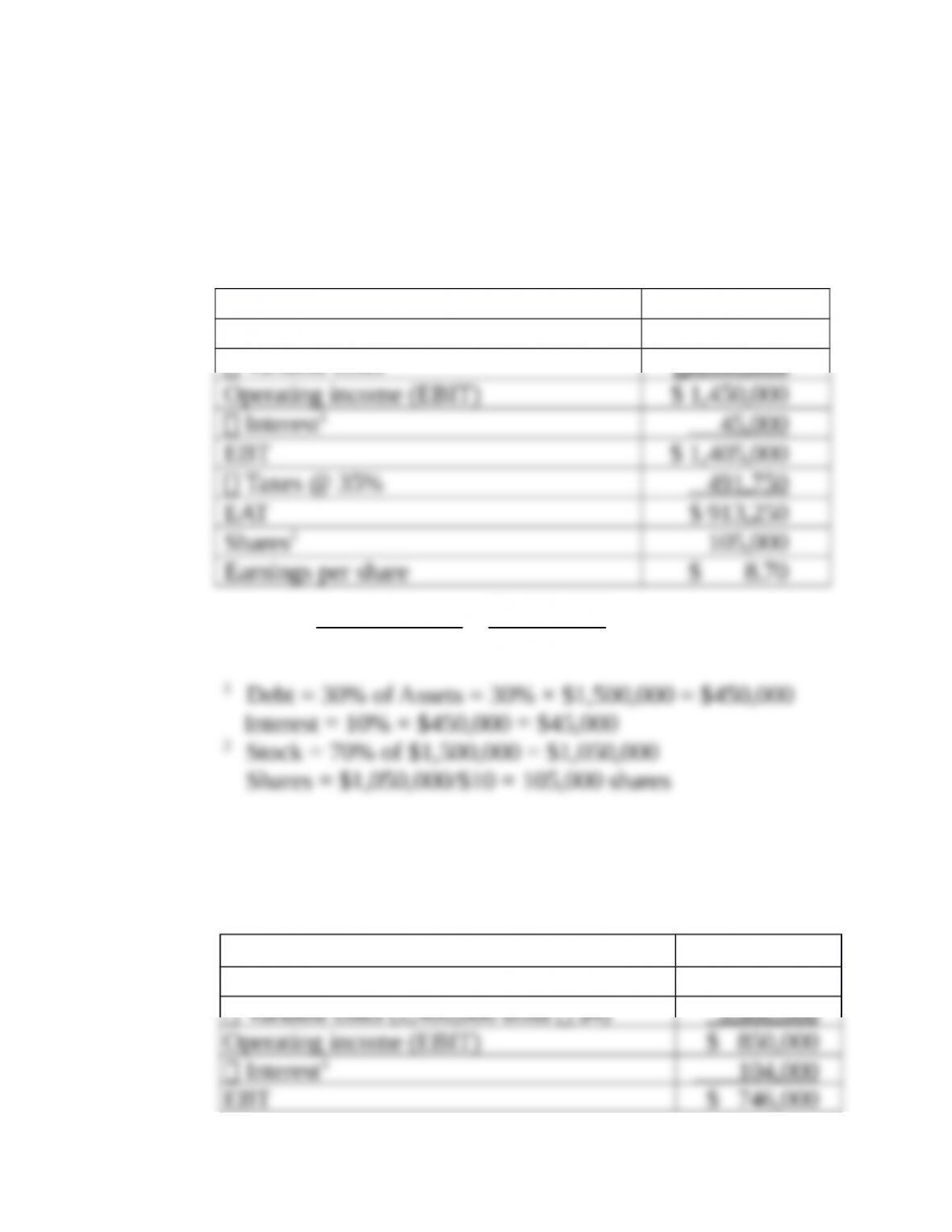
5-26. Solution:
Gold-Silverman
a. Gold Plan
Sales ($1,500,000 units $6) $9,000,000
Fixed costs 1,550,000
Variable costs 6,000,000
Sales $9,000,000
Assets $1,500,000
Asset turnover 6
= = =
5-26. (Continued)
b. Silverman Plan
Sales ($2,400,000 units at $5.00) $12,000,000
Fixed costs
1,550,000
Variable costs (2,400,000 units $4)
9,600,000
Operating income (EBIT)
$ 850,000
Interest3
104,000
EBT
$ 746,000
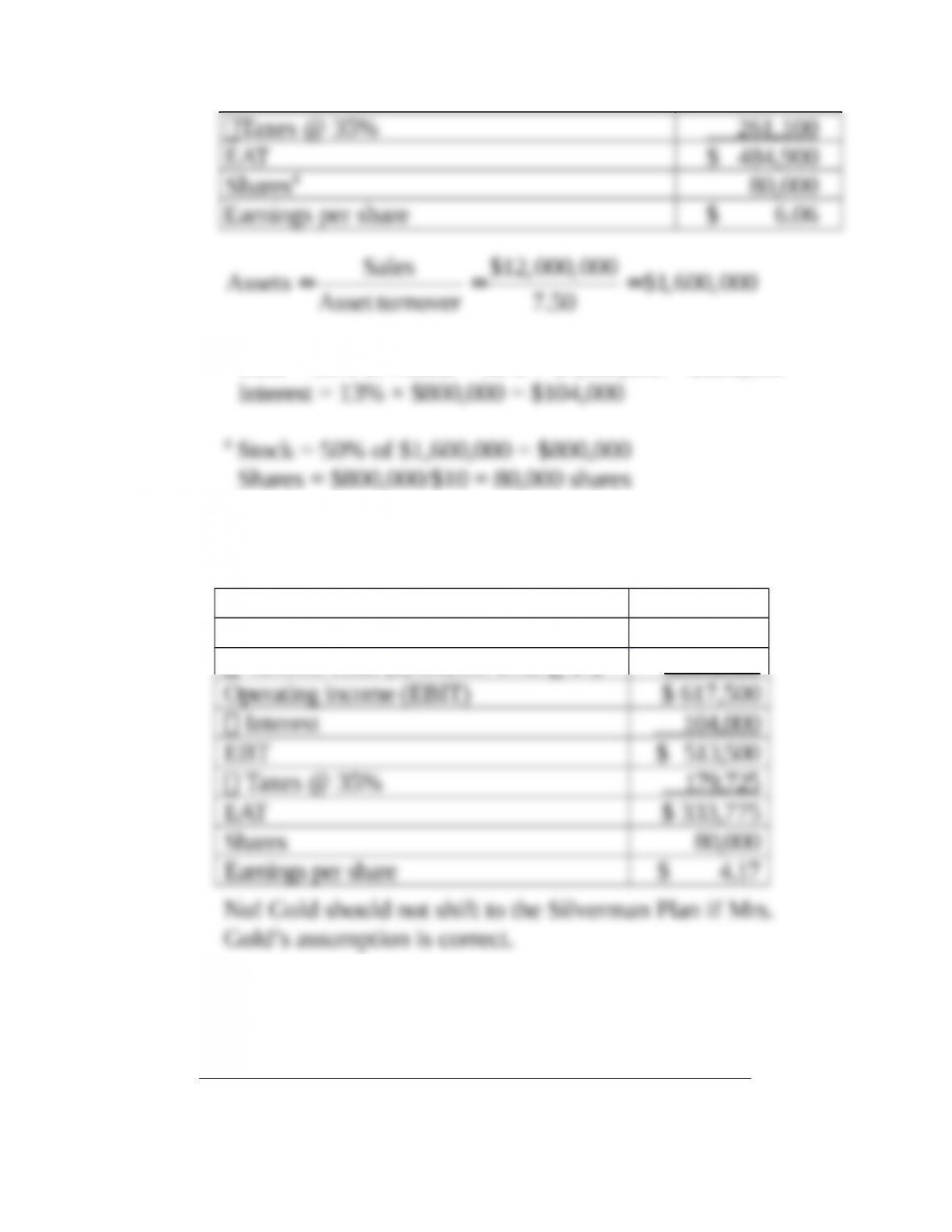
Taxes @ 35%
261,100
EAT
$ 484,900
Shares4
80,000
Earnings per share $ 6.06
Sales $12,000,000
Assets $1,600,000
Asset turnover 7.50
= = =
3 Debt = 50% of Assets = 50% × $1,600,000 = $800,000
5-26. (Continued)
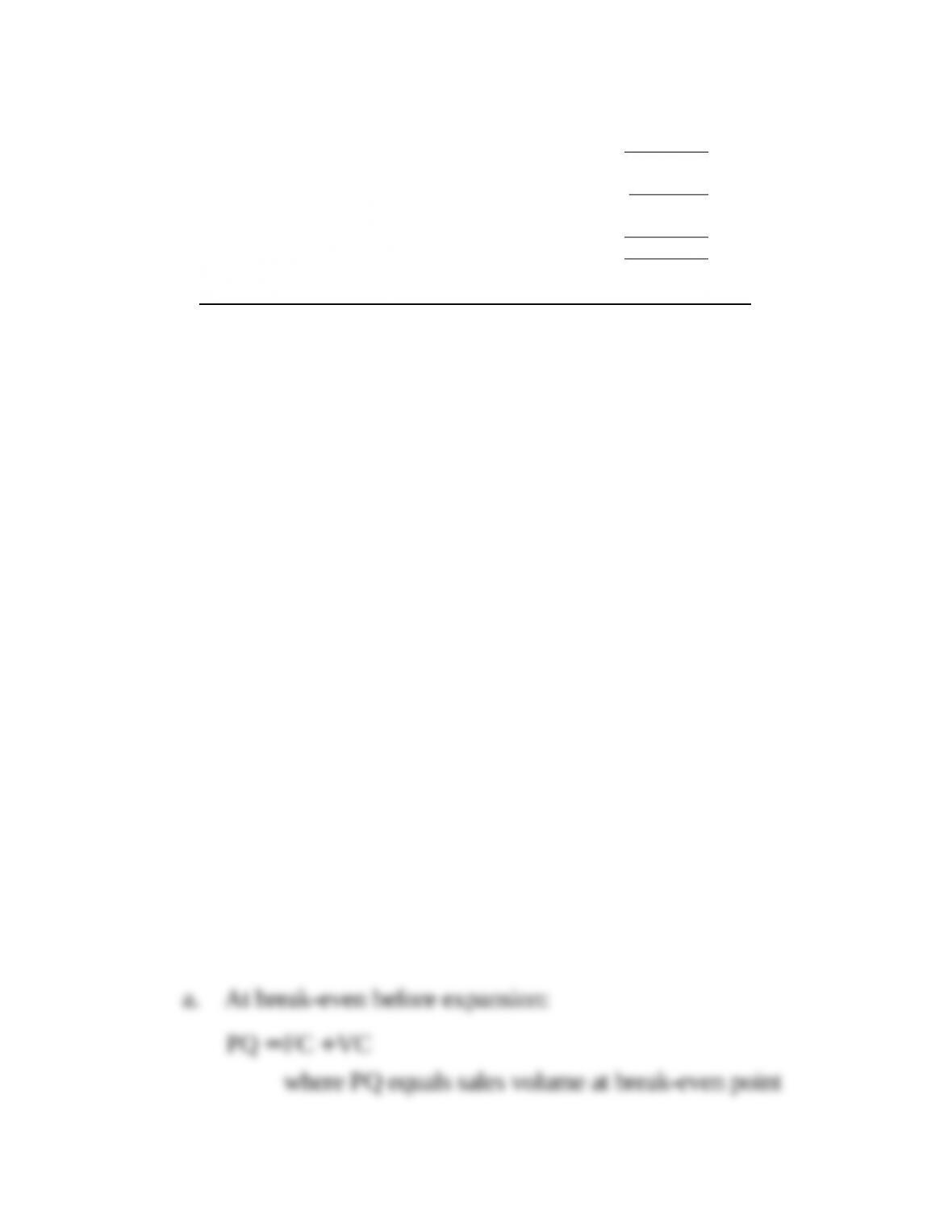
c. Silverman Plan (based on Mrs. Gold’s Assumption)
Sales ($2,400,000 units at $5.00) $12,000,000
Fixed costs ($1,550,000 1.15) 1,782,500
Variable costs (2,400,000 units $4) 9,600,000
27. Expansion, break-even analysis, and leverage (LO2, 3, and 4) Delsing Canning
Company is considering an expansion of its facilities. Its current income statement is as
follows:
Sales………………………………………………………… $5,500,000
Less: Variable expense (50% of sales)........... 2,750,000
Fixed expense……………………………….……… 1,850,000
Earnings before interest and taxes (EBIT)........ 900,000
Interest (10% cost)……………………………….……. 300,000
Earnings before taxes (EBT)…………….….……… 600,000
Tax (40%)………………………………………….……… 240,000
Earnings after taxes (EAT)…………..……………… $ 360,000
Shares of common stock—250,000…...............
Earnings per share………………………..……………. $1.44
The company is currently financed with 50 percent debt and 50 percent equity (common
stock, par value of $10). In order to expand the facilities, Mr. Delsing estimates a need for
$2.5 million in additional financing. His investment banker has laid out three plans for him
to consider:
1. Sell $2.5 million of debt at 13 percent.
2. Sell $2.5 million of common stock at $20 per share.
3. Sell $1.25 million of debt at 12 percent and $1.25 million of common stock at $25 per
share.
Variable costs are expected to stay at 50 percent of sales, while fixed expenses will increase
to $2,350,000 per year. Delsing is not sure how much this expansion will add to sales, but
he estimates that sales will rise by $1.25 million per year for the next five years.
Delsing is interested in a thorough analysis of his expansion plans and methods of
financing. He would like you to analyze the following:
a. The break-even point for operating expenses before and after expansion (in sales
dollars).
b. The degree of operating leverage before and after expansion. Assume sales of $5.5
million before expansion and $6.5 million after expansion. Use the formula in
footnote 2 of the chapter.
c. The degree of financial leverage before expansion and for all three methods of
financing after expansion. Assume sales of $6.5 million for this question.
d. Compute EPS under all three methods of financing the expansion at $6.5 million in
sales (first year) and $10.5 million in sales (last year).
e. What can we learn from the answer to part d about the advisability of the three
methods of financing the expansion?
5-27. Solution:
Delsing Canning Company
Sales Fixed costs Variable costs
(Variable costs 50% of sales)
Sales $1,850,000 .50 Sales
.50 Sales $1,850,000
Sales $3,700,000
= +
=
= +
=
=
At break-even after expansion:
Sales $2,350,000 .50 Sales
.50 Sales $2,350,000
Sales $4,700,000
= +
=
=
b. Degree of operating leverage, before expansion, at sales of
$5,500,000
( )
( )
VC TVC
DOL = VC FC TVC FC
$5,500,000 $2,750,000
$5,500,000 $2,750,000 $1,850,000
$2,750,000 3.06x
$900,000
Q P S
Q P S
––
=
– – – –
–
=– –
= =
5-27. (Continued)
Degree of operating leverage after expansion at sales of
$6,500,000
$6,500,000 $3, 250,000
DOL = $6,500,000 $3, 250,000 $2,350,000
$3, 250, 000 3.61x
–
– –
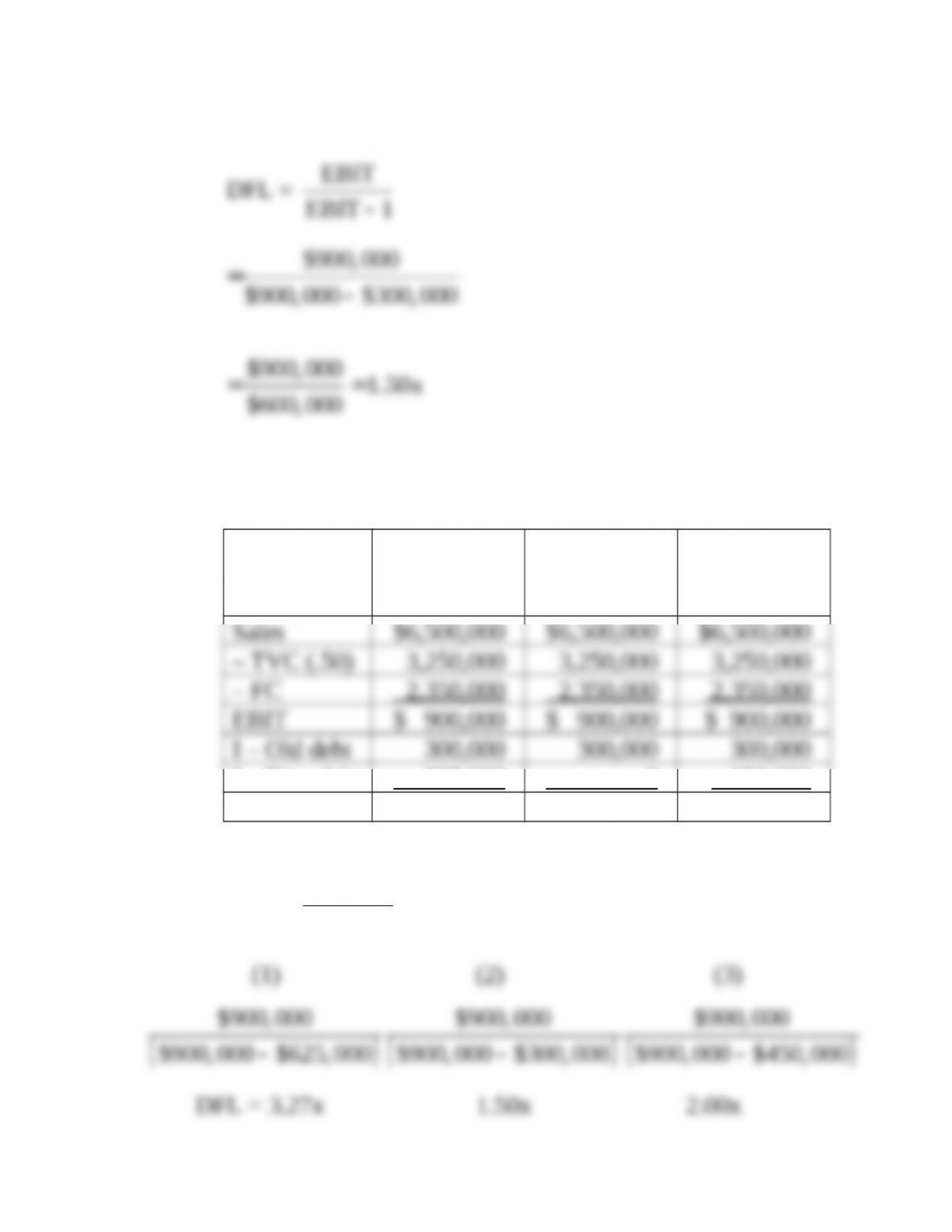
c. DFL before expansion:
EBIT
DFL = EBIT 1
$900,000
$900,000 $300,000
$900,000 1.50x
$600,000
=–
= =
DFL after expansion:
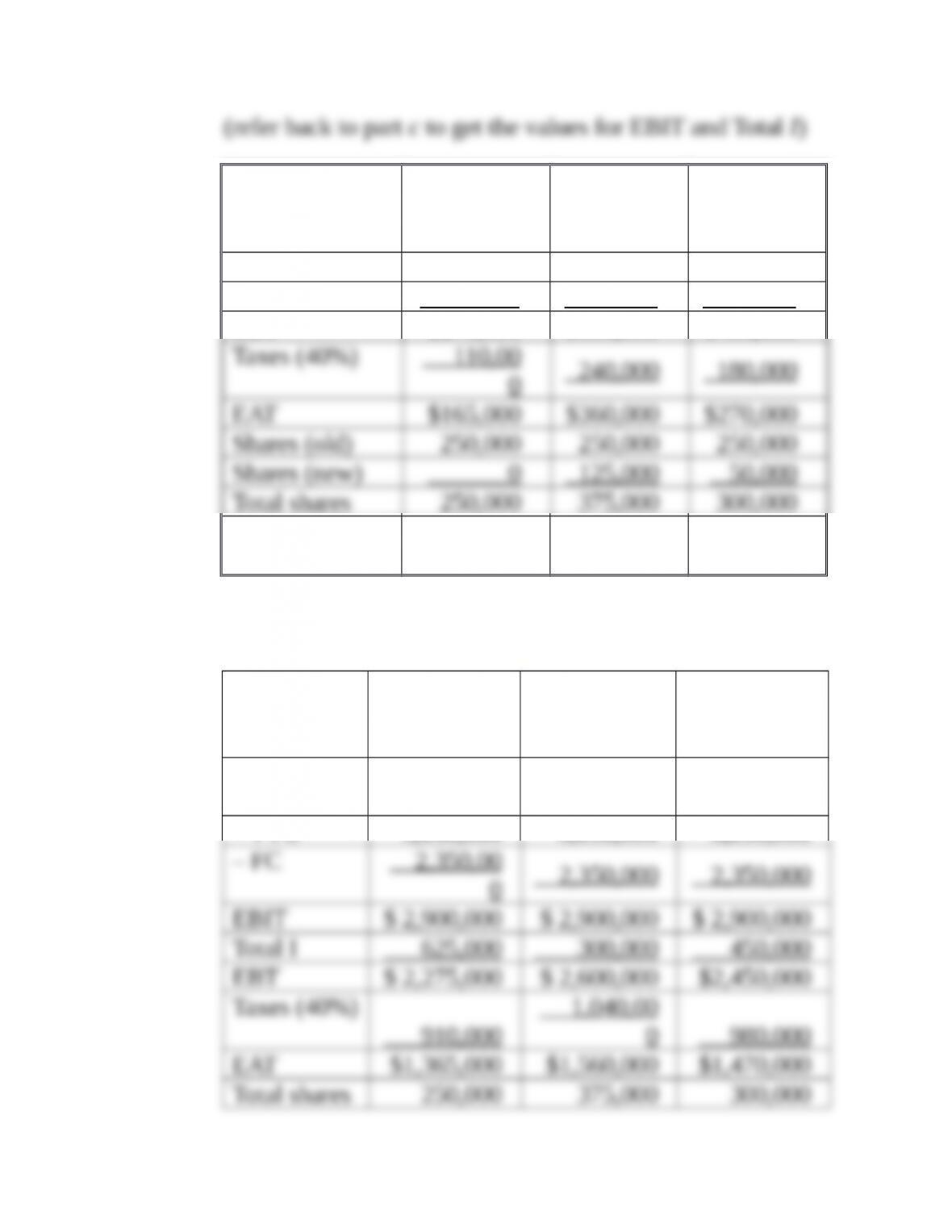
Compute EBIT and I for all three plans:
(100%
Debt) (1)
(100%
Equity) (2)
(50% Debt
and 50%
Equity) (3)
I – New debt 325,000 0 150,000
Total interest $ 625,000 $ 300,000 $ 450,000
5-27. (Continued)
EBIT
DFL = EBIT I–

(100%
Debt) (1)
(100%
Equity) (2)
(50% Debt
and 50%
Equity) (3)
EBIT $900,000 $900,000 $900,000
Total I 625,000 300,000 450,000
EBT $275,000 $600,000 $450,000
EPS (EAT/Total
shares) $0.66 $0.96 $0.90
EPS @ sales of $10,500,000
(100%
Debt) (1)
(100%
Equity) (2)
(50% Debt
and 50%
Equity) (3)
Sales $10,500,00
0$10,500,000 $10,500,00
0
– TVC 5,250,000 5,250,000 5,250,000
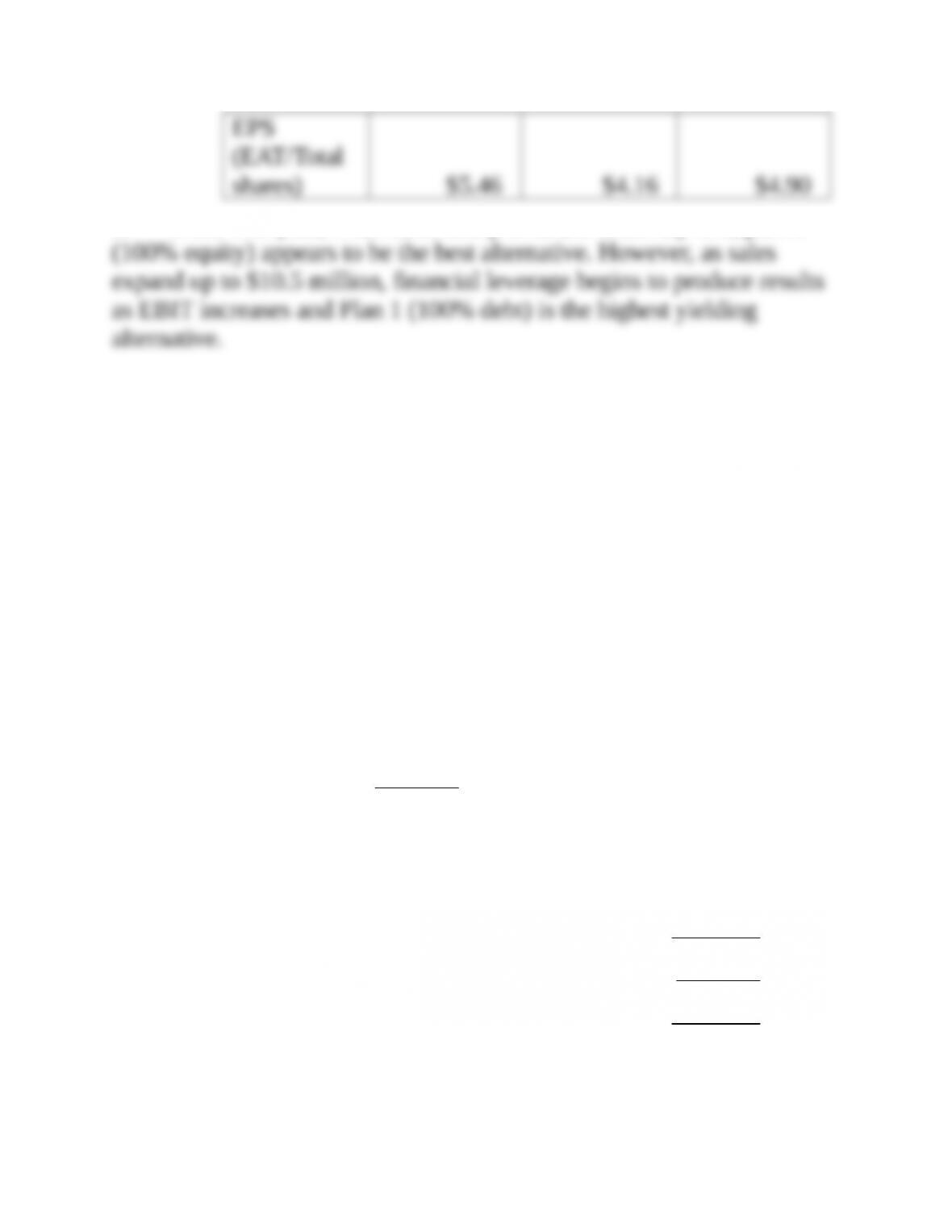
e. In the first year, when sales and profits are relatively low, plan 2
COMPREHENSIVE PROBLEM
Comprehensive Problem 1.
Ryan Boot Company (review of Chapters 2 through 5) (multiple LO’s from Chapters 2
through 5)
RYAN BOOT COMPANY
Balance Sheet
December 31, 20X1
Assets Liabilities and Stockholders’ Equity
Cash……………………………………. $ 50,000 Accounts payable…..…….……. $2,200,000
Marketable securities………....... 80,000 Accrued expenses………………. 150,000
Accounts receivable…….……….. 3,000,000 Notes payable (current)….…... 400,000
Inventory…………………………….. 1,000,000 Bonds (10%)….……………….... 2,500,000
Gross plant and equipment
Less…………………..…….……….
6,000,00 Common stock (1.7 million
shares, par value $1)…………
1,700,000
Accumulated depreciation... 2,000,000 Retained earnings………..…….. 1,180,000
Total assets………………..………… $8,130,000
Total liabilities and
stockholders’ equity............
$8,130,000
Income Statement—20X1
Sates (credit)……………………………………………………………….… $7,000,000
Fixed costs*……………………………………………………………..…… 2,100,000
Variable costs (0.60)……………………………………………..……….. 4,200,000
Earnings before interest and taxes………………………………….… 700,000
Less: Interest………………………………………..……………….…… 250,000
Earnings before taxes……………………………………………….……. 450,000
Less: Taxes @ 35%…………………………………….…………….… 157,500
Earnings after taxes………………………………………….….………… $ 292,500
Dividends (40% payout)………………………………………………. 117,000
Increased retained earnings…………………………………………….. $ 175,500

*Fixed costs include (a) lease expense of $200,000 and (b) depreciation of
$500,000.
Note: Ryan Boots also has $65,000 per year in sinking fund obligations
associated with its bond issue. The sinking fund represents an annual repayment
of the principal amount of the bond. It is not tax-deductible.
Comprehensive Problem 1 (Continued)
Ratios
Ryan Boot
(to be filled in) Industry
Profit margin…….…………………….… _____________ 5.75%
Return on assets……………………….... _____________ 6.90%
Return on equity…………………….….. _____________ 9.20%
Receivables turnover………..………… _____________ 4.35X
Inventory turnover………………….….. _____________ 6.50X
Fixed-asset turnover…………………… _____________ 1.85X
Total-asset turnover………………….… _____________ 1.20X
Current ratio…………..…….…………… _____________ 1.45X
Quick ratio…………………………….….. _____________ 1.10X
Debt to total assets……………………… _____________ 25.05%
Interest coverage…….…………………. _____________ 5.35X
Fixed charge coverage………………… _____________ 4.62X
a. Analyze Ryan Boot Company, using ratio analysis. Compute the ratios on the prior
page for Ryan and compare them to the industry data that is given. Discuss the weak
points, strong points, and what you think should be done to improve the company’s
performance.
b. In your analysis, calculate the overall break-even point in sales dollars and the cash
break-even point. Also compute the degree of operating leverage, degree of financial
leverage, and degree of combined leverage. (Use footnote 2 for DOL and footnote 3
in the chapter for DCL.)
c. Use the information in parts a and b to discuss the risk associated with this company.
Given the risk, decide whether a bank should lend funds to Ryan Boot.
Ryan Boot Company is trying to plan the funds needed for 20X2. The management
anticipates an increase in sales of 20 percent, which can be absorbed without increasing
fixed assets.
d. What would be Ryan’s needs for external funds based on the current balance sheet?
Compute RNF (required new funds). Notes payable (current) and bonds are not part
of the liability calculation.
e. What would be the required new funds if the company brings its ratios into line with
the industry average during 20X2? Specifically examine receivables turnover,
inventory turnover, and the profit margin. Use the new values to recompute the
factors in RNF (assume liabilities stay the same).
f. Do not calculate, only comment on these questions. How would required new funds
change if the company
(1) Were at full capacity?
(2) Raised the dividend payout ratio?
(3) Suffered a decreased growth in sales?
(4) Faced an accelerated inflation rate?