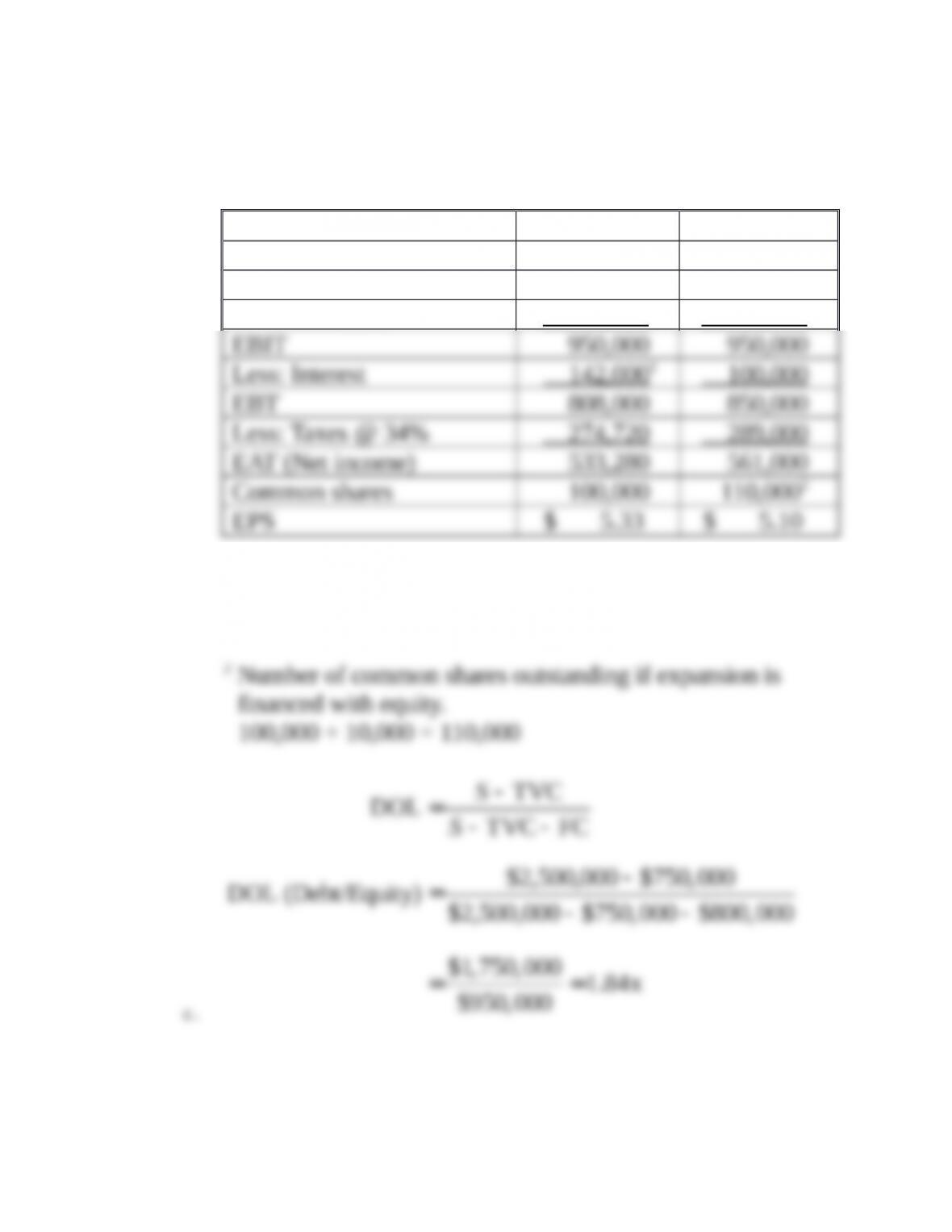
5-21. (Continued)
b. Income Statement after Expansion
Debt Equity
Sales $2,500,000 $2,500,000
Less: Variable costs (30%) 750,000 750,000
Fixed costs 800,000 800,000
1 New interest expense level if expansion is financed with
debt.
$100,000 + 14% ($300,000) = $142,000
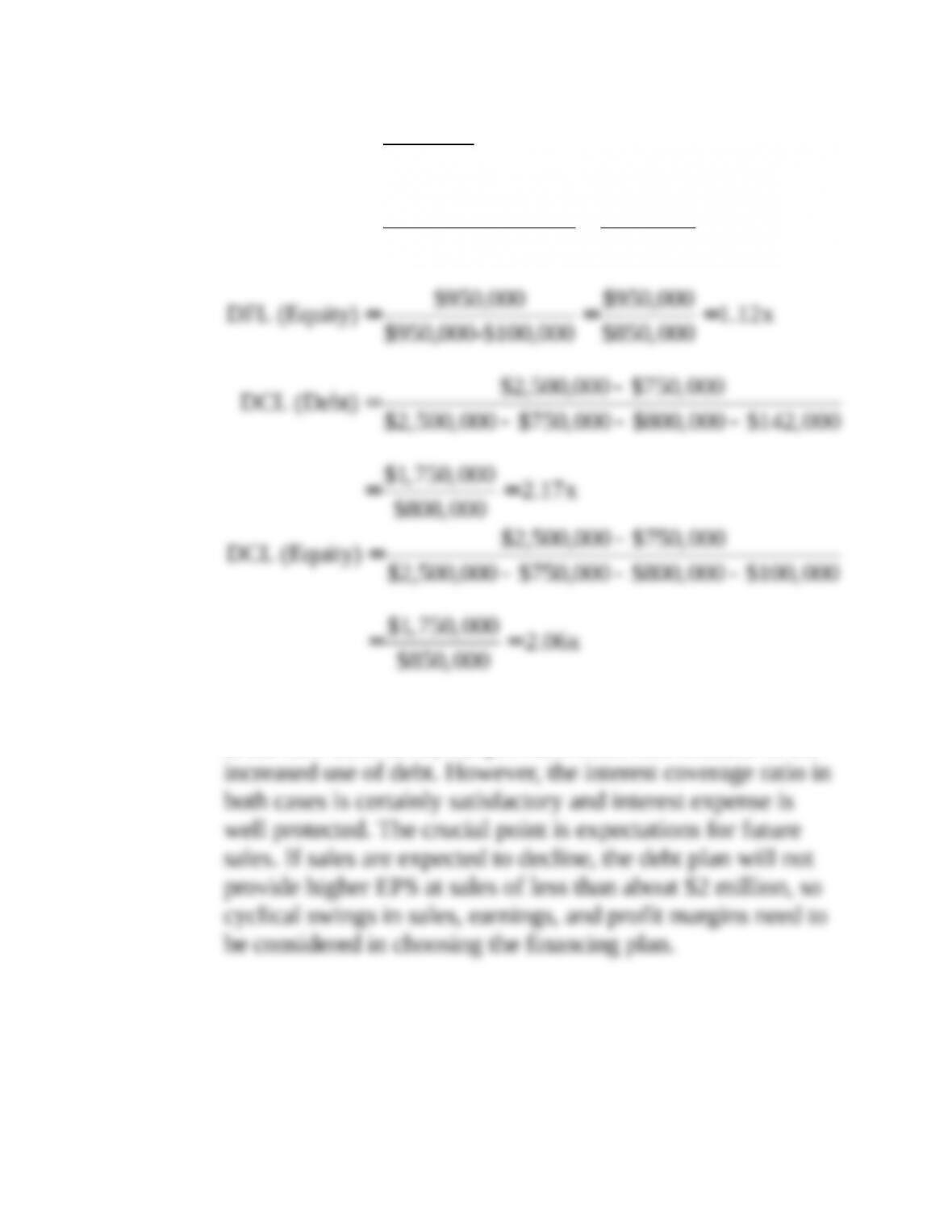
EBIT
DFL EBIT
$950,000 $950,000
DFL (Debt) 1.18x
$950,000-$142,000 $808,000
$950,000 $950,000
DFL (Equity) 1.12x
$950,000-$100,000 $850,000
$2,500,000 $750,000
DCL (Debt) $2,500,000 $750,000 $800,000 $142,00
I
=–
= = =
= = =
–
=—0
$1,750,000 2.17x
$808,000
= =
$2,500,000 $750,000
DCL (Equity) $2,500,000 $750,000 $800,000 $100,000
$1,750,000 2.06x
$850,000
–
=– – –
= =
d. The debt financing plan provides a greater earnings per share
at the new sales level, but provides more risk because of the
5-22. Solution:
23. Leverage and sensitivity analysis (LO6) Dickinson Company has $12 million in assets.
Currently half of these assets are financed with long-term debt at 10 percent and half with
common stock having a par value of $8. Ms. Smith, vice president of finance, wishes to
analyze two refinancing plans, one with more debt (D) and one with more equity (E). The
company earns a return on assets before interest and taxes of 10 percent. The tax rate is 45
percent.
Under Plan D, a $3 million long-term bond would be sold at an interest rate of
12 percent and 375,000 shares of stock would be purchased in the market at $8 per share
and retired.
Under Plan E, 375,000 shares of stock would be sold at $8 per share and the $3,000,000
in proceeds would be used to reduce long-term debt.
a. How would each of these plans affect earnings per share? Consider the current plan
and the two new plans.
b. Which plan would be most favorable if return on assets fell to 5 percent? Increased to
15 percent? Consider the current plan and the two new plans.
c. If the market price for common stock rose to $12 before the restructuring, which plan
would then be most attractive? Continue to assume that $3 million in debt will be
used to retire stock in Plan D and $3 million of new equity will be sold to retire debt
in Plan E. Also assume for calculations in part c that return on assets is 10 percent.
5-23. Solution:
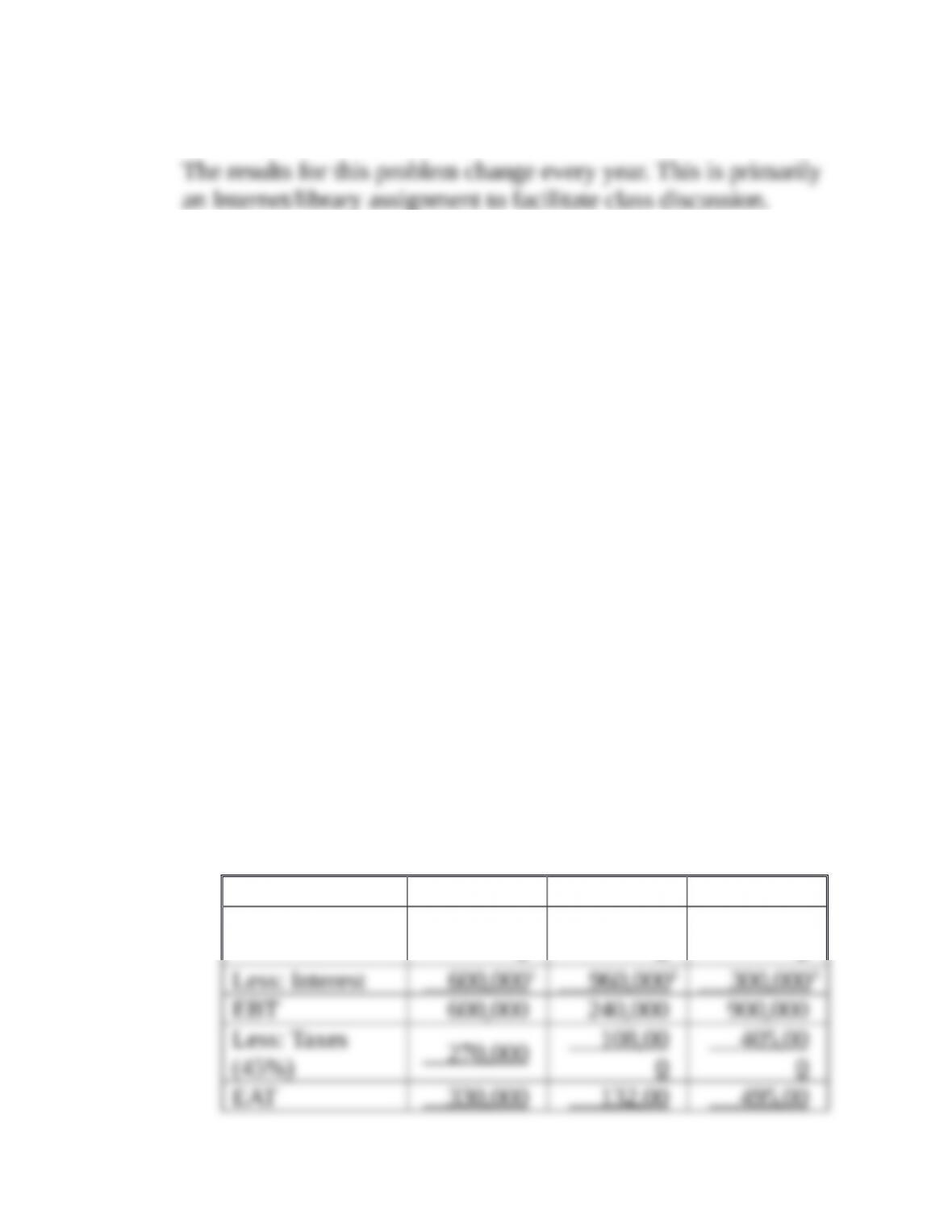
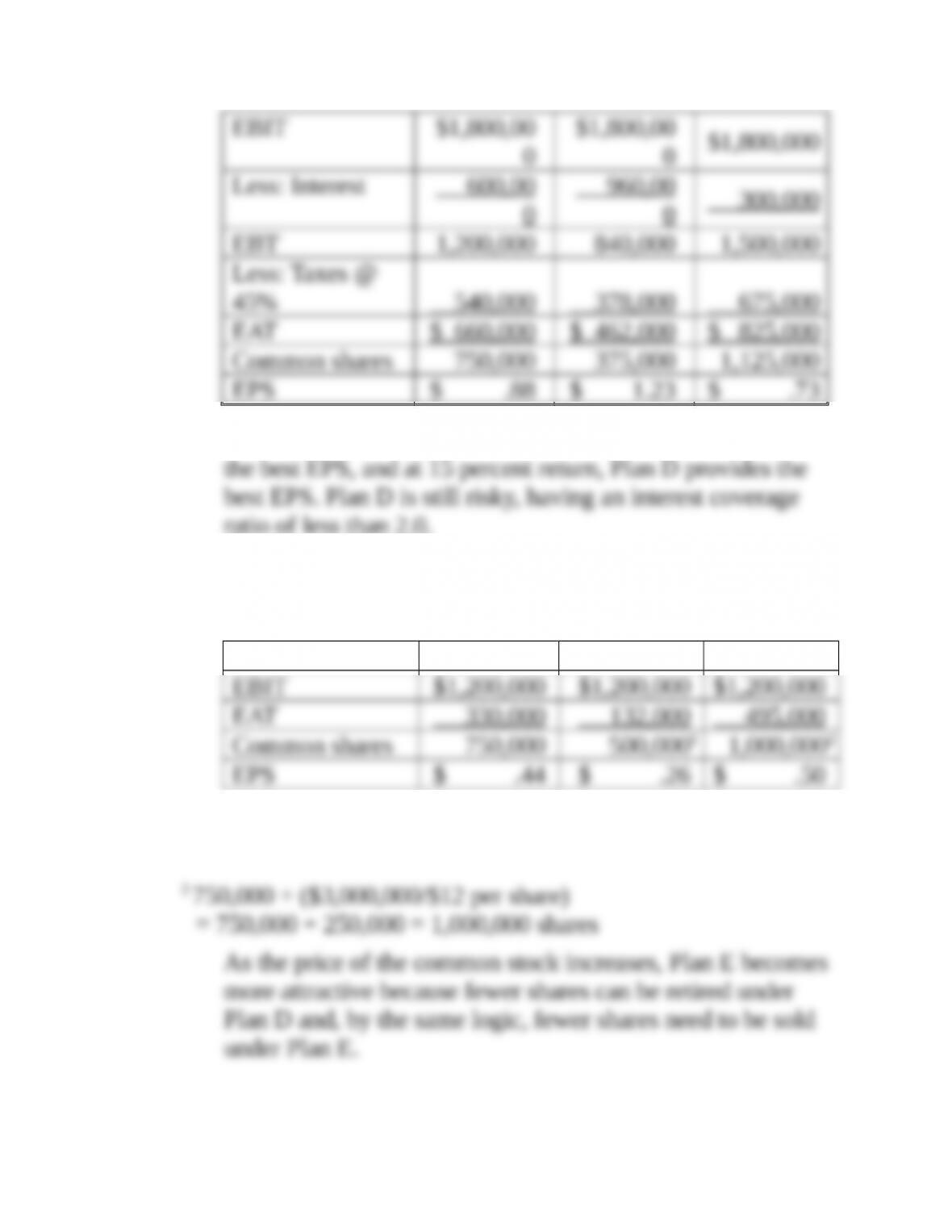
Dickinson Company
Income Statements
a. Return on assets = 10% EBIT = $ 1,200,000
Current Plan D Plan E
EBIT $1,200,00
0
$1,200,00
0
$1,200,00
0
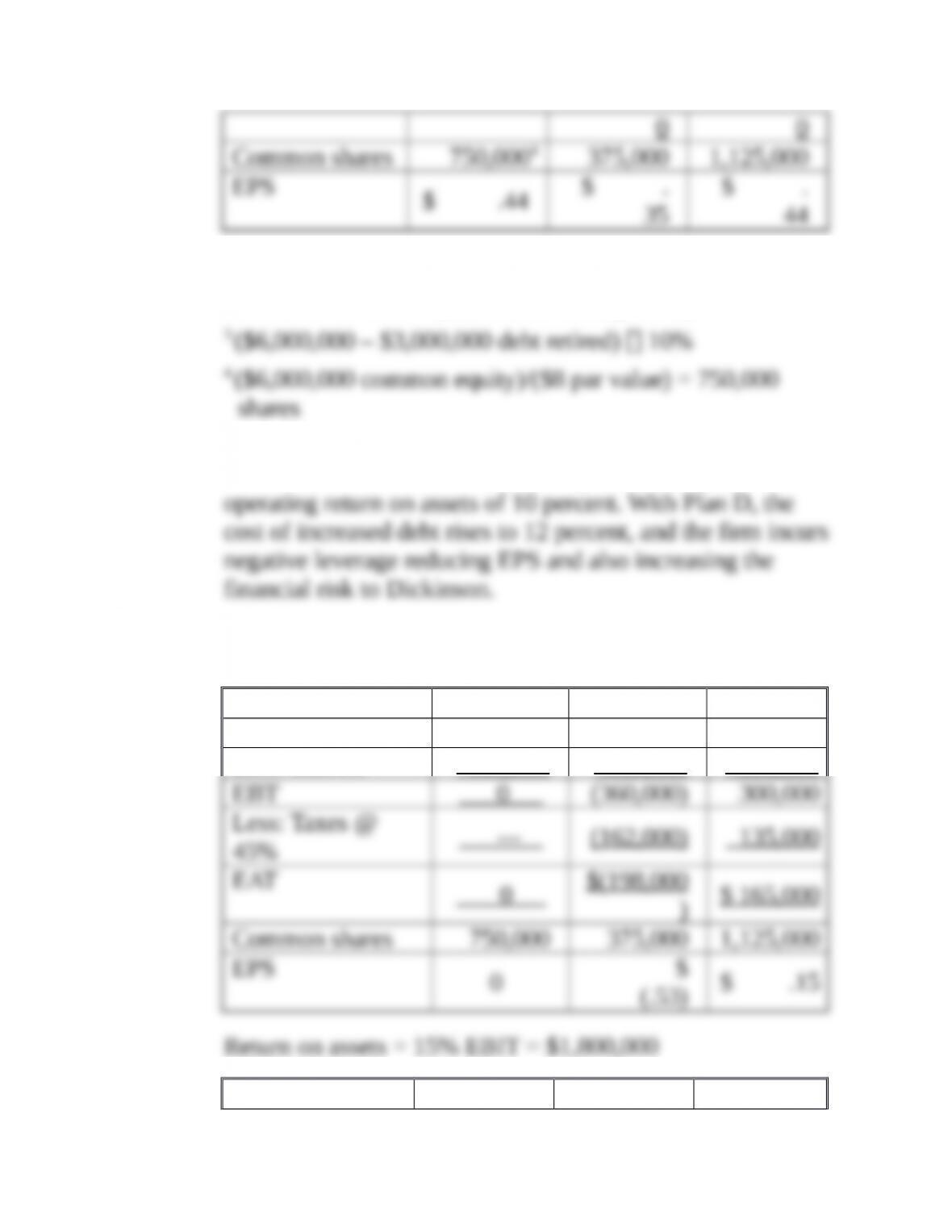
1 $6,000,000 debt @ 10%
2 $600,000 interest + ($3,000,000 debt @ 12%)
Plan E and the original plan provide the same earnings per
share because the cost of debt at 10 percent is equal to the
5-23. (Continued)
b. Return on assets = 5% EBIT = $600,000
Current Plan D Plan E
EBIT $600,000 $600,000 $ 600,000
Less: Interest 600,000 960,000 300,000
Current Plan D Plan E
If the return on assets decreases to 5 percent, Plan E provides
5-23. (Continued)
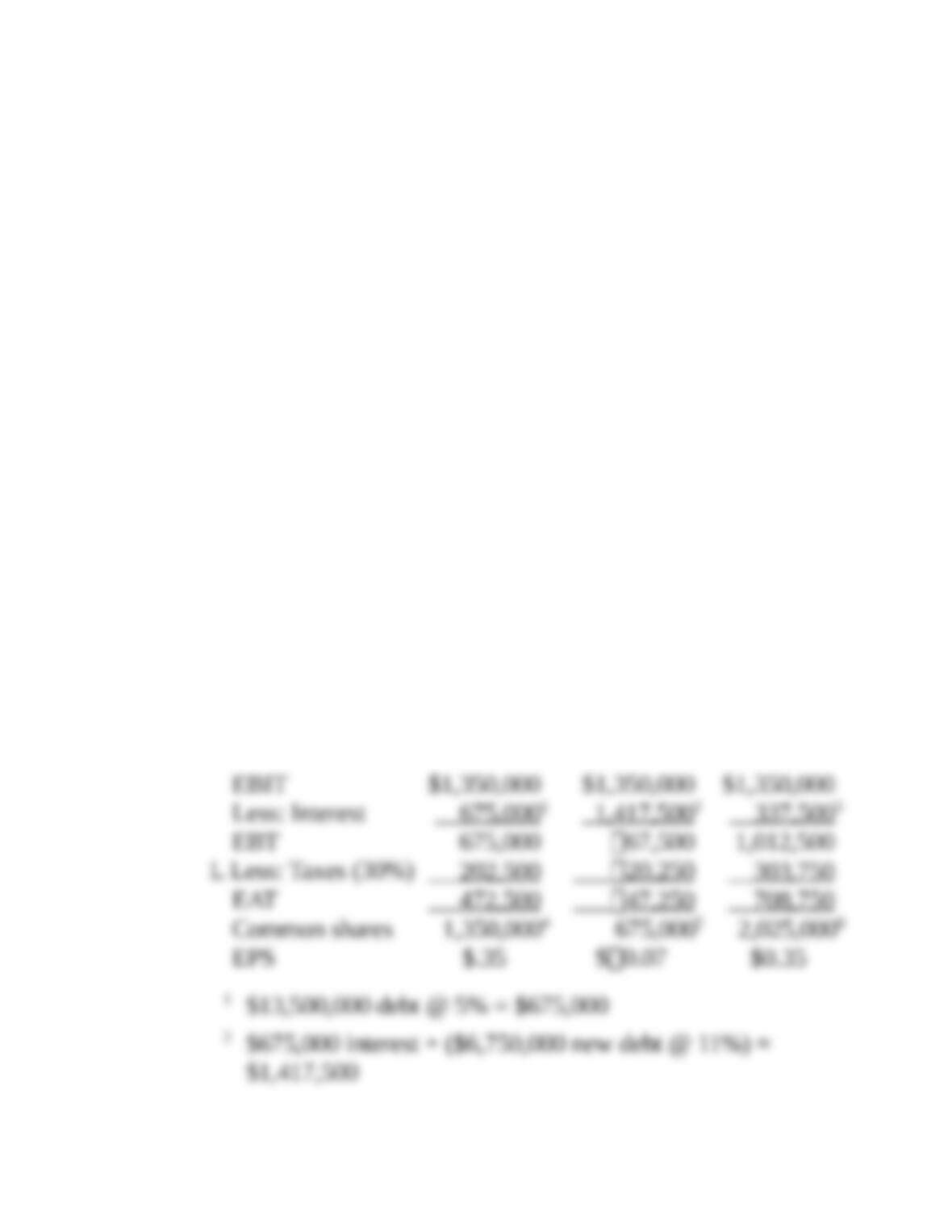
c. Return on Assets = 10% EBIT = $1,200,000
Current Plan D Plan E
1 750,000 – ($3,000,000/$12 per share)
= 750,000 – 250,000 = 500,000 shares
24. Leverage and sensitivity analysis (LO6) Edsel Research Labs has $27 million in assets.
Currently, half of these assets are financed with long-term debt at 5 percent and half with
common stock having a par value of $10. Ms. Edsel, the vice president of finance, wishes
to analyze two refinancing plans, one with more debt (D) and one with more equity (E).
The company earns a return on assets before interest and taxes of 5 percent. The tax rate is
30 percent.
Under Plan D, a $6.75 million long-term bond would be sold at an interest rate of 11
percent and 675,000 shares of stock would be purchased in the market at $10 per share and
retired. Under Plan E, 675,000 shares of stock would be sold at $10 per share and the
$6,750,000 in proceeds would be used to reduce long-term debt.
a. How would each of these plans affect earnings per share? Consider the current plan
and the two new plans. Which plan(s) would produce the highest EPS? Note that due
to tax loss carry-forwards and carry-backs, taxes can be a negative number.
b. Which plan would be most favorable if return on assets increased to 8 percent?
Compare the current plan and the two new plans. What has caused the plans to give
different EPS numbers?
c. Assuming return on assets is back to the original 5 percent, but the interest rate on
new debt in Plan D is 7 percent, which of the three plans will produce the highest
EPS? Why?
5-24. Solution:
Edsel Research Labs
Income Statement
a. Return on assets = 5% EBIT = $1,350,000
Current Plan D Plan E
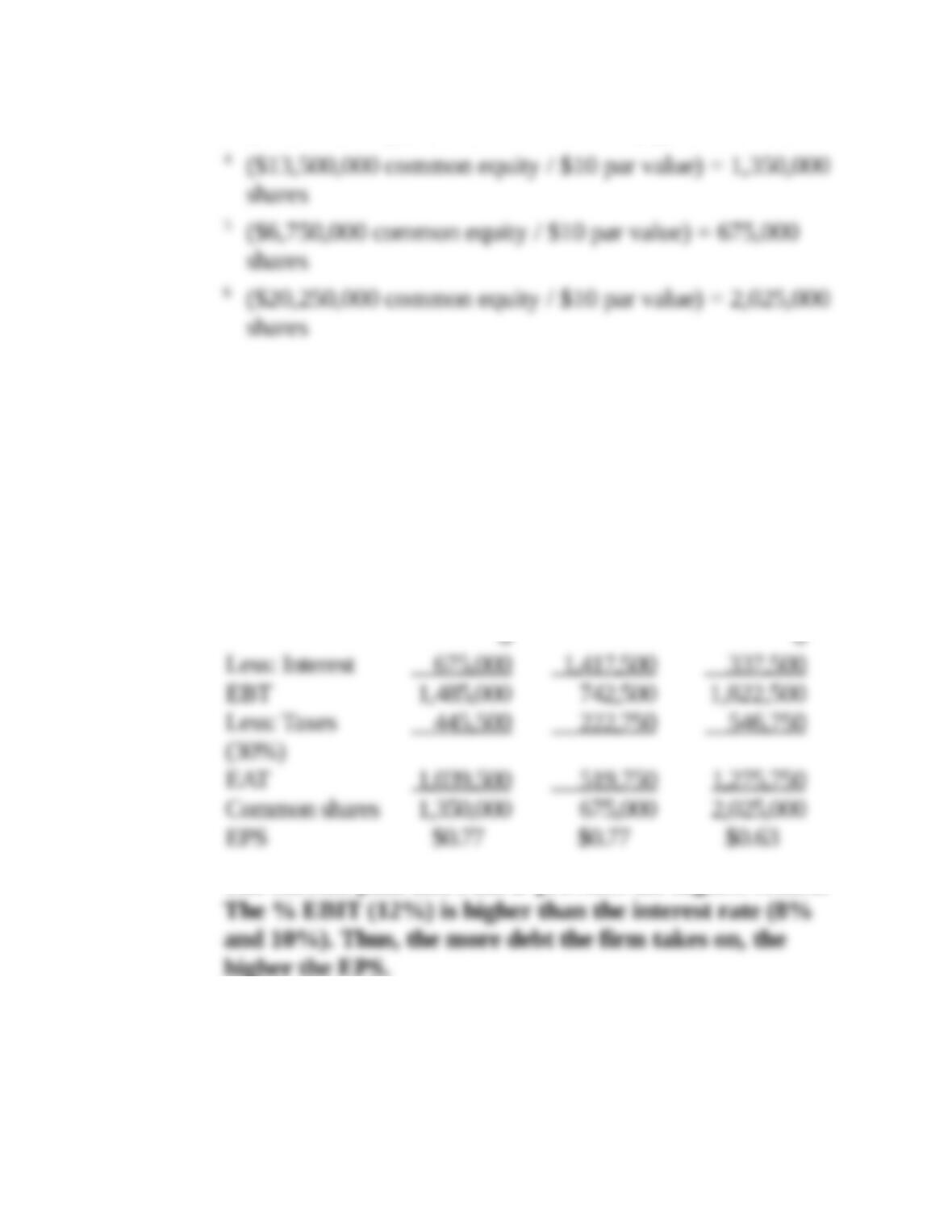
3($13,500,000 $6,750,000 debt retired) 5% = $337,500
The current plan and Plan E provide the highest return of $0.35.
5-25. (Continued)
b. Return on assets = 8% EBIT = $2,160,000
Current Plan D Plan E
EBIT $2,160,00
$2,160,000 $2,160,00
The current plan and Plan D provides the highest return.
c. Return on assets = 5% EBIT = $1,350,000
Current Plan D Plan E
EBIT $1,350,000 $1,350,00 $1,350,000
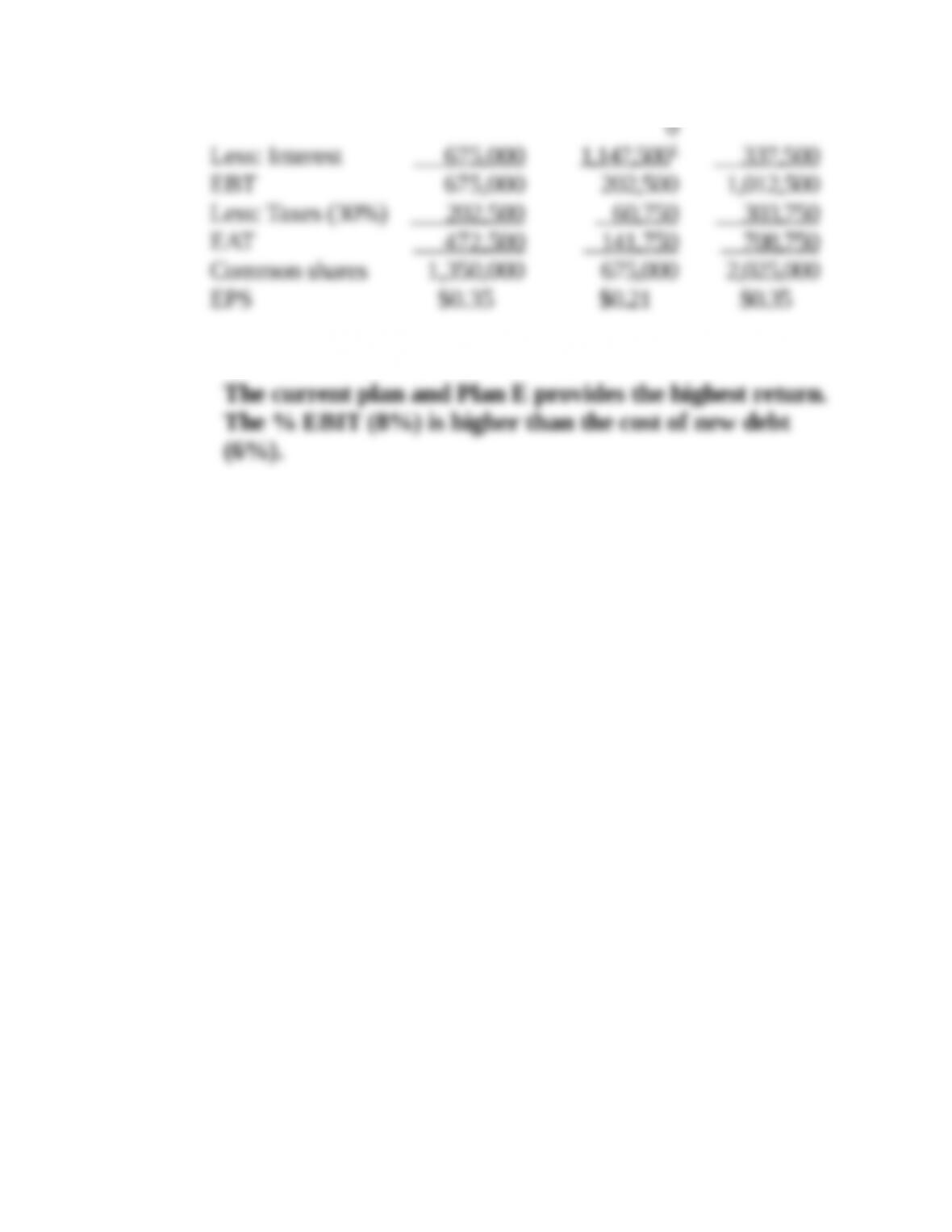
1 $675,000 + (6,750,000 7%) = 1,147,500
25. Leverage and sensitivity analysis (LO6) The Lopez-Portillo Company has $10.6 million
in assets, 80 percent financed by debt, and 20 percent financed by common stock. The
interest rate on the debt is 9 percent and the par value of the stock is $10 per share.
President Lopez-Portillo is considering two financing plans for an expansion to $18 million
in assets.
Under Plan A, the debt-to-total-assets ratio will be maintained, but new debt will cost a
whopping 12 percent! Under Plan B, only new common stock at $10 per share will be
issued. The tax rate is 40 percent.
a. If EBIT is 9 percent on total assets, compute earnings per share (EPS) before the
expansion and under the two alternatives.
b. What is the degree of financial leverage under each of the three plans?
c. If stock could be sold at $20 per share due to increased expectations for the firm’s
sales and earnings, what impact would this have on earnings per share for the two
expansion alternatives? Compute earnings per share for each.
d. Explain why corporate financial officers are concerned about their stock values.
5-25. Solution:
Lopez-Portillo Company
a. Return on Assets = 20%
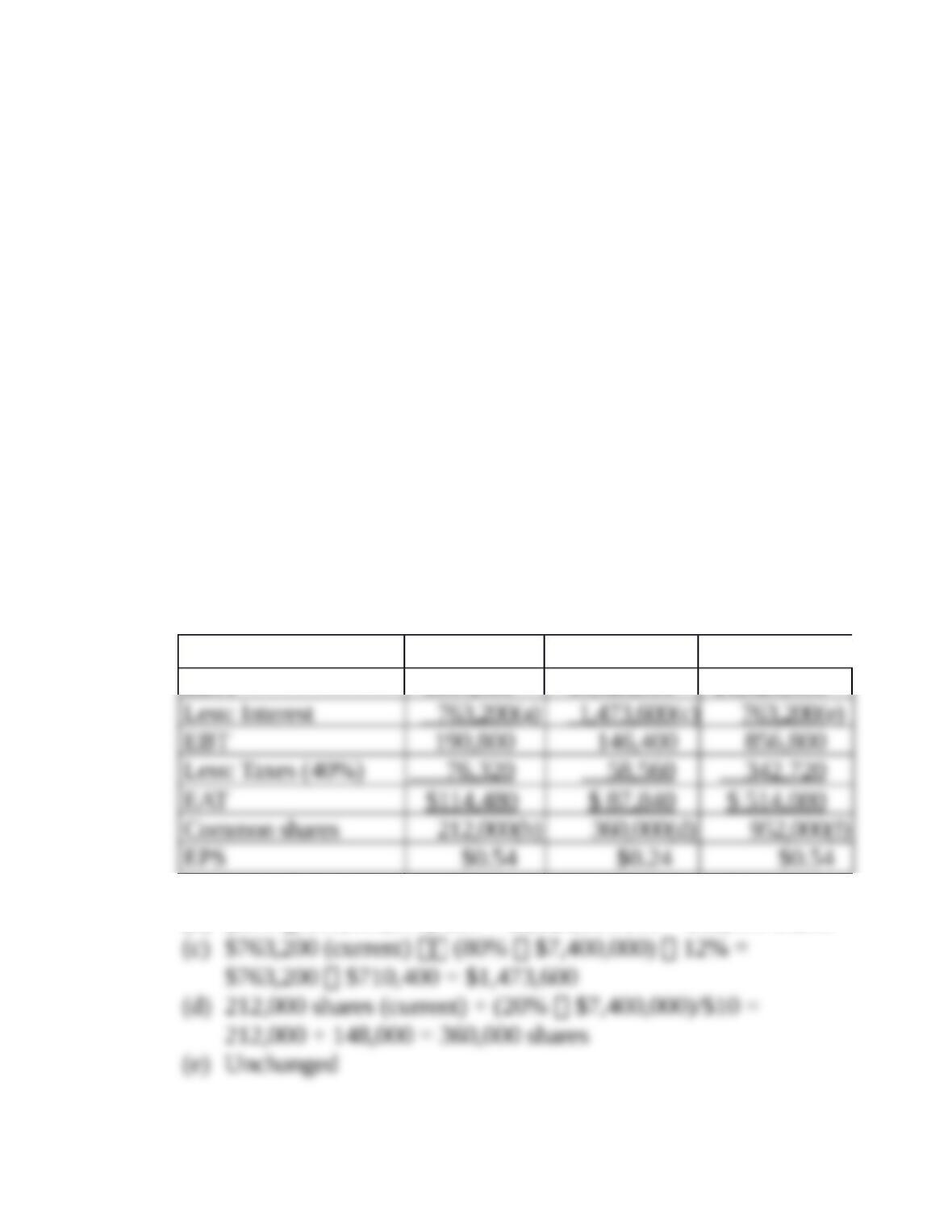
Current Plan A Plan B
EBIT
$954,000
$1,620,000
$1,620,000
Less: Interest
763,200(a)
1,473,600(c)
763,200(e)
EBT
190,800
146,400
856,800
Less: Taxes (40%) 76,320 58,560 342,720
EAT
$114,480
$ 87,840
$ 514,080
Common shares
212,000(b)
360,000(d)
952,000(f)
EPS $0.54 $0.24 $0.54
(a) (80% $10,600,000) 9% = $8,480,000 9% = $763,200
(b) (20% $10,600,000)/$10 = $2,120,000/$10 = 212,000 shares
5-25. (Continued)
b.
EBIT
DFL EBIT I
=–
$954,000
DFL (Current) 5.00x
$954,000 $763, 200
$1,620,000
DFL (Plan A) 11.07x
$1, 620, 000 $1, 473, 600
$1,620,000
DFL (Plan B) 1.89x
$1, 620, 000 $763, 200
= =
–
= =
–
= =
–
c.
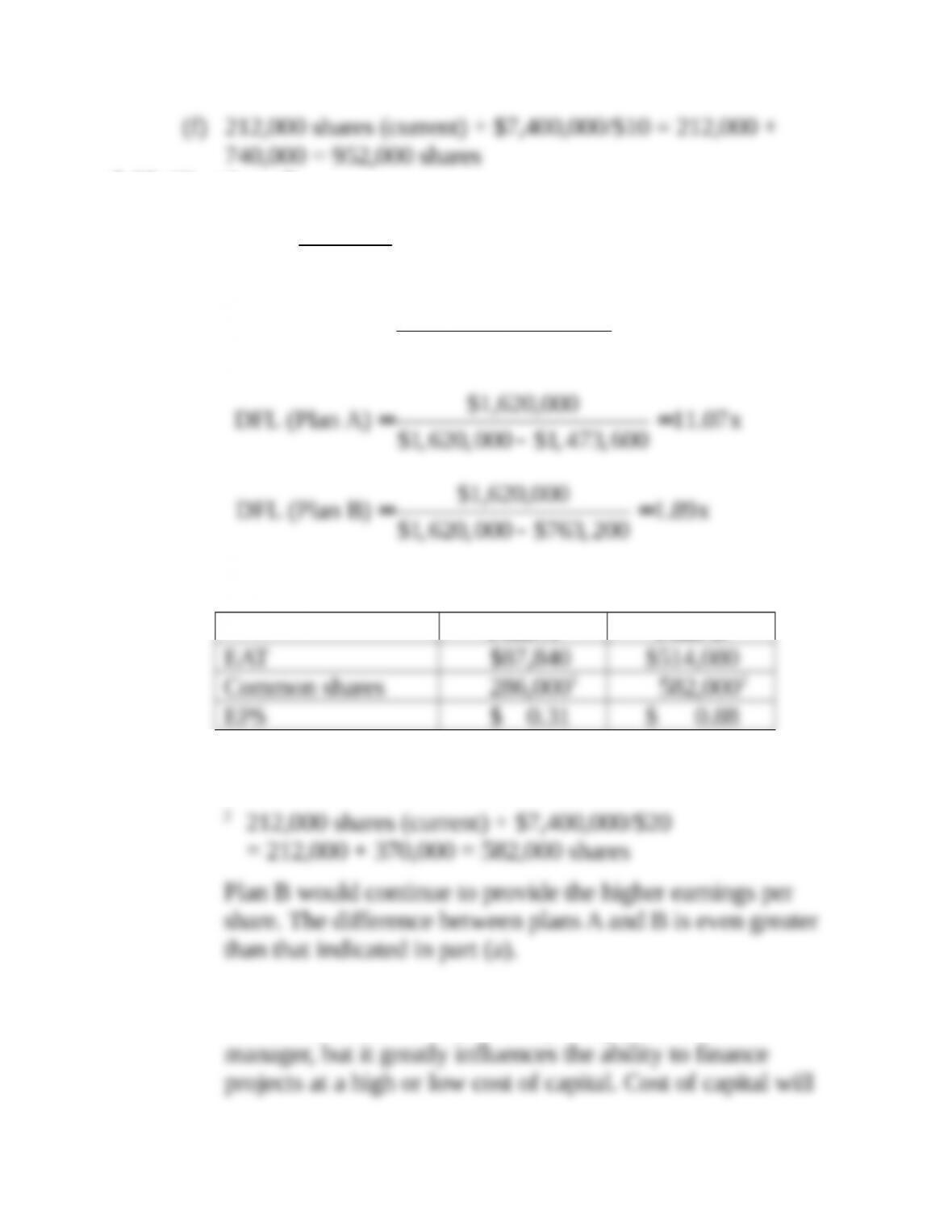
Plan A Plan B
1212,000 shares (current) + (20% $7,400,000)/$20
= 212,000 + 74,000 = 286,000 shares
d. Not only does the price of the common stock create wealth to
the shareholder, which is the major objective of the financial

26. Operating leverage and ratios (LO6) Mr. Gold is in the widget business. He currently
sells 1.5 million widgets a year at $6 each. His variable cost to produce the widgets is $4 per
unit, and he has $1,550,000 in fixed costs. His sales-to-assets ratio is six times, and 30 percent of
his assets are financed with 10 percent debt, with the balance financed by common stock at $10
par value per share. The tax rate is 35 percent.
His brother-in-law, Mr. Silverman, says he is doing it all wrong. By reducing his price to
$5.00 a widget, he could increase his volume of units sold by 60 percent. Fixed costs would
remain constant, and variable costs would remain $4 per unit. His sales-to-assets ratio
would be 7.5 times. Furthermore, he could increase his debt-to-assets ratio to 50 percent,
with the balance in common stock. It is assumed that the interest rate would go up by 1
percent and the price of stock would remain constant.
a. Compute earnings per share under the Gold plan.
b. Compute earnings per share under the Silverman plan.
c. Mr. Gold’s wife, the chief financial officer, does not think that fixed costs would
remain constant under the Silverman plan but that they would go up by 15 percent.
If this is the case, should Mr. Gold shift to the Silverman plan, based on earnings per
share?