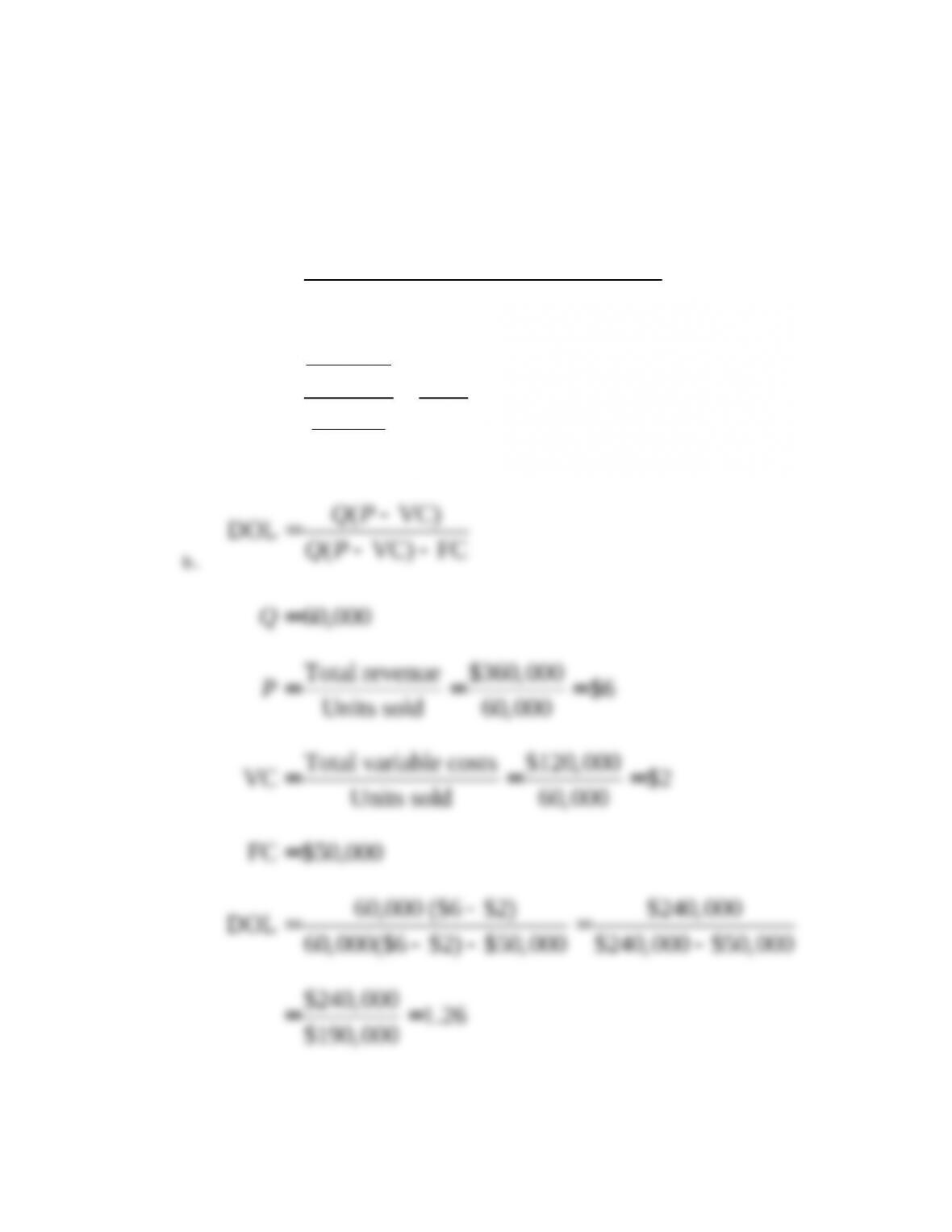
5-15. Solution:
U.S. Steal
a.
Percent change in operating income
DOL Percent change in units sold
$80,000
42%
190,000 1.27
20,000 33%
60,000
=
= = =
( VC)
DOL ( VC) FC
Q P
Q P
–
=– –
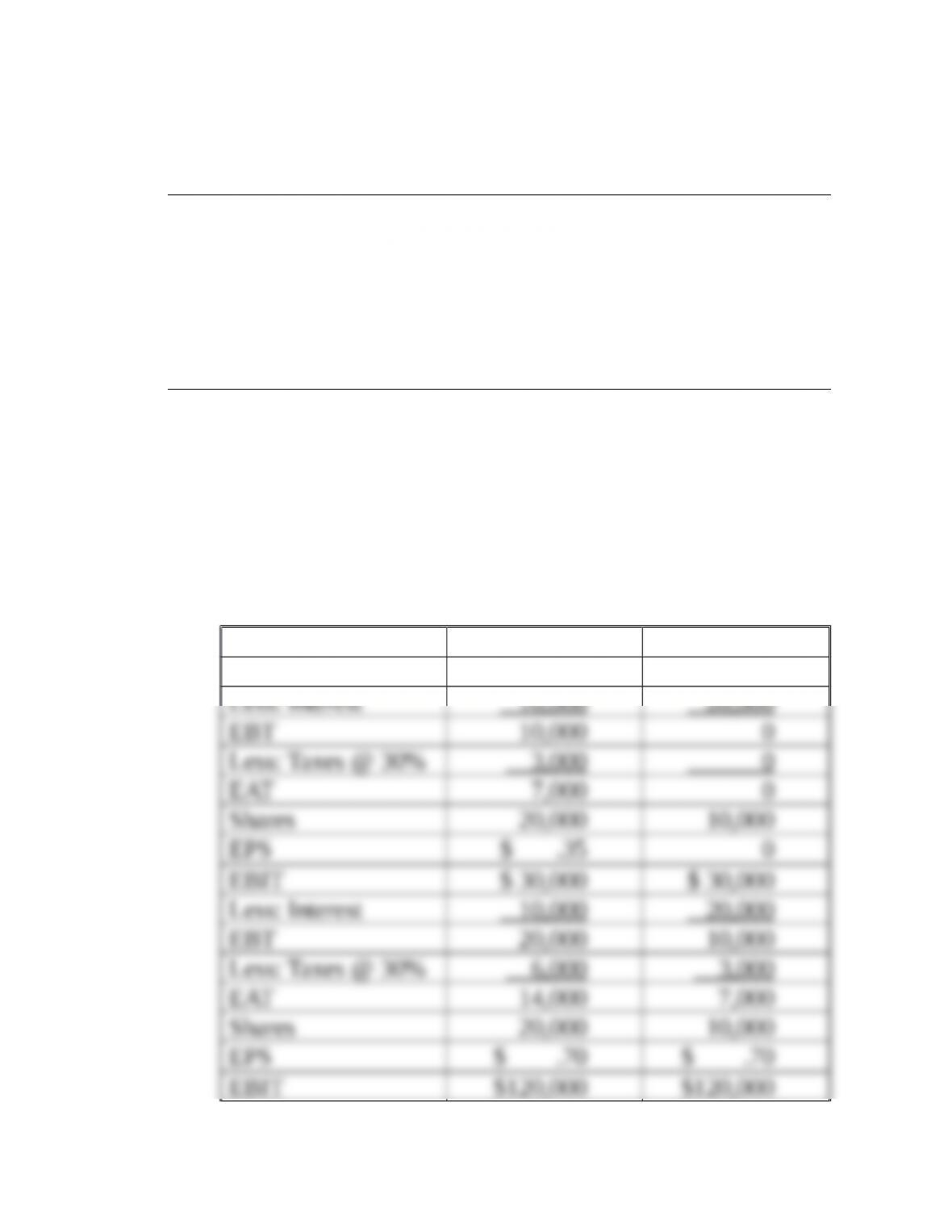
16. Earnings per share and financial leverage (LO4) Lenow’s Drug Stores and Hall’s
Pharmaceuticals are competitors in the discount drug chain store business. The separate
capital structures for Lenow and Hall are presented next.
Lenow Hall
Debt @ 10%…………….……… $100,000 Debt @ 10%
……………………………………….. $200,000
Common stock, $10 par....... 200,000 Common stock, $10 par
……………………………………….. 100,000
Total……………………………….. $300,000 Total
……………………………………….. $300,000
Shares………………….….……… 20,000 Common shares
……………………………………….. 10,000
a. Compute earnings per share if earnings before interest and taxes are $20,000,
$30,000, and $120,000 (assume a 30 percent tax rate).
b. Explain the relationship between earnings per share and the level of EBIT.
c. If the cost of debt went up to 12 percent and all other factors remained equal, what
would be the break-even level for EBIT?
5-16. Solution:
a. Lenow Drug Stores and Hall Pharmaceuticals
Lenow Hall
EBIT $ 20,000 $ 20,000
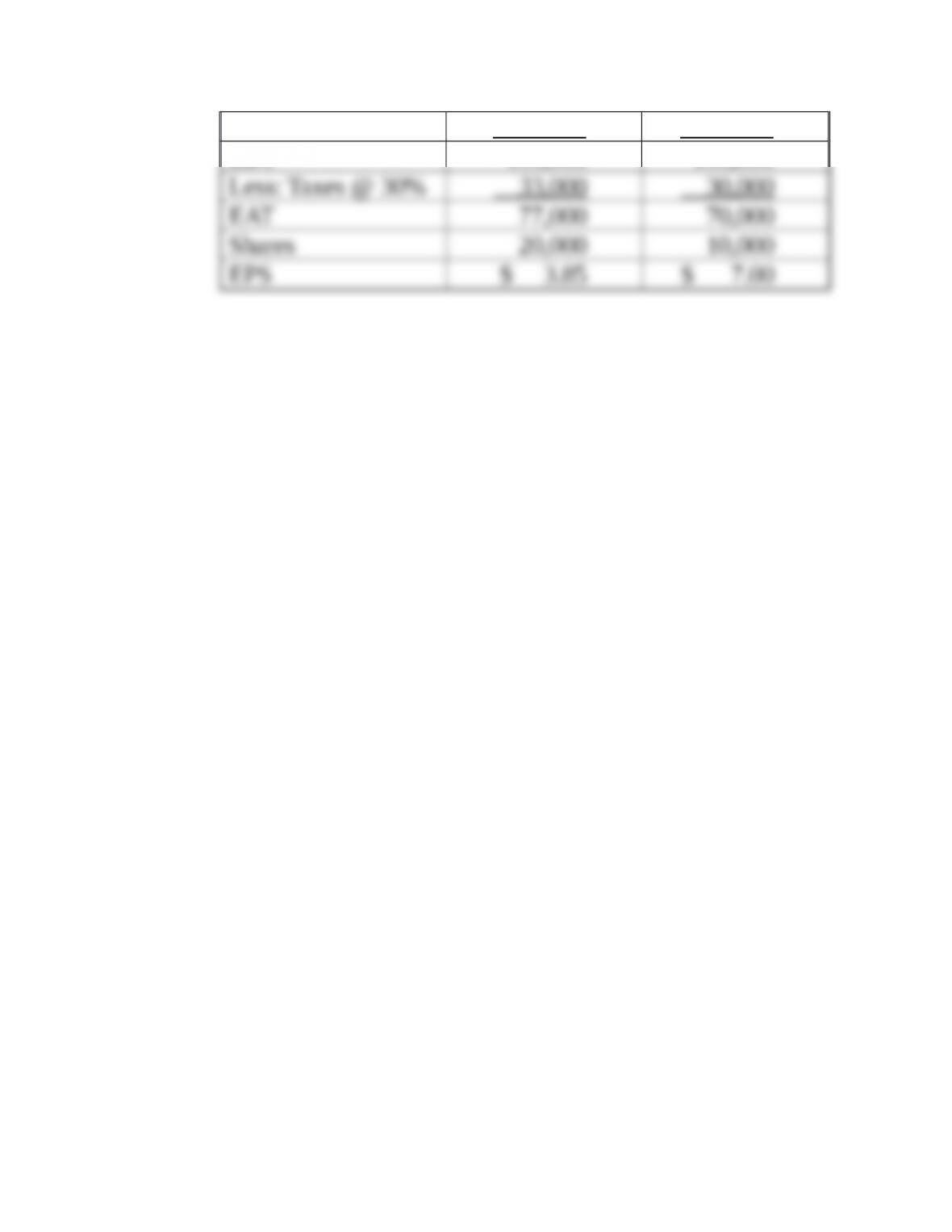
Less: Interest 10,000 20,000
EBT 110,000 100,000
5-16. (Continued)
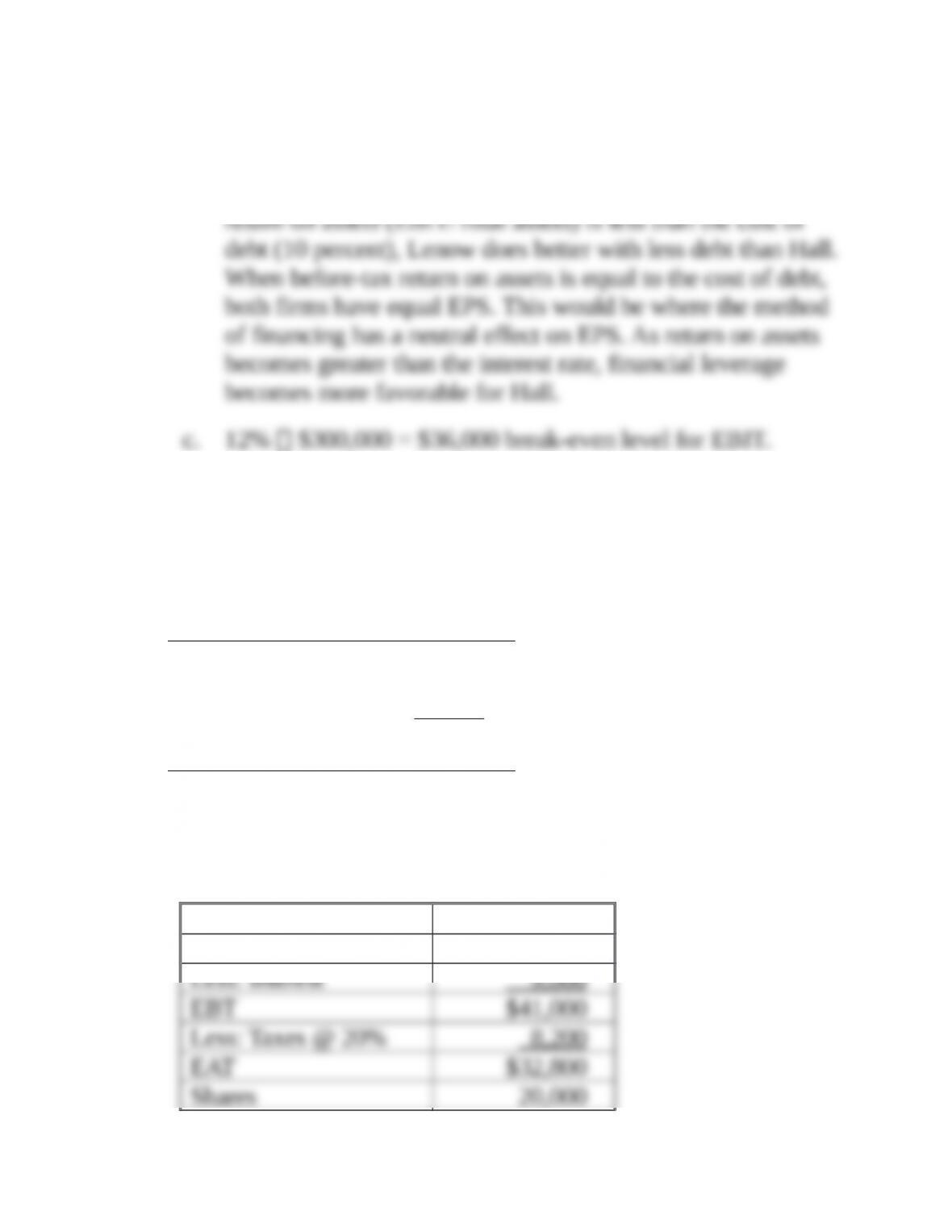
b. Before-tax return on assets = 6.67 percent, 10 percent, and 40
percent at the respective levels of EBIT. When the before-tax
17. P/E ratio (LO6) The capital structure for Cain Supplies is presented next. Compute the
stock price for Cain if it sells at 19 times earnings per share and EBIT is $50,000. The tax
rate is 20 percent.
Cain
Debt @ 9%……………….……. $100,000
Common stock, $10 par……. 200,000
Total……………………….….. $300,000
Common shares………………. 20,000
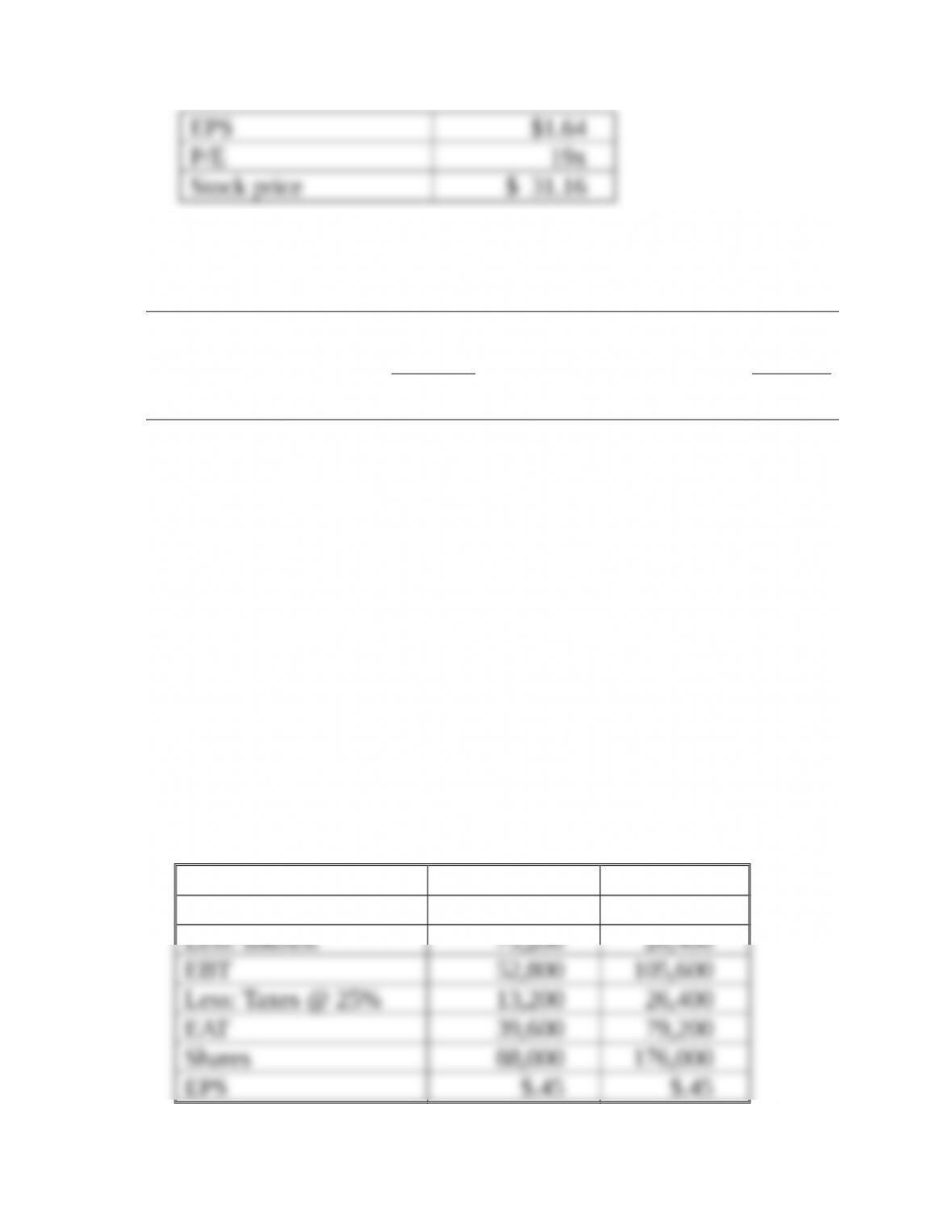
5-17. Solution:
Cain Supplies
Cain
EBIT $50,000
18. Leverage and stockholder wealth (LO4) Sterling Optical and Royal Optical both make
glass frames and each is able to generate earnings before interest and taxes of $132,000.
The separate capital structures for Sterling and Royal are shown here:
Sterling Royal
Debt @ 12%……………… $ 660,000 Debt @ 12%…………… $ 220,000
Common stock, $5 par…… 440,000 Common stock, $5 par 880,000
Total……………………… $1,100,000 Total…………………… $1,100,000
Common shares………….. 88,000 Common shares………… 176,000
a. Compute earnings per share for both firms. Assume a 25 percent tax rate.
b. In part a, you should have gotten the same answer for both companies’ earnings per
share. Assuming a P/E ratio of 22 for each company, what would its stock price be?
c. Now as part of your analysis, assume the P/E ratio would be 16 for the riskier
company in terms of heavy debt utilization in the capital structure and 24 for the less
risky company. What would the stock prices for the two firms be under these
assumptions? (Note: Although interest rates also would likely be different based on
risk, we will hold them constant for ease of analysis.)
d. Based on the evidence in part c, should management be concerned only about the
impact of financing plans on earnings per share, or should stockholders’ wealth
maximization (stock price) be considered as well?
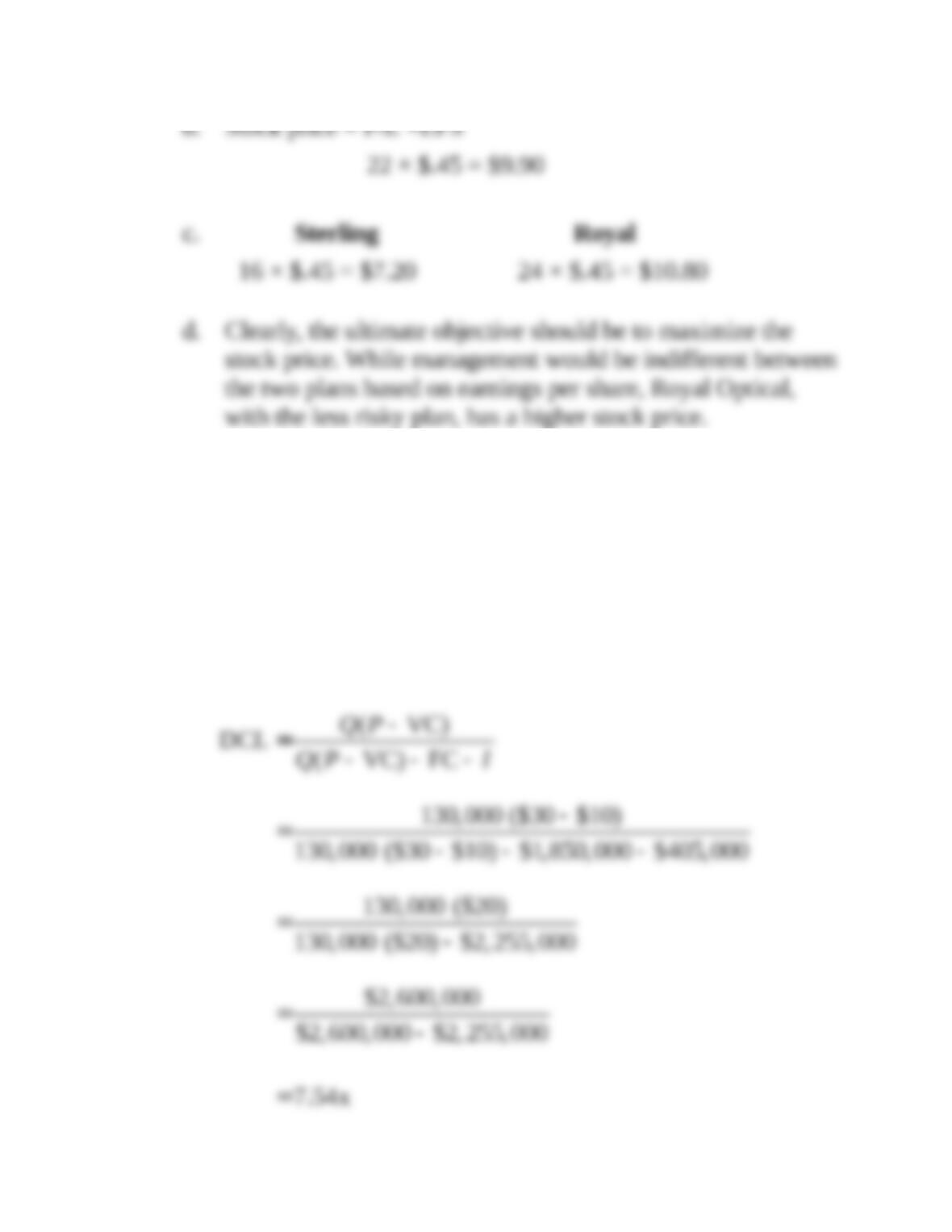
5-18. Solution:
Sterling Optical and Royal Optical
a.
Sterling Royal
EBIT $132,000 $132,000
19. Japanese firm and combined leverage (LO5) Firms in Japan often employ both high
operating and financial leverage because of the use of modern technology and close
borrower–lender relationships. Assume the Mitaka Company has a sales volume of 130,000
units at a price of $30 per unit; variable costs are $10 per unit and fixed costs are
$1,850,000. Interest expense is $405,000. What is the degree of combined leverage for this
Japanese firm?
5-19. Solution:
Mitaka Company
( VC)
DCL ( VC) FC
130,000 ($30 $10)
Q P
Q P I
–
=– – –
–
=– – –

20. Combining operating and financial leverage (LO5) Sinclair Manufacturing and
Boswell Brothers Inc. are both involved in the production of brick for the homebuilding industry.
Their financial information is as follows:
Capital Structure
Sinclair Boswell
Debt @ 11%…………………………………………………… $ 900,000 0
Common stock, $10 per share………………………….. 600,000 $ 1,5000,000
Total…………………………………………………………… $ 1,500,000 $ 1,500,000
Common shares………………………………………………. 60,000 150,000
Operating Plan
Sales (55,000 units at $20 each)………………………… $ 1,100,000 $ 1,100,000
Less: Variable costs……………………………………… 880,000 550,000
………………………………………………………………………. ($16 per unit) ($10 per unit)
Fixed costs……. 0 305,000
Earnings before interest and taxes (EBIT)…………… $ 220,000 $ 245,000
a. If you combine Sinclair’s capital structure with Boswell’s operating plan, what is the
degree of combined leverage? (Round to two places to the right of the decimal point.)
b. If you combine Boswell’s capital structure with Sinclair’s operating plan, what is the
degree of combined leverage?
c. Explain why you got the results you did in part b.
d. In part b, if sales double, by what percentage will EPS increase?
5-20. Solution:
Sinclair Manufacturing and Boswell Brothers
a.
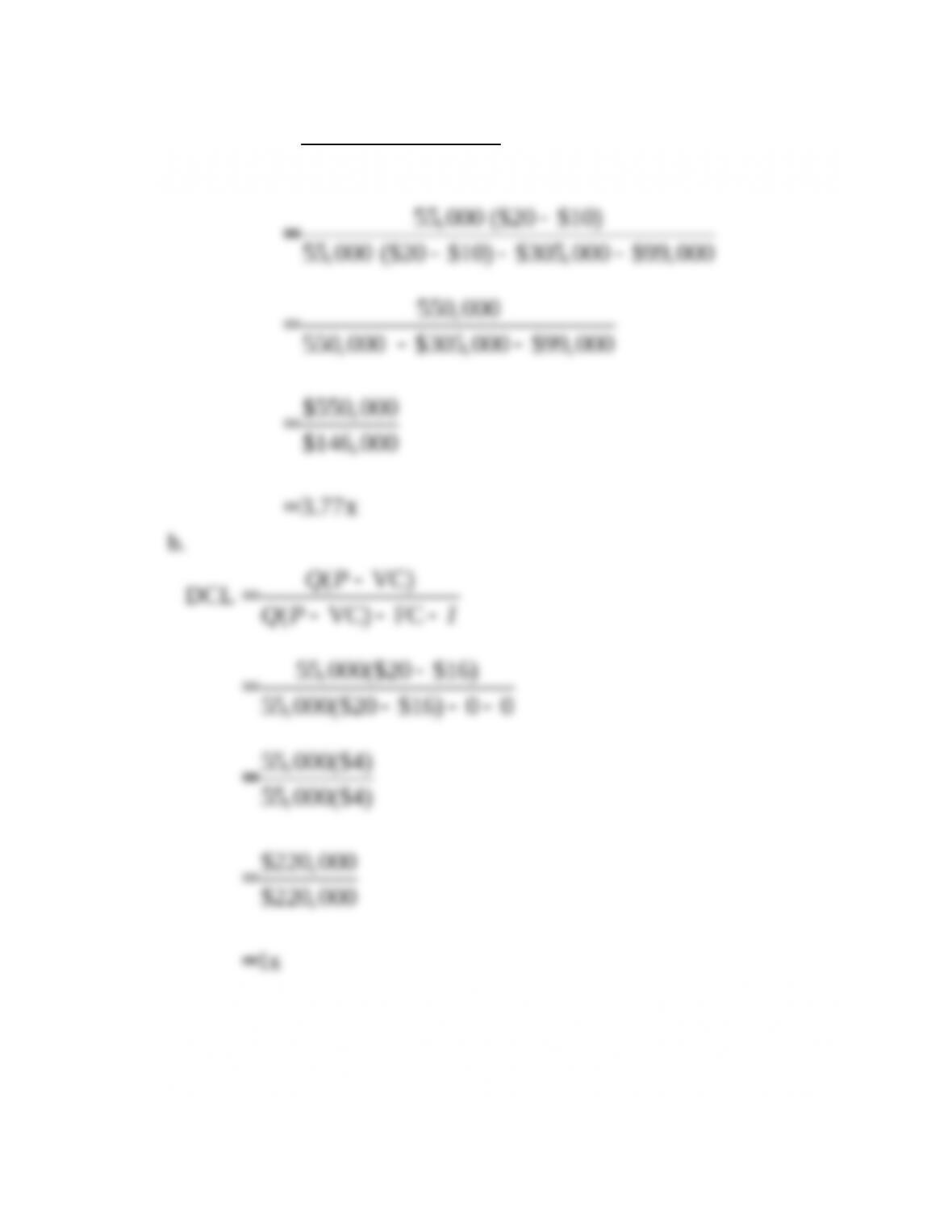
( VC)
DCL ( VC) FC
55,000 ($20 $10)
55,000 ($20 $10) $305,000 $99,000
550,000
550,000 $305,000 $99,000
$550,000
$146,000
3.77x
Q P
Q P I
–
=– – –
–
=– – –
=– –
=
=
b.
( VC)
DCL ( VC) FC
55,000($20 $16)
55,000($20 $16) 0 0
55,000($4)
55,000($4)
$220,000
$220,000
Q P
Q P I
–
=– – –
–
=– – –
=
=

21. Expansion and leverage (LO5) DeSoto Tools Inc. is planning to expand production. The
expansion will cost $300,000, which can be financed either by bonds at an interest rate of
14 percent or by selling 10,000 shares of common stock at $30 per share. The current
income statement before expansion is as follows:
DESOTO TOOLS Inc.
Income Statement
20X1
Sales………………………………………………….….………….…. $1,500,000
Less: Variable costs……………………………….…….……… $450,000
Fixed costs……………………………………………………….. 550,000 1,000,000
Earnings before interest and taxes……………………………. 500,000
Less: Interest expense…………………………….…………... 100,000
Earnings before taxes………………………………..…….…….. 400,000
Less: Taxes @ 34%……………………………….……….…… 136,000
Earnings after taxes………………………………………….……. $ 264,000
Shares……………………………………………………….….……… 100,000
Earnings per share…………………………………………………. $ 2.64
After the expansion, sales are expected to increase by $1,000,000. Variable costs will
remain at 30 percent of sales, and fixed costs will increase to $800,000. The tax rate is
34 percent.
a. Calculate the degree of operating leverage, the degree of financial leverage, and the
degree of combined leverage before expansion. (For the degree of operating leverage,
use the formula developed in footnote 2. For the degree of combined leverage, use the
formula developed in footnote 3. These instructions apply throughout this problem.)
b. Construct the income statement for the two alternative financing plans.
c. Calculate the degree of operating leverage, the degree of financial leverage, and the
degree of combined leverage, after expansion.
d. Explain which financing plan you favor and the risks involved with each plan.
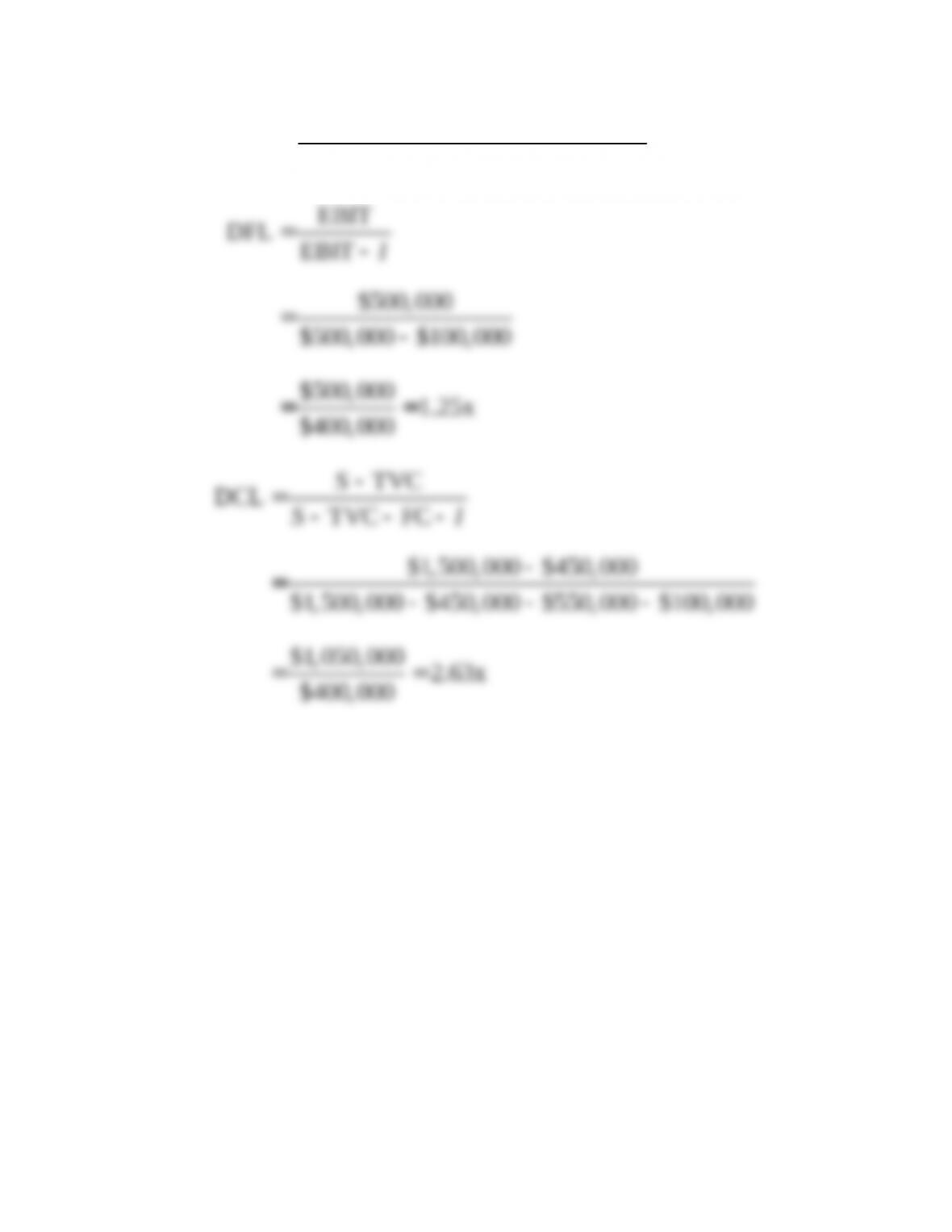
5-21. Solution:
DeSoto Tools Inc.
a.
VC
DOL TVC FC
S
S
–
=– –
$1,500,000 $450,000 2.1x
$1,500,000 $450,000 $550,000
EBIT
DFL EBIT
$500,000
$500,000 $100,000
$500,000 1.25x
$400,000
I
–
= =
– –
=–
=–
= =
TVC
DCL TVC FC
$1,500,000 $450,000
$1,500,000 $450,000 $550,000 $100,000
$1,050,000 2.63x
$400,000
S
S I
–
=– – –
–
=—
= =