5-11. (Continued)
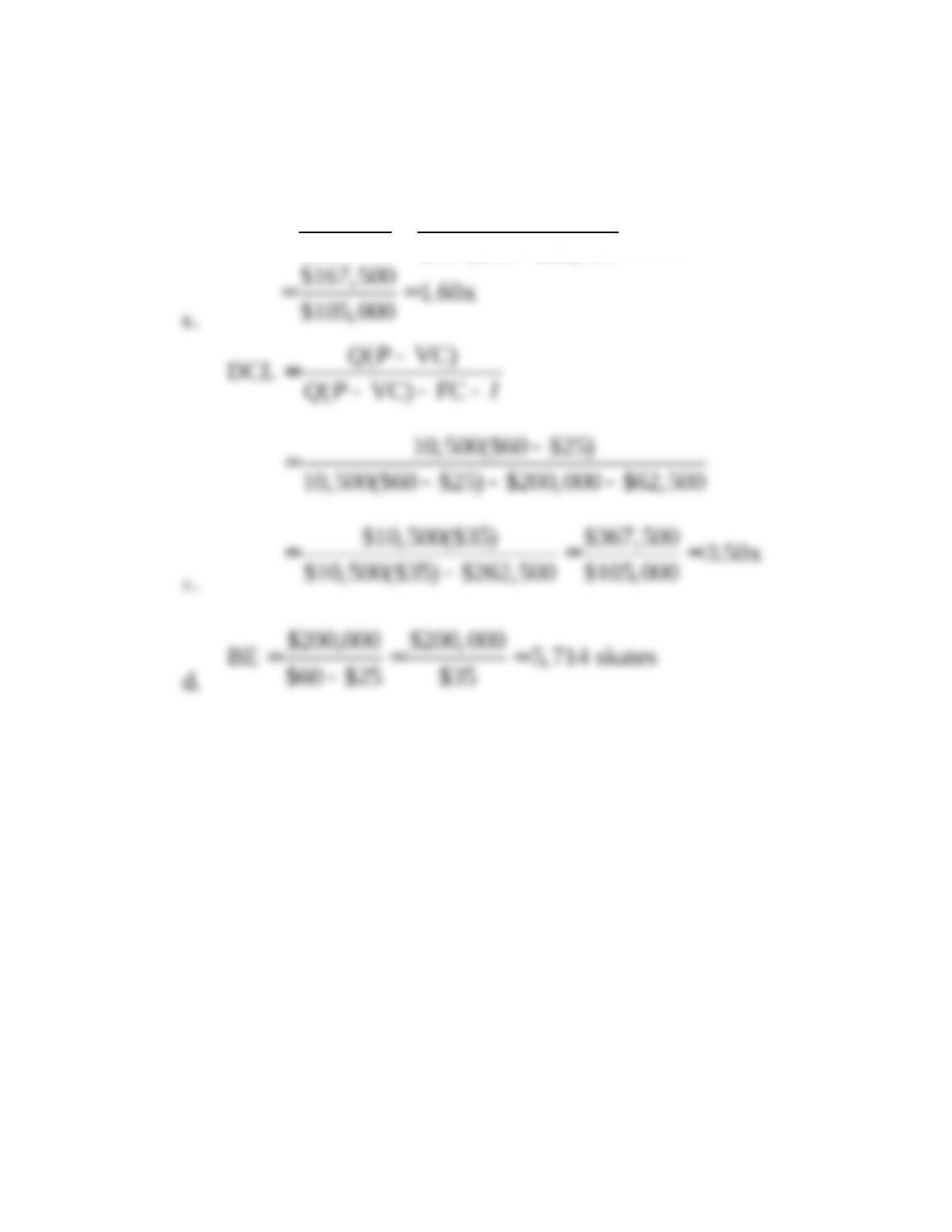
EBIT $167,500
DFL EBIT $167,500 $62,500
$167,500 1.60x
$105,000
I
= =
– –
= =
c.
( VC)
DCL ( VC) FC
10,500($60 $25)
10,500($60 $25) $200,000 $62,500
$10,500($35) $367,500 3.50x
$10,500($35) $262,500 $105,000
Q P
Q P I
–
=– – –
–
=– – –
= = =
–
d.
$200,000 $200,000
BE 5,714 skates
$60 $25 $35
= = =
–
12. Break-even point and degree of leverage (LO2 and 5) Healthy Foods Inc. sells 50-pound
bags of grapes to the military for $10 a bag. The fixed costs of this operation are $80,000,
while the variable costs of grapes are $0.10 per pound.
a. What is the break-even point in bags?
b. Calculate the profit or loss on 12,000 bags and on 25,000 bags.
c. What is the degree of operating leverage at 20,000 bags and at 25,000 bags?
Why does the degree of operating leverage change as the quantity sold increases?
d. If Healthy Foods has an annual interest expense of $10,000, calculate the degree of
financial leverage at both 20,000 and 25,000 bags.
e. What is the degree of combined leverage at both sales levels?
5-12. Solution:
Healthy Foods Inc.
a.
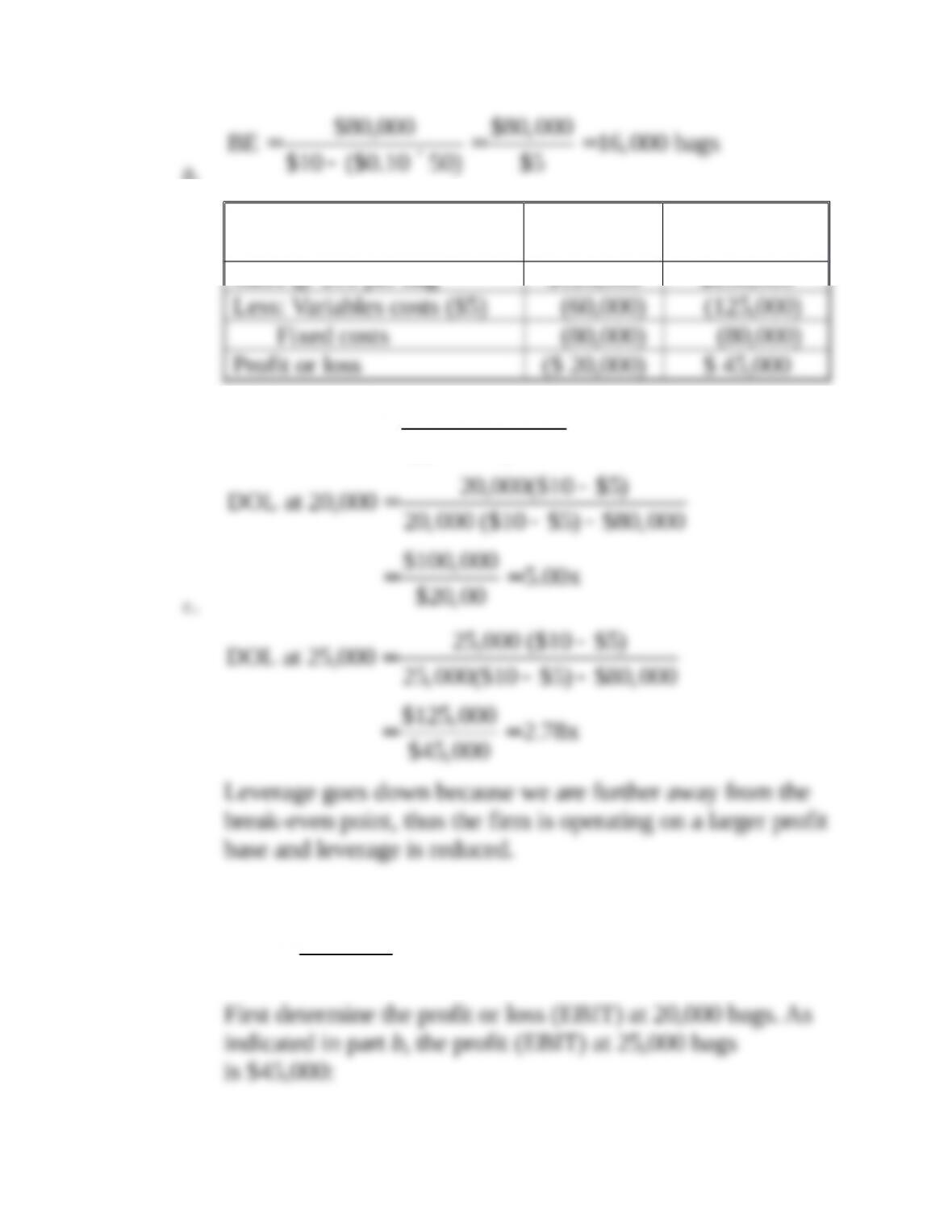
$80,000 $80,000
BE 16,000 bags
$10 ($0.10 50) $5
= = =
– ´
b. 12,000
bags 25,000 bags
Sales @ $10 per bag $120,000 $250,000
25,000 ($10 $5)
DOL at 25,000 25,000($10 $5) $80,000
$125,000 2.78x
$45,000
–
=– –
= =
Leverage goes down because we are further away from the
break-even point, thus the firm is operating on a larger profit
base and leverage is reduced.
5-12. (Continued)
d.
EBIT
DFL EBIT I
=–
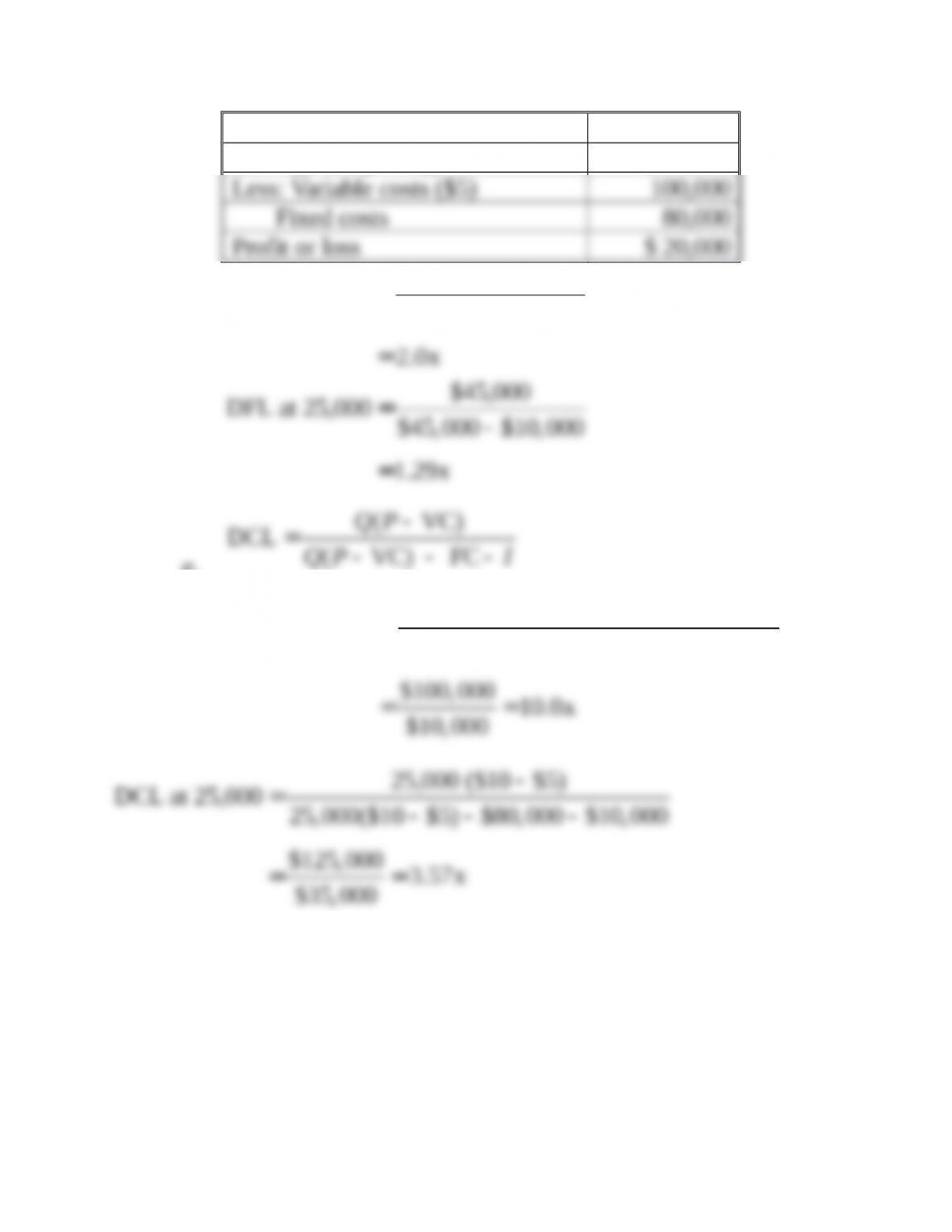
20,000 bags
Sales @ $10 per bag $200,000
$20,000
DFL at 20,000 $20,000 $10,000
2.0x
=–
=
$45,000
DFL at 25,000 $45,000 $10,000
1.29x
=–
=
e.
( VC)
DCL ( VC) FC
Q P
Q P I
–
=– – –
20,000 ($10 $5)
DCL at 20,000
20,000($10 $5) $80,000 $10,000
$100,000 10.0x
$10,000
–
=– – –
= =
25,000 ($10 $5)
DCL at 25,000 25,000($10 $5) $80,000 $10,000
$125,000 3.57x
$35,000
–
=– – –
= =
13. Break-even point and degree of leverage (LO2 and 5) United Snack Company sells
50-pound bags of peanuts to university dormitories for $20 a bag. The fixed costs of this
operation are $176,250, while the variable costs of peanuts are $.15 per pound.
a. What is the break-even point in bags?
b. Calculate the profit or loss on 7,000 bags and on 20,000 bags.
c. What is the degree of operating leverage at 19,000 bags and at 24,000 bags? Why
does the degree of operating leverage change as the quantity sold increases?
d. If United Snack Company has an annual interest expense of $15,000, calculate the
degree of financial leverage at both 19,000 and 24,000 bags.
e. What is the degree of combined leverage at both sales levels?
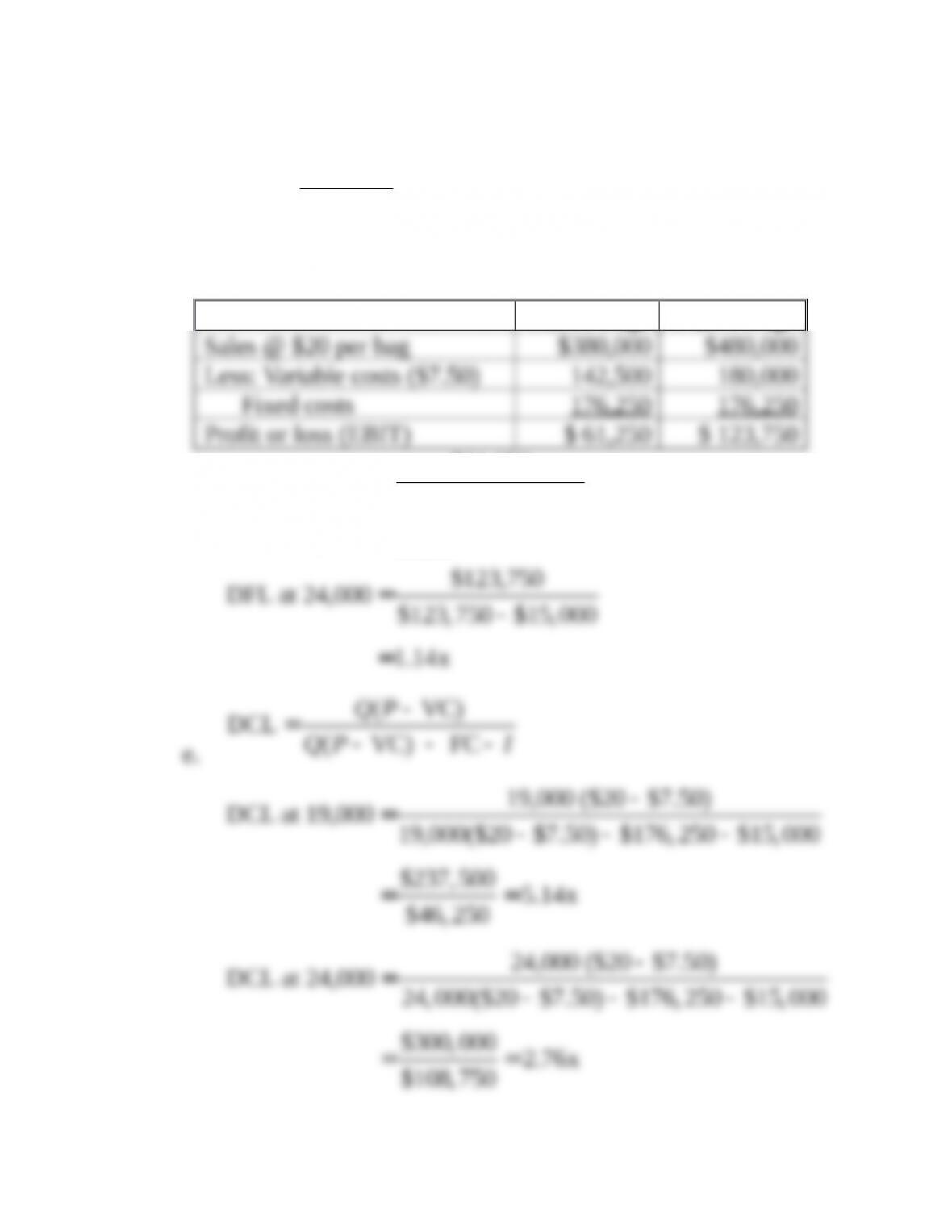
5-13. Solution:
United Snack Company
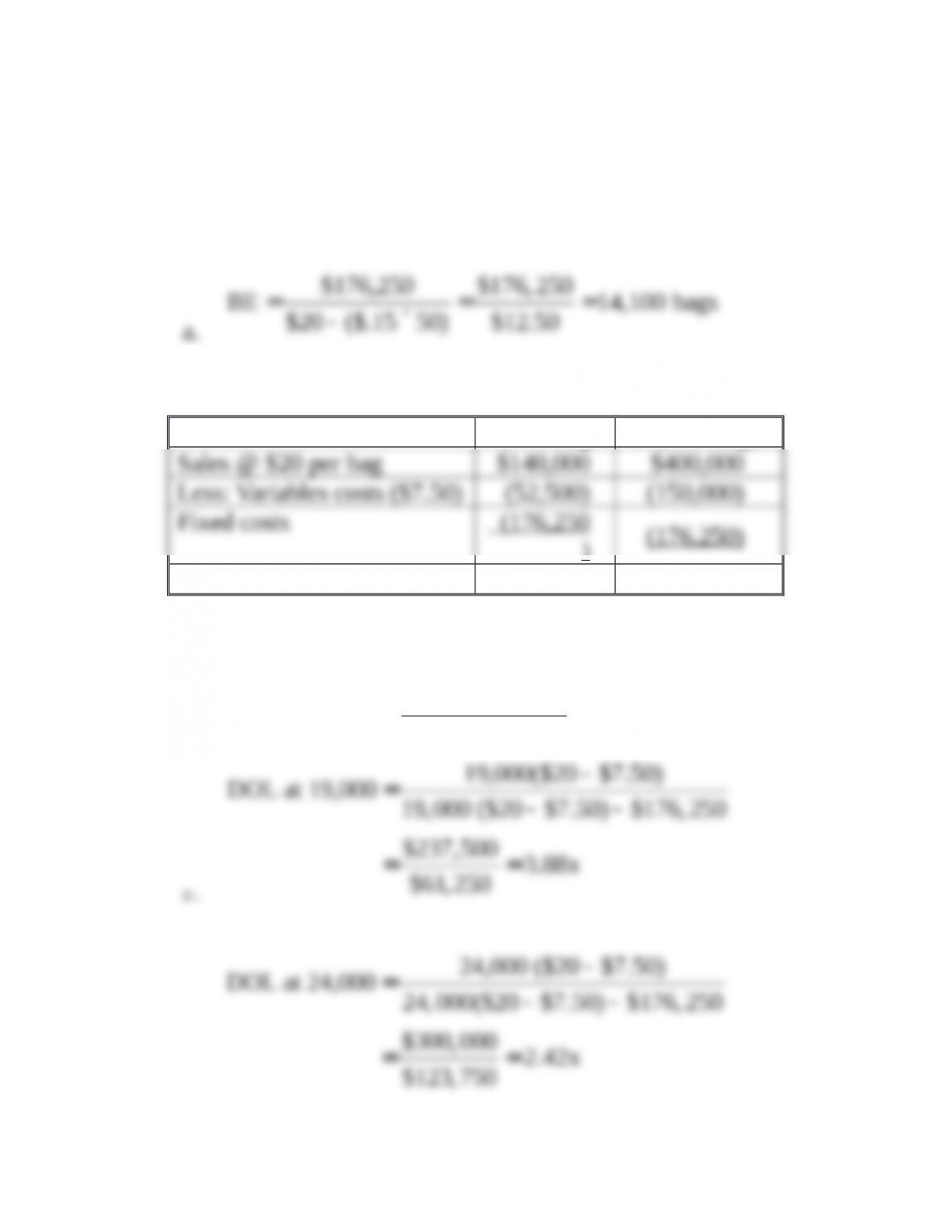
$176,250 $176, 250
BE 14,100 bags
$20 ($.15 50) $12.50
= = =
– ´

5-13. (Continued)
d.
EBIT
DFL EBIT I
=–
First determine the profit or loss (EBIT) at 19,000 bags and
at 24,000 bag:
19,000 bags 24,000 bags
$61,250
DFL at 19,000 $61, 250 $15, 000
1.32x
=–
=
$123,750
DFL at 24,000 $123,750 $15, 000
1.14x
=–
=
e.
( VC)
DCL ( VC) FC
Q P
Q P I
–
=– – –
19,000 ($20 $7.50)
DCL at 19,000
19,000($20 $7.50) $176,250 $15, 000
$237,500 5.14x
$46, 250
–
=– – –
= =
24,000 ($20 $7.50)
DCL at 24,000 24, 000($20 $7.50) $176,250 $15, 000
$300, 000 2.76x
$108,750
–
=– – –
= =
14. Nonlinear breakeven analysis (LO2) International Data System’s information on revenue
and costs is relevant only up to a sales volume of 105,000 units. After 105,000 units, the
market becomes saturated and the price per unit falls from $14.00 to $8.80. Also, there are
cost overruns at a production volume of over 105,000 units, and variable cost per unit goes
up from $7.00 to $8.00. Fixed costs remain the same at $55,000.
a. Compute operating income at 105,000 units.
b. Compute operating income at 205,000 units.
5-14. Solution:
International Data Systems
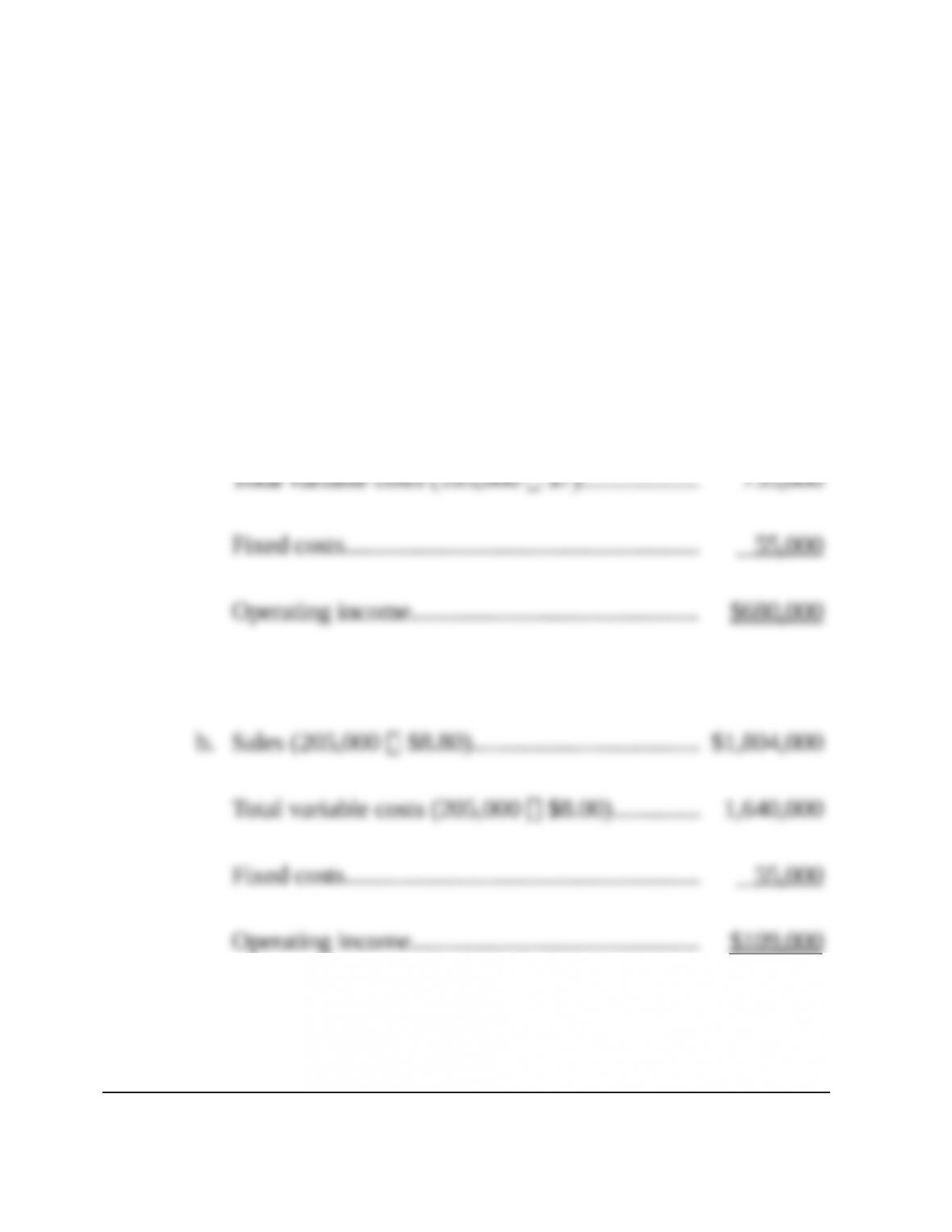
a. Sales (105,000 $14)……………..…….….….….… $1,470,000
15. Use of different formulas for operating leverage (LO3) U.S. Steal has the following
income statement data:
Units Total Fixed Total Total Operating
Sold
Variable
Costs Costs Costs Revenue
Income
(Loss)
60,000 $ 120,000 $50,000 $170,000 $360,000 $190,000
80,000 160,000 50,000 210,000 480,000 270,000
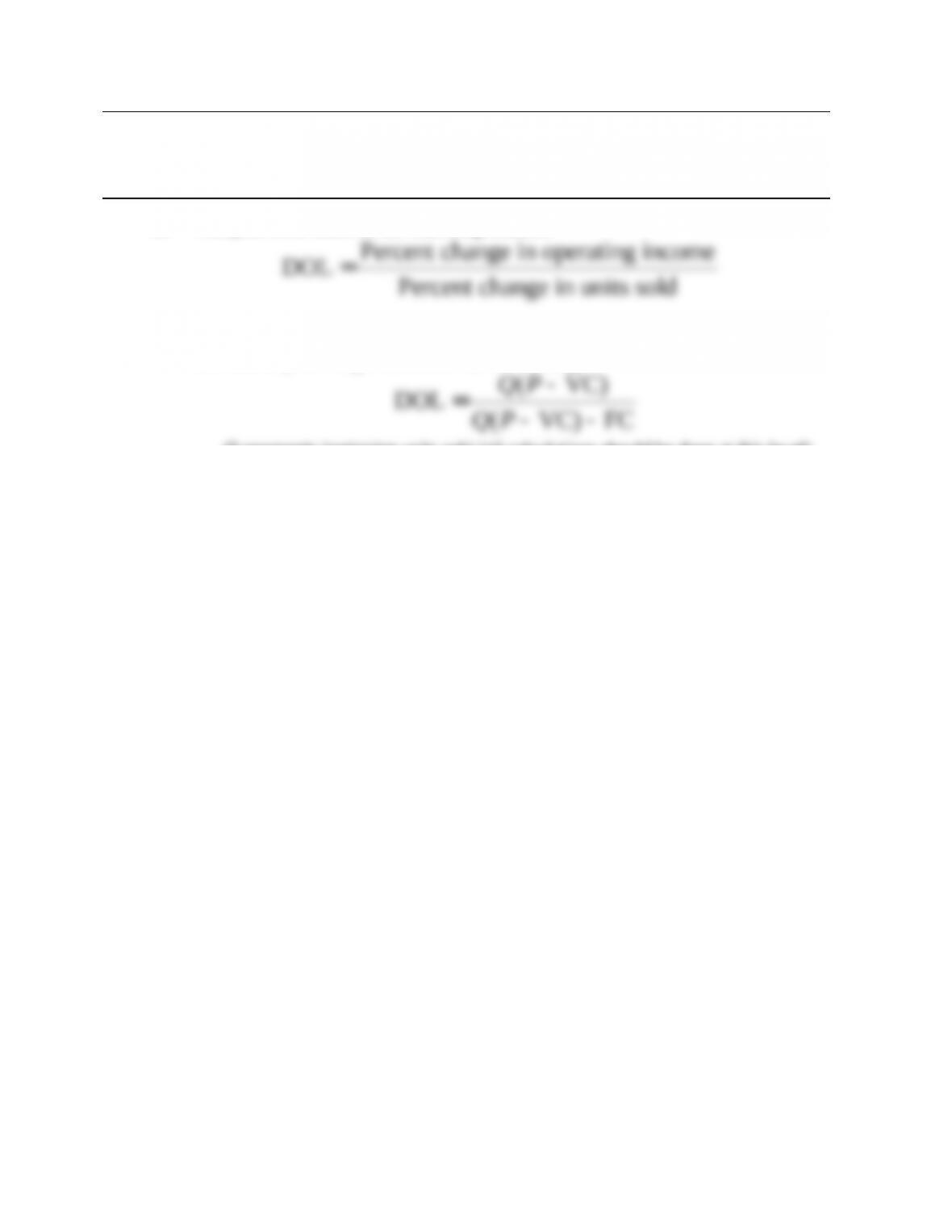
a. Compute DOL based on the following formula:
Percent change in operating income
DOL Percent change in units sold
=
b. Confirm that your answer to part a is correct by recomputing DOL using Formula 5–
3. There may be a slight difference due to rounding.
( VC)
DOL ( VC) FC
Q P
Q P
–
=– –
Q represents beginning units sold (all calculations should be done at this level).
P can be found by dividing total revenue by units sold.
VC can be found by dividing total variable costs by units sold.