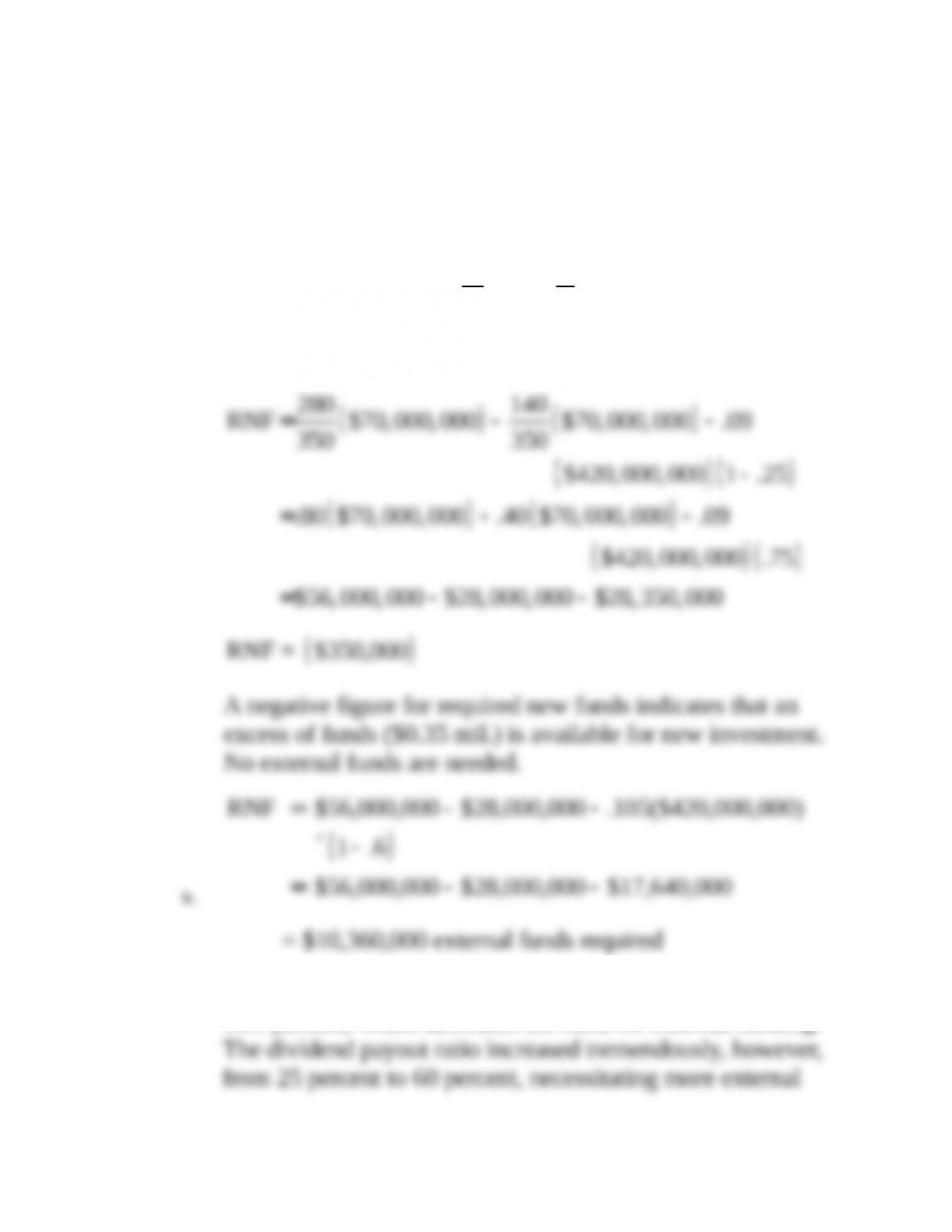
4-29. Solution:
Conn Man’s Shops
a.
2
A L
Required New Funds = S S PS 1 D
S S
S = 20% $350,000,000 = $70, 000, 000D ´
( ) ( )
( ) ( )
( ) ( )
( ) ( )
280 140
RNF $70,000,000 $70,000,000 .09
350 350
$420, 000, 000 1 .25
.80 $70,000,000 .40 $70,000,000 .09
$420, 000, 000 .75
$56,000,000 $28,000,000 $28,350,000
= – –
–
= – –
= – –
( )
RNF = $350,000
A negative figure for required new funds indicates that an
excess of funds ($0.35 mil.) is available for new investment.
No external funds are needed.
b.
( )
RNF $56,000,000 $28,000,000 .105($420,000,000)
1 .6
$56,000,000 $28,000,000 $17,640,000
= –
–
´ –
= – –
= $10,360,000 external funds required
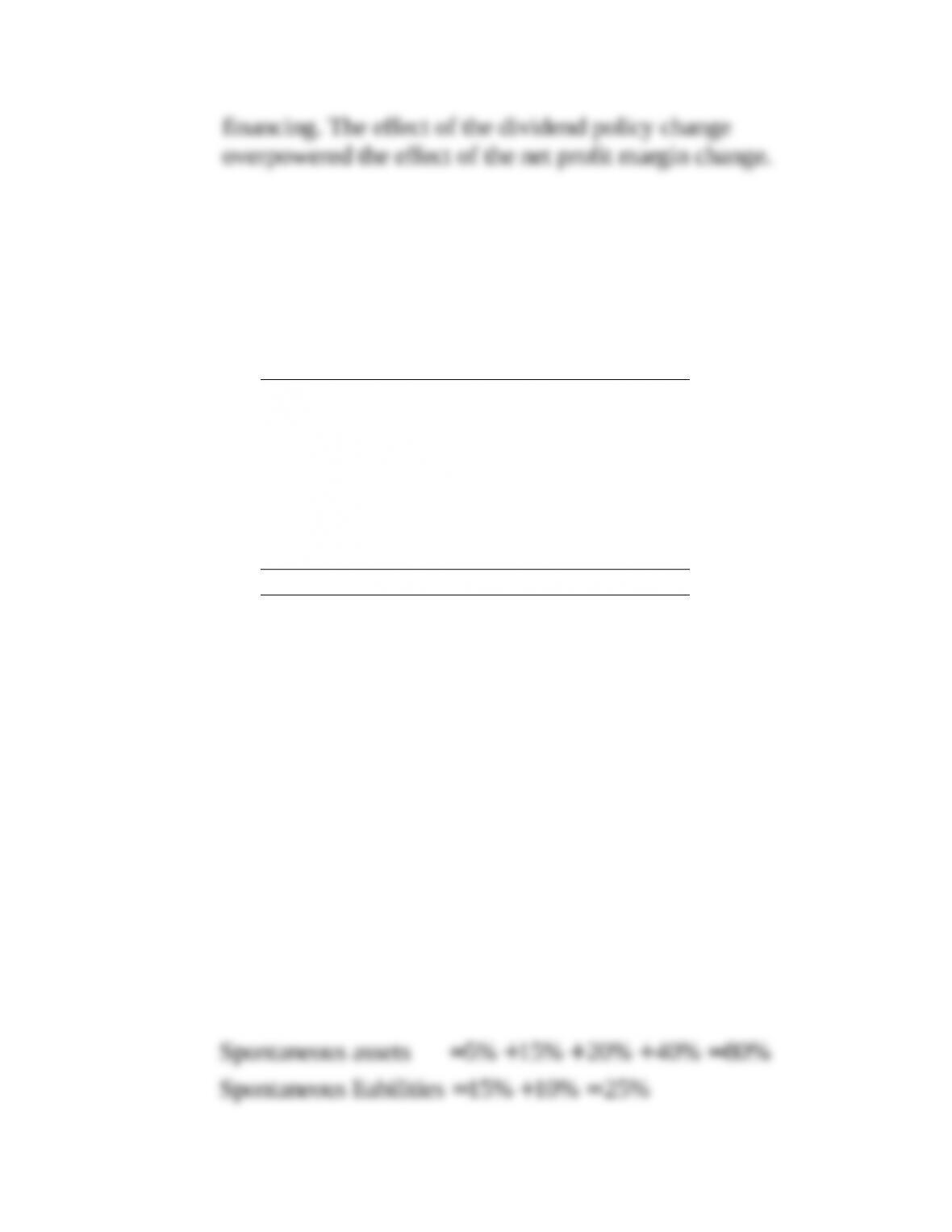
The net profit margin increased slightly, from 9 percent to
10.5 percent, which decreases the need for external funding.
COMPREHENSIVE PROBLEM
Comprehensive Problem 1.
Mansfield Corporation (external funds requirement) (LO4) Mansfield Corporation had 20X1
sales of $100 million. The balance sheet items that vary directly with sales and the profit margin
are as follows:
Percent
Cash…………………………………………………….….. 5%
Accounts receivable………………………………….………..15
Inventory…………………………………………………………..20
Net fixed assets…………………………………….……….…..40
Accounts payable…………………………………….…….…..15
Accruals………………………………………..….……….……..10
Profit margin after taxes………………………………………10%
The dividend payout rate is 50 percent of earnings, and the balance in retained earnings
at the end of 20X1 was $33 million. Notes payable are currently $7 million. Long-term
bonds and common stock are constant at $5 million and $10 million, respectively.
a. How much additional external capital will be required for next year if sales increase
15 percent? (Assume that the company is already operating at full capacity.)
b. What will happen to external fund requirements if Mansfield Corporation reduces the
payout ratio, grows at a slower rate, or suffers a decline in its profit margin? Discuss
each of these separately.
c. Prepare a pro forma balance sheet for 20X2 assuming that any external funds being
acquired will be in the form of notes payable. Disregard the information in part b in
answering this question (that is, use the original information and part a in constructing
your pro forma balance sheet).
CP 4-1. Solution:
Mansfield Corporation
Sales .15 $100 million =15 million
Spontaneous assets 5% 15% 20% 40% 80%
Spontaneous liabilities 15% 10% 25%
D = ´
= + + + =
= + =
( ) ( ) ( )
( ) ( ) ( ) ( )
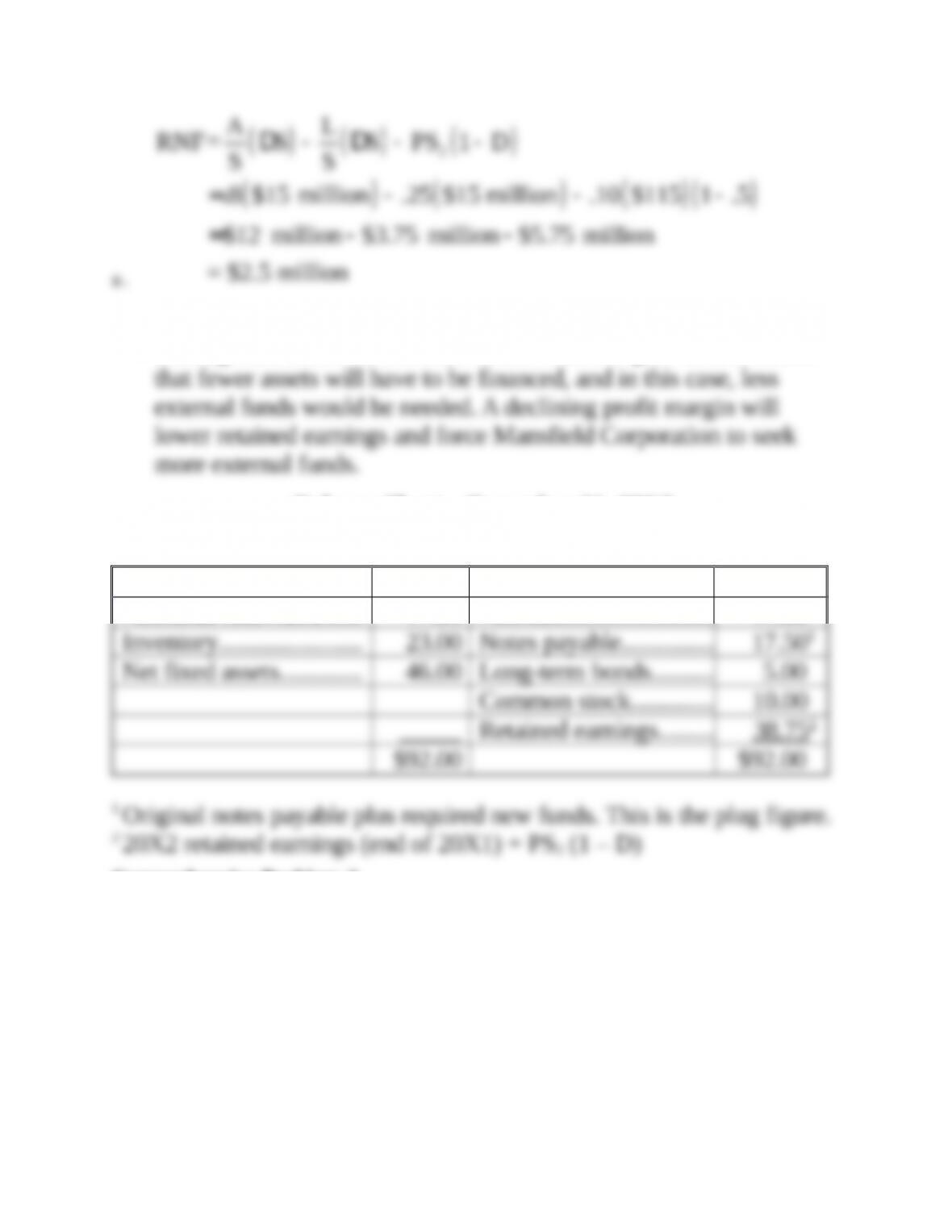
2
A L
RNF= S S PS 1 D
S S
.8 $15 million .25 $15 million .10 $115 1 .5
$12 million $3.75 million $5.75 million
= $2.5 million
D – D – –
= – – –
= – –

February............. $186,000 (1,200,000 fasteners)
March….............. $217,000 (1,400,000 fasteners)
April….……......... $310,000 (2,000,000 fasteners)
May………………… $387,500 (2,500,000 fasteners)
Last year Marsh Corporation’s sales were $175,000 in November and $232,500 in
December (1,500,000 fasteners).
Mr. Marsh is preparing for a meeting with his banker to arrange the financing for the
first quarter. Based on his sales forecast and the following information he has provided,
your job as his new financial analyst is to prepare a monthly cash budget, monthly and
quarterly pro forma income statements, a pro forma quarterly balance sheet, and all
necessary supporting schedules for the first quarter.
Past history shows that Marsh Corporation collects 50 percent of its accounts receivable
in the normal 30-day credit period (the month after the sale) and the other 50 percent in 60
days (two months after the sale). It pays for its materials 30 days after receipt. In general,
Mr. Marsh likes to keep a two-month supply of inventory in anticipation of sales. Inventory
at the beginning of December was 2,600,000 units. (This was not equal to his desired two-
month supply.)
The major cost of production is the purchase of raw materials in the form of steel rods,
which are cut, threaded, and finished. Last year raw material costs were $52 per 1,000
fasteners, but Mr. Marsh has just been notified that material costs have risen, effective
January 1, to $60 per 1,000 fasteners. The Marsh Corporation uses FIFO inventory
accounting. Labor costs are relatively constant at $20 per thousand fasteners, since workers
are paid on a piecework basis. Overhead is allocated at $10 per thousand units, and selling
and administrative expense is 20 percent of sales. Labor expense and overhead are direct
cash outflows paid in the month incurred, while interest and taxes are paid quarterly.
The corporation usually maintains a minimum cash balance of $25,000, and it puts its
excess cash into marketable securities. The average tax rate is 40 percent, and Mr. Marsh
usually pays out 50 percent of net income in dividends to stockholders. Marketable
securities are sold before funds are borrowed when a cash shortage is faced. Ignore the
interest on any short-term borrowings. Interest on the long-term debt is paid in March, as
are taxes and dividends.
As of year-end, the Marsh Corporation balance sheet was as follows:
MARSH CORPORATION
Balance Sheet
December 31, 20X1
Assets
Current assets:
Cash………………………………..….………….……. $ 30,000
Accounts receivable…………………..……….….. 320,000
Inventory………………………………………..…….. 237,800
Total current assets………………………………. $ 587,800
Fixed assets:
Plant and equipment……………………………….. 1,000,000
Less: Accumulated depreciation………….... 200,000 800,000
Total assets…………………………………….….……. $1,387,800
Liabilities and Stockholders’ Equity
Accounts payable……………………………..……... $ 93,600
Notes payable………………………………………….. 0
Long-term debt, 8 percent……………………….... 400,000
Common stock…………………………….…….……. 504,200
Retained earnings…………………………………….. 390,000
Total liabilities and stockholders’ equity........ $1,387,800
CP 4-2. Solution:
Marsh Corporation
Forecasting with Seasonal Production
Dec. Jan. Feb. Mar.
Projected
1,500,000 1,700,000 1,200,000 1,400,000
inventory
Units to be
produced
1,800,000 1,400,000 2,000,000 2,500,000
CP 4-2. (Continued)
Monthly Cash Payments
Dec. Jan. Feb.Mar.
Units to be
produced 1,800,000 1,400,000 2,000,000 2,500,000
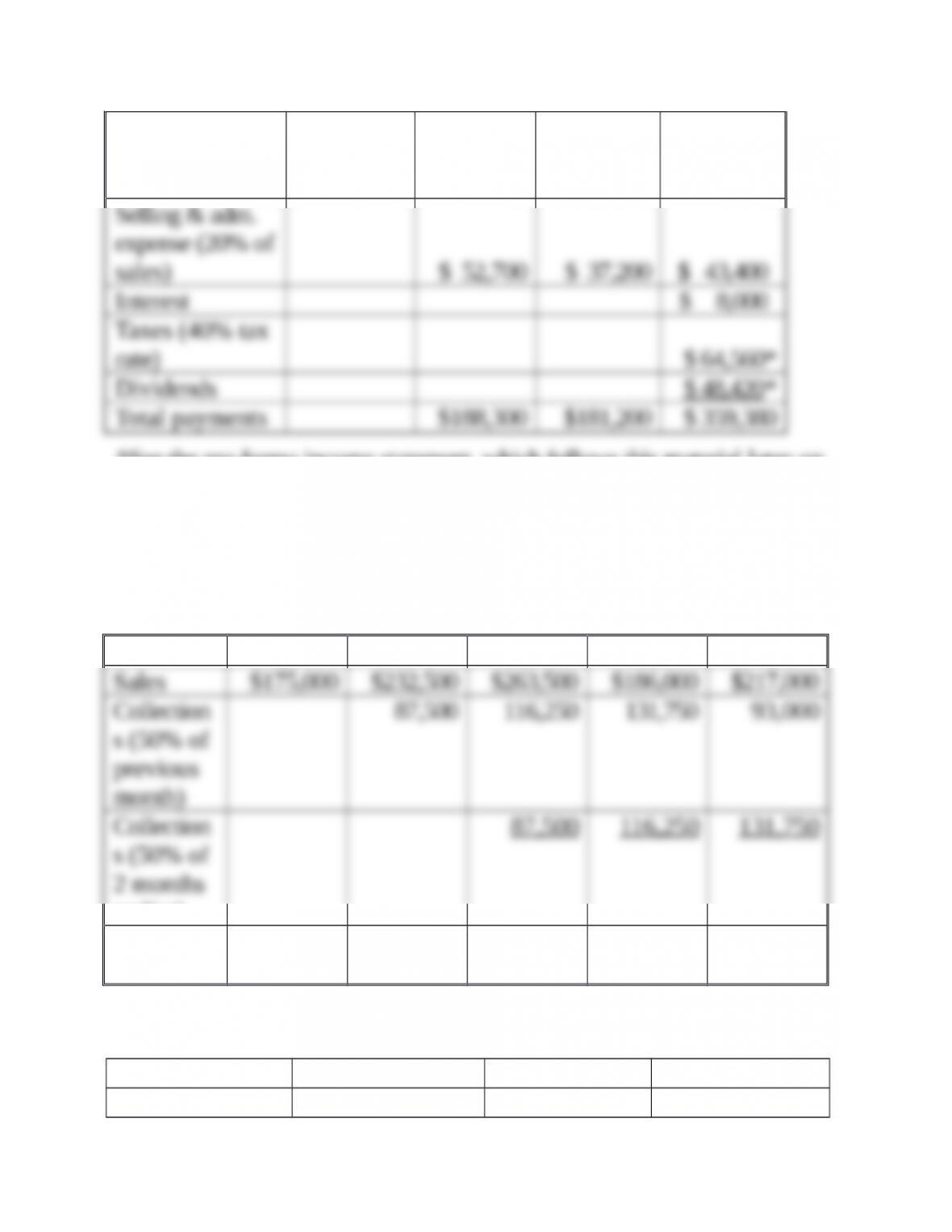
Overhead ($10
per thousand
units) $ 14,000 $ 20,000 $ 25,000
*See the pro forma income statement, which follows this material later on,
for the development of these values.
CP 4-2. (Continued)
Marsh Corporation
Monthly Cash Receipts
Nov. Dec. Jan. Feb. Mar.
earlier)
Total
collections
$203,750 $248,000 $224,750
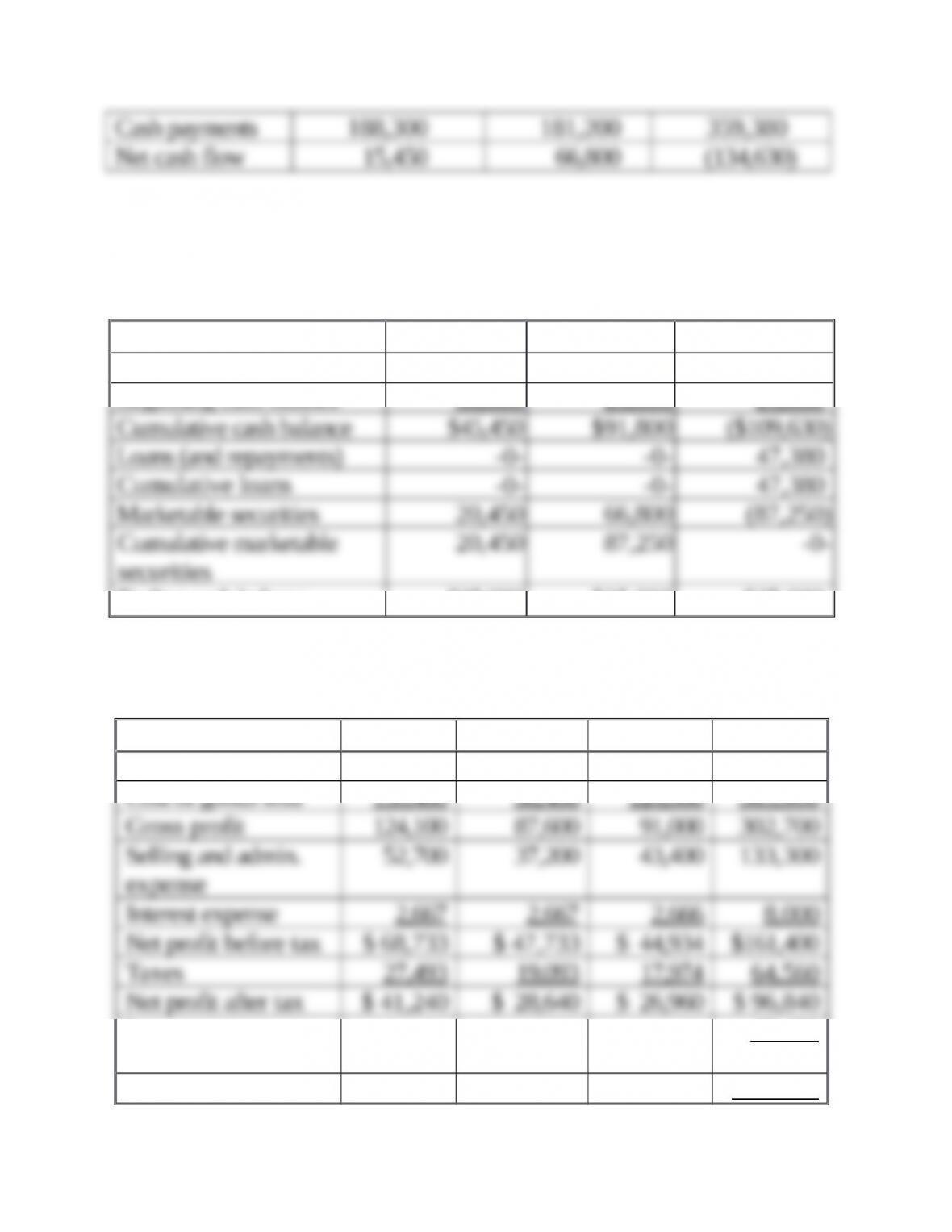
Monthly Cash Flow
January February March
Cash receipts $203,750 $248,000 $224,750
CP 4-2. (Continued)
Marsh Corporation
Cash Budget
January February March
Net cash flow $15,450 $66,800 $(134,630)
Beginning cash balance
30,000
25,000
25,000
Cumulative cash balance
$45,450
$91,800
($109,630)
Loans (and repayments)
-0-
-0-
47,380
Cumulative loans
-0-
-0-
47,380
Marketable securities
20,450
66,800
(87,250)
Cumulative marketable
securities
20,450 87,250 -0-
Ending cash balance $25,000 $25,000 $25,000
Marsh Corporation
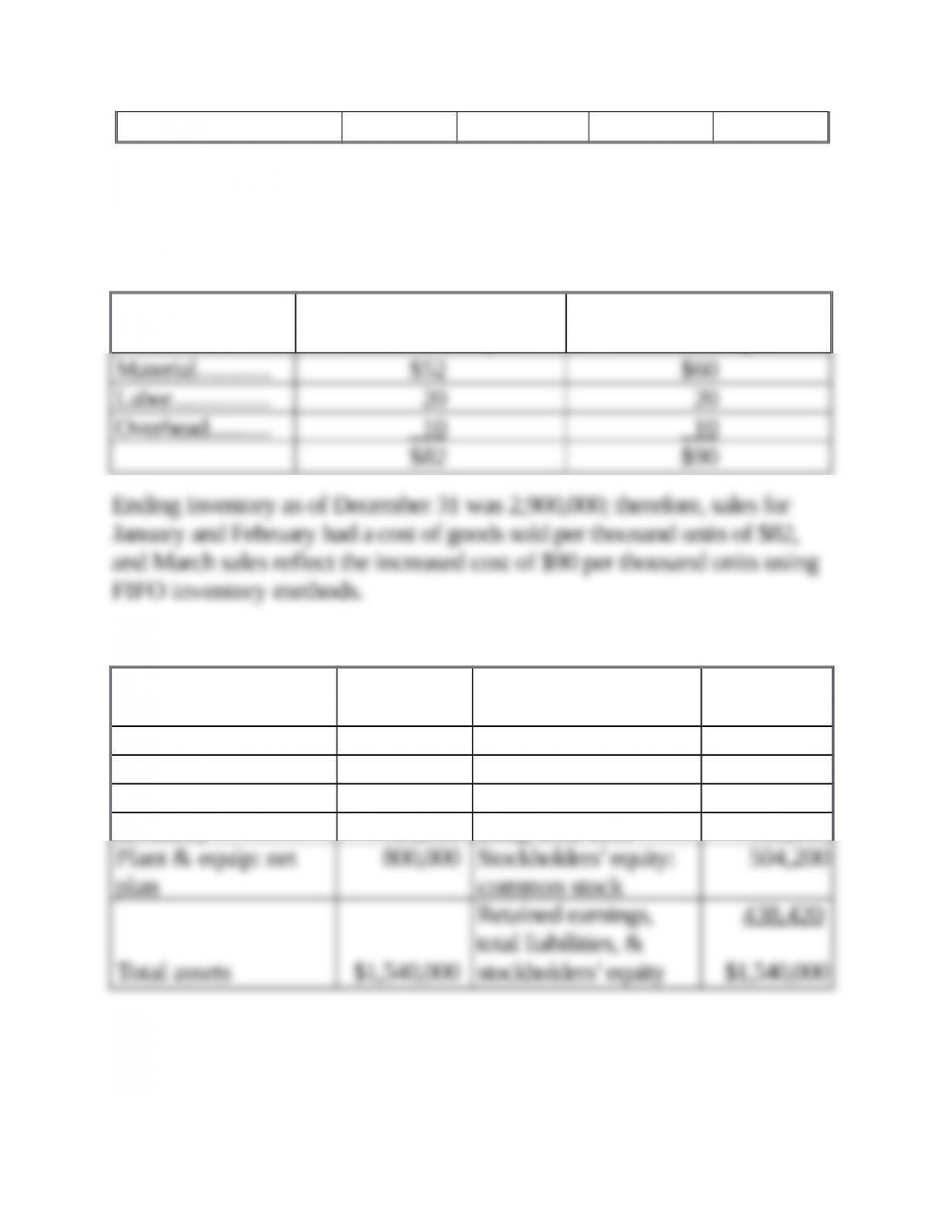
Pro Forma Income Statement
Jan. Feb. Mar. Total
Sales $263,500 $186,000 $217,000 $666,500
Less: common
dividends
48,420
Increase in retained $ 48,420
earnings
CP 4-2. (Continued)
Marsh Corporation
Cost of Goods Sold
Unit Cost per Thousand
before January 1st
Unit Cost per Thousand
after January 1st
Material...........
$52
$60
Labor...............
20
20
Overhead…….…
10
10
$82 $90
Ending inventory as of December 31 was 2,900,000; therefore, sales for
January and February had a cost of goods sold per thousand units of $82,
and March sales reflect the increased cost of $90 per thousand units using
FIFO inventory methods.
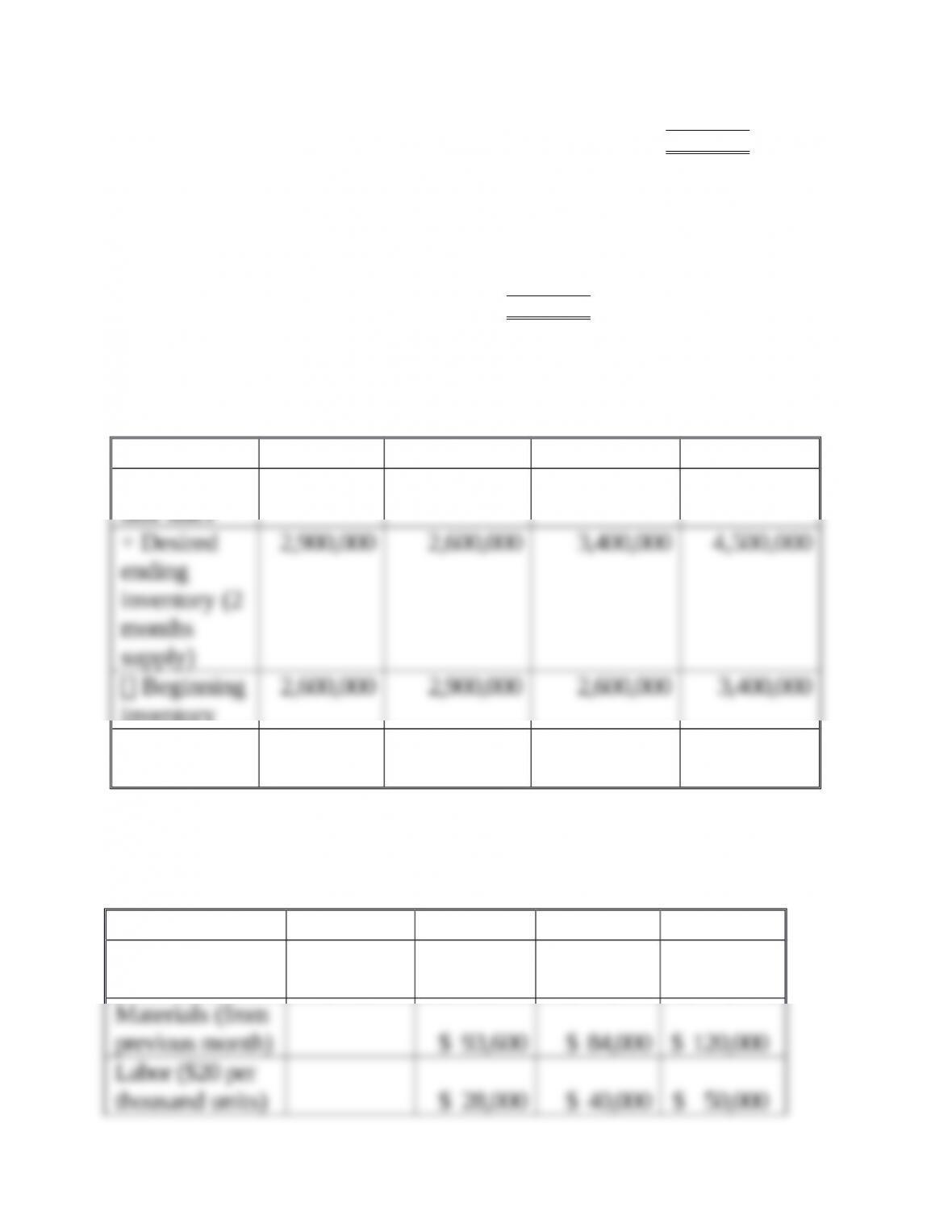
Pro Forma Balance Sheet (March)
Assets Liabilities &
Stockholders’ Equity
Current assets:
Current liabilities:
Cash
$ 25,000
Accounts payable
$ 150,000
Accounts receivable
310,000
Notes payable
47,380
Inventory
405,000
Long-term debt
400,000
CP 4-2. (Continued)
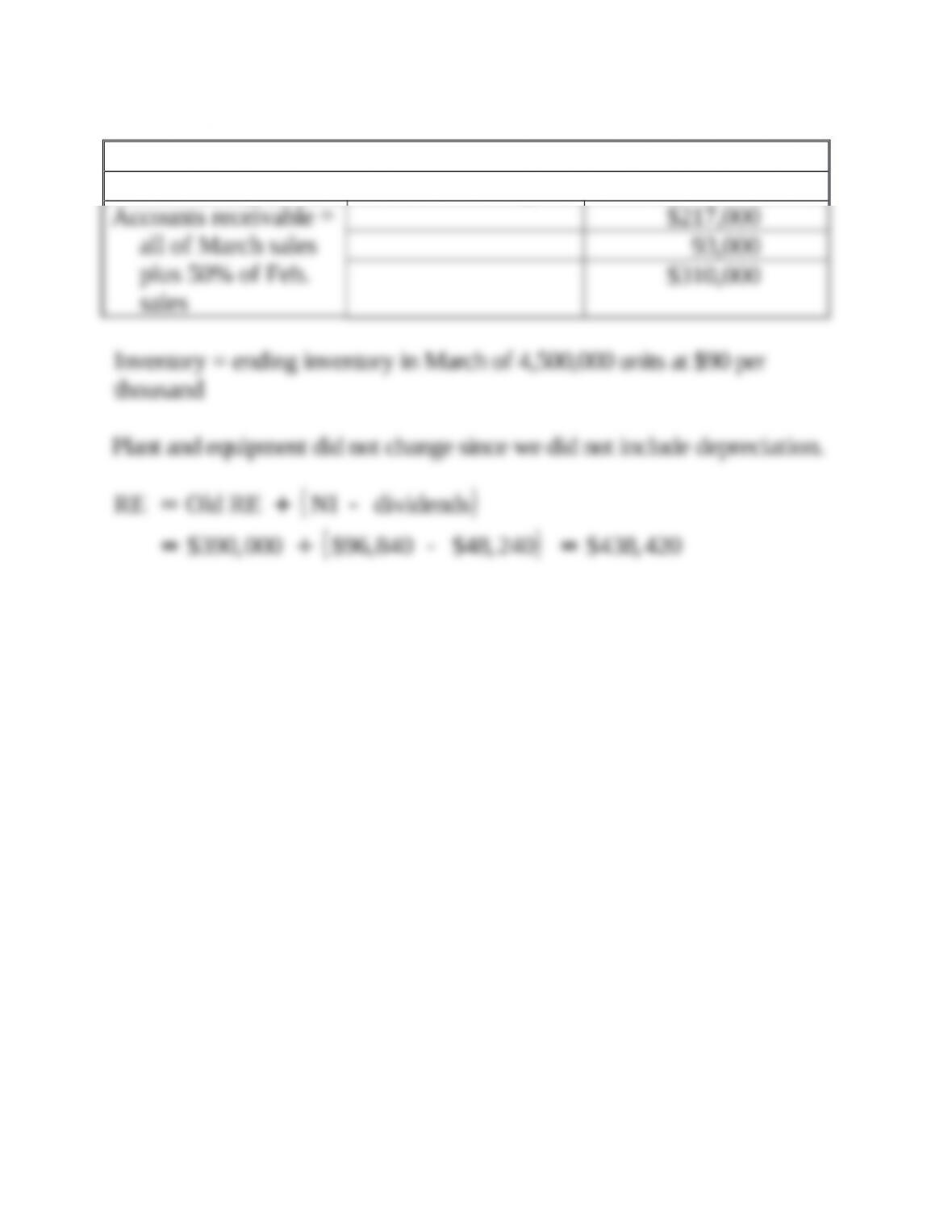
Explanation of Changes in the Balance Sheet:
Cash = Ending cash balance from cash budget in March