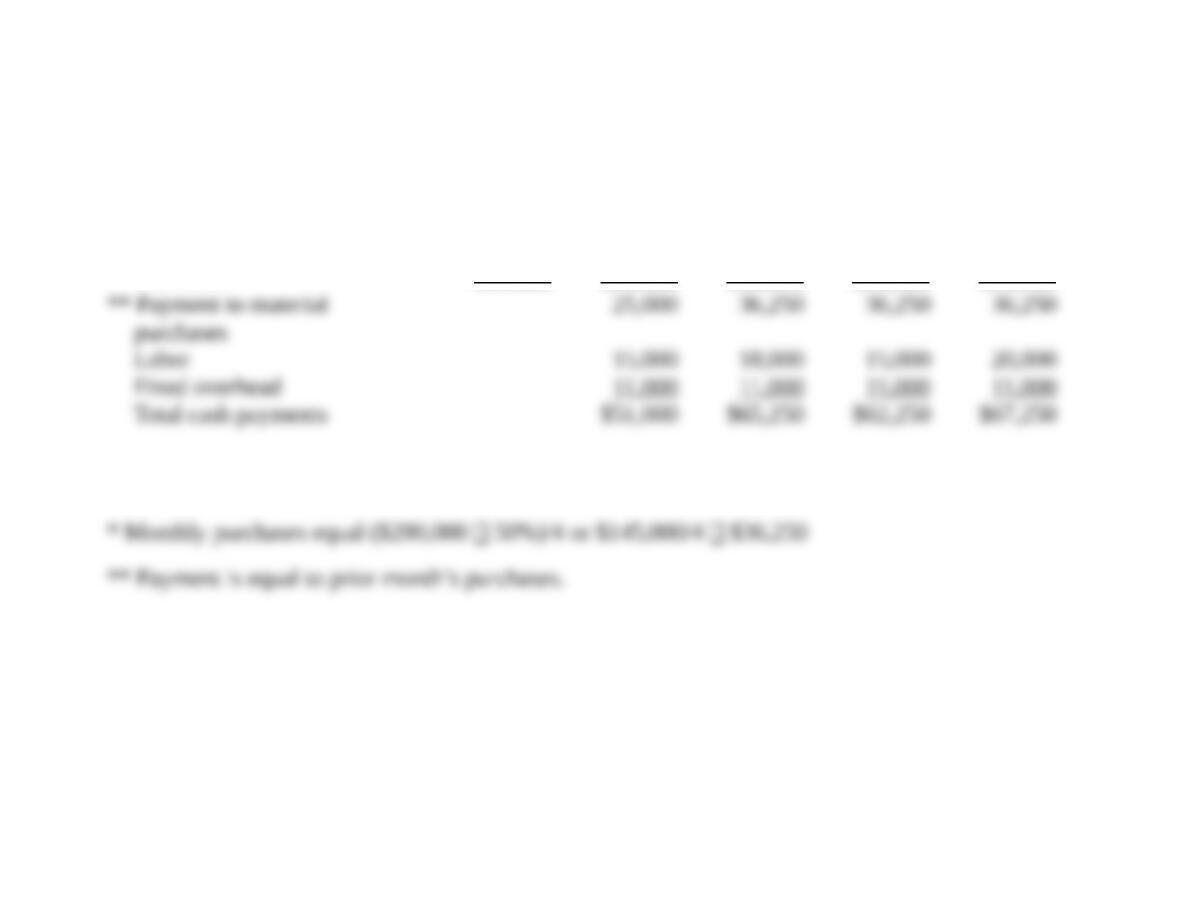
4-20. Solution:
Ultravision Inc.
Cash Payment Schedule
Dec. Jan. Feb. March April
* Purchases $25,000 $36,250 $36,250 $36,250 $36,250
For January through April

21. Schedule of cash payments (LO2) The Denver Corporation has forecast the following
sales for the first seven months of the year:
January…………….. $15,000 May……… $15,000
February…………… 17,000 June……… 21,000
March………………. 19,000 July…….. 23,000
April………………… 25,000
Monthly material purchases are set equal to 40 percent of forecast sales for the next month.
Of the total material costs, 50 percent are paid in the month of purchase and 50 percent in
the following month. Labor costs will run $4,500 per month, and fixed overhead is $4,500
per month. Interest payments on the debt will be $3,500 for both March and June. Finally,
the Denver salesforce will receive a 3.00 percent commission on total sales for the first six
months of the year, to be paid on June 30.
Prepare a monthly summary of cash payments for the six-month period from January
through June. (Note: Compute prior December purchases to help get total material
payments for January.)
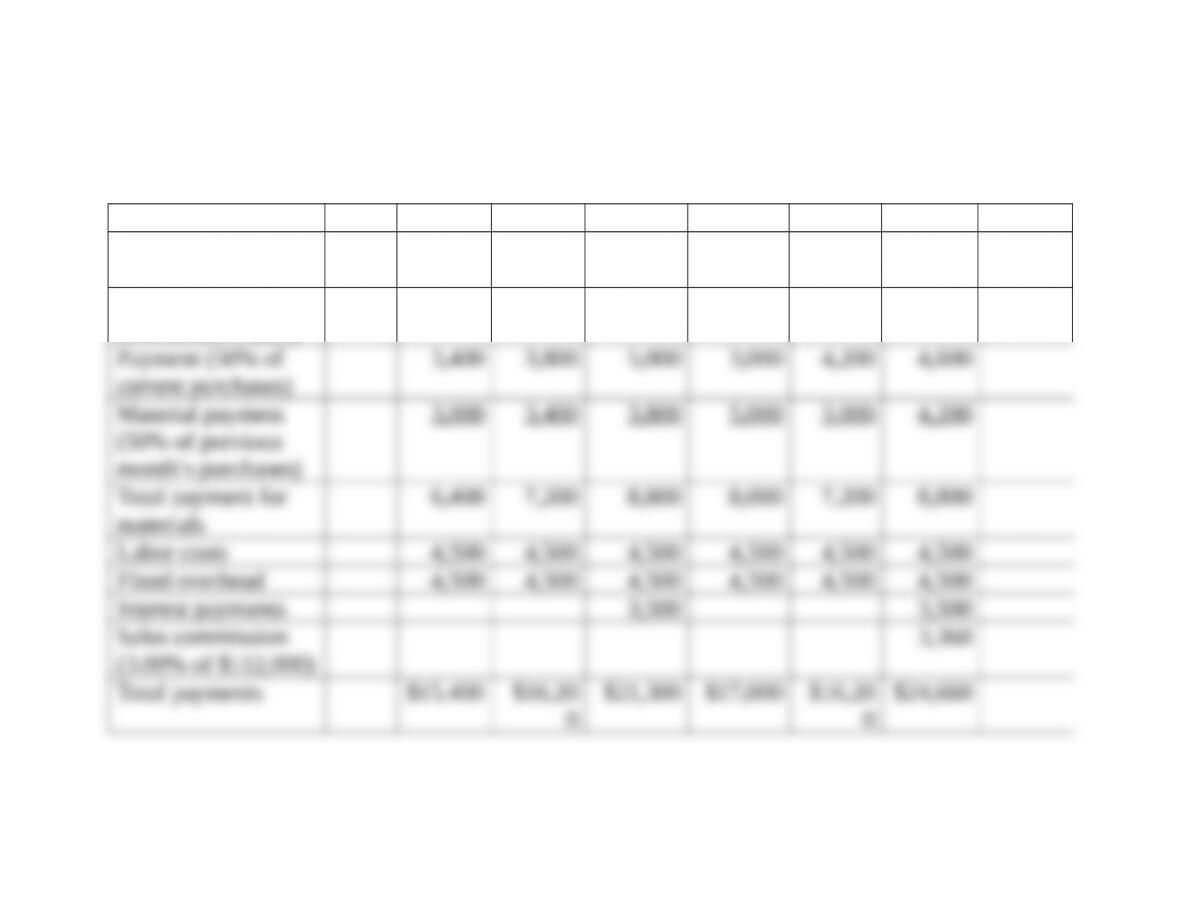
4-21. Solution:
Denver Corporation
Cash Payments Schedule
Dec. Jan. Feb. March April May June July
Sales $15,000 $17,00
0
$19,000 $25,000 $15,00
0
$21,000 $23,000
Purchases (40% of
next month’s sales)
6,000 6,800 7,600 10,000 6,000 8,400 9,200
0
0
22. Schedule of cash payments (LO2) Wright Lighting Fixtures forecasts its sales in units for
the next four months as follows:
March 4,000
April 10,000
May 8,000
June 6,000
Wright maintains an ending inventory for each month in the amount of one and one-half
times the expected sales in the following month. The ending inventory for February
(March’s beginning inventory) reflects this policy. Materials cost $7 per unit and are paid
for in the month after production. Labor cost is $3 per unit and is paid for in the month
incurred. Fixed overhead is $10,000 per month. Dividends of $14,000 are to be paid in
May. Eight thousand units were produced in February.
Complete a production schedule and a summary of cash payments for March, April,
and May. Remember that production in any one month is equal to sales plus desired ending
inventory minus beginning inventory.
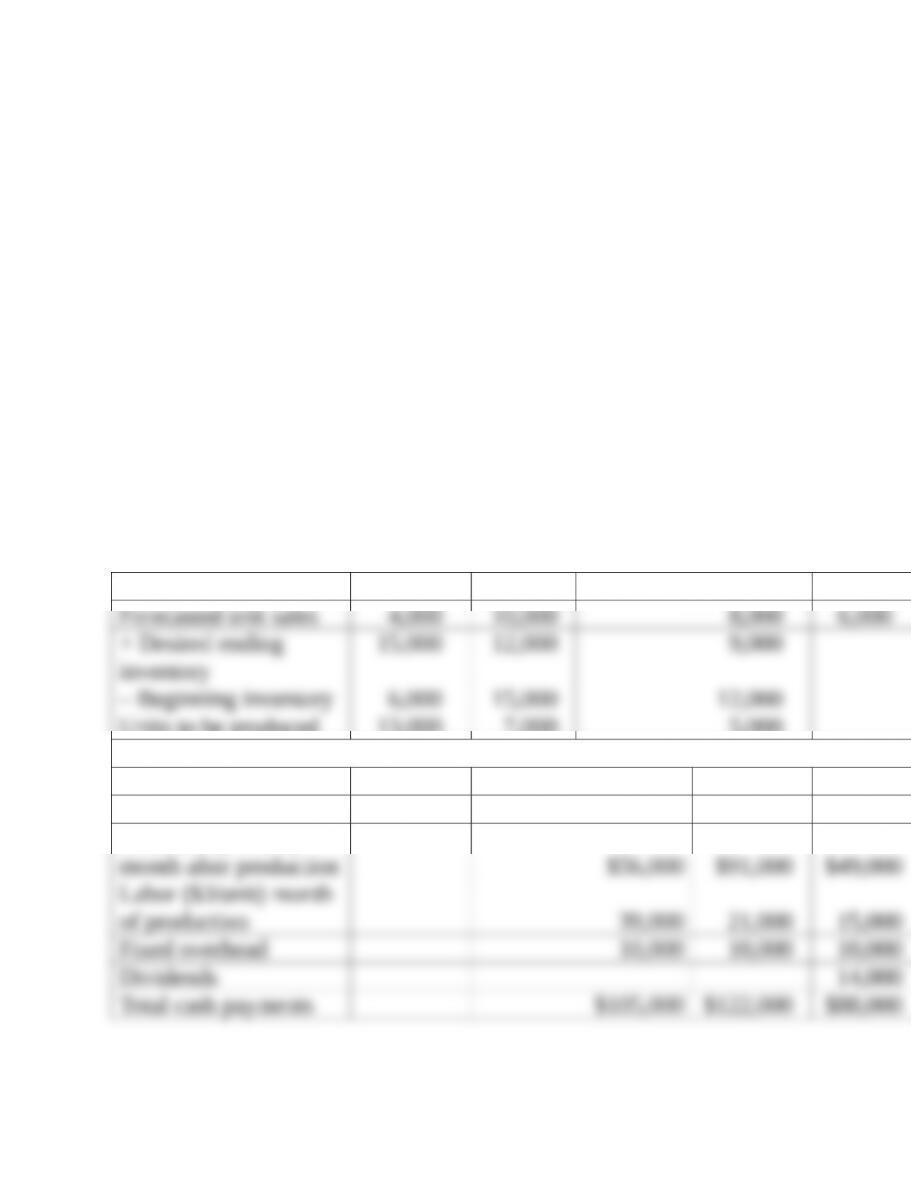
4-22. Solution:
Wright Lighting Fixtures
Production Schedule
March April May June
Units to be produced 13,000 7,000 5,000
Cash Payments
Feb March April May
Units produced 8,000 13,000 7,000 5,000
Materials ($7/unit)

23. Schedule of cash payments (LO2) The Volt Battery Company has forecast its sales in
units as follows:
January…………….. 1,300 May……… 1,850
February…………… 1,150 June……… 2,000
March………………. 1,100 July……… 1,700
April………………… 1,600
Volt Battery always keeps an ending inventory equal to 110 percent of the next month’s
expected sales. The ending inventory for December (January’s beginning inventory) is
1,460 units, which is consistent with this policy.
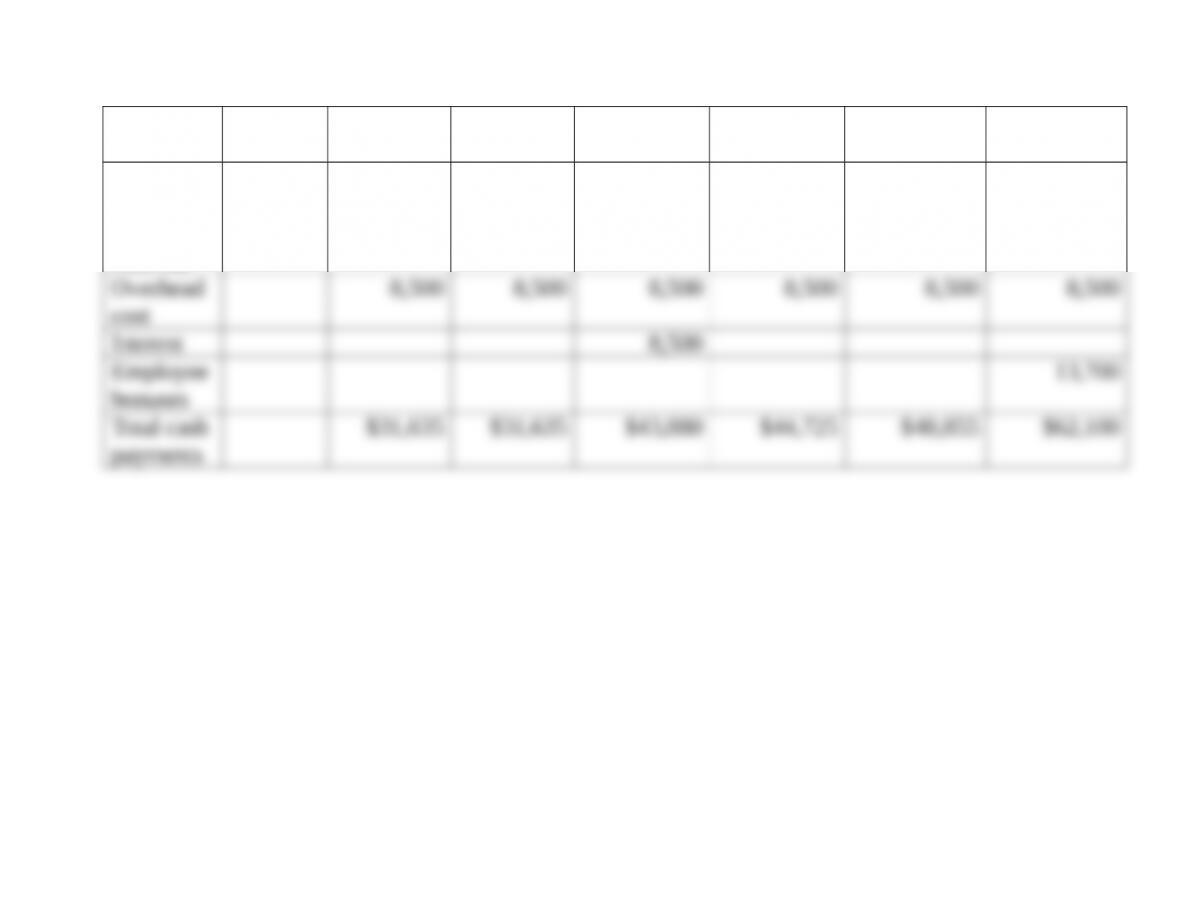
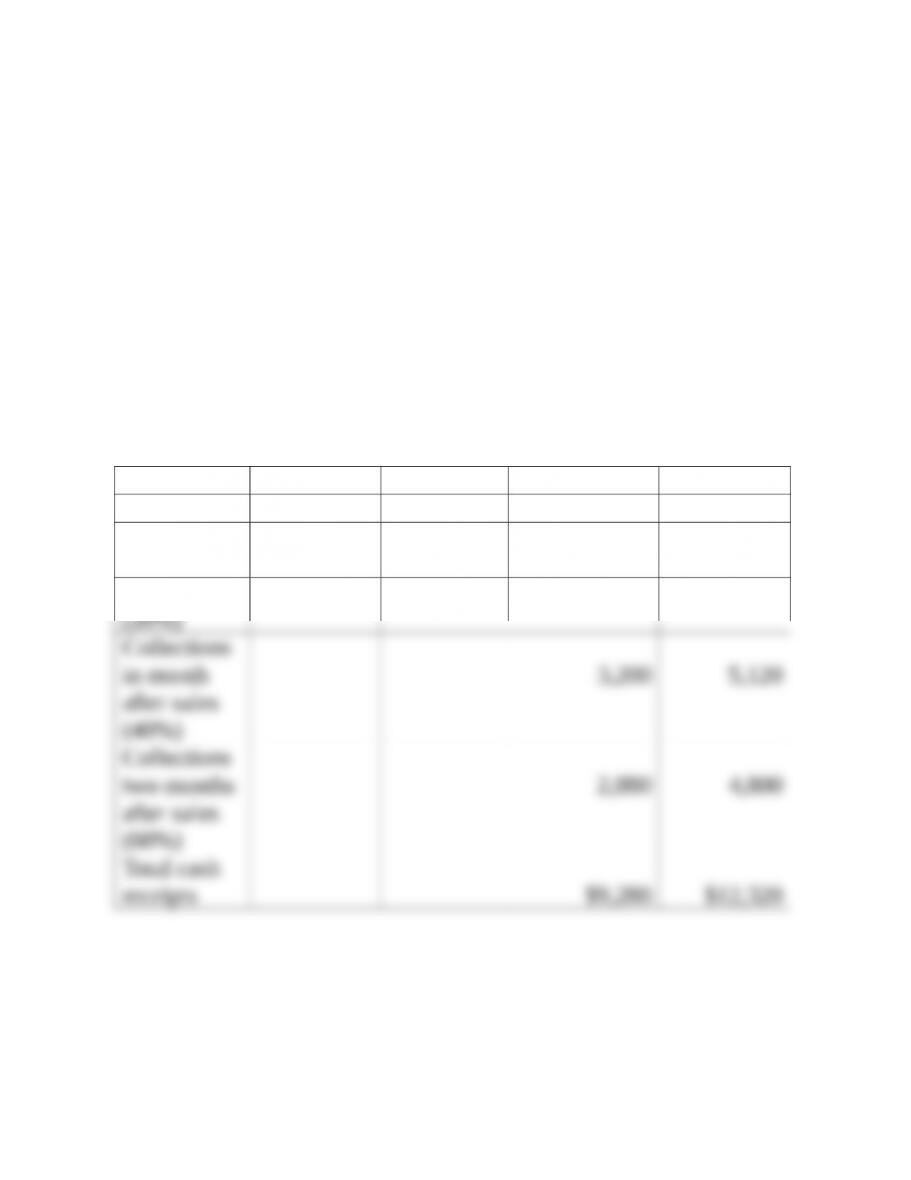
Materials cost $14 per unit and are paid for in the month after purchase. Labor cost is $7
per unit and is paid in the month the cost is incurred. Overhead costs are $8,500 per month.
Interest of $8,500 is scheduled to be paid in March, and employee bonuses of $13,700 will
be paid in June.
Prepare a monthly production schedule and a monthly summary of cash payments for
January through June. Volt produced 1,100 units in December.
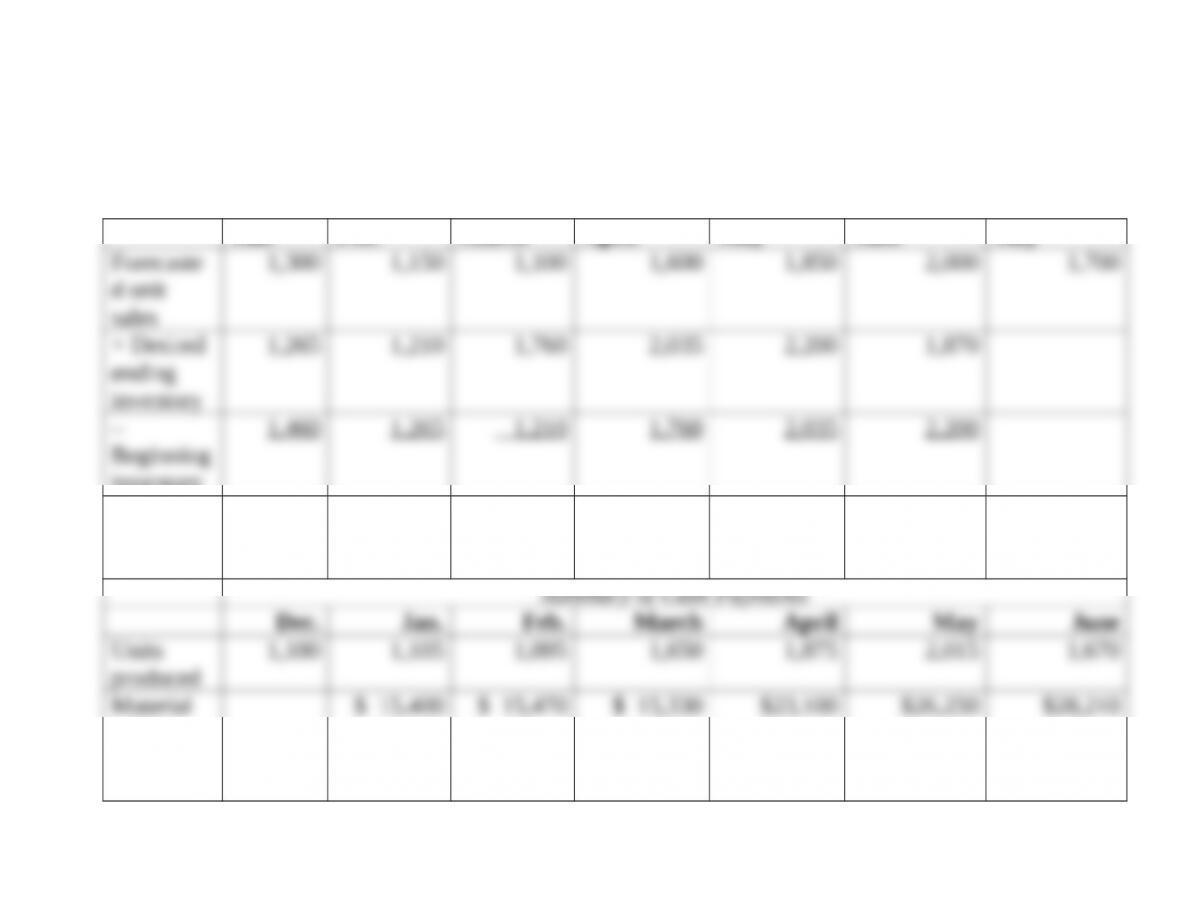
4-23. Solution:
Volt Battery Company
Production Schedule
Jan. Feb. March April May June July
inventory
= Units to
be
produced
1,105 1,095 1,650 1,875 2,015 1,670
cost
($12/unit)
month
after
purchase
Labor cost
($5/unit)
month
incurred
7,735 7,665 11,550 13,125 14,105 11,690
payments
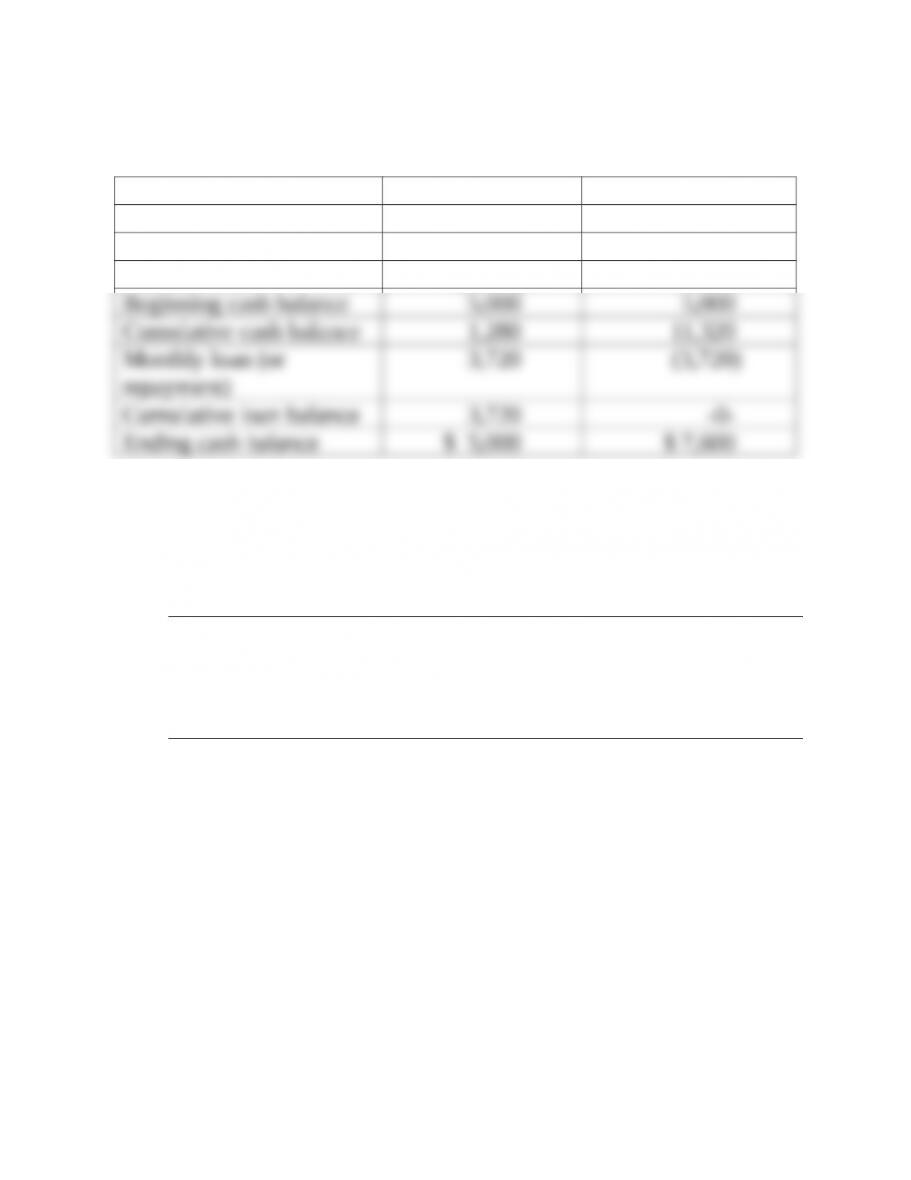
24. Cash Budget (LO2) Graham Potato Company has projected sales of $6,000 in September,
$10,000 in October, $16,000 in November, and $12,000 in December. Of the company’s
sales, 20 percent are paid for by cash and 80 percent are sold on credit. Experience shows
that 40 percent of accounts receivable are paid in the month after the sale, while the
remaining 60 percent are paid two months after. Determine collections for November and
December.
Also assume Graham’s cash payments for November and December are $13,000 and
$6,000, respectively. The beginning cash balance in November is $5,000, which is the
desired minimum balance.
Prepare a cash budget with borrowing needed or repayments for November and
December. (You will need to prepare a cash receipts schedule first.)
4-24. Solution:
Graham Potato Company
Cash Receipts Schedule
September October November December
Sales $6,000 $10,000 $16,000 $12,000
Credit sales
(80%)
4,800 8,000 12,800 9,600
Cash sales
1,200 2,000 3,200 2,400
Graham Potato Company (Continued)
Cash Budget
November December
Cash receipts $ 9,280 $12,320
Cash payments 13,000 6,000
Net cash flow (3,720) 6,320
25. Complete cash budget (LO2) Harry’s Carryout Stores has eight locations. The firm
wishes to expand by two more stores and needs a bank loan to do this. Mr. Wilson, the
banker, will finance construction if the firm can present an acceptable three-month
financial plan for January through March. The following are actual and forecasted sales
figures:
Actual Forecast Additional Information
November........... $260,000 January………… $400,000 April forecast...... $400,000
December……..…. 340,000 February………. 440,000
March……….. 410,000
Of the firm’s sales, 60 percent are for cash and the remaining 40 percent are on credit. Of
credit sales, 20 percent are paid in the month after sale and 80 percent are paid in the
second month after the sale. Materials cost 20 percent of sales and are purchased and
received each month in an amount sufficient to cover the following month’s expected sales.
Materials are paid for in the month after they are received. Labor expense is 50 percent of
sales and is paid for in the month of sales. Selling and administrative expense is 15 percent
of sales and is also paid in the month of sales. Overhead expense is $31,000 in cash per
month.
Depreciation expense is $10,600 per month. Taxes of $8,600 will be paid in January, and
dividends of $5,000 will be paid in March. Cash at the beginning of January is $92,000,
and the minimum desired cash balance is $87,000.
For January, February, and March, prepare a schedule of monthly cash receipts, monthly
cash payments, and a complete monthly cash budget with borrowings and repayments.