Chapter 03: Financial Analysis
3-17. (Continued)
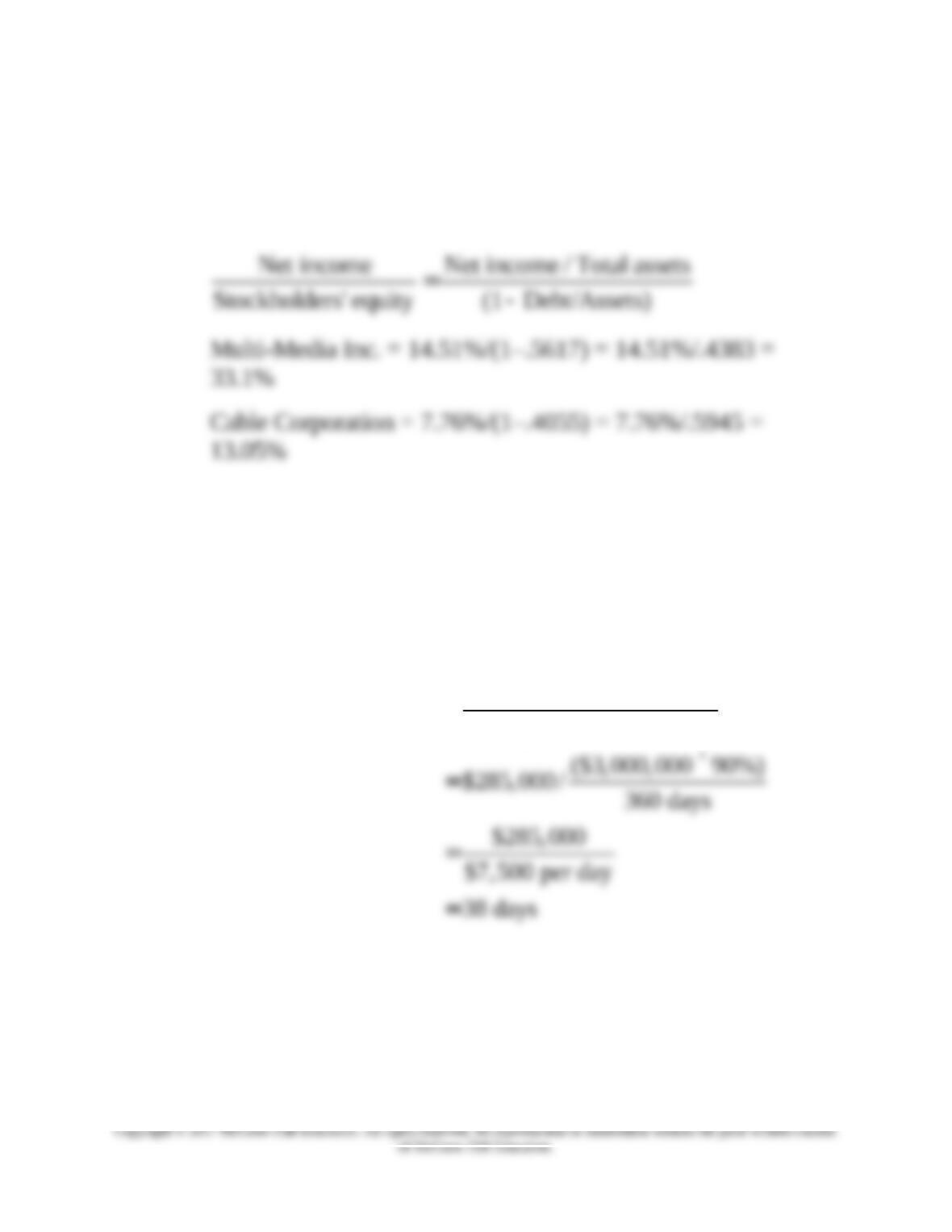
Although not requested in the question, one could show the
following:
Net income Net income / Total assets
Stockholders’ equity (1 Debt/Assets)
=–
Multi-Media Inc. = 14.51%/(1–.5617) = 14.51%/.4383 =
33.1%
Cable Corporation = 7.76%/(1–.4055) = 7.76%/.5945 =
13.05%
18. Average collection period (LO2) A firm has sales of $3 million, and 10 percent of the
sales are for cash. The year-end accounts receivable balance is $285,000. What is the
average collection period? (Use a 360-day year.)
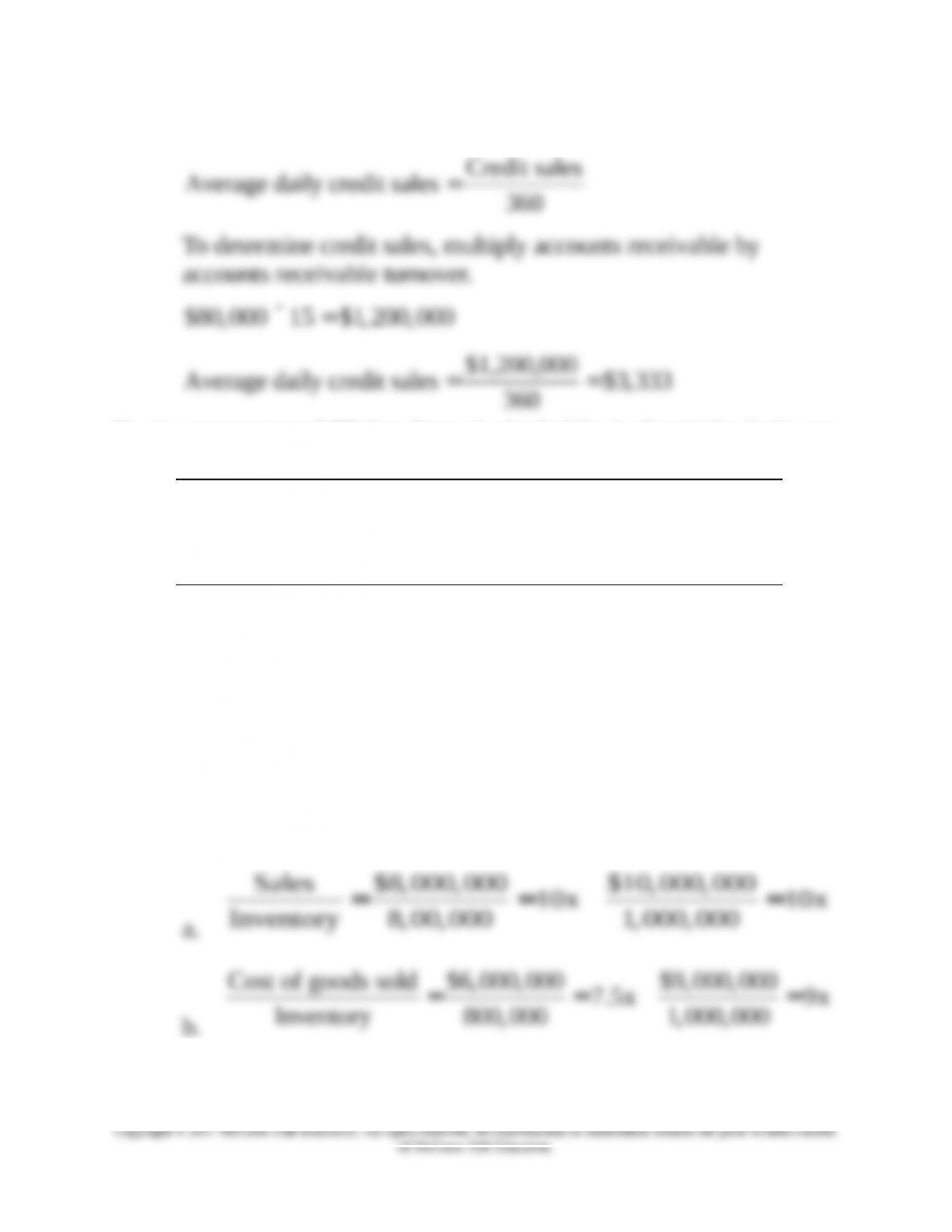
3-18. Solution:
Accounts receivable
Average collection period Average daily credit sales
($3,000,000 90%)
$285,000 / 360 days
$285,000
$7,500 per day
38 days
=
´
=
=
=
19. Average daily sales (LO2) Martin Electronics has an accounts receivable turnover equal to
15 times. If accounts receivable are equal to $80,000, what is the value for average daily
credit sales?
Chapter 03: Financial Analysis
Martin Electronics
Credit sales
Average daily credit sales 360
=
To determine credit sales, multiply accounts receivable by
accounts receivable turnover.
$80,000 15 $1,200,000´ =
$1,200,000
Average daily credit sales $3,333
360
= =
20. Inventory turnover (LO2) Perez Corporation has the following financial data for the years
20X1 and 20X2:
20X1 20X2
Sales………………………… $8,000,000 $10,000,000
Cost of goods sold…………… 6,000,000 9,000,000
Inventory…………………….. 800,000 1,000,000
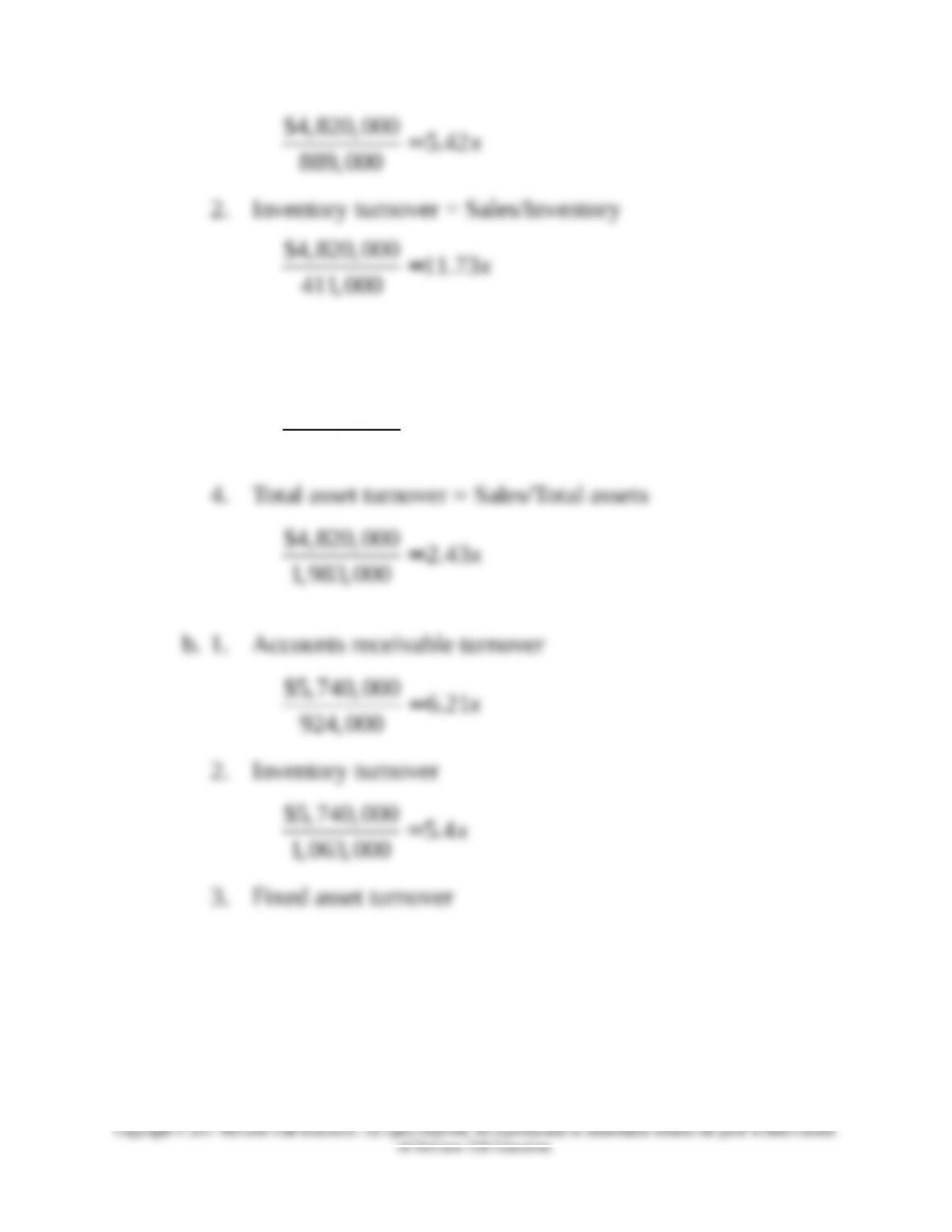
a. Compute inventory turnover based on ratio number 6, Sales/Inventory, for each year.
b. Compute inventory turnover based on an alternative calculation that is used by many
financial analysts, Cost of goods sold/Inventory, for each year.
c. What conclusions can you draw from part a and part b?
3-20. Solution:
Perez Corporation
20X1 20X2
Sales $8,000,000 $10,000,000
10x 10x
Inventory 8,00,000 1,000,000
= = =

Chapter 03: Financial Analysis
21. Turnover ratios (LO2) Jim Short’s Company makes clothing for schools. Sales in 20X1
were $4,820,000. Assets were as follows:
Cash………………………………………. $ 163,000
Accounts receivable………………………. 889,000
Inventory………………………………….. 411,000
Net plant and equipment………………….. 520,000
Total assets…………………………… $1,983,000
a. Compute the following:
1. Accounts receivable turnover.
2. Inventory turnover.
3. Fixed asset turnover.
4. Total asset turnover.
b. In 20X2, sales increased to $5,740,000 and the assets for that year were as follows:
Cash………………………………………… $ 163,000
Accounts receivable……………………….. 924,000
Inventory…………………………………… 1,063,000
Net plant and equipment…………………… 520,000
Total assets…………………………….. $2,670,000
Once again, compute the four ratios.
c. Indicate if there is an improvement or decline in total asset turnover, and based on the
other ratios, indicate why this development has taken place.
3-21. Solution:
Jim Short’s Company
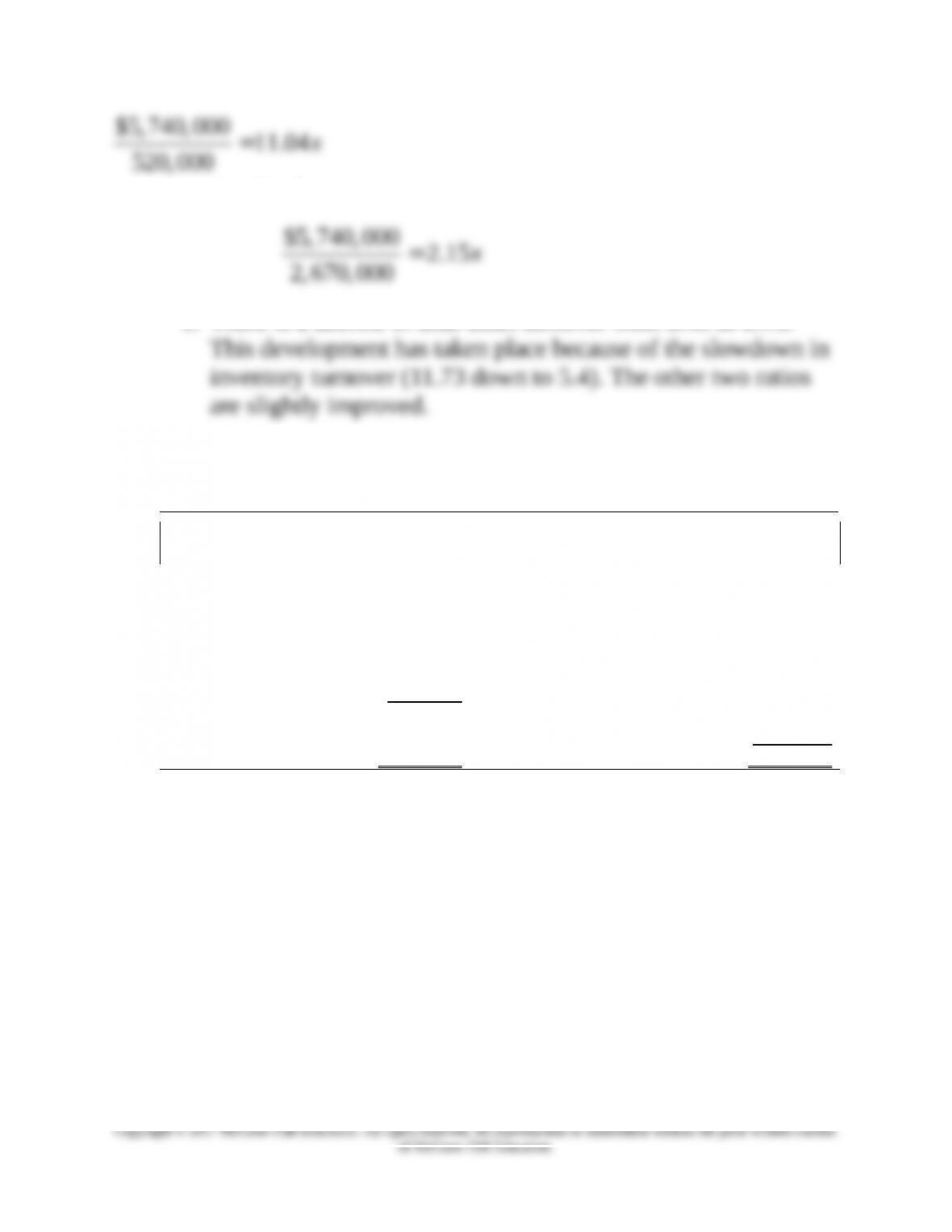
a. 1. Accounts receivable turnover = Sales/Accounts
Receivable
Chapter 03: Financial Analysis
$4,820, 000 5.42
889, 000 x=
2. Inventory turnover = Sales/Inventory
$4,820, 000 11.73
411,000 x=
3-21. (Continued)
3. Fixed asset turnover = Sales/(Net Plant & Equipment)
$4,820, 000 9.27
520, 000 x=
Chapter 03: Financial Analysis
$5,740,000 11.04
520,000 x=
4. Total asset turnover
$5,740,000 2.15
2,670,000 x=
c. There is a decline in total asset turnover from 2.43 to 2.15.
22. Overall ratio analysis (LO2) The balance sheet for Stud Clothiers is shown next. Sales for
the year were $2,400,000, with 90 percent of sales sold on credit.
STUD CLOTHIERS
Balance Sheet 20X1
Assets Liabilities and Equity
Cash…………………… $ 60,000 Accounts payable…………….. $ 220,000
Accounts receivable…… 240,000 Accrued taxes………………… 30,000
Inventory……………… 350,000 Bonds payable
(long-term)……………………
150,000
Plant and equipment…… 410,000 Common stock……………….. 80,000
Paid-in capital………………… 200,000
Retained earnings…………….. 380,000
Total assets………… $1,060,000 Total liabilities and equity… $1,060,000
Compute the following ratios:
a. Current ratio.
b. Quick ratio.
c. Debt-to-total-assets ratio.
d. Asset turnover.
e. Average collection period.
3-22. Solution:
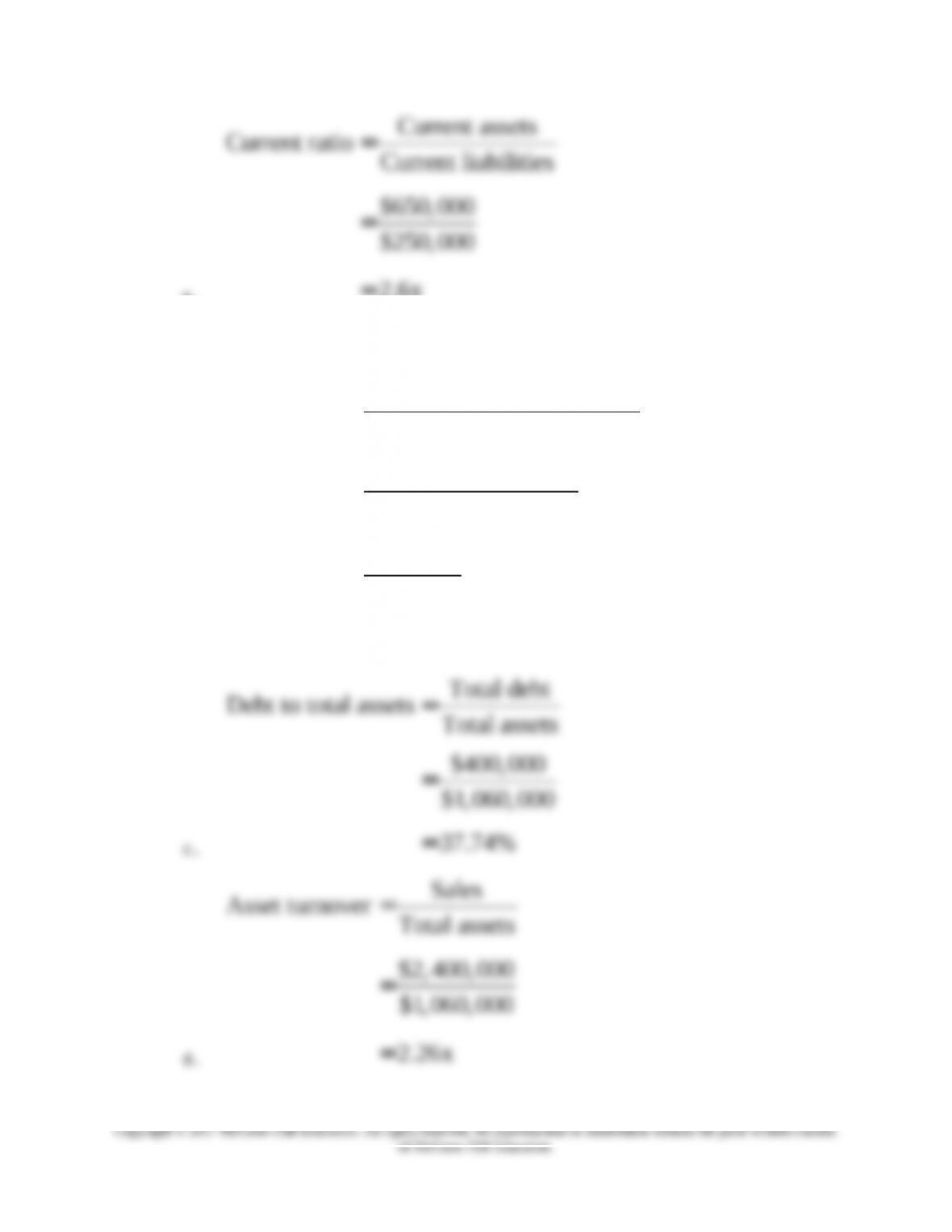
Stud Clothiers
Chapter 03: Financial Analysis
a.
Current assets
Current ratio Current liabilities
$650,000
$250,000
2.6x
=
=
=
3-22. (Continued)
b.
(Current assets inventory)
Quick ratio Current liabilities
$650,000 $350,000
$250,000
$300,000
$250,000
1.2x
–
=
–
=
=
=
Total debt
Debt to total assets Total assets
$400,000
$1,060,000
37.74%
=
=
=
Chapter 03: Financial Analysis
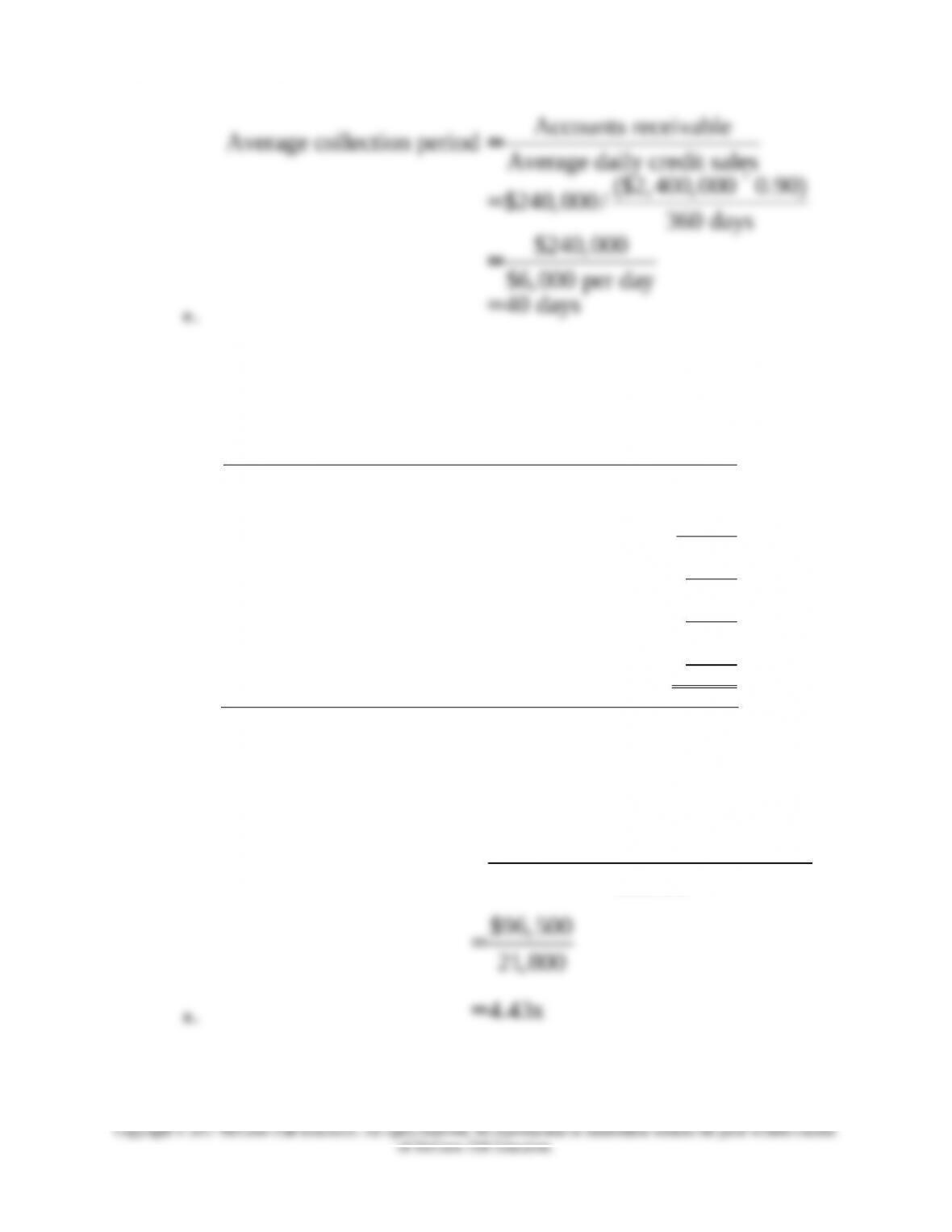
Accounts receivable
Average collection period Average daily credit sales
($2,400,000 0.90)
$240,000/ 360 days
$240,000
$6,000 per day
40 days
=
´
=
=
=
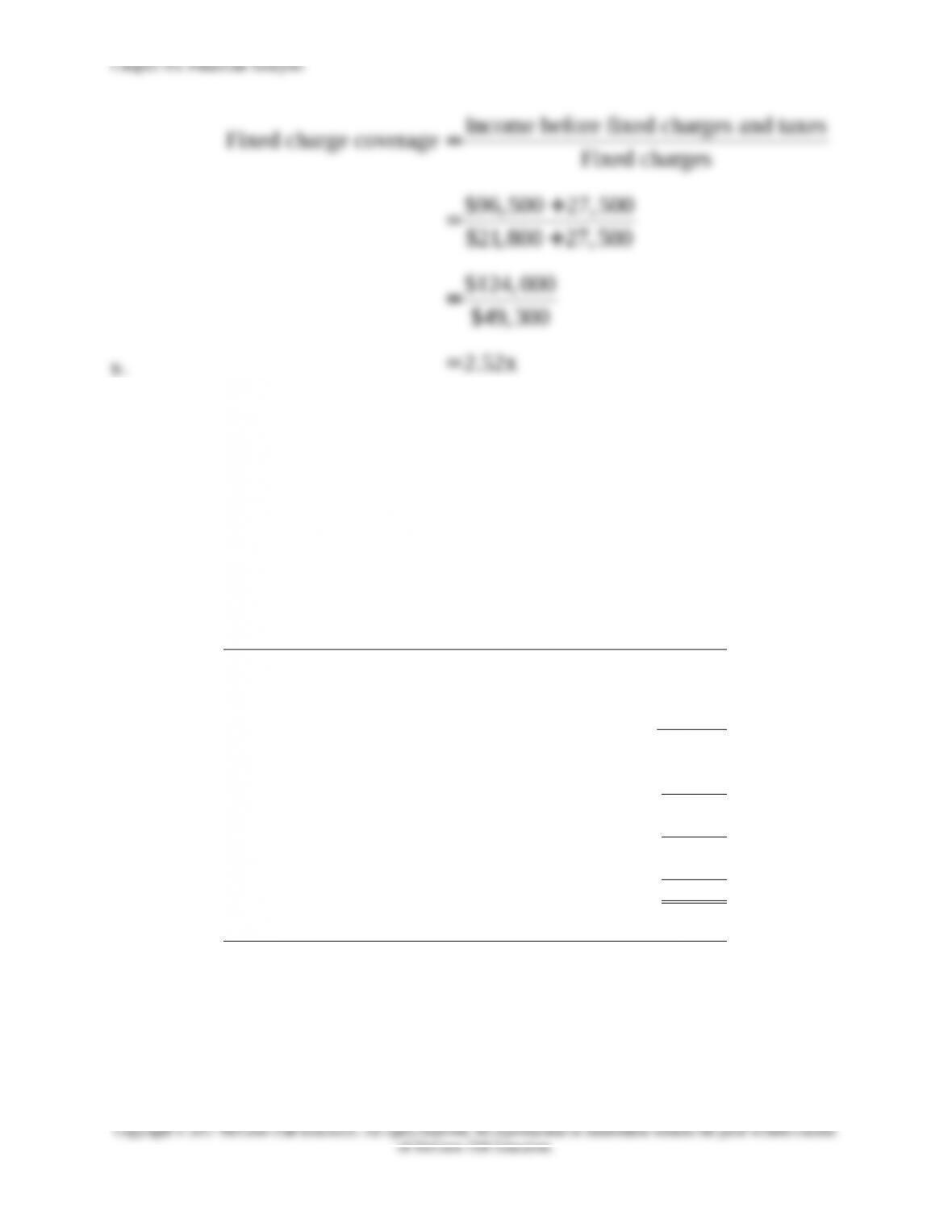
Chapter 03: Financial Analysis
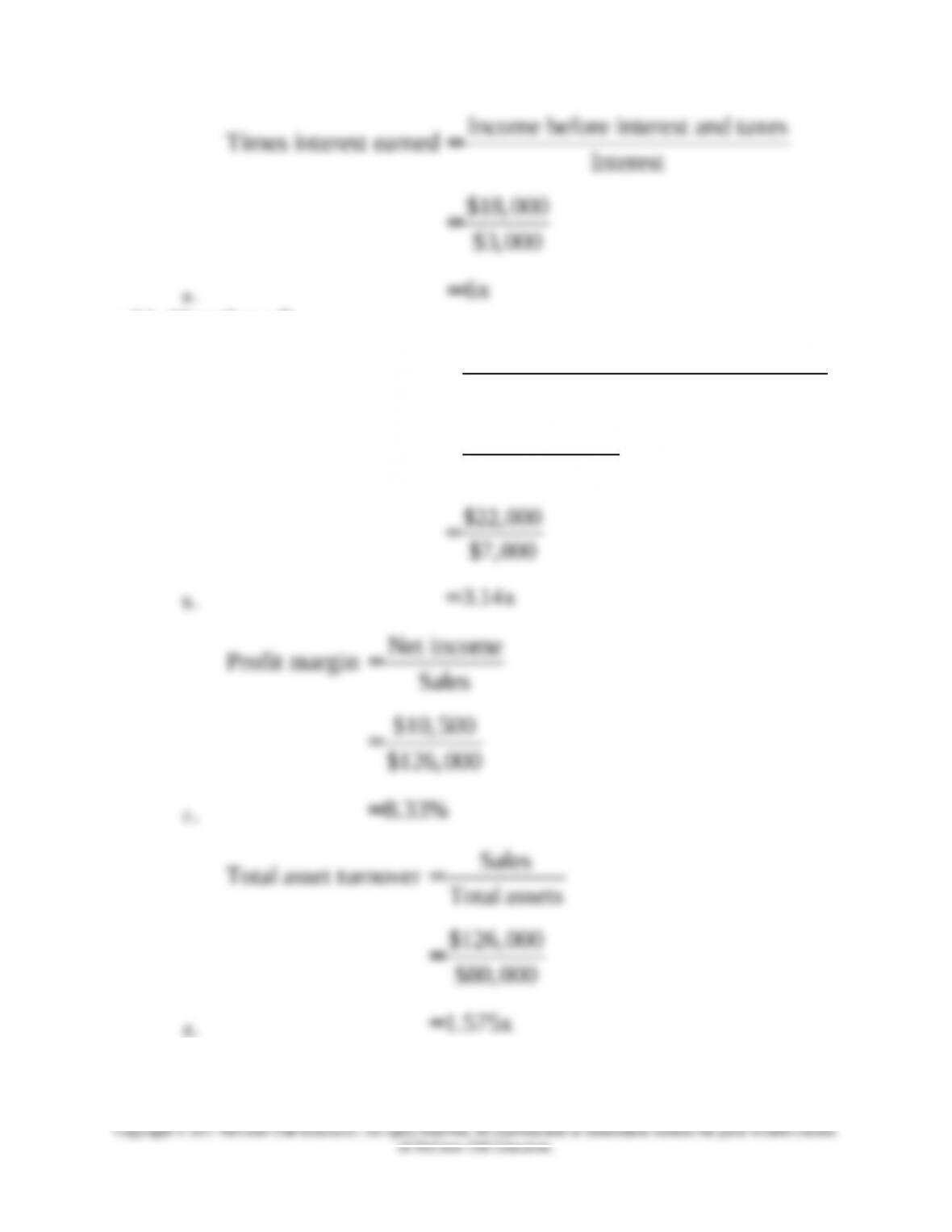
Income before interest and taxes
Times interest earned Interest
$18,000
$3,000
=
=
Chapter 03: Financial Analysis
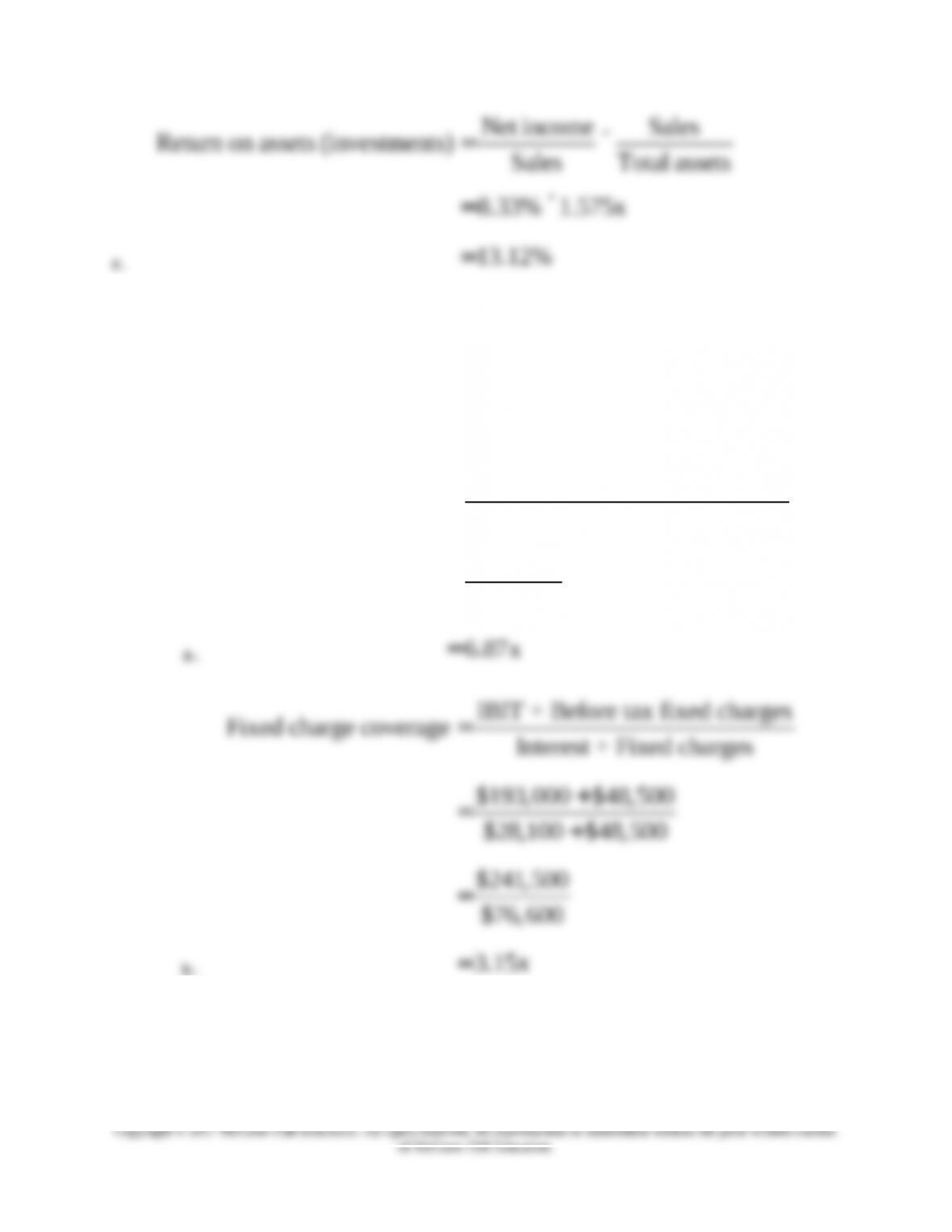
Net income Sales
Return on assets (investments) Sales Total assets
8.33% 1.575x
13.12%
= ´
= ´
=

Chapter 03: Financial Analysis
assets to have useful lives of 10 years. Aftertax income has been $29,000 per year each of
the last 10 years. Other assets have not changed since 2007.
a. Compute return on assets at year-end for 2007, 2009, 2012, 2014, and 2016.
(Use $29,000 in the numerator for each year.)
b. To what do you attribute the phenomenon shown in part a?
c. Now assume income increased by 10 percent each year. What effect would this have
on your preceding answers? (A comment is all that is necessary.)