Chapter 20 – External Growth through Mergers
20-6 Solution:
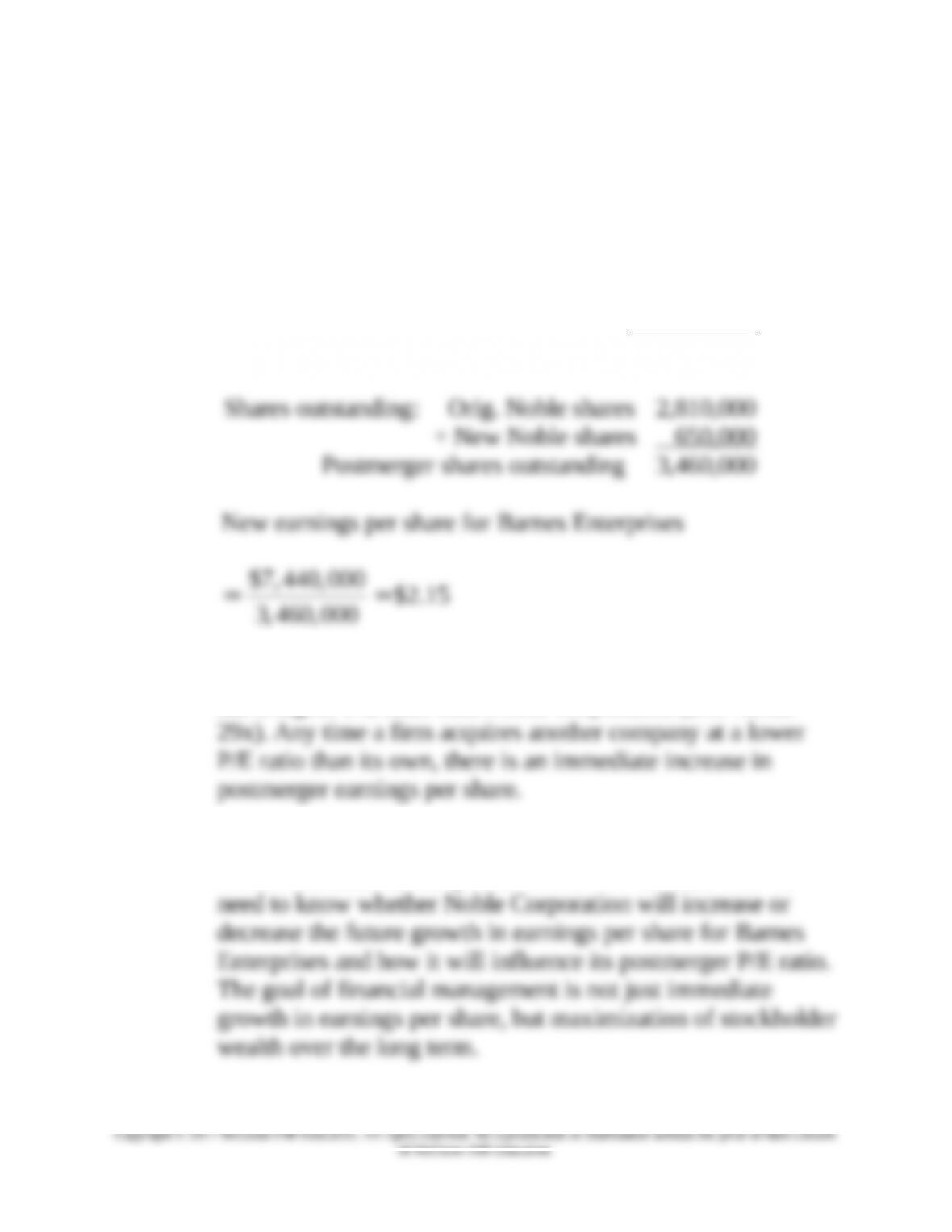
Noble Corporation and Barnes Enterprises
(approach similar to Table 20–3)
a. Total earnings: Noble $ 1,820,000
+ Barnes $ 5,620,000
Combined earnings $ 7,440,000
Chapter 20 – External Growth through Mergers
7. Mergers and dilution (LO20-3) The Jeter Corporation is considering acquiring the A-Rod
Corporation.
The data for the two companies are as follows:
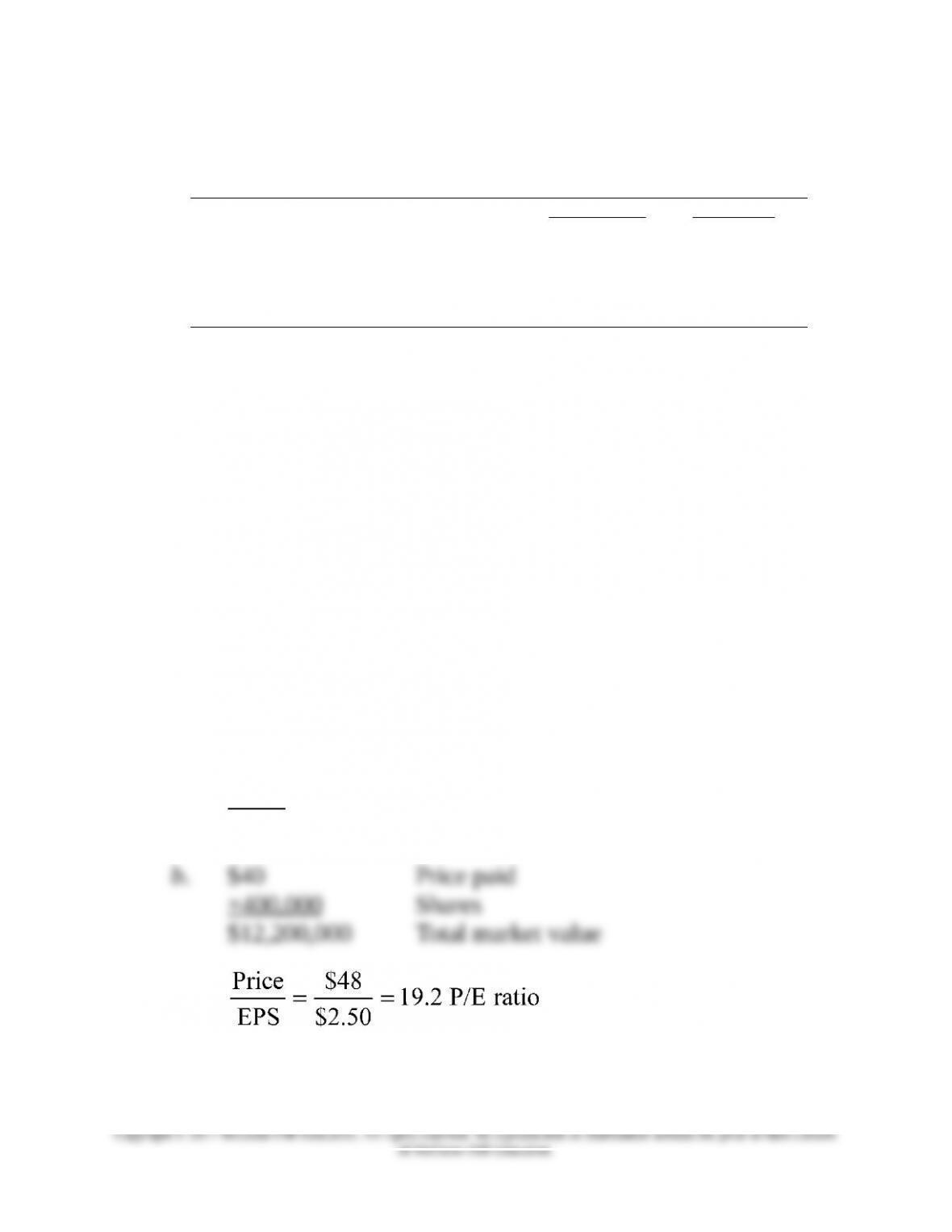
A-Rod Corp. Jeter Corp.
Total earnings…………………………………….…… $1,000,000 $4,000,000
Number of shares of stock outstanding………. 400,000 2,000,000
Earnings per share………………………………..…. $2.50 $2.00
Price-earnings ratio (P/E)…………………………. 12 15
Market price per share……….…….………….….. $30 $30
a. The Jeter Corp. is going to give A-Rod Corp. a 60 percent premium over A-Rod’s
current market value. What price will it pay?
b. At the price computed in part a, what is the total market value of A-Rod Corp.?
(Use the number of A-Rod Corp. shares times price.)
c. At the price computed in part a, what is the P/E ratio Jeter Corp. is assigning
A-Rod Corp?
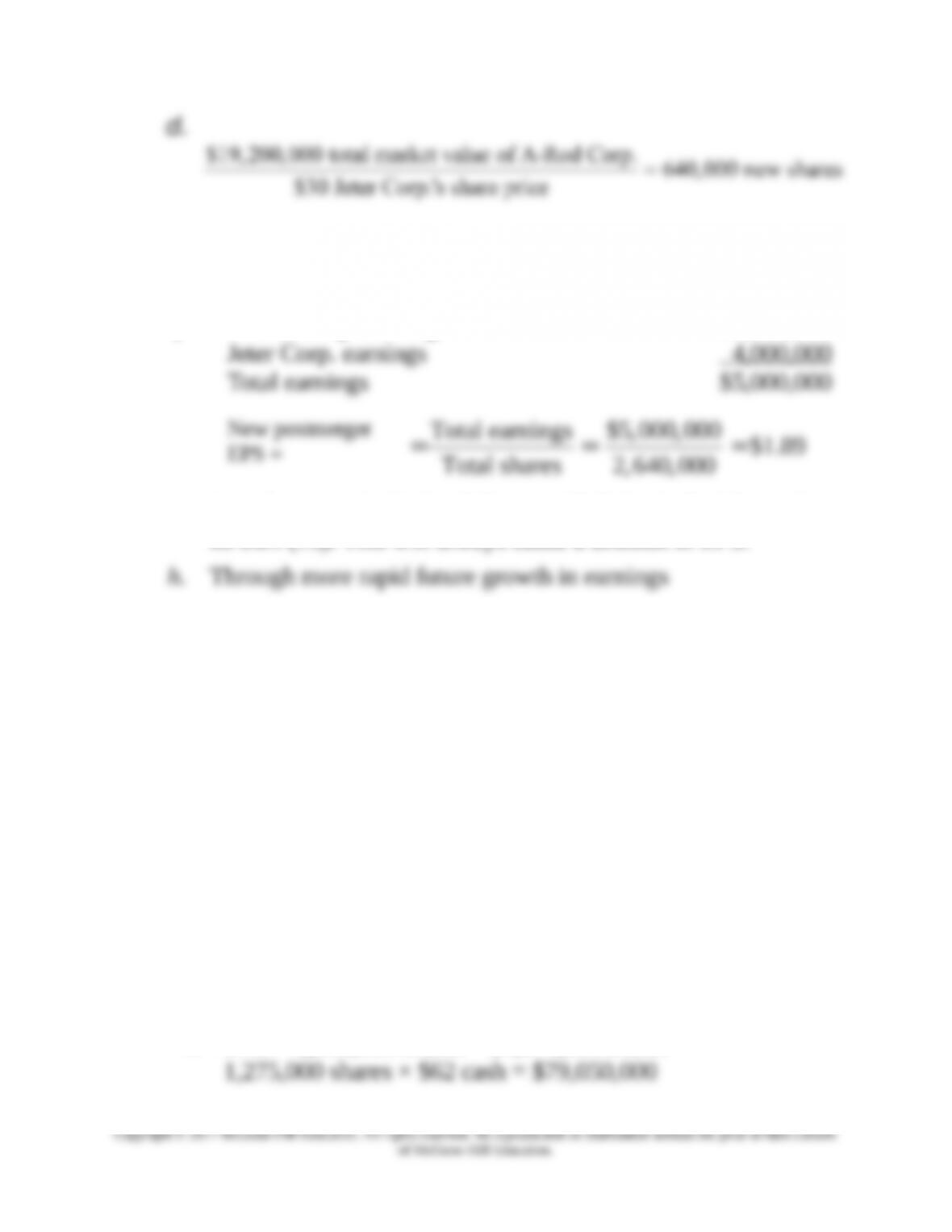
d. How many shares must Jeter Corp. issue to buy the A-Rod Corp. at the total value
computed in part b? (Keep in mind that Jeter Corp.’s price per share is $30.)
e. Given the answer to part d, how many shares will Jeter Corp. have after the merger?
f. Add together the total earnings of both corporations and divide by the total shares
computed in part e. What are the new postmerger earnings per share?
g. Why has Jeter Corp.’s earnings per share gone down?
h. How can Jeter Corp. hope to overcome this dilution?
20-7 Solution:
Jeter Corp. A-Rod Corp.
a. $30 Current price
×1.60 60% premium
$60 Price paid
c.
Chapter 20 – External Growth through Mergers
e. 2,000,000 old shares + 640,00 new shares = 2,640,000 total
shares
f. A-Rod Corp. earnings $1,000,000
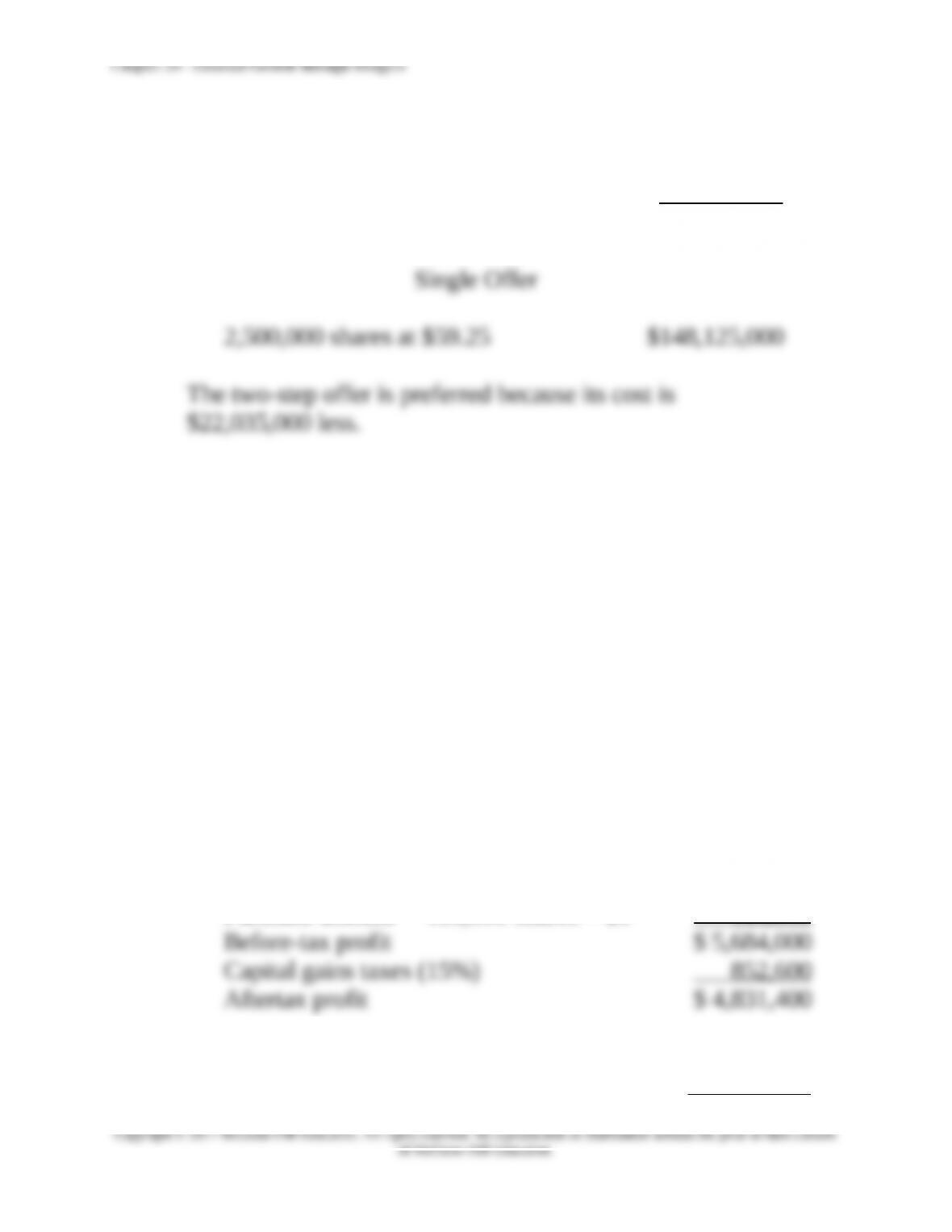
2. 840,000 shares of convertible preferred stock ×
$40 (1.40) = 840,000 × $56 = $47,040,000
Cost of two-step offer = $126,090,000
9. Future tax obligation to selling stockholder (LO20-1) Al Simpson helped start Excel
Systems several years ago. At the time, he purchased 116,000 shares of stock at $1 per
share. Now he has the opportunity to sell his interest in the company to Folsom Corp. for
$50 a share in cash. His capital gains tax rate would be 15 percent.
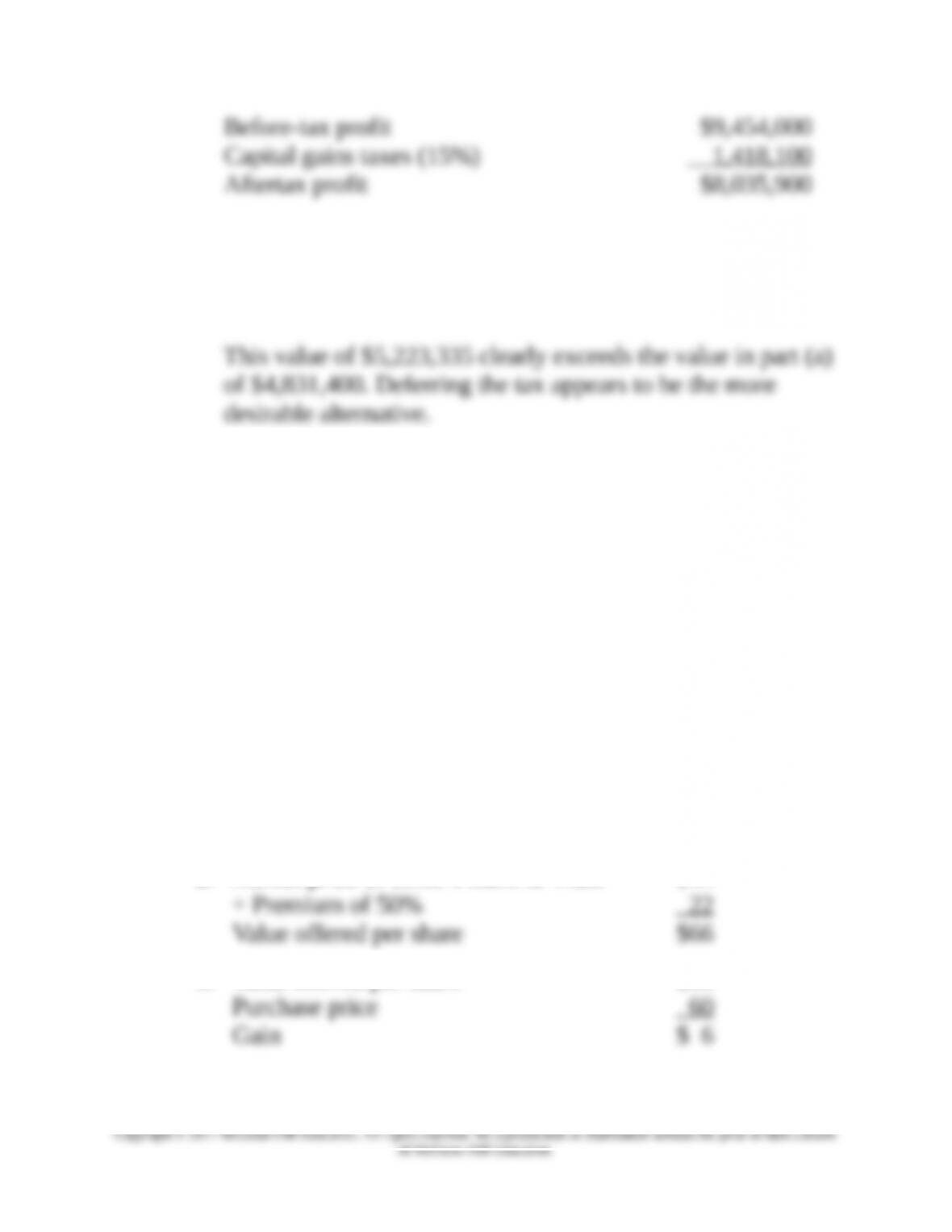
a. If he sells his interest, what will be the value for before-tax profit, taxes, and aftertax
profit?
b. Assume, instead of cash, he accepts Folsom Corp. stock valued at $50 per share. He
pays no tax at that time. He holds the stock for five years and then sells it for $82.50
(the stock pays no cash dividends). What will be the value for before-tax profit, taxes,
and aftertax profit in 2020? His capital gains tax is once again 15 percent.
c. Using a 9 percent discount rate, calculate the aftertax profit. That is, discount back the
answer in part b for five years and compare it to the answer in part a.
20-9 Solution:
Excel Systems
a. Sales amount 116,000 Shares × $50 $5,800,000
Purchase amount 116,000 Shares × $1 116,000
b. Sales amount 116,000 shares × $82.50 $9,570,000
Purchase amount 116,000 shares × $1 116,000
Chapter 20 – External Growth through Mergers
c. Discount back $8,035,900 for five years at 9 percent.
$8,035,900, n = 5, i = 9% (Appendix B)
$8,035,900 × .650 = $5,223,335
10. Premium offers and stock price movement (LO20-1) Chicago Savings Corp. is planning
to make an offer for Ernie’s Bank & Trust. The stock of Ernie’s Bank & Trust is currently
selling for $44 a share.
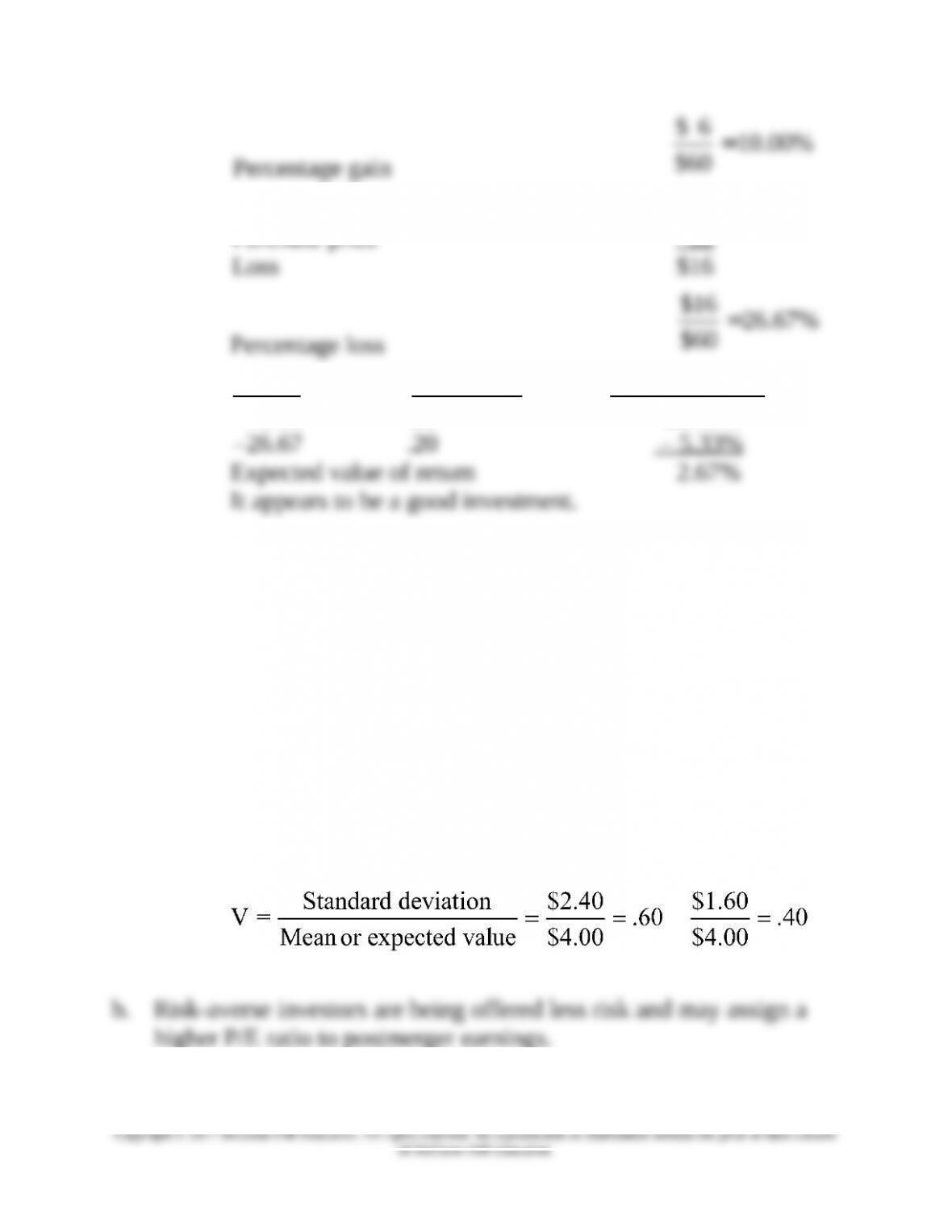
a. If the tender offer is planned at a premium of 50 percent over market price, what will be
the value offered per share for Ernie’s Bank & Trust?
b. Suppose before the offer is actually announced, the stock price of Ernie’s Bank & Trust
goes to $60 because of strong merger rumors. If you buy the stock at that price and the
merger goes through (at the price computed in part a), what will be your percentage gain?
c. Because there is always the possibility that the merger could be called off after it is
announced, you also want to consider your percentage loss if that happens. Assume you
buy the stock at $60 and it falls back to its original value after the merger cancellation.
What will be your percentage loss?
d. If there is an 80 percent probability that the merger will go through when you buy the
stock at $60 and only a 20 percent chance that it will be called off, does this appear to
be a good investment? Compute the expected value of the return on the investment.
20-10. Solution:
Chicago Savings Corp.
a. Market price of Ernie’s Bank & Trust $44
b. Value offered per share $66
Chapter 20 – External Growth through Mergers
$ 6 10.00%
$60 =

Chapter 20 – External Growth through Mergers
12. Portfolio consideration and risk aversion (LO20-4) General Meters is considering two
mergers. The first is with Firm A in its own volatile industry, the auto speedometer industry,
while the second is a merger with Firm B in an industry that moves in the opposite
direction (and will tend to level out performance due to negative correlation).
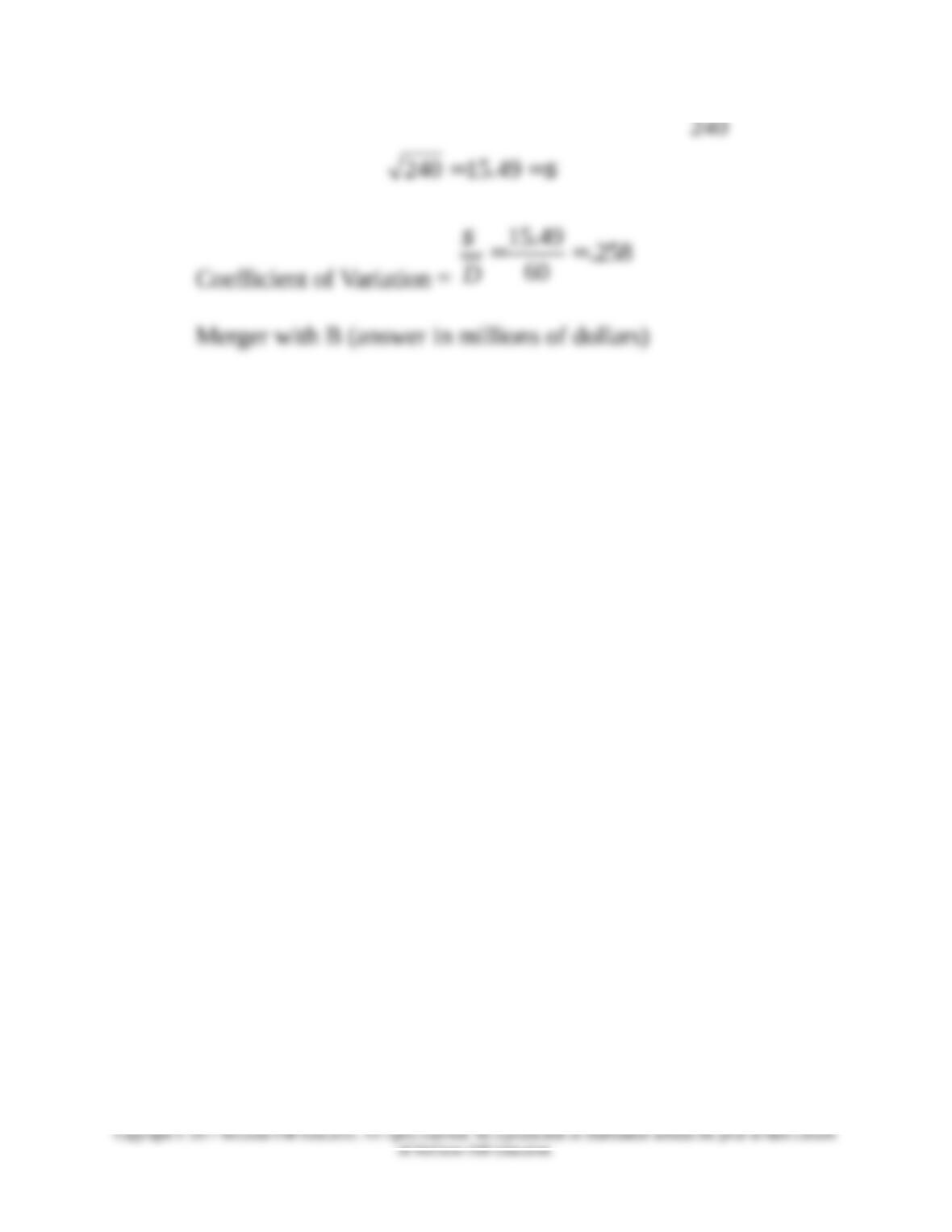
a Compute the mean, standard deviation, and coefficient of variation for both investments
(refer to Chapter 13 if necessary).
General Meters Merger General Meters Merger
with Firm A with Firm B
Possible Possible
Earnings Earnings
($ in millions) Probability ($ millions) Probability
$40…………………… .30 $40……………... .25
60………….……….. .40 60…............... .50
80…………..……….. .30 80…............... .25
b. Assuming investors are risk-averse, which alternative can be expected to bring the
higher valuation?
20-12. Solution:
General Meters
a. Merger with A (answer in millions of dollars)
D DP=
å
D P DP
40 .30 12.0
Chapter 20 – External Growth through Mergers

Chapter 20 – External Growth through Mergers
D DP=
å
D P DP
40 .25 10.0
60 .50 30.0