Chapter 19: Convertibles, Warrants, and Derivatives
Chapter 19
Convertibles, Warrants, and Derivatives
Discussion Questions
19-1. What are the basic advantages to the corporation of issuing convertible
securities?
The advantages to the corporation of a convertible security are:
19-2. Why are investors willing to pay a premium over the theoretical value (pure
bond value or conversion value)?
Investors are willing to pay a premium over the theoretical value for a
19-3. Why is it said that convertible securities have a floor price?
The floor price of a convertible is based on the pure bond value associated with
Chapter 19: Convertibles, Warrants, and Derivatives
19-4. The price of Haltom Corporation 5¼ 2019 convertible bonds is $1,380. For the
Williams Corporation, the 6⅛ 2018 convertible bonds are selling at $725.
a. Explain what factors might cause their prices to be different from their par
value of $1,000.
b. What will happen to each bond’s value if long-term interest rates decline?
Convertible bond pricing
19-5. How can a company force conversion of a convertible bond?
A firm may force conversion of a bond issue through the use of the call
19-6. What is meant by a step-up in the conversion price?
19-7. Explain the difference between basic earnings per share and diluted earnings per
share.
Basic earnings per share do not consider the potentially dilative effects of
Chapter 19: Convertibles, Warrants, and Derivatives
19-8. Explain how convertible bonds and warrants are similar and different.
Convertible bonds and warrants are similar in that they give the security holder
a future option on the common stock of the corporation. They are dissimilar in
19-9. Explain why warrants are issued. (Why are they used in corporate finance?)
Warrants may be used to sweeten a debt offering or as part of a merger offer or
19-10. What are the reasons that warrants often sell above their intrinsic value?
Warrants may sell above their intrinsic value because the investor views the
19-11. What are the differences between a call option and a put option?
put option is an option to sell at a set price for a given period of time.
19-12. Suggest two areas where the use of futures contracts is most common. What
percent of the value of the underlying security is typical as a down payment in a
futures contract?
Futures contracts are most common for commodities and interest rate securities,
especially government bonds.
Chapter 19: Convertibles, Warrants, and Derivatives
19-13. You buy a stock option with an exercise price of $50. The cost of the option is
$4. If the stock ends up at $56, indicate whether you have a profit or loss with a
call option? With a put option?
With a call option, you would have a profit of $2. You bought the option for $4
Chapter 19
Problems
1. Value of warrants (LO19-4) Preston Toy Co. has warrants outstanding that allow the
holder to purchase a share of stock for $22 (exercise price). The common stock is currently
selling for $28, while the warrant is selling for $9.25 per share.
a. What is the intrinsic (minimum) value of this warrant?
b. What is the speculative premium on this warrant?
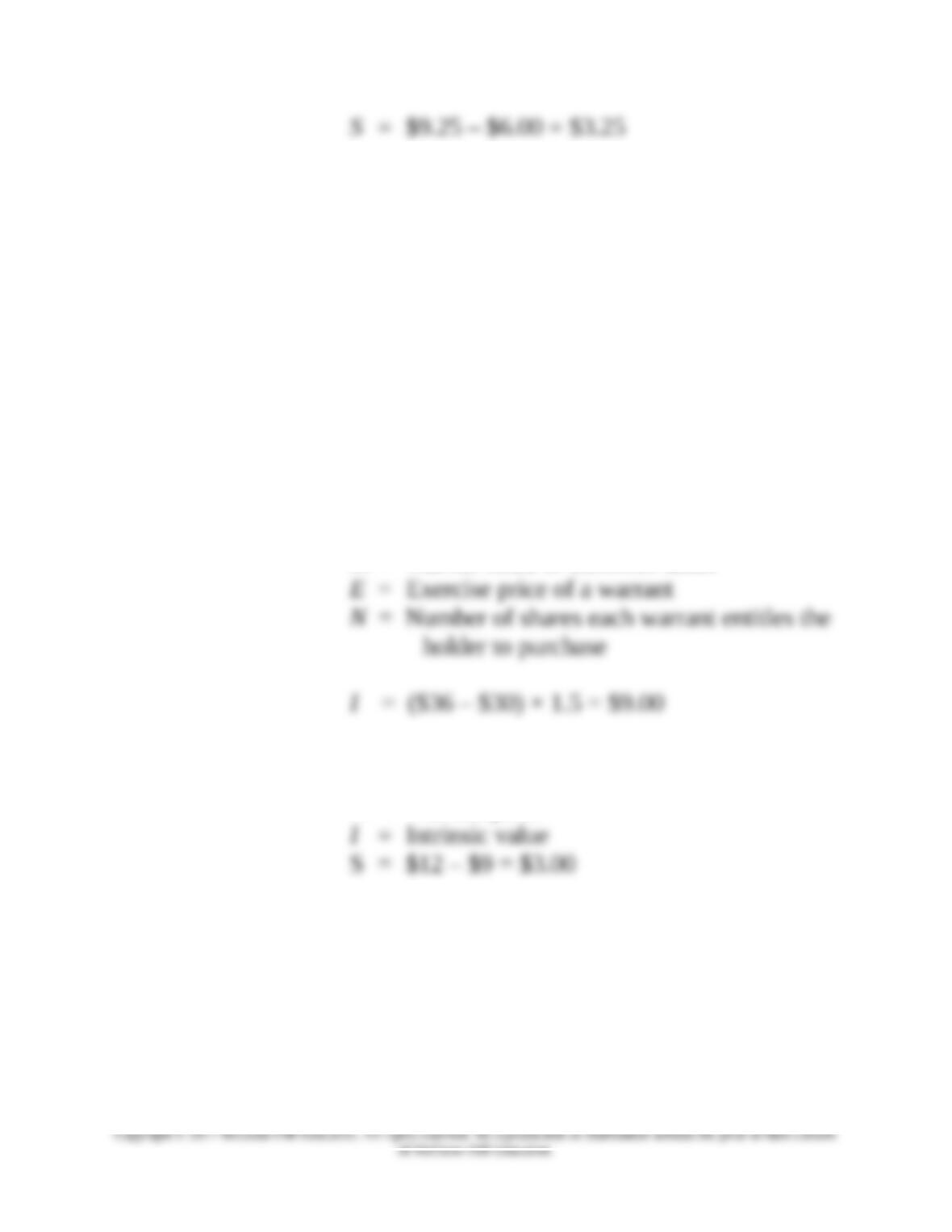
19-1. Solution:
Preston Toy Company
a. I = (M – E) × N
Where: I= Intrinsic value of a warrant
M= Market value of common stock
b. S = W – I
Where: S= Speculative premium
W= Warrant price
Chapter 19: Convertibles, Warrants, and Derivatives
2. Value of warrants (LO19-4) Quantum Inc. has warrants outstanding that allow the holder
to purchase 1.5 shares of stock per warrant at $30 per share (exercise price). Thus, each
individual share can be purchased at $30 with the warrant. The common stock is currently
selling for $36. The warrant is selling for $12.
a. What is the intrinsic (minimum) value of this warrant?
b. What is the speculative premium on this warrant?
c. What should happen to the speculative premium as the expiration date approaches?
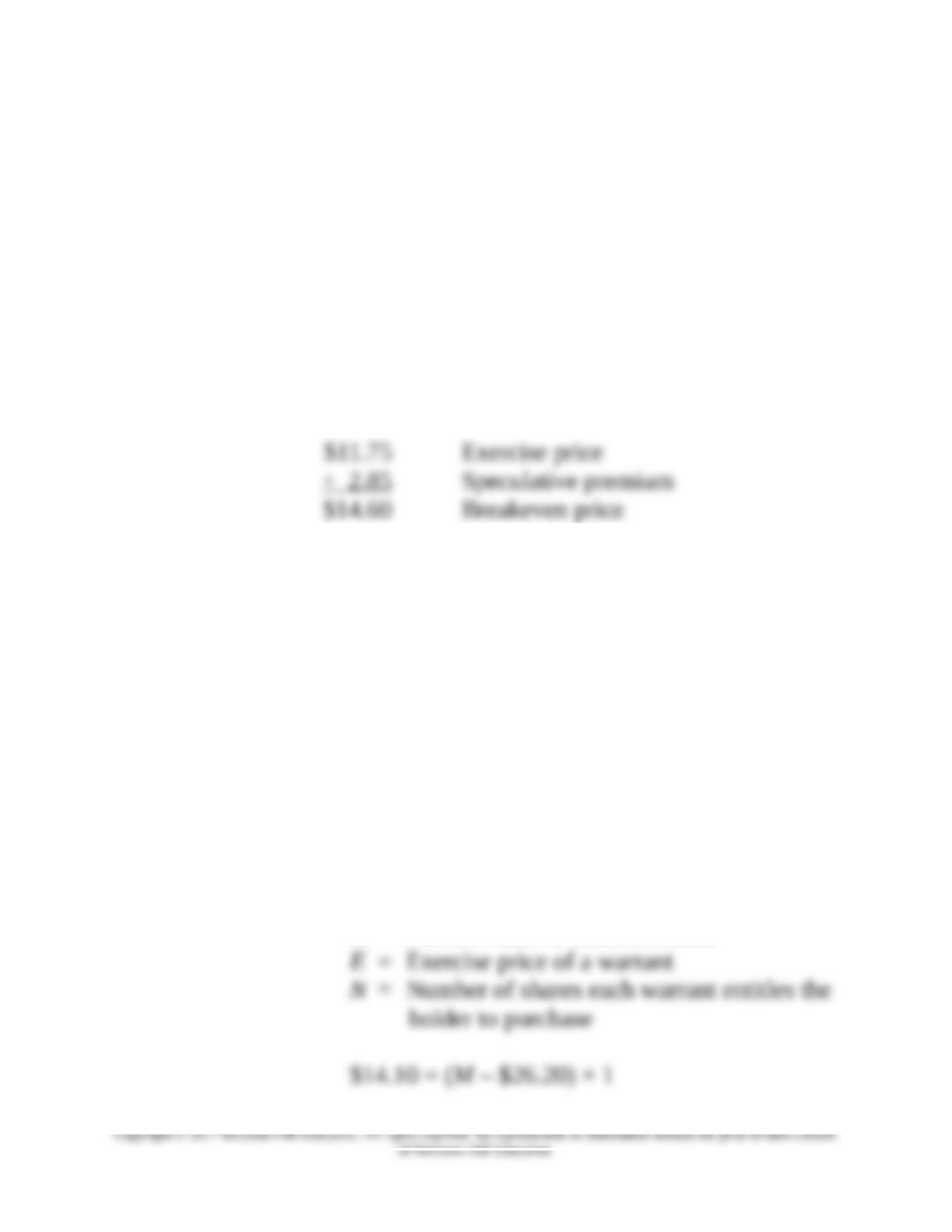
19-2. Solution:
Quantum Inc.
a. I = (M – E) × N
Where: I= Intrinsic value of a warrant
M= Market value of common stock
b. S = W – I
Where S= Speculative premium
W= Warrant price
c. The speculative premium should decrease and approach $0
as the expiration date nears.
Chapter 19: Convertibles, Warrants, and Derivatives
3. Breakeven on warrants (LO19-4)The warrants of Integra Life Sciences allow the holder
to buy a share of stock at $11.75 and are selling for $2.85. The stock price is currently
$8.50. To what price must the stock go for the warrant purchaser to at least be assured of
breaking even?
19-3. Solution:
Integra Life Sciences
The stock price must go to $14.60. At that point, the warrant
will be worth at least $2.85 ($14.60 – $11.75), which equals the
cost of the warrant.
4. Breakeven on warrants (LO19-4) The warrants of Dragon Pet Co. allow the holder to buy
a share of stock at $26.20 and are selling for $14.10. The stock price is currently $23.50. To
what price must the stock go for the warrant purchaser to at least be assured of breaking
even?
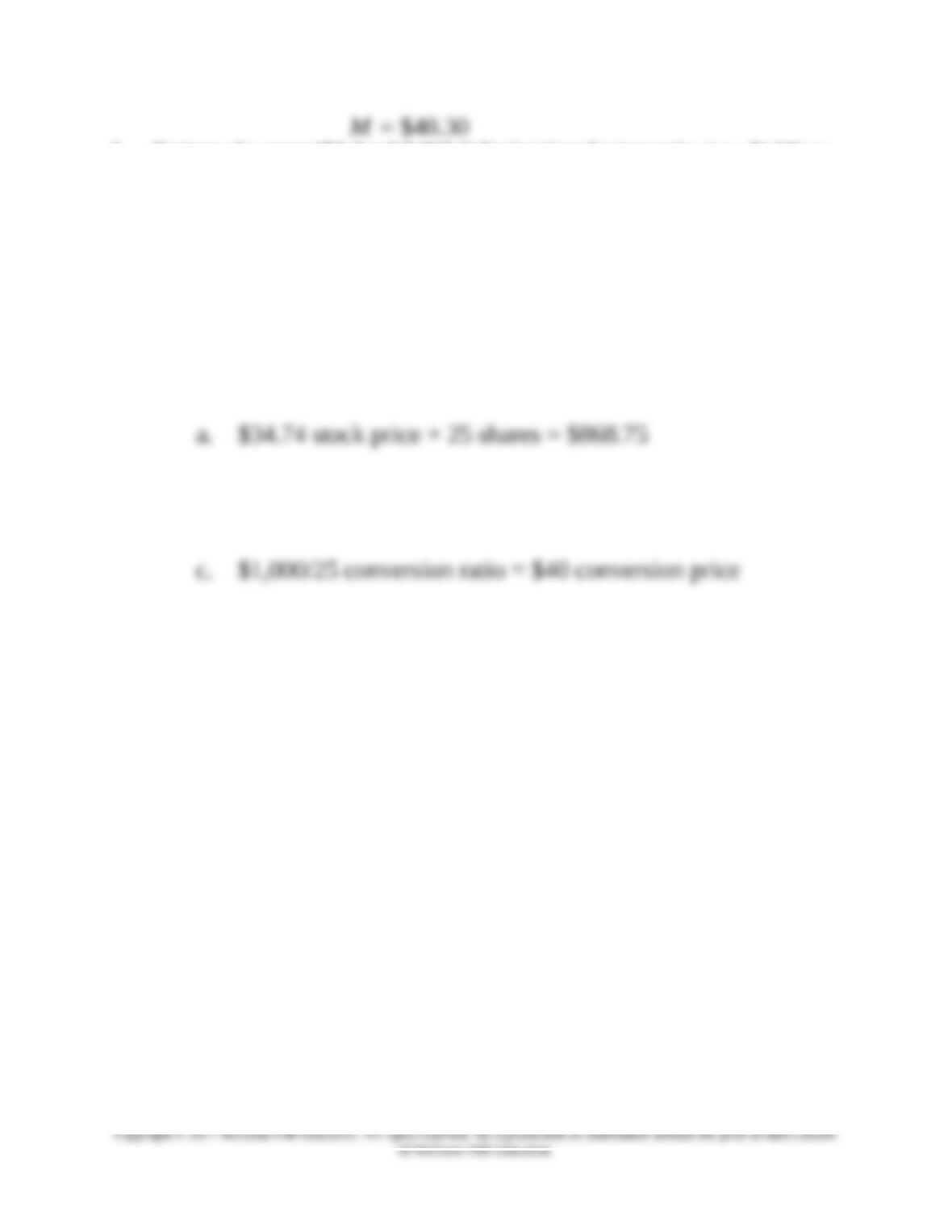
19-4. Solution:
Dragon Pet Company
The stock price must go to $40.30. At that point, the warrant
will be worth at least the current price of $14.10.
I = (M – E) × N
Where: I= Intrinsic value of a warrant
M= Market value of common stock
Chapter 19: Convertibles, Warrants, and Derivatives
5. Features of a convertible bond (LO19-1) Plunkett Gym Equipment Inc. has a $1,000 par
value convertible bond outstanding that can be converted into 25 shares of common stock.
The common stock is currently selling for $34.75 a share, and the convertible bond is
selling for $960.
a. What is the conversion value of the bond?
b. What is the conversion premium?
c. What is the conversion price?
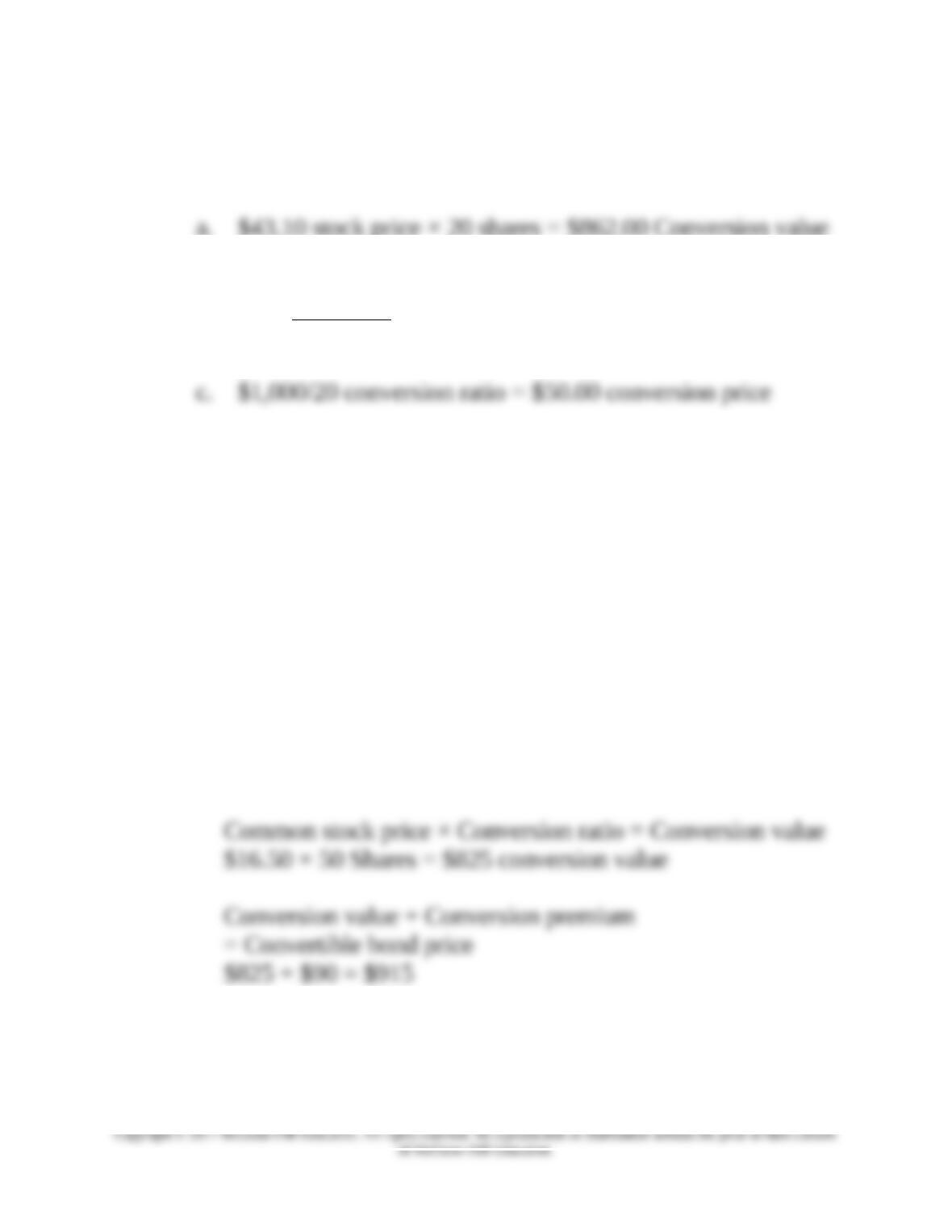
19-5. Solution:
Plunkett Gym Equipment Inc.
b. $960 bond price – $868.75 conversion value = $91.25
conversion premium
(Assume all bonds in the following problems have a par value of $1,000.)
6. Features of a convertible bond (LO19-1) O’Reilly Moving Company has a $1,000 par
value convertible bond outstanding that can be converted into 20 shares of common stock.
The common stock is currently selling for $43.10 a share, and the convertible bond is
selling for $900.00.
a. What is the conversion value of the bond?
b. What is the conversion premium?
c. What is the conversion price?
Chapter 19: Convertibles, Warrants, and Derivatives
19-6. Solution:
O’Reilly Moving Company
a. $43.10 stock price × 20 shares = $862.00 Conversion value
b. $900.00 Bond price
– $862.00 Conversion value
$ 38.00 Conversion premium
7. Price of a convertible bond (LO19-2) The bonds of Goniff Bank & Trust have a
conversion premium of $90. Their conversion price is $20. The common stock price is $16.50.
What is the price of the convertible bonds?
19-7. Solution:
Goniff Bank & Trust
The conversion ratio is equal to the par value divided by the
conversion price:
Par value/Conversion price = Conversion ratio
$1,000/$20 = 50 conversion ratio
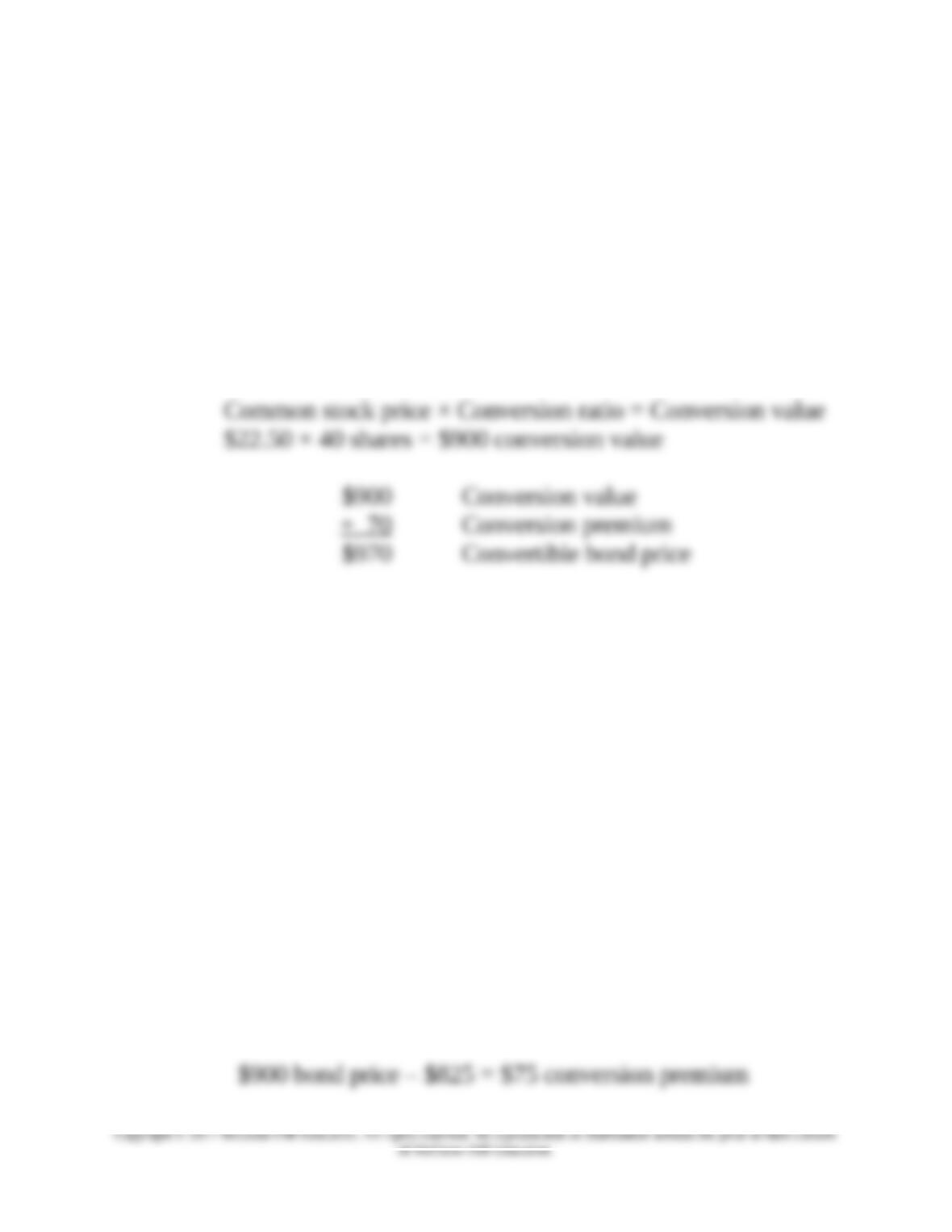
8. Price of a convertible bond (LO19-2) The bonds of Generic Labs Inc. have a conversion
premium of $70. Their conversion price is $25. The common stock price is $22.50. What is
the price of the convertible bond?
Chapter 19: Convertibles, Warrants, and Derivatives
19-8. Solution:
Generic Labs Inc.
The conversion ratio is equal to the $1,000 par value divided by
the conversion price:
Par value/Conversion price = Conversion ratio
$1,000/$25 = 40 conversion ratio
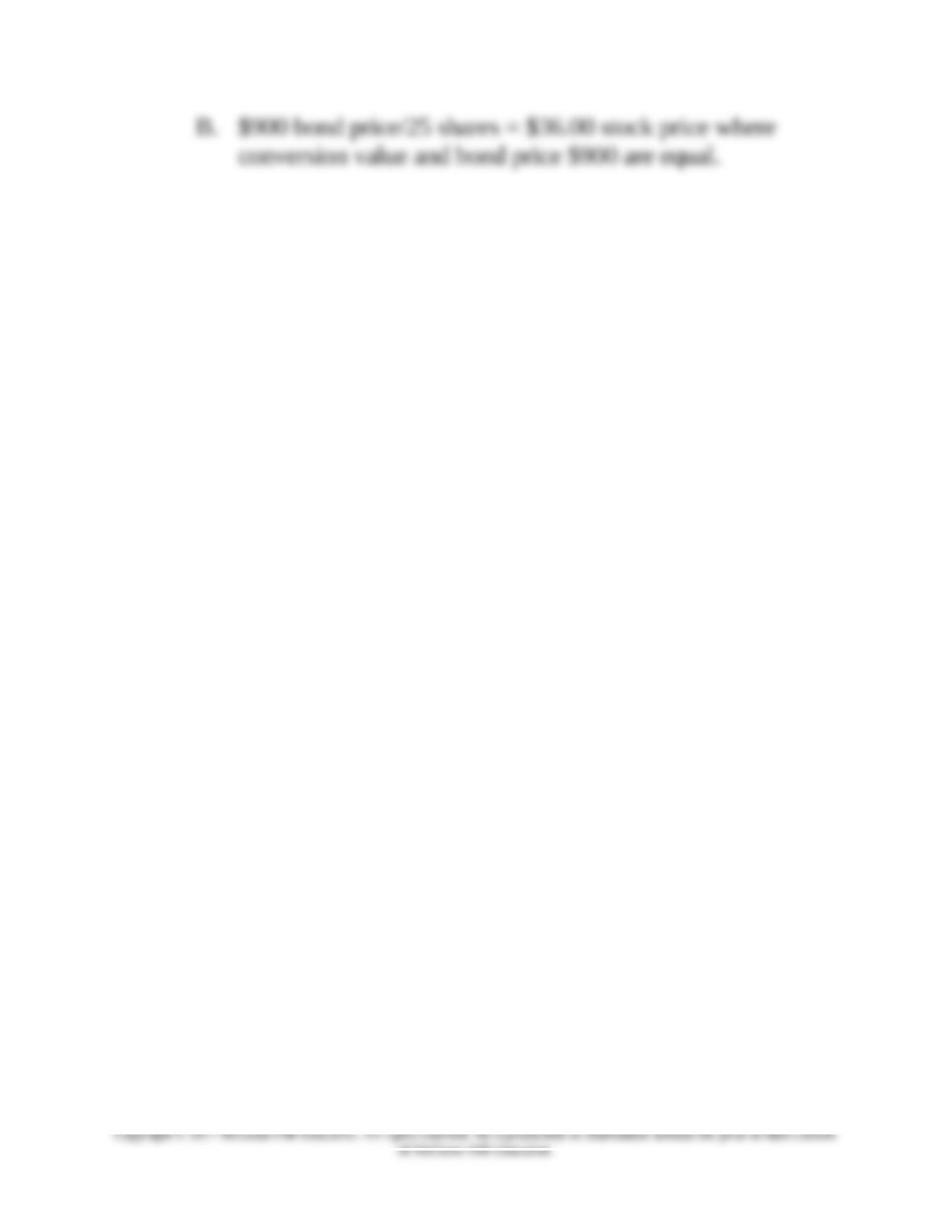
9. Conversion premium for bond (LO19-2) Sherwood Forest Products has a convertible
bond quoted on the NYSE bond market at 90. (Bond quotes represent the percentage of par
value. Thus 70 represents $700, 80 represents $800, and so on.) It matures in 10 years and
carries a coupon rate of 5½ percent. The conversion ratio is 25, and the common stock is
currently selling for $33 per share on the NYSE.
a. Compute the conversion premium.
b. At what price does the common stock need to sell for the conversion value to be equal
to the current bond price?
19-9. Solution:
Sherwood Forest Products
First calculate the bond price = 90% × $1,000 par value
= $900 bond price
A. $33 common stock price × 25 shares =
$825 conversion value
Chapter 19: Convertibles, Warrants, and Derivatives
10. Conversion value and pure bond value (LO19-1) Reynolds Technology has a convertible
bond outstanding, trading in the marketplace at $835. The par value is $1,000, the coupon
rate is 9 percent, and the bond matures in 25 years. The conversion ratio is 20, and the
company’s common stock is selling for $41 per share. Interest is paid semiannually.
a. What is the conversion value?
b. If similar bonds, which are not convertible, are currently yielding 12 percent, what is
the pure bond value of this convertible bond? (Use semiannual analysis as described
in Chapter 10.)