19. Stock dividend and cash dividend (LO18-4) Health Systems Inc. is considering a 15
percent stock dividend. The capital accounts are as follows:
Common stock (6,000,000 shares at $10 par)….... $60,000,000
Capital in excess of par*………………….……….……. 35,000,000
Retained earnings………………………………….………. 75,000,000
Net worth…………………………………………………... $170,000,000
*The increase in capital in excess of par as a result of a stock dividend
is equal to the shares created times (Market price – Par value).
The company’s stock is selling for $32 per share. The company had total earnings of
$19,200,000 with 6,000,000 shares outstanding and earnings per share were $3.20. The
firm has a P/E ratio of 10.
a. What adjustments would have to be made to the capital accounts for a 15 percent stock
dividend? Show the new capital accounts.
b. What adjustments would be made to EPS and the stock price? (Assume the P/E ratio
remains constant.)
c. How many shares would an investor have if he or she originally had 80?
d. What is the investor’s total investment worth before and after the stock dividend if the
P/E ratio remains constant? (There may be a slight difference due to rounding.)
e. Assume Mr. Heart, the president of Health Systems, wishes to benefit stockholders by
keeping the cash dividend at a previous level of $1.25 in spite of the fact that the
stockholders now have 15 percent more shares. Because the cash dividend is not
reduced, the stock price is assumed to remain at $32.
What is an investor’s total investment worth after the stock dividend if he/she had
80 shares before the stock dividend?
f. Under the scenario described in part e, is the investor better off?
g. As a final question, what is the dividend yield on this stock under the scenario
described in part e?
18-19. Solution:
Health Systems Inc.
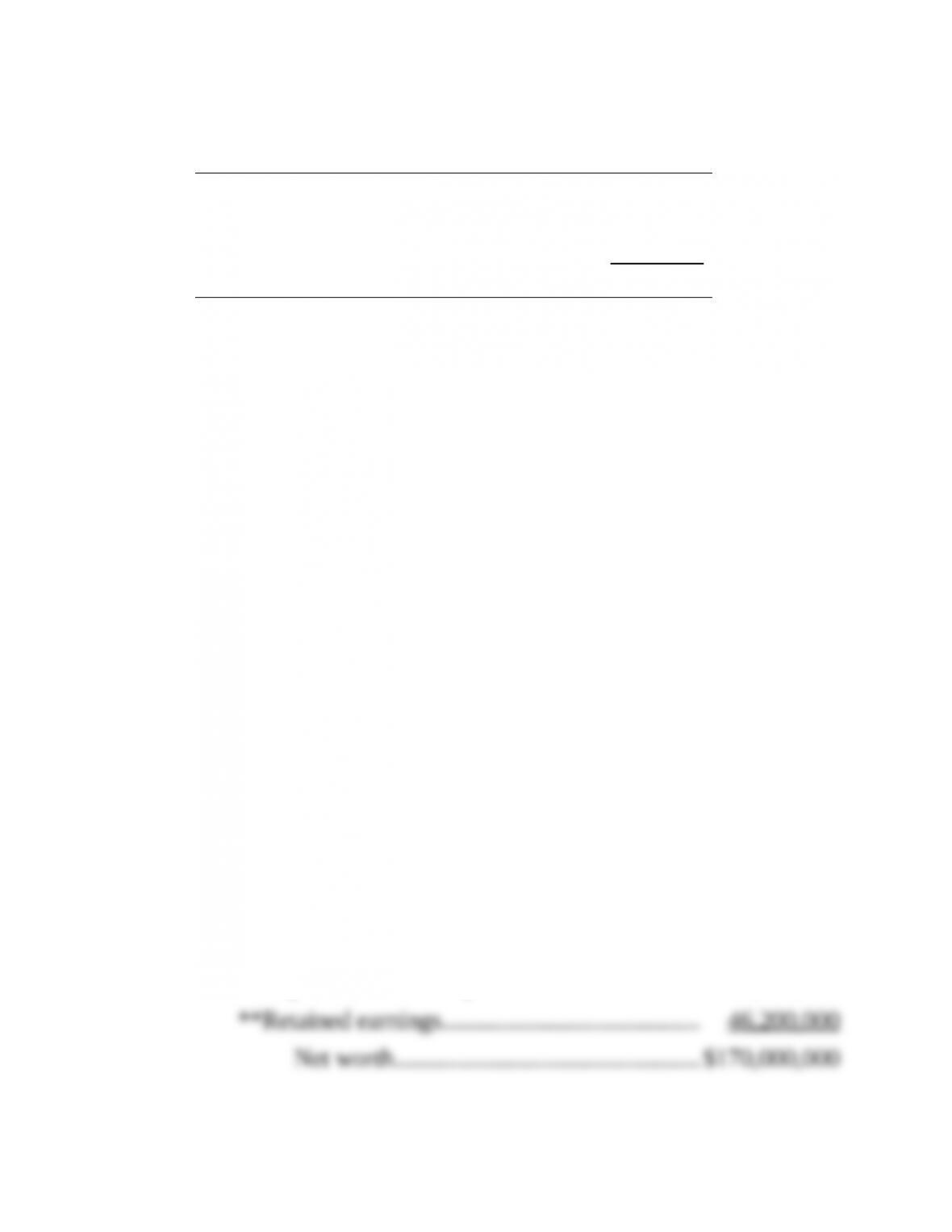
a. Common stock (6,900,000 shares at $10 par).. $69,000,000
*Capital in excess of par……….…….…….…….. 54,800,000
18-19. (Continued)
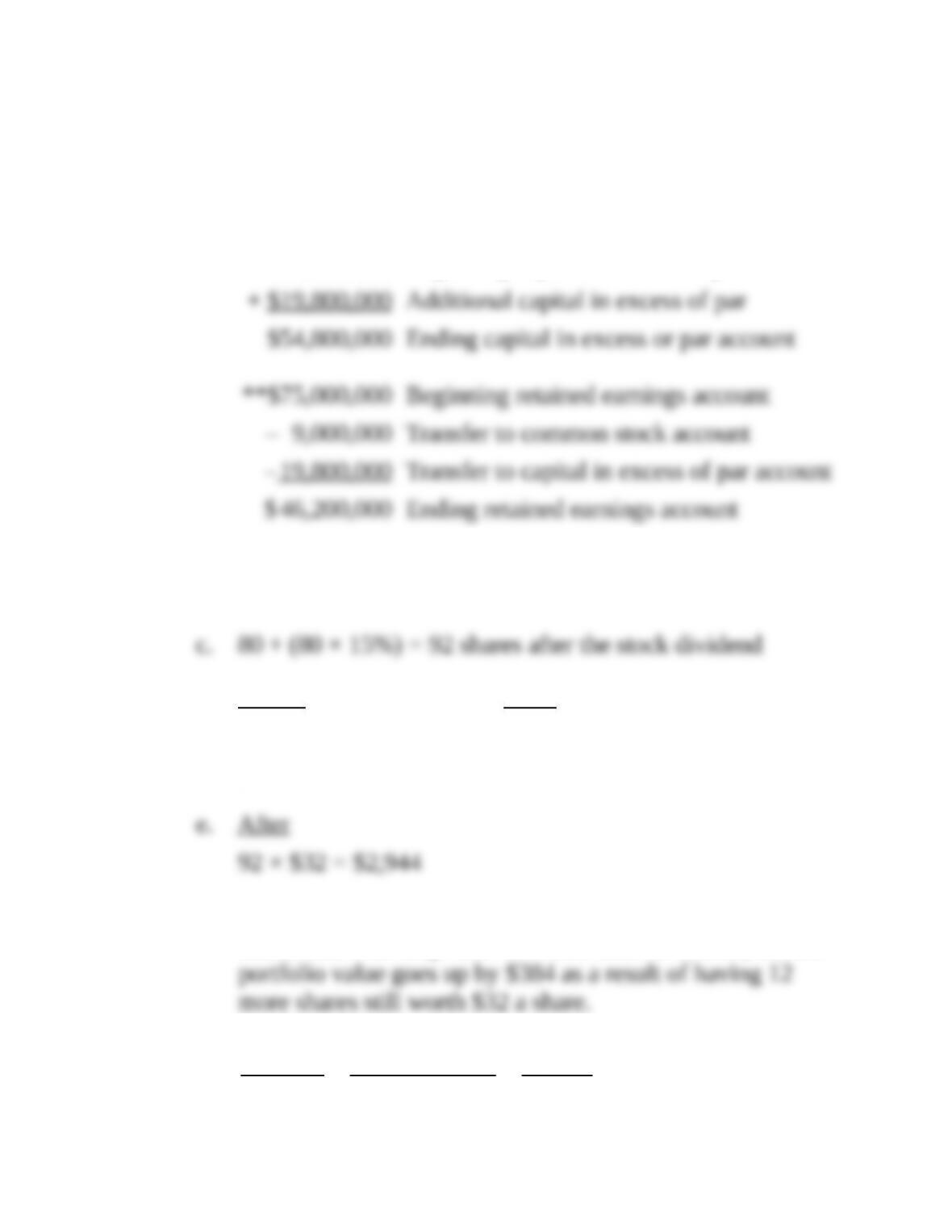
*900,000 shares × ($32 Market price – $10 Stock price)
= 900,000 × 22 = 19,800,000
$35,000,000 Beginning capital in excess of par account
b. EPS after the stock dividend = $19,200,000/6,900,000 = $2.78
price = P/E ratio × EPS = 10 × $2.78 = $27.80
d. Before After
80 × $32 = $2,560 92 × $27.80 = $2,557.60
($2.40 rounding difference)
f. Yes. As a result of keeping the cash dividend constant, the
stockholder not only received more cash dividends, but the
g.
Divided Cash dividend $1.25 3.91%
Yield Market price $32.00
= = =
20. Reverse stock split (LO18-4) Worst Buy Company has had a lot of complaints from
customers of late and its stock price is now only $2 per share. It is going to employ a one-
for-five reverse stock split to increase the stock value. Assume Dean Smith owns 140
shares.
a. How many shares will he own after the reverse stock split?
b. What is the anticipated price of the stock after the reverse stock split?
c. Because investors often have a negative reaction to a revere stock split, assume the
stock only goes up to 80 percent of the value computed in part b. What will the stock’s
price be?
d. How has the total value of Dean Smith’s holdings changed from before the reverse
stock split to after the reverse stock split (based on the stock value computed in part c)?
To get the total value before and after the split, multiply the shares held times the
stock price.
18-20. Solution:
Worst Buy Company
a. Number of shares after reverse stock split
b. Anticipated stock price
= Original stock price × Reverse split ratio
= $2 × 5 = $10
c. Actual stock price based on the 80 percent assumption
d. Dean Smith’s total holdings
Before reverse stock split
140 shares × $2 = $280
21. Cash dividend versus stock repurchase (LO18-5) The Carlton Corporation has $5
million in earnings after taxes and 2 million shares outstanding. The stock trades at a P/E of
20. The firm has $4 million in excess cash.
a. Compute the current price of the stock.
b. If the $4 million is used to pay dividends, how much will dividends per share be?
c. If the $4 million is used to repurchase shares in the market at a price of $54 per share,
how many shares will be acquired? (Round to the nearest share.)
d. What will the new earnings per share be? (Round to two places to the right of the
decimal.)
e. If the P/E ratio remains constant, what will the price of the securities be? By how much,
in terms of dollars, did the repurchase increase the stock price?
f. Has the stockholder’s total wealth changed as a result of the stock repurchase as
opposed to receiving the cash dividend?
g. What are some reasons a corporation may wish to repurchase its own shares in the
market?
18-21. Solution:
Carlton Corporation
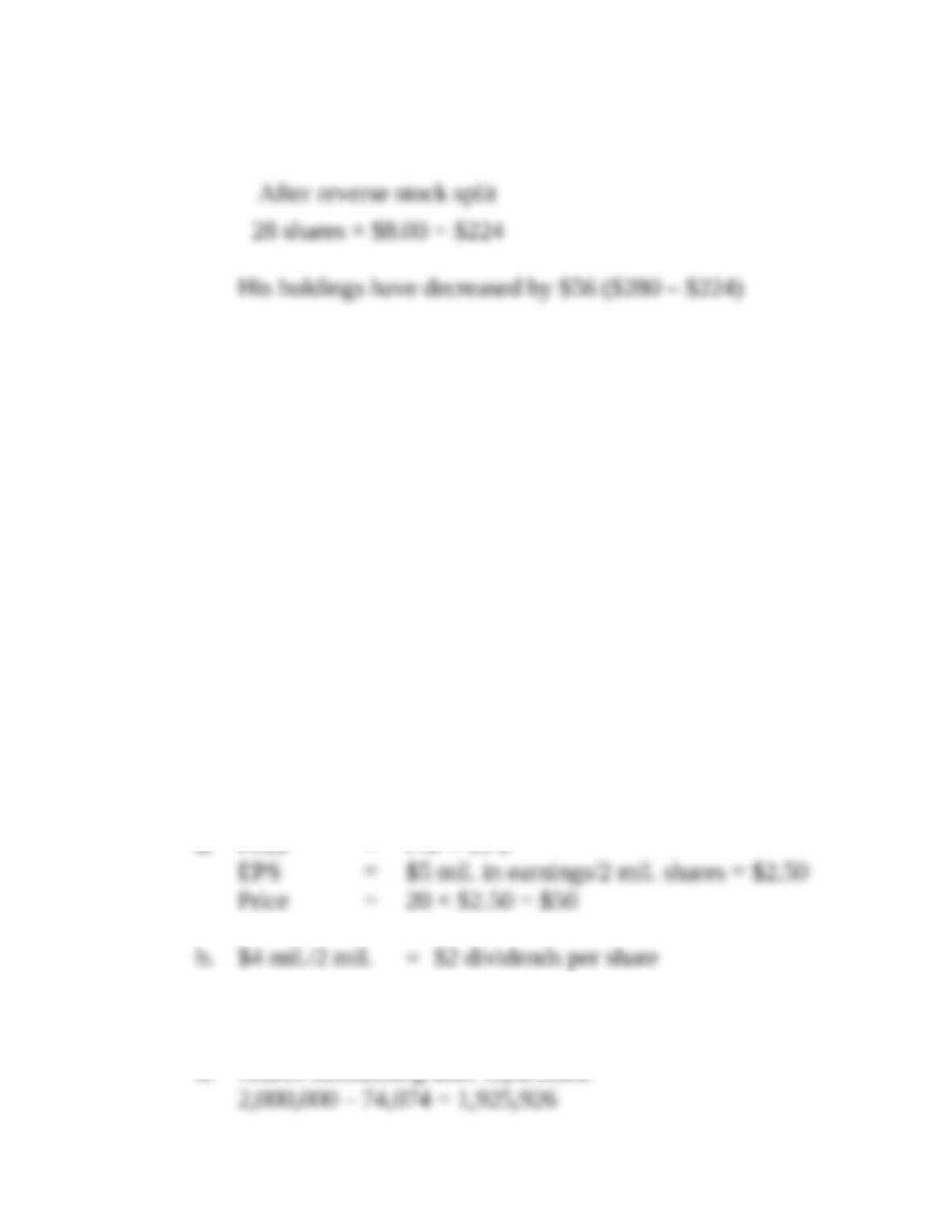
a. Price = P/E × EPS
c. $4,000,000/$54 = 74,074 shares reacquired
d. Shares outstanding after repurchase
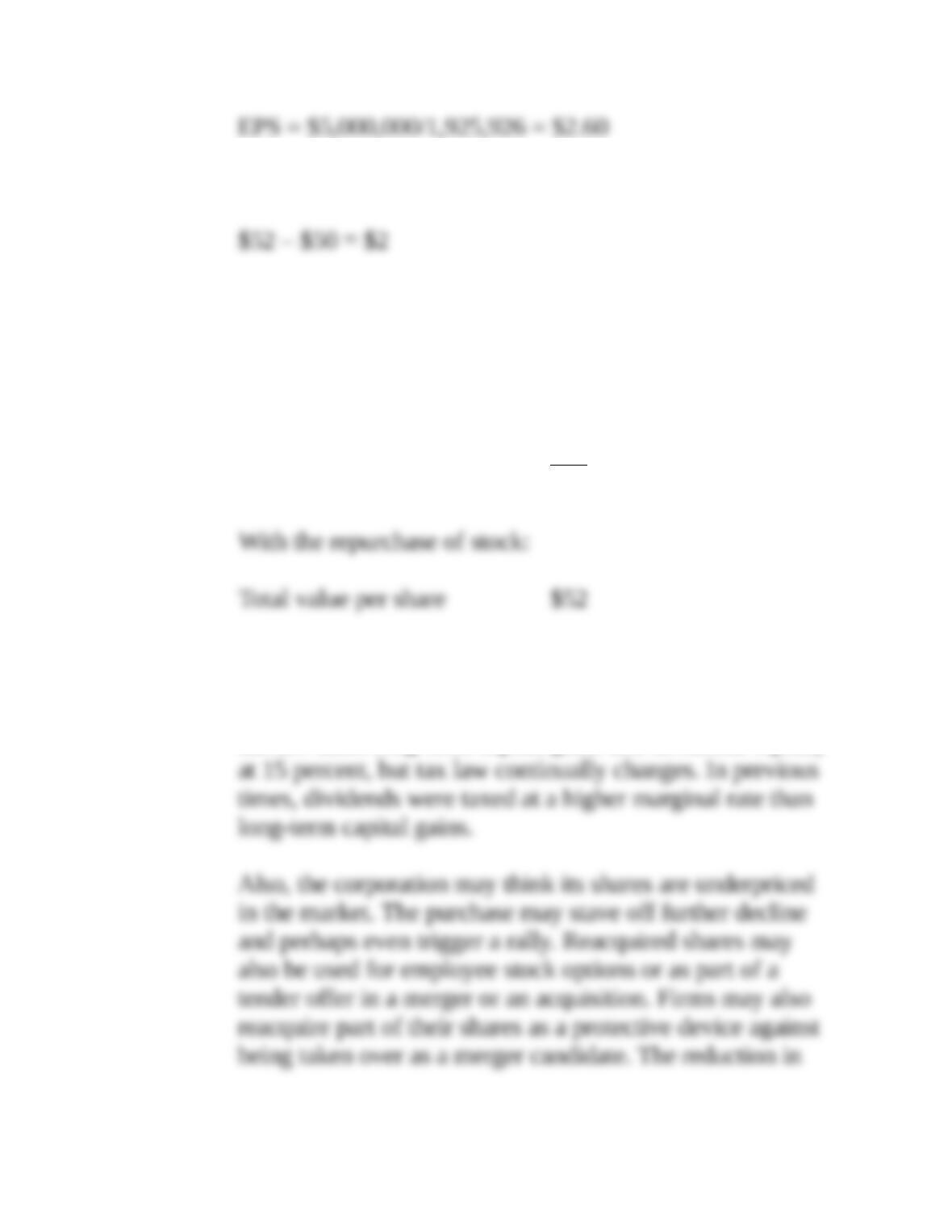
e. Price = P/E × EPS = 20 × $2.60 = $52.00
18-21. (Continued)
f. No. With the cash dividend:
Market value per share $50
Cash dividend per share 2
Total value $52
g. The (potential) appreciation in value associated with a stock
repurchase defers the capital gains tax until the stock is
sold, whereas dividends are taxed when received. Current
tax law taxes long-term capital gains and dividends equally

22. Retaining funds versus paying them out (LO18-1) The Hastings Sugar Corporation has
the following pattern of net income each year, and associated capital expenditure projects.
The firm can earn a higher return on the projects than the stockholders could earn if the
funds were paid out in the form of dividends.
Year Net Income
Profitable Capital
Expenditure
1……… $14 million $ 7 million
2……… 16 million 11 million
3……… 12 million 6 million
4……… 16 million 8 million
5……… 16 million 9 million
The Hastings Corporation has 3 million shares outstanding (the following questions are
separate from each other).
a. If the marginal principle of retained earnings is applied, how much in total cash
dividends will be paid over the five years?
b. If the firm simply uses a payout ratio of 30 percent of net income, how much in total
cash dividends will be paid?
c. If the firm pays a 10 percent stock dividend in years 2 through 5, and also pays a cash
dividend of $3.40 per share for each of the five years, how much in total dividends will
be paid?
d. Assume the payout ratio in each year is to be 20 percent of net income and the firm will
pay a 10 percent stock dividend in years 2 through 5. How much will dividends per
share for each year be? (Assume cash dividend is paid after the stock dividend).
18-22. Solution:
Hastings Sugar Corporation
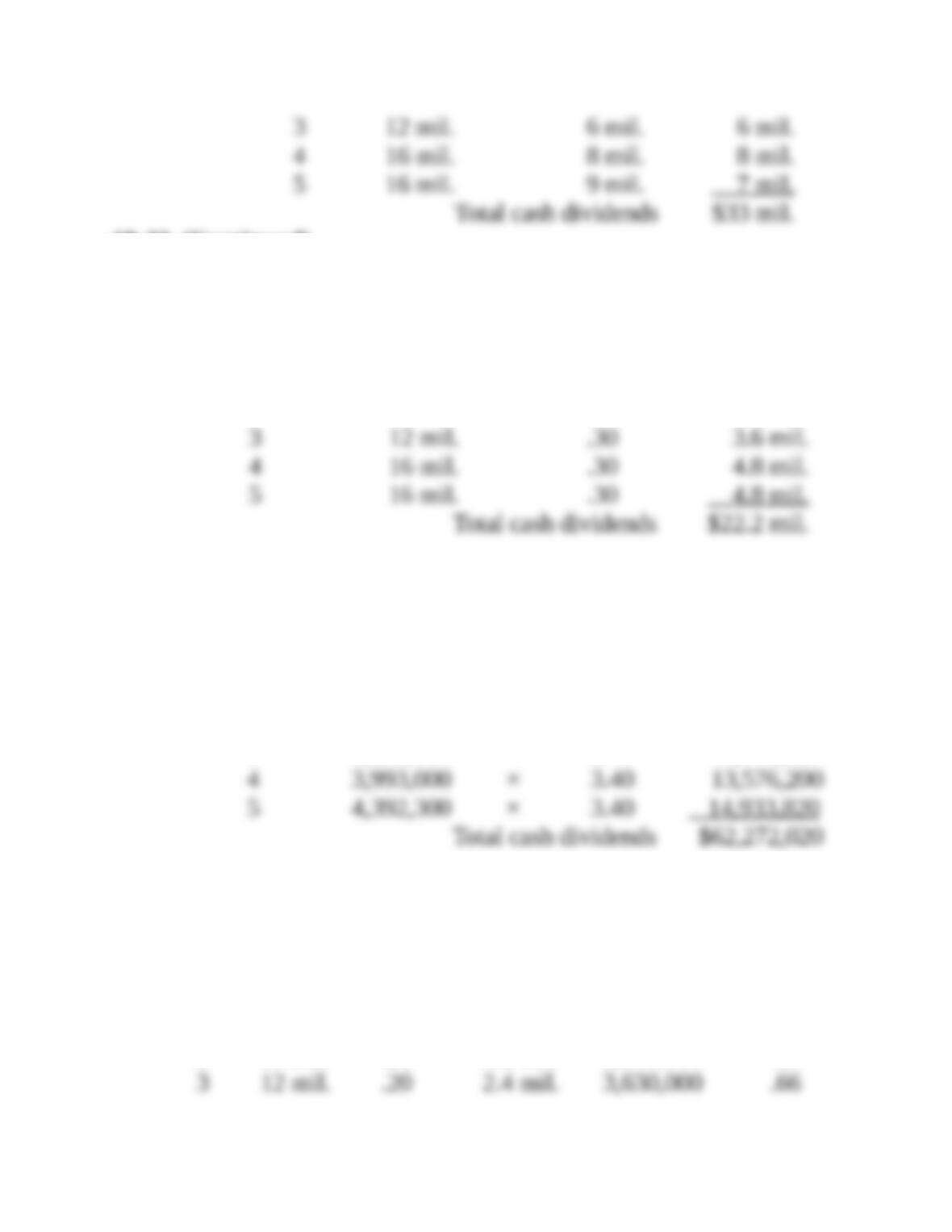
a. Dividends represent what is left over after profitable capital
expenditures are undertaken.
Year
Net
Income –
Profitable
Capital
Expenditures Dividends
1 $14 mil. $ 7 mil. $ 7 mil.
2 16 mil. 11 mil. 5 mil.
18-22. (Continued)
b.
Year Net Income ×Payout Ratio Dividends
1 $14 mil. .30 $ 4.2 mil.
2 16 mil. .30 4.8 mil.
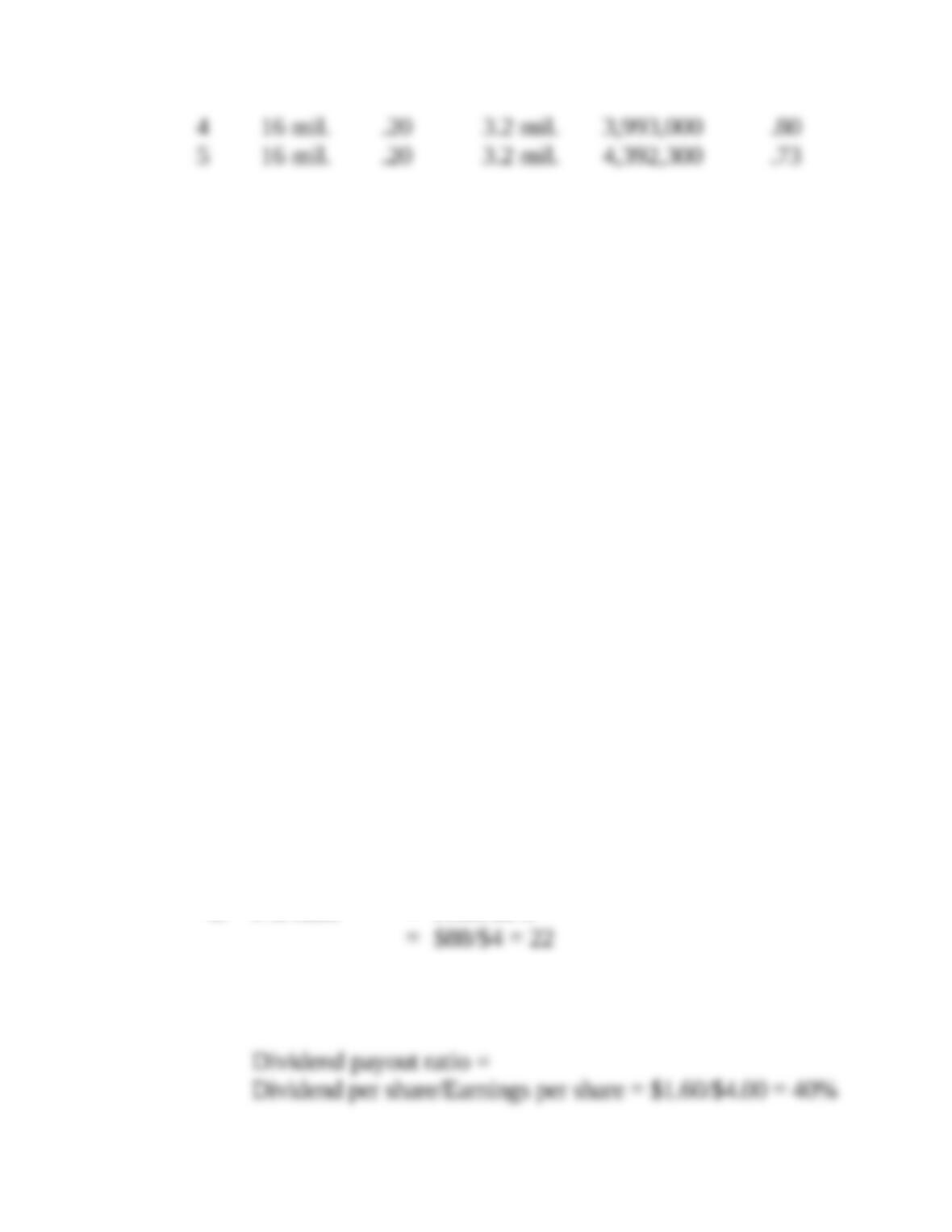
c.
Year
Shares
Outstanding ×
Dividends
per Share Dividends
1 3,000,000 × $3.40 $ 10,200,000
2 3,300,000 × 3.40 11,220,000
3 3,630,000 × 3.40 12,342,000
d.
Year
Net
Income
Payout
Ratio Dividends Shares
Dividends
per Share
1 $14 mil. .20 $2.8 mil. 3,000,000 $.93
2 16 mil. .20 3.2 mil. 3,300,000 .97
COMPREHENSIVE PROBLEM
Modern Furniture Company (Dividend payments versus stock repurchases) (LO18-5)
Modern Furniture Company had finally arrived at the point where it had a sufficient excess cash
flow of $4.8 million to consider paying a dividend. It had 3 million shares of stock outstanding
and was considering paying a cash dividend of $1.60 per share. The firm’s total earnings were
$12 million, providing $4.00 in earnings per share. The stock traded in the market at $88.00 per
share.
However, Al Rosen, the chief financial officer, was not sure that paying a cash dividend was the
best route to go. He had recently read a number of articles in The Wall Street Journal about the
advantages of stock repurchases and before he made a recommendation to the CEO and board of
directors, he decided to do a number of calculations.
a. What is the firm’s P/E ratio?
b. If the firm paid the cash dividend, what would be its dividend yield and dividend payout ratio
per share?
c. If a stockholder held 100 shares of stock and received the cash dividend, what would
be the total value of his portfolio (stock plus dividends)?
d. Assume instead of paying the cash dividend, the firm used the $4.8 million of excess funds to
purchase shares at slightly over the current market value of $88 at a price of $89.60. How
many shares could be repurchased? (Round to the nearest share.)
e. What would the new earnings per share be under the stock repurchase alternative? (Round to
three places to the right of the decimal point.)
f. If the P/E ratio stayed the same under the stock repurchase alternative, what would be the
stock value per share? If a stockholder owned 100 shares, what would now be the total value
of his portfolio? (This answer should be approximately the same as the answer to part c.)
CP18-1. Solution:
Modern Furniture Company
a. P/E ratio = Price/EPS
b. Dividend yield = Dividend per share/price
= $1.60/$88 = 1.82%
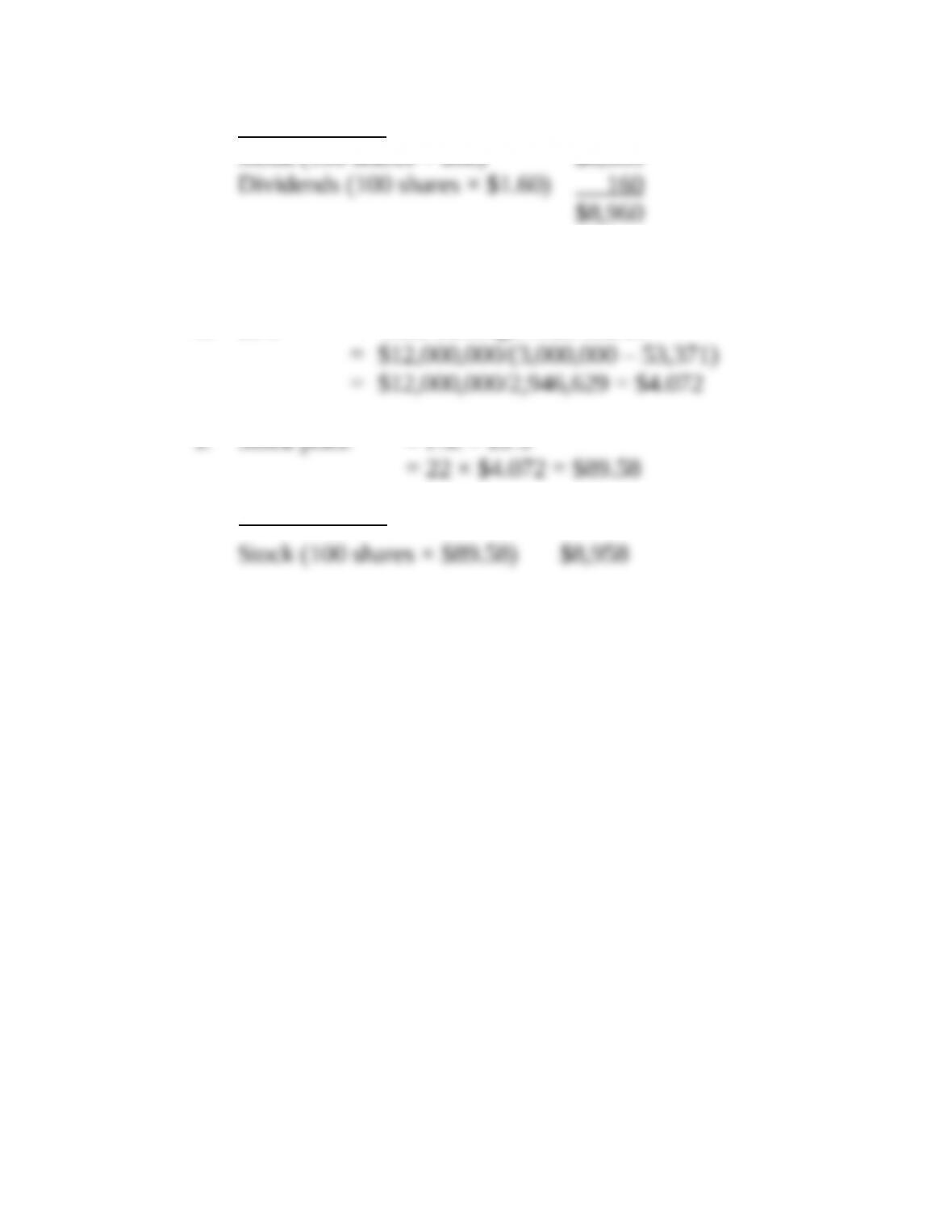
c. Portfolio value
Stock (100 shares × $88) $8,800
d. $4,800,000/$89.60 = 53,371 shares
e. EPS = Total earnings/Total shares
Portfolio value