Chapter 18: Dividend Policy and Retained Earnings
10. Dividend yield (LO18-1) The stock of Pills Berry Company is currently selling at $60 per
share. The firm pays a dividend of $1.80 per share.
a. What is the annual dividend yield?
b. If the firm has a payout rate of 50 percent, what is the firm’s P/E ratio?
18-10. Solution:
Pills Berry Company
a. Annual dividend yield = Cash dividends/Price
= $1.80/$60 = 3.00%
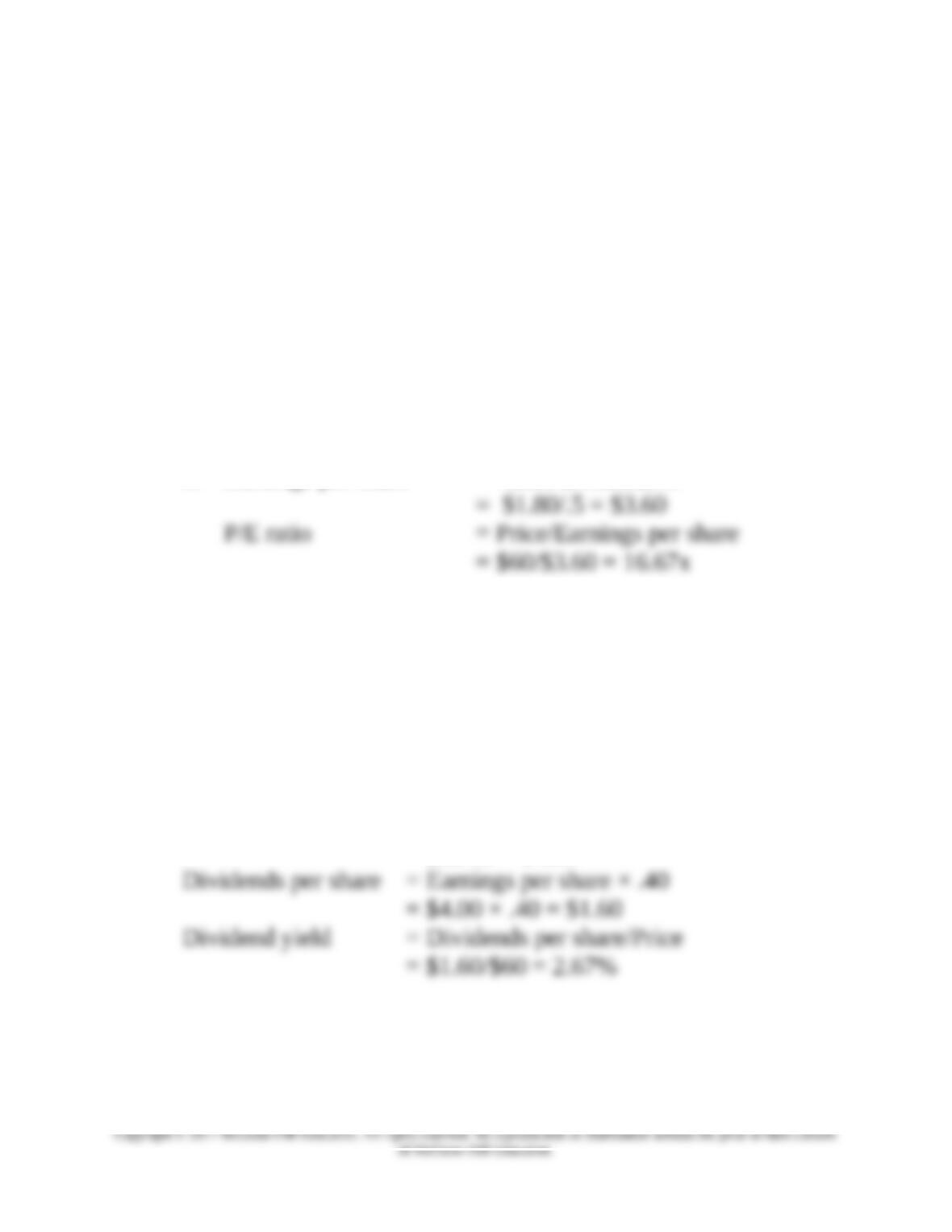
b. Earnings per share = Cash dividends/.5
11. Dividend yield (LO18-1) The shares of the Dyer Drilling Co. sell for $60. The firm has a
P/E ratio of 15. Forty percent of earnings is paid out in dividends. What is the firm’s
dividend yield?
18-11. Solution:
Dyer Drilling Company
Earnings per share = Stock price/Price – Earnings ratio
= $60/15 = $4.00
Chapter 18: Dividend Policy and Retained Earnings
12. Ex-dividends date and stock price (LO18-1) Peabody Mining Company’s common stock
is selling for $50 the day before the stock goes ex-dividend. The annual dividend yield is
5.6 percent, and dividends are distributed quarterly. Based solely on the impact of the cash
dividend, by how much should the stock go down on the ex-dividend date? What will the
new price of the stock be?
18-12. Solution:
Peabody Mining Company
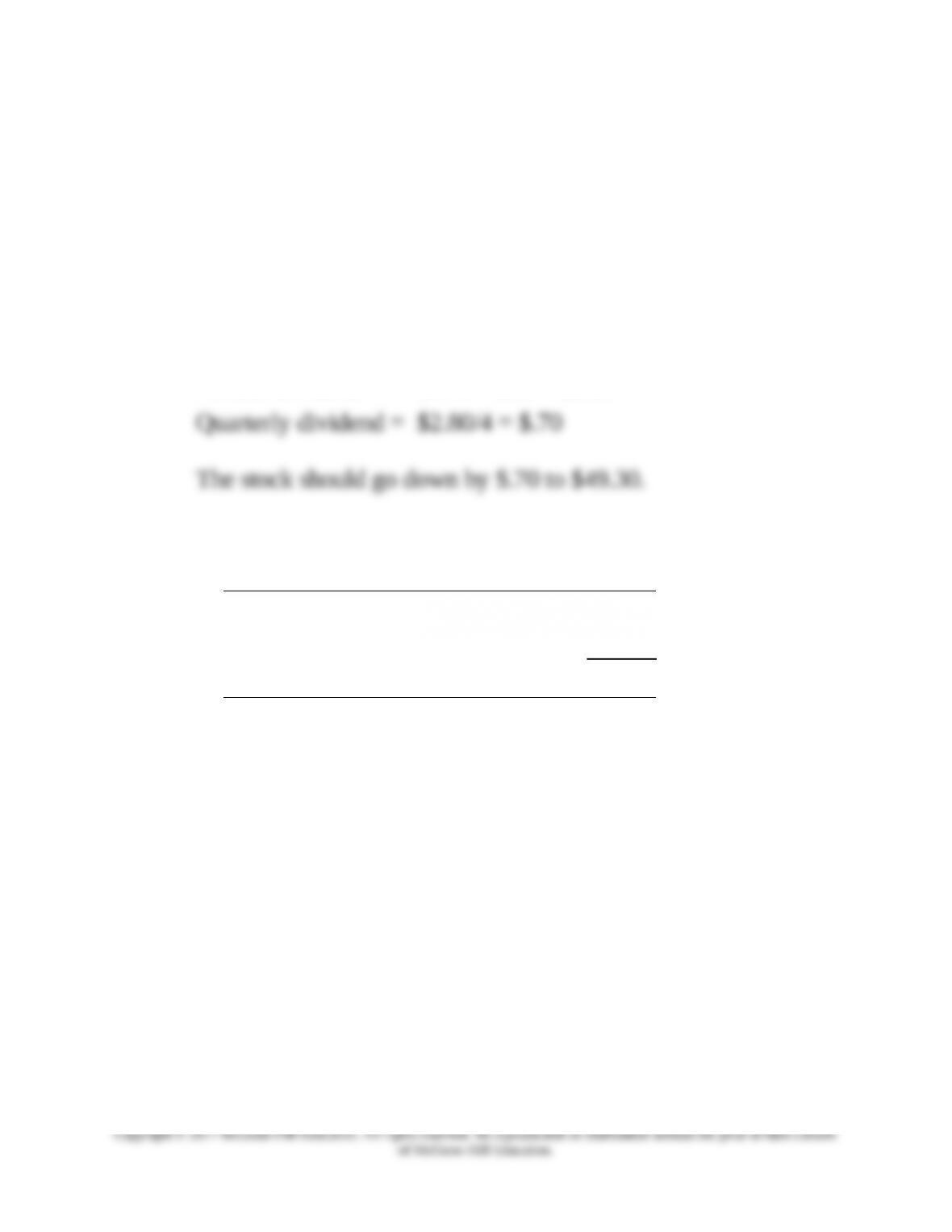
Annual dividend = 5.6% × $50 = $2.80
13. Stock dividend and cash dividend (LO18-4) The Western Pipe Company has the
following capital section in its balance sheet. Its stock is currently selling for $6 per share.
Common stock (50,000 shares at $2 par)………. $ 100,000
Capital in excess of par……………………..……….. 100,000
Retained earnings………………………………………. 250,000
$450,000
The firm intends to first declare a 15 percent stock dividend and then pay a 25-cent cash
dividend (which also causes a reduction of retained earnings). Show the capital section of
the balance sheet after the first transaction and then after the second transaction.
18-13. Solution:
Western Pipe Co.
After first transaction
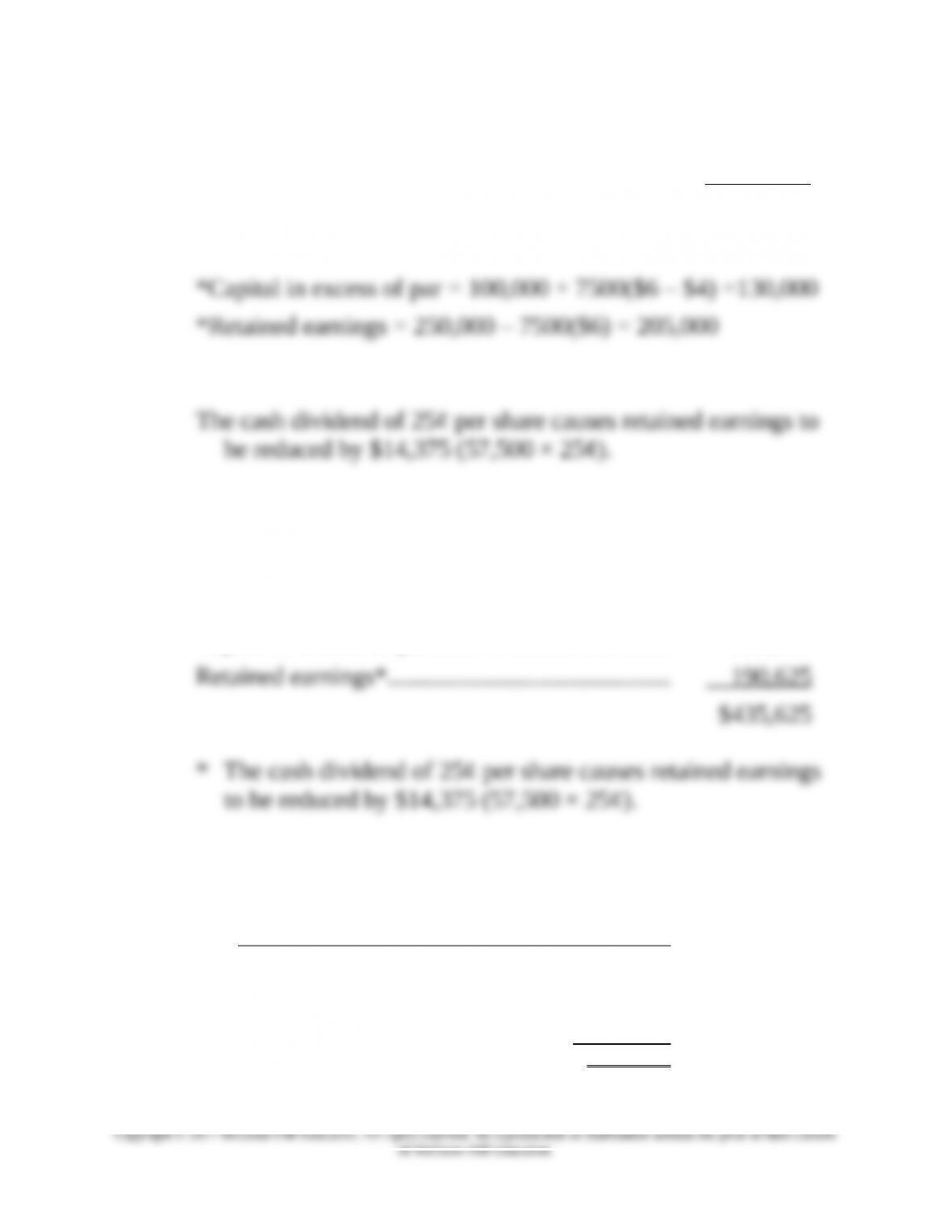
Common stock (57,500 shares at $2 par)........... $ 115,000
Chapter 18: Dividend Policy and Retained Earnings
Capital in excess of par*…………….………….….... 130,000
Retained earnings……………….……….………….….. 205,000
$450,000
After second transaction
Common stock (57,500 shares at $2 par)........... $ 110,000
Capital in excess of par……………………………….. 130,000
14. Cash dividend policy (LO18-1) Phillips Rock and Mud is trying to determine the
maximum amount of cash dividends it can pay this year. Assume its balance sheet is as
follows:
Assets
Cash………………………………………………………. $ 386,000
Accounts receivable……………………….……….. 836,000
Fixed assets………………………………..…….……. 1,048,000
Total assets………………………….…………. $2,270,000
Liabilities and Stockholders’ Equity
Chapter 18: Dividend Policy and Retained Earnings
Accounts payable………………………….………… $ 459,000
Long-term payable………………………..………… 371,000
Common stock (295,000 shares at $1 par)….. 295,000
Retained earnings……………………………………. 1,145,000
Total liabilities and stockholders’ equity.... $2,270,000
a. From a legal perspective, what is the maximum amount of dividends per share the firm
could pay?
b. In terms of cash availability, what is the maximum amount of dividends per share the
firm could pay?
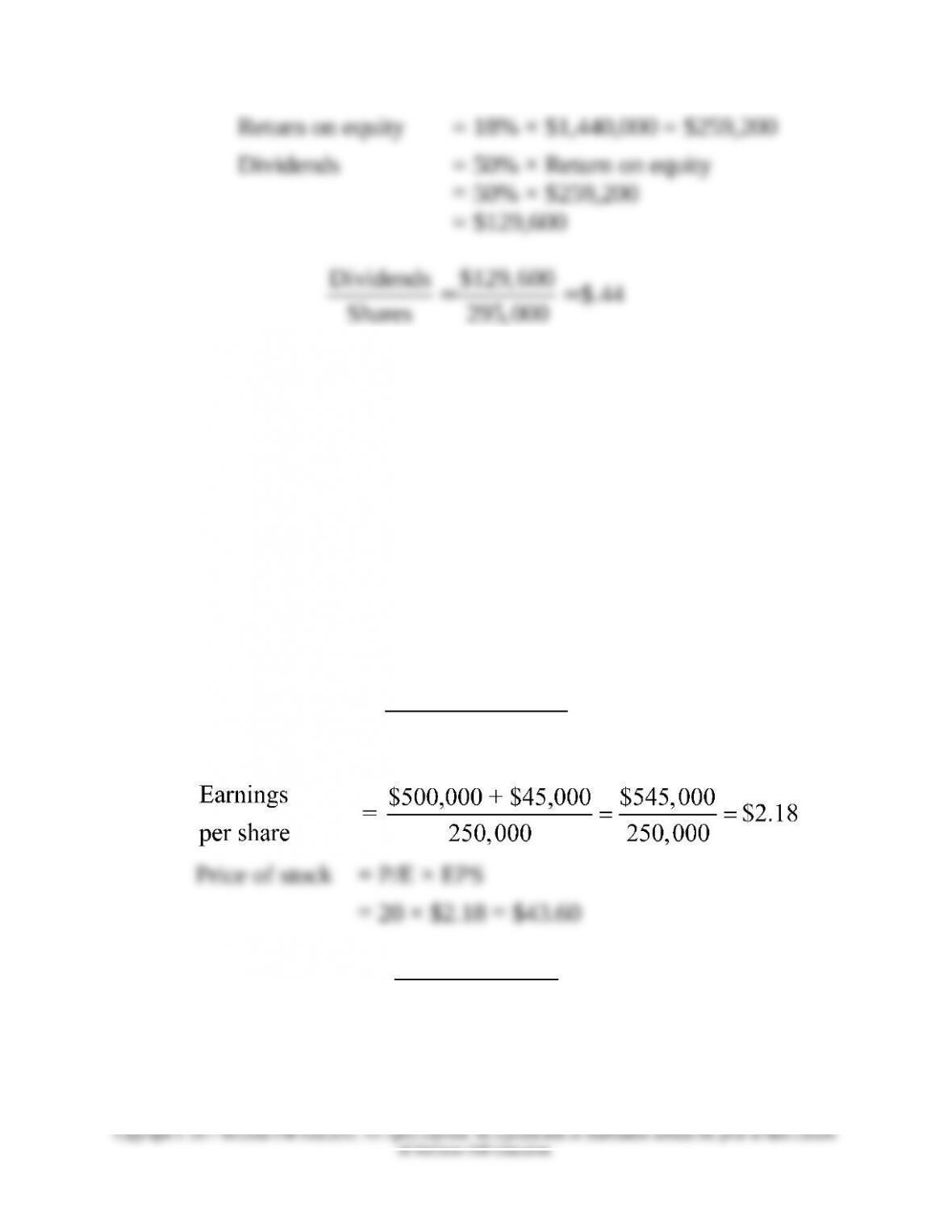
c. Assume the firm earned an 18 percent return on stockholders’ equity last year. If the
board wishes to pay out 50 percent of earnings in the form of dividends, how much will
dividends per share be? (Round to two places to the right of the decimal point.)
18-14. Solution:
Phillips Rock and Mud
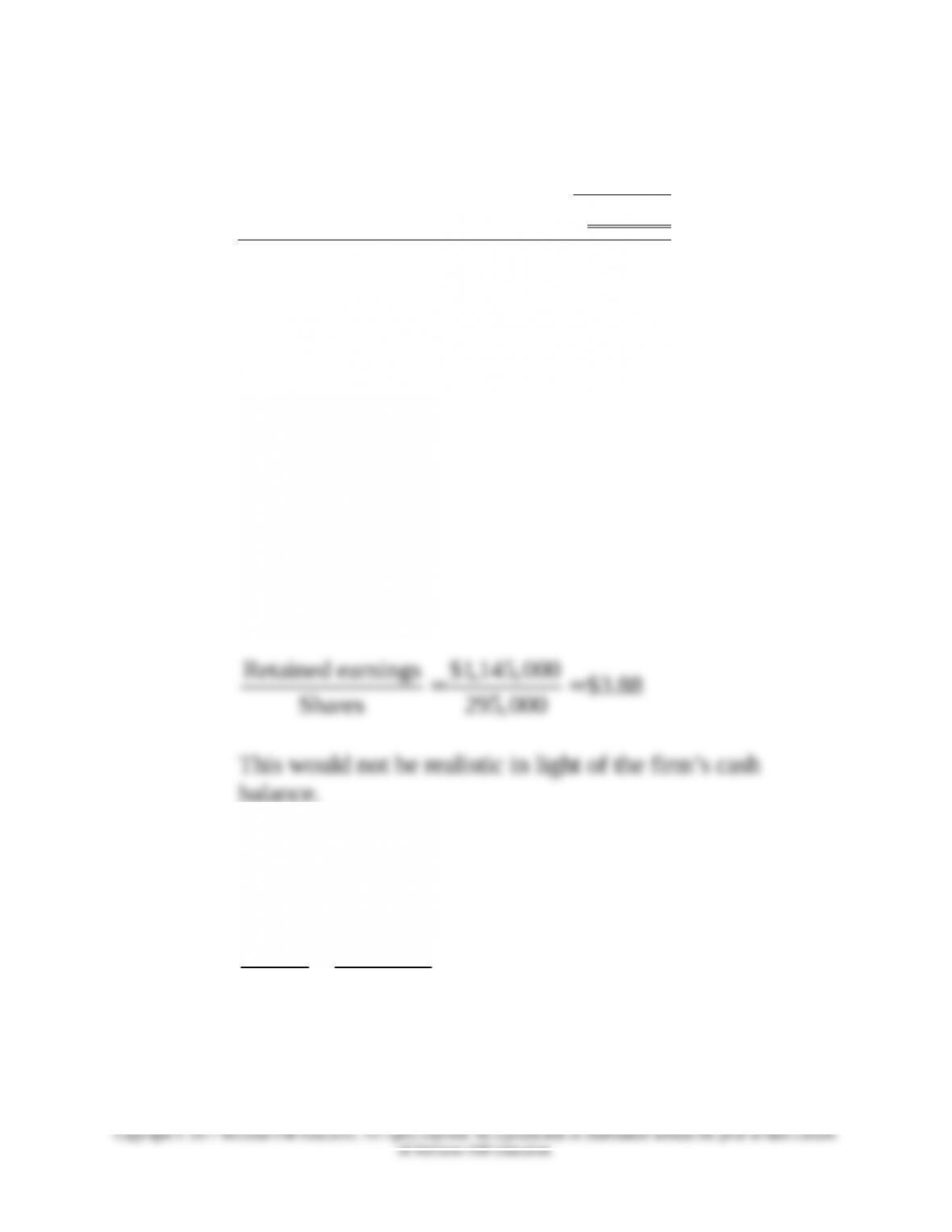
a. From a legal viewpoint, the firm can pay cash dividends
equal to retained earnings of $1,145,000. On a per share
basis, this represents $3.88 per share.
Retained earnings $1,145,000 $3.88
Shares 295,000
= =
This would not be realistic in light of the firm’s cash
balance.
18-14. (Continued)
b.
Cash $386,000 $1.31
Shares 295,000
= =
c. Stockholders’ equity = Common stock + Retained earnings
$1,440,000 = $295,000 + $1,145,000
Chapter 18: Dividend Policy and Retained Earnings
Chapter 18: Dividend Policy and Retained Earnings
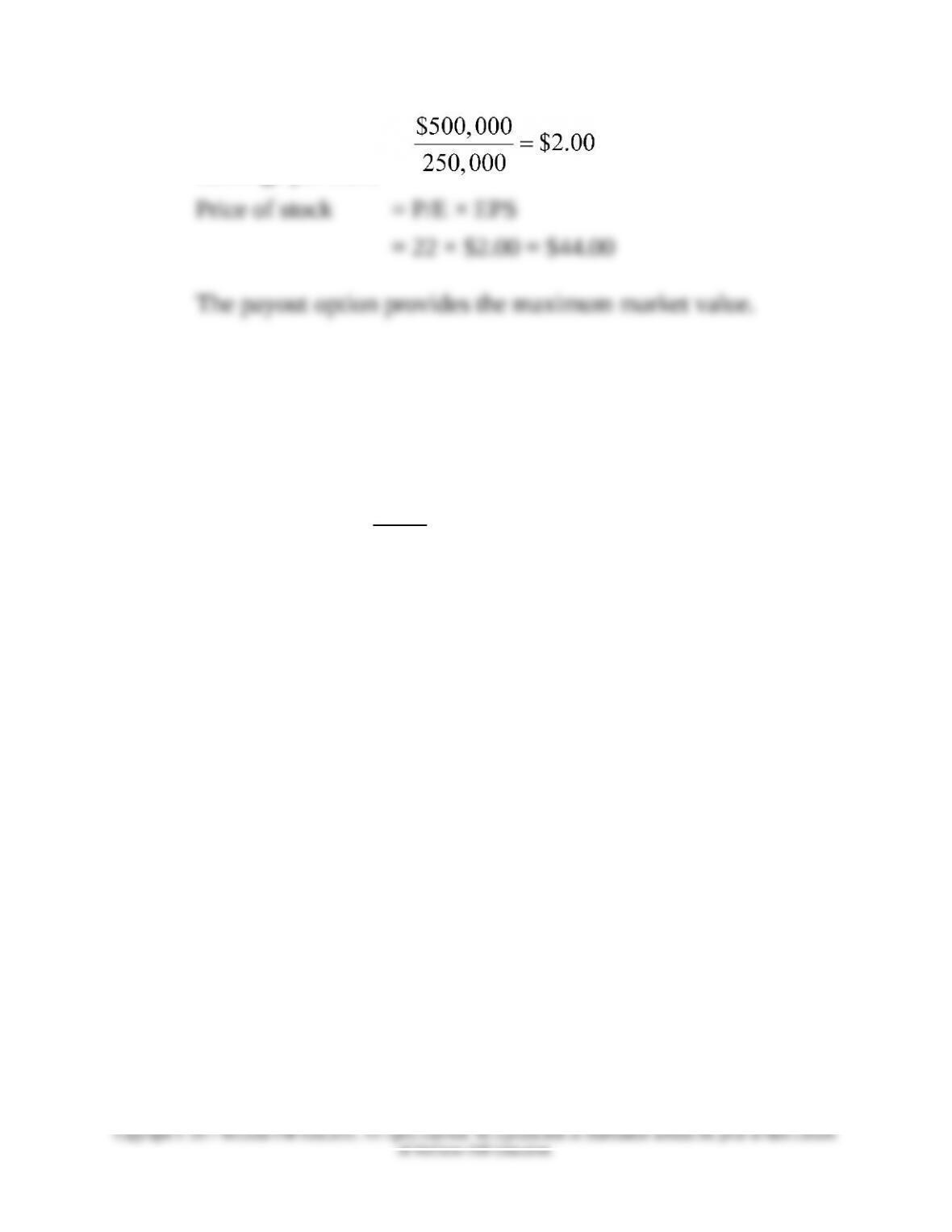
Earnings per share =
16. Dividend valuation model and wealth maximization (LO18-2) Omni Telecom is trying
to decide whether to increase its cash dividend immediately or use the funds to increase its
future growth rate. It will use the dividend valuation model originally presented in Chapter
10 for purposes of analysis. The model was shown as Formula 10-9 and is reproduced next
(with a slight addition in definition of terms):
0
1
D
PK g
e
=–
P0 = Price of the stock today
D1 = Dividend at the end of the first year
D0 × (1 + g)
D0 = Dividend today
Ke = Required rate of return
g = Constant growth rate in dividends
D0 is currently $2.50, Ke is 10 percent, and g is 5 percent.
Under Plan A, D0 would be immediately increased to $3.00 and Ke and g will remain
unchanged.
Under Plan B, D0 will remain at $2.50 but g will go up to 6 percent and Ke will remain
unchanged.
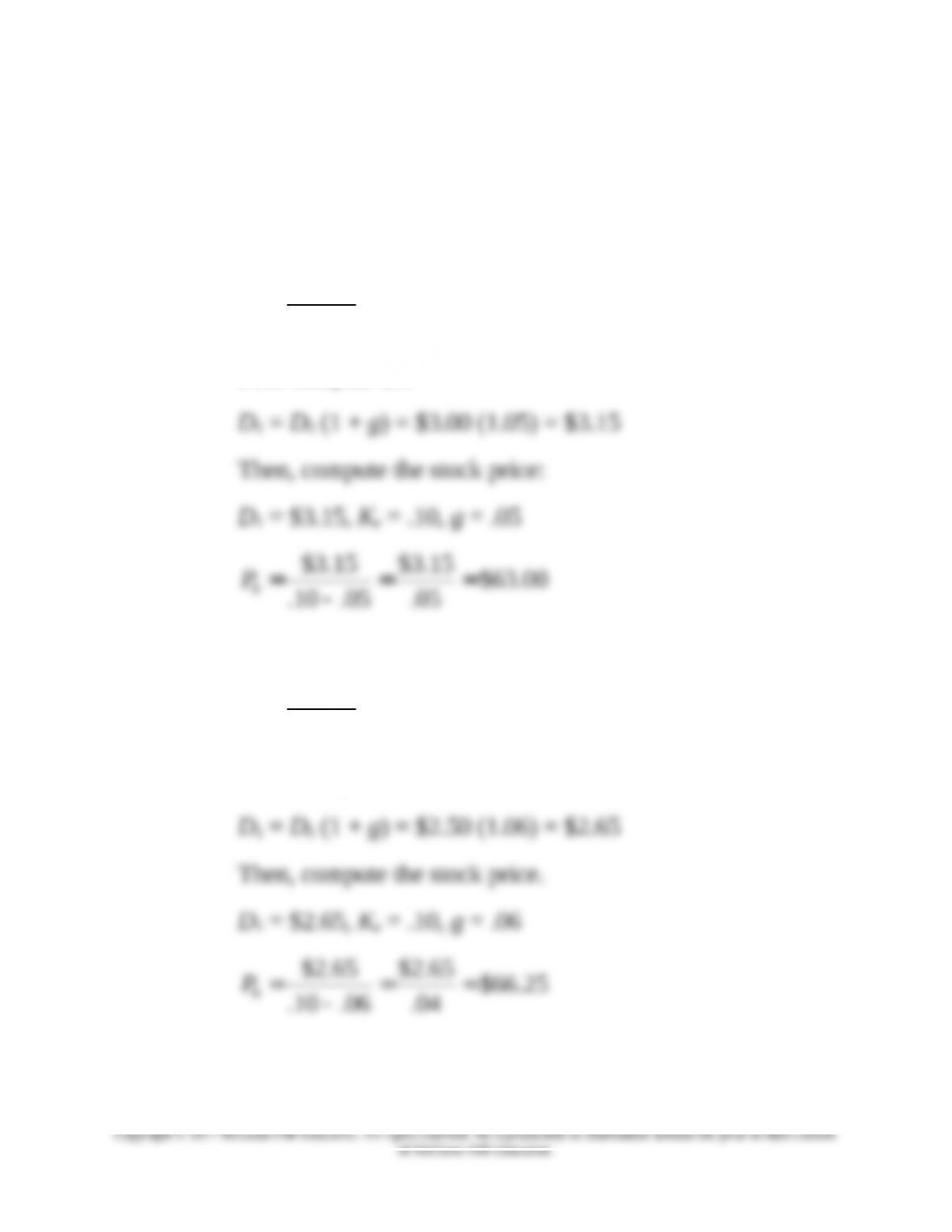
a. Compute P0 (price of the stock today) under Plan A. Note D1 will be equal to D0 × (1 +
g) or $3.00 (1.05). Ke will equal 10 percent, and g will equal 5 percent.
b. Compute P0 (price of the stock today) under Plan B. Note D1 will be equal to D0 × (1 +
g) or $2.50 (1.06). Ke will be equal to 10 percent, and g will be equal to 6 percent.
c. Which plan will produce the higher value?
Chapter 18: Dividend Policy and Retained Earnings
18-16. Solution:
Omni Telecom
a. Plan A – Increase cash dividend immediately
1
0
e
D
PK g
=–
First compute D1.
1
0
e
D
PK g
=–
Chapter 18: Dividend Policy and Retained Earnings
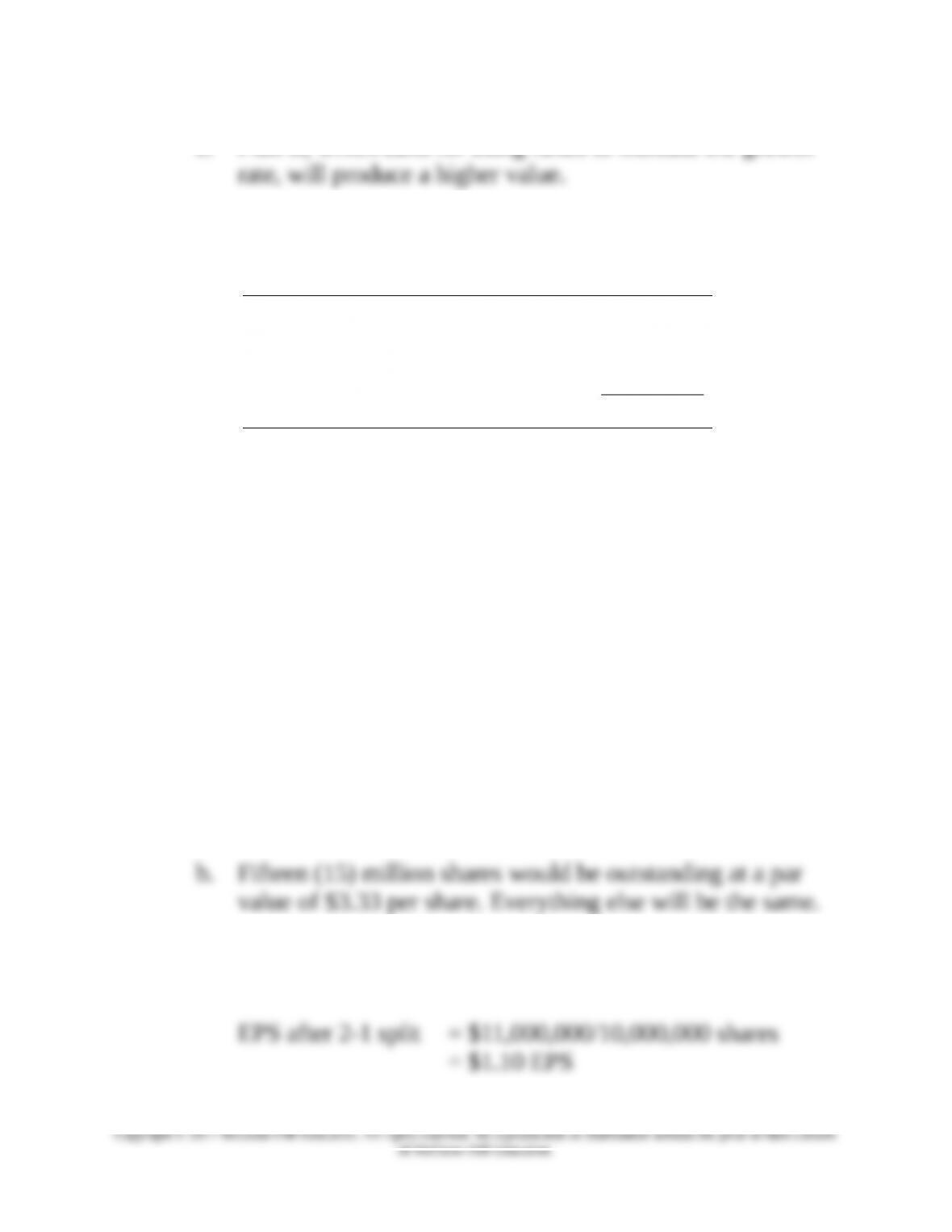
c. Plan B, which calls for using funds to increase the growth
17. Stock split and its effects (LO18-4) Wilson Pharmaceuticals’ stock has done very well in
the market during the last three years. It has risen from $55 to $80 per share. The firm’s
current statement of stockholders’ equity is as follows:
Common stock (5 million shares issued
at a par value of $10 per share)….……… $ 50,000,000
Paid-in capital in excess of par…….......... 13,000,000
Retained earnings………………………………. 57,000,000
Net worth………………………….……………… $120,000,000
a. How many shares would be outstanding after a two-for-one stock split? What would be
its par value?
b. How many shares would be outstanding after a three-for-one stock split? What would
be its par value?
c. Assume that Wilson earned $11 million. What would its earnings per share be before
and after the two-for-one stock split? After the three-for-one stock split?
d. What would be the price per share after the two-for-one stock splits? After the three-
for-one stock split? (Assume that the price-earnings ratio of 36.36 stays the same.)
e. Should a stock split change the price-earnings ratio for Wilson?
18-17. Solution:
Wilson Pharmaceutical
a. Ten (10) million shares would be outstanding at a par value
of $5 per share. Everything else will be the same.
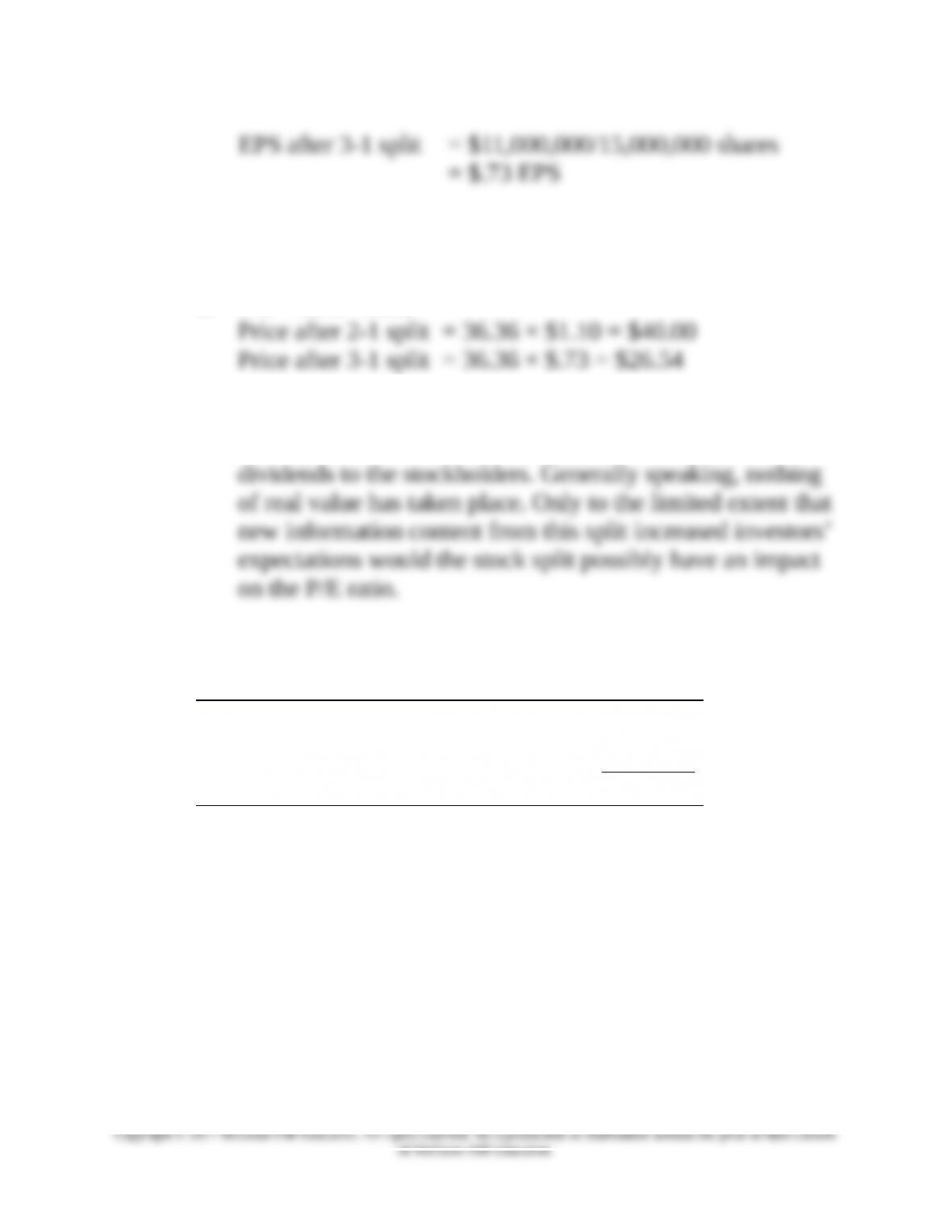
c. EPS before split = $11,000,000/5,000,000 shares
= $2.20 EPS
Chapter 18: Dividend Policy and Retained Earnings
18-17. (Continued)
d. P/E × EPS =Price
e. Probably not. A stock split should not change the price-
earnings ratio unless it is combined with a change in
18. Stock dividend and its effect (LO18-4) Ace Products sells marked playing cards to
blackjack dealers. It has not paid a dividend in many years, but is currently contemplating
some kind of dividend. The capital accounts for the firm are as follows:
Common stock (2,400,000 shares at $5 par)....... $12,000,000
Capital in excess of par*………………….……………. 5,000,000
Retained earnings…………………………..……………. 23,000,000
Net worth………………………………………..…….…. $40,000,000
*The increase in capital in excess of par as a result of a stock dividend
is equal to the new shares created times (Market price – Par value).
The company’s stock is selling for $20 per share. The company had total earnings
of $4,800,000 during the year. With 2,400,000 shares outstanding, earnings per share
were $2.00. The firm has a P/E ratio of 10.
a. What adjustments would have to be made to the capital accounts for a 10 percent stock
dividend? Show the new capital accounts.
b. What adjustments would be made to EPS and the stock price? (Assume the P/E ratio
remains constant.)
c. How many shares would an investor end up with if he or she originally had 70 shares?
Chapter 18: Dividend Policy and Retained Earnings
d. What is the investor’s total investment worth before and after the stock dividend if the
P/E ratio remains constant? (There may be a $1 to $2 difference due to rounding.)
18-18. Solution:
Ace Products
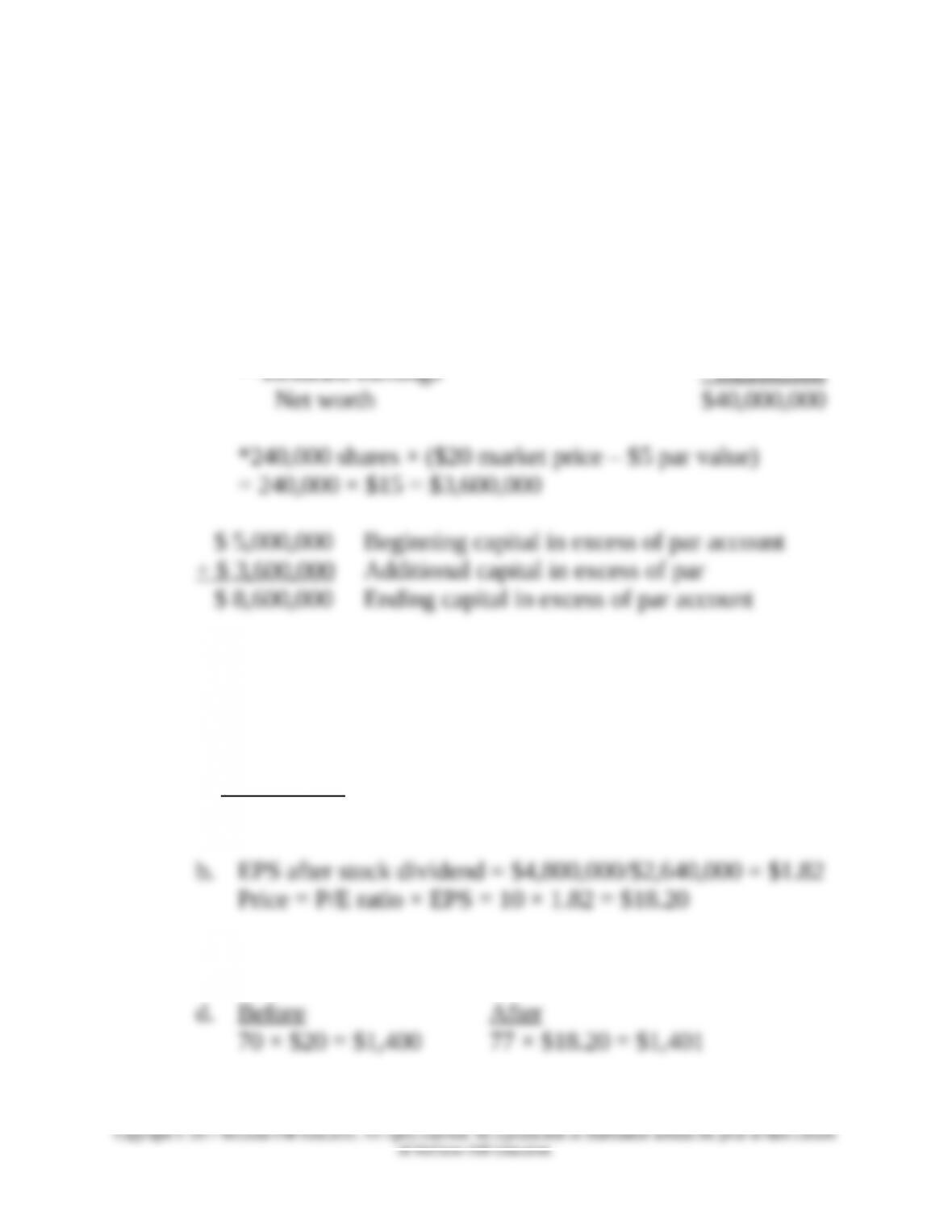
a. Common stock (2,640,000 shares at $5 par) $13,200,000
*Capital in excess of par 8,600,000
18-18. (Continued)
**$23,000,000 Beginning retained earnings account
– $1,200,000 Transfer to common stock account
– $3,600,000 Transfer to capital in excess of par account
$18,200,000 Ending retained earnings account
c. 70 + (70 × 10%) = 77 shares after the stock dividend