Chapter 18: Dividend Policy and Retained Earnings
Chapter 18
Dividend Policy and Retained Earnings
Discussion Questions
18-1. How does the marginal principle of retained earnings relate to the returns that a
stockholder may make in other investments?
18-2. Discuss the difference between a passive and an active dividend policy.
A passive dividend policy suggests that dividends should be paid out if the
18-3. How does the stockholder, in general, feel about the relevance of dividends?
The stockholder would appear to consider dividends as relevant. Dividends do
18-4. Explain the relationship between a company’s growth possibilities and its
dividend policy.
The greater a company’s growth possibilities, the more funds that can be justified
Chapter 18: Dividend Policy and Retained Earnings
18-5. Since initial contributed capital theoretically belongs to the stockholders, why
are there legal restrictions on paying out the funds to the stockholders?
Creditors have extended credit on the assumption that a given capital base would
18-6. Discuss how desire for control may influence a firm’s willingness to pay
dividends.
Management’s desire for control could imply that a closely held firm should
18-7. If you buy stock on the ex-dividend date, will you receive the upcoming
quarterly dividend?
18-8. How is a stock split (versus a stock dividend) treated on the financial
statements of a corporation?
For a stock split, there is no transfer of funds, but merely a reduction in
par value and a proportionate increase in the number of shares outstanding.
Chapter 18: Dividend Policy and Retained Earnings
18-9. Why might a stock dividend or a stock split be of limited value to an investor?
The asset base remains the same and the stockholders’ proportionate interest is
unchanged (everyone got the same new share). Earnings per share will go down
18-10. Does it make sense for a corporation to repurchase its own stock? Explain.
A corporation can make a rational case for purchasing its own stock as an
alternate to a cash dividend policy. Earnings per share will go up as the shares
decline, and if the price-earnings ratio remains the same, the stockholder will
18-11. What advantages to the corporation and the stockholder do dividend
reinvestment plans offer?
Dividend reinvestment plans allow corporations to raise funds continually from
present stockholders. This reduces the need for some external funds. These
Chapter 18: Dividend Policy and Retained Earnings
Chapter 18
Problems
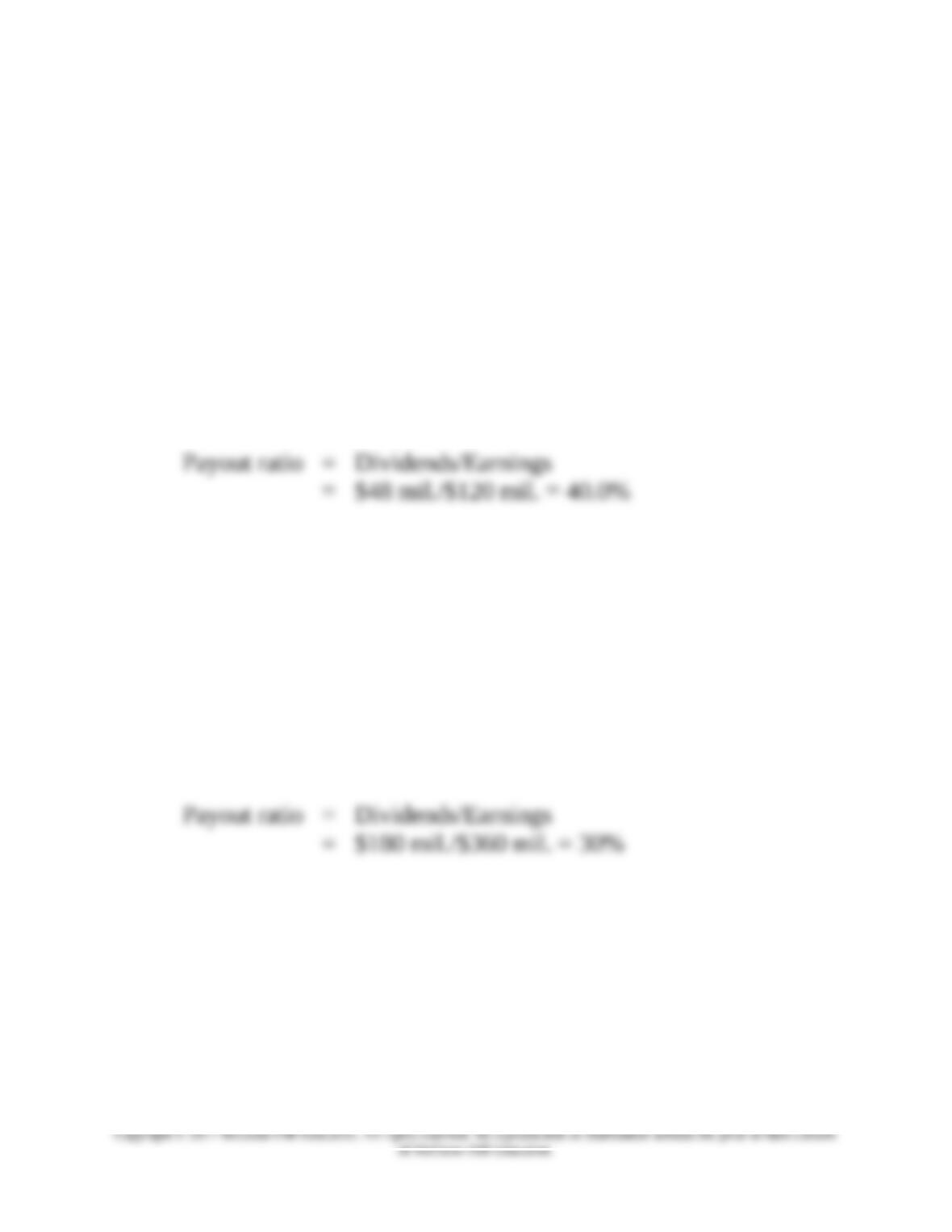
1. Payout ratio (LO18-1) Moon and Sons Inc. earned $120 million last year and retained $72
million. What is the payout ratio?
18-1. Solution:
Moon and Sons Inc.
Dividends = Earnings – Retained funds
= $120 mil. – $72 mil. = $48 mil.
2. Payout ratio (LO18-1) Ralston Gourmet Foods Inc. earned $360 million last year and
retained $252 million. What is the payout ratio?
18-2. Solution:
Ralston Gourmet Foods Inc.
Dividends = Earnings – Retained funds
= $360 mil. – $252 mil. = $108 mil.
Chapter 18: Dividend Policy and Retained Earnings
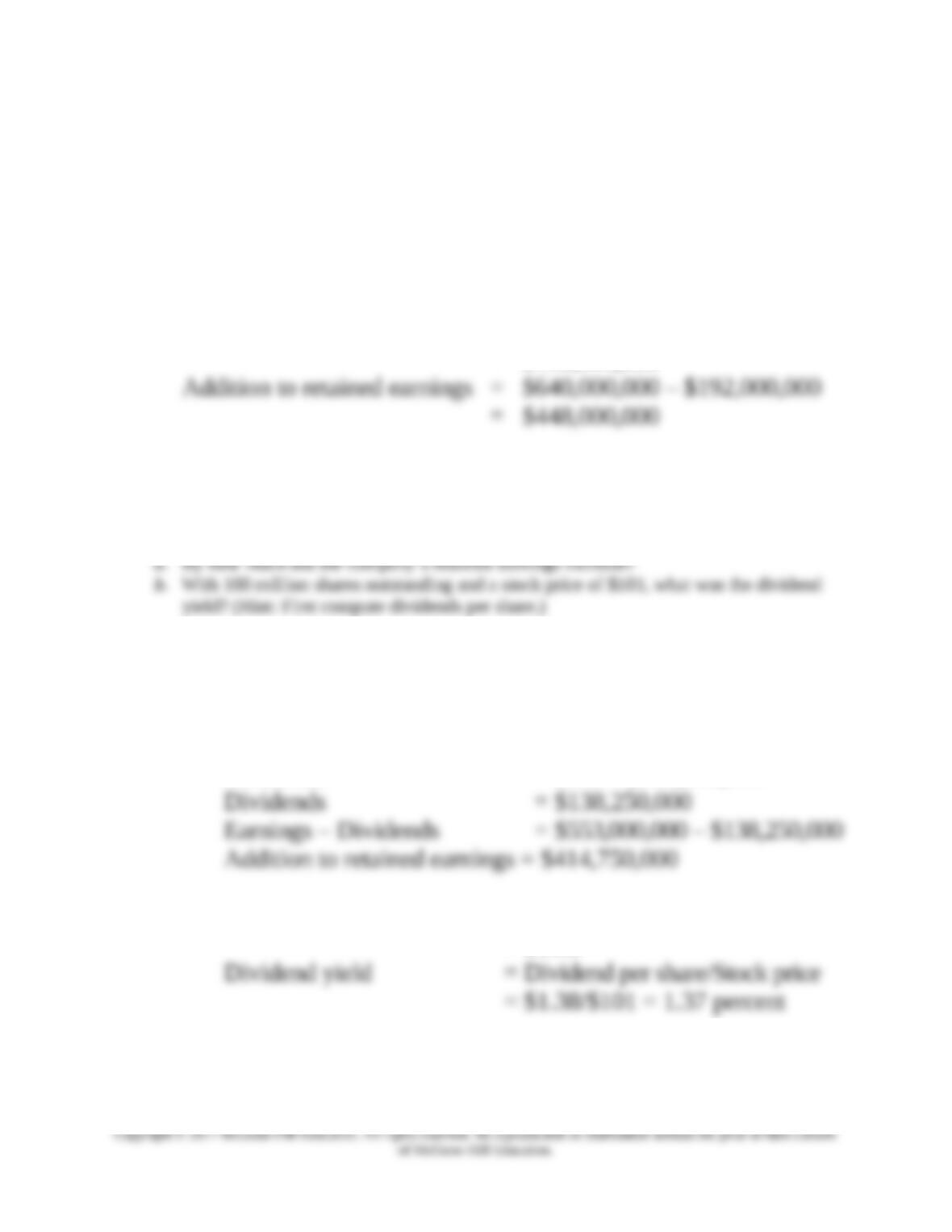
3. Payout ratio (LO18-1) Swank Clothiers earned $640 million last year and had a 30
percent payout ratio. How much did the firm add to its retained earnings?
18-3. Solution:
Swank Clothiers
Addition to retained earnings = Earnings – Dividends
Dividends = 30% × $640,000,000
= $192,000,000
4. Dividends, retained earnings, and yield (LO18-1) Polycom Systems earned $553 million
last year and paid out 25 percent of earnings in dividends.
18-4. Solution:
Polycom Systems
a. Addition to retained earnings= Earnings – Dividends
Dividends = 25% × $553,000,000
b. Dividends/Shares = $138,250,000/100,000,000
= $1.38
5. Growth and dividend policy (LO18-2) The following companies have different financial
statistics. What dividend policies would you recommend for them? Explain your reasons.
Chapter 18: Dividend Policy and Retained Earnings
Turtle Co. Hare Corp.
Growth rate in sales and earnings……...... 22% 4%
Cash as a percentage of total assets......... 5 20
18-5. Solution:
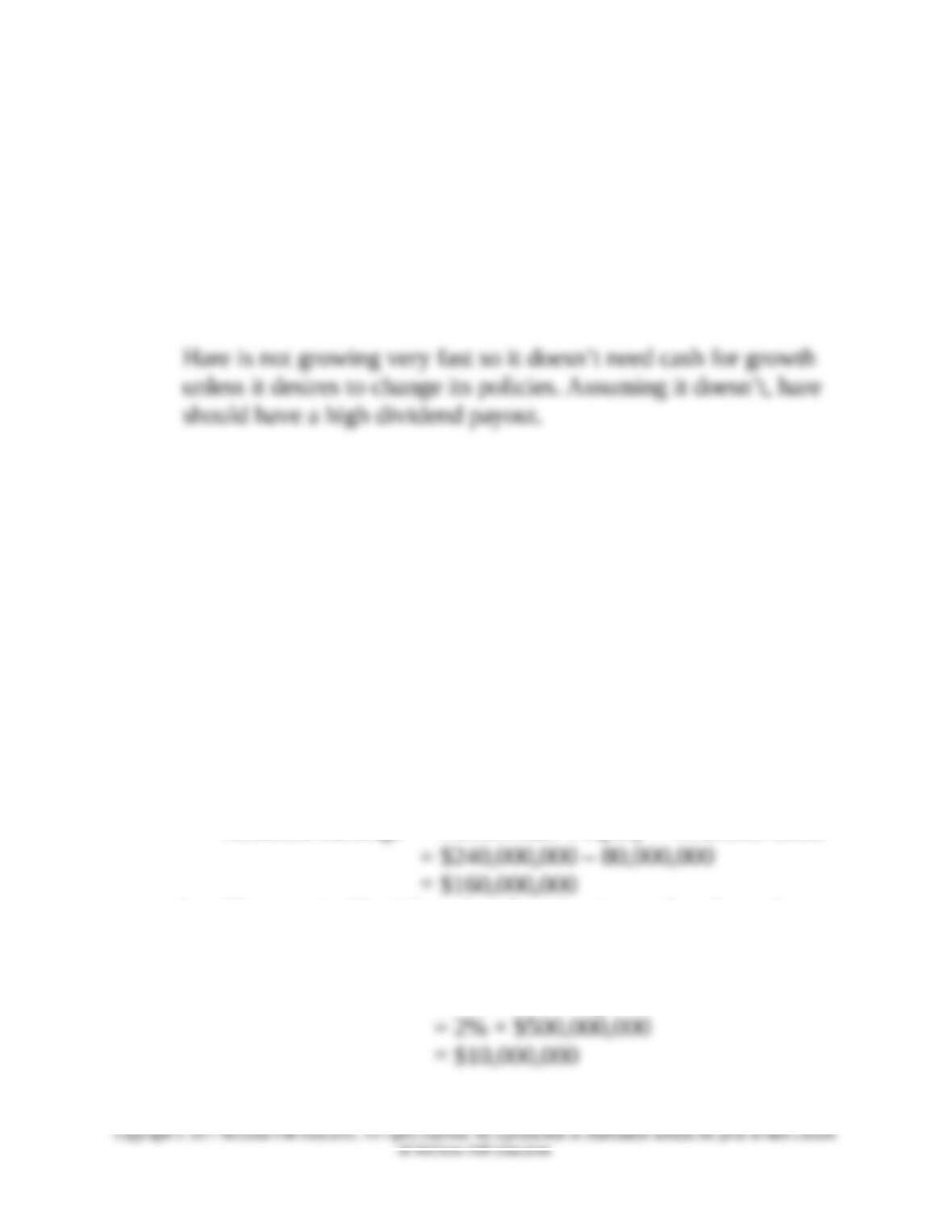
Turtle is growing very fast and needs its cash for reinvestment in
assets. For this reason, Turtle should have a low payout ratio.
6. Limits on dividends (LO18-3) Planetary Travel Co. has $240,000,000 in stockholders’
equity. Eighty million dollars is listed as common stock and the balance is in retained
earnings. The firm has $500,000,000 in total assets and 2 percent of this value is in cash.
Earnings for the year are $40,000,000 and are included in retained earnings.
a. What is the legal limit on current dividends?
b. What is the practical limit based on liquidity?
c. If the company pays out the amount in part b, what is the dividend payout ratio?
(Compute this based on total dollars rather than on a per share basis because the
number of shares is not given.)
Payout ratio = Dividends/Earnings
18-6. Solution:
Planetary Travel Co.
a. The legal limit is equal to retained earnings
Retained earnings = Stockholder’s equity – Common stock
b. The practical limit based on liquidity is equal to the cash
balance.
Cash = Cash percentage × Total assets
Chapter 18: Dividend Policy and Retained Earnings
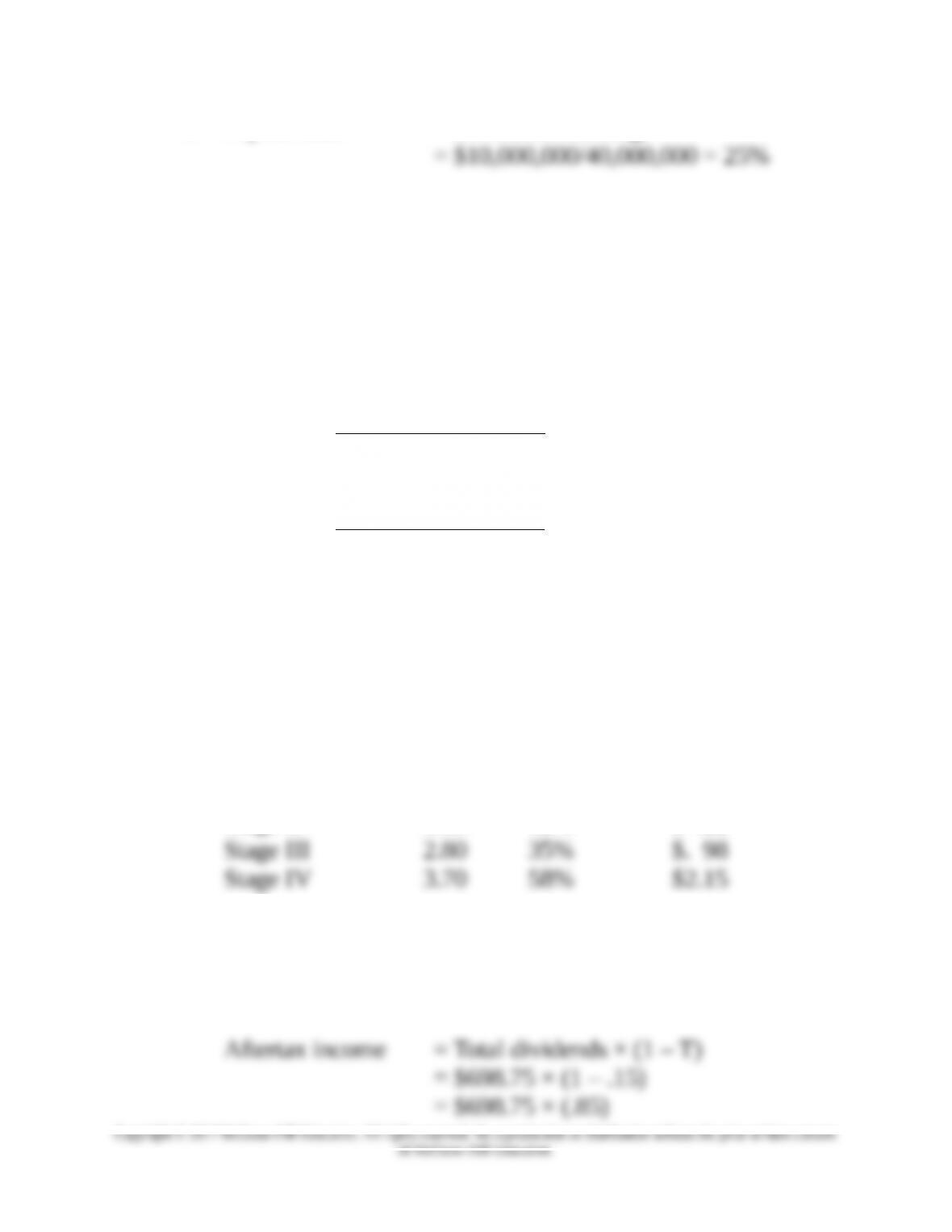
c. Payout ratio = Dividends/Earnings
7. Life cycle growth and dividends (LO18-2) A financial analyst is attempting to assess the
future dividend policy of Environmental Systems by examining its life cycle. She anticipates
no payout of earnings in the form of cash dividends during the development stage (I). During
the growth stage (II), she anticipates 12 percent of earnings will be distributed as dividends.
As the firm progresses to the expansion stage (III), the payout ratio will go up to 35 percent
and eventually reach 58 percent during the maturity stage (IV).
a. Assuming earnings per share will be as follows during each of the four stages, indicate
the cash dividend per share (if any) during each stage.
Stage I….…………..... $ .10
Stage II……………….. 1.80
Stage III………………. 2.80
Stage IV……............ 3.70
b. Assume in Stage IV that an investor owns 325 shares and is in a 15 percent tax bracket.
What will be the investor’s aftertax income from the cash dividend?
c. In what two stages is the firm most likely to utilize stock dividends or stock splits?
18-7. Solution:
Environmental Systems
a. Earnings Payout Ratio Dividends
Stage I $ .10 0 0
Stage II 1.80 12% $ .22
b. Total Dividends = Shares × Dividends per share
= 325 × $2.15
= $698.75

Chapter 18: Dividend Policy and Retained Earnings
c. Stock dividends or stock splits are most likely to be utilized
8. Stock split and stock dividend (LO18-4) Squash Delight Inc. has the following balance
sheet:
Assets
Cash………………………………………………………. $ 100,000
Accounts receivable……………………….……….. 300,000
Fixed assets………………………………..………….. 600,000
Total assets…………………………………….. $1,000,000
Liabilities
Accounts payable………….………… $ 150,000
Notes payable…………………………. 50,000
Common stock
(50,000 shares @ $2 par)......... 100,000
Capital in excess of par…..……….. 200,000
Retained earnings……………………. 500,000
$1,000,000
The firm’s stock sells for $10 a share.
a. Show the effect on the capital account(s) of a two-for-one stock split.
b. Show the effect on the capital accounts of a 10 percent stock dividend. Part b is
separate from part a. In part b, do not assume the stock split has taken place.
c. Based on the balance in retained earnings, which of the two dividend plans is more
restrictive on future cash dividends?
Chapter 18: Dividend Policy and Retained Earnings
18-8. Solution:
Squash Delight Inc.
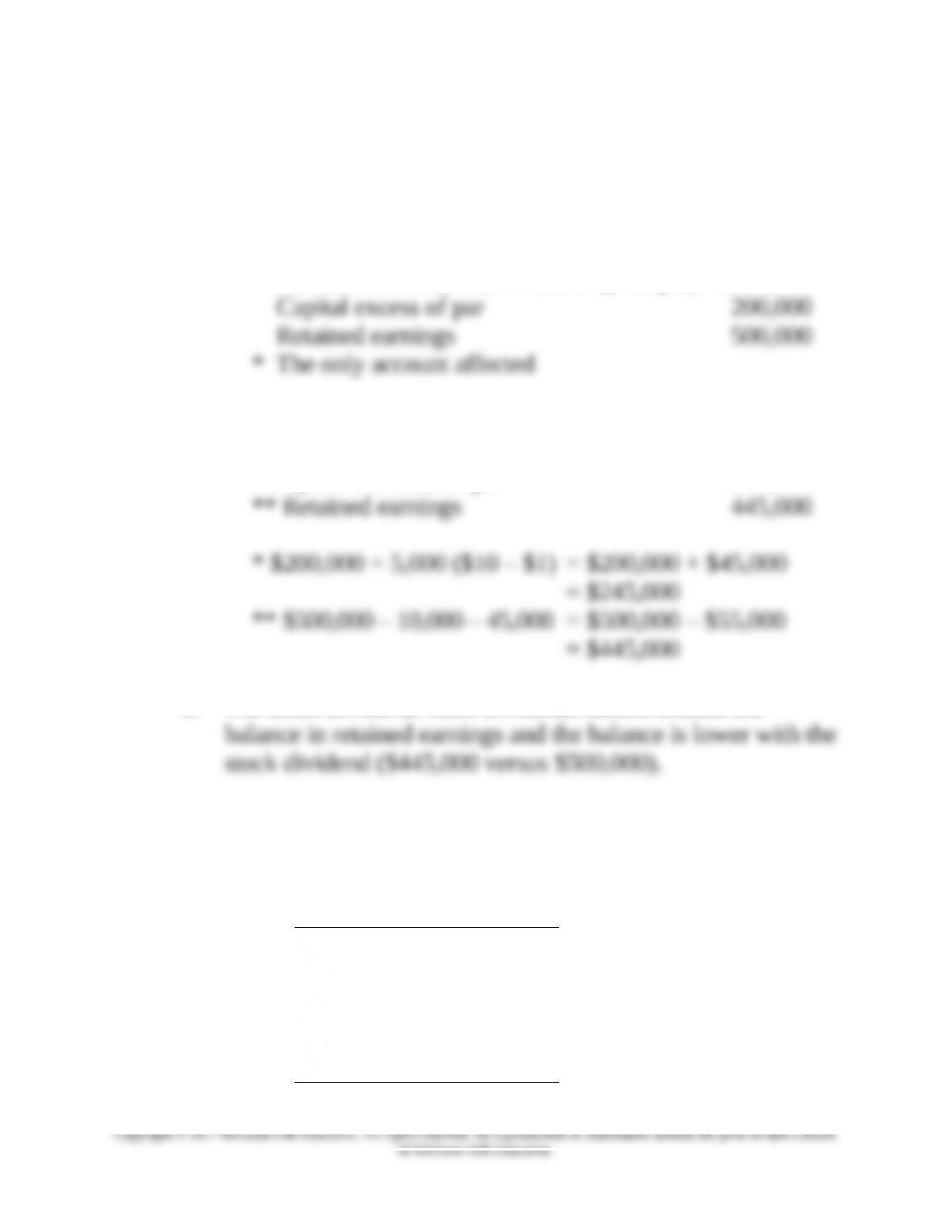
a. 2 for 1 stock split
* Common stock (100,000 shares @ $1 par) $100,000
b. 10 percent stock dividend
Common stock (55,000 shares @ $2 par) $110,000
* Capital in excess of par 245,000
c. The stock dividend. Cash dividends cannot exceed the
9. Policy on payout ratio (LO18-1) In doing a five-year analysis of future dividends, the
Dawson Corporation is considering the following two plans. The values represent
dividends per share.
Year Plan A Plan B
1…..….......... $1.70 $ .60
2…..….......... 1.70 2.50
3…..….......... 1.70 .30
4…..….......... 1.90 5.00
5…..….......... 1.90 1.30
Chapter 18: Dividend Policy and Retained Earnings
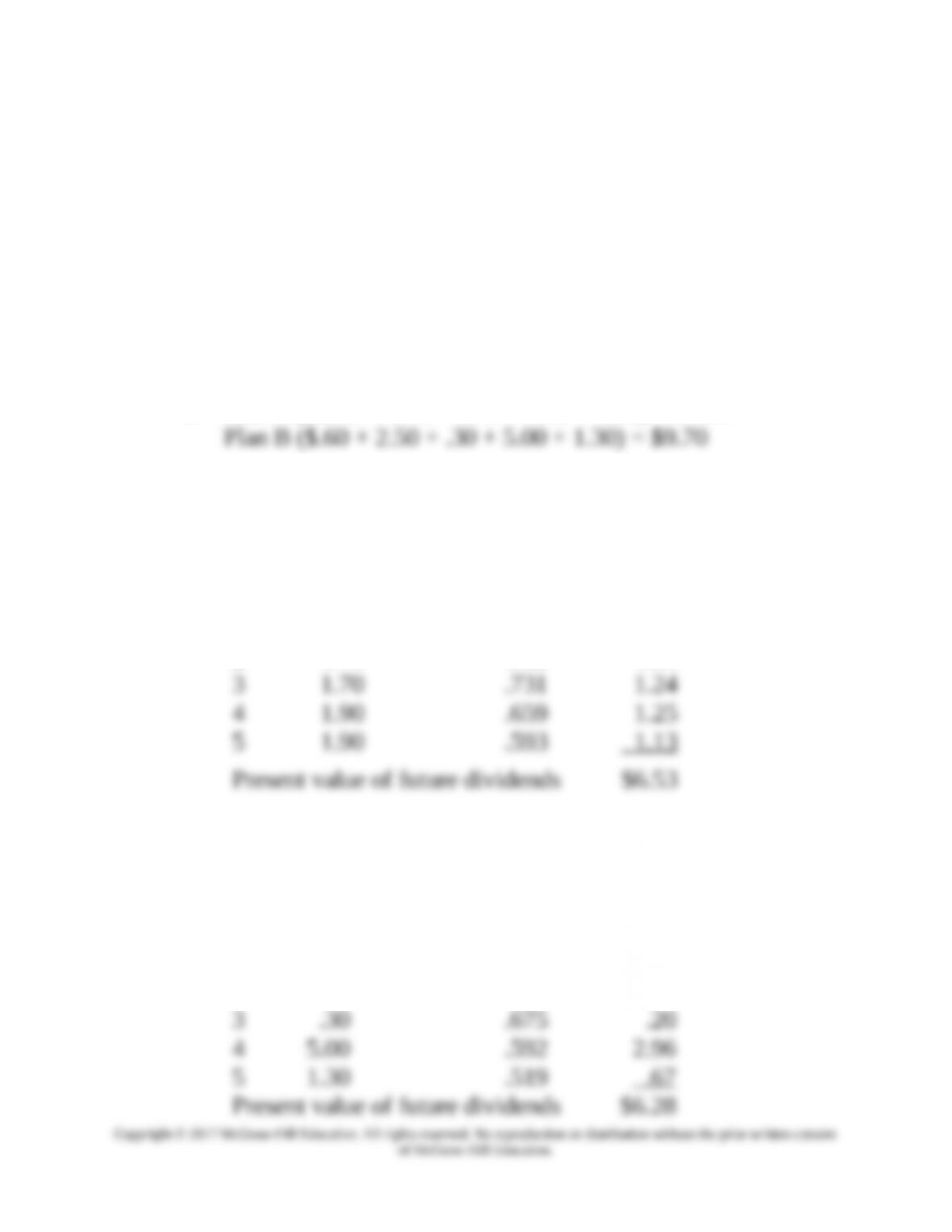
a. How much in total dividends per share will be paid under each plan over five years?
b. Mr. Bright, the vice president of finance, suggests that stockholders often prefer a stable
dividend policy to a highly variable one. He will assume that stockholders apply a
lower discount rate to dividends that are stable. The discount rate to be used for Plan A
is 11 percent; the discount rate for Plan B is 14 percent. Compute the present value of
future dividends. Which plan will provide the higher present value for the future
dividends? (Round to two places to the right of the decimal point.)
18-9. Solution:
Dawson Corporation
a. Plan A ($1.70 + 1.70 + 1.70 + 1.90 + 1.90) = $8.90
b. Plan A
Dividend
per Share ×PVIF (11%) PV
1 $1.70 .901 $1.53
2 1.70 .812 1.38
Plan B
Dividend
per Share ×PVIF (14%) PV
1 $ .60 .877 $ .53
2 2.50 .769 1.92

Chapter 18: Dividend Policy and Retained Earnings
Plan A will provide the higher present value of future