Chapter 17: Common and Preferred Stock Financing
17-9. Solution:
Midland Petroleum
a. Number of
directors
that can be
elected
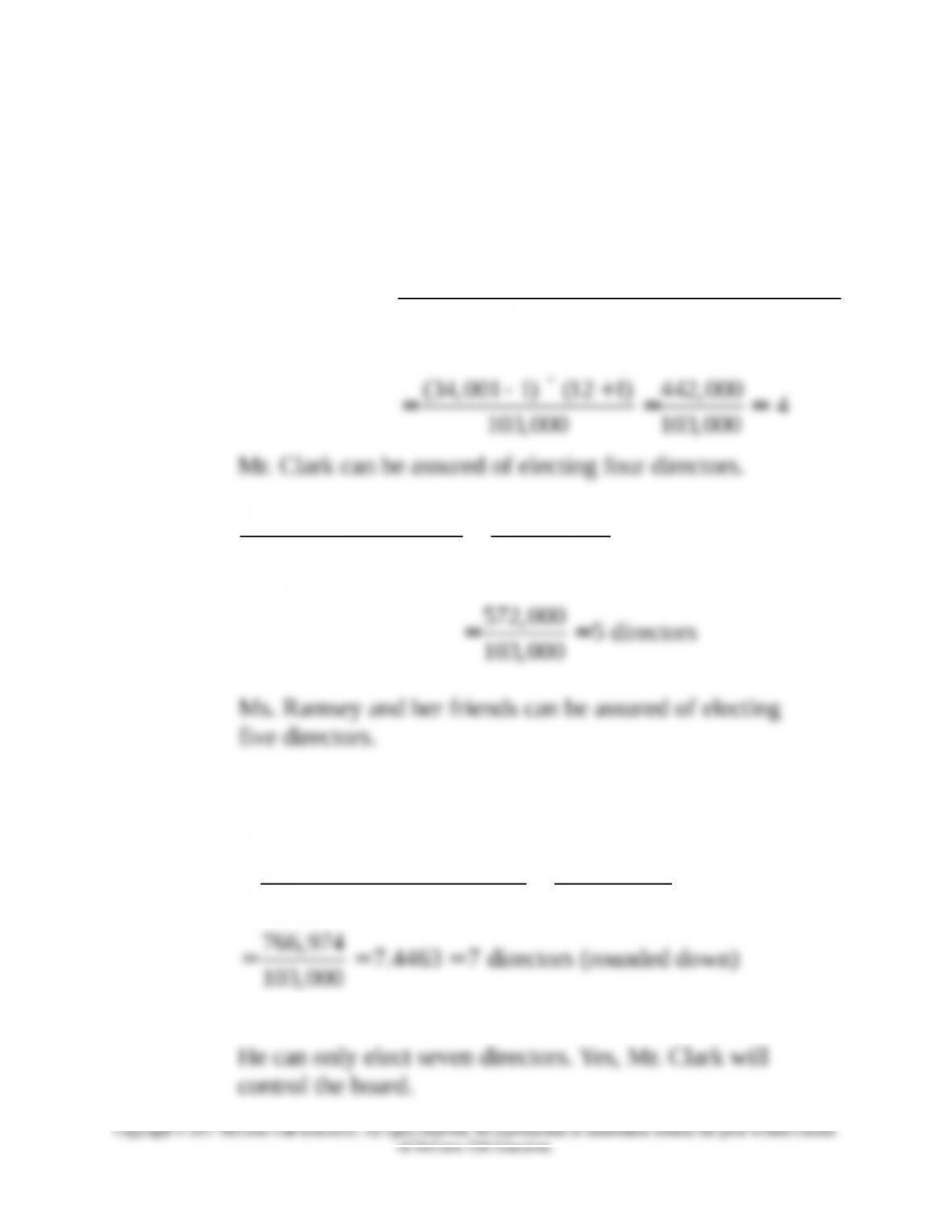
(34,001 1) (12 1) 442,000 4
103,000 103,000
– ´ +
= = =
Mr. Clark can be assured of electing four directors.
b.
(44,001 1) (12 1) 44,000 13
103,000 103,000
– ´ + ´
=
572,000 5 directors
103,000
= =
Ms. Ramsey and her friends can be assured of electing
five directors.
c. Shares owned = Shares owned and proxies of other voters
(34,001 24,998 1) 13 58,998 13
103,000 103,000
+ – ´ ´
= =
766,974 7.4463 7 directors (rounded down)
103,000
= = =
He can only elect seven directors. Yes, Mr. Clark will
control the board.
Copyright © 2017 McGraw-Hill Education. All rights reserved. No reproduction or distribution without the prior written consent
of McGraw-Hill Education.
(Shares owned 1)
(Total number of directors to be elected + 1)
=Total number of shares outstanding
– ´
Chapter 17: Common and Preferred Stock Financing
d.
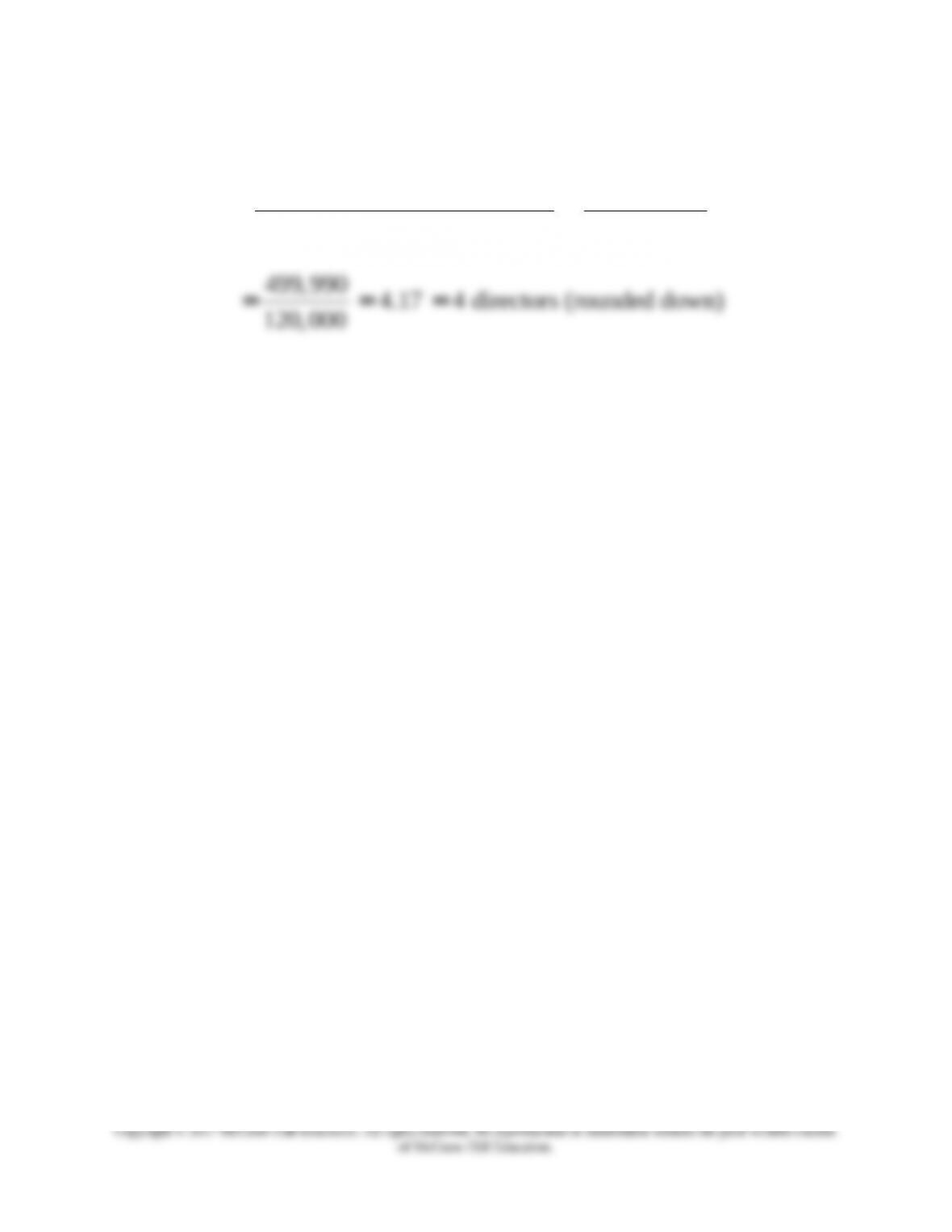
(40, 001 9,999 1) (9 1) 49,999 10
120,000 120, 000
+ – ´ + ´
=
499,990 4.17 4 directors (rounded down)
120, 000
= = =
Copyright © 2017 McGraw-Hill Education. All rights reserved. No reproduction or distribution without the prior written consent
of McGraw-Hill Education.
Chapter 17: Common and Preferred Stock Financing
10. Strategies under cumulative voting (LO17-2) Mr. Michaels controls proxies for 40,000 of
the 75,000 outstanding shares of Northern Airlines. Mr. Baker heads a dissident group that
controls the remaining 35,000 shares. There are seven board members to be elected and
cumulative voting rules apply. Michaels does not understand cumulative voting and plans to
cast 100,000 of his 280,000 (40,000 × 7) votes for his brother-in-law, Scott. His remaining
votes will be spread evenly between three other candidates.
How many directors can Baker elect if Michaels acts as described in the preceding
paragraph? Use logical numerical analysis rather than a set formula to answer the question.
Baker has 245,000 votes (35,000 × 7).
17-10. Solution:
Northern Airlines
Mr. Michaels controls 280,000 votes (40,000 shares × 7
directors).
Mr. Baker controls 245,000 votes (35,000 shares × 7 directors).
Chapter 17: Common and Preferred Stock Financing
11. Different classes of voting stock (LO17-1) Rust Pipe Co. was established in 1994. Four
years later, the company went public. At that time, Robert Rust, the original owner, decided
to establish two classes of stock. The first represents Class A founders’ stock and is entitled
to nine votes per share. The normally traded common stock, designated as Class B, is
entitled to one vote per share. In late 2010, Mr. Stone, an investor, was considering
purchasing shares in Rust Pipe Co. While he knew founders’ shares were not often present
in other companies, he decided to buy the shares anyway because of a new technology Rust
Pipe had developed to improve the flow of liquids through pipes.
Of the 1,450,000 total shares currently outstanding, the original founder’s family owns
51,825 shares. What is the percentage of the founder’s family votes to Class B votes?
17-11. Solution:
Rust Pipe Company
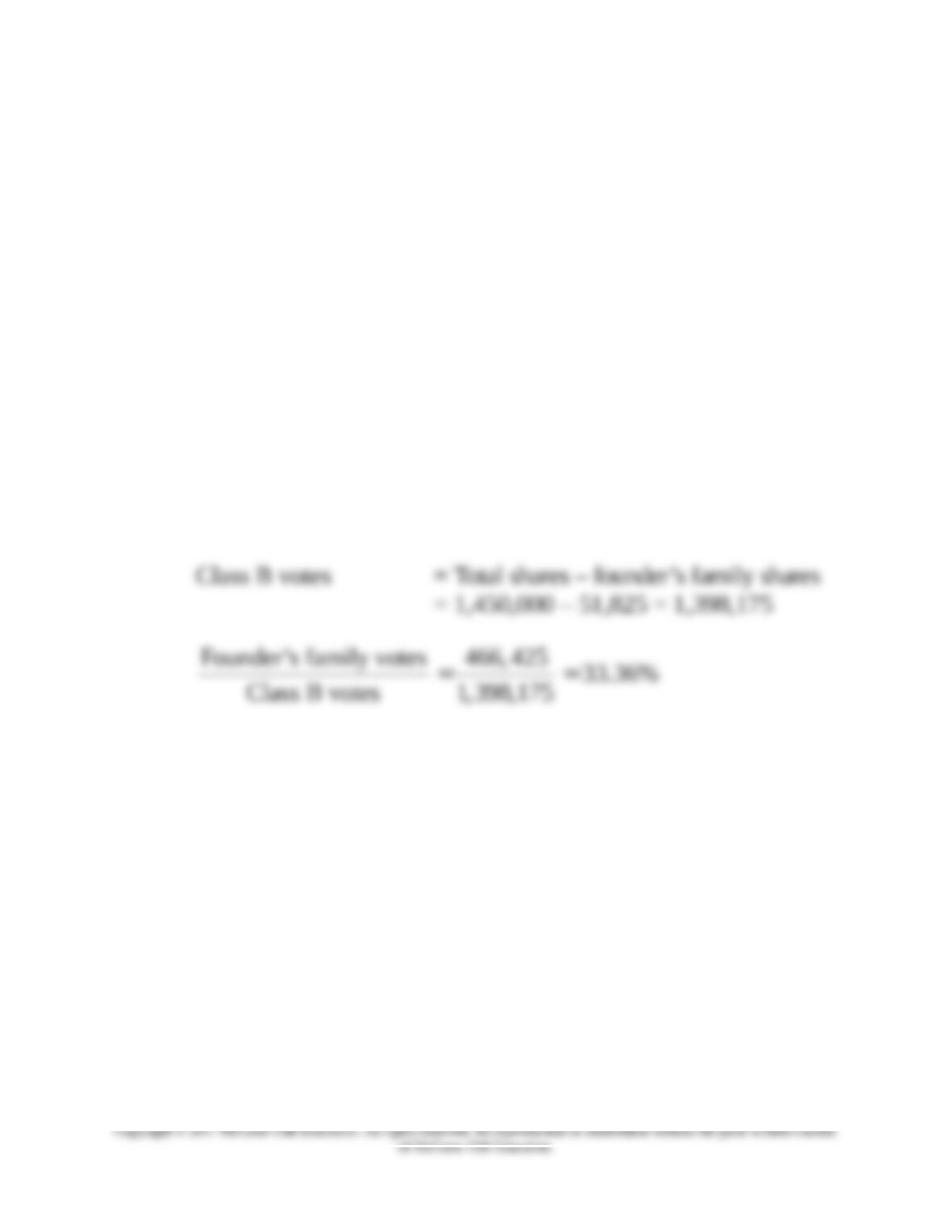
Founder’s family votes = Shares owned × 9
= 51,825 ×9
= 466,425
Chapter 17: Common and Preferred Stock Financing
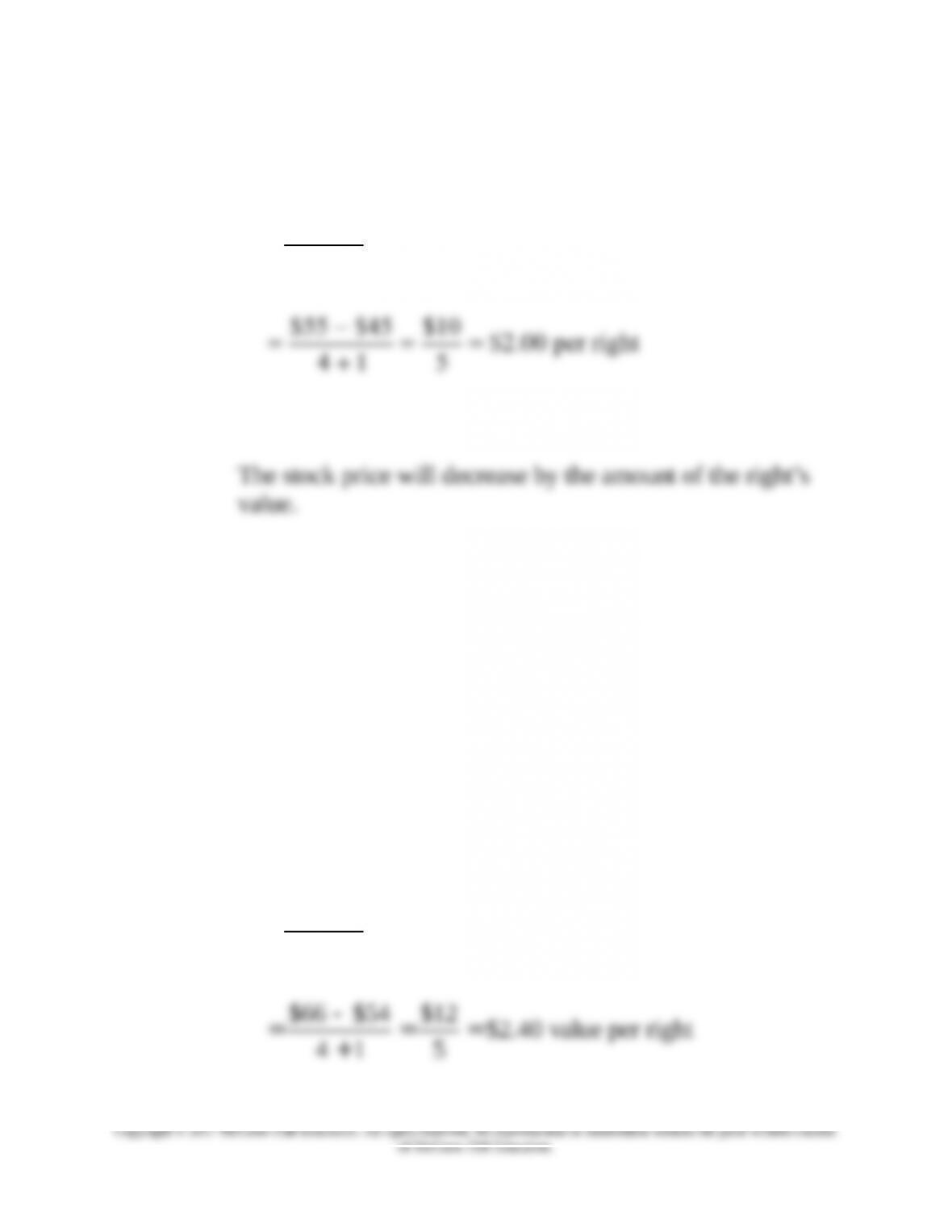
17-12. Solution:
Boles Bottling Co.
a.
1
o
M S
R
N
–
=+
b. $55.00 – $2.00 = –$53.00
13. Procedures associated with a rights offering (LO17-3) Computer Graphics has
announced a rights offering for its shareholders. Carol Stevens owns 1,400 shares of
Computer Graphics stock. Four rights plus $54 cash are needed to buy one of the new
shares. The stock is currently selling for $66 rights-on.
a. What is the value of a right?
b. How many of the new shares could Carol buy if she exercised all her rights? How
much cash would this require?
c. Carol doesn’t know if she wants to exercise her rights or sell them. Would either
alternative have a more positive effect on her wealth?
17-13. Solution:
Computer Graphics
a.
1
o
M S
R
N
–
=+
$66 $54 $12 $2.40 value per right
4 1 5
–
= = =
+
Copyright © 2017 McGraw-Hill Education. All rights reserved. No reproduction or distribution without the prior written consent
of McGraw-Hill Education.

Chapter 17: Common and Preferred Stock Financing
b. Carol owns 1,400 shares, so she would receive 1,400 rights.
c. Neither exercising the rights nor selling them would have any
14. Investing in rights (LO17-3) Todd Winningham IV has $4,800 to invest. He has been
looking at Gallagher Tennis Clubs Inc. common stock. Gallagher has issued a rights
offering to its common stockholders. Six rights plus $48 cash will buy one new share.
Gallagher’s stock is selling for $66 ex-rights.
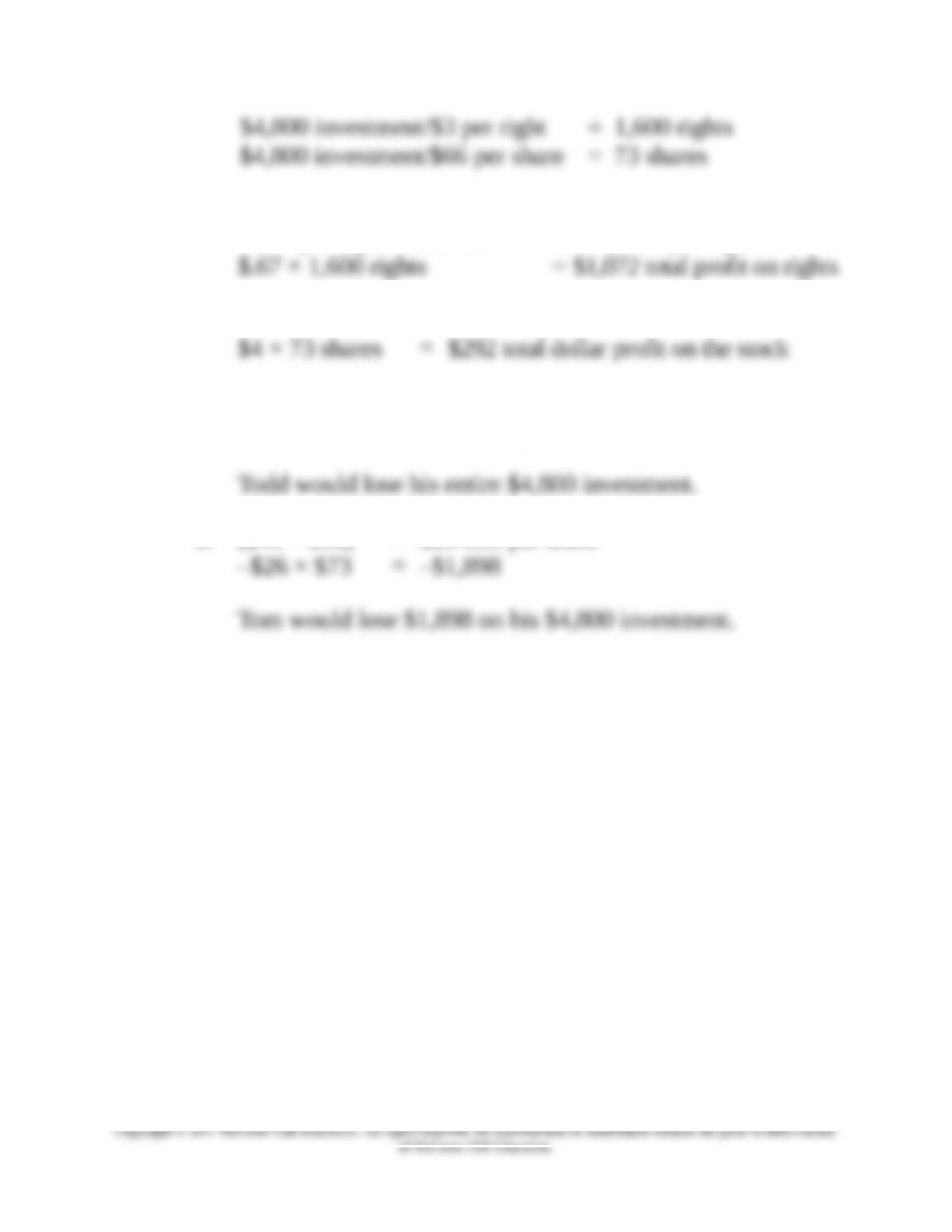
a. How many rights could Todd buy with his $4,800? Alternatively, how many shares
of stock could he buy with the same $4,800 at $66 per share?
b. If Todd invests his $4,800 in Gallagher rights and the price of Gallagher stock rises to
$70 per share ex-rights, what would his dollar profit on the rights be? (First compute
profit per right.)
c. If Todd invests his $4,800 in Gallagher stock and the price of the stock rises to $70
per share ex-rights, what would his total dollar profit be?
d. What would be the answer to part b if the price of Gallagher’s stock falls to $40 per
share ex-rights instead of rising to $70?
e. What would be the answer to part c if the price of Gallagher’s stock falls to $40 per
share ex-rights?
17-14. Solution:
Gallagher Tennis Clubs Inc.
(Todd Winningham IV)
a.
e
M S
R
N
–
=
$66 $48 $3 per right
6
–
= =
Chapter 17: Common and Preferred Stock Financing
b. ($70 – $48)/6 = $3.67 per right value
$3.67 per right value – $ 3.00 = $.67 profit per right
c. ($70 – $66) = $4 profit per share
d. ($40 – $48)/6 = –$1; the right’s value = 0
e. ($40 – $66) = $26 loss per share

Chapter 17: Common and Preferred Stock Financing
15. Effect of rights on stockholder position (LO17-3) Mr. and Mrs. Anderson own two
shares of Magic Tricks Corporation’s common stock. The market value of the stock is $58.
The Andersons also have $46 in cash. They have just received word of a rights offering.
One new share of stock can be purchased at $46 for each two shares currently owned
(based on two rights).
a. What is the value of a right?
b. What is the value of the Andersons’ portfolio before the rights offering? (Portfolio in
this question represents stock plus cash.)
c. If the Andersons participate in the rights offering, what will be the value of their
portfolio, based on the diluted value (ex-rights) of the stock?
d. If they sell their two rights but keep their stock at its diluted value and hold onto their
cash, what will be the value of their portfolio?
17-15. Solution:
Magic Tricks Corp.
(The Andersons)
1
o
M S
R
N
–
=+
$58 $46 $12 $4
2 1 $3
–
= = =
+
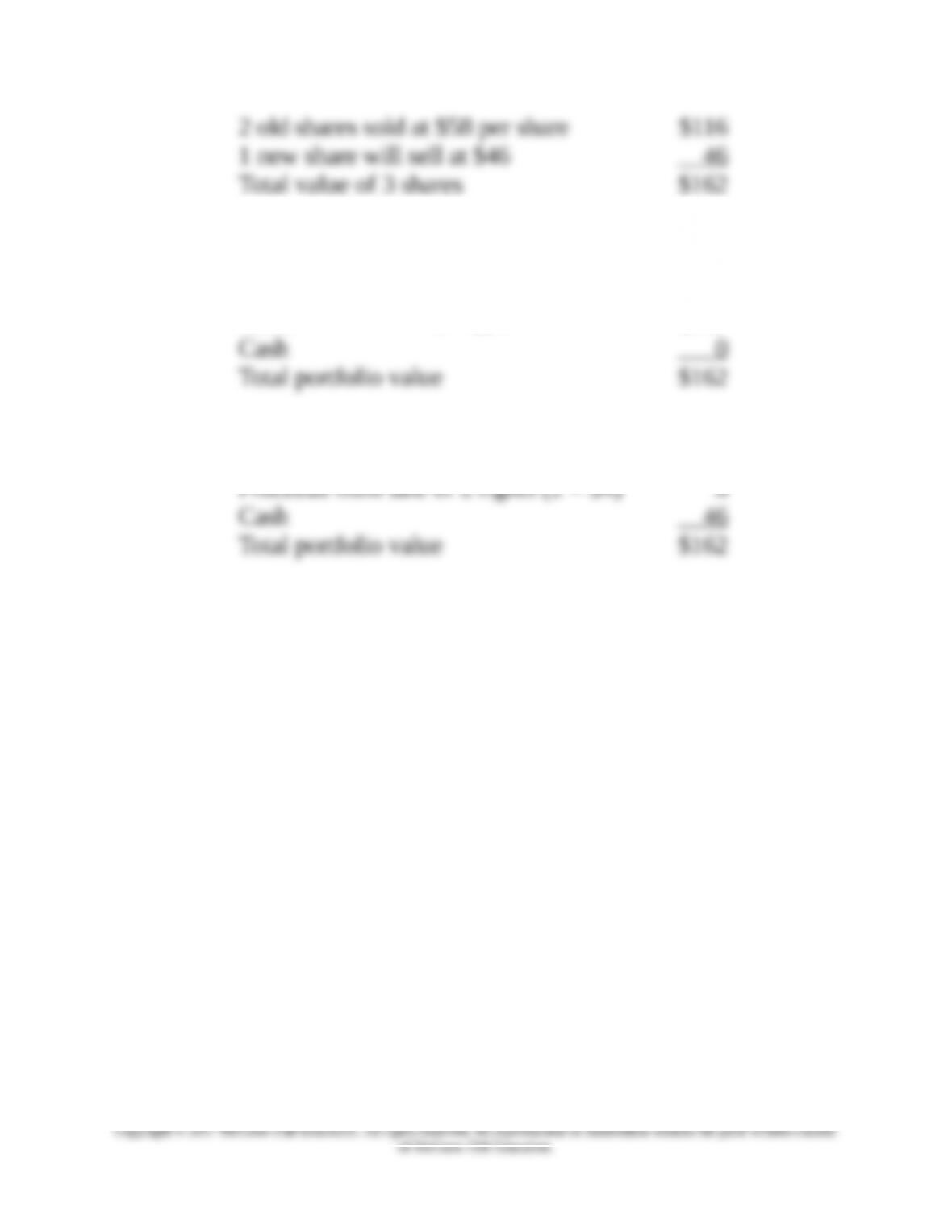
b. Portfolio value
Stock 2 × $58 = $116
c. First compute diluted value:
Diluted value = Market value ex-rights
Me = Mo – R = $58 – $4 = $54
or
Chapter 17: Common and Preferred Stock Financing
Average value of 1 share (Market value ex-rights) = $54
Portfolio value
Stock 3 × $54 = $162
d. Portfolio value
Stock 2 × $54 = $108
16. Relation of rights to EPS and the price-earnings ratio (LO17-3) Walker Machine Tools
has 5.5 million shares of common stock outstanding. The current market price of Walker
common stock is $52 per share rights-on. The company’s net income this year is $17.5
million. A rights offering has been announced in which 550,000 new shares will be sold at
$46.50 per share. The subscription price plus five rights is needed to buy one of the new
shares.
a. What are the earnings per share and price-earnings ratio before the new shares are
sold via the rights offering?
b. What would the earnings per share be immediately after the rights offering? What
would the price-earnings ratio be immediately after the rights offering? (Assume there
is no change in the market value of the stock, except for the change when the stock
begins trading ex-rights.) Round all answers to two places after the decimal point.
Chapter 17: Common and Preferred Stock Financing
17-16. Solution:
Walter Machine Tools
a. $17.5 million earnings/5.5 million shares = $3.18 earnings
per share
b. 5.5 million original shares + 550,000 new shares =
6,050,000 shares
$17.5 million earnings $2.89 earnings per share
6,050,000 shares =
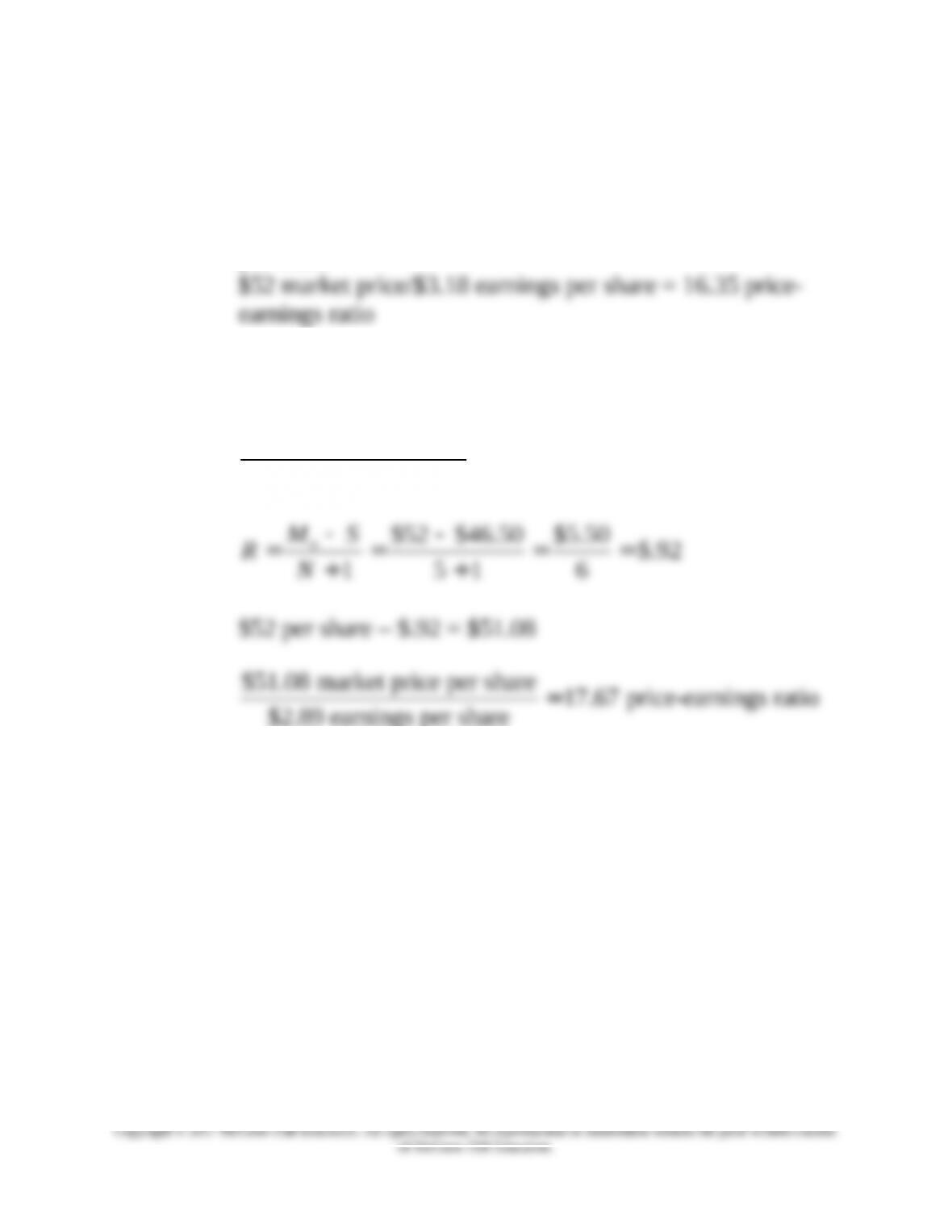
$52 $46.50 $5.50 $.92
1 5 1 6
o
M S
R
N
––
= = = =
+ +
$52 per share – $.92 = $51.08
$51.08 market price per share 17.67 price-earnings ratio
$2.89 earnings per share =
17. Aftertax comparison of preferred stock and other investments (LO17-5) The Omega
Corporation has some excess cash it would like to invest in marketable securities for
a long-term hold. Its vice president of finance is considering three investments (Omega
Corporation is in a 35 percent tax bracket and the tax rate on dividends is 20 percent).
Which one should she select based on aftertax return: (a) Treasury bonds at a 10 percent
yield; (b) corporate bonds at a 13 percent yield; or (c) preferred stock at an 11 percent
yield?
Chapter 17: Common and Preferred Stock Financing
17-17. Solution:
Omega Corporation
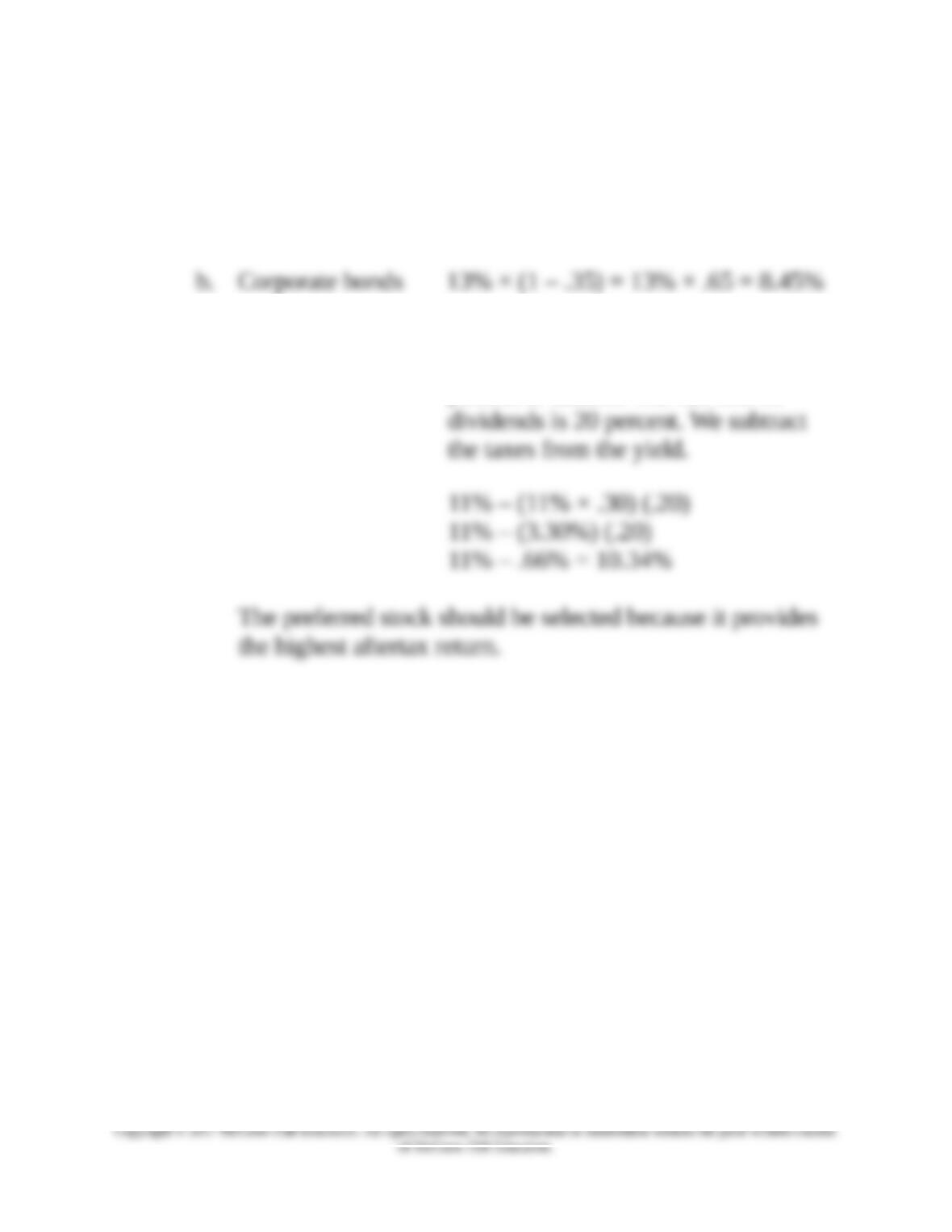
a. Treasury bonds 10% × (1 – .35) = 10% × .65 = 6.50%
c. Preferred stock 70 percent of the dividend is excluded
from corporate taxes so only 30
percent is taxable. The tax rate on
18. Preferred stock dividends in arrears (LO17-5) National Health Corporation (NHC) has a
cumulative preferred stock issue outstanding, which has a stated annual dividend of $8 per
share. The company has been losing money and has not paid preferred dividends for the
last five years. There are 350,000 shares of preferred stock outstanding and 650,000 shares
of common stock.
a. How much is the company behind in preferred dividends?
b. If NHC earns $13,500,000 in the coming year after taxes but before dividends, and
this is all paid out to the preferred stockholders, how much will the company be in
arrears (behind in payments)? Keep in mind that the coming year would represent the
sixth year.
c. How much, if any, would be available in common stock dividends in the coming year
if $13,500,000 is earned as explained in part b?