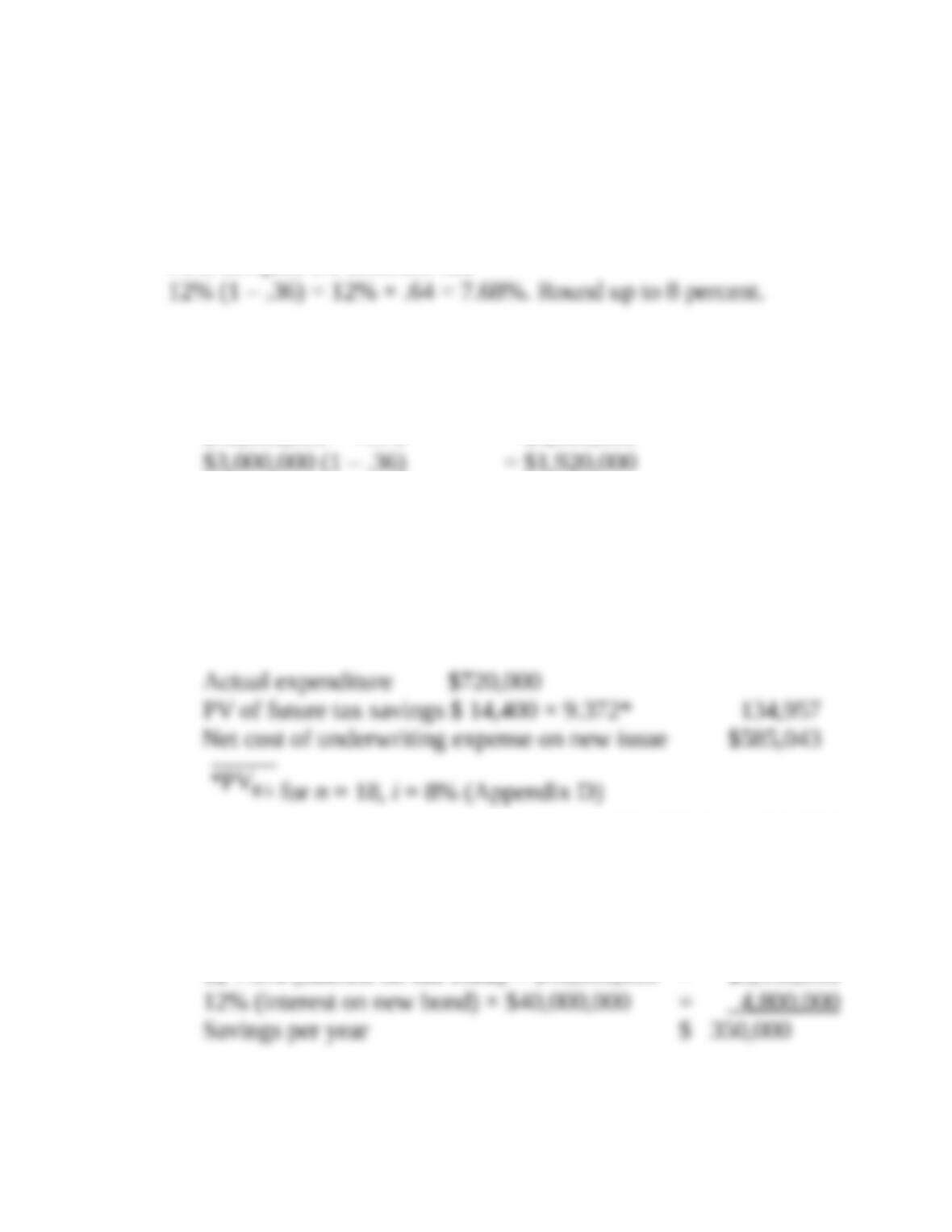
16-19. Solution:
The Sunbelt Corporation
First compute the discount rate
Outflows
1. Payment on call provision
$40,000,000 × 7.5% = $3,000,000
2. Underwriting cost on new issue
Actual expenditure 1.8% × $40,000,000 = $720,000
Amortization of costs ($720,000/18) (.36) =
Tax savings per year = $40,000 (.36) = $ 14,400
16-19. (Continued)
Inflows
3. Cost savings in lower interest rates
12 7/8% (interest on old bond) × $40,000,000 = $5,150,000
Savings per year $350,000 × (1 – .36) = $224,000 Aftertax
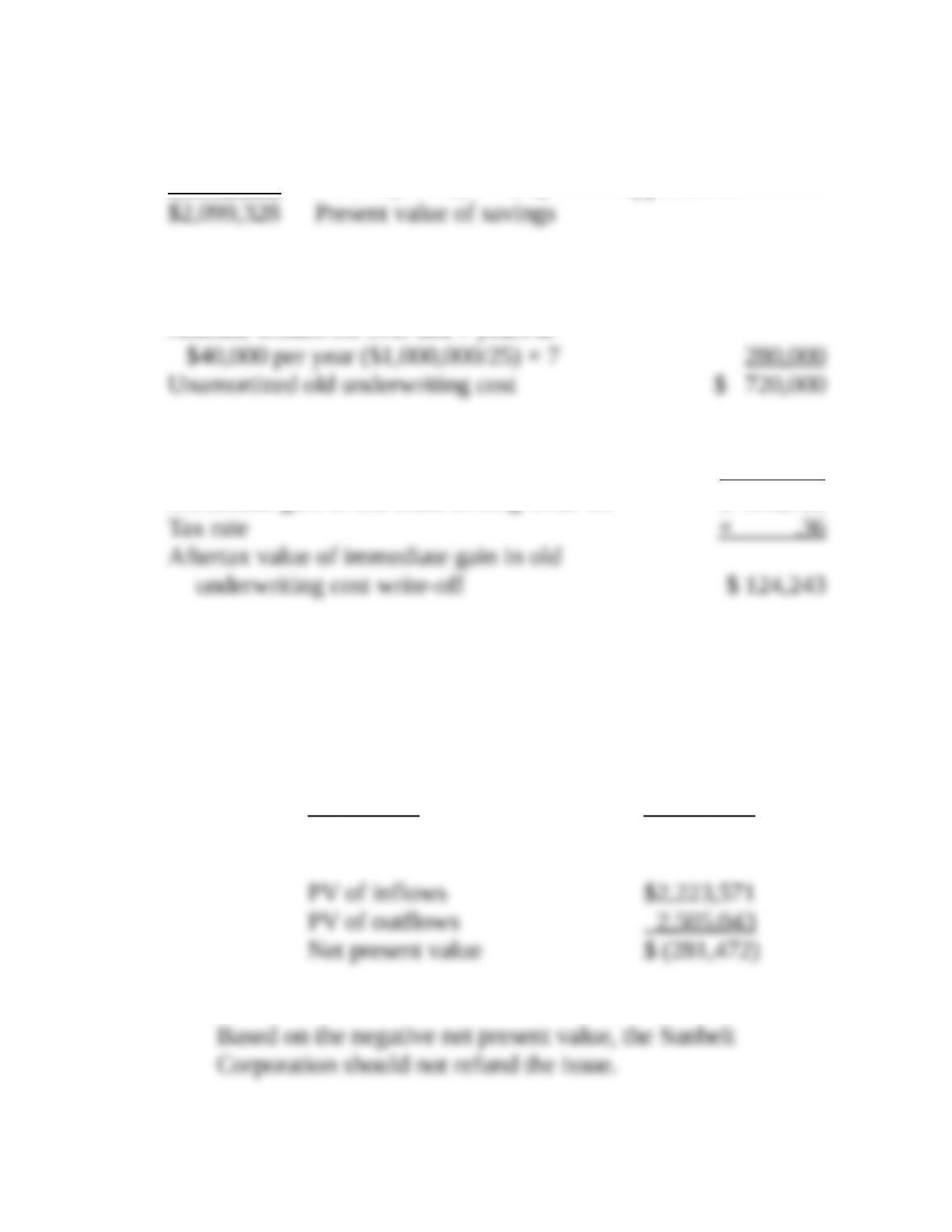
$ 224,000
× 9.372 PVIFA (n = 18, i = 8%) Appendix D
4. Underwriting cost on old issue
Original amount (2.5% × $40,000,000) $1,000,000
Amount written off over last 7 years at
Present value of deferred future write-off:
$40,000 × 9.372 (n = 18, i = 8%).. . 374,880
Immediate gain in old underwriting write-off $ 345,120
Summary
Outflows Inflows
1. $1,920,000 3. $2,099,328
2. 585,043 4. 124,243
$2,505,043 $2,223,571
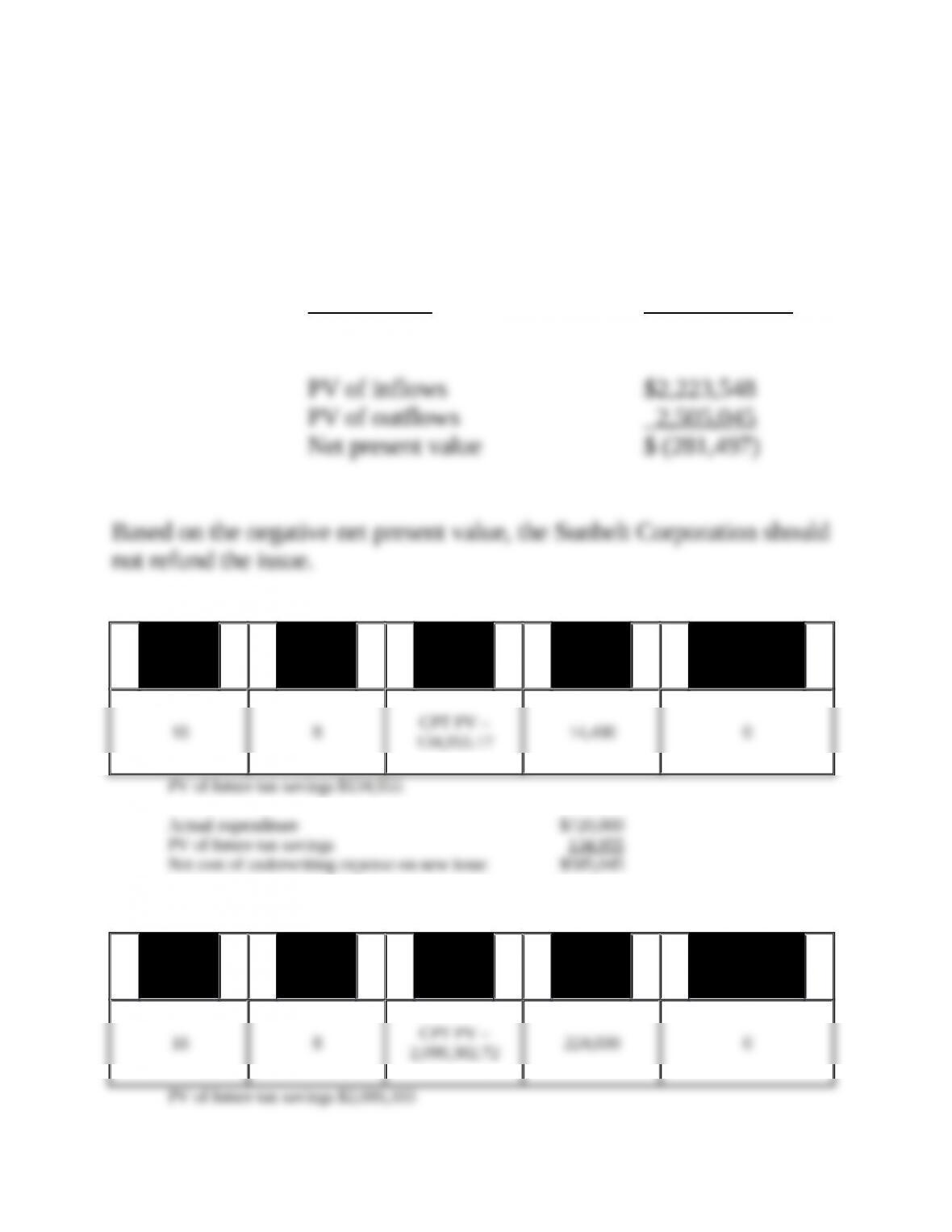
Calculator solution:
Summary
Outflows Inflows
1. $1,920,000 3. $2,099,303**
2. 585,045* 4. 124,245***
$2,505,045 $2,223,548
*Present value of future tax savings
N I/Y PV PMT FV
**Present value of savings
N I/Y PV PMT FV
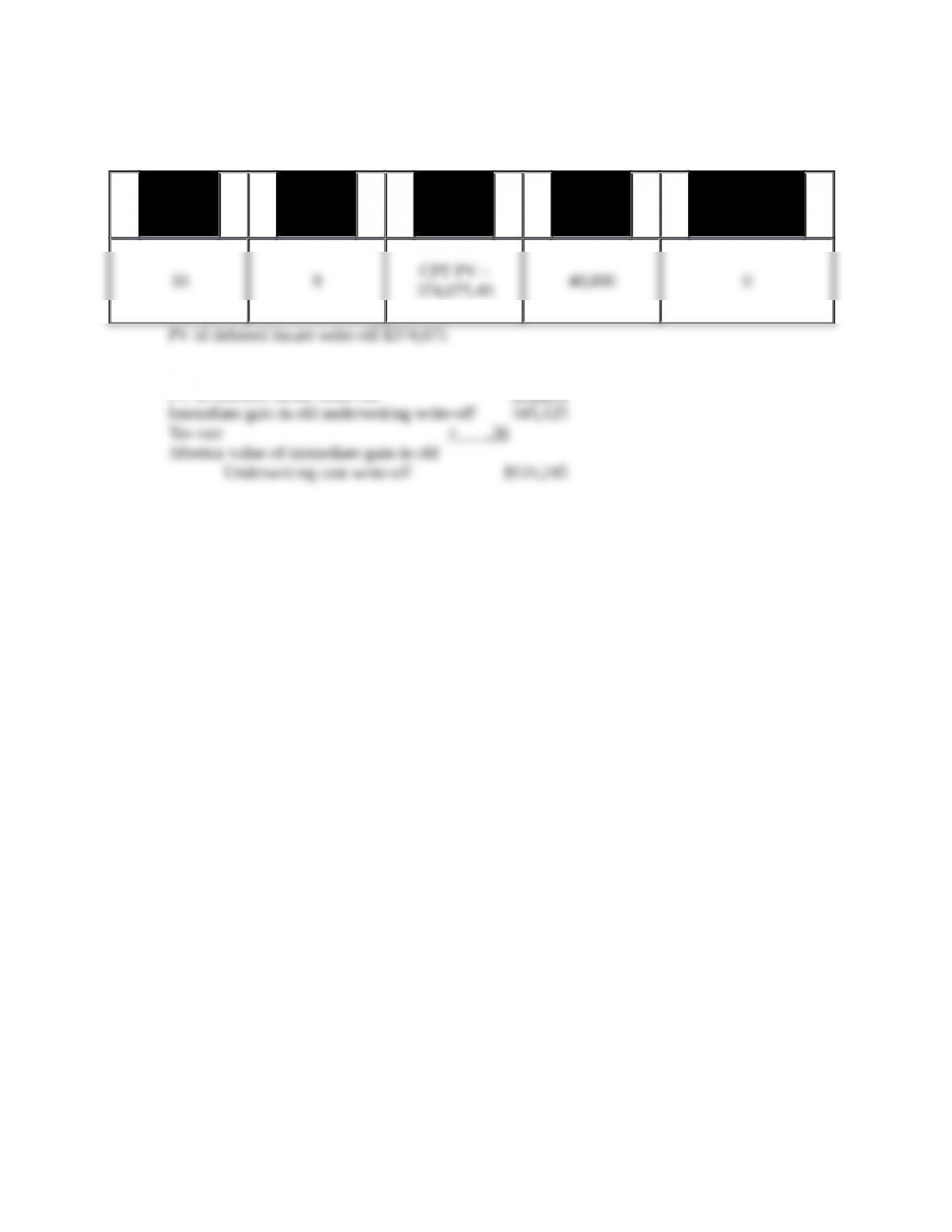
***Present value of deferred future write-off:
N I/Y PV PMT FV
Unamortized old underwriting cost $720,000
PV of deferred future write-off 374,875
20. Capital lease or operating lease (LO16-4) The Deluxe Corporation has just signed a 168-
month lease on an asset with a 19-year life. The minimum lease payments are $1,300 per
month ($15,600 per year) and are to be discounted back to the present at a 9 percent annual
discount rate. The estimated fair value of the property is $165,000.
a. Calculate the lease period as a percentage to the estimated life of the leased property.
b. Calculate the present value of lease payments as a percentage to the fair value of the
property.
c. Should the lease be recorded as a capital lease or an operating lease. (Use criteria 3 and
4 for a capital lease.)
16-20. Solution:
The Deluxe Corporation
The lease is less than 75 percent of the estimated life of the
leased property.
168 months = 14 years
14/19 = 74%
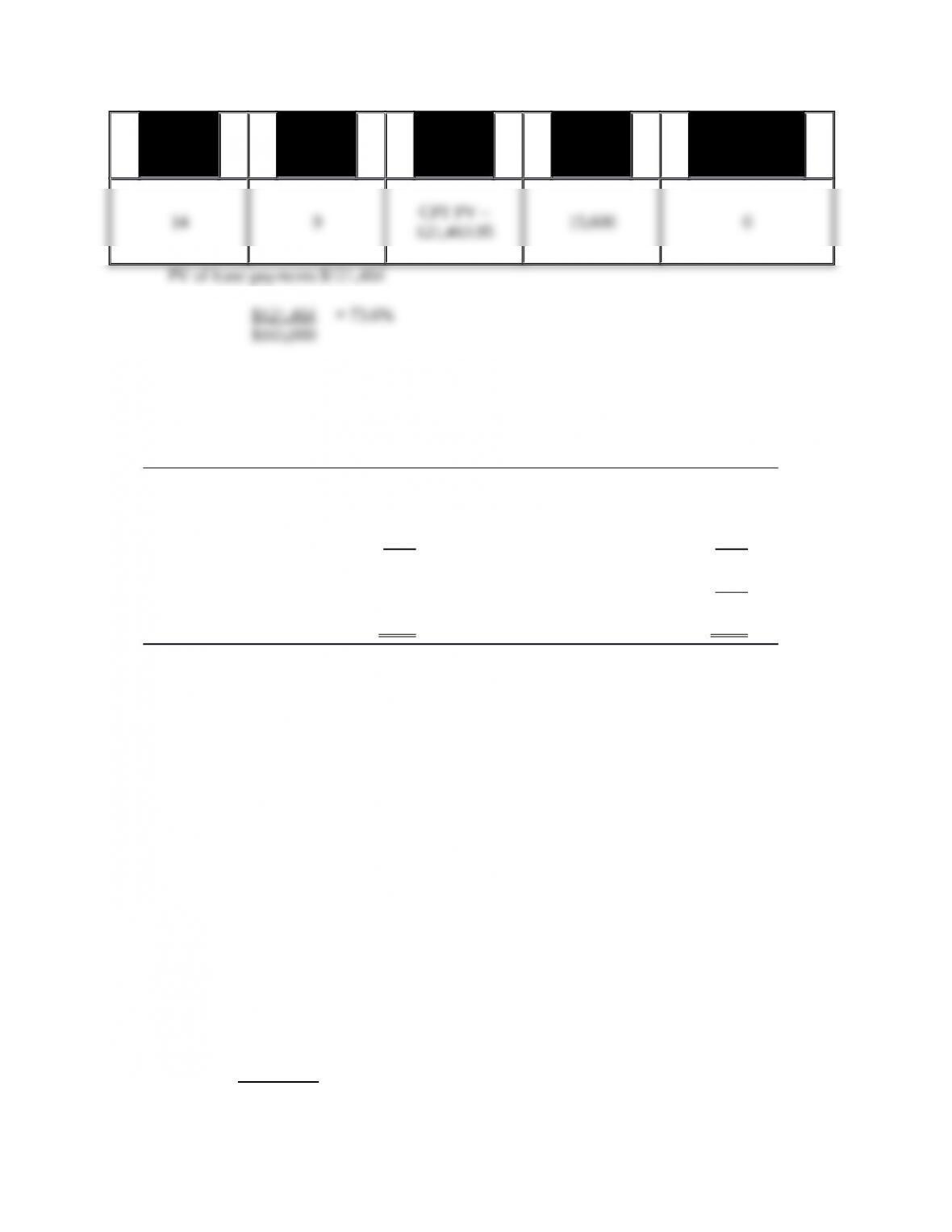
The present value of the lease payments is less than 90 percent
of the fair value of the property.
Calculator solution:
Present value of lease payments
N I/Y PV PMT FV
21. Balance sheet effect of leases (LO16-4) The Ellis Corporation has heavy lease
commitments. Prior to SFAS No. 13, it merely footnoted lease obligations in the balance
sheet, which appeared as follows:
In $ millions In $ millions
Current asserts……………………………...$ 70 Current liabilities……..……………….….$ 30
Fixed asserts……………………………..…. 70 Long-term liabilities……………………… 30
Total liabilities……………………….….$ 60
Stockholders’ equity……………………… 80
Total assets……………………….………….$140
Total liabilities and
stockholders’ equity…………….…….$140
The footnotes stated that the company had $14 million in annual capital lease obligations
for the next 20 years.
a. Discount these annual lease obligations back to the present at a 10 percent discount
rate (round to the nearest million dollars).
b. Construct a revised balance sheet that includes lease obligations, as in Table 16-8.
c. Compute total debt to total assets on the original and revised balance sheets.
d. Compute total debt to equity on the original and revised balance sheets.
e. In an efficient capital market environment, should the consequences of SFAS No. 13,
as viewed in the answers to parts c and d, change stock prices and credit ratings?
f. Comment on management’s perception of market efficiency (the viewpoint of the
financial officer).
16-21. Solution:
The Ellis Corporation
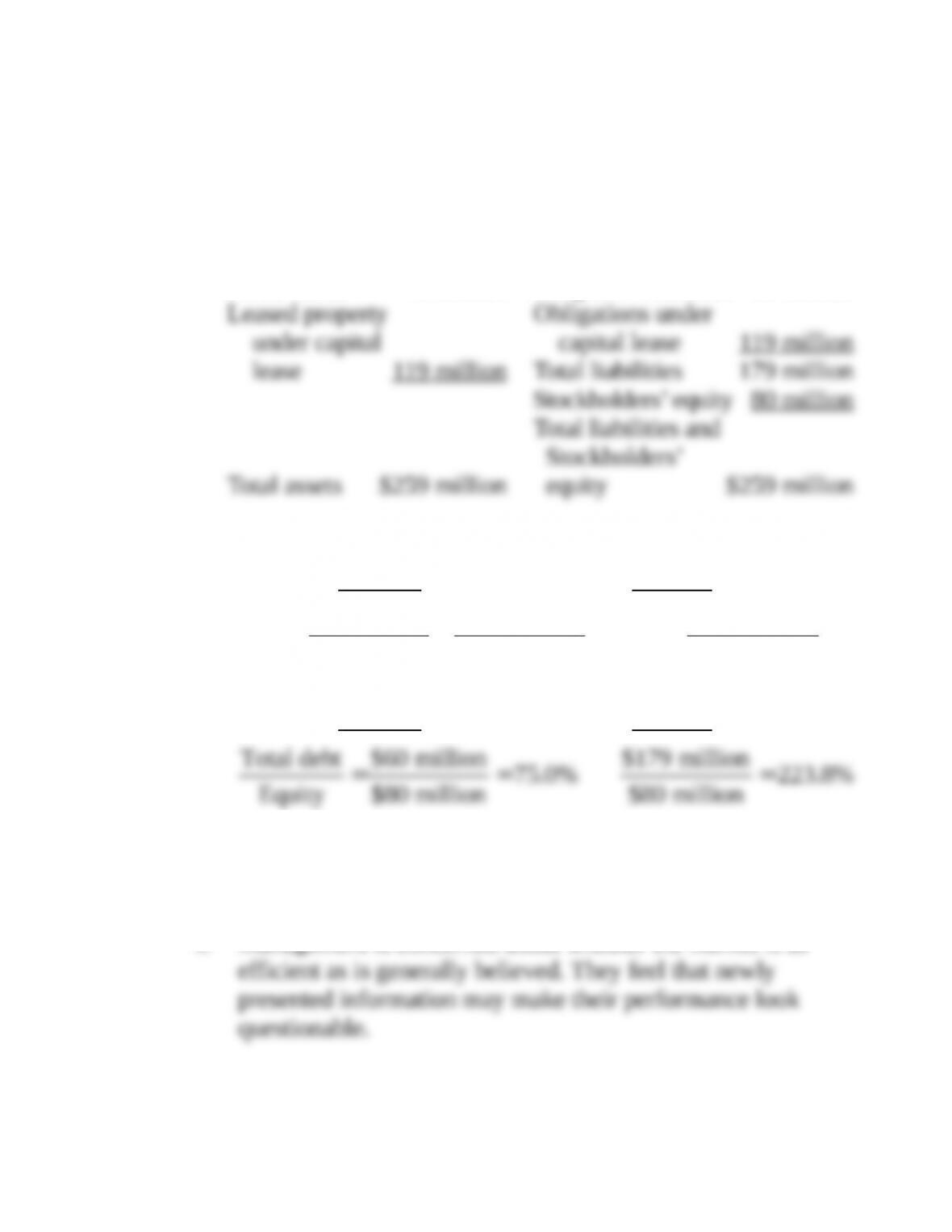
a. $14 million annual lease payments
8.514 (PVIFA for n = 20, i = 10%)
$119.196 million (round to $119 million)
16-21. (Continued)
b. Current assets $70 million Current liabilities $ 30 million
Fixed assets 70 million Long-term liabilities 30 million
c. Original Revised
Total debt $60 million $179 million
42.9% 69.1%
Total assets $140 million $259 million
= = =
d. Original Revised
Total debt $60 million $179 million
75.0% 223.8%
Equity $80 million $80 million
= = =
e. No, the information was already known by financial
analysts before it was brought into the balance sheet.
f. Management is concerned about whether the market is as
Calculator solution:
*Present value of annual lease payments
N I/Y PV PMT FV
22. Determining size of lease payment (LO16-4) The Hardaway Corporation plans to lease a
$740,000 asset to the O’Neil Corporation. The lease will be for 11 years.
a. If the Hardaway Corporation desires a 13 percent return on its investment, how much
should the lease payments be?
b. If the Hardaway Corporation is able to take a 10 percent deduction from the purchase
price of $740,000 and will pass the benefits along to the O’Neil Corporation in the
form of lower lease payments (related to the Hardaway Corporation in the form of
lower initial net cost), how much should the revised lease payments be? The
Hardaway Corporation desires a 13 percent return on the 11-year lease.
16-22. Solution:
Hardaway Corporation
a. Determine 11-year annuity that will yield 13 percent.
A IFA
A = PV / PV ( = 13%, = 11) Appendix D
$740,000
= $130,121
5.687
i n
=
b. Original amount $740,000
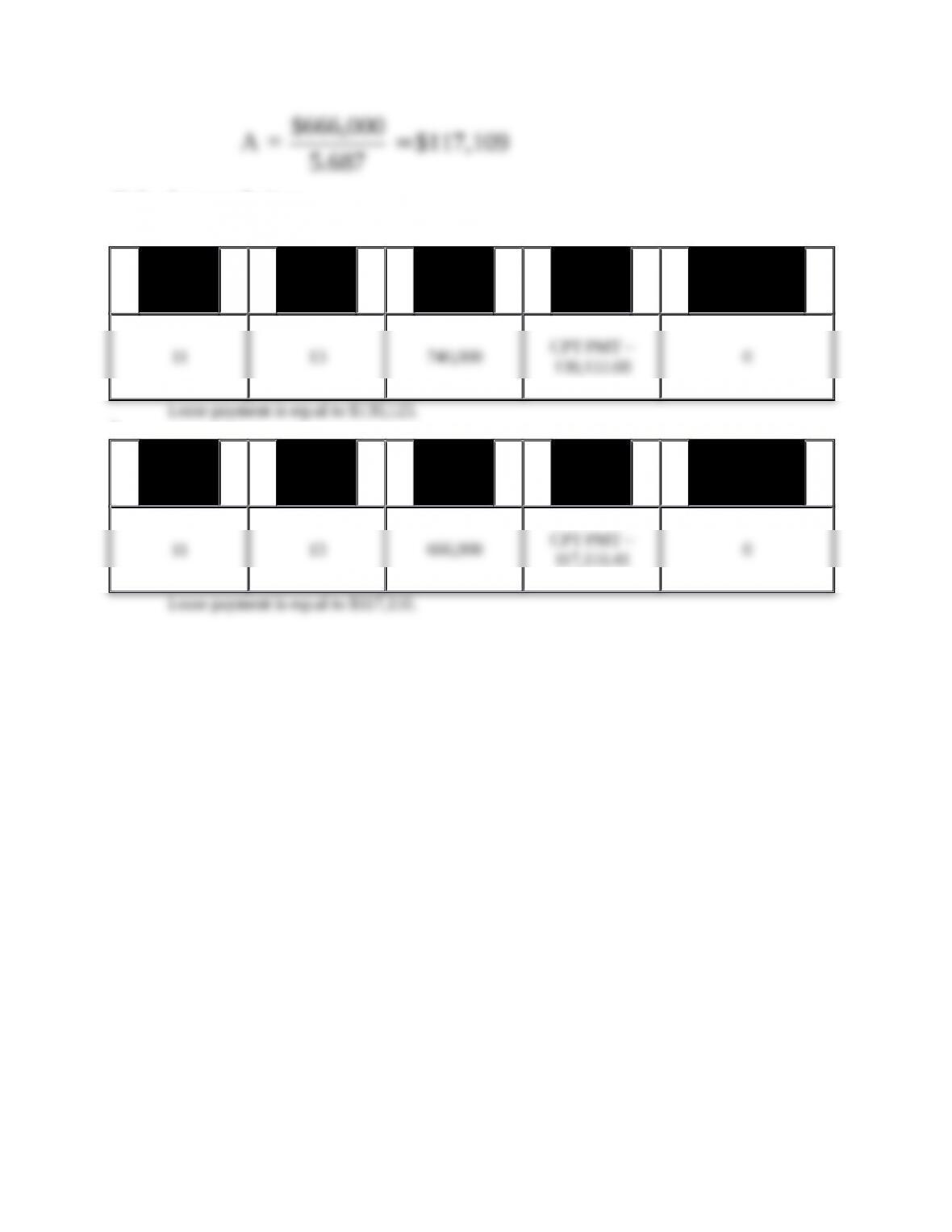
$666,000
A = $117,109
5.687 =
Calculator solution:
a.
N I/Y PV PMT FV
b.
N I/Y PV PMT FV
COMPREHENSIVE PROBLEM
Comprehensive Problem 1.
Broadband Inc. Bond prices refunding (LO16-2 and 3) Barton Simpson, the chief financial
officer of Broadband Inc. could hardly believe the change in interest rates that had taken place
over the last few months. The interest rate on A2 rated bonds was now 6 percent. The $30
million, 15-year bond issue that his firm has outstanding was initially issued at 9 percent five
years ago.
Because interest rates had gone down so much, he was considering refunding the bond issue.
The old issue had a call premium of 8 percent. The underwriting cost on the old issue had been
3 percent of par and on the new issue, it would be 5 percent of par. The tax rate would be 30
percent and a 4 percent discount rate will be applied for the refunding decision. The new bond
would have a 10-year life.
Before Barton used the 8 percent call provision to reacquire the old bonds, he wanted to make
sure he could not buy them back cheaper in the open market.
a. First compute the price of the old bonds in the open market. Use the valuation procedures for
a bond that were discussed in Chapter 10 (use the annual analysis). Determine the price of a
single $1,000 par value bond.
b. Compare the price in part a to the 8 percent call premium over par value. Which appears to
be more attractive in terms of reacquiring the old bonds?
c. Now do the standard bond refunding analysis as discussed in this chapter. Is the refunding
financially feasible?
d In terms of the refunding decision, how should Barton be influenced if he thinks interest rates
might go down even more?
CP 16-1. Solution:
a.
Broadband Inc.
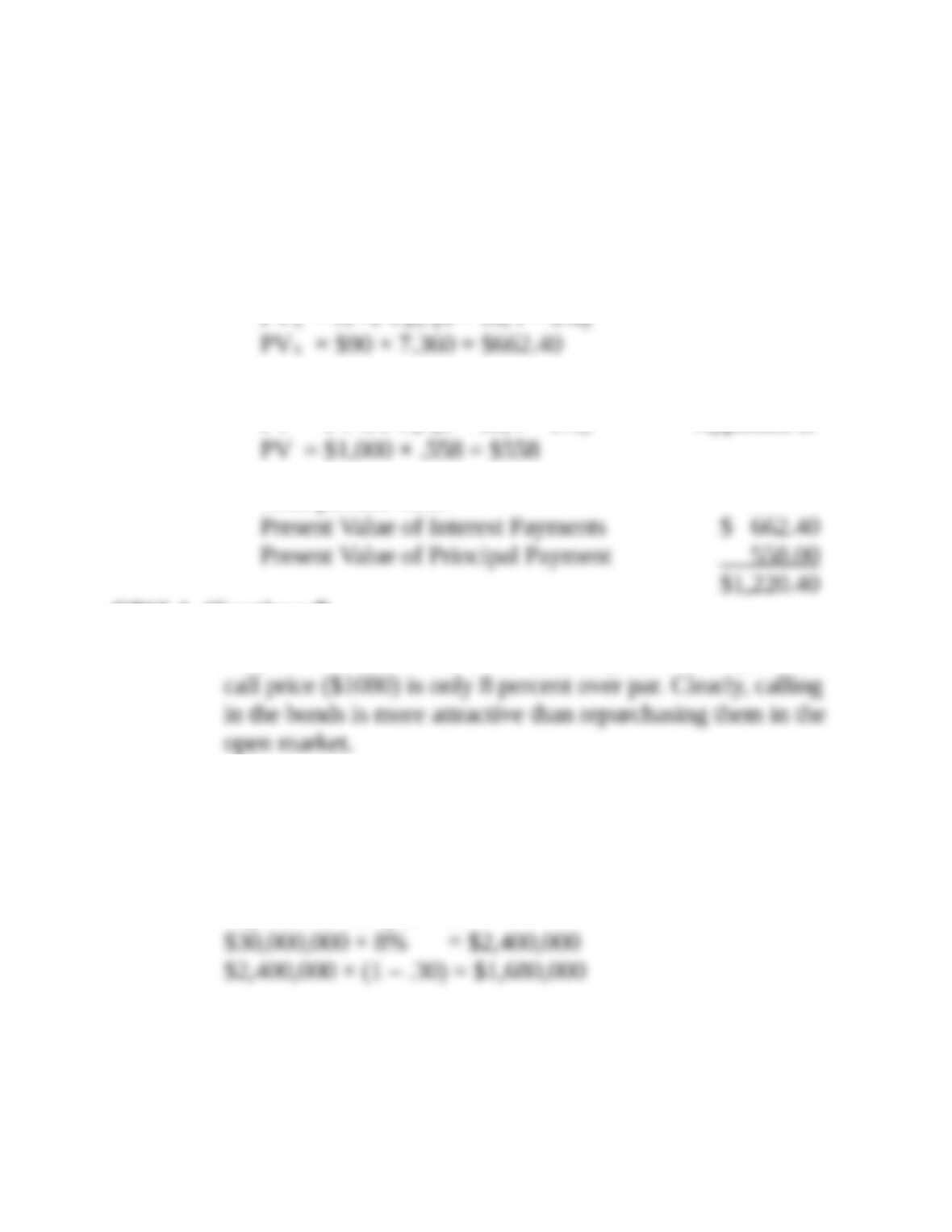
Price of Old Bond
Present Value of Interest Payments Appendix D
Present Value of Principal Payment at Maturity
PV = FV x PVIF (n = 10, i = 6%) Appendix D
Total present value
CP16-1. (Continued)
b. The price of $1,220.40 is more than 20 percent over par. The
c. Refunding Decision
Outflows
1. Payment of call premium
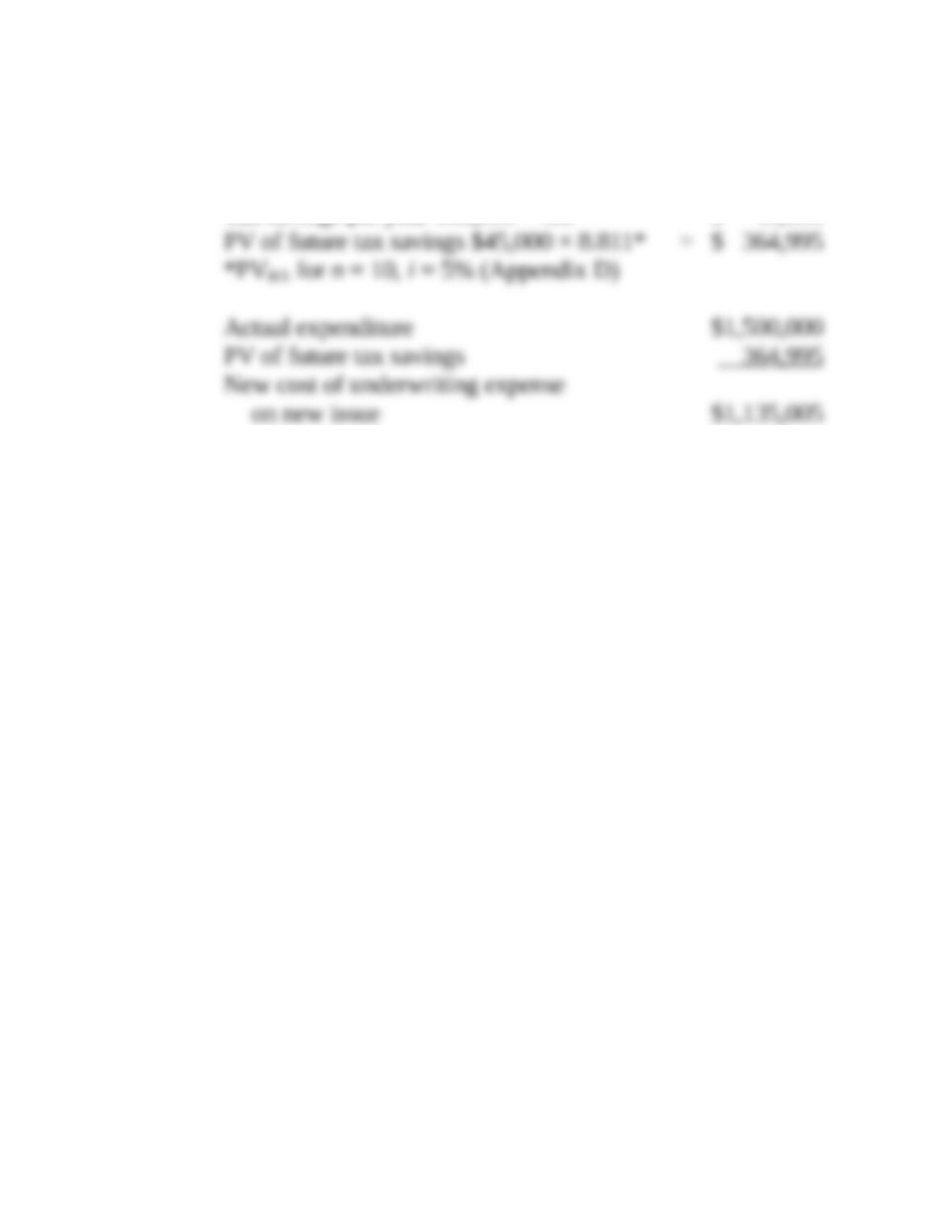
2. Underwriting cost on new issue
Actual expenditure $30,000,000 × 5% = $1,500,000
Amortization of cost = ($1,500,000/10) = $ 150,000
Tax savings per year 150,000 × .30 = $ 45,000