Chapter 16: Long-Term Debt and Lease Financing
16-16. Solution:
Mr. Robinson – Mrs. Pinson
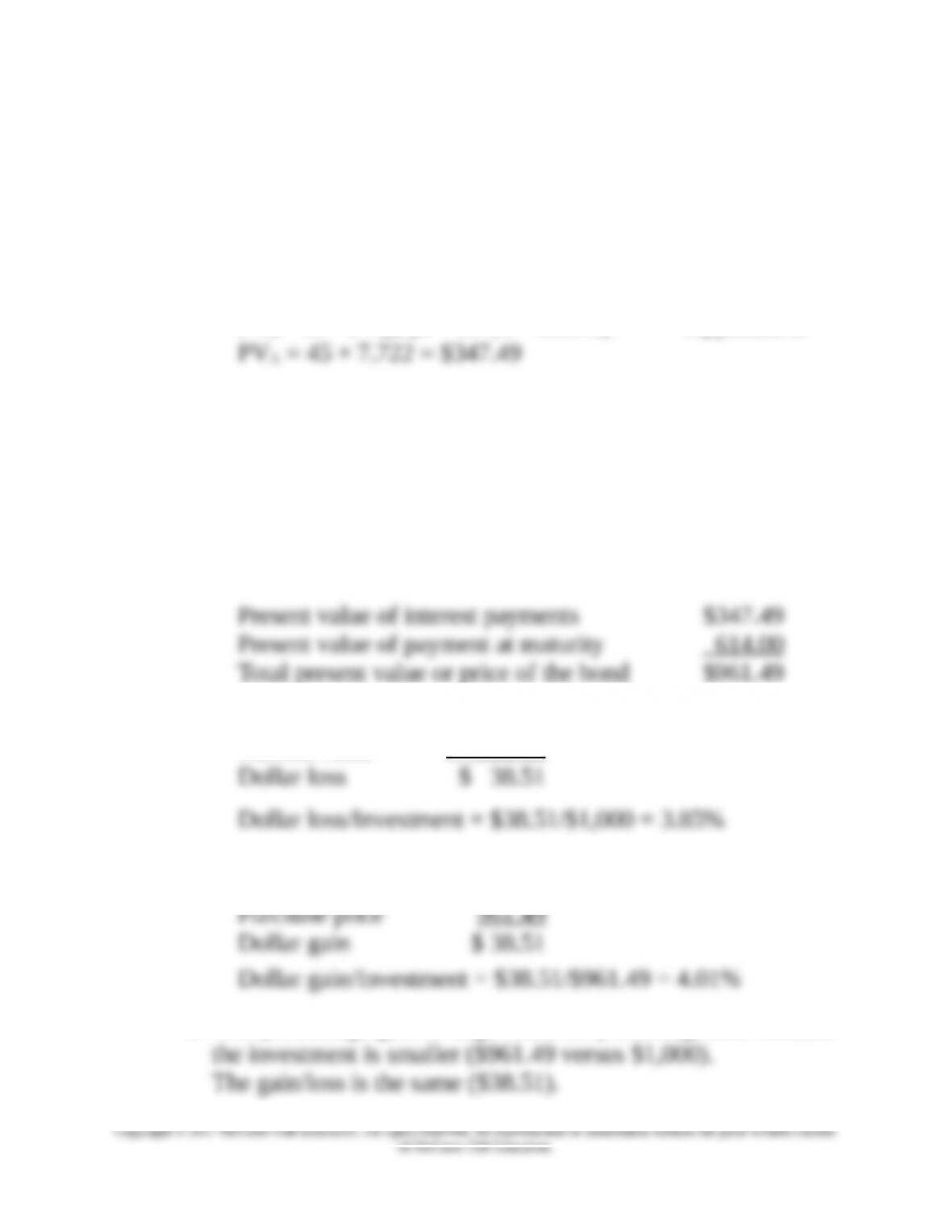
a. Present value of interest payments
PVA = A × PVIFA (n = 10*, i = 5.00%) Appendix D
Present value of principal payment at maturity
PV = FV × PVIF (n = 10*, i = 5.00%)
PV = $1,000 × .614 = $614.00 Appendix B
Total present value
b. Purchase price $1,000.00
Current value 961.49
c. Maturity value $1,000.00
d. The percentage gain is larger than the percentage loss because
Chapter 16: Long-Term Debt and Lease Financing
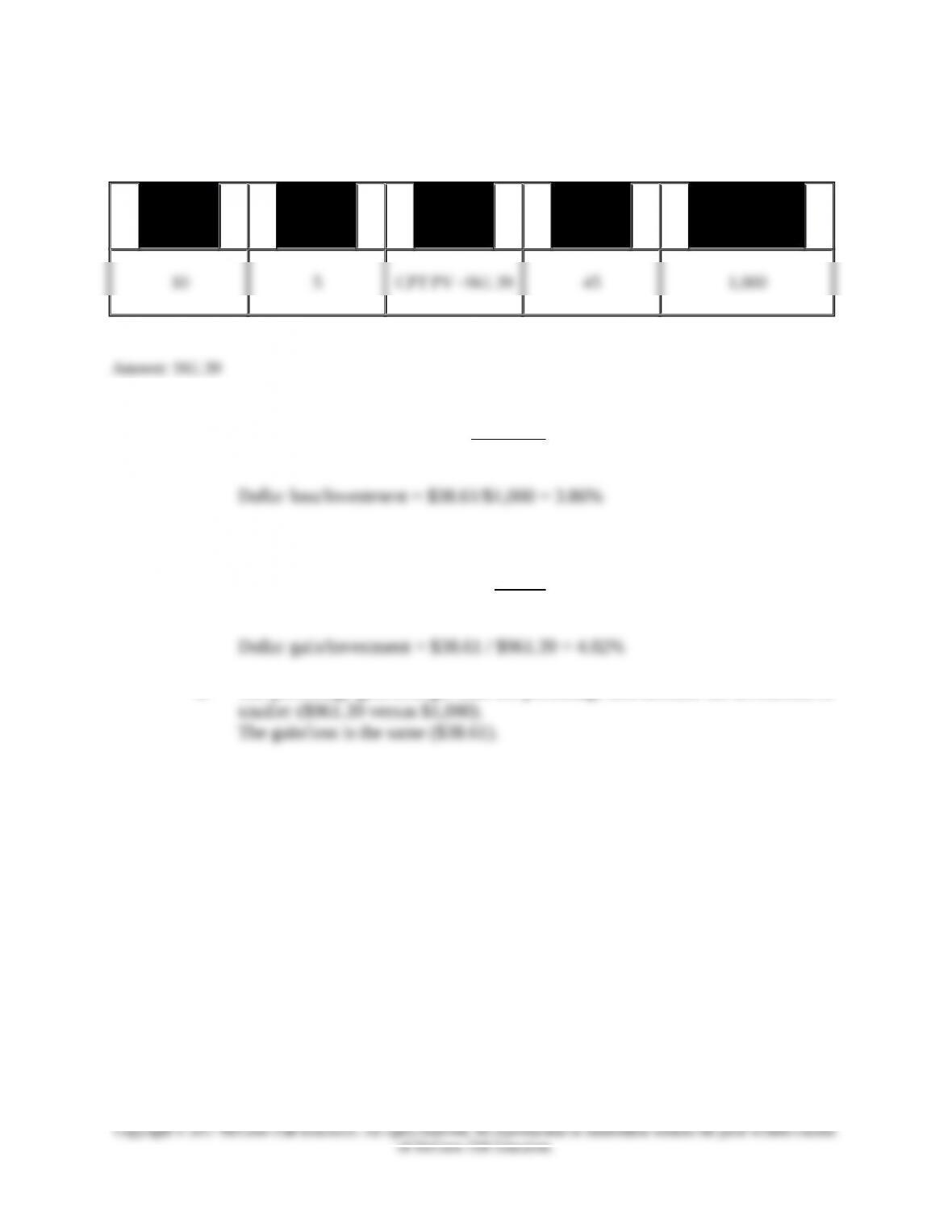
Calculator Solution:
(a)
N I/Y PV PMT FV
b. Purchase price $1,000.00
Current value 961.39
Dollar loss $ 38.61
c. Maturity value $1,000.00
Purchase price 961.39
Dollar gain $ 38.61
d. The percentage gain is larger than the percentage loss because the investment is
Chapter 16: Long-Term Debt and Lease Financing
17. Advanced refunding decision (LO16-3) The Bowman Corporation has a $18 million
bond obligation outstanding, which it is considering refunding. Though the bonds were
initially issued at 10 percent, the interest rates on similar issues have declined to 8.5
percent. The bonds were originally issued for 20 years and have 10 years remaining. The
new issue would be for 10 years. There is a 9 percent call premium on the old issue. The
underwriting cost on the new $18,000,000 issue is $530,000, and the underwriting cost on
the old issue was $380,000. The company is in a 35 percent tax bracket, and it will use an 8
percent discount rate (rounded aftertax cost of debt) to analyze the refunding decision.
a. Calculate the present value of total outflows.
b. Calculate the present value of total inflows.
c. Calculate the net present value.
d. Should the old issue be refunded with new debt?
16-17. Solution:
Bowman Corporation
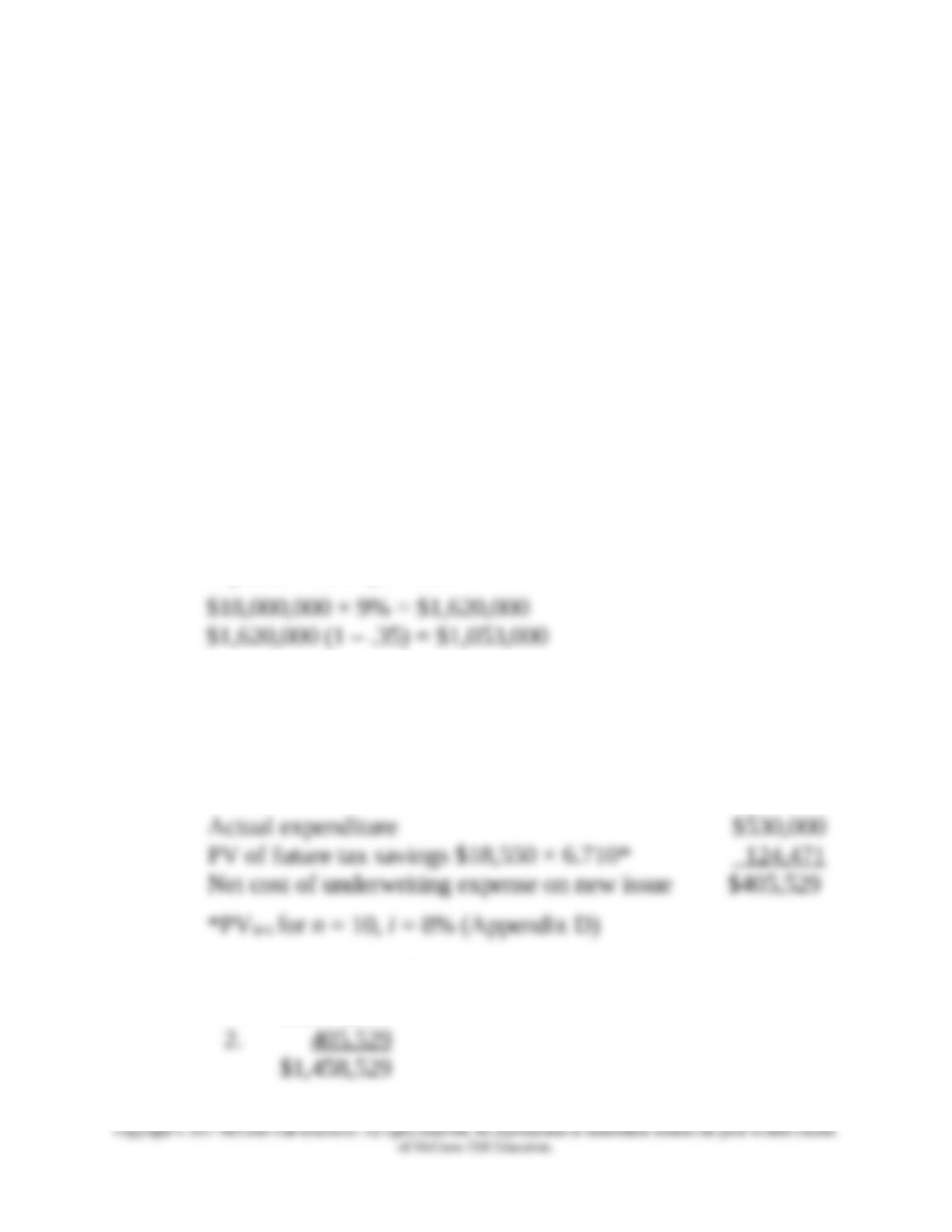
Outflows
1. Payment of call premium
2. Underwriting cost on new issue
Amortization of costs ($530,000/10) (.35)
$53,000 × (.35) = $18,550 tax savings per year
Outflows
1. $1,053,000
Chapter 16: Long-Term Debt and Lease Financing
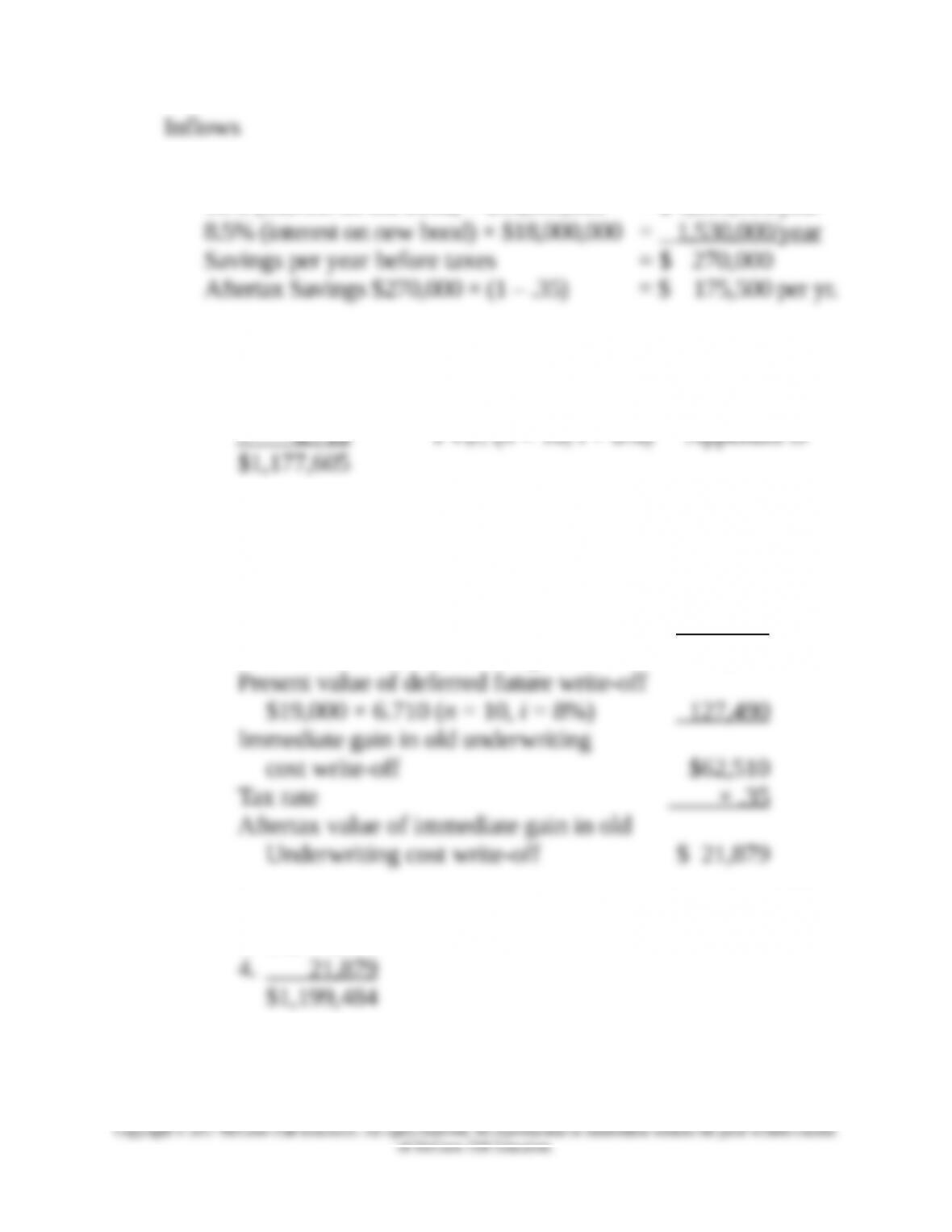
3. Cost savings in lower interest rates
10% (interest on old bond) × $18,000,000 = $ 1,800,000/year
16-17. (Continued)
$ 175,500
4. Underwriting cost on old issue
Original amount $380,000
Amount written off over 10 years
at $19,000 per year 190,000
Unamortized old underwriting cost $190,000
Inflows
3. $1,177,605
Summary
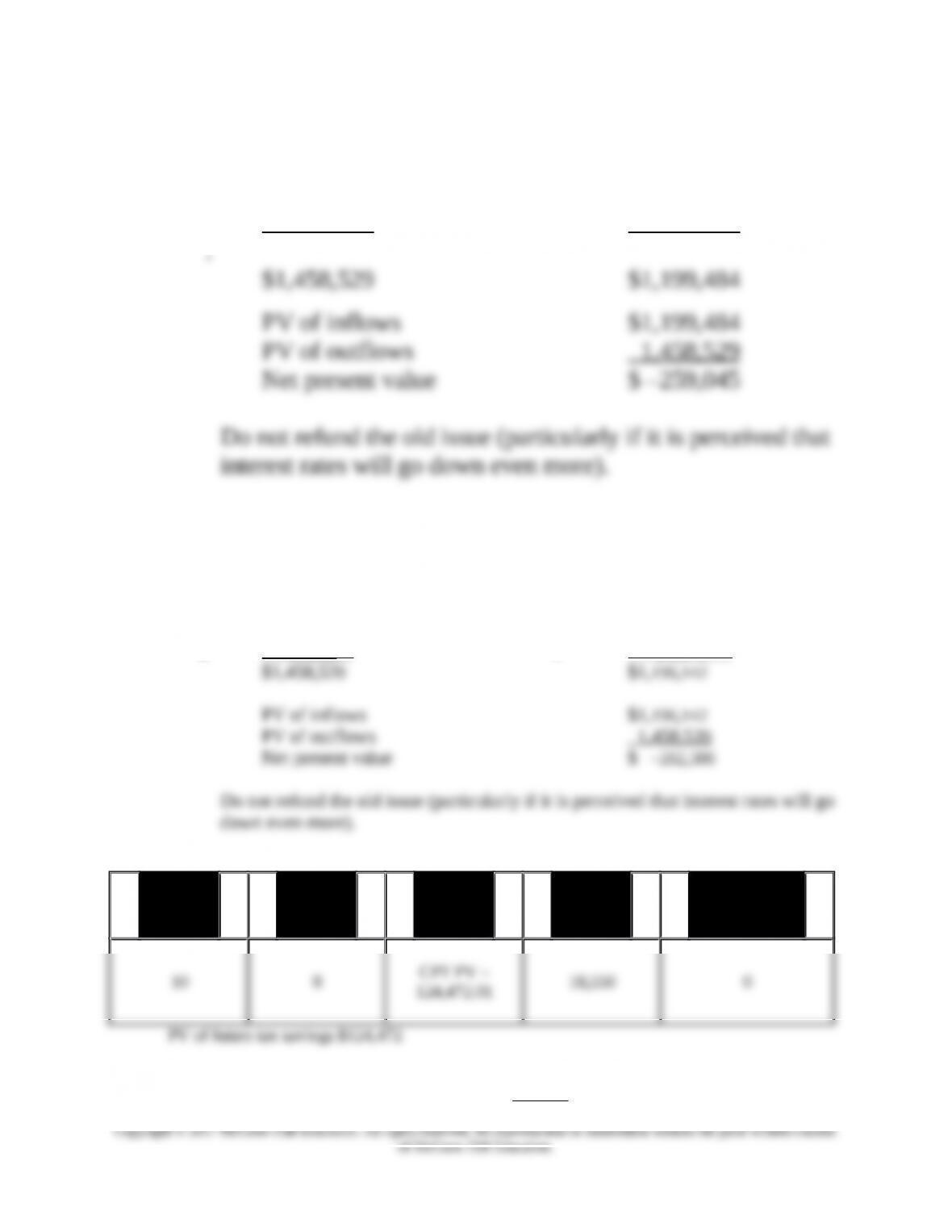
Chapter 16: Long-Term Debt and Lease Financing
Outflows Inflows
1
.
$1,053,000 3. $1,177,605
2
405,529 4. 21,879
Calculator solution:
Summary
Outflows Inflows
1. $1,053,000 3. $1,174,264**
2. 405,52 8* 4. 21,87 8***
*Present value of future tax savings
N I/Y PV PMT FV
Actual expenditure $530,000
PV of future tax savings 124,472
Chapter 16: Long-Term Debt and Lease Financing
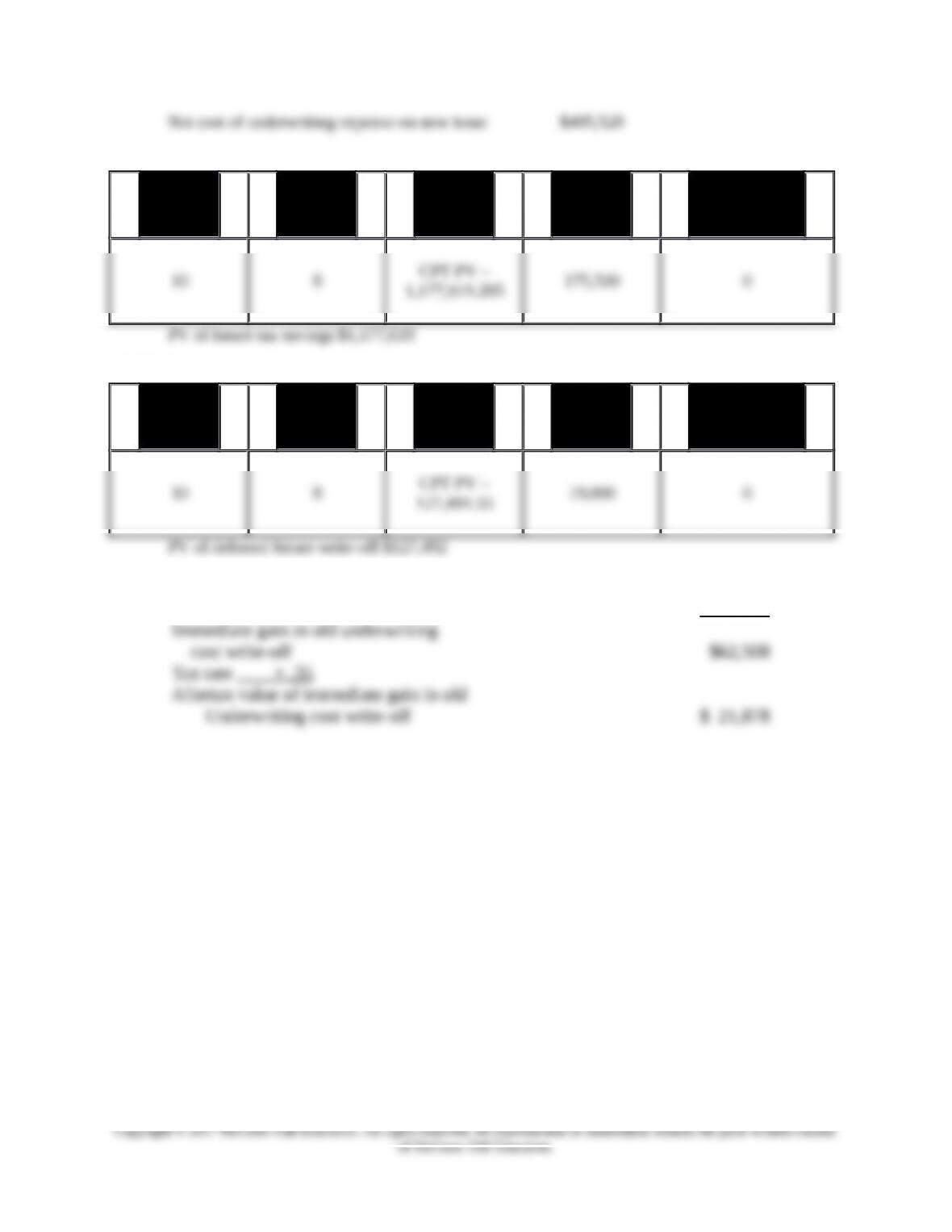
**Present value of future tax savings
N I/Y PV PMT FV
***Present value of deferred future write-off
N I/Y PV PMT FV
Unamortized old underwriting cost $190,000
Present value of deferred future write-off 127,492
18. Refunding decision (LO16-3) The Robinson Corporation has $43 million of bonds
outstanding that were issued at a coupon rate of 11¾ percent seven years ago. Interest rates
have fallen to 10¾ percent. Mr. Brooks, the vice president of finance, does not expect rates
to fall any further. The bonds have 17 years left to maturity, and Mr. Brooks would like to
refund the bonds with a new issue of equal amount also having 17 years to maturity. The
Robinson Corporation has a tax rate of 30 percent. The underwriting cost on the old issue
was 2.4 percent of the total bond value. The underwriting cost on the new issue will be 1.7
percent of the total bond value. The original bond indenture contained a five-year
protection against a call, with a 9 percent call premium starting in the sixth year and
scheduled to decline by one-half percent each year thereafter. (Consider the bond to be
seven years old for purposes of computing the premium.) Assume the discount rate is equal
to the aftertax cost of new debt rounded up to the nearest whole number.
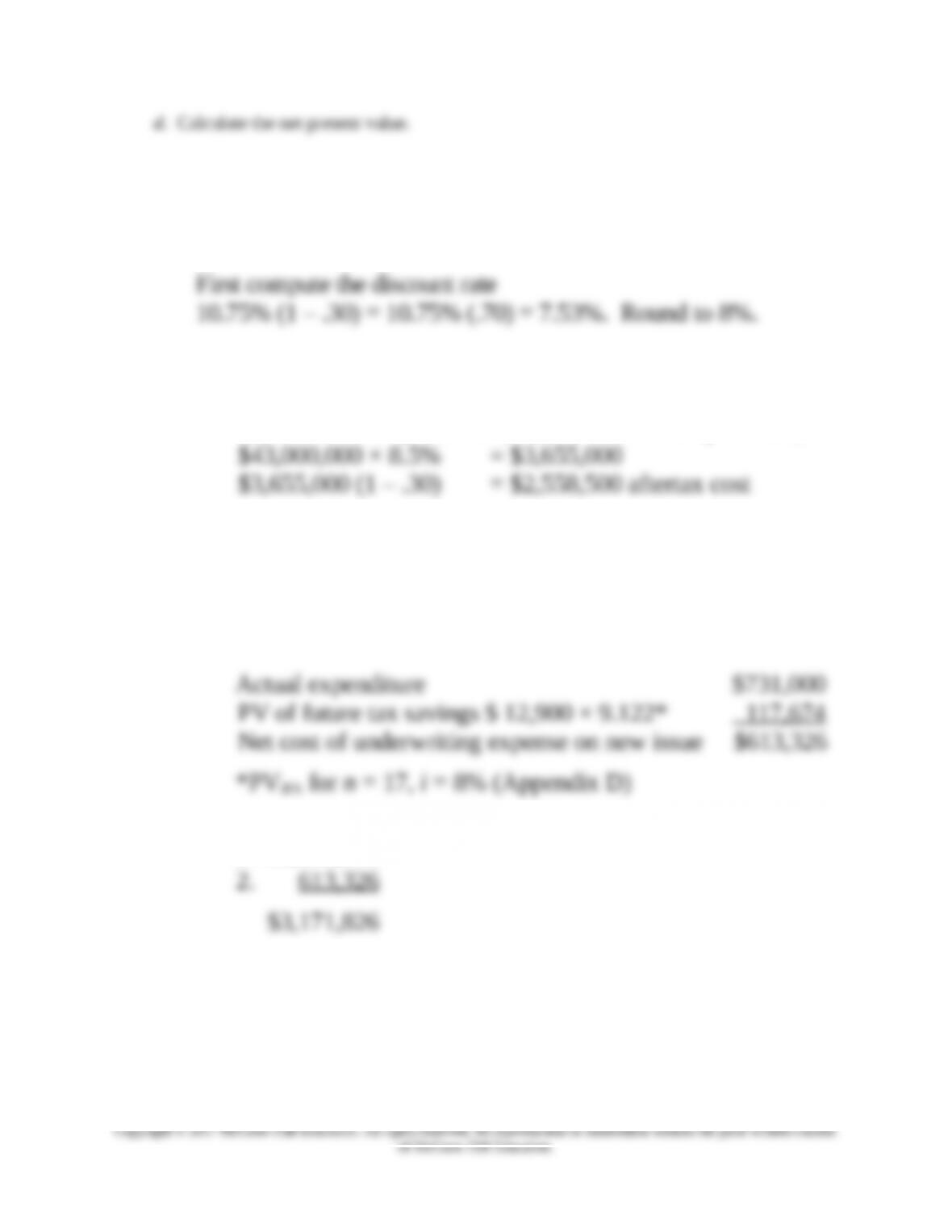
a. Compute the discount rate.
b. Calculate the present value of total outflows.
c. Calculate the present value of total inflows.
Chapter 16: Long-Term Debt and Lease Financing
16-18. Solution:
Robinson Corporation
Outflows
1. Payment on call provision (7th year = 8.5% call premium)
2. Underwriting cost on new issue
Actual expenditure 1.7% × $43,000,000 = $731,000
Amortization of costs ($731,000/17) = $ 43,000
Tax savings per year = $43,000 (.30) = $ 12,900
Outflows
1. $2,558,500
16-18. (Continued)
Inflows
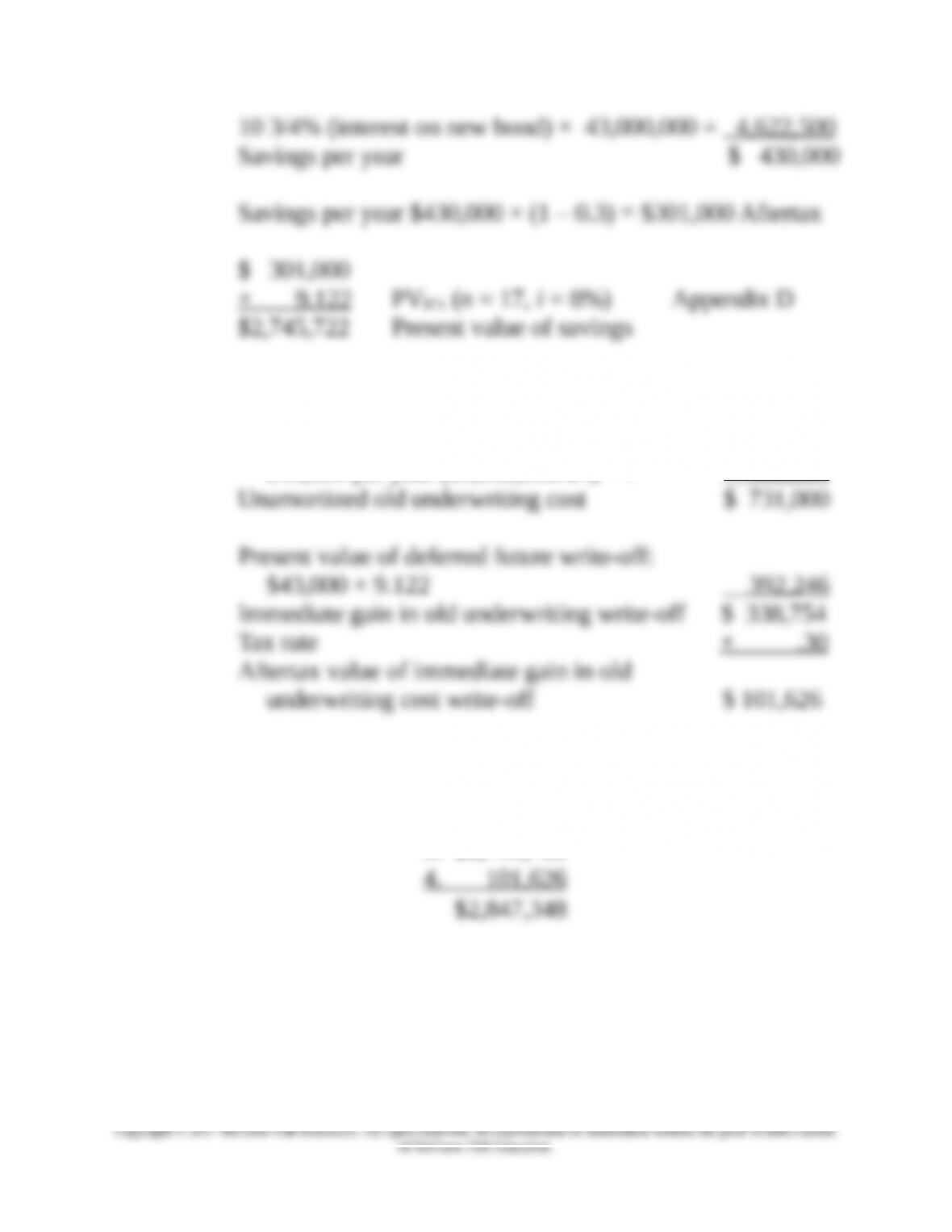
3. Cost savings in lower interest rates
11 3/4% (interest on old bond) × $43,000,000 = $5,052,500
Chapter 16: Long-Term Debt and Lease Financing
4. Underwriting cost on old issue
Original amount (2.40% × $43,000,000) $1,032,000
Amount written off over last 7 years at
$43,000 per year ($1,032,000/24) × 7 301,000
16-18. (Continued)
Inflows
3. $2,745,722
Summary
Chapter 16: Long-Term Debt and Lease Financing
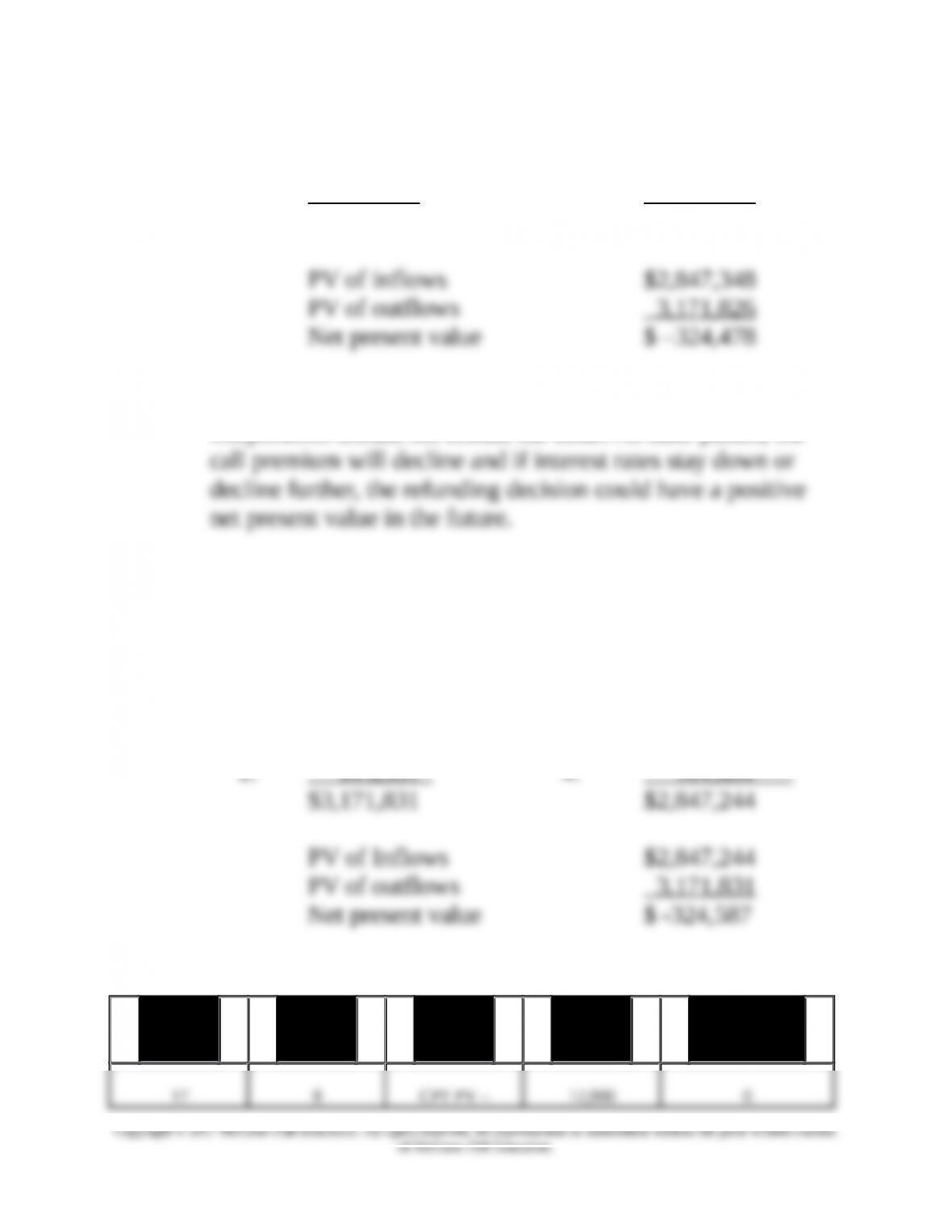
Outflows Inflows
1. $2,558,500 3. $2,745,722
2. 613,326 4. 101,626
$3,171,826 $2,847,348
Based on the negative net present value, the Robinson
Corporation should not refund the issue. As time passes, the
Calculator Solution:
Summary
Outflows Inflows
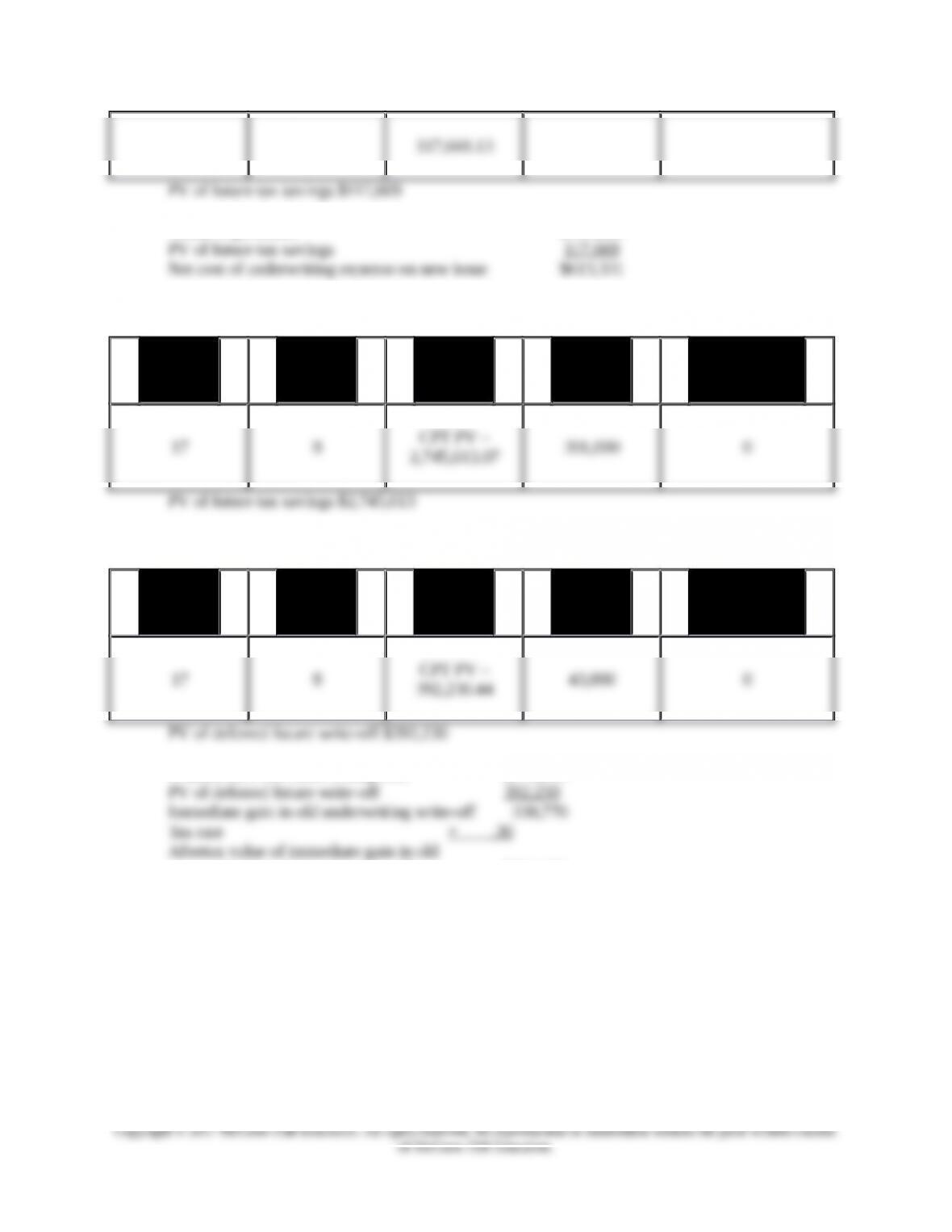
1. $2,558,500 3. $2,745,613**
*Present value of future tax savings
N I/Y PV PMT FV
Chapter 16: Long-Term Debt and Lease Financing
Actual expenditure $731,000
**Present value of savings
N I/Y PV PMT FV
***Present value of deferred future write-off:
N I/Y PV PMT FV
Unamortized old underwriting cost $731,000
Underwriting cost write-off $101,631
19. Call premium (LO16-3) The Sunbelt Corporation has $40 million of bonds outstanding
that were issued at a coupon rate of 12⅞ percent seven years ago. Interest rates have fallen
to 12 percent. Mr. Heath, the vice president of finance, does not expect rates to fall any
further. The bonds have 18 years left to maturity, and Mr. Heath would like to refund the
bonds with a new issue of equal amount also having 18 years to maturity. The Sunbelt
Corporation has a tax rate of 36 percent. The underwriting cost on the old issue was 2.5
percent of the total bond value. The underwriting cost on the new issue will be 1.8 percent

Chapter 16: Long-Term Debt and Lease Financing
of the total bond value. The original bond indenture contained a five-year protection against
a call, with an 8 percent call premium starting in the sixth year and scheduled to decline by
one-half percent each year thereafter (consider the bond to be seven years old for purposes
of computing the premium). Assume the discount rate is equal to the aftertax cost of new
debt rounded up to the nearest whole number. Should the Sunbelt Corporation refund the
old issue?