Chapter 15: Investment Banking: Public and Private Placement
15-11. Solution:
Kevin’s Bacon Company Inc.
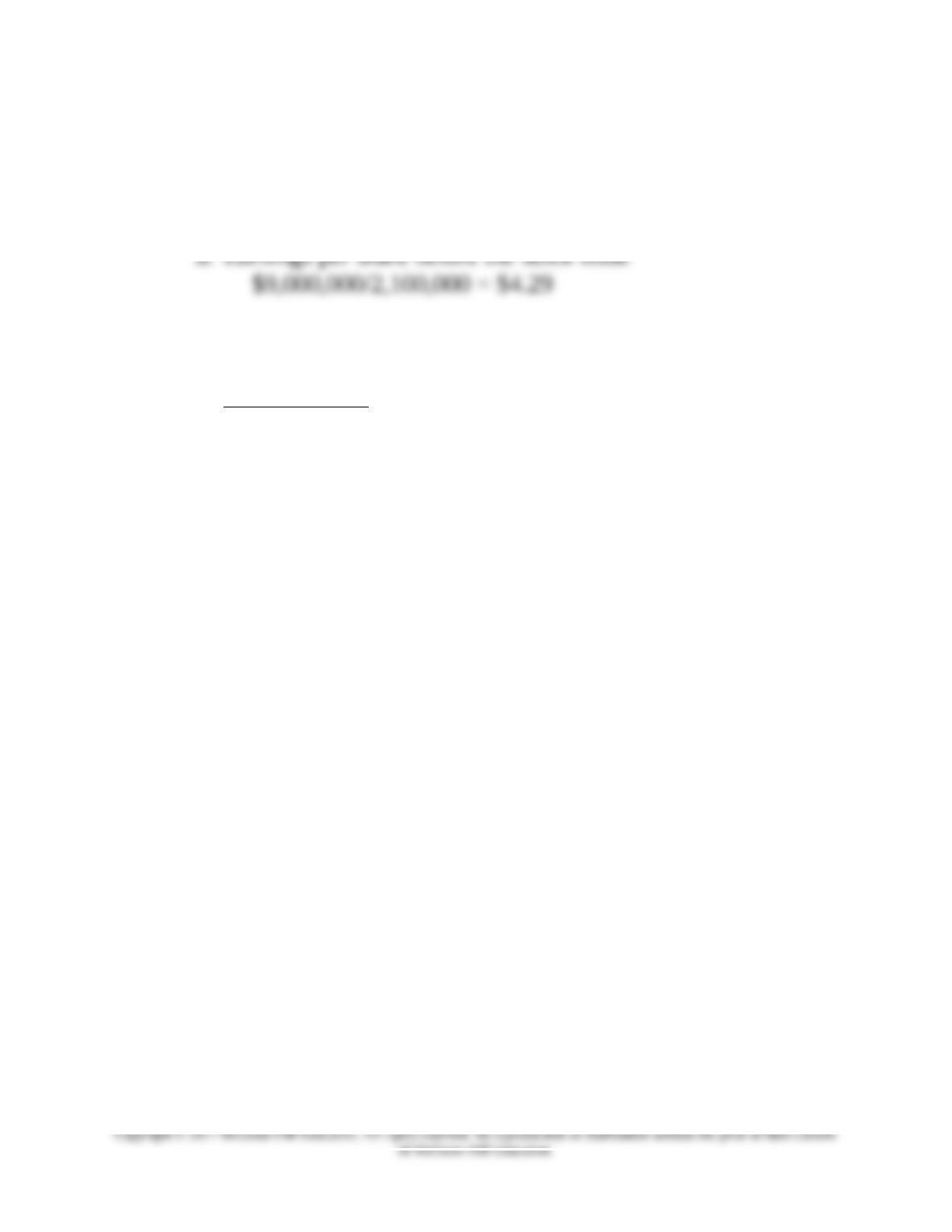
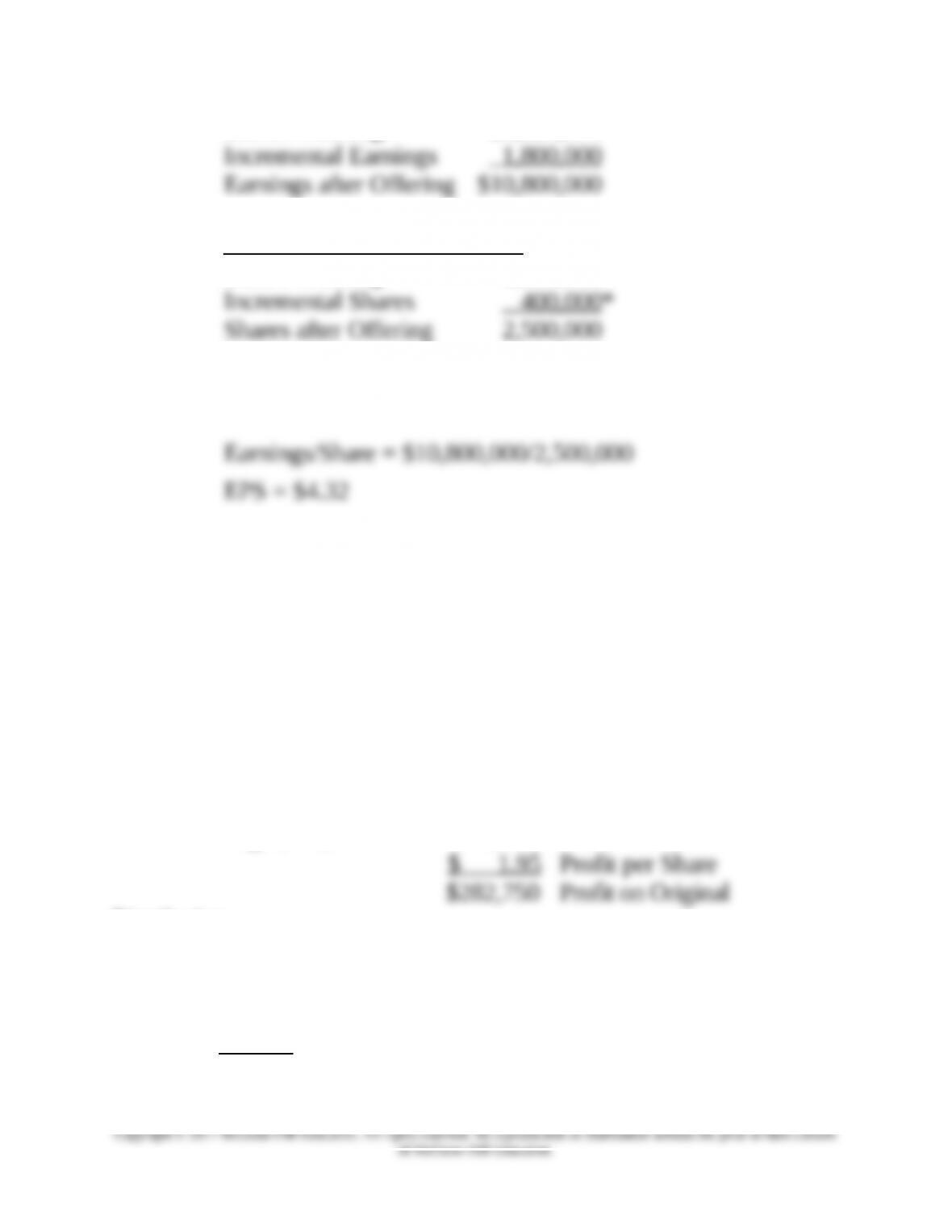
b. Earnings per share after the stock issue
Total Earnings
Chapter 15: Investment Banking: Public and Private Placement
Before Offering $9,000,000
Corporate Shares Outstanding
Before Offering 2,100,000
* The 300,000 secondary shares are not included as new
corporate shares.
12. Market stabilization and risk (LO15-2) Becker Brothers is the managing underwriter for
a 1.45-million-share issue by Jay’s Hamburger Heaven. Becker Brothers is “handling” 10
percent of the issue. Its price is $27 per share, and the price to the public is $28.95.
Becker also provides the market stabilization function. During the issuance, the market
for the stock turns soft, and Becker is forced to purchase 50,000 shares in the open market
at an average price of $27.50. It later sells the shares at an average value of $27.20.
Compute Becker Brothers’ overall gain or loss from managing the issue.
15-12. Solution:
Becker Brothers
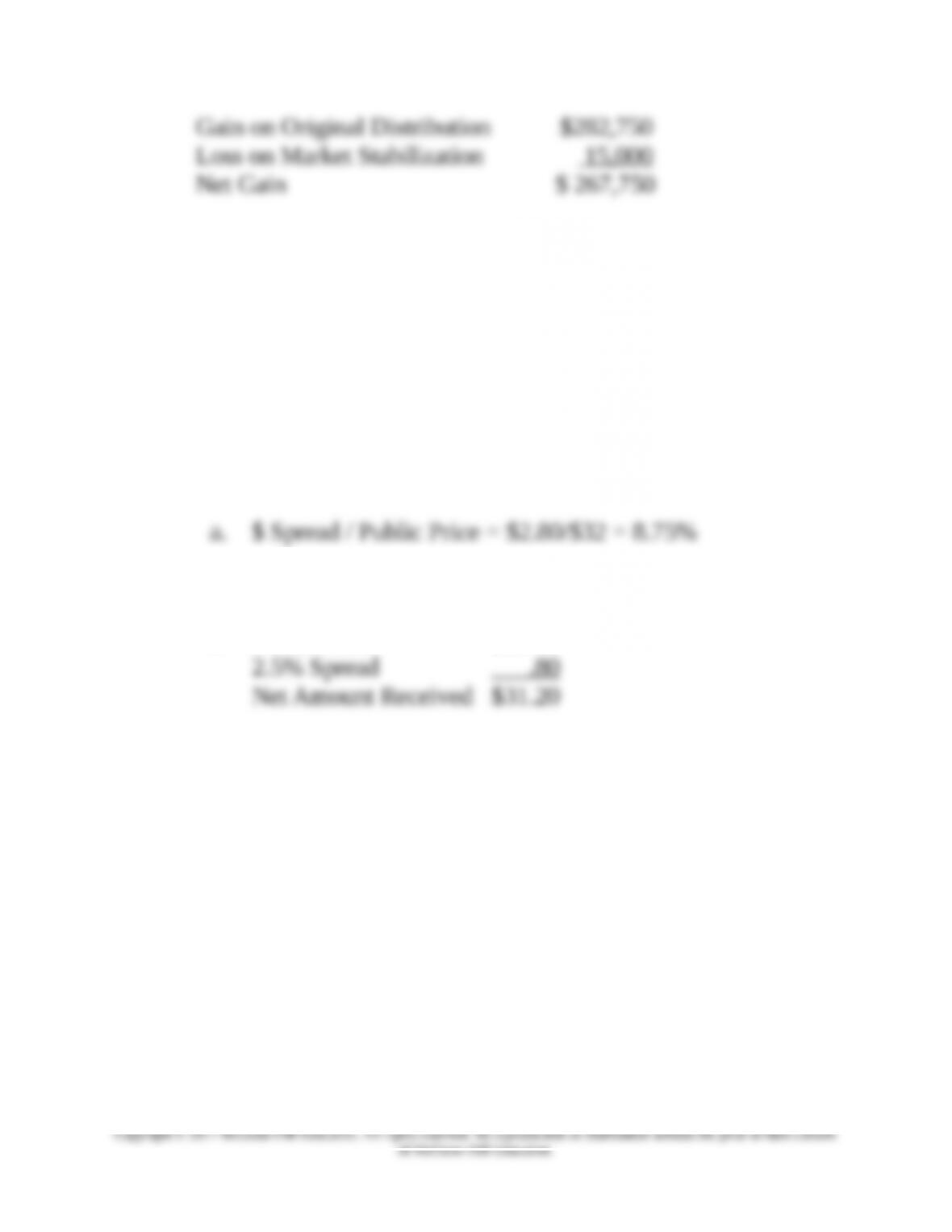
Original Distribution
10% 1,450,000 = 145,000 Shares for Becker
Distribution
Market Stabilization
50,000 Shares for Becker
$ 0.3 Loss per Share ($27.20 – $27.50)
$15,000 Loss on Market Stabilization
Chapter 15: Investment Banking: Public and Private Placement
13. Underwriting costs (LO15-2) Trump Card Co. will issue stock at a retail (public) price of
$32. The company will receive $29.20 per share.
a. What is the spread on the issue in percentage terms?
b. If the firm demands receiving a new price only $2.20 below the public price suggested
in part a, what will the spread be in percentage terms?
c. To hold the spread down to 2.5 percent based on the public price in part a, what net
amount should Trump Card Co. receive?
15-13. Solution:
Trump Card Company
b. $ Spread / Public Price = $2.20/$32 = 6.88%
c. Public Price $32.00
14. Underwriting costs (LO15-2) Winston Sporting Goods is considering a public offering of
common stock. Its investment banker has informed the company that the retail price will be
$16.85 per share for 550,000 shares. The company will receive $15.40 per share and will incur
$180,000 in registration, accounting, and printing fees.
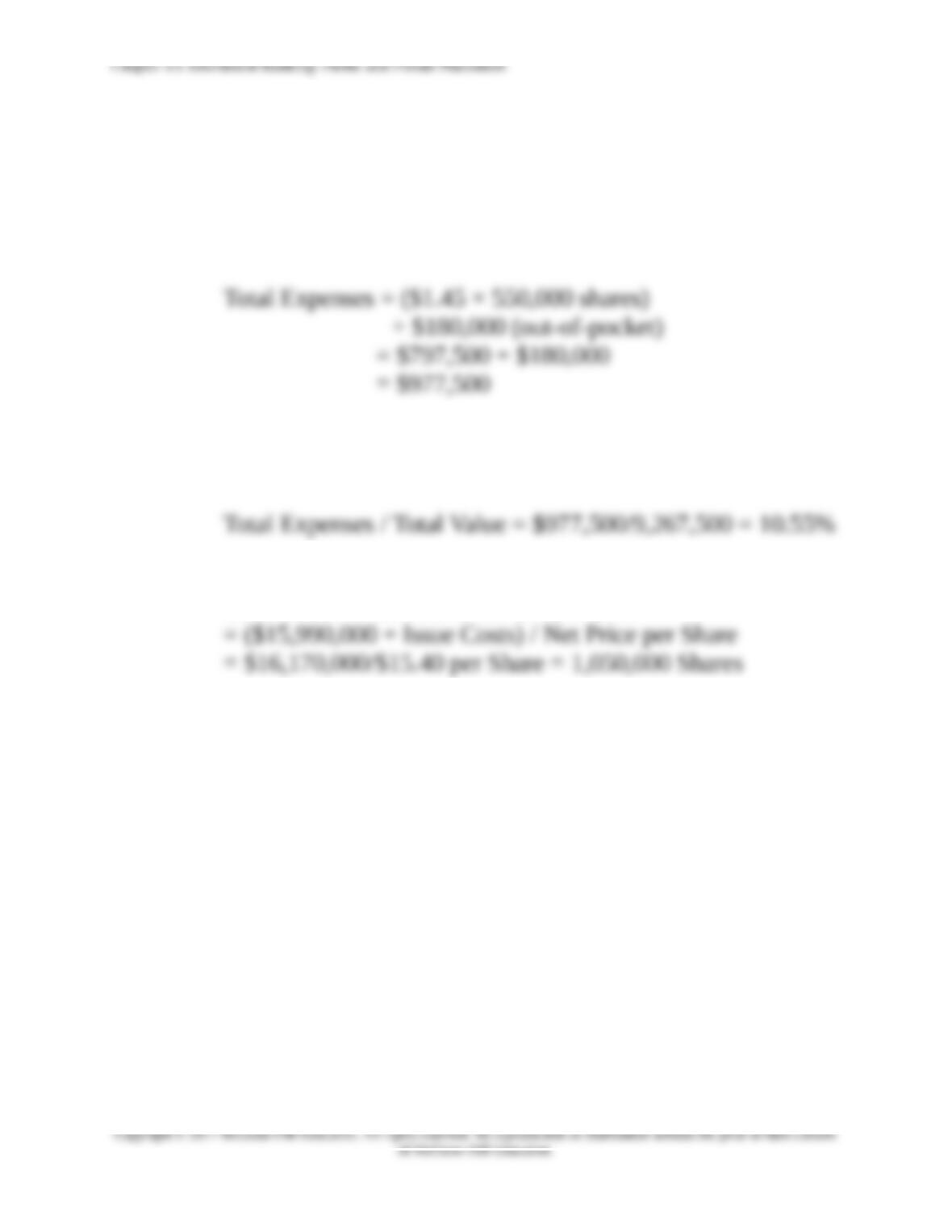
a. What is the spread on this issue in percentage terms? What are the total expenses of the
issue as a percentage of total value (at retail)?
b. If the firm wanted to net $15.99 million from this issue, how many shares must be sold?
15-14. Solution:
Winston Sporting Goods
a. $16.85 – $15.40 = $1.45 spread
$1.45/$16.85 = 8.61% spread
Total Value = 550,000 Shares $16.85 = $9,267,500
b. Amount Needed = $15,990,000
Total shares to be sold to net $15,990,000
15. P/E ratio for new public issue (LO15-2) Richmond Rent-A-Car is about to go public. The
investment banking firm of Tinkers, Evers, and Chance is attempting to price the issue. The
car rental industry generally trades at a 20 percent discount below the P/E ratio on the
Standard & Poor’s 500 Stock Index. Assume that index currently has a P/E ratio of 25. The
firm can be compared to the car rental industry as follows:
Richmond Car Rental Industry
Growth rate in earnings per share......... 15% 10%
Consistency of performance……........... Increased earnings Increased earnings
4 out of 5 years 3 out of 5 years
Debt to total assets………….….……….….. 52% 39%
Turnover of product……….….…….……... Slightly below Average
average
Quality of management………………..….. High Average
Assume, in assessing the initial P/E ratio, the investment banker will first determine the
appropriate industry P/E based on the Standard & Poor’s 500 Index. Then, a half point will
Chapter 15: Investment Banking: Public and Private Placement
be added to the P/E ratio for each case in which Richmond Rent-A-Car is superior to the
industry norm, and a half point will be deducted for an inferior comparison. On this basis,
what should the initial P/E be for the firm?
15-15. Solution:
Richmond Rent-A-Car
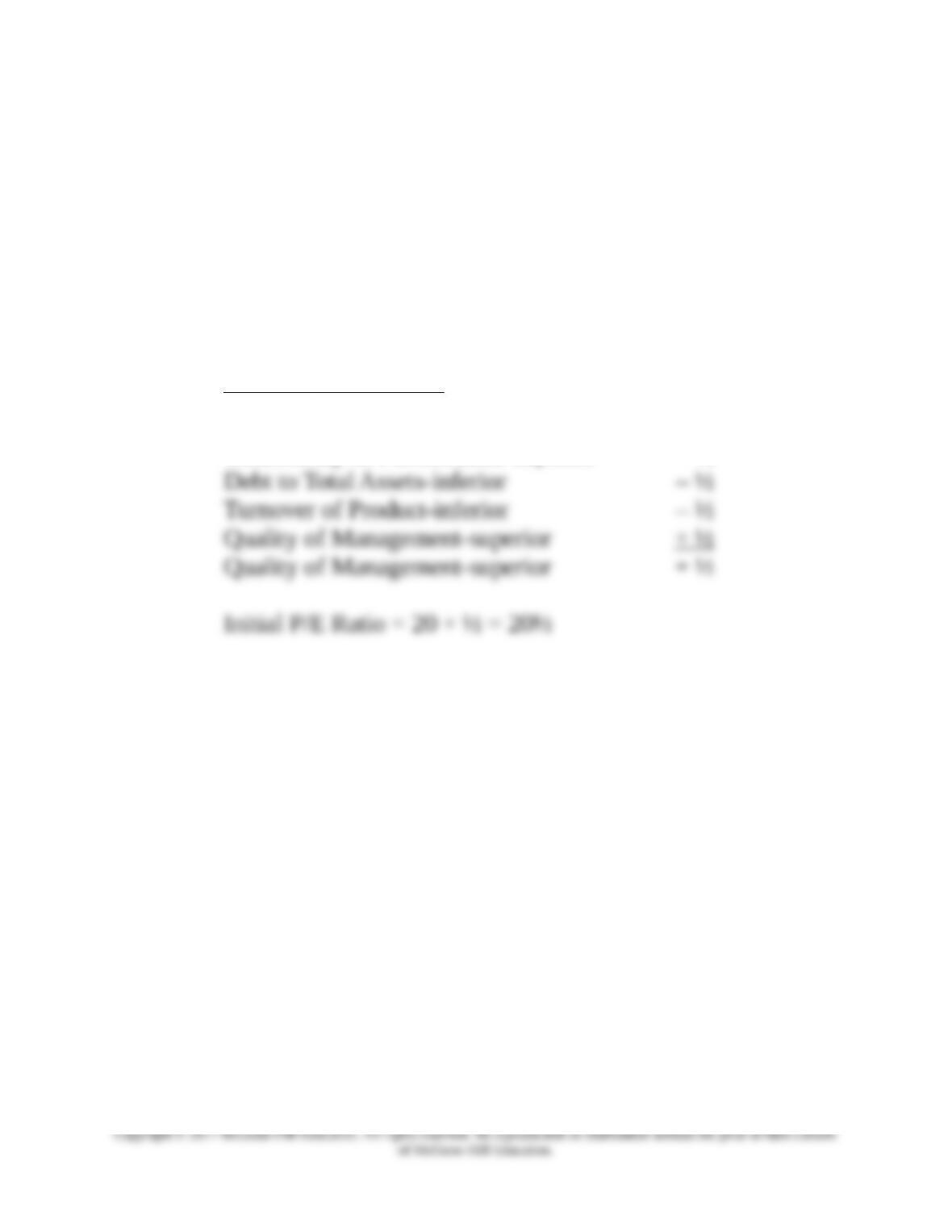
80% of the S&P 500 Stock Index = 80% × 25 = 20
Industry Comparisons
Growth rate in Earnings per Share-superior + ½
Consistency of Performance-superior + ½
16. Dividend valuation model for new public issue (LO15-1) The investment banking firm
of Einstein & Co. will use a dividend valuation model to appraise the shares of the Modern
Physics Corporation. Dividends (D1) at the end of the current year will be $1.64. The
growth rate (g) is 8 percent and the discount rate (Ke) is 13 percent.
a. What should be the price of the stock to the public?
b. If there is a 7 percent total underwriting spread on the stock, how much will the issuing
corporation receive?
c. If the issuing corporation requires a net price of $31.30 (proceeds to the corporation)
and there is a 7 percent underwriting spread, what should be the price of the stock to the
public? (Round to two places to the right of the decimal point.)
15-16. Solution:
Einstein & Co.
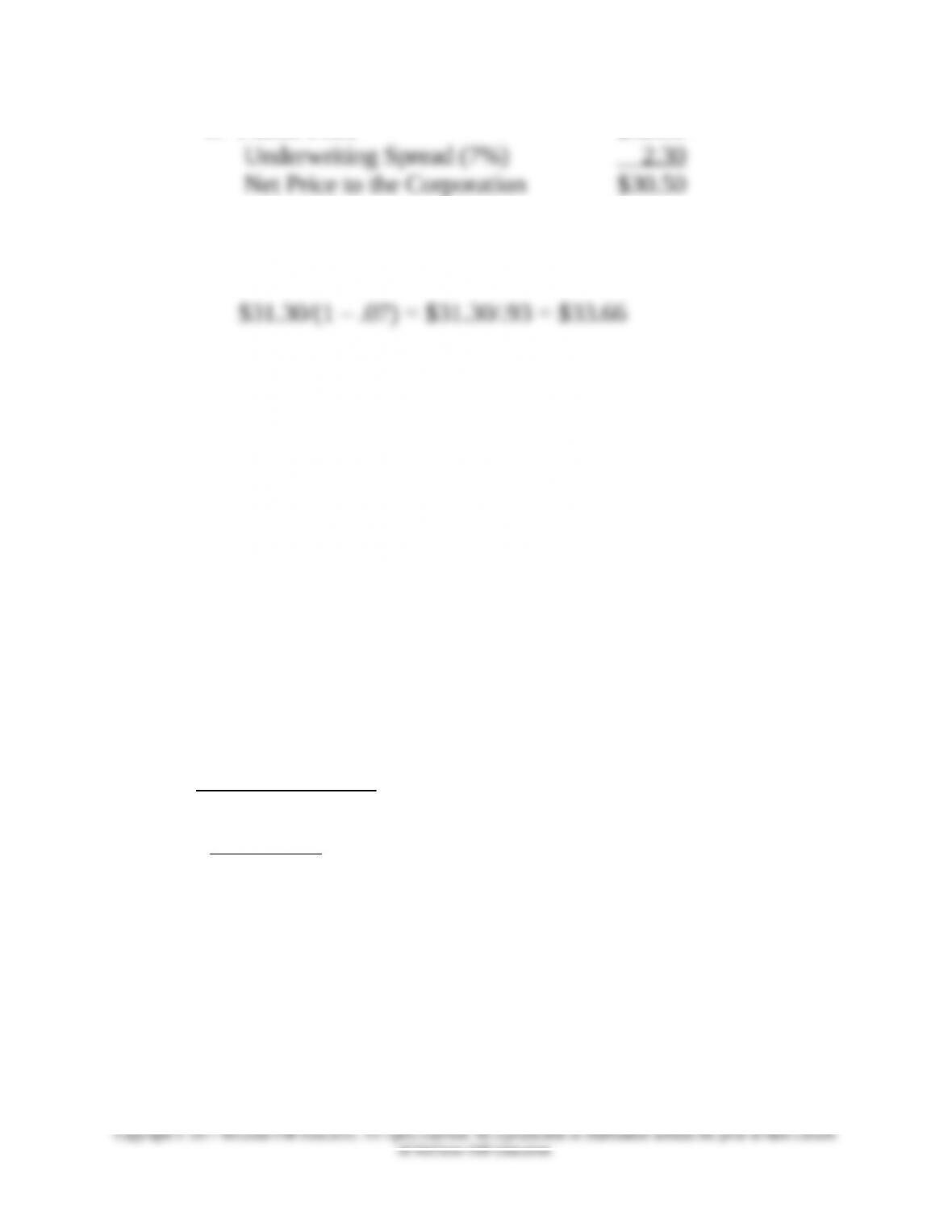
a. P0 = D1 / Ke – g = $1.64/0.13 – 0.08 = $1.64/0.05 = $32.8
Chapter 15: Investment Banking: Public and Private Placement
b. Public Price $32.80
c. Necessary = Net Price / (1 – Underwriting Spread)
Public Price
17. Comparison of private and public debt offering (LO15-1) The Landers Corporation
needs to raise $1.60 million of debt on a 20-year issue. If it places the bonds privately, the
interest rate will be 10 percent. Twenty thousand dollars in out-of-pocket costs will be
incurred. For a public issue, the interest rate will be 9 percent, and the underwriting spread
will be 2 percent. There will be $120,000 in out-of-pocket costs. Assume interest on the
debt is paid semiannually, and the debt will be outstanding for the full 20-year period, at
which time it will be repaid.
For each plan, compare the net amount of funds initially available—inflow—to the
present value of future payments of interest and principal to determine net present value.
Assume the stated discount rate is 12 percent annually. Use 6 percent semiannually
throughout the analysis. (Disregard taxes.)
15-17. Solution:
Landers Corporation
Private Placement
$1,600,000 Debt
– 20,000 Out-of-Pocket Costs
$ 1,580,000 Net Amount to Landers
Chapter 15: Investment Banking: Public and Private Placement
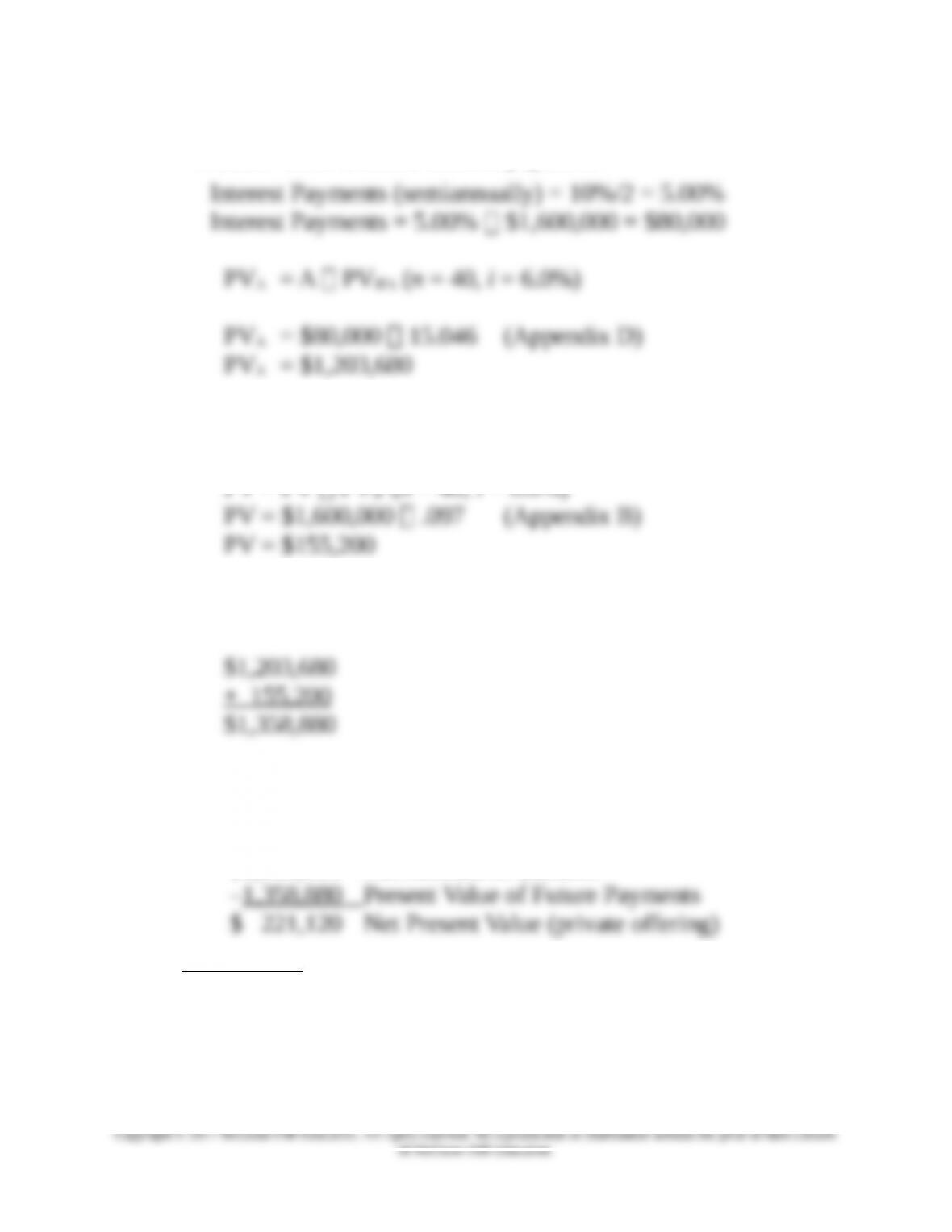
Present value of future interest payments
Present value of lump-sum payment at maturity
Total present value of interest and maturity payments
The net present value equals the net amount to Landers minus the
present value of future payments.
$1,580,000 Net Amount to Landers
Public Issue
Chapter 15: Investment Banking: Public and Private Placement
$1,600,000 Debt
–32,000 2% Spread
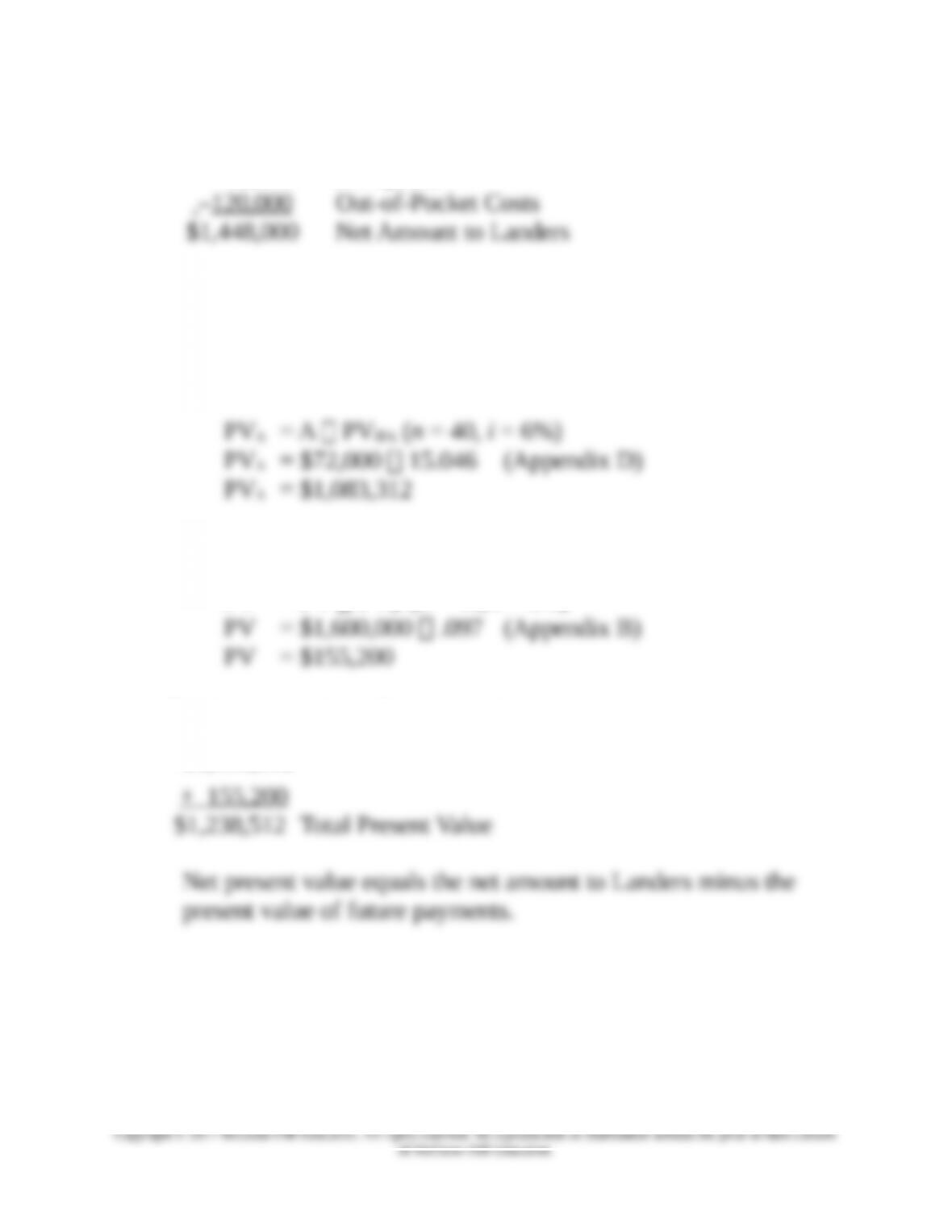
Present value of future interest payments
Interest Payments (semiannually) = 9%/2 = 4.50%
Interest Payments = 4.50% $1,600,000 = $72,000
Present value of lump-sum payment at maturity
PV = FV PVIF (n = 40, i = 6%)
Total present value of interest and maturity payments
$1,083,312
Chapter 15: Investment Banking: Public and Private Placement
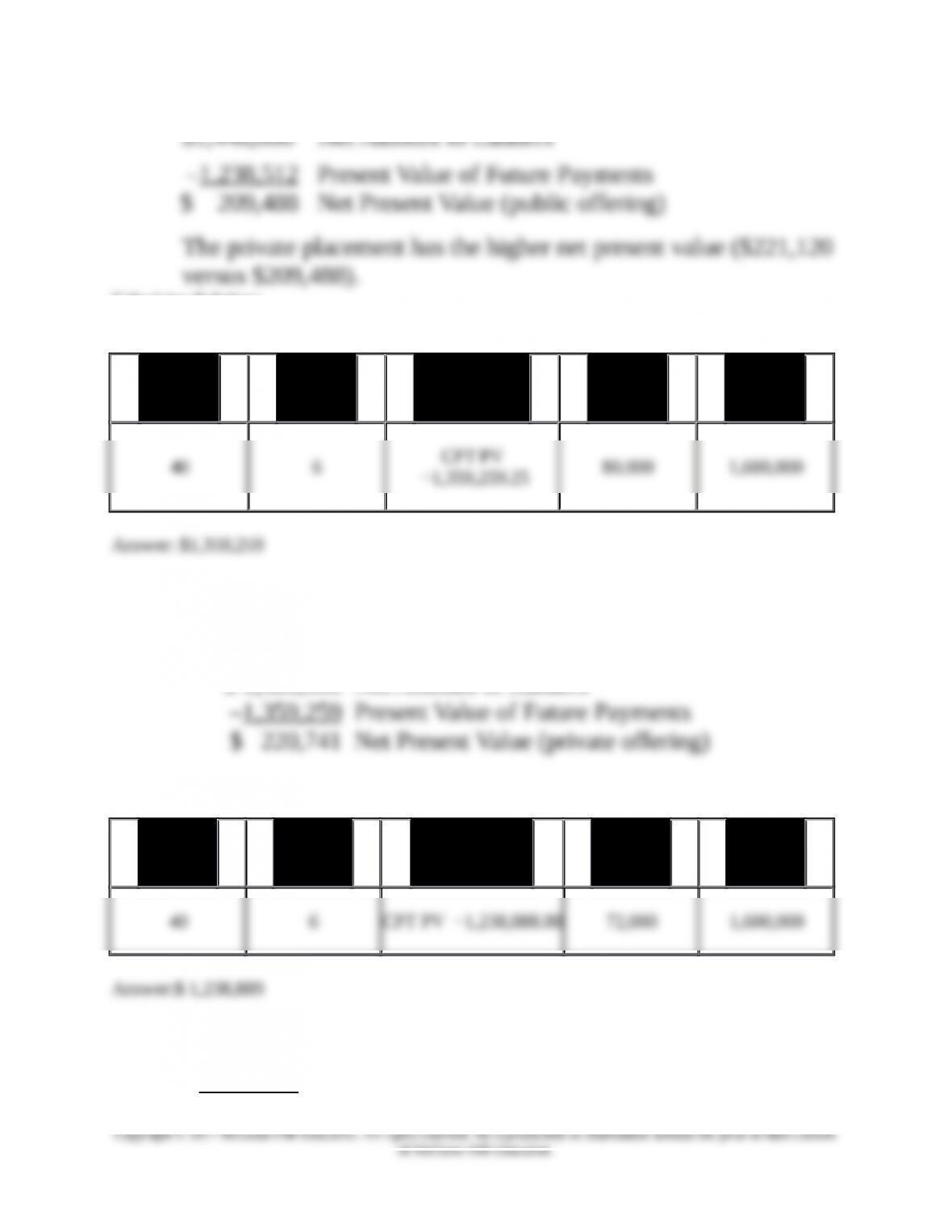
Calculator Solution:
Private Placement
N I/Y PV PMT FV
The net present value equals the net amount to Landers minus the
present value of future payments.
$ 1,580,000 Net Amount to Landers
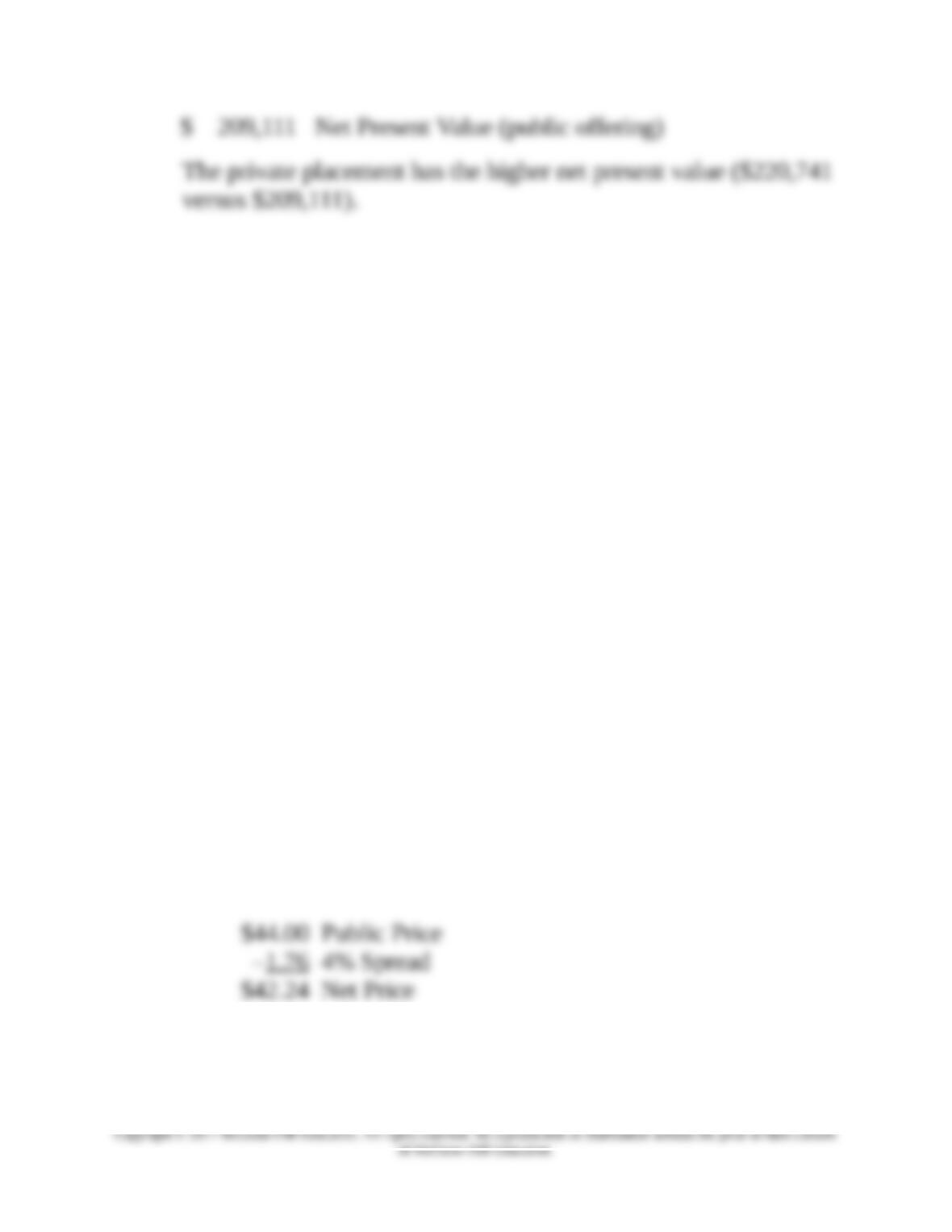
Public issue
N I/Y PV PMT FV
$ 1,448,000 Net Amount to Landers
–1,238,889 Present Value of Future Payments
Chapter 15: Investment Banking: Public and Private Placement
18. Features associated with a stock distribution (LO15-3) Midland Corporation has a net
income of $19 million and 4 million shares outstanding. Its common stock is currently
selling for $48 per share. Midland plans to sell common stock to set up a major new
production facility with a net cost of $21,120,000. The production facility will not produce
a profit for one year, and then it is expected to earn a 13 percent return on the investment.
Stanley Morgan and Co., an investment banking firm, plans to sell the issue to the public
for $44 per share with a spread of 4 percent.
a. How many shares of stock must be sold to net $21,120,000? (Note: No out-of-pocket
costs must be considered in this problem.)
b. Why is the investment banker selling the stock at less than its current market price?
c. What are the earnings per share (EPS) and the price-earnings ratio before the issue
(based on a stock price of $48)? What will be the price per share immediately after the
sale of stock if the P/E stays constant?
d. Compute the EPS and the price (if the P/E stays constant) after the new production
facility begins to produce a profit.
e. Are the shareholders better off because of the sale of stock and the resultant
investment? What other financing strategy could the company have tried to increase
earnings per share?
15-18. Solution:
Midland Corporation
a. $21,120,000 net amount to be raised.
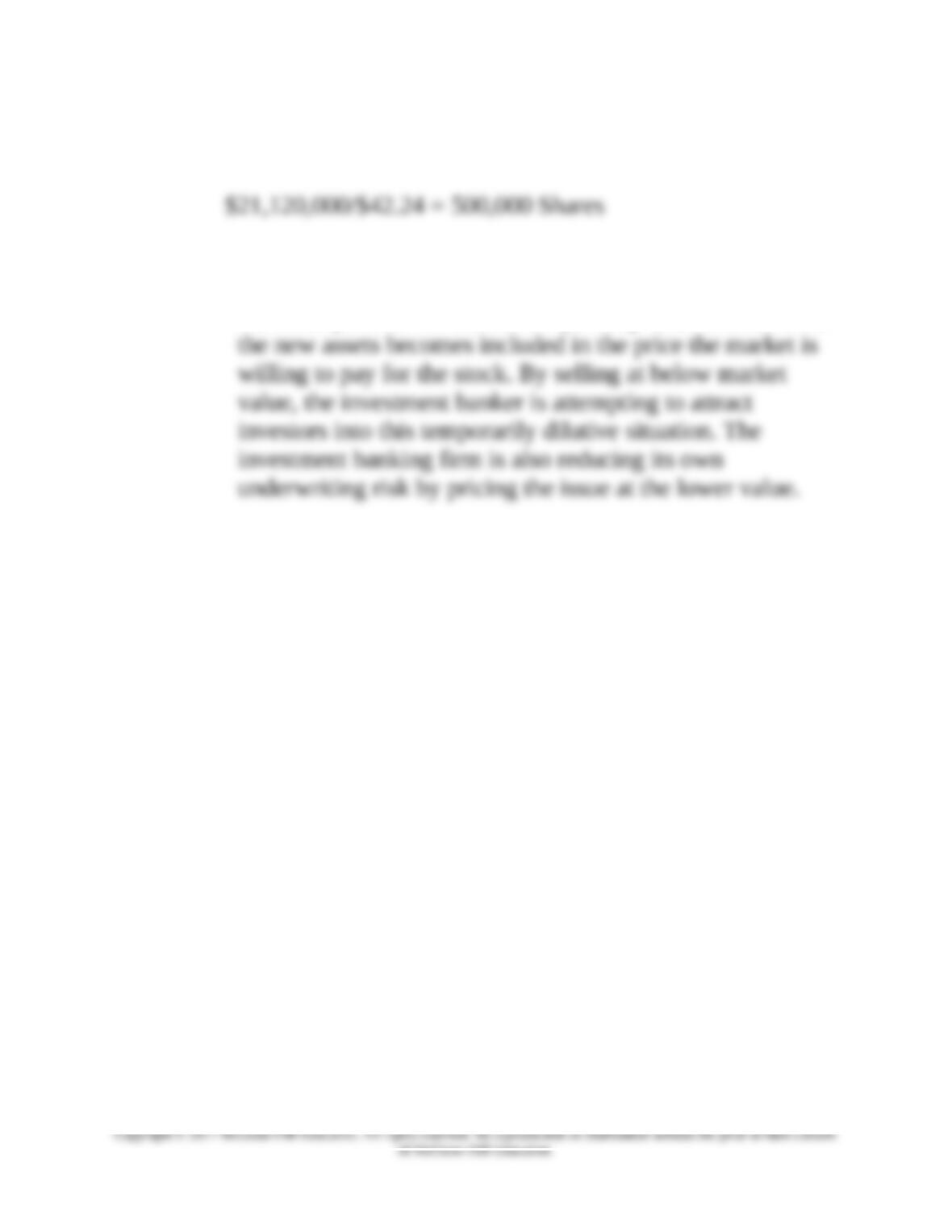
Determine net price to the corporation
Chapter 15: Investment Banking: Public and Private Placement
Determine number of shares to be sold
b. The new shares will increase the total number of shares
outstanding and dilute EPS. This dilution effect may reduce
the stock price in the market temporarily until income from