Chapter 15: Investment Banking: Public and Private Placement
Chapter 15
Investment Banking: Public and Private Placement
Discussion Questions
15-1. In what way is an investment banker a risk taker?
The investment banker is a risk taker (underwriter) in that the investment
15-2. What is the purpose of market stabilization activities during the distribution
process?
Market stabilization activities are managed in an attempt to insure that the
15-3. Discuss how an underwriting syndicate decreases risk for each underwriter and
at the same time facilitates the distribution process.
By forming a syndicate of many underwriters rather than just one, the overall
15-4. Discuss the reason for the differences between underwriting spreads for stocks
and bonds.
Chapter 15: Investment Banking: Public and Private Placement
15-5. What is shelf registration? How does it differ from the traditional requirements
for security offerings?
Shelf registration permits large companies to file one comprehensive
registration statement (under SEC Rule 415). This statement outlines the firm’s
15-6. Discuss the benefits accruing to a company that is traded in the public securities
markets.
The benefits of having a publicly traded security are:
a. Greater ability to raise capital.
15-7. What are the disadvantages to being public?
The disadvantage of being public are:
a. All information must be made available to the public through SEC and state
filings. This can be very expensive for a small company.
15-8. If a company was looking for capital by way of a private placement, where
would it look for funds?
Chapter 15: Investment Banking: Public and Private Placement
15-9. How does a leveraged buyout work? What does the debt structure of the firm
normally look like after a leveraged buyout? What might be done to reduce the
debt?
The use of a leveraged buy-out implies that either management or some other
15-10. How might a leveraged buyout eventually lead to high returns for companies?
15-11. What is privatization?
In the international markets, investment bankers sell companies to the public
Chapter 15
Problems
1. Dilution effect of stock issue (LO15-3) Louisiana Timber Company currently has 5
million shares of stock outstanding and will report earnings of $9 million in the current
year. The company is considering the issuance of 1 million additional shares that will net
$40 per share to the corporation.
a. What is the immediate dilution potential for this new stock issue?
b. Assume the Louisiana Timber Company can earn 11 percent on the proceeds of the
stock issue in time to include it in the current year’s results. Should the new issue be
undertaken based on earnings per share?
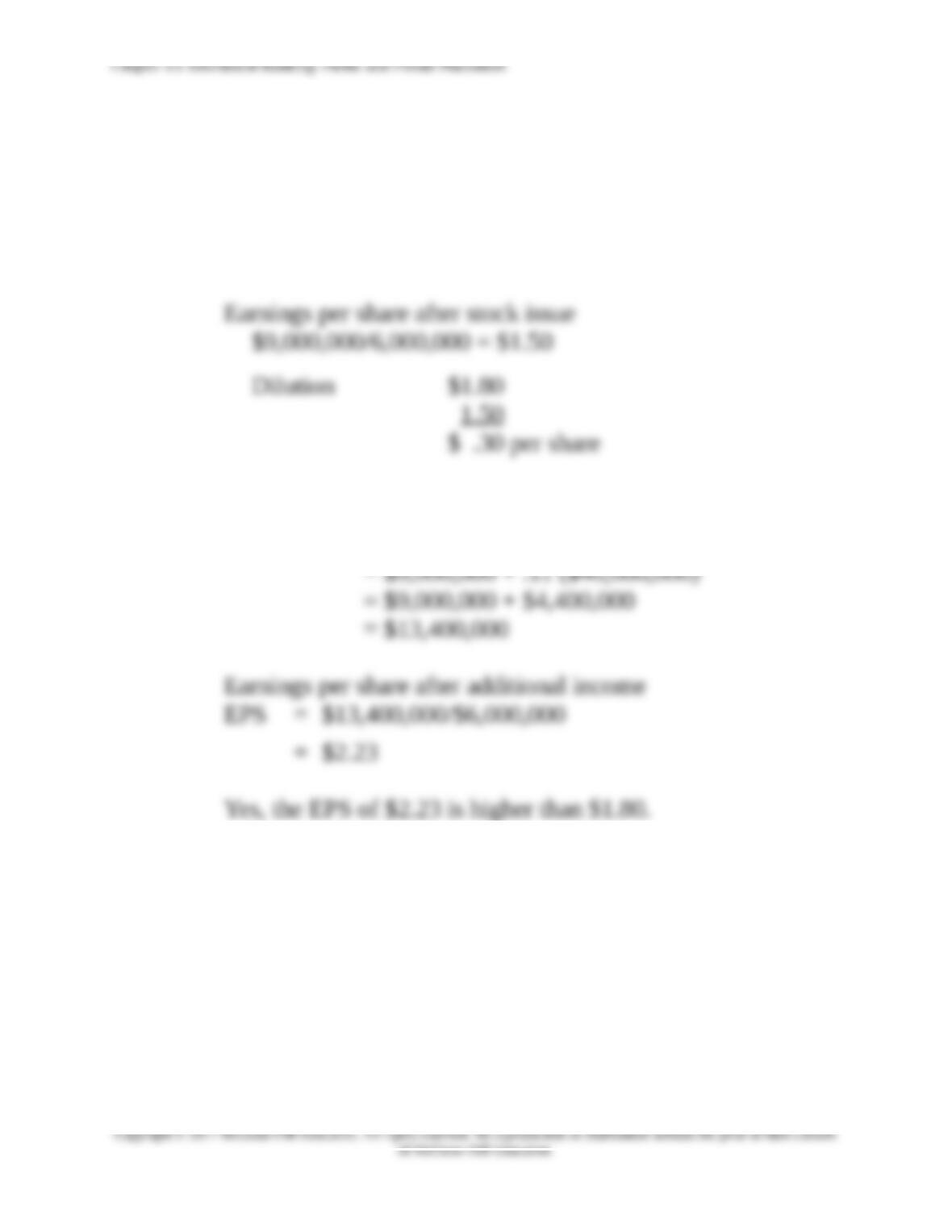
15-1. Solution:
Louisiana Timber Company
a. Earnings per share before stock issue
$9,000,000/5,000,000 = $1.80
b. Net income = $9,000,000 + .11 ($1,000,000 $40)
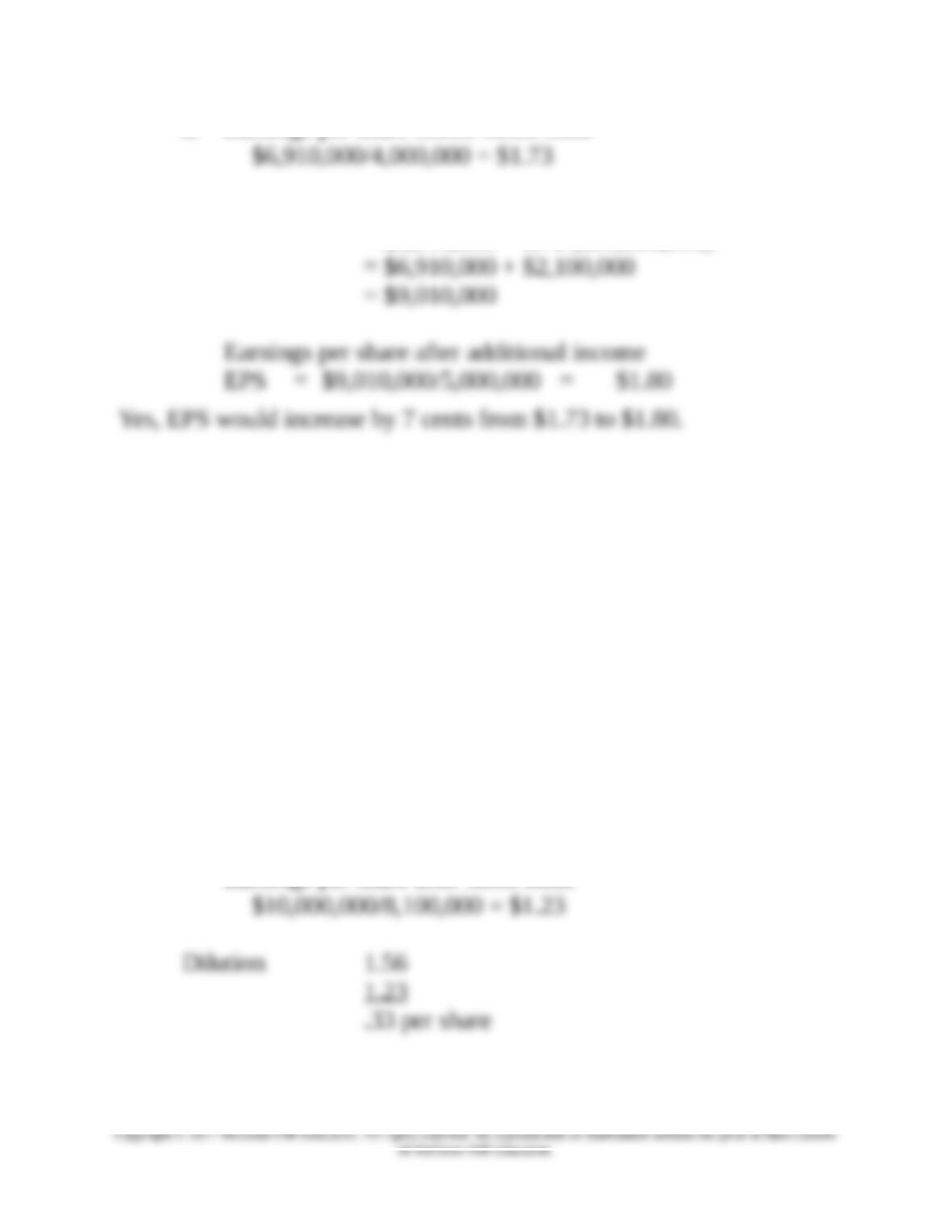
2. Dilution effect of stock issue (LO15-3) The Hamilton Corporation Company has 4 million
shares of stock outstanding and will report earnings of $6,910,000 in the current year. The
company is considering the issuance of 1 million additional shares that can only be issued
at $30 per share.
a. Assume the Hamilton Corporation Company can earn 7.00 percent on the proceeds.
Calculate the earnings per share.
b. Should the new issue be undertaken based on earnings per share?
15-2. Solution:
Chapter 15: Investment Banking: Public and Private Placement
a. Earnings per share before stock issue
b. Net income = $6,910,000 + .070 (1,000,000 $30)
= $6,910,000 + .070 ($30,000,000)
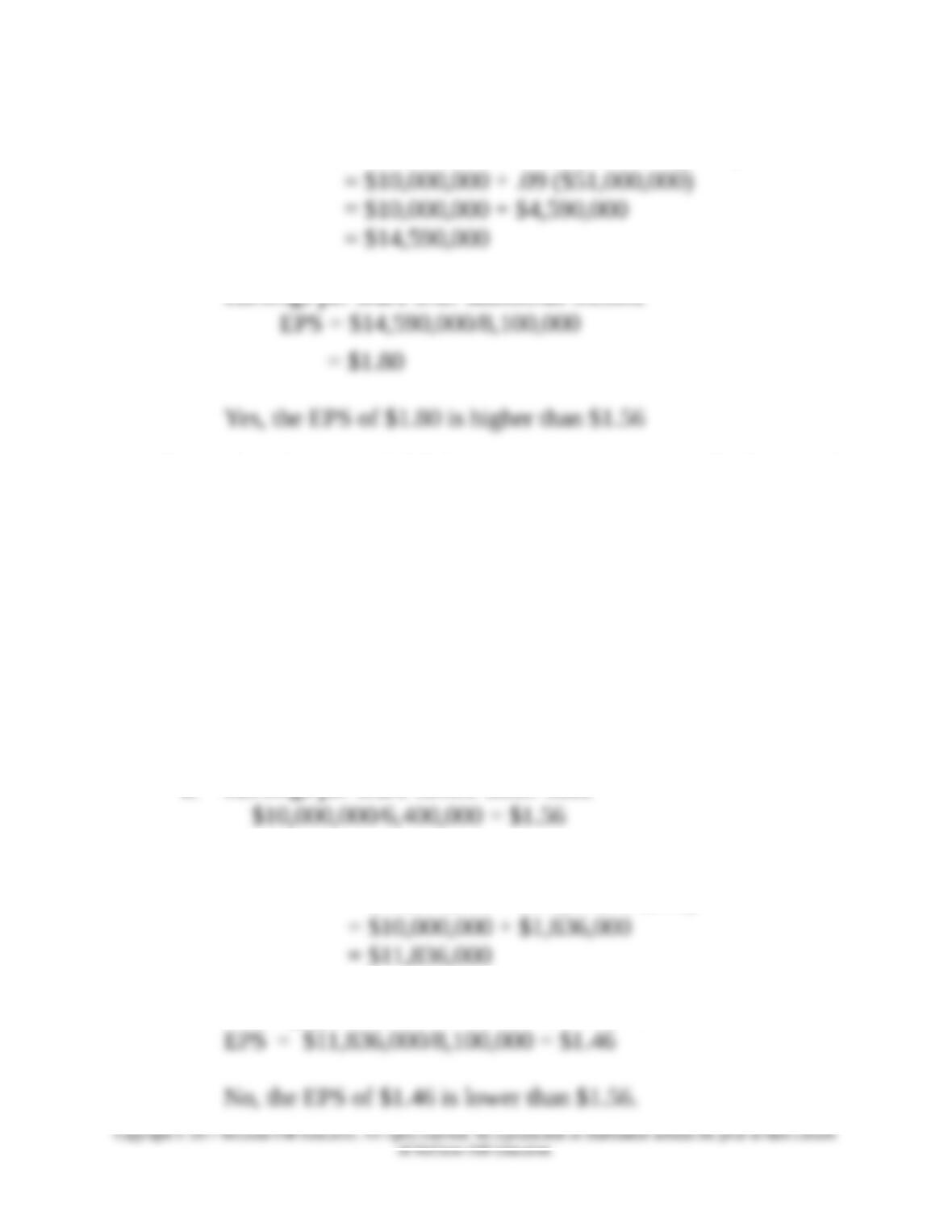
3. Dilution effect of stock issue (LO15-3) American Health Systems currently has 6,400,000
shares of stock outstanding and will report earnings of $10 million in the current year. The
company is considering the issuance of 1,700,000 additional shares that will net $30 per
share to the corporation.
a. What is the immediate dilution potential for this new stock issue?
b. Assume that American Health Systems can earn 9 percent on the proceeds of the stock
issue in time to include them in the current year’s results. Calculate earnings per share.
Should the new issue be undertaken based on earnings per share?
15-3. Solution:
American Health Systems
a. Earnings per share before stock issue
$10,000,000/6,400,000 = $1.56
Earnings per share after stock issue

Chapter 15: Investment Banking: Public and Private Placement
Chapter 15: Investment Banking: Public and Private Placement
b. Net income = $10,000,000 + .09 (1,700,000 $30)
Earnings per share after additional income
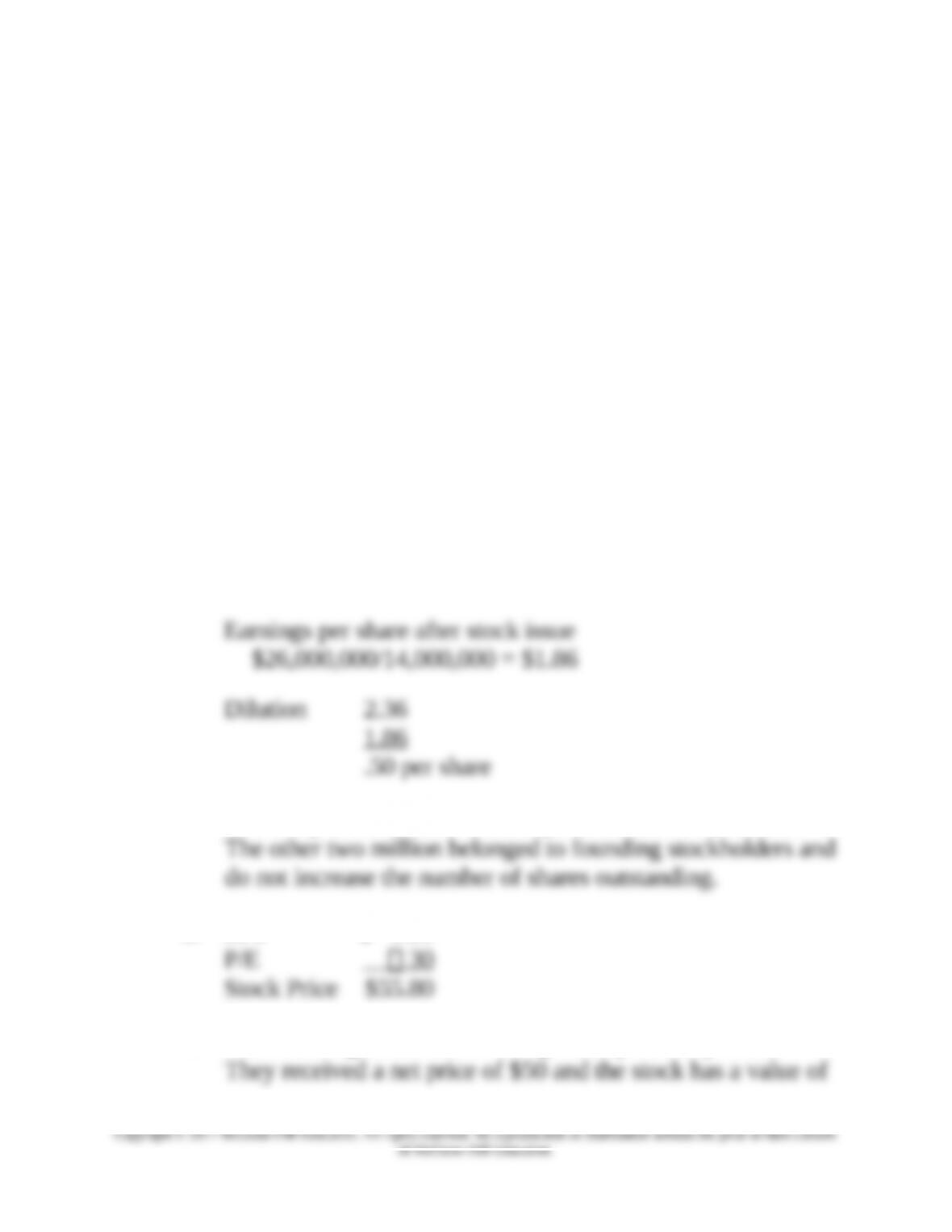
4. Dilution effect of stock issue (LO15-3) American Health Systems has 6,400,000 shares of
stock outstanding and will report earnings of $10 million in the current year. The company
is considering the issuance of 1,700,000 additional shares, which can only be issued at $18
per share.
a. Assume that American Health Systems can earn 6 percent on the proceeds. Calculate
earnings per share.
b. Should the new issue be undertaken based on earnings per share?
15-4. Solution:
American Health Systems
a. Earnings per share before stock issue
b. Net income = $10,000,000 + .06 (1,700,000 $18)
= $10,000,000 + .06 ($30,600,000)
Earnings per share after additional income
Chapter 15: Investment Banking: Public and Private Placement
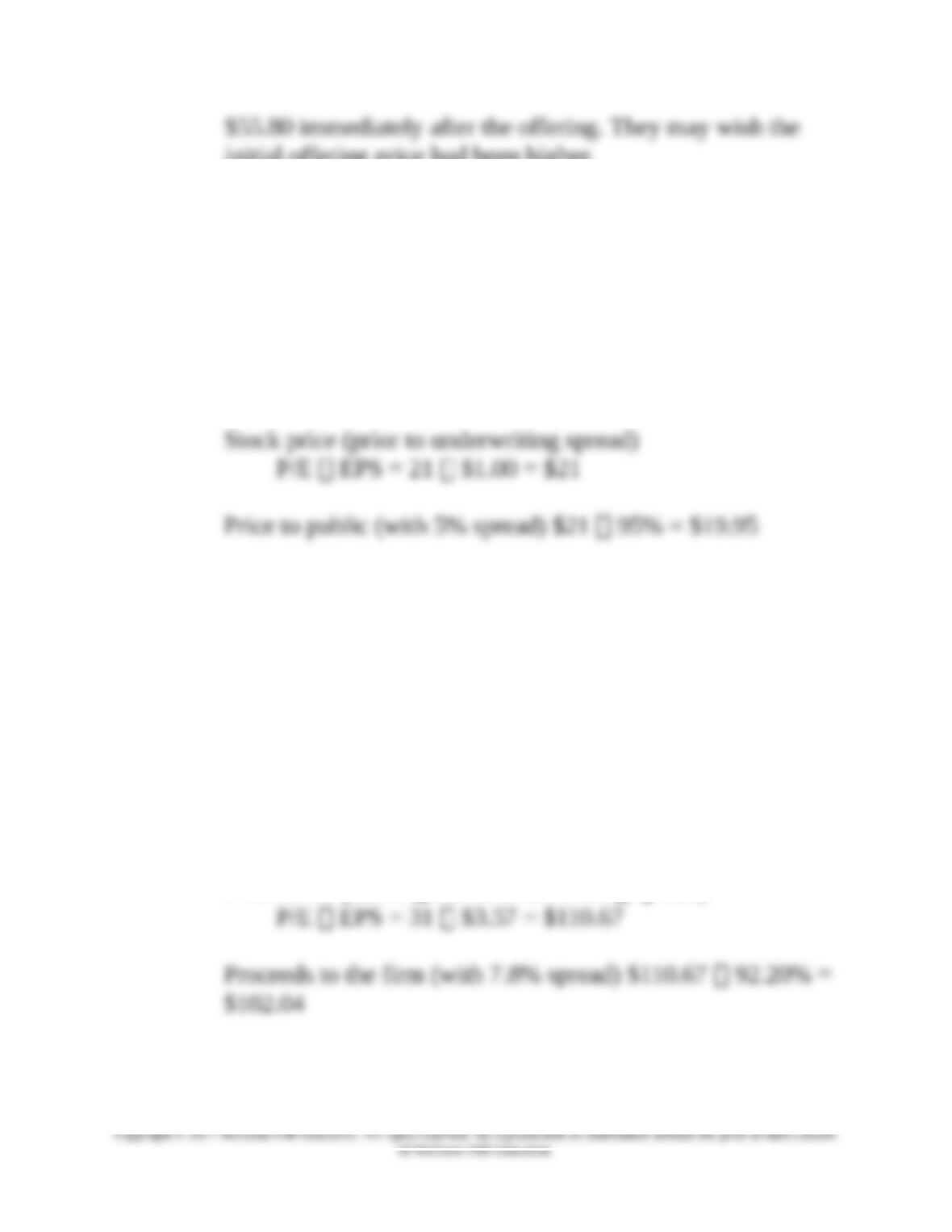
5. Dilution and pricing effect of stock issue (LO15-3) Jordan Broadcasting Company is
going public at $50 net per share to the company. There also are founding stockholders that
are selling part of their shares at the same price. Prior to the offering, the firm had $26
million in earnings divided over 11 million shares. The public offering will be for 5 million
shares; 3 million will be new corporate shares and 2 million will be shares currently owned
by the founding stockholders.
a. What is the immediate dilution based on the new corporate shares that are being
offered?
b. If the stock has a P/E of 30 immediately after the offering, what will the stock price be?
c. Should the founding stockholders be pleased with the $50 they received for their
shares?
15-5. Solution:
Jordan Broadcasting Company
a. Earnings per share before stock issue
$26,000,000/11,000,000 = $2.36
Note only three million new corporate shares were issued.
b. EPS $ 1.86
c. The founding stockholders will probably not be pleased.
Chapter 15: Investment Banking: Public and Private Placement
initial offering price had been higher.
6. Underwriting Spread (LO15-2) Solar Energy Corp. has $4 million in earnings with four
million shares outstanding. Investment bankers think the stock can justify a P/E ratio of 21.
Assume the underwriting spread is 5 percent. What should the price to the public be?
15-6. Solution:
Solar Energy Corp.
Earnings per share = $4 million / 4 million = $1.00
7. Underwriting Spread (LO15-2) Tiger Golf Supplies has $25 million in earnings with 7
million shares outstanding. Its investment banker thinks the stock should trade at a P/E
ratio of 31. Assume there is an underwriting spread of 7.8 percent. What should the price to
the public be?
15-7. Solution:
Tiger Golf Supplies
Earnings per share = $25 million / 7 million = $3.57
Price to the public (prior to underwriting spread)
Chapter 15: Investment Banking: Public and Private Placement
8. Underwriting Spread (LO15-2) Assume Sybase Software is thinking about three different
size offerings for issuance of additional shares.
Size of Offer Public Price Net to Corporation
a. 1.1 million........ $30 $27.50
b. 7.0 million........ $30 28.44
c. 28.0 million...... $30 29.15
What is the percentage underwriting spread for each size offer?
15-8. Solution:
Sybase Software
a. Spread = $30 – $27.50 =
b. Spread = $30 – $28.44 = $1.56 (on $7.0 million)
c. Spread = $30 – $29.15 = $.85 (on $28 million)
9. Underwriting spread (LO15-2) Walton and Company is the managing investment banker
for a major new underwriting. The price of the stock to the investment banker is $23 per
share. Other syndicate members may buy the stock for $24.25. The price to the selected
dealers group is $24.80, with a price to brokers of $25.20. Finally, the price to the public is
$29.50.
a. If Walton and Company sells its shares to the dealer group, what will the percentage
return be?
b. If Walton and Company performs the dealer’s function also and sells to brokers, what
will the percentage return be?
c. If Walton and Company fully integrates its operation and sells directly to the public,
what will its percentage return be?
15-9. Solution:
Chapter 15: Investment Banking: Public and Private Placement
Walton and Company
a. $24.80 Selected Dealer Group’s Price
23.00 Managing Investing Banker’s Price
b. $25.20 Broker’s Price
23.00 Managing Investing Banker’s Price
c. $29.50 Public Price
23.00 Managing Investing Banker’s Price
10. Underwriting spread (LO15-2) The Wrigley Corporation needs to raise $44 million. The
investment banking firm of Tinkers, Evers, & Chance will handle the transaction.
a. If stock is utilized, 2,300,000 shares will be sold to the public at $20.50 per share.
The corporation will receive a net price of $19 per share. What is the percentage
underwriting spread per share?
b. If bonds are utilized, slightly over 43,700 bonds will be sold to the public at $1,009 per
bond. The corporation will receive a net price of $994 per bond. What is the percentage
of underwriting spread per bond? (Relate the dollar spread to the public price.)
c. Which alternative has the larger percentage of spread? Is this the normal relationship
between the two types of issues?
15-10. Solution:
Chapter 15: Investment Banking: Public and Private Placement
Wrigley Corporation
a. Spread = $20.50 – $19.00 = $1.50
b. Spread = $1,009 – $994 = $15
c. The stock alternative has the larger percentage spread. This is
11. Secondary offering (LO15-2) Kevin’s Bacon Company Inc. has earnings of $9 million
with 2,100,000 shares outstanding before a public distribution. Seven hundred thousand
shares will be included in the sale, of which 400,000 are new corporate shares, and 300,000 are
shares currently owned by Ann Fry, the founder and CEO. The 300,000 shares that Ann is
selling are referred to as a secondary offering, and all proceeds will go to her.
The net price from the offering will be $16.50, and the corporate proceeds are expected
to produce $1.8 million in corporate earnings.
a. What were the corporation’s earnings per share before the offering?
b. What are the corporation’s earnings per share expected to be after the offering?