12-29. (Continued)
Next, determine the net present value.
Cash Flow Present
Year (Inflows) PVIF at 12% Value
1 $29,064 .893 $ 25,954
2 33,960 .797 27,066
3 30,600 .712 21,787
4 17,400 .636 11,066
5 15,672 .567 8,886
Calculator Solution:
Using a financial calculator,
Press the following keys: 2nd, CF, 2nd, Clear.
Press down arrow, enter 1, and press Enter.
Press down arrow, enter 30,600, and press Enter.
Press down arrow, enter 3, and press Enter.
Press down arrow, enter 13,560, and press Enter.
Press down arrow; calculator shows NPV = 0.00.
Press CPT; calculator shows NPV = 3,053, which is the NPV of the project.
30. Working capital requirements in capital budgeting (LO12-4) The Spartan Technology
Company has a proposed contract with the Digital Systems Company of Michigan. The initial
investment in land and equipment will be $120,000. Of this amount, $70,000 is subject to five–
year MACRS depreciation. The balance is in nondepreciable property. The contract covers six
years; at the end of six years, the nondepreciable assets will be sold for $50,000. The
depreciated assets will have zero resale value.
The contract will require an additional investment of $55,000 in working capital at the
beginning of the first year and, of this amount, $25,000 will be returned to the Spartan
Technology Company after six years.
The investment will produce $50,000 in income before depreciation and taxes for each of
the six years. The corporation is in a 40 percent tax bracket and has a 10 percent cost of capital.
Should the investment be undertaken? Use the net present value method.
12-30. Solution:
Spartan Technology Company
Although there are some complicated features to this problem,
we are still comparing the present value of cash flows to the
total initial investment.
The initial investment is:
Percentage
Depreciation Depreciation Annual
Year Base (Table 12-9) Depreciation
1 $70,000 .200 $14,000
2 70,000 .320 22,400
3 70,000 .192 13,440
We then determine the annual cash flow. In addition to normal
Then, determine the annual cash flow.
Annual Cash Flow
1 2 3 4 5 6
EBDT $50,000 $50,000 $50,000 $50,000 $50,000 $50,000
– D 14,000 22,400 13,440 8,050 8,050 4,060
EBT 36,000 27,600 36,560 41,950 41,950 45,940
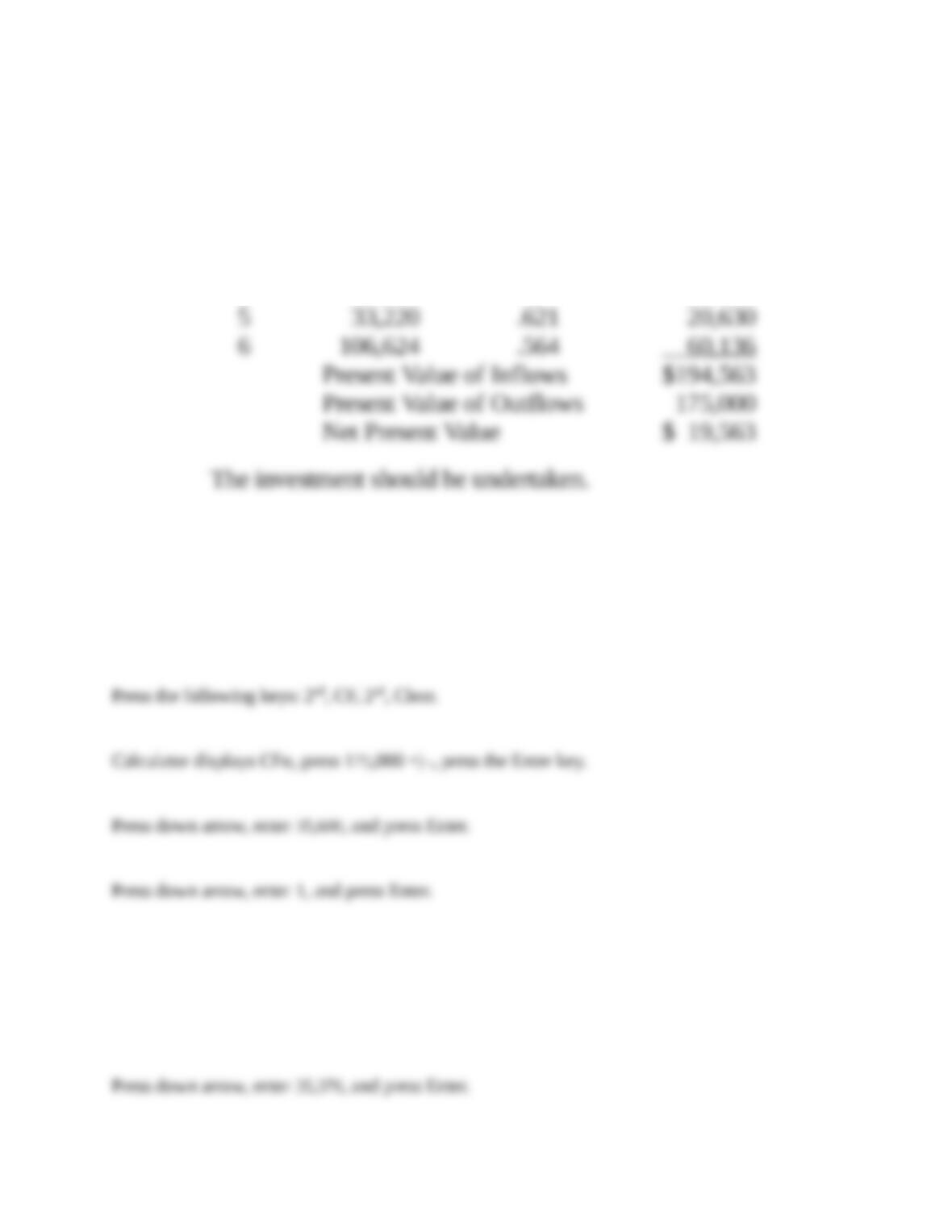
Cash Flow Present
Year (Inflows) PVIF @ 10% Value
1 $ 35,600 .909 $ 32,360
2 38,960 .826 32,181
3 35,376 .751 26,567
4 33,220 .683 22,689
Calculator Solution:
Using a financial calculator:
Press down arrow, enter 38,960, and press Enter.
Press down arrow, enter 1, and press Enter.
Press down arrow, enter 106,624, and press Enter.
Press down arrow, enter 1, and press Enter.
31. Tax losses and gains in capital budgeting (LO12-2) An asset was purchased three years
ago for $120,000. It falls into the five-year category for MACRS depreciation. The firm is
in a 35 percent tax bracket. Compute the following:
a. Tax loss on the sale and the related tax benefit if the asset is sold now for $15,060.
b. Gain and related tax on the sale if the asset is sold now for $56,060. (Refer to footnote 4 in
the chapter.)
12-31. Solution:
First determine the book value of the asset.
Percentage
Depreciation Depreciation Annual
Year Base (Table 12-9) Depreciation
1 $120,000 .200 $24,000
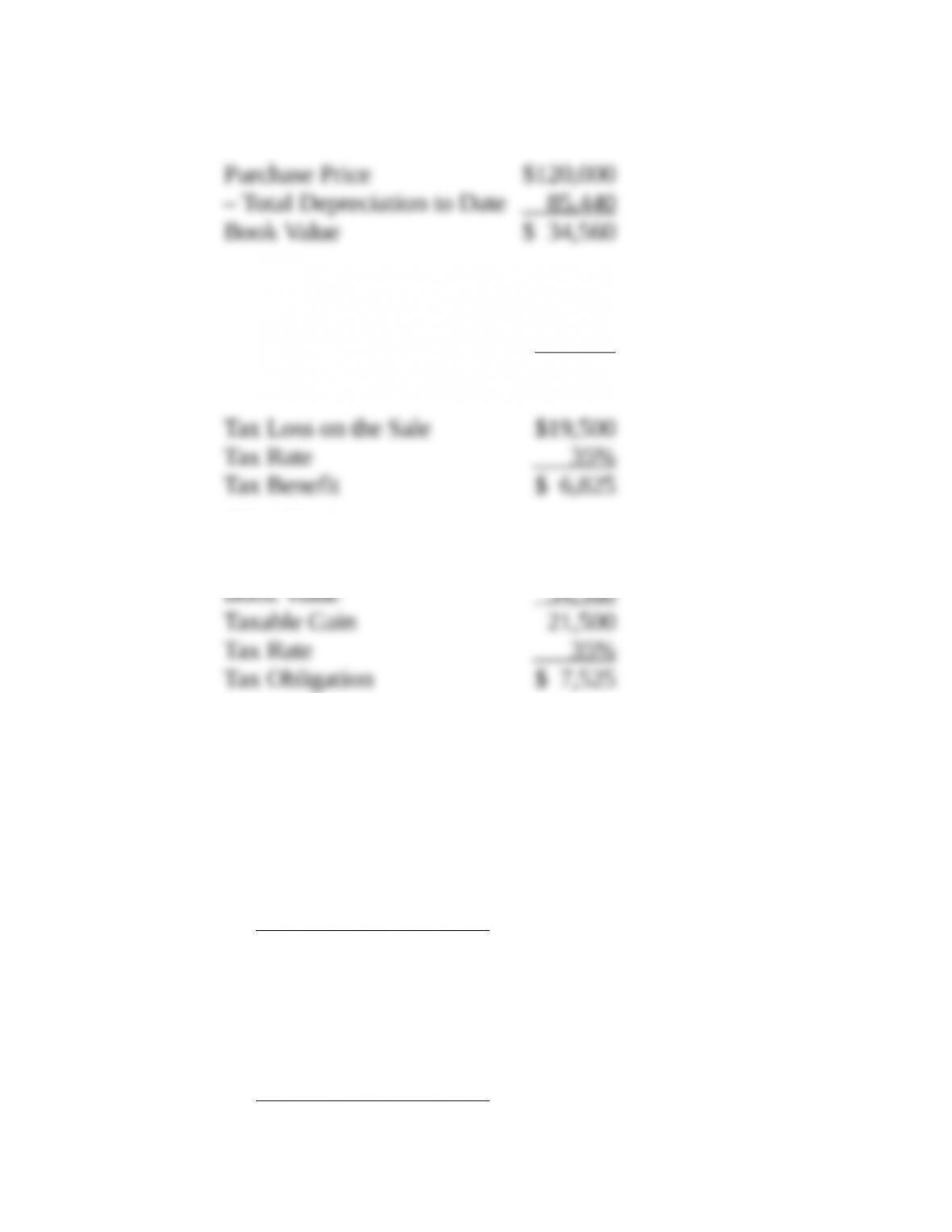
a. $15,060 sales price
Book Value $34,560
Sales Price 15,060
Tax Loss on the Sale $19,500
b. $56,060 sales price
Sales Price $56,060
32. Capital budgeting with cost of capital computation (LO12-5) DataPoint Engineering is
considering the purchase of a new piece of equipment for $240,000. It has an eight-year
midpoint of its asset depreciation range (ADR). It will require an additional initial
investment of $140,000 in nondepreciable working capital. Thirty-five thousand dollars of
this investment will be recovered after the sixth year and will provide additional cash flow
for that year. Here is the projected income before depreciation and taxes for the next six
years:
Year Amount
1…………………. $185,000
2…………………. 160,000
3…………………. 130,000
4…………………. 115,000
5…………………. 95,000
6…..…….......... 85,000

The tax rate is 40 percent. The cost of capital must be computed based on
the following (round the final value to the nearest whole number):
Cost (aftertax) Weights
Debt…………………………………………….…….. Kd 9.5% 25%
Preferred stock…………………………………….. Kp13.2 25
Common equity (retained earnings)…........ Ke18.0 50
a. Determine the annual depreciation schedule.
b. Determine annual cash flow. Include recovered working capital in the sixth year.
c. Determine the weighted average cost of capital.
d. Determine the net present value. Should DataPoint purchase the new equipment?
12-32. Solution:
DataPoint Engineering
a. An eight-year midpoint of the ADR leads to five-year
MACRS depreciation.
Percentage
Depreciation Depreciation Annual
Year Base (Table 12-9) Depreciation
1 $ 240,000 .200 $ 48,000
2 240,000 .320 76,800
3 240,000 .192 46,080
b. Annual Cash Flow
1 2 3 4 5 6
EBDT $185,000 $160,000 $130,000 $115,000 $95,000 $85,000
– D 48,000 76,800 46,080 27,600 27,600 13,920
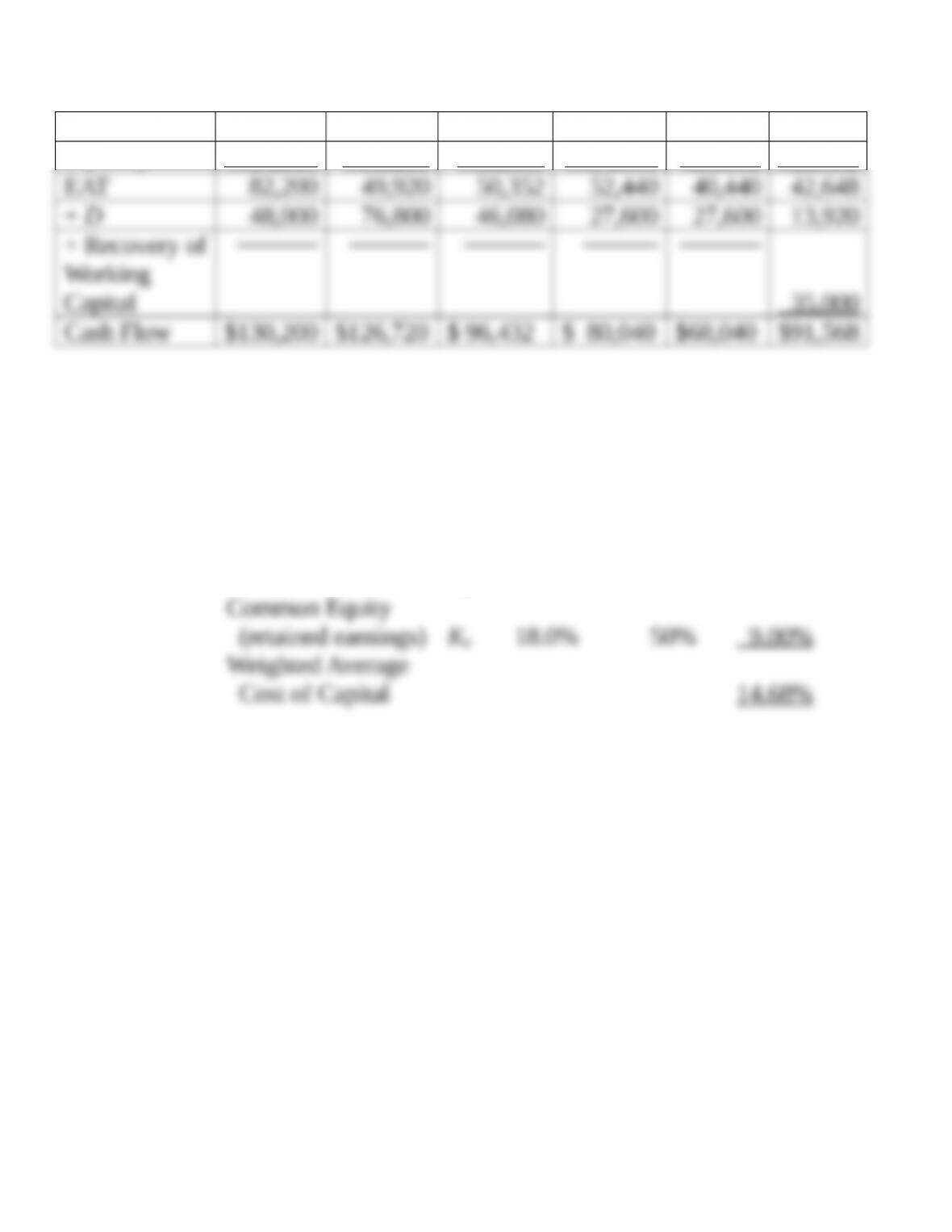
EBT $137,000 $ 83,200 $ 83,920 87,400 $67,400 71,080
T (40%) 54,800 33,280 33,568 34,960 26,960 28,432
c. Weighted Average Cost of Capital
Cost
(aftertax) Weights Weighted
Debt Kd9.5% 25% 2.38%
Preferred Stock Kp13.2% 25% 3.30%
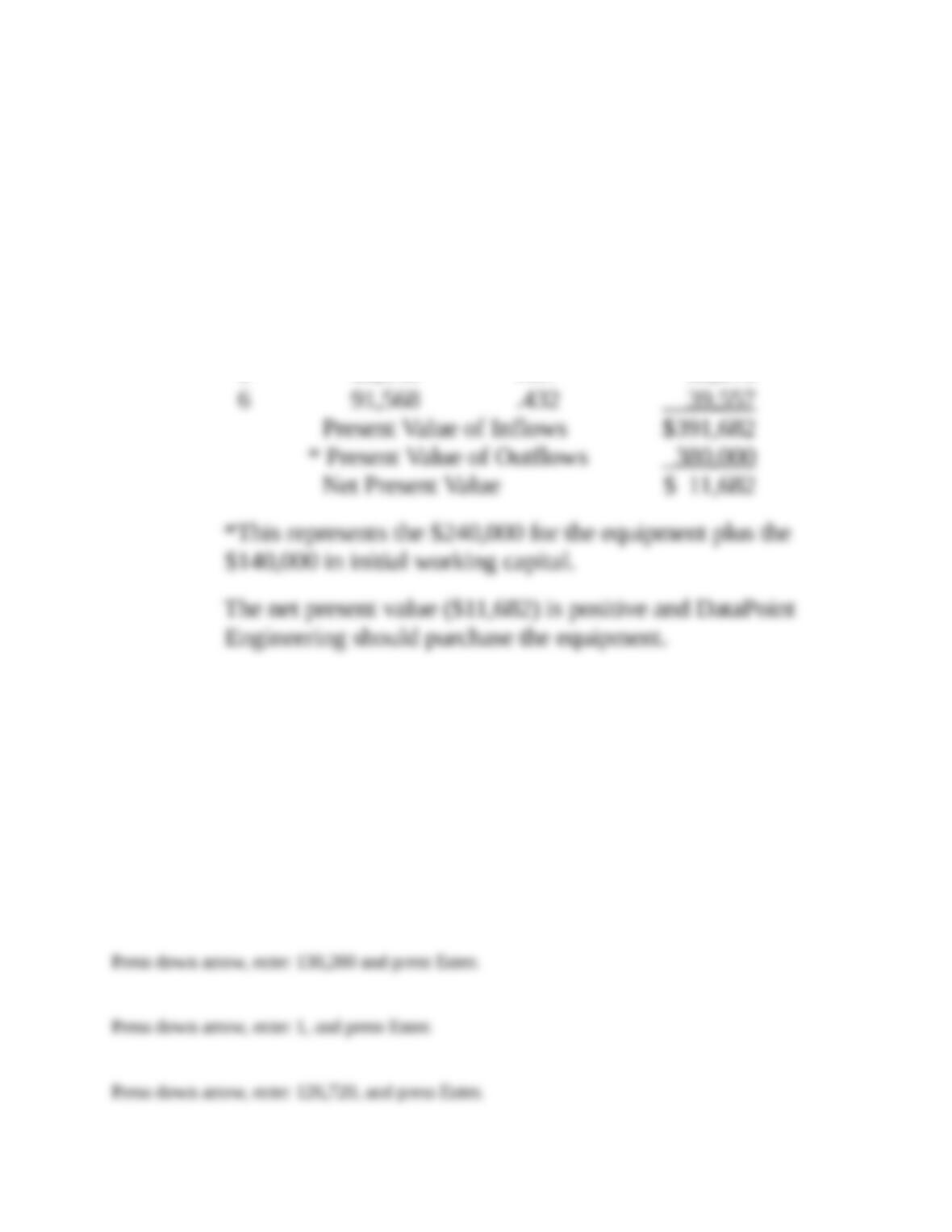
d. Net Present Value
Cash Flow Present
Year (inflows) PVIF at 15% Value
1 $130,200 .870 $113,274
2 126,720 .756 95,800
3 96,432 .658 63,452
4 80,040 .572 45,783
5 68,040 .497 33,816
Calculator Solution:
Using a financial calculator:
(d)
Press the following keys: 2nd, CF, 2nd, Clear.
Calculator displays CFo, press 380,000 +|–, press the Enter key.
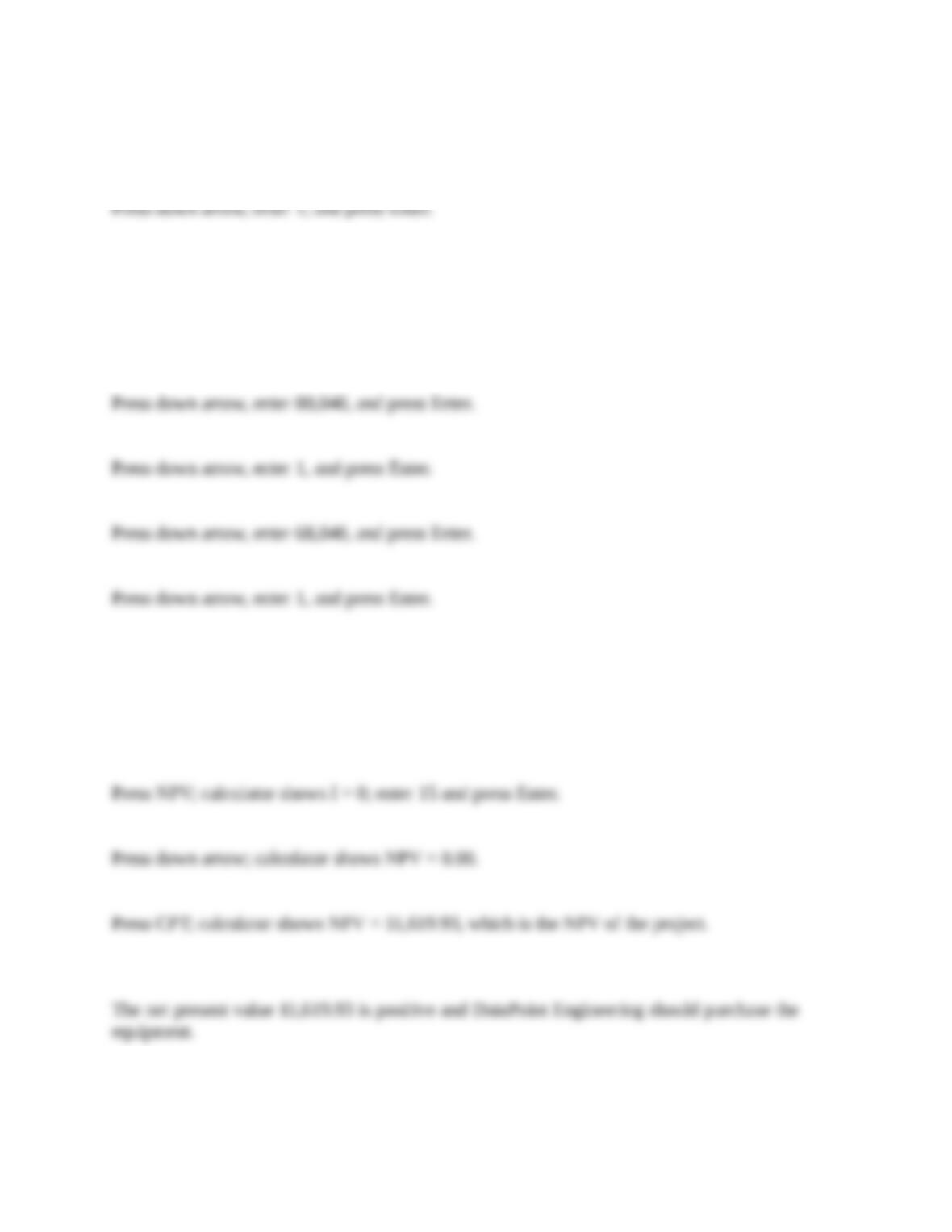
Press down arrow, enter 96,432, and press Enter.
Press down arrow, enter 1, and press Enter.
Press down arrow, enter 91,568, and press Enter.
Press down arrow, enter 1, and press Enter.

33. Replacement decision analysis (LO12-4) Hercules Exercise Equipment Co. purchased a
computerized measuring device two years ago for $58,000. The equipment falls into the
five-year category for MACRS depreciation and can currently be sold for $24,800.
A new piece of equipment will cost $148,000. It also falls into the five-year category
for MACRS depreciation.
Assume the new equipment would provide the following stream of added cost savings
for the next six years.
Year Cash Savings
1………… $62,000
2………… 54,000
3………… 52,000
4………… 50,000
5………… 47,000
6………… 36,000
The firm’s tax rate is 35 percent and the cost of capital is 12 percent.
a. What is the book value of the old equipment?
b. What is the tax loss on the sale of the old equipment?
c. What is the tax benefit from the sale?
d. What is the cash inflow from the sale of the old equipment?
e. What is the net cost of the new equipment? (Include the inflow from the sale of the
old equipment.)
f. Determine the depreciation schedule for the new equipment.
g. Determine the depreciation schedule for the remaining years of the old equipment.
h. Determine the incremental depreciation between the old and new equipment and the
related tax shield benefits.
i. Compute the aftertax benefits of the cost savings.
j. Add the depreciation tax shield benefits and the aftertax cost savings, and determine
the present value. (See Table 12-17 as an example.)
k. Compare the present value of the incremental benefits (j) to the net cost of the new
equipment (e). Should the replacement be undertaken?
12-33. Solution:
Hercules Exercise Equipment Co.
a.
Percentage
Depreciation Depreciation Annual
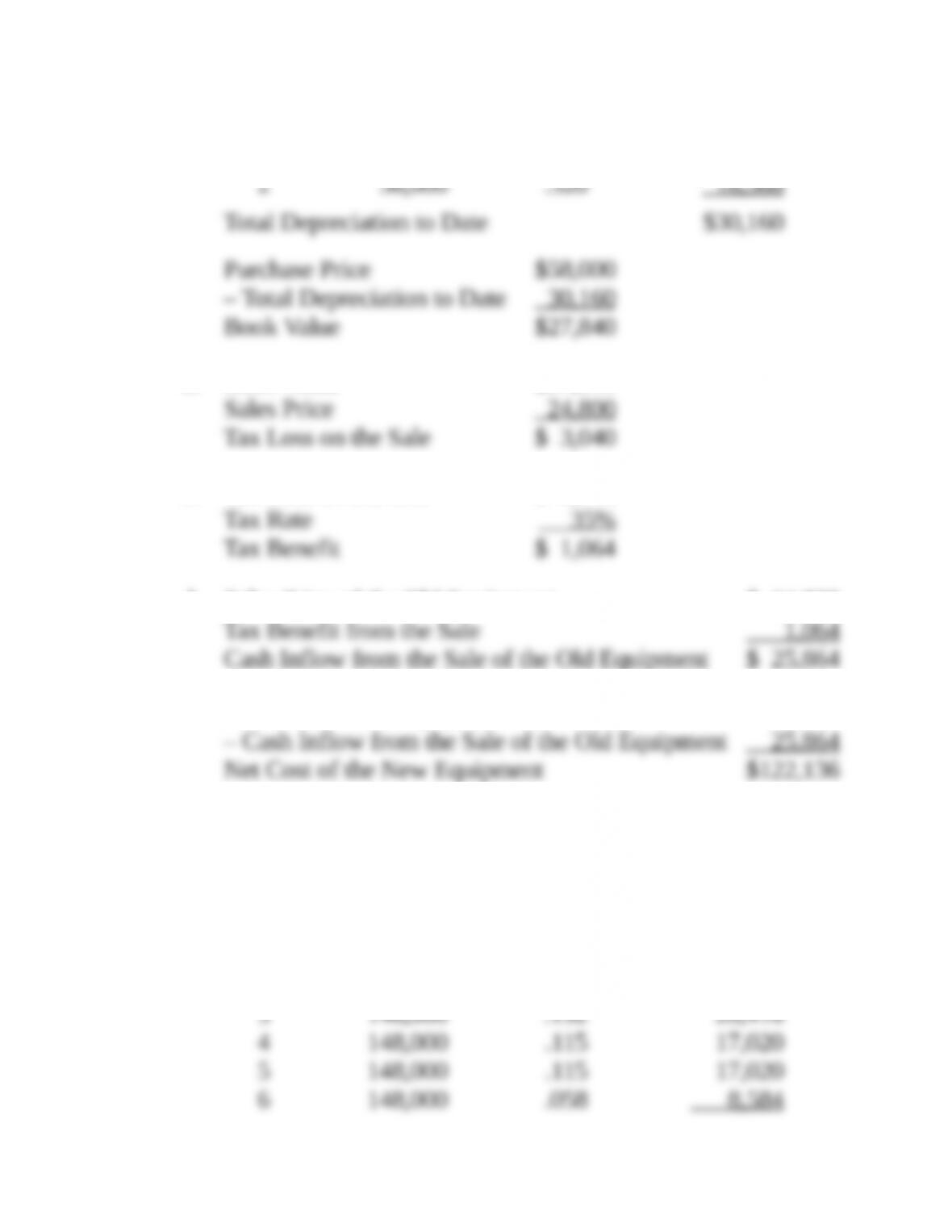
Year Base (Table 12-9) Depreciation
1 $58,000 .200 $11,600
b. Book Value $27,840
c. Tax Loss on the Sale $ 3,040
d. Sales Price of the Old Equipment $ 24,800
e. Price of the New Equipment $148,000
f. Depreciation schedule on the new equipment
Percentage
Depreciation Depreciation Annual
Year Base (Table 12-9) Depreciation
1 $148,000 .200 $ 29,600
2 148,000 .320 47,360
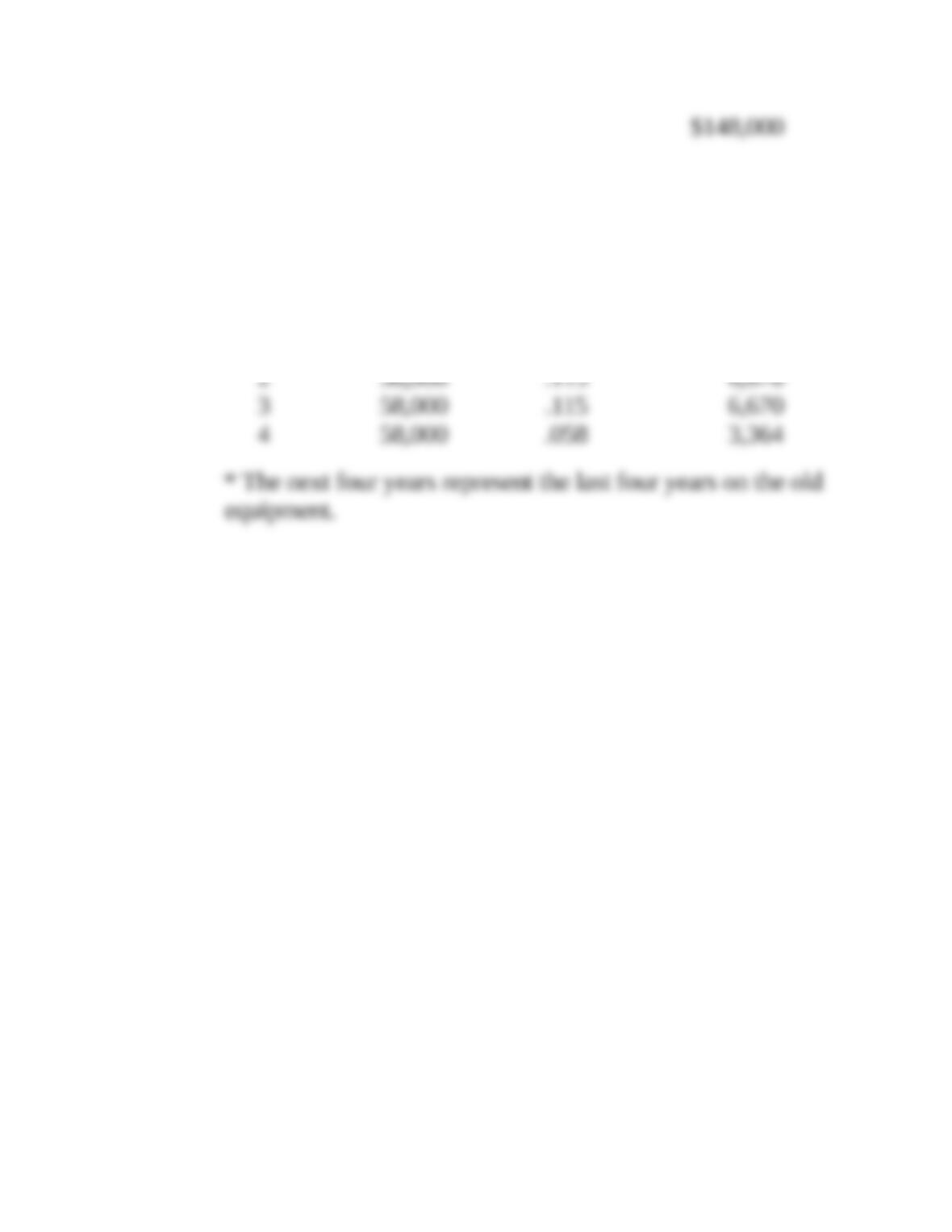
g. Depreciation schedule for the remaining years of the old
equipment
Percentage
Depreciation Depreciation Annual
Year* Base (Table 12-9) Depreciation
1 $58,000 .192 $11,136