Chapter 12: The Capital Budgeting Decision
12-20. Solution:
Turner Video
a. Reinvestment assumption of NPV
No. of
Year Inflows Rate Periods
Value
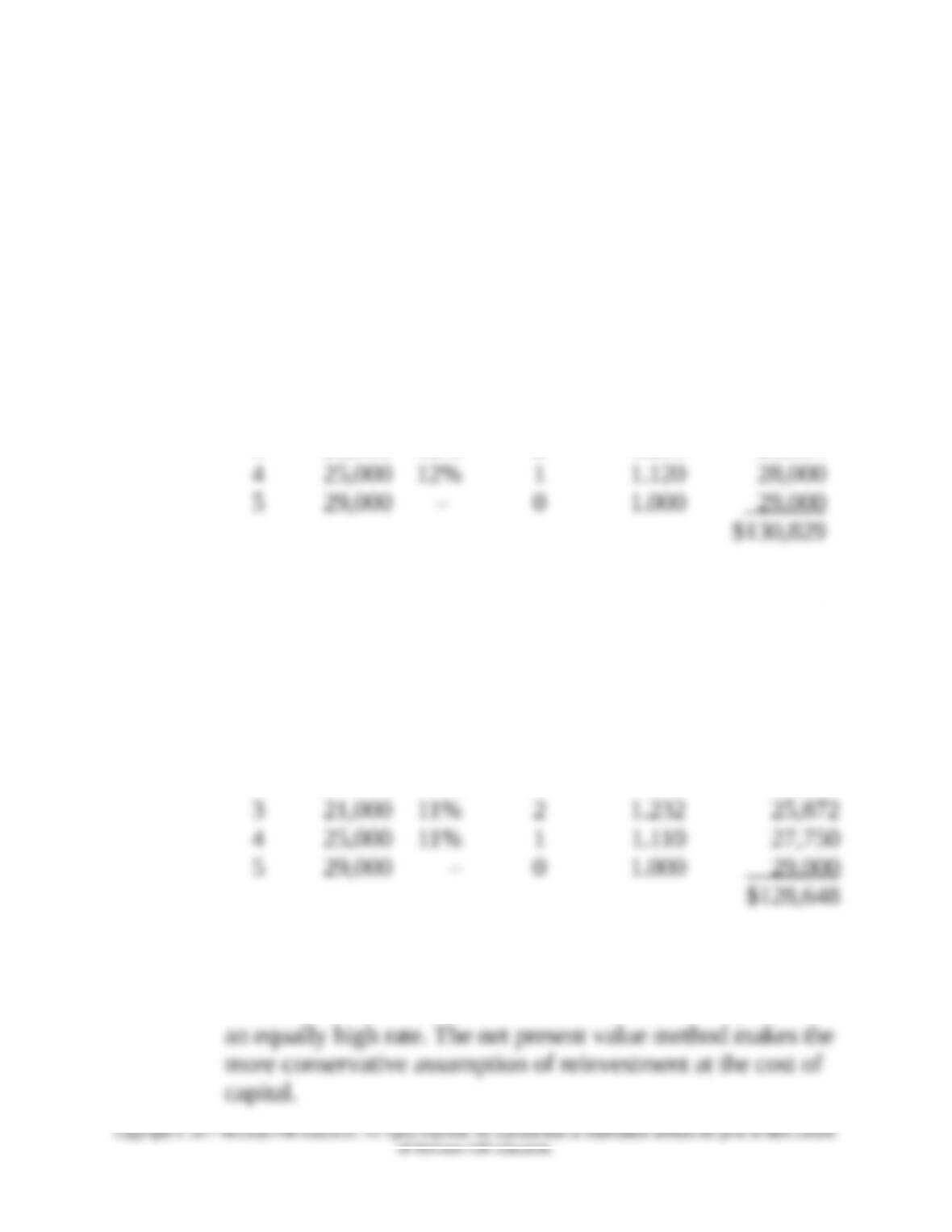
1 $15,000 12% 4 1.574 $23,610
2 17,000 12% 3 1.405 23,885
3 21,000 12% 2 1.254 26,334
b. Reinvestment assumption of IRR
No. of
Year Inflows Rate Periods
Value
1 $15,000 11% 4 1.518 $ 22,770
2 17,000 11% 3 1.368 23,256
c. No. However, for investments with a very high IRR, it may
be unrealistic to assume that reinvestment can take place at
Chapter 12: The Capital Budgeting Decision
(a)
Calculator Solution:
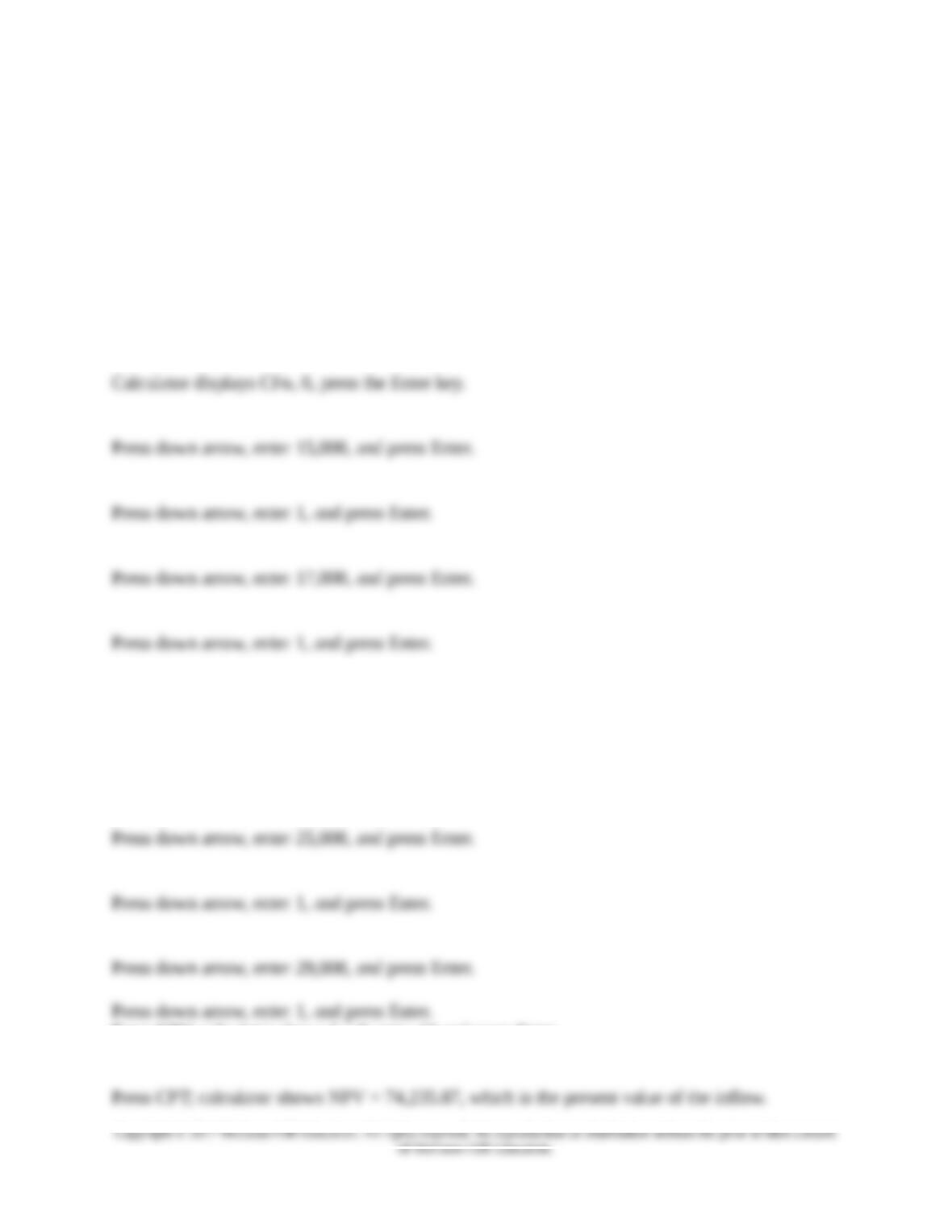
Find PV of cash inflow using a financial calculator at 12 percent:
Press the following keys: 2nd, CF, 2nd, Clear.
Press down arrow, enter 21,000, and press Enter.
Press down arrow, enter 1, and press Enter.
Press NPV; calculator shows I = 0; enter 12 and press Enter.
Press down arrow; calculator shows NPV = 0.00.
Chapter 12: The Capital Budgeting Decision
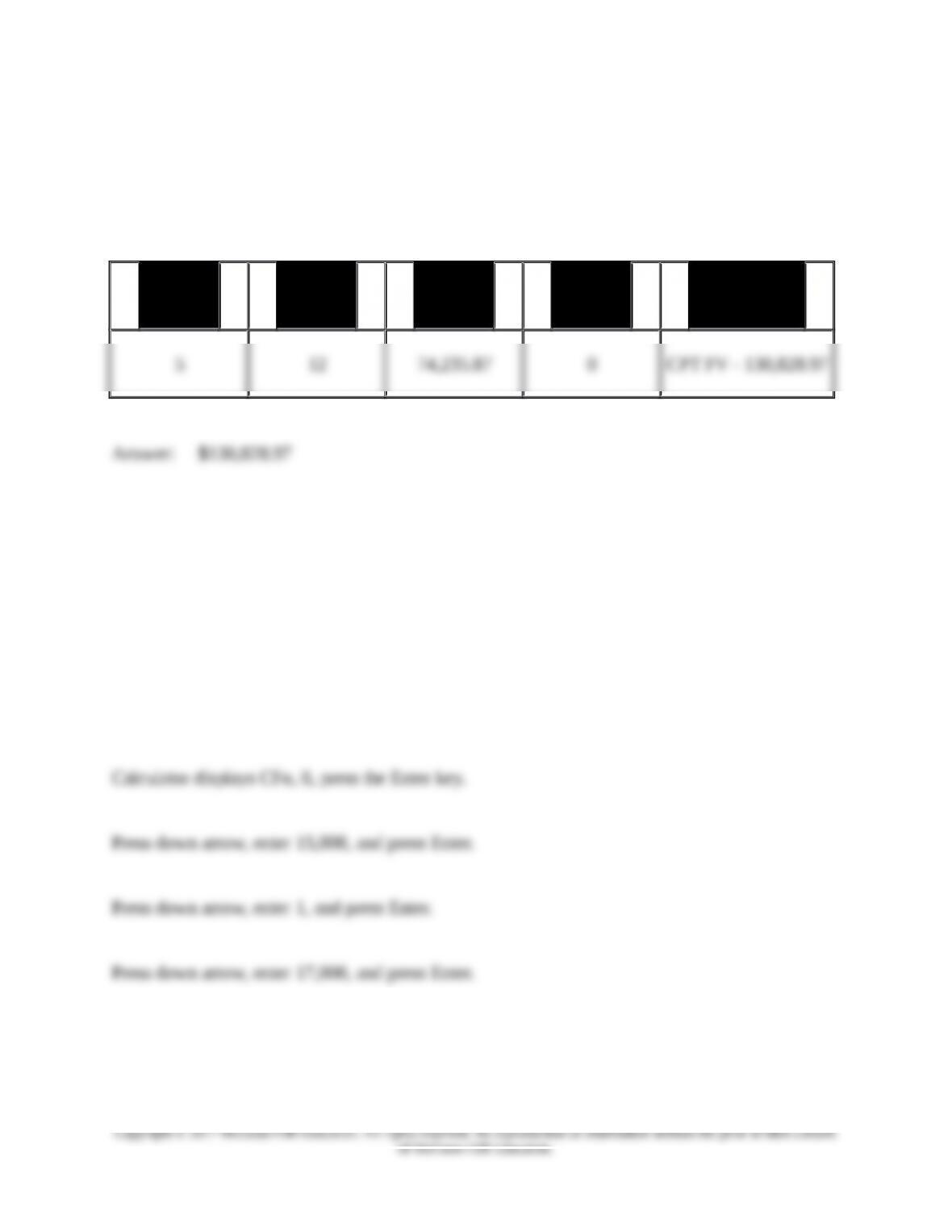
Next, find the FV of the 74,235.87 as of year 5 at a 12 percent annual rate.
N I/Y PV PMT FV
(b)
Calculator Solution:
Find PV of cash inflow using a financial calculator at 11 percent:
Press the following keys: 2nd, CF, 2nd, Clear.
Press down arrow, enter 1, and press Enter.
Press down arrow, enter 21,000, and press Enter.

Chapter 12: The Capital Budgeting Decision
Press down arrow, enter 1, and press Enter.
Press NPV; calculator shows I = 0; enter 11 and press Enter.
Next, find the FV of the 76,344.48 as of year 5 at an 11 percent annual rate.
N I/Y PV PMT FV
21. Modified internal rate of return (LO12-4) The Caffeine Coffee Company uses the
modified internal rate of return. The firm has a cost of capital of 11 percent. The project
being analyzed is as follows ($26,000 investment):
Year Cash Flow
1…..……. $12,000
2………… 11,000
3………… 9,000
a. What is the modified internal rate of return? An approximation from Appendix B is
adequate. (You do not need to interpolate.)
b. Assume the traditional internal rate of return on the investment is 17.5 percent.
Explain why your answer in part a would be lower.
Chapter 12: The Capital Budgeting Decision
12-21. Solution:
Caffeine Coffee Company
Terminal Value (end of year 3)
a. FV Factor
Period of (11%) Future
Growth (Appendix A) Value
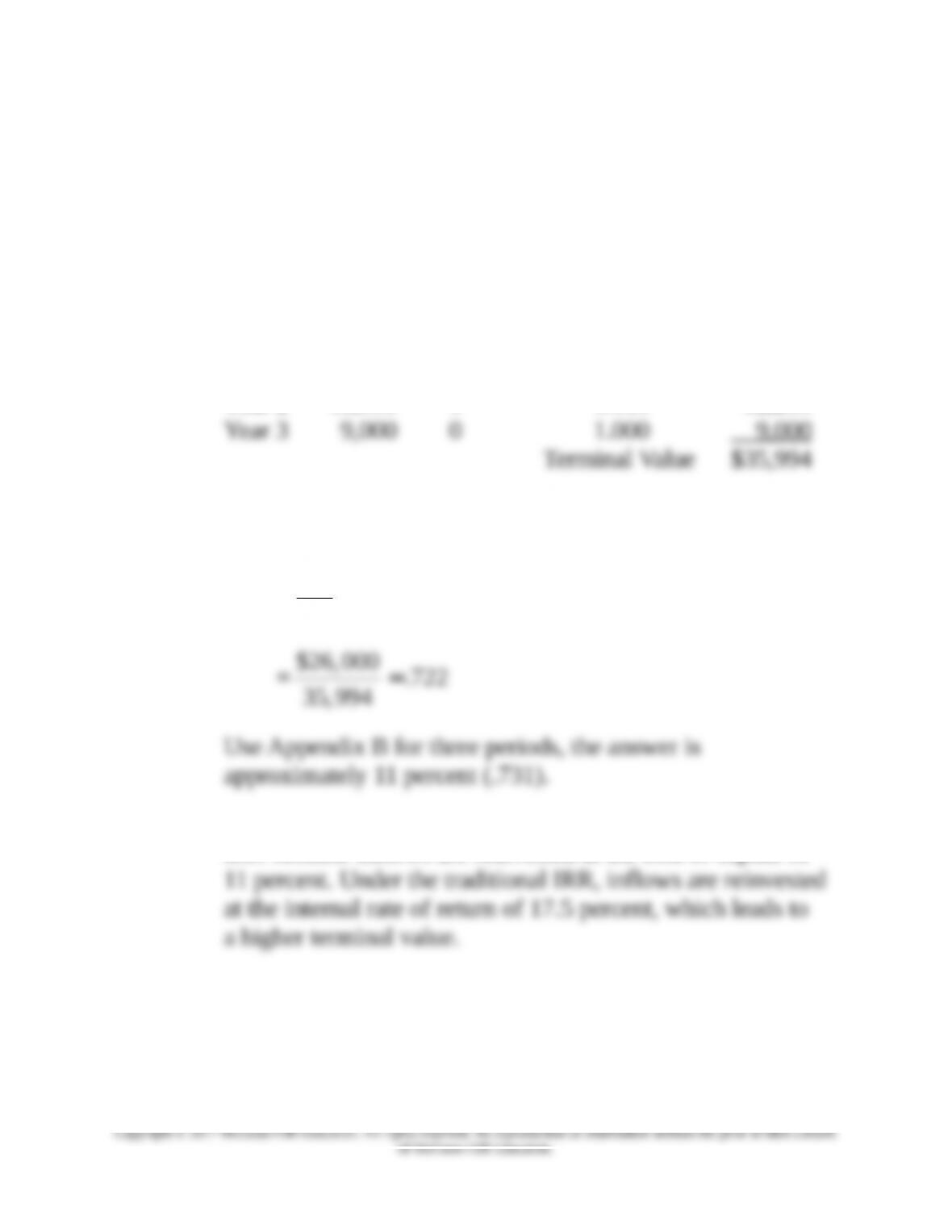
Year 1 $12,000 2 1.232 $14,784
Year 2 11,000 1 1.110 12,210
To determine the modified internal rate of return, calculate
the yield on the investment.
IF
PV
PV (Appendix B)
FV
$26,000
= .722
35,994
= =
=
Use Appendix B for three periods, the answer is
approximately 11 percent (.731).
b. The answer is lower than 17.5 percent under the Modified
IRR because inflows are reinvested at the cost of capital of
Calculator Solution:
Using a financial calculator:

Chapter 12: The Capital Budgeting Decision
Find the PV of cash inflow using a financial calculator at 11 percent:
Press down arrow, enter 11,000, and press Enter.
Press down arrow, enter 1, and press Enter.
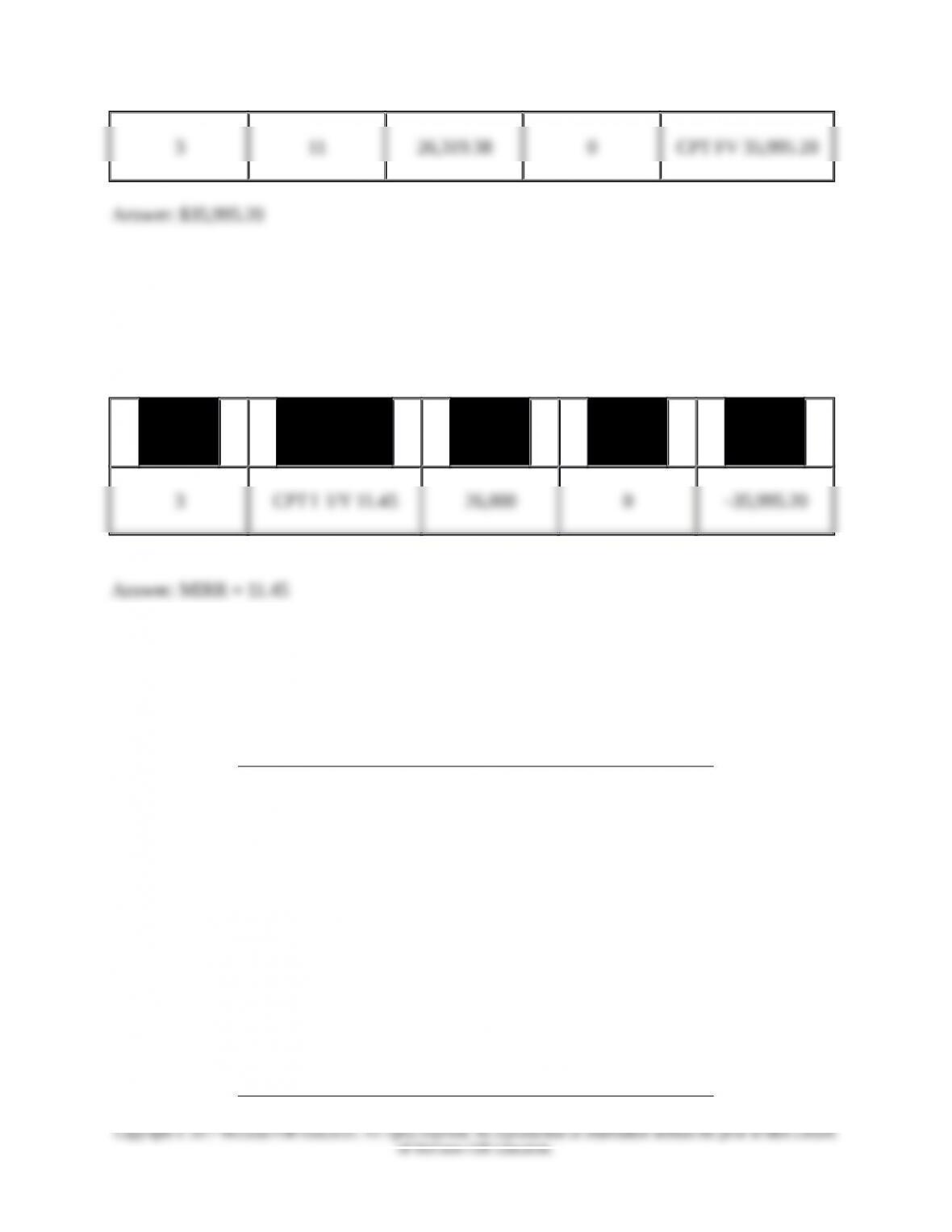
Press CPT; calculator shows NPV = 26,319.38, which is the present value of the inflow.
Next find the FV of the 26,319.38 as of year 3 at an 11 percent annual rate.
(a)
N I/Y PV PMT FV
Chapter 12: The Capital Budgeting Decision
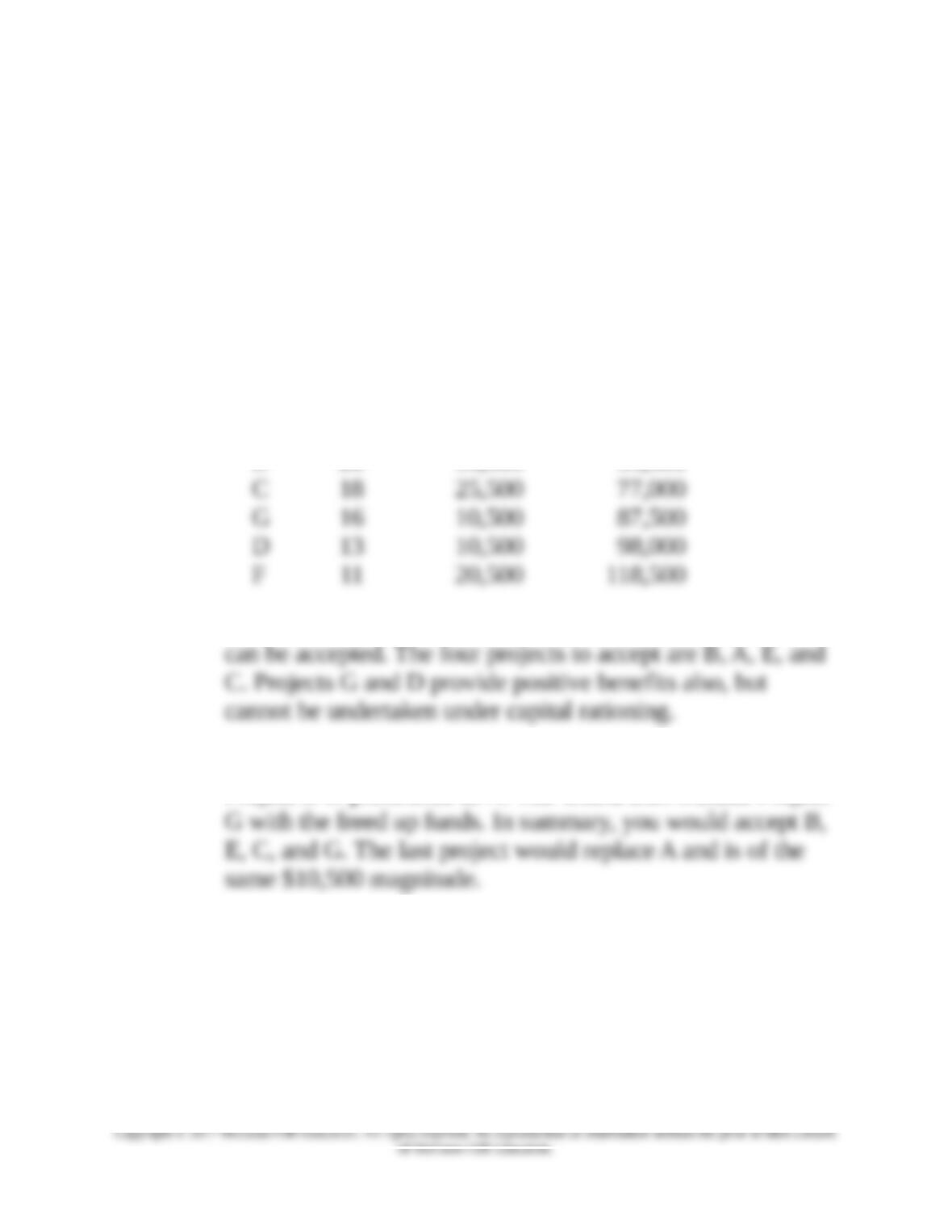
Next, find the discount rate that produces a PV of 26,000.
N I/Y PV PMT FV
22. Capital rationing and mutually exclusive investments (LO12-4) The Suboptimal Glass
Company uses a process of capital rationing in its decision making. The firm’s cost of
capital is 10 percent. It will only invest $77,000 this year. It has determined the internal rate
of return for each of the following projects.
Project Project Size
Internal Rate of
Return
A
…………………… $10,500 21%
B
…………………… 30,500 22
C
…………………… 25,500 18
D
…………………… 10,500 13
E
…………………… 10,500 20
F
…………………… 20,500 11
G
…………………… 10,500 16
Chapter 12: The Capital Budgeting Decision
a. Select the projects that the firm should accept.
b. If Projects A and B are mutually exclusive, how would that affect your overall
answer? That is, which projects would you accept in spending the $77,000?
12-22. Solution:
Suboptimal Glass Company
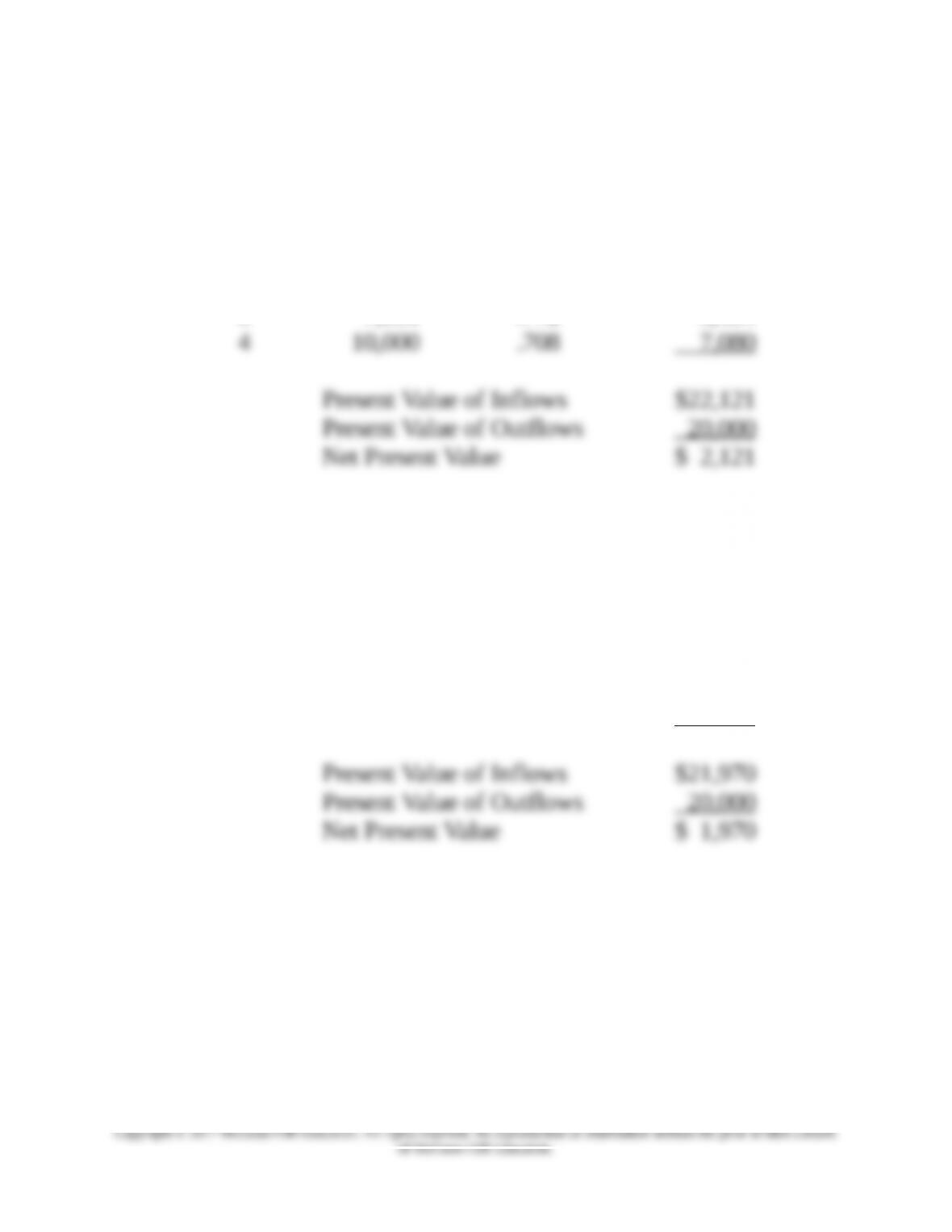
You should rank the investments in terms of IRR.
Project IRR Project Size Total Budget
B 22% $30,500 $ 30,500
A 21 10,500 41,000
E 20 10,500 51,500
a. Because of capital rationing, only $77,000 worth of projects
b. If Projects A and B are mutually exclusive, you would select
Project B in preference to A. You would then include Project
23. Net present value profile (LO12-4) Keller Construction is considering two new
investments. Project E calls for the purchase of earthmoving equipment. Project H
represents an investment in a hydraulic lift. Keller wishes to use a net present value profile
in comparing the projects. The investment and cash flow patterns are as follows:

Chapter 12: The Capital Budgeting Decision
Project E
($20,000 Investment)
Project H
($20,000 Investment)
Year Cash Flow Year Cash Flow
1……………….…….. $ 5,000 1
…….……………………… $16,000
2……………….…….. 6,000 2
…….……………………… 5,000
3……………….…….. 7.000 3
…….……………………… 4,000
4……………….…….. 10,000
a. Determine the net present value of the projects based on a zero discount rate.
b. Determine the net present value of the projects based on a 9 percent discount rate.
c. The internal rate of return on Project E is 13.25 percent, and the internal rate of return
on Project H is 16.30 percent. Graph a net present value profile for the two
investments similar to Figure 12-3. (Use a scale up to $8,000 on the vertical axis, with
$2,000 increments. Use a scale up to 20 percent on the horizontal axis, with
5 percent increments.)
d. If the two projects are not mutually exclusive, what would your acceptance or
rejection decision be if the cost of capital (discount rate) is 8 percent? (Use the net
present value profile for your decision; no actual numbers are necessary.)
e. If the two projects are mutually exclusive (the selection of one precludes the selection
of the other), what would be your decision if the cost of capital is (1) 6 percent,
(2) 13 percent, and (3) 18 percent? Once again, use the net present value profile for
your answer.
12-23. Solution:
Keller Construction Company
a. Zero discount rate
Project E
Inflows Outflow
Project H
Inflows Outflow
Chapter 12: The Capital Budgeting Decision
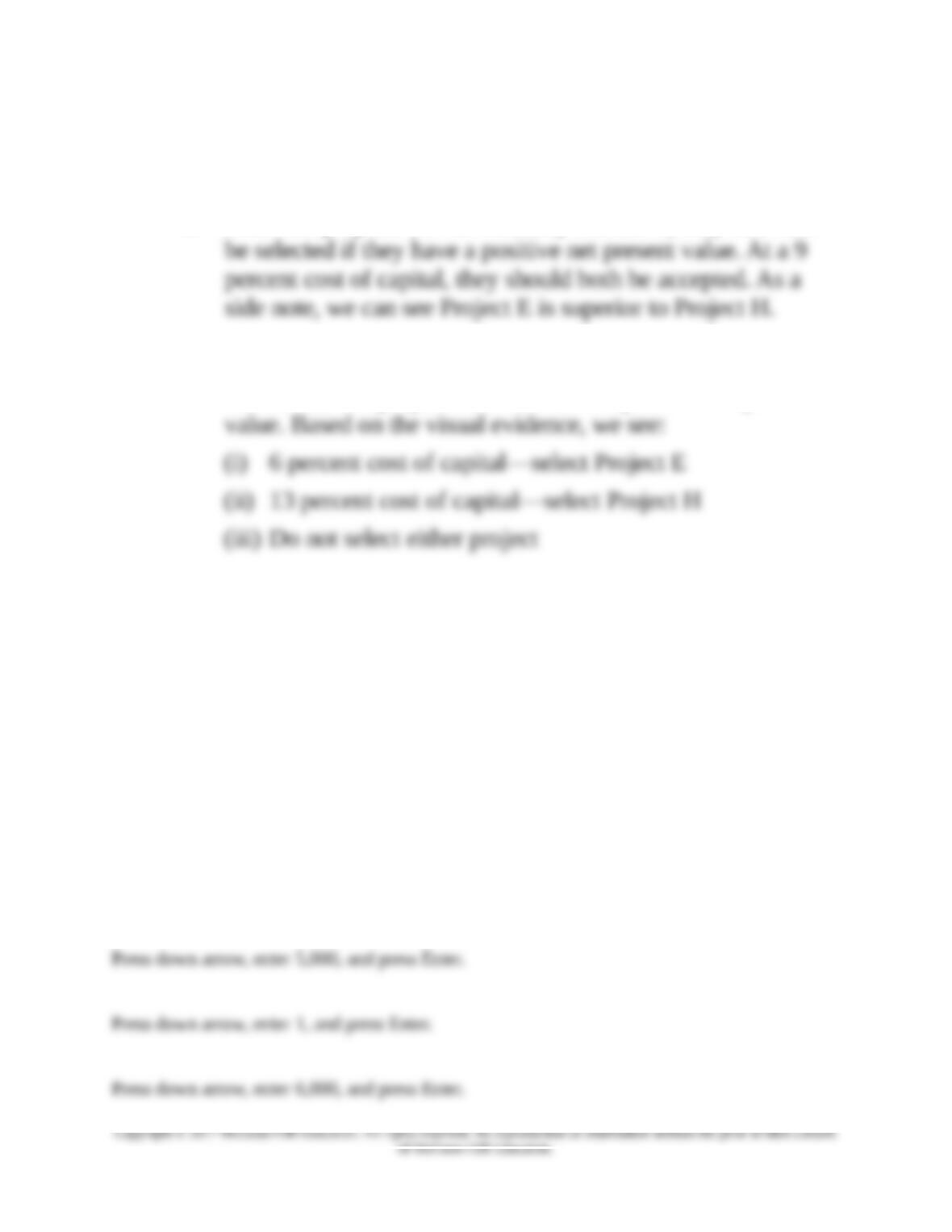
b. 9 percent discount rate
Project E
Year Cash Flow PVIF at 9% Present Value
1 $ 5,000 .917 $ 4,585
2 6,000 .842 5,052
3 7,000 .772 5,404
12-23. (Continued)
Project H
Year Cash Flow PVIF at 9% Present Value
1 $16,000 .917 $14,672
2 5,000 .842 4,210
3 4,000 .772 3,088
Chapter 12: The Capital Budgeting Decision
c. Net Present Value Profile
d. Since the projects are not mutually exclusive, they both can
e. With mutually exclusive projects, only one can be accepted.
Of course, that project must still have a positive net present
Calculator Solution:
(b)
Using a financial calculator:
Project E:
Press the following keys: 2nd, CF, 2nd, Clear.
Calculator displays CFo, press 20,000 +|–, press the Enter key.
Chapter 12: The Capital Budgeting Decision
Press down arrow, enter 7,000, and press Enter.
Press down arrow, enter 1, and press Enter.
Press CPT; calculator shows NPV = 2,126.77, which is the NPV of Project E.
Project H:
Press the following keys: 2nd, CF, 2nd, Clear.
Calculator displays CFo, press 20,000 +|–, press the Enter key.

Press down arrow, enter 4,000, and press Enter.
Press down arrow, enter 1, and press Enter.
24. Net present value profile (LO12-4) Davis Chili Company is considering an investment of
$35,000, which produces the following inflows:
Year Cash Flow
1…………….. $16,000
2…………….. 15,000
3…………….. 12,000
You are going to use the net present value profile to approximate the value for the internal
rate of return. Please follow these steps:
a. Determine the net present value of the project based on a zero discount rate.
b. Determine the net present value of the project based on a 10 percent discount rate.
c. Determine the net present value of the project based on a 15 percent discount rate
(it will be negative).
d. Draw a net present value profile for the investment and observe the discount rate at
which the net present value is zero. This is an approximation of the internal rate of
return based on the interpolation procedure presented in this chapter.