12-17. Solution:
Hudson Corporation
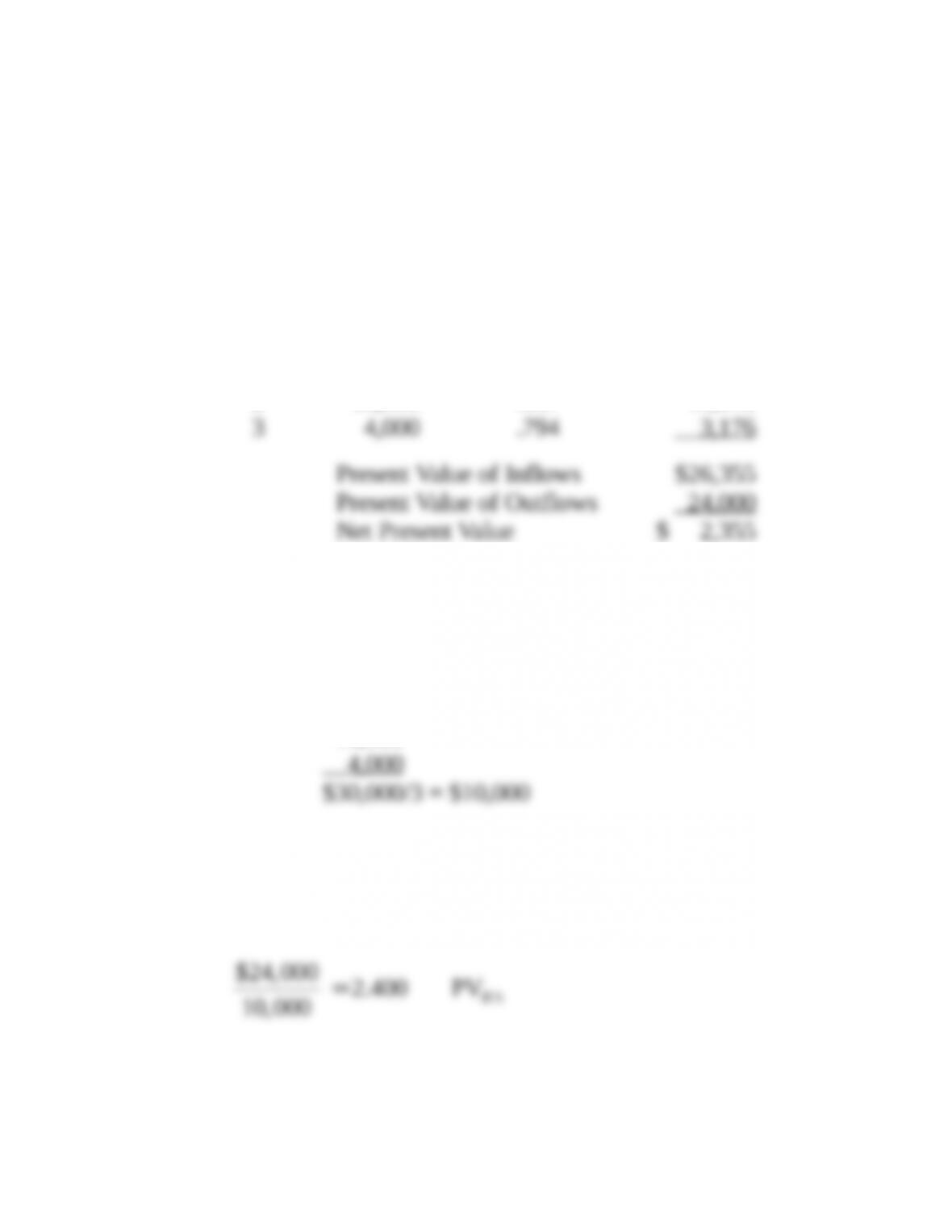
a. Net Present Value
Year Cash Flow × 8% PVIF Present Value
1 $13,000 .926 $ 12,038
2 13,000 .857 11,141
b. Internal Rate of Return
We will average the inflows to arrive at an assumed annuity
value.
$13,000
13,000
12-17. (Continued)
We divide the investment by the assumed annuity value.
IFA
$24,000 2.400 PV
10,000 =
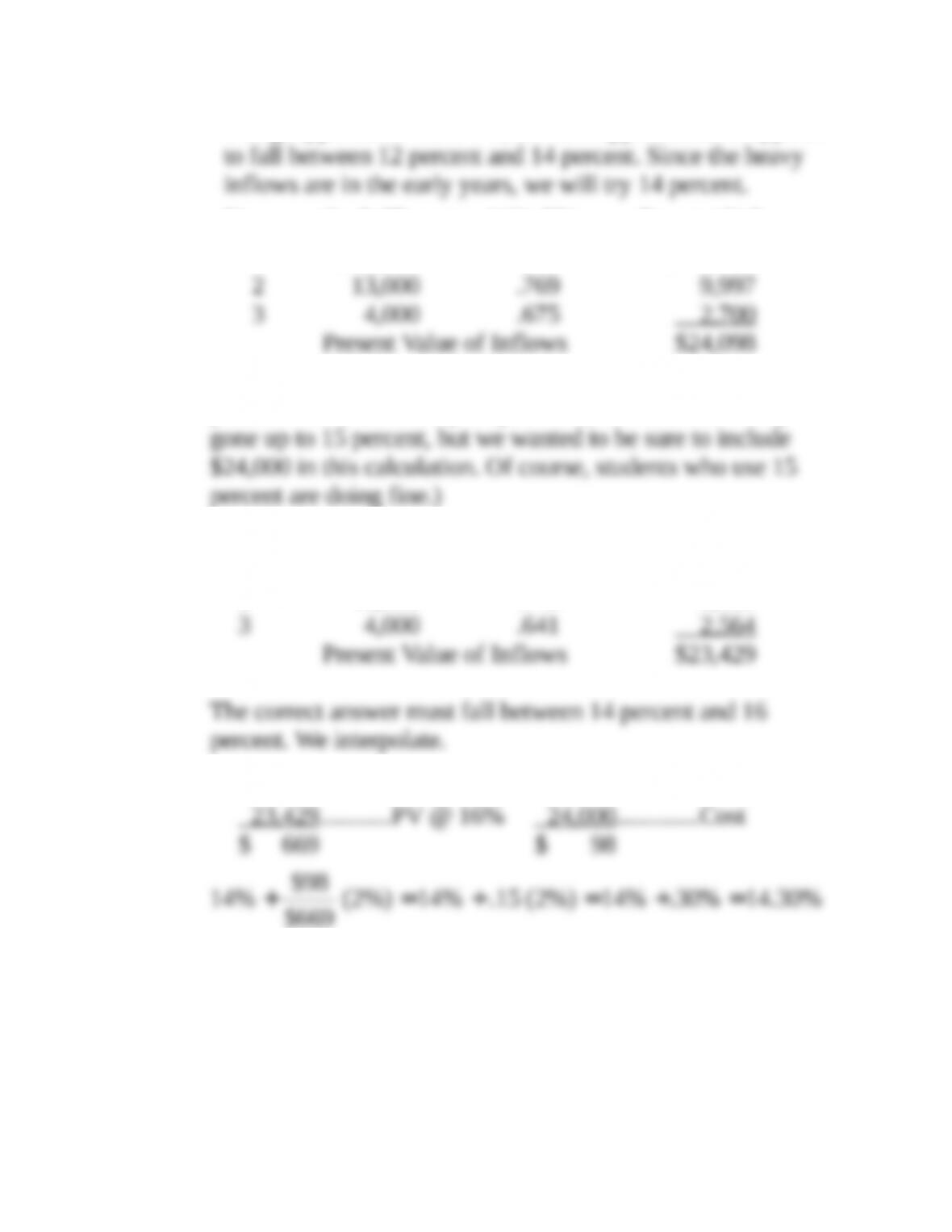
Using Appendix D for n = 3, the first approximation appears
Year Cash Flow × 14% PVIF Present Value
1 $13,000 .877 $ 11,401
Since 14 percent is not high enough to get $24,000 as the
present value, we will try 16 percent. (We could have only
Year Cash Flow × 16%PVIF Present Value
1 $13,000 .862 $ 11,206
2 13,000 .743 9,659
$24,098...........PV @ 14% $24,098…..........PV @ 14%
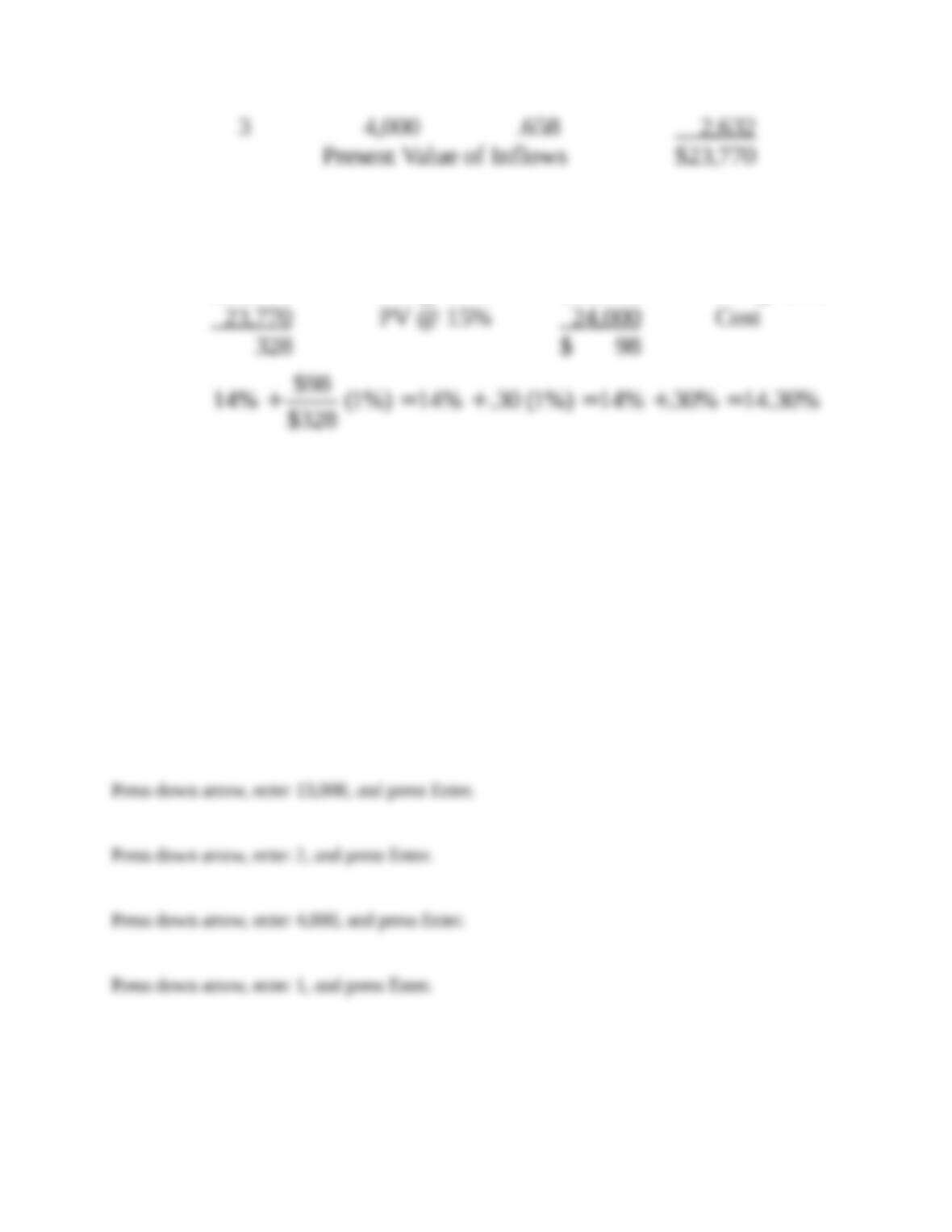
The correct answer falls between 14 percent and 15 percent.
We interpolate.
$24,098 PV @ 14% $24,098 PV @ 14%
Press down arrow; calculator shows NPV = 0.00
(b)
Press the following keys: 2nd, CF, 2nd, Clear.
Calculator displays CFo, 24,000 +|– key, press Enter.
Press IRR; calculator shows IRR = 0.00.
Press CPT; calculator shows IRR = 14.29.
18. Net present value and internal rate of return methods (LO12-4) The Pan American
Bottling Co. is considering the purchase of a new machine that would increase the speed of
bottling and save money. The net cost of this machine is $60,000. The annual cash flows
have the following projections:
Year Cash Flow
1…..……. $23,000
2………… 26,000
3………… 29,000
4………… 15,000
5………… 8,000
a. If the cost of capital is 13 percent, what is the net present value of selecting a new
machine?
b. What is the internal rate of return?
c. Should the project be accepted? Why?
12-18. Solution:
Pan American Bottling Co.
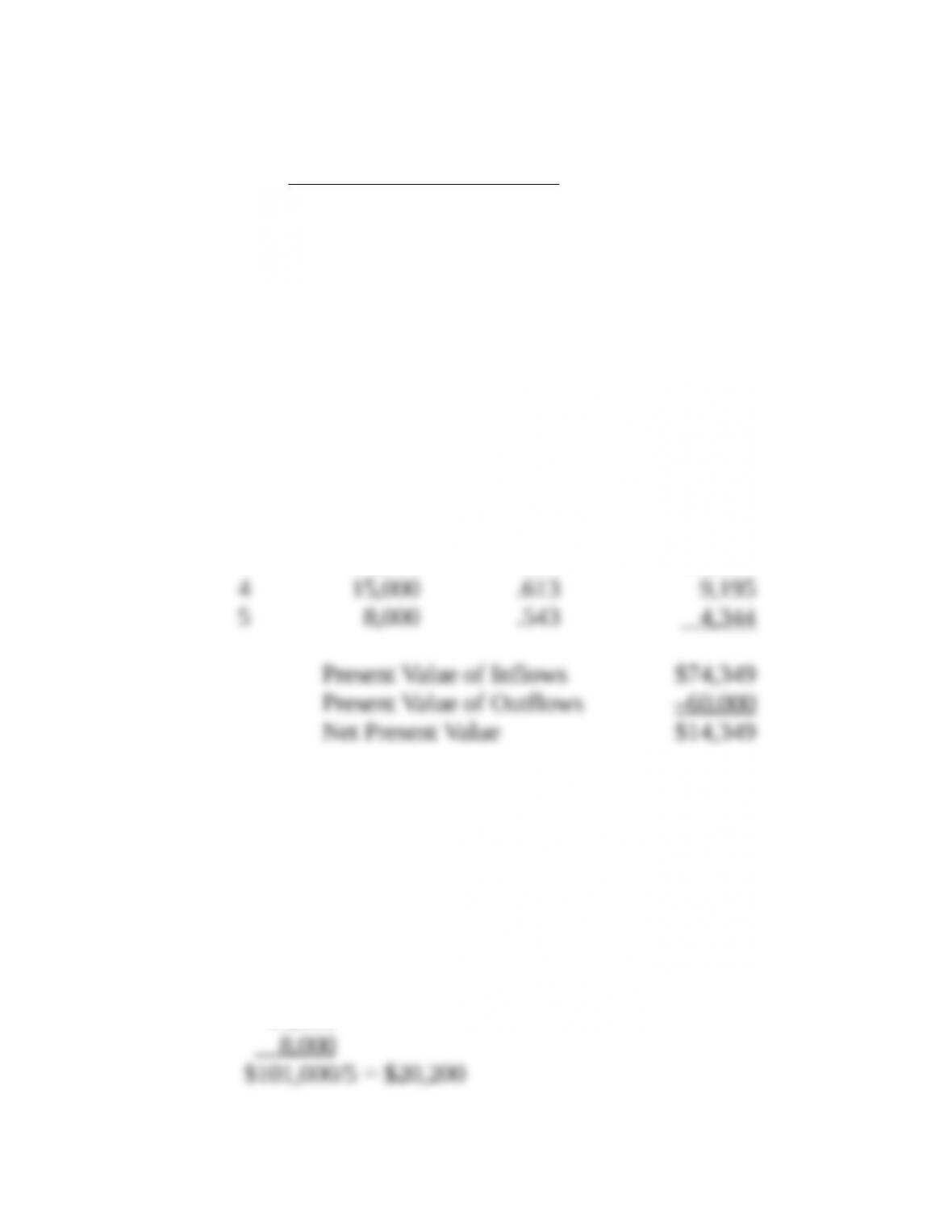
a. Net Present Value
Year Cash Flow × 13% PVIF Present Value
1 $23,000 .885 $20,355
2 26,000 .783 20,358
3 29,000 .693 20,097
12-18. (Continued)
b. Internal Rate of Return
We will average the inflows to arrive at an assumed annuity.
$23,000
26,000
29,000
15,000
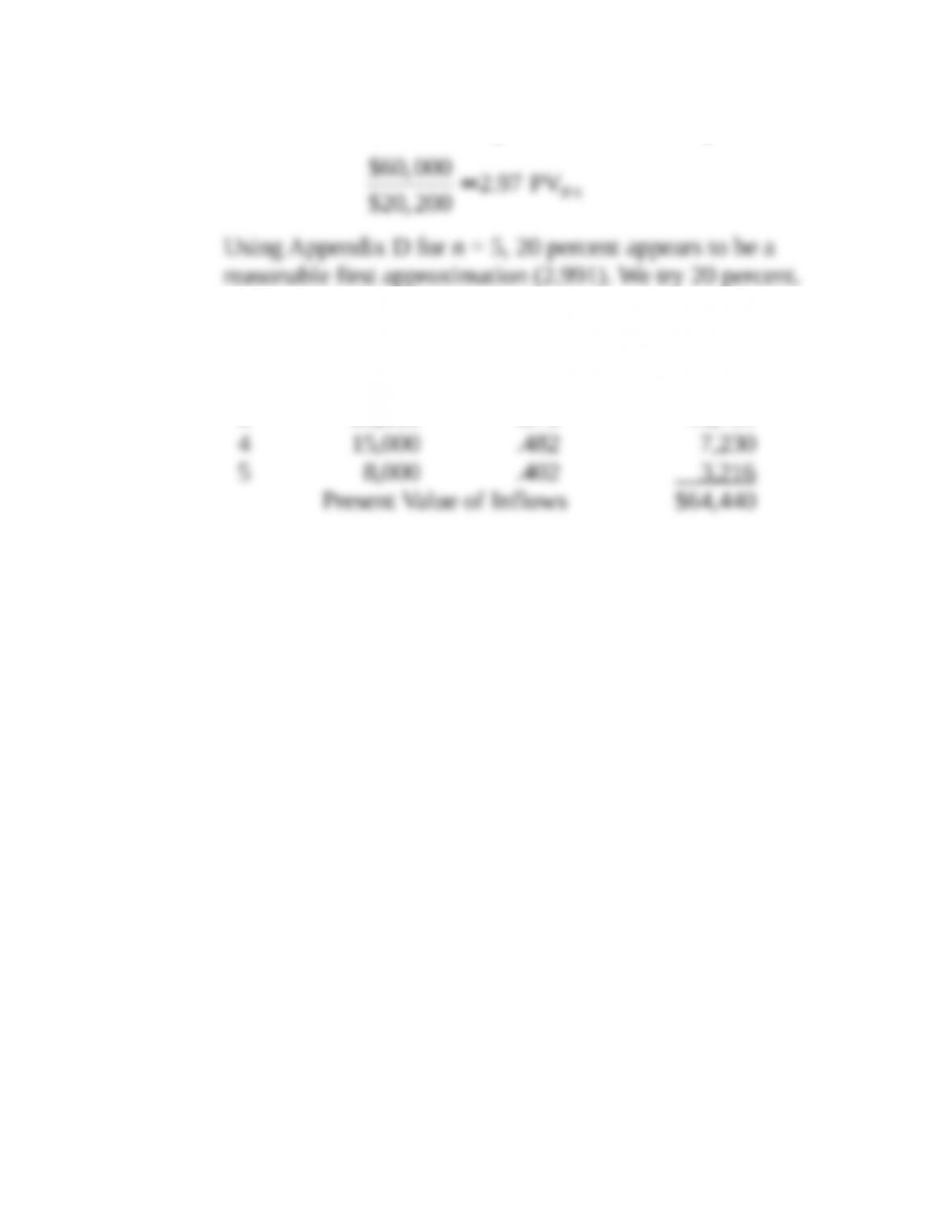
We divide the investment by the assumed annuity value.
IFA
$60,000 2.97 PV
$20, 200 =
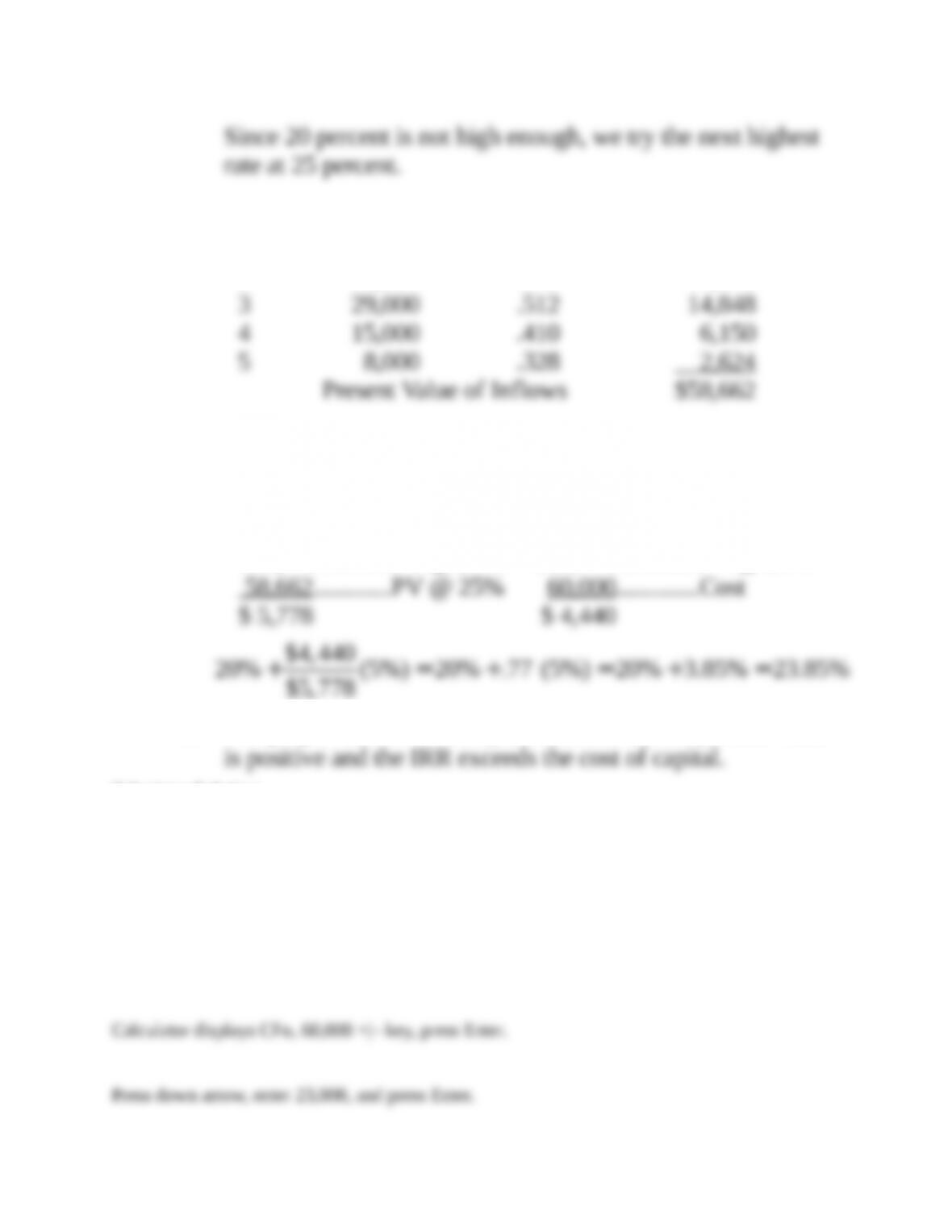
Using Appendix D for n = 5, 20 percent appears to be a
reasonable first approximation (2.991). We try 20 percent.
Year Cash Flow × 20% PVIF Present Value
1 $23,000 .833 $19,159
2 26,000 .694 18,044
3 29,000 .579 16,791
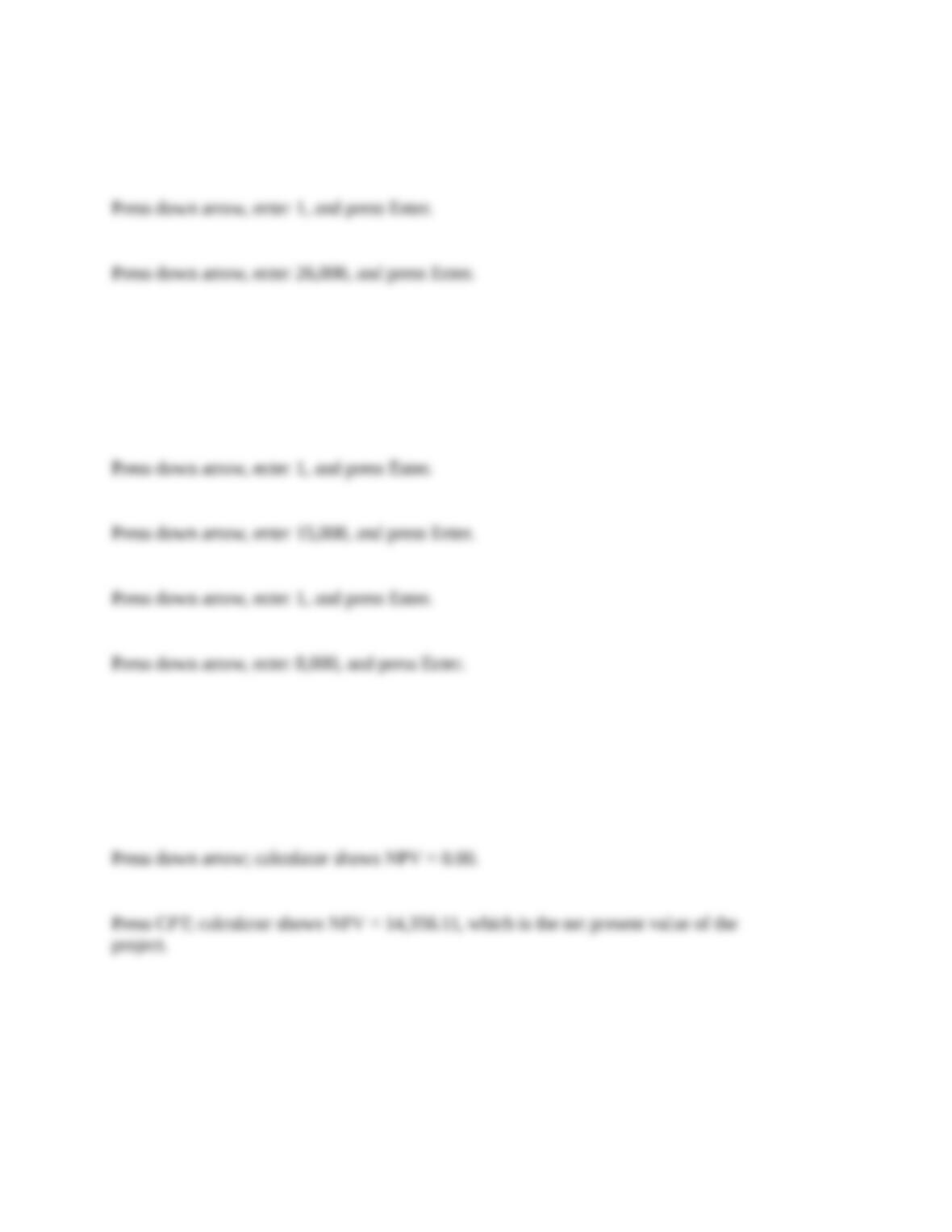
Year Cash Flow × 25% PVIF Present Value
1 $23,000 .800 $18,400
2 26,000 .640 16,640
12-18. (Continued)
The correct answer must fall between 20 and 25 percent. We
interpolate.
$64,440...........PV @ 20% $64,440…..........PV @ 20%
Press down arrow, enter 1, and press Enter.
Press down arrow, enter 29,000, and press Enter.
Press down arrow, enter 1, and press Enter.
Press NPV; calculator shows I = 0; enter 10 and press Enter.
(b)
Calculator Solution:
Find the IRR using a financial calculator:
Press the following keys: 2nd, CF, 2nd, Clear.
Press down arrow, enter 1, and press Enter.
Press down arrow, enter 29,000, and press Enter.
Press down arrow, enter 1, and press Enter.
Press IRR; calculator shows IRR = 0.

19. Use of profitability index (LO12-4) You are asked to evaluate the following two projects
for the Norton Corporation. Using the net present value method combined with the
profitability index approach described in footnote 2 of this chapter, which project would
you select? Use a discount rate of 14 percent.
Project X (Videotapes
of the Weather Report)
($20,000 Investment)
Project Y (Slow-Motion
Replays of Commercials)
($40,000 investment)
Year Cash Flow Year Cash Flow
1……………………. $10,000 1
………………………….…. $20,000
2……………………. 8,000 2
………………………….…. 13,000
3……………………. 9,000 3
………………………….…. 14,000
4……………………. 8,600 4
………………………….…. 16,000
12-19. Solution:
Norton Corporation
NPV for Project X
Year Cash Flow × PVIF at 14% Present Value
1 $10,000 .877 $ 8,770
2 8,000 .769 6,152
3 9,000 .675 6,075
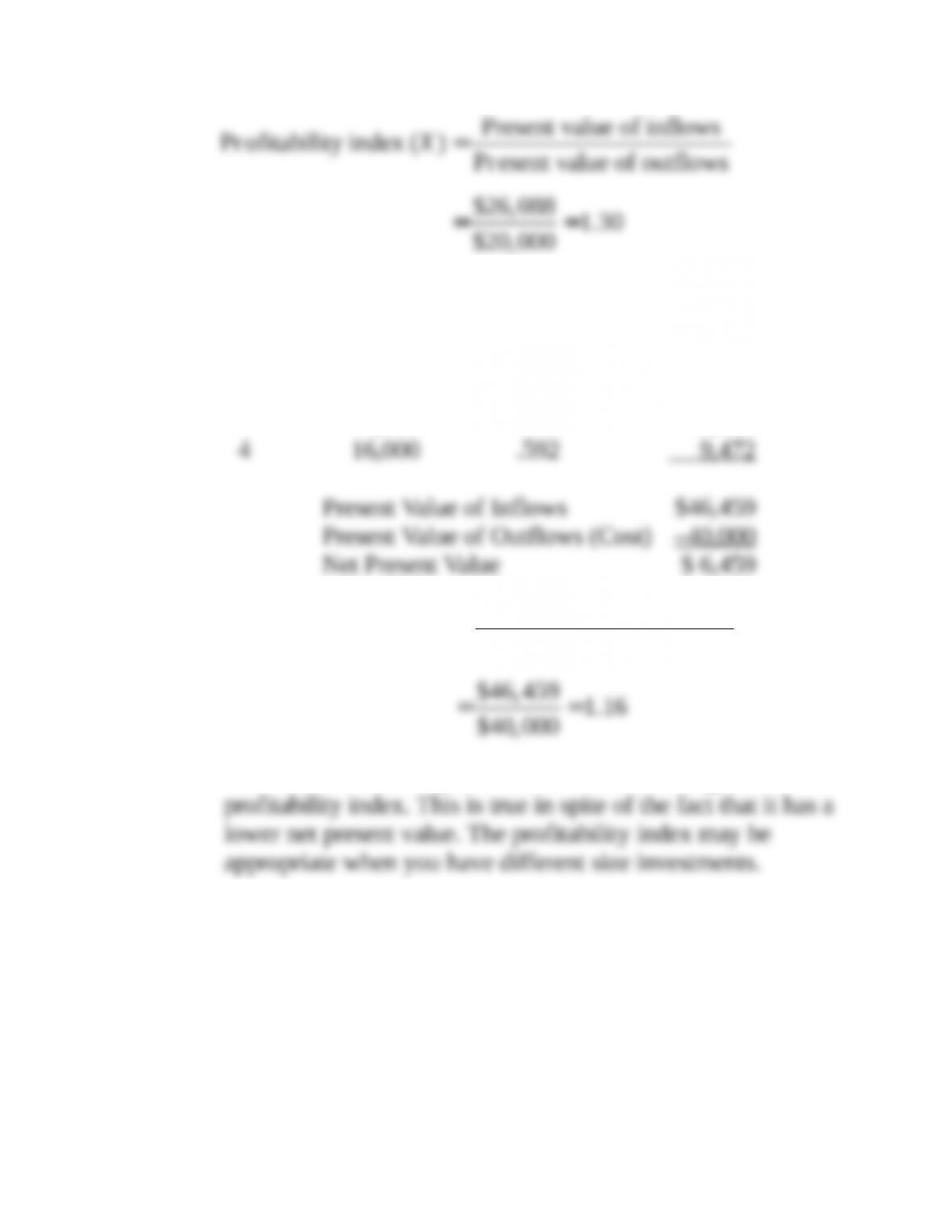
Present value of inflows
Pr ofitability index ( ) Pr esent value of outflows
$26,088 1.30
$20,000
X=
= =
NPV for Project Y
Year Cash Flow × PVIF at 14% Present Value
1 $20,000 .877 $ 17,540
2 13,000 .769 9,997
3 14,000 .675 9,450
Present value of inflows
Pr ofitability index ( ) Pr esent value of outflows
$46,459 1.16
$40,000
Y=
= =
You should select Project X because it has the higher
Calculator Solution:
(a)
Find NPV using a financial calculator:
Press the following keys: 2nd, CF, 2nd, Clear.
Press down arrow, enter 1, and press Enter.
Press down arrow, enter 9,000, and press Enter.
Press down arrow; calculator shows NPV = 0.00.
Press CPT; calculator shows NPV = 6,094.30, which is the net present value of Project X.
(b)
Find NPV using a financial calculator:
Press the following keys: 2nd, CF, 2nd, Clear.
Press down arrow, enter 1, and press Enter.
Press down arrow, enter 14,000, and press Enter.
Press down arrow; calculator shows NPV = 0.00.

Press CPT; calculator shows NPV = 8,771.93, which is the net present value of Project Y.
Profitability Index Using Financial Calculator:
20. Reinvestment rate assumption in capital budgeting (LO12-4) Turner Video will invest
$58,500 in a project. The firm’s cost of capital is 12 percent. The investment will provide
the following inflows:
Year Inflow
1…………….. $15,000
2…………….. 17,000
3…………….. 21,000
4…………….. 25,000
5…………….. 29,000
The internal rate of return is 11 percent.
a. If the reinvestment assumption of the net present value method is used, what will be
the total value of the inflows after five years? (Assume the inflows come at the end of
each year.)
b. If the reinvestment assumption of the internal rate of return method is used, what will
be the total value of the inflows after five years?
c. Generally is one investment assumption likely to be better than another?