28. Marginal cost of capital (LO11-5) The Nolan Corporation finds it is necessary to
determine its marginal cost of capital. Nolan’s current capital structure calls for 50 percent debt,
30 percent preferred stock, and 20 percent common equity. Initially, common equity will be in
the form of retained earnings (Ke) and then new common stock (Kn). The costs of the various
sources of financing are as follows: debt, 9.6 percent; preferred stock, 9 percent; retained
earnings, 10 percent; and new common stock, 11.2 percent.
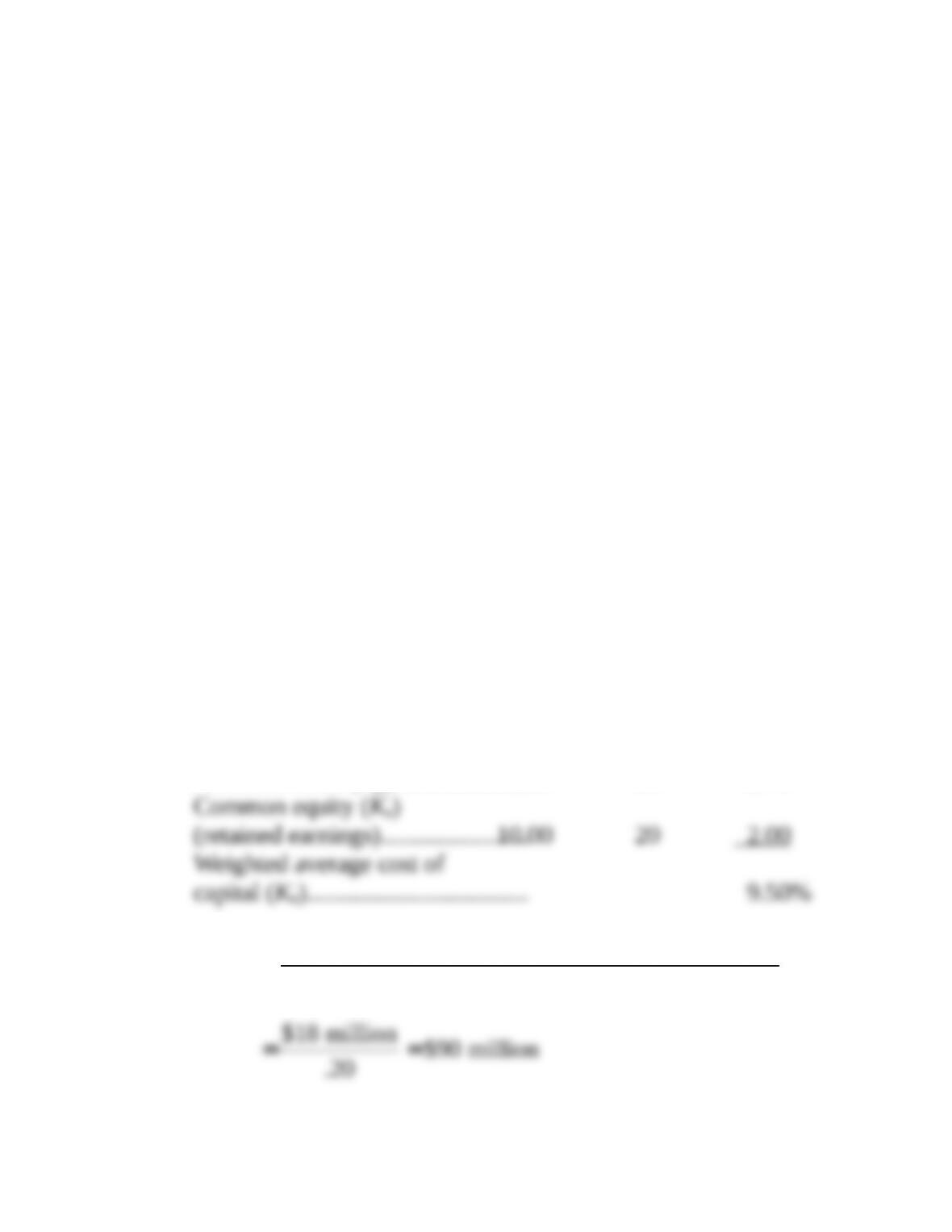
a. What is the initial weighted average cost of capital? (Include debt, preferred stock, and
common equity in the form of retained earnings, Ke.)
b. If the firm has $18 million in retained earnings, at what size capital structure will the
firm run out of retained earnings?
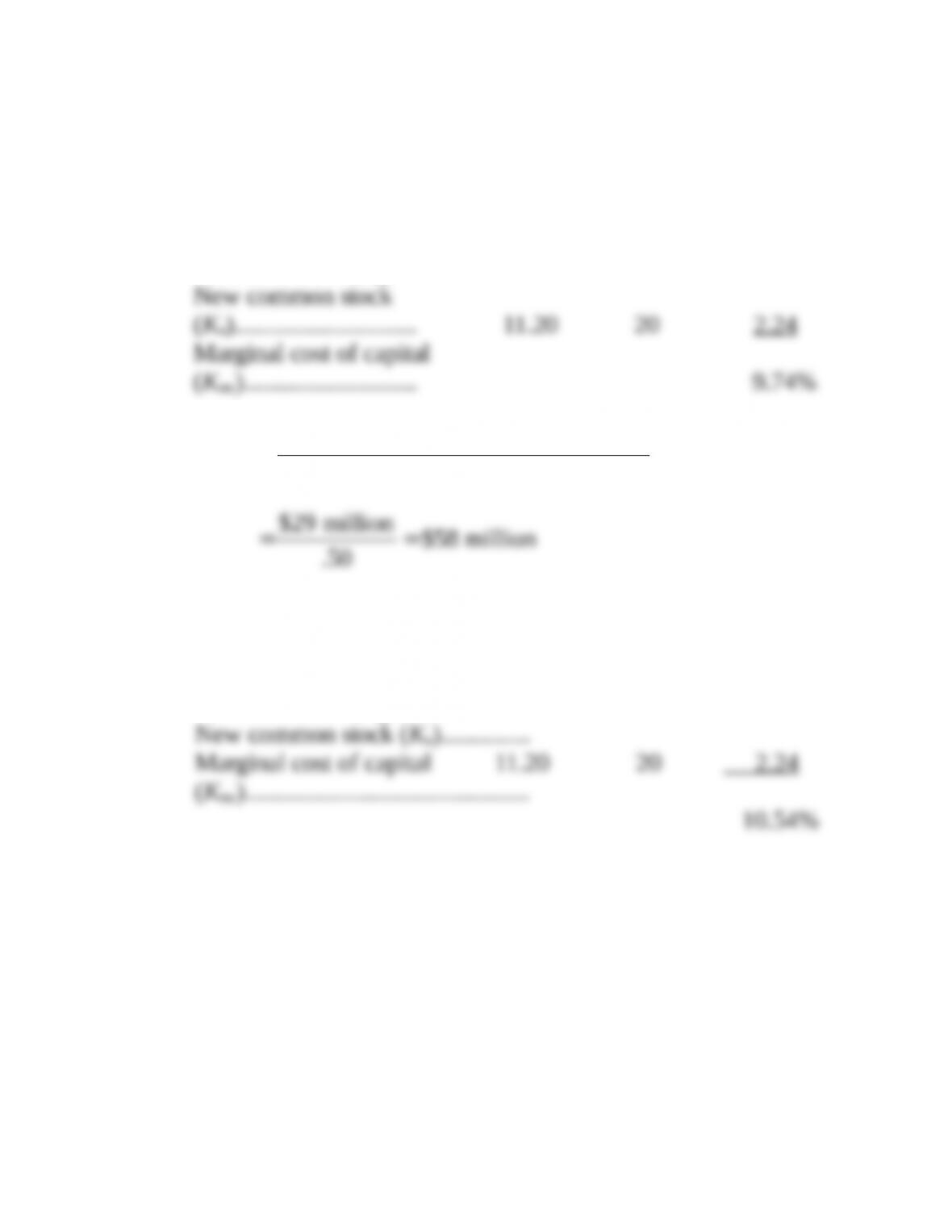
c. What will the marginal cost of capital be immediately after that point? (Equity will
remain at 20 percent of the capital structure, but will all be in the form of new
common stock, Kn.)
d. The 9.6 percent cost of debt referred to earlier applies only to the first $29 million of
debt. After that, the cost of debt will be 11.2 percent. At what size capital structure will
there be a change in the cost of debt?
e. What will the marginal cost of capital be immediately after that point? (Consider the
facts in both parts c and d.)
11-28. Solution:
Nolan Corporation
a. Cost
(aftertax) Weights
Weighted
Cost
Debt (Kd)………...........
Preferred stock (Kp)……………….…
9.60%
9.00
50%
30
4.80%
2.70
Retained earnings
b. % of retained earnings within the capital structure
$18 million $90 million
.20
X=
= =
11-28. (Continued)
c. Cost
(aftertax) Weights
Weighted
Cost
Debt (Kd)………...........
Preferred stock (Kp)....
9.60%
9.00
50%
30
4.80%
2.70
Amount of lower cost debt
d. % of debt within the capital structure
$29 million $58 million
.50
Z=
= =
e. Cost
(aftertax) Weights
Weighted
Cost
Debt (Kd)…….………………………….
Preferred stock (Kp)……………….…
11.20%
9.00
50%
30
5.60%
2.70
29. Marginal cost of capital (LO11-5) The McGee Corporation finds it is necessary to
determine its marginal cost of capital. McGee’s current capital structure calls for 40 percent debt,
30 percent preferred stock, and 30 percent common equity. Initially, common equity will be in
the form of retained earnings (Ke) and then new common stock (Kn). The costs of the various
sources of financing are as follows: debt, 9.6 percent; preferred stock, 9.0 percent; retained
earnings, 10.0 percent; and new common stock, 11.4 percent.
a. What is the initial weighted average cost of capital? (Include debt, preferred stock, and
common equity in the form of retained earnings, Ke.)
b. If the firm has $28.5 million in retained earnings, at what size capital structure will the
firm run out of retained earnings?
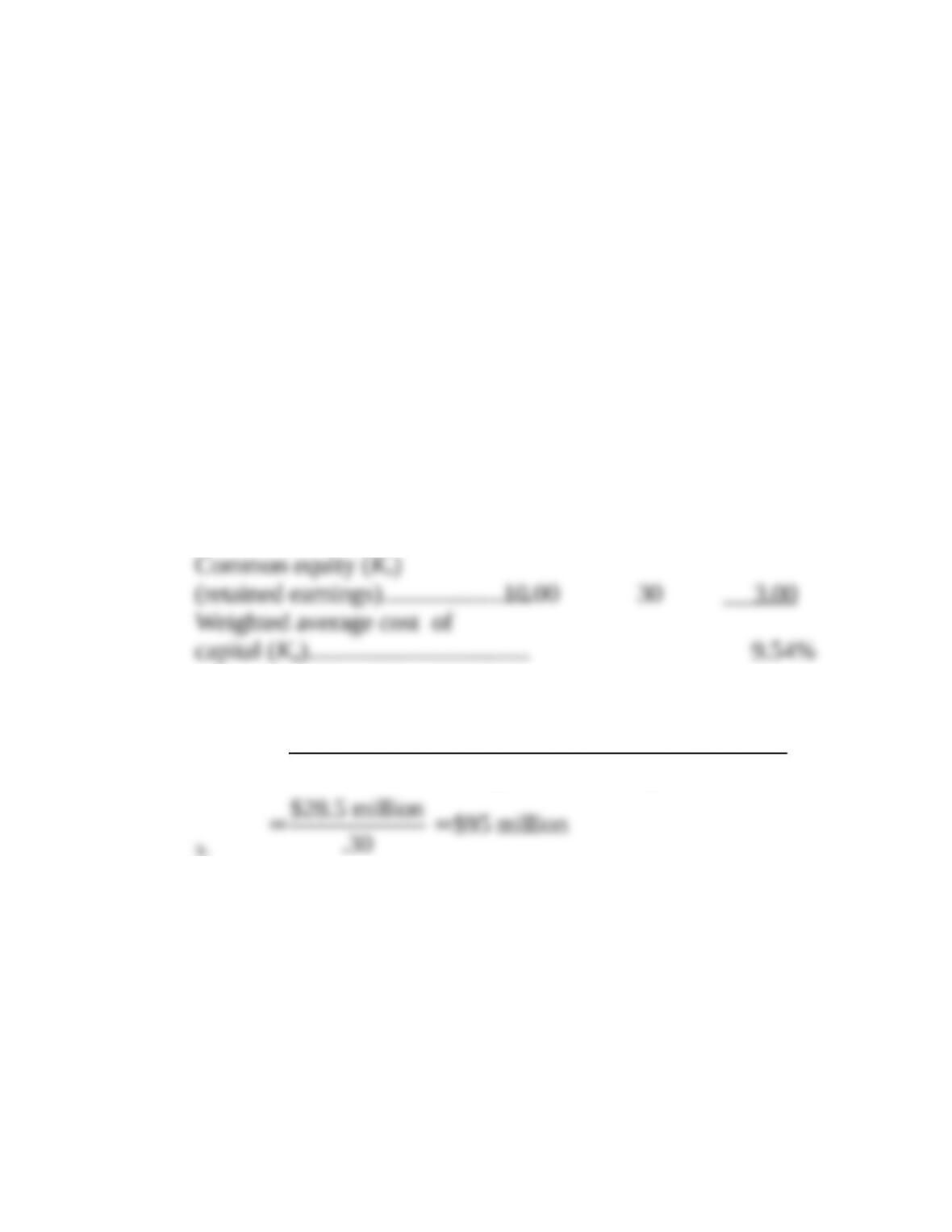
c. What will the marginal cost of capital be immediately after that point? (Equity will
remain at 30 percent of the capital structure, but will all be in the form of new
common stock, Kn.)
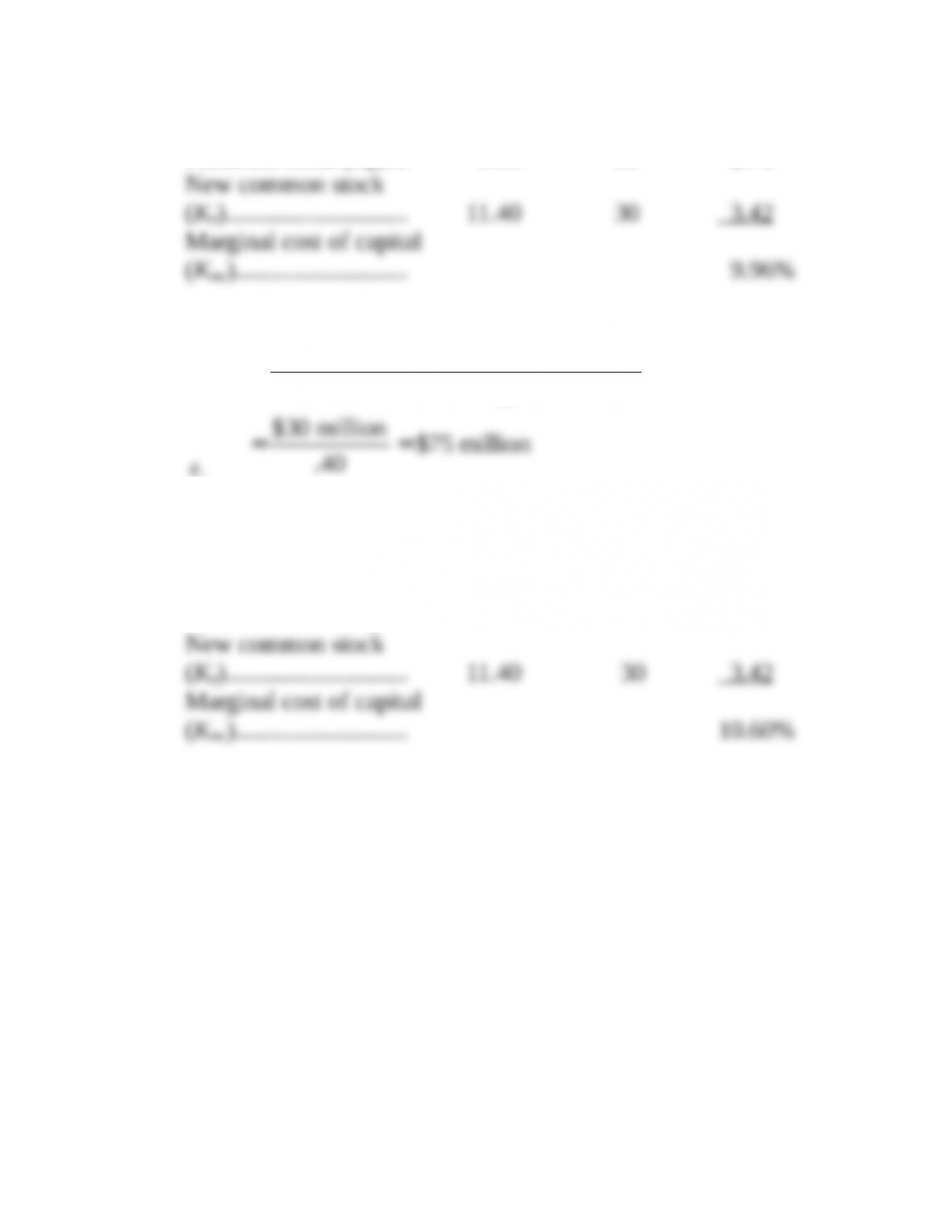
d. The 9.6 percent cost of debt referred to earlier applies only to the first $30 million of
debt. After that, the cost of debt will be 11.2 percent. At what size capital structure will
there be a change in the cost of debt?
e. What will the marginal cost of capital be immediately after that point? (Consider the
facts in both parts c and d.)
11-29. Solution:
The McGee Corporation
a. Cost
(aftertax) Weights
Weighted
Cost
Debt (Kd).….……………………………
Preferred stock (Kp)………………….
9.60%
9.00
40%
30
3.84%
2.70
11-29. (Continued)
c. Cost
(aftertax) Weights
Weighted
Cost
Debt (Kd)…..…….........
Preferred stock (Kp)....
9.60%
9.00
40%
30
3.84%
2.70
e. Cost
(aftertax) Weights
Weighted
Cost
Debt (Kd)…..…….........
Preferred stock (Kp)....
11.20%
9.00
40%
30
4.48%
2.70
30. Capital asset pricing model and dividend valuation model (LO11-3) Eaton Electronic
Company’s treasurer uses both the capital asset pricing model and the dividend valuation model
to compute the cost of common equity (also referred to as the required rate of return for common
equity).
Assume:
Rf= 7%
Km= 10%
β = 1.6
D1= $.70
P0= $19
g= 8%
a. Compute Ki (required rate of return on common equity based on the capital asset
pricing model).
b. Compute Ke (required rate of return on common equity based on the dividend
valuation model).
11-30. Solution:
Eaton Electronic Company
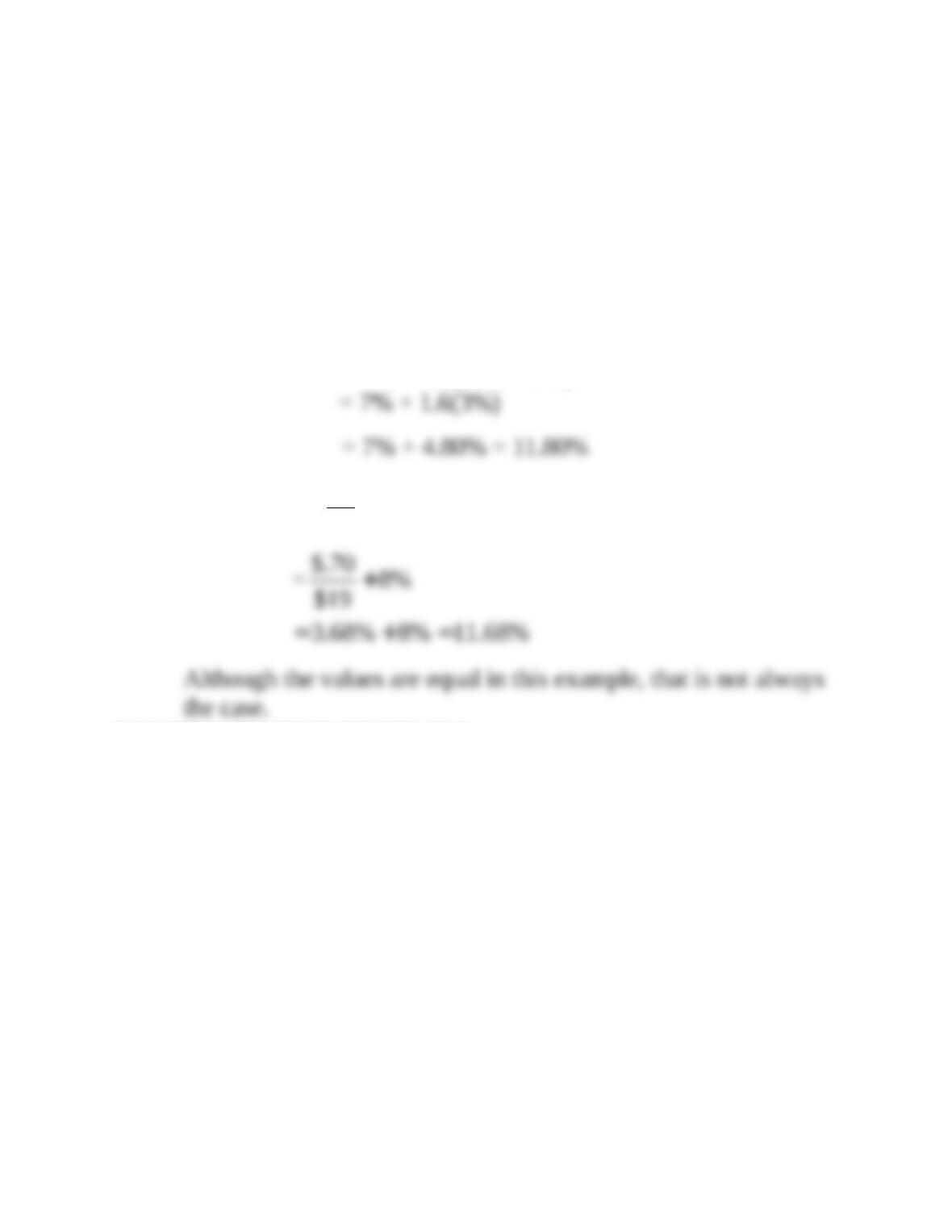
a. Kj = Rf. + β(Km – Rf)
= 7% + 1.6(10% – 7%)
1
0
b.
$.70
= 8%
$19
3.68% 8% 11.68%
e
D
K g
P
= +
+
= + =
Although the values are equal in this example, that is not always
the case.
COMPREHENSIVE PROBLEM
Comprehensive Problem 1
Medical Research Corporation is expanding its research and production capacity to introduce a
new line of products. Current plans call for the expenditure of $100 million on four projects of
equal size ($25 million each), but different returns. Project A is in blood clotting proteins and has an
expected return of 18 percent. Project B relates to a hepatitis vaccine and carries a potential return of
14 percent. Project C, dealing with a cardiovascular compound, is expected to earn 11.8 percent, and
Project D, an investment in orthopedic implants, is expected to show a 10.9 percent return.
The firm has $15 million in retained earnings. After a capital structure with $15 million in
retained earnings is reached (in which retained earnings represent 60 percent of the financing),
all additional equity financing must come in the form of new common stock.
Common stock is selling for $25 per share and underwriting costs are estimated at $3 if new
shares are issued. Dividends for the next year will be $.90 per share (D1), and earnings and
dividends have grown consistently at 11 percent per year.
The yield on comparative bonds has been hovering at 11 percent. The investment banker
feels that the first $20 million of bonds could be sold to yield 11 percent while additional debt
might require a 2 percent premium and be sold to yield 13 percent. The corporate tax rate is 30
percent. Debt represents 40 percent of the capital structure.
a. Based on the two sources of financing, what is the initial weighted average cost of capital?
(Use Kd and Ke.)
b. At what size capital structure will the firm run out of retained earnings?
c. What will the marginal cost of capital be immediately after that point?
d. At what size capital structure will there be a change in the cost of debt?
e. What will the marginal cost of capital be immediately after that point?
f. Based on the information about potential returns on investments in the first paragraph and
information on marginal cost of capital (in parts a, c, and e), how large a capital investment
budget should the firm use?
g. Graph the answer determined in part f.