Chapter 10: Valuation and Rates of Return
10-35. Solution:
Beasley Ball Bearings
a. D1$4.000 (1.02) = $4.08
D2$4.080 (1.02) = 4.162
b. Dividends PV(15%) PV of Dividends
D1$4.080 .870 $ 3.550
D24.162 .756 3.146
c.
5
4 5
4.330 (1.02) $4.417
e
D
P D
K g
= = =
–
4
$4.417 $4.417 $33.977
.15 .02 .13
P= = =
–
d. PV of P4 for n = 4, i = 15%
e. Answer to part b (PV of dividends) $11.966
f.
1
0
$4.08 $4.08 $31.385
.15 .02 .13
e
D
PK g
= = = =
– –
Chapter 10: Valuation and Rates of Return
10-35. (Continued)
h. Part g$35.86
i. 1) D1 increases, stock price increases
Calculator Solution:
(b)
N I/Y PV PMT FV
N I/Y PV PMT FV
N I/Y PV PMT FV
Chapter 10: Valuation and Rates of Return
N I/Y PV PMT FV
(d)
N I/Y PV PMT FV
COMPREHENSIVE PROBLEM
Preston Products (Dividend valuation model, P/E ratio) (LO10-5)
Mel Thomas, the chief financial officer of Preston Resources, has been asked to do
an evaluation of Dunning Chemical Company by the president and Chair of the
Board, Sarah Reynolds. Preston Resources was planning a joint venture with
Dunning (which was privately traded), and Sarah and Mel needed a better feel for
what Dunning’s stock was worth because they might be interested in buying the
firm in the future.
Dunning Chemical paid a dividend at the end of year one of $1.30, the anticipated
growth rate was 10 percent, and the required rate of return was 14 percent.
a. What is the value of the stock based on the dividend valuation model
(Formula 10-8)?
b. Indicate that the value you computed in part a is correct by showing the value of
D1, D2, and D3 and discounting each back to the present at 14 percent. D1 is
$1.30 and it increases by 10 percent (g) each year. Also discount back the
anticipated stock price at the end of year three to the present and add it to the
present value of the three dividend payments.
The value of the stock at the end of year three is:

Chapter 10: Valuation and Rates of Return
( )
4
3 4 3
1
e
D
P D D g
K g
= = +
–
If you have done all these steps correctly, you should get an answer approximately
equal to the answer in part a.
c. As an alternative measure, you also examine the value of the firm based on the
price-earnings (P/E) ratio times earnings per share.
Since the company is privately traded (not in the public stock market), you will
get your anticipated P/E ratio by taking the average value of five publicly traded
chemical companies. The P/E ratios were as follows during the time period under
analysis:
P/E Ratio
Dow Chemical........... 15
DuPont………………….. 18
Georgia Gulf....…….... 7
3M……………….……….. 19
Olin Corp…….…......... 21
Assume Dunning Chemical has earnings per share of $2.10. What is the stock value
based on the P/E ratio approach? Multiply the average P/E ratio you computed
times earnings per share. How does this value compare to the dividend valuation
model values that you computed in parts a and b?
d. If in computing the industry average P/E, you decide to weight Olin Corp. by
40 percent and the other four firms by 15 percent, what would be the new
weighted average industry P/E? (Note: You decided to weight Olin Corp. more
heavily because it is similar to Dunning Chemical.) What will the new stock
price be? Earnings per share will stay at $2.10.
e. By what percent will the stock price change as a result of using the weighted
average industry P/E ratio in part d as opposed to that in part c?
Present Value of Principal Payment at Maturity
PV = FV × PVIF (n = 20, i = 11%) (Appendix B)
PV = $1,000 × .124 = $124
Total Present Value
Present value of interest payments…………………….. $ 939.63
Present value of principal payment at maturity...... 124.00
Total present value, or price, of the bond…………. $1,063.63
The discount rate of 11 percent gives us a value slightly lower than the bond
price of $1,085. The rate for the bond must fall between 10 and 11 percent.
Using linear interpolation, the answer is 10.76 percent
Chapter 10: Valuation and Rates of Return
$1,153.65 PV @ 10% $1,153.65 PV @ 10%
1,063.63 PV @ 11% 1,085.00 bond price
$ 90.02 $ 68.65
( ) ( )
$68.65
10% 1% 10% .76 1% 10.76%
$90.02
+ = + =
CP 10-1. Solution:
Preston Resources—Dunning Chemical
a.
1
10
$1.30 $1.30 $32.50
.14 .10 .04
e
D
PK g
= = = =
– –
b. Future Value of Dividends
D1$1.30 (1.00) = $1.30
Present Value of Dividends
Dividends PV (14%) (PV of Dividend)
D1$1.30 .877 $1.14
Value of Stock Price at the end of Year 3
4
3 4 3
P (1 ) 1.573 (1.10) $1.730
e
DD D g
K g
= = + = =
–
3
$1.730 $1.730 $43.25
.14 .10 .04
P= = =
–
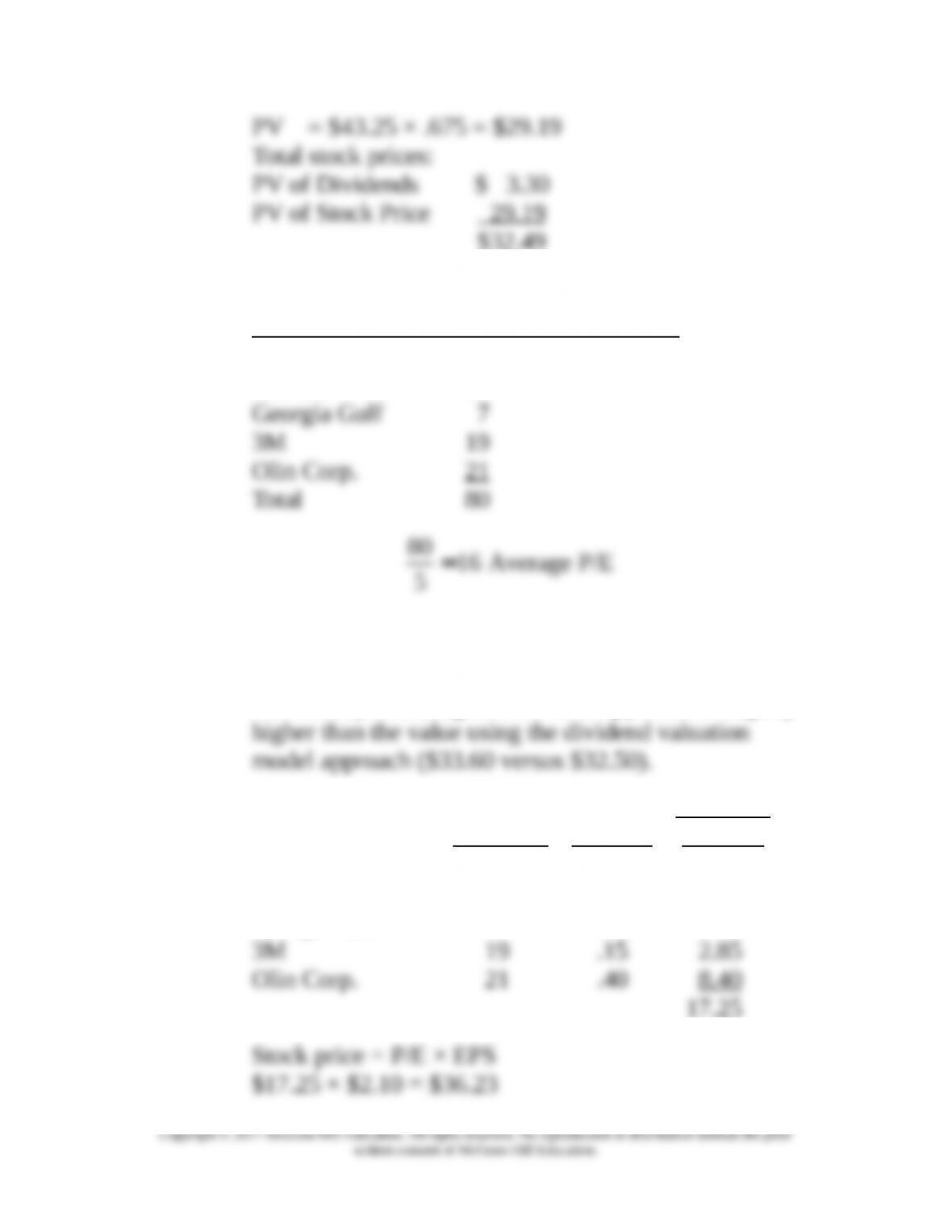
Present Value of Future Stock Price
P3= $43.25 n = 3, i = 14% (Appendix B)
Chapter 10: Valuation and Rates of Return
CP 10-1. (Continued)
c. Average P/E Ratio of Five Chemical Firms
Dow Chemical 15
DuPont 18
Chapter 10: Valuation and Rates of Return
CP 10-1. (Continued)
e. Stock price (d) $36.23
Chapter 10: Valuation and Rates of Return
b.
Supernormal
Dividends
Discount
Rate
Ke = 12%
Present Value of
Dividends
During the
Supernormal
Growth Period
D1$1.40 .893 $1.25
c.
4
3
e
D
PK g
=–
4 3
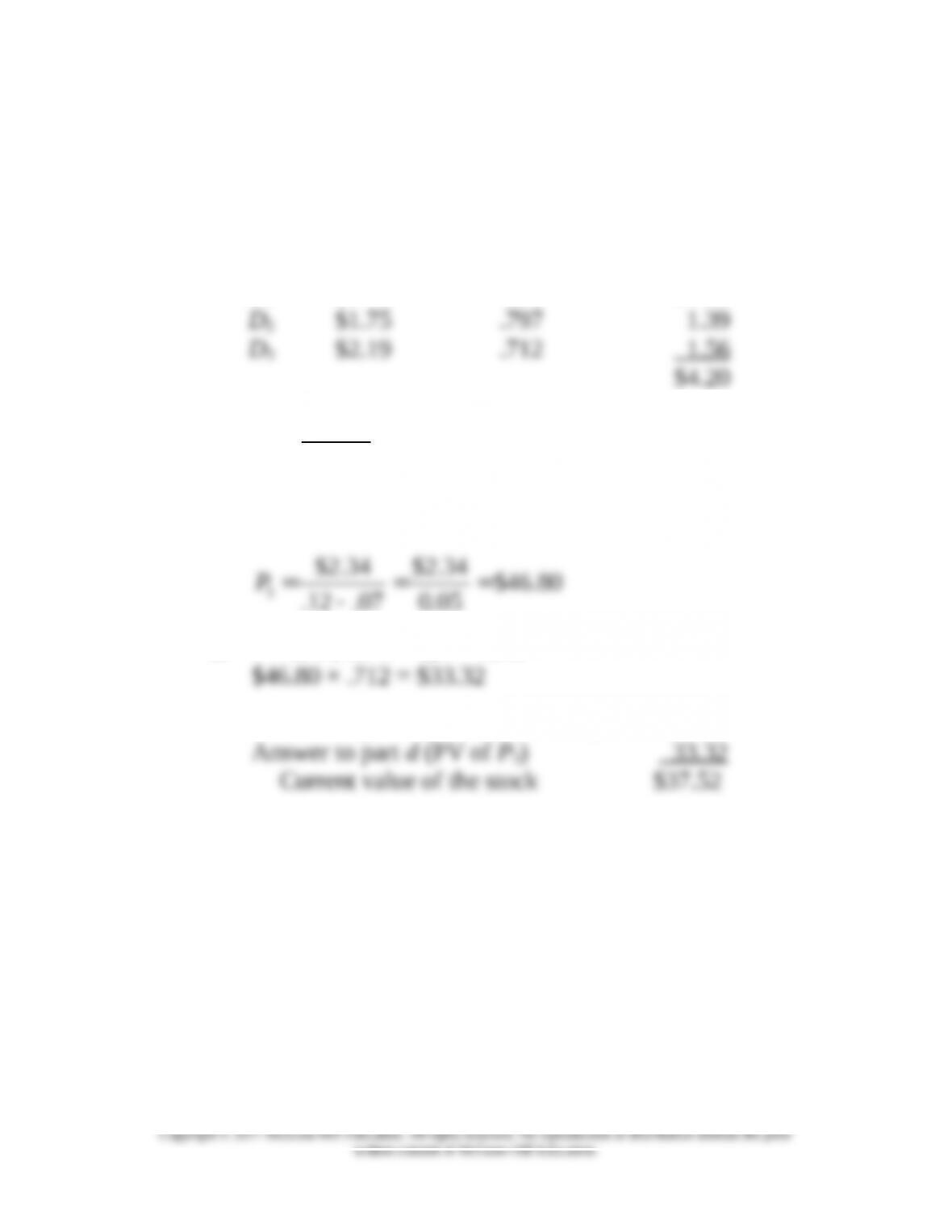
(1.07) $2.19 (1.07) $2.34D D= = =
3
$2.34 $2.34 $46.80
.12 .07 0.05
P= = =
–
d. PV of P3 for n = 3, i = 12%
e. Answer to part b (PV of dividends) $ 4.20