Chapter 10: Valuation and Rates of Return
10-24. Solution:
North Pole Cruise Lines
a. Original price
$6.00 $100
.06
p
p
p
D
PK
= = =
b. Current value
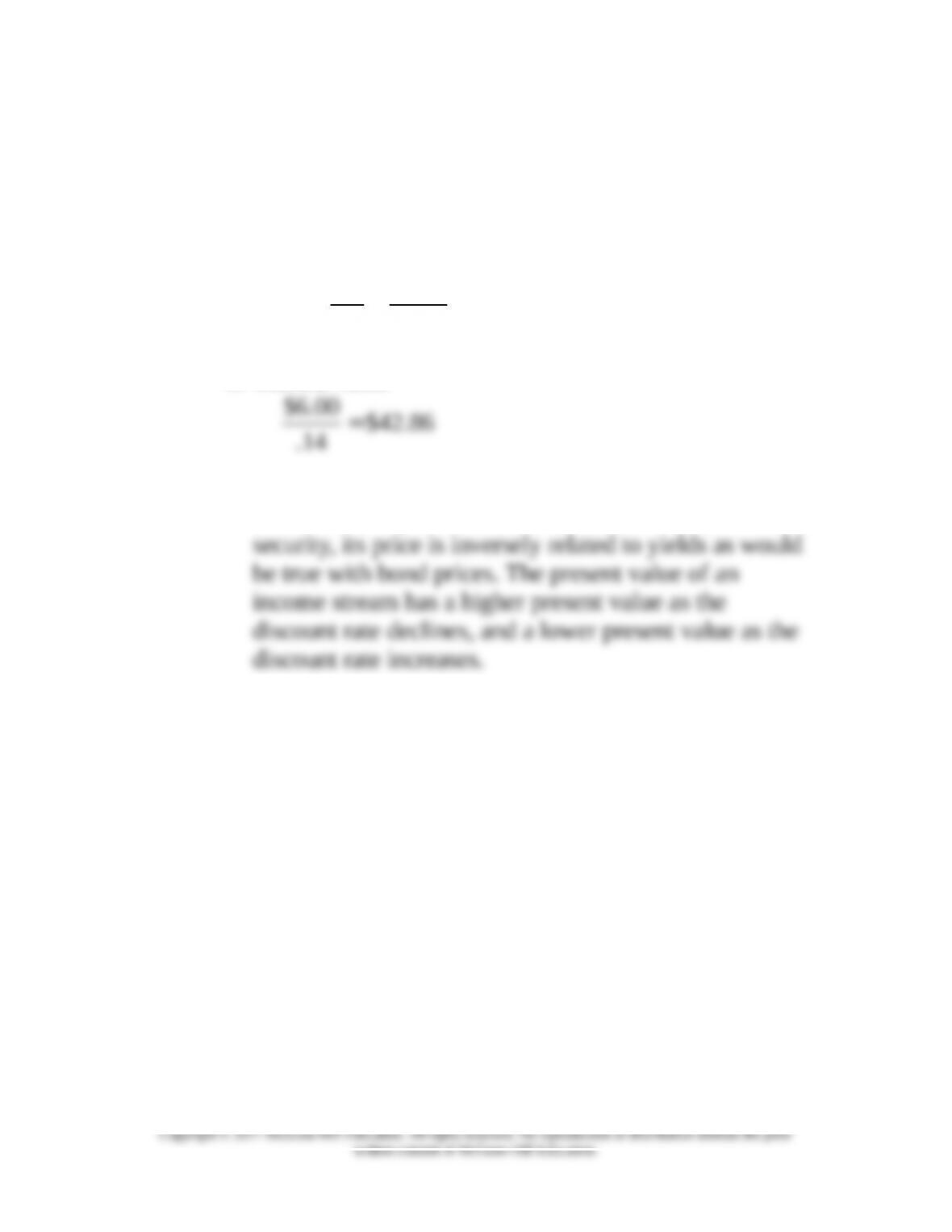
$6.00 $42.86
.14 =
c. The price of preferred stock will increase as yields
decline. Since preferred stock is a fixed income
25. Preferred stock value (LO10-4) X-Tech Company issued preferred stock many
years ago. It carries a fixed dividend of $12.00 per share. With the passage of time,
yields have soared from the original 10 percent to 17 percent (yield is the same as
required rate of return).
a.What was the original issue price?
b. What is the current value of this preferred stock?
c. If the yield on the Standard & Poor’s Preferred Stock Index declines, how will
the price of the preferred stock be affected?
10-25. Solution:
X-Tech Company
a. Original price
Chapter 10: Valuation and Rates of Return
$12.00 $120
0.10
p
p
p
D
PK
= = =
b. Current value
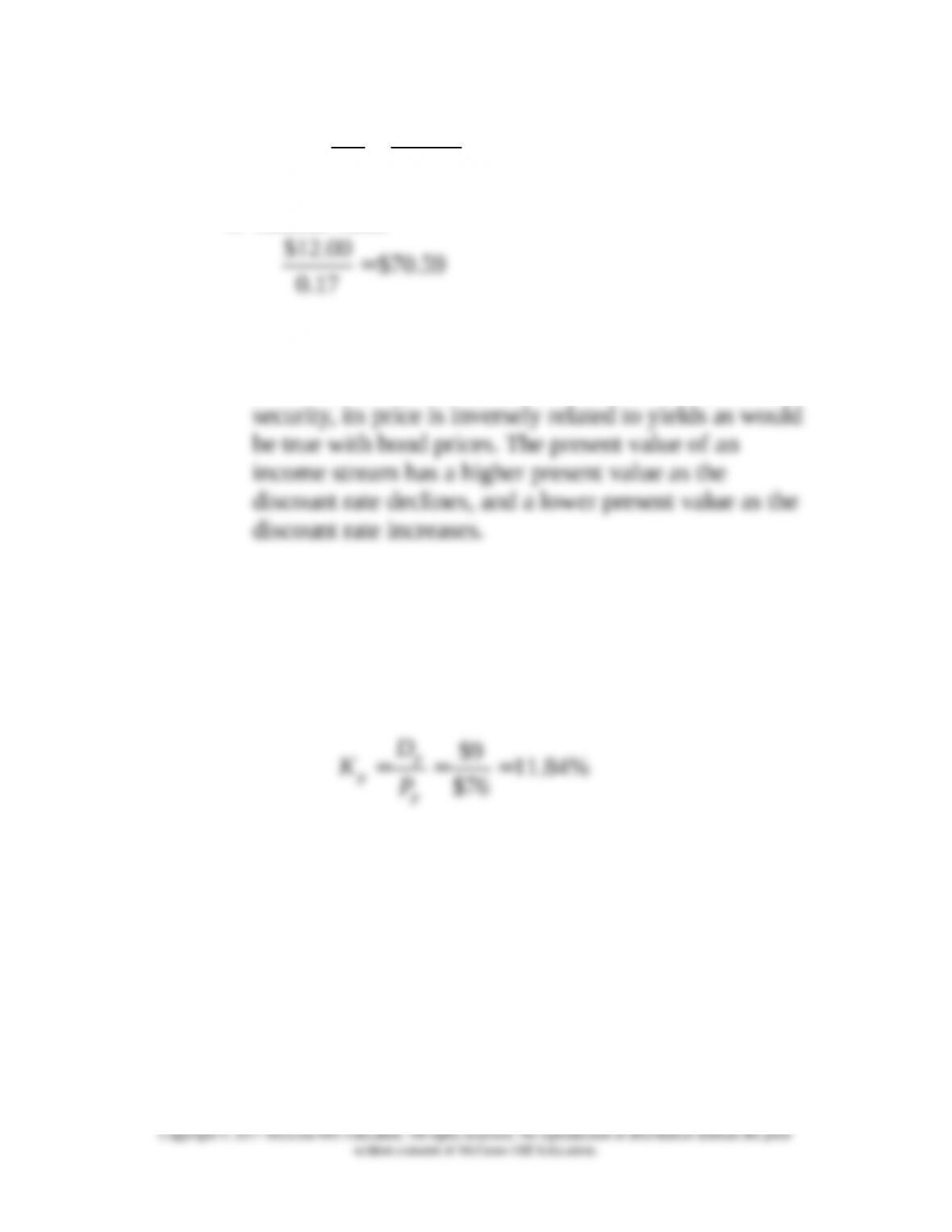
$12.00 $70.59
0.17 =
c. The price of preferred stock will increase as yields
decline. Since preferred stock is a fixed income
26. Analogue Technology has preferred stock outstanding that pays a $9 annual
dividend. It has a price of $76. What is the required rate of return (yield) on the
preferred stock?
10-26. Solution:
Analogue Technology
$9 11.84%
$76
p
p
p
D
KP
= = =
(All of the following problems pertain to the common stock section of the chapter.)
27. Common stock value (LO10-5) Stagnant Iron and Steel currently pays a $12.25
annual cash dividend (D0). The company plans to maintain the dividend at this level
for the foreseeable future as no future growth is anticipated. If the required rate of
return by common stockholders (Ke) is 18 percent, what is the price of the common
stock?
10-27. Solution:
Stagnant Iron and Steel
Chapter 10: Valuation and Rates of Return
0
0
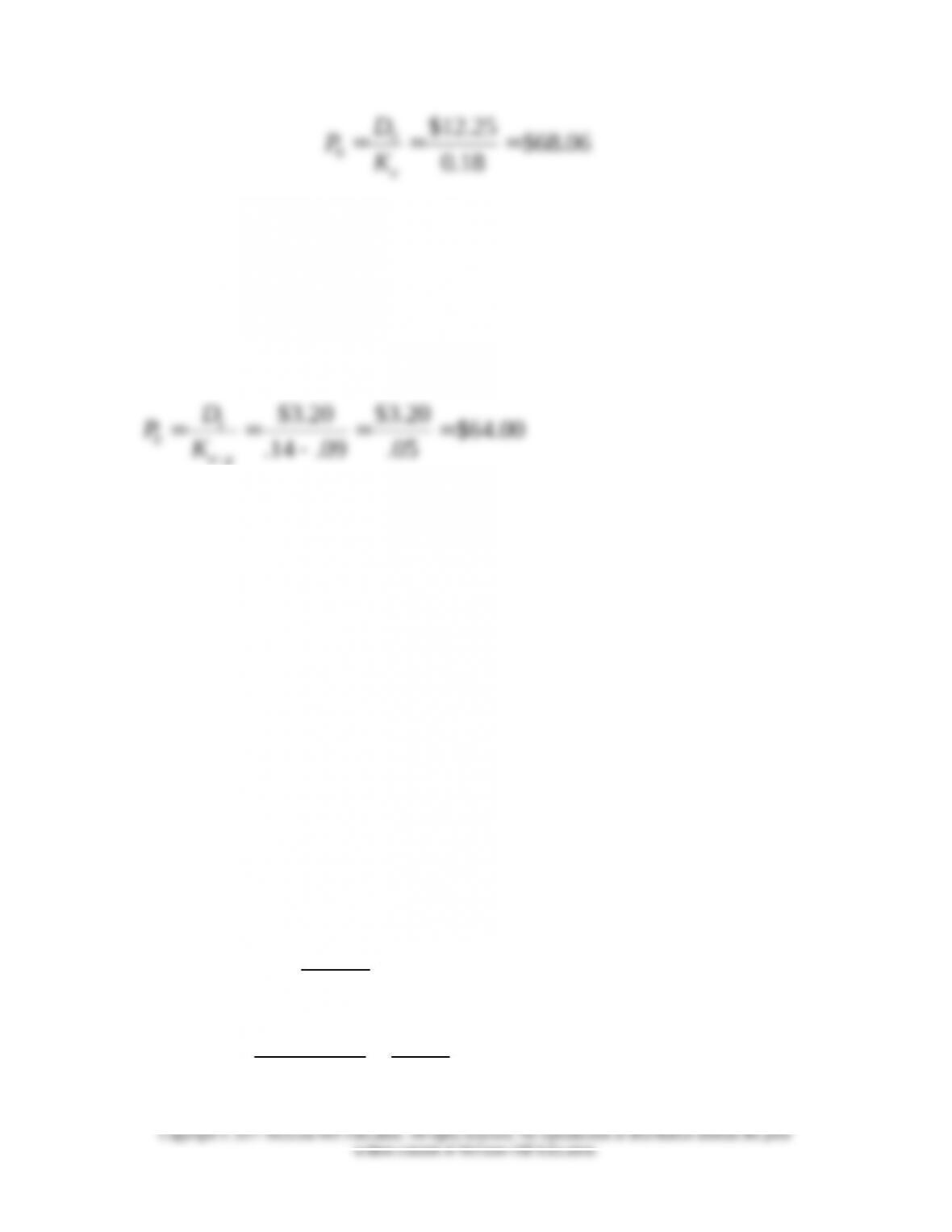
$12.25 $68.06
0.18
e
D
PK
= = =
28. BioScience Inc. will pay a common stock dividend of $3.20 at the end of the year
(D1). The required return on common stock (Ke) is 14 percent. The firm has a
constant growth rate (g) of 9 percent. Compute the current price of the stock (P0).
10-28. Solution:
BioScience Inc.
1
0
$3.20 $3.20 $64.00
.14 .09 .05
e g
D
PK
–
= = = =
–
29. Common stock value under different market conditions (LO10-5) Ecology Labs
Inc. will pay a dividend of $6.40 per share in the next 12 months (D1). The required
rate of return (Ke) is 14 percent and the constant growth rate is 5 percent.
a.Compute P0.
(For parts b, c, and d in this problem, all variables remain the same except the one
specifically changed. Each question is independent of the others.)
b. Assume Ke, the required rate of return, goes up to 18 percent. What will be the
new value of P0?
c. Assume the growth rate (g) goes up to 9 percent. What will be the new value of
P0? Ke goes back to its original value of 14 percent.
d. Assume D1 is $7.00. What will be the new value of P0? Assume Ke is at its
original value of 14 percent and g goes back to its original value of 5 percent.
10-29. Solution:
Ecology Labs Inc.
1
0
e
D
PK g
=–
a.
$6.40 $6.40 $71.11
0.14 0.05 0.09
= =
–
Chapter 10: Valuation and Rates of Return
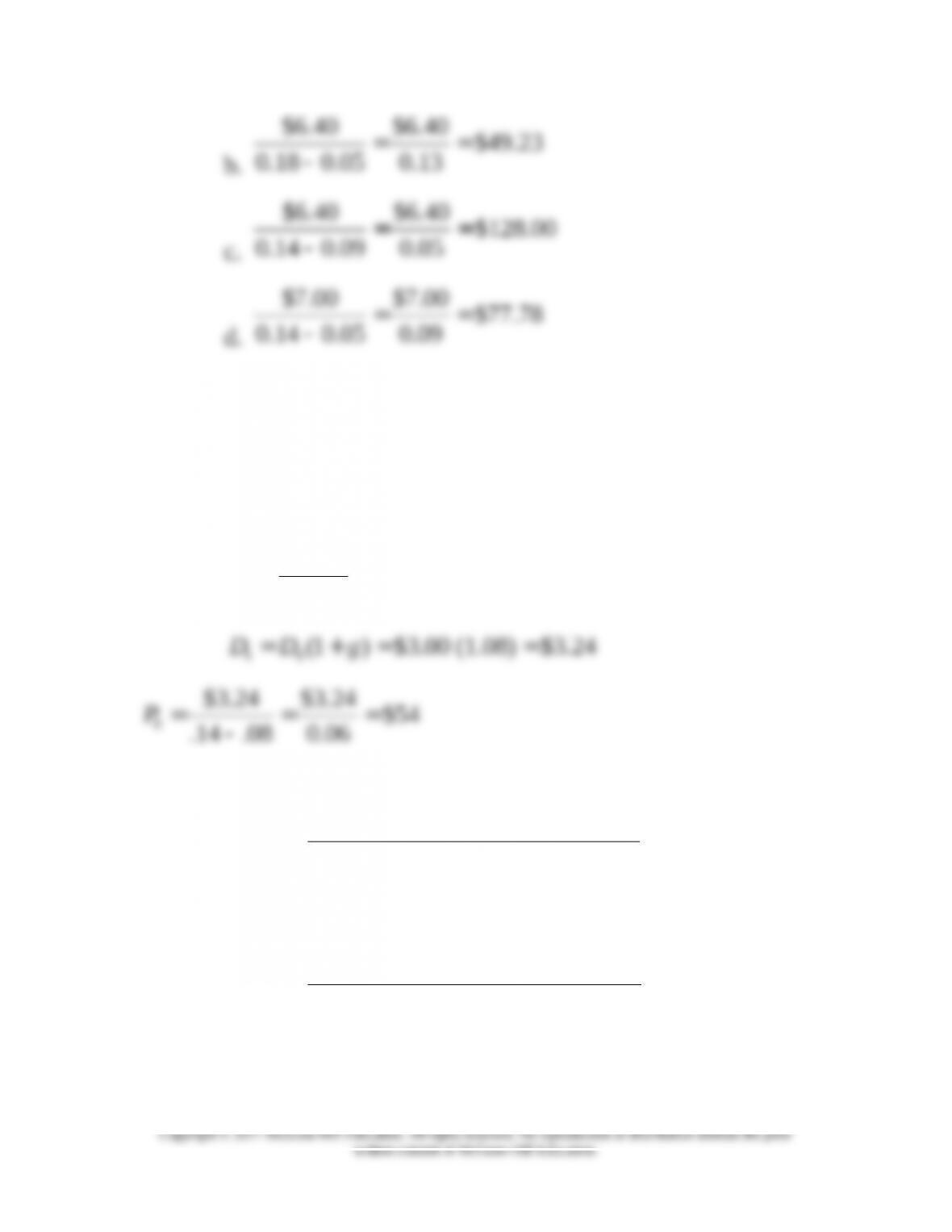
$6.40 $6.40 $49.23
= =
Chapter 10: Valuation and Rates of Return
10-31. Solution:
Justin Cement Company
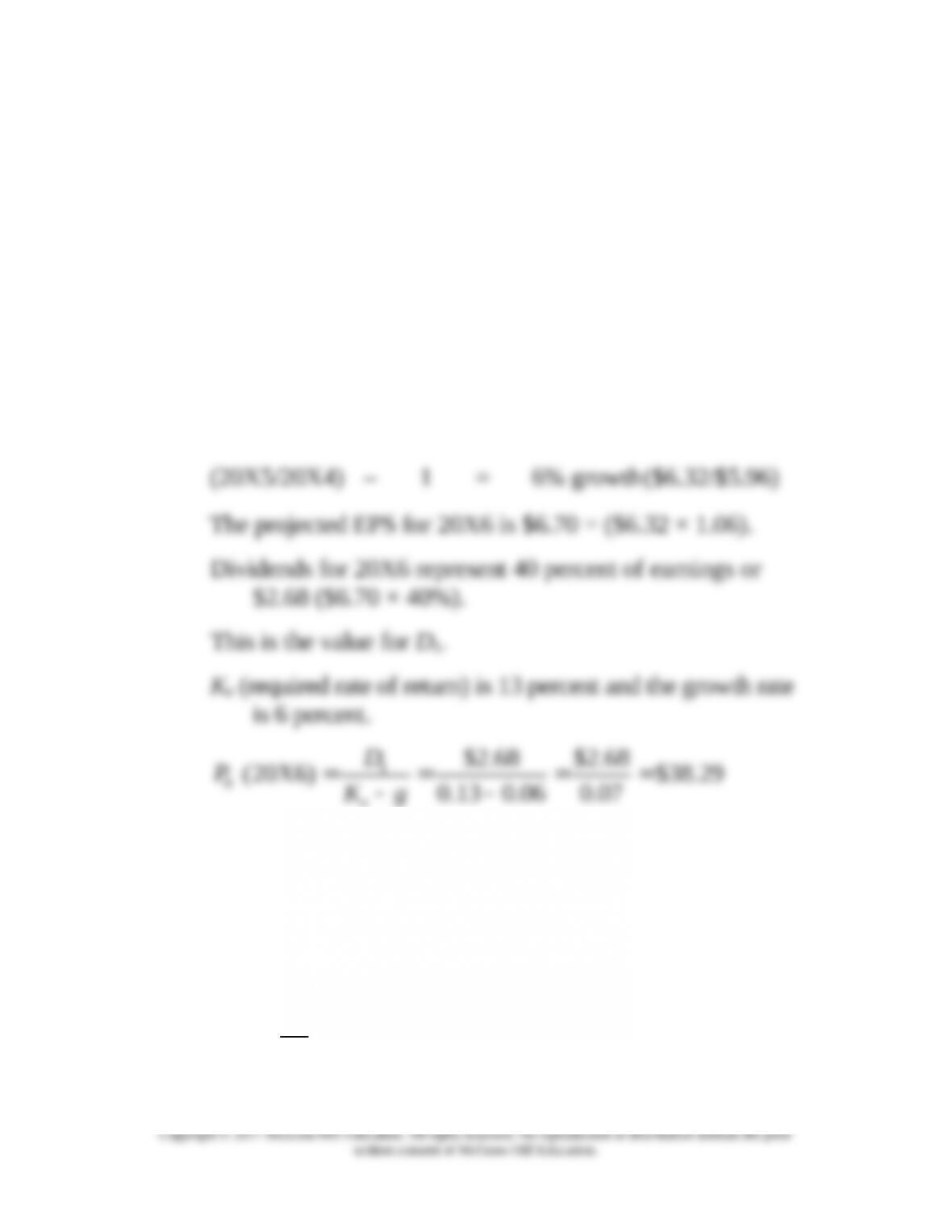
Earnings have been growing at a rate of 6 percent per year.
Base Period
(20X2/20X1) – 1 = 6% growth($5.30/$5.00)
(20X3/20X2) – 1 = 6% growth($5.62/$5.30)
(20X4/20X3) – 1 = 6% growth($5.96/$5.62)
Chapter 10: Valuation and Rates of Return
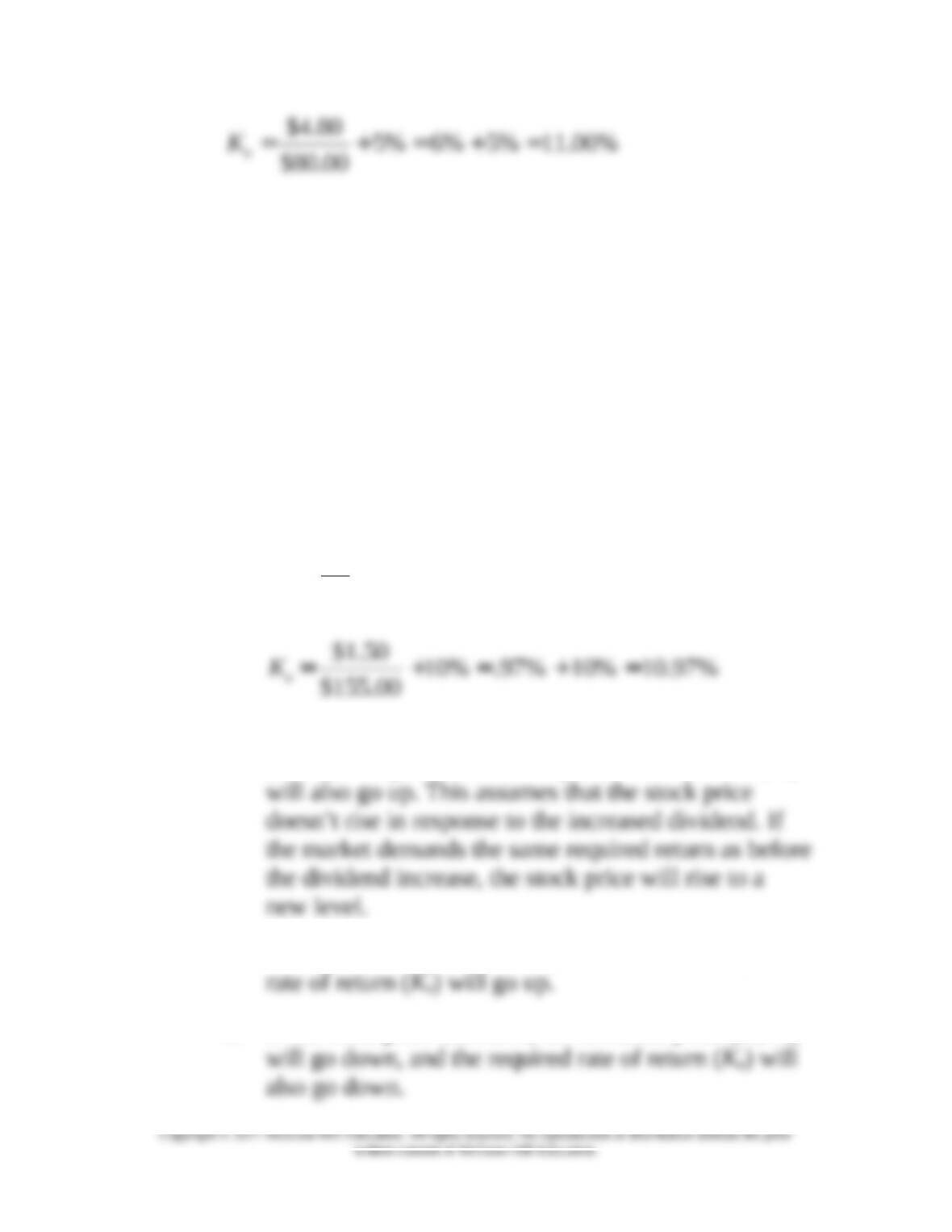
$4.80 5% 6% 5% 11.00%
$80.00
e
K= + = + =
33. Common stock required rate of return (LO10-5) A firm pays a $1.50 dividend at
the end of year one (D1), has a stock price of $155 (P0), and a constant growth rate
(g) of 10 percent.
a.Compute the required rate of return (Ke).
Indicate whether each of the following changes would make the required rate of
return (Ke) go up or down. (Each question is separate from the others. That is,
assume only one variable changes at a time.) No actual numbers are necessary.
b. The dividend payment increases.
c. The expected growth rate increases.
d. The stock price increases.
10-33. Solution:
a.
1
0
e
D
K g
P
= +
$1.50 10% .97% 10% 10.97%
$155.00
e
K= + = + =
b. If the dividend payment increases, the dividend yield
(D1/P0) will go up, and the required rate of return (Ke)
c. If the expected growth rate (g) increases, the required
d. If the stock price increases, the dividend yield (D1/P0)

Chapter 10: Valuation and Rates of Return
34. Trump Office Supplies paid a $3 dividend last year. The dividend is expected to
grow at a constant rate of 7 percent over the next four years. The required rate of
return is 14 percent (this will also serve as the discount rate in this problem). Round
all values to three places to the right of the decimal point where appropriate.
a.Compute the anticipated value of the dividends for the next four years. That is,
compute D1, D2, D3, and D4—for example, D1 is $3.21 ($3.00 × 1.07).
b. Discount each of these dividends back to the present at a discount rate of 14
percent and then sum them.
c. Compute the price of the stock at the end of the fourth year (P4).
5
4
e
D
PK g
=–
(D5 is equal to D4 times 1.07)
d. After you have computed P4, discount it back to the present at a discount rate of
14 percent for four years.
e. Add together the answers in part b and part d to get P0, the current value of the
stock. This answer represents the present value of the four periods of dividends,
plus the present value of the price of the stock after four periods (which, in turn,
represents the value of all future dividends).
f. Use Formula 10-8 to show that it will provide approximately the same answer
as part e.
1
0
e
D
PK g
=–
For Formula 10-8, use D1 = $3.21, Ke = 14 percent, and g = 7 percent. (The
slight difference between the answers to part e and part f is due to rounding.)
g. If current EPS is equal to $5.32 and the P/E ratio is 1.1 times higher than the
industry average of 8, what would the stock price be?
h. By what dollar amount is the stock price in part g different from the stock price
in part f?
i. In regard to the stock price in part f, indicate which direction it would move if
(1) D1 increases, (2) Ke increases, and (3) g increases.
10-34. Solution:
Trump Office Supplies
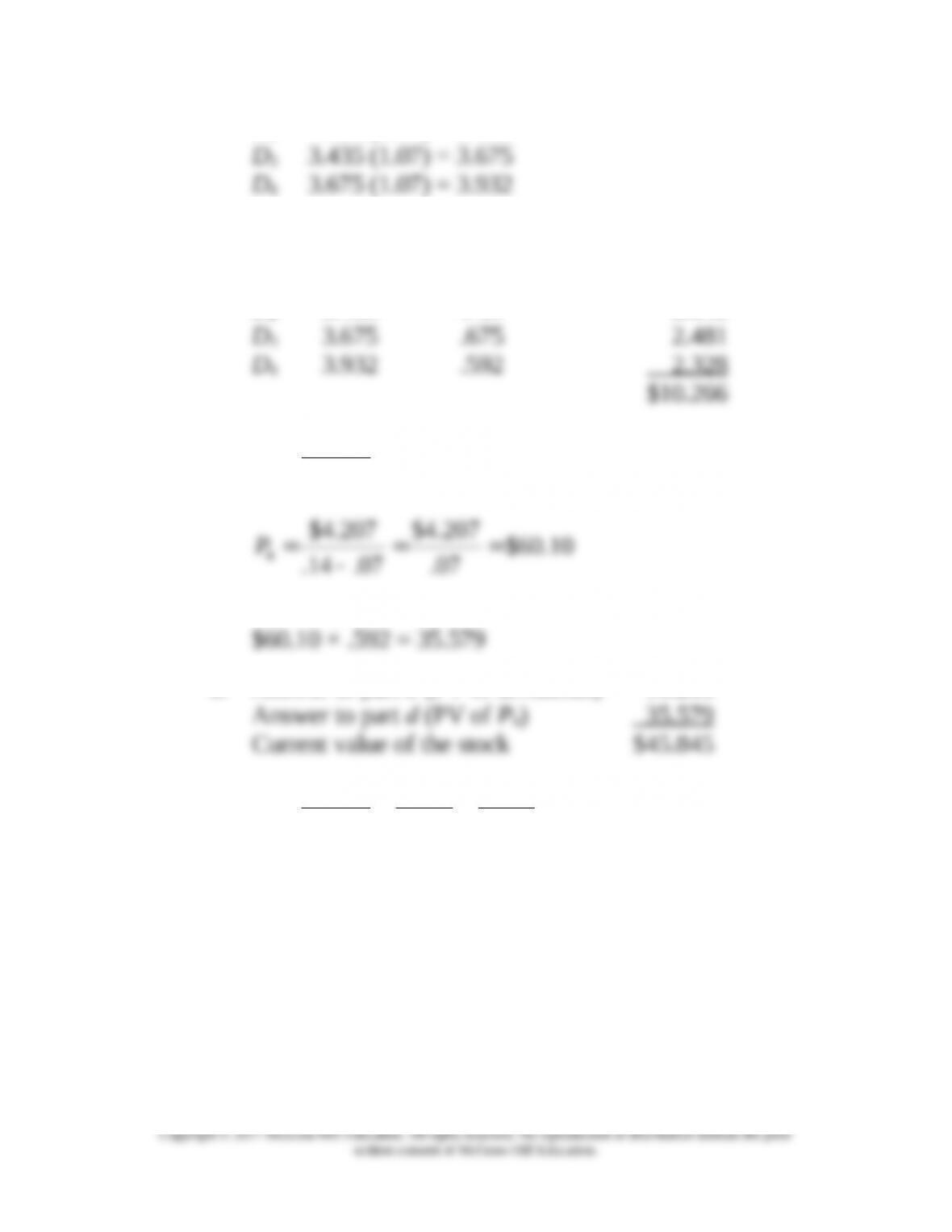
a. D1$3.00 (1.07) = $3.21
Chapter 10: Valuation and Rates of Return
D2 3.21 (1.07) = 3.435
b. Dividends PV(14%) PV of Dividends
D1$3.21 .877 $ 2.815
D23.435 .769 2.642
c.
5
4 5
3.932 (1.07) $4.207
e
D
P D
K g
= = =
–
4
$4.207 $4.207 $60.10
.14 .07 .07
P= = =
–
d. PV of P4 for n = 4, i = 14%
e. Answer to part b (PV of dividends) 10.266
f.
1
0
$3.21 $3.21 $45.857
14.07 .07
e
D
PK g
= = = =
–
Chapter 10: Valuation and Rates of Return
10-34. (Continued)
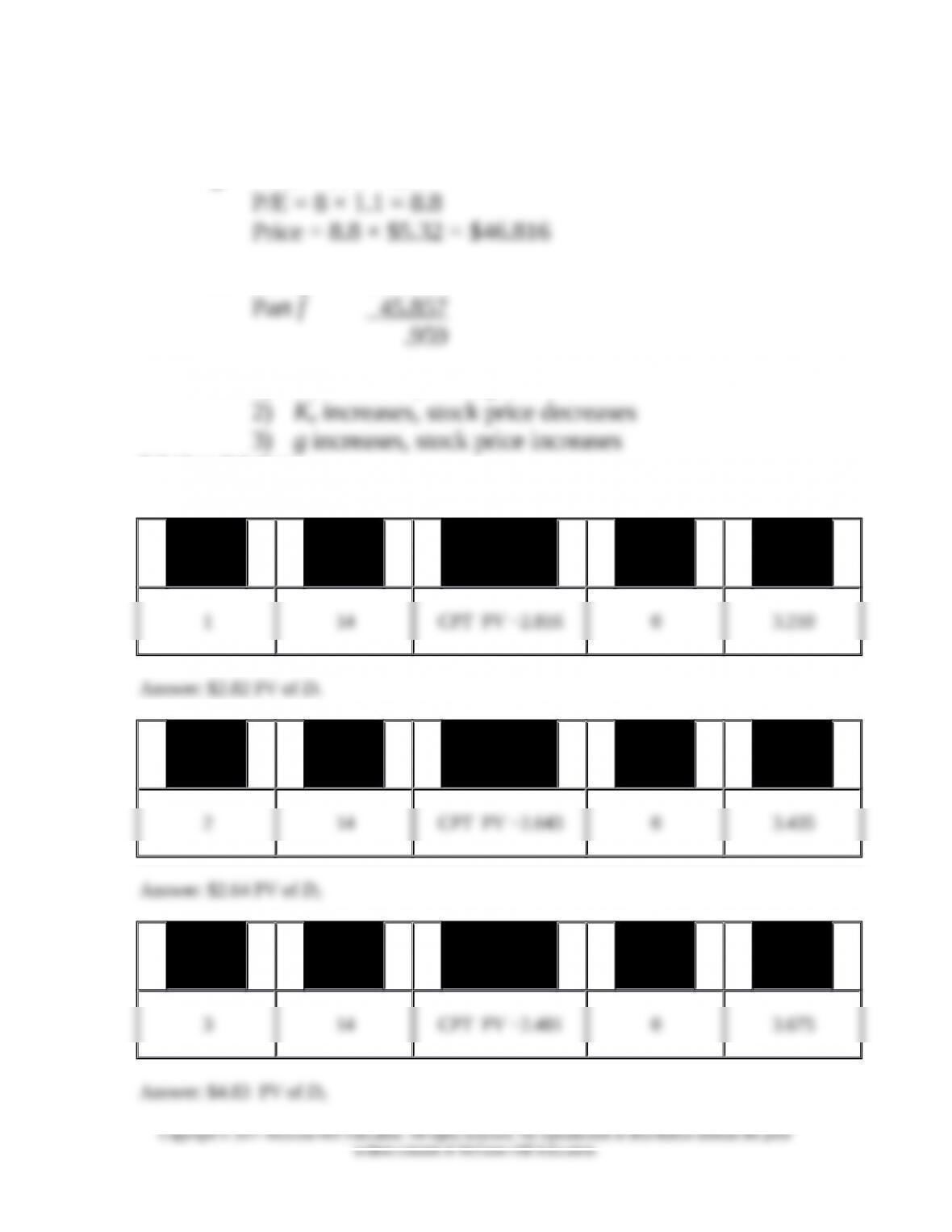
g. Price = P/E × EPS
h. Part g$46.816
i. 1) D1 increases, stock price increases
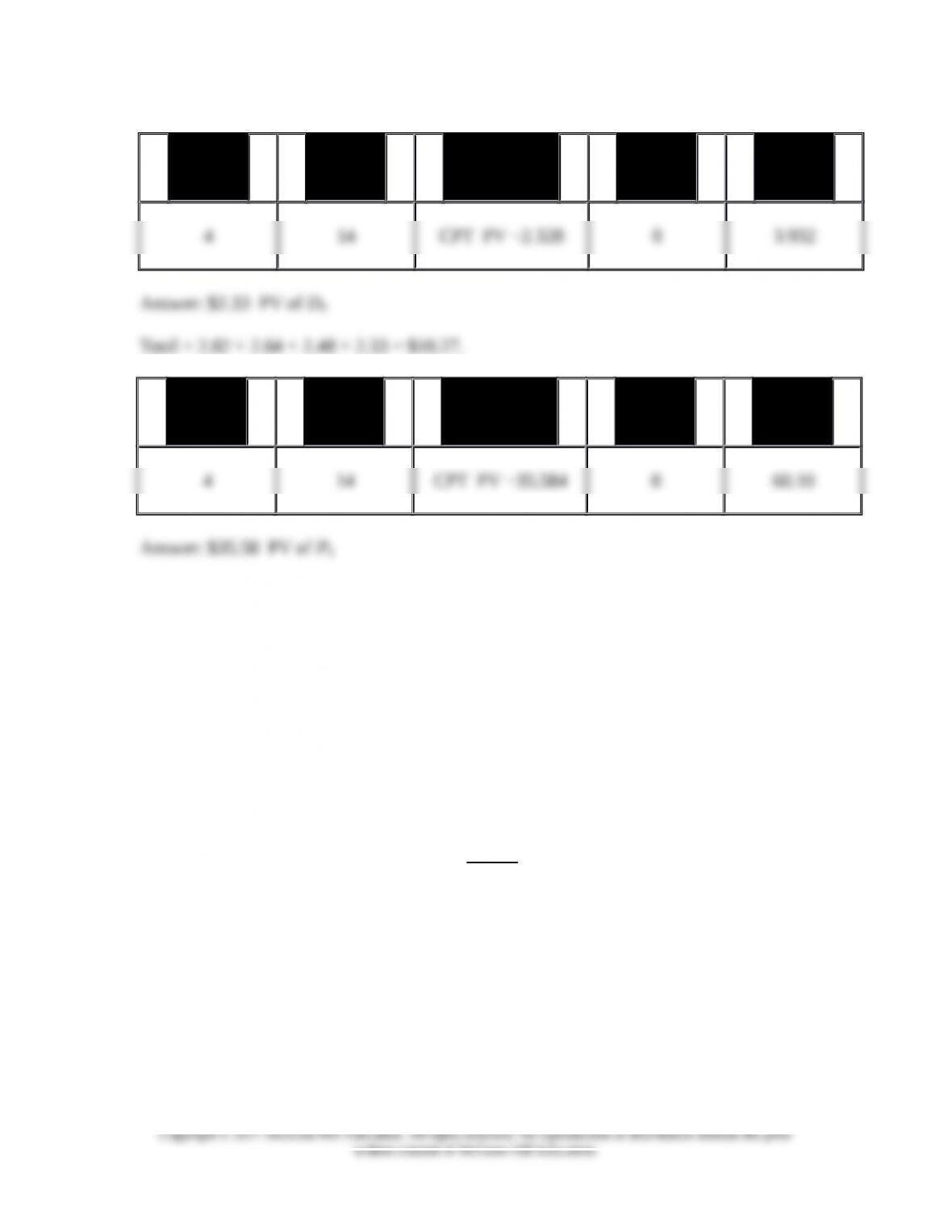
Calculator Solution:
(b)
N I/Y PV PMT FV
N I/Y PV PMT FV
N I/Y PV PMT FV
Chapter 10: Valuation and Rates of Return
N I/Y PV PMT FV
(d)
N I/Y PV PMT FV
35. Common stock value based on PV calculations (LO10-5) Beasley Ball Bearings
paid a $4 dividend last year. The dividend is expected to grow at a constant rate of 2
percent over the next four years. The required rate of return is 15 percent (this will
also serve as the discount rate in this problem). Round all values to three places to
the right of the decimal point where appropriate.
a.Compute the anticipated value of the dividends for the next four years. That is,
compute D1, D2, D3, and D4—for example, D1 is $4.08 ($4 × 1.02).
b. Discount each of these dividends back to present at a discount rate of 15 percent
and then sum them.
c. Compute the price of the stock at the end of the fourth year (P4).
5
4
e
D
PK g
=–
(D5 is equal to D4 times 1.02.)
d. After you have computed P4, discount it back to the present at a discount rate of
15 percent for four years.
e. Add together the answers in part b and part d to get P0, the current value of the
stock. This answer represents the present value of the four periods of dividends,
plus the present value of the price of the stock after four periods, (which, in
turn, represents the value of all future dividends).
f. Use Formula 10-8 to show that it will provide approximately the same answer
as part e.

Chapter 10: Valuation and Rates of Return
1
0
e
D
PK g
=–
For Formula 10-8, use D1 = $4.08, Ke = 15 percent, and g = 2 percent. (The
slight difference between the answers to part e and part f is due to rounding.)
g. If current EPS were equal to $4.98 and the P/E ratio is 1.2 times higher than the
industry average of 6, what would the stock price be?
h. By what dollar amount is the stock price in part g different from the stock price
in part f?
i. In regard to the stock price in part f, indicate which direction it would move if
(1) D1 increases, (2) Ke increases, and (3) g increases.