Chapter 10: Valuation and Rates of Return
10-5. Solution:
Essex Biochemical
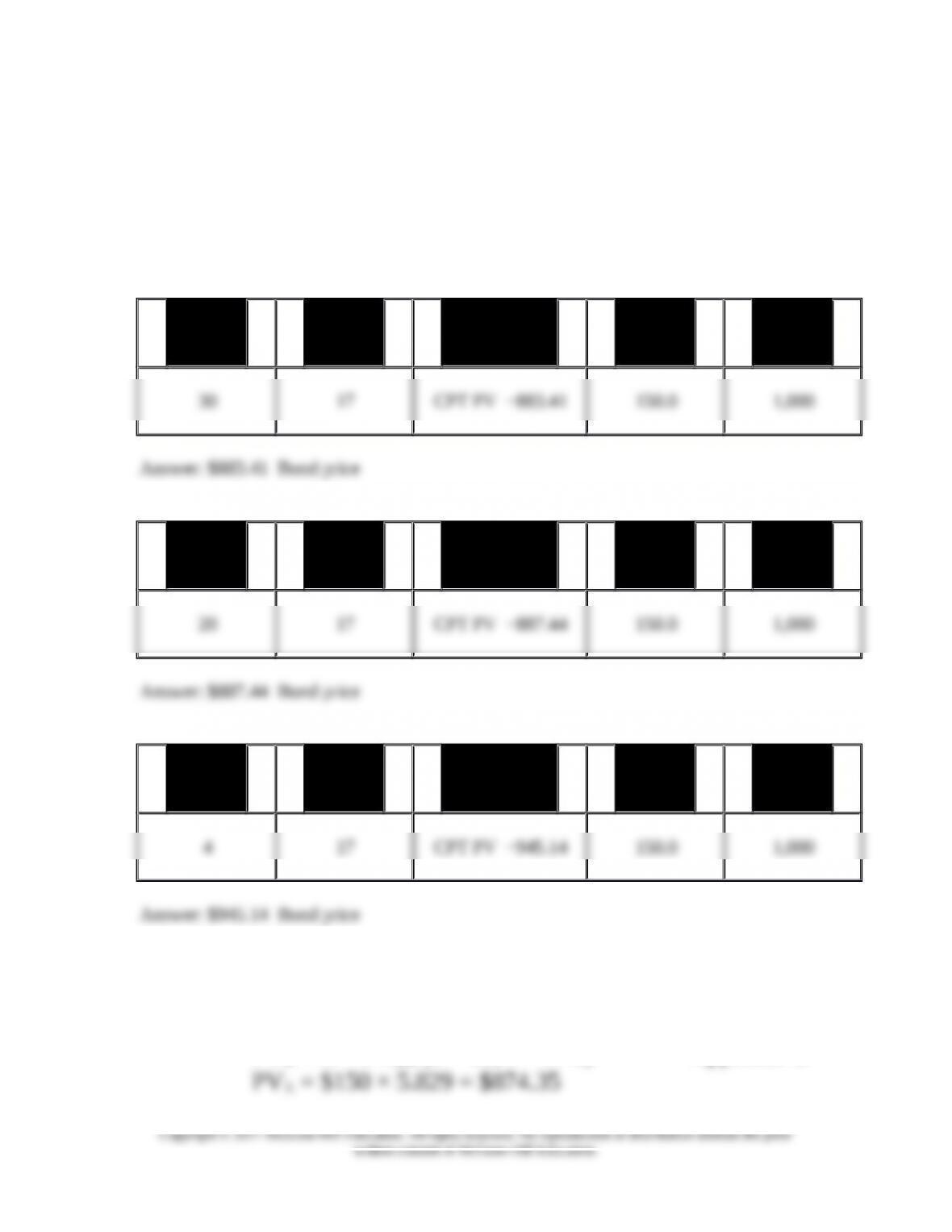
Calculator Solution:
(a) 30 years to maturity
N I/Y PV PMT FV
(b) 20 years to maturity
N I/Y PV PMT FV
(c) 4 years to maturity
N I/Y PV PMT FV
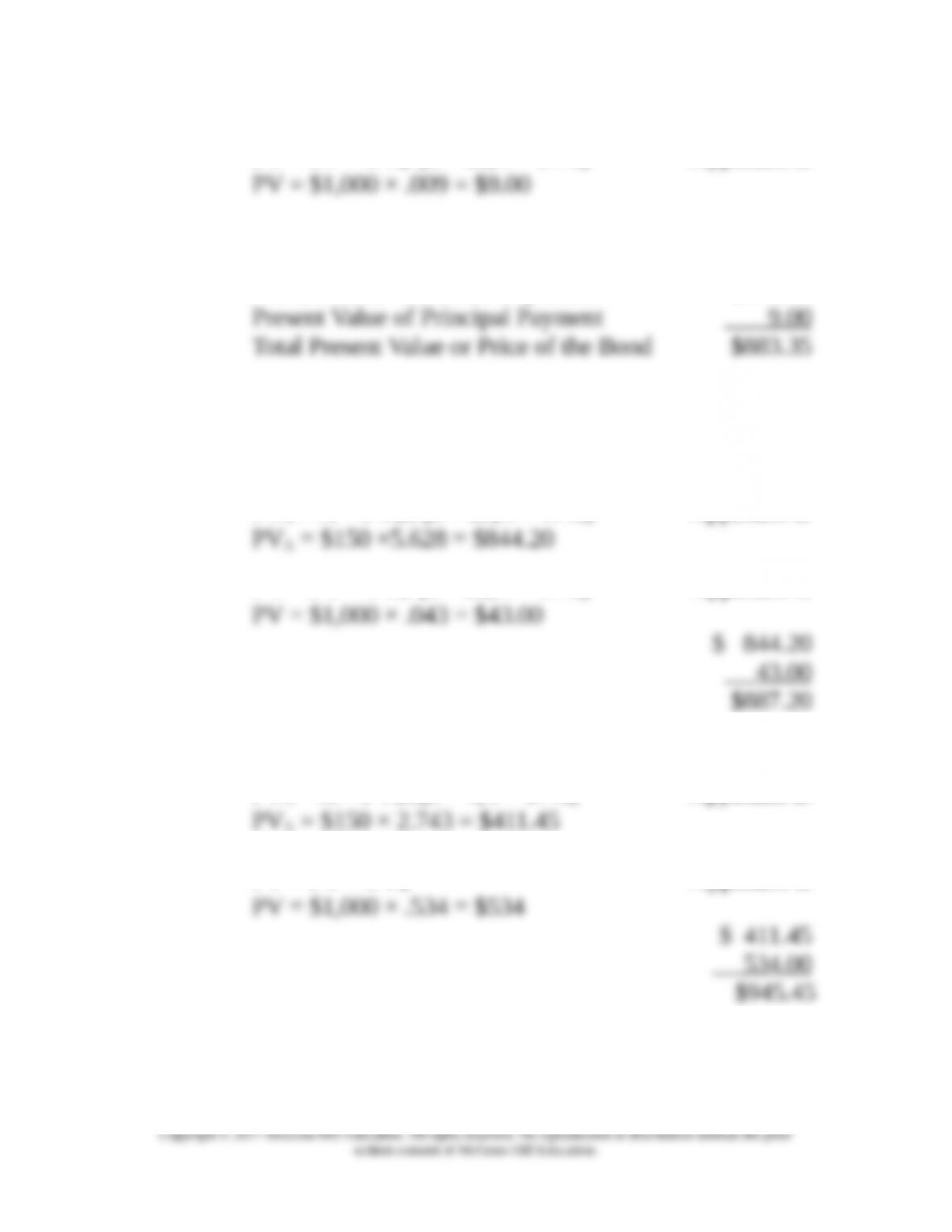
a. 30 years to maturity
Present Value of Interest Payments
PVA = A × PVIFA (n = 30, i = 17%) Appendix D
Chapter 10: Valuation and Rates of Return
PV = FV × PVIF (n = 30, i = 17%) Appendix B
Total Present Value
Present Value of Interest Payments $874.35
10-5. (Continued)
b. 20 years to maturity
PVA = A × PVIFA (n = 20, i = 17%) Appendix D
PV = FV × PVIF (n = 20, i = 17%) Appendix B
c. 4 years to maturity
PVA = A × PVIFA (n = 4, i = 17%) Appendix D
PV = FV × PVIF Appendix B
6. Kilgore Natural Gas has a $1,000 par value bond outstanding that pays 9 percent
annual interest. The current yield to maturity on such bonds in the market is
12 percent. Compute the price of the bonds for the following maturity dates:
Chapter 10: Valuation and Rates of Return
a.30 years
b. 15 years
c. 1 year
10-6. Solution:
Kilgore Natural Gas
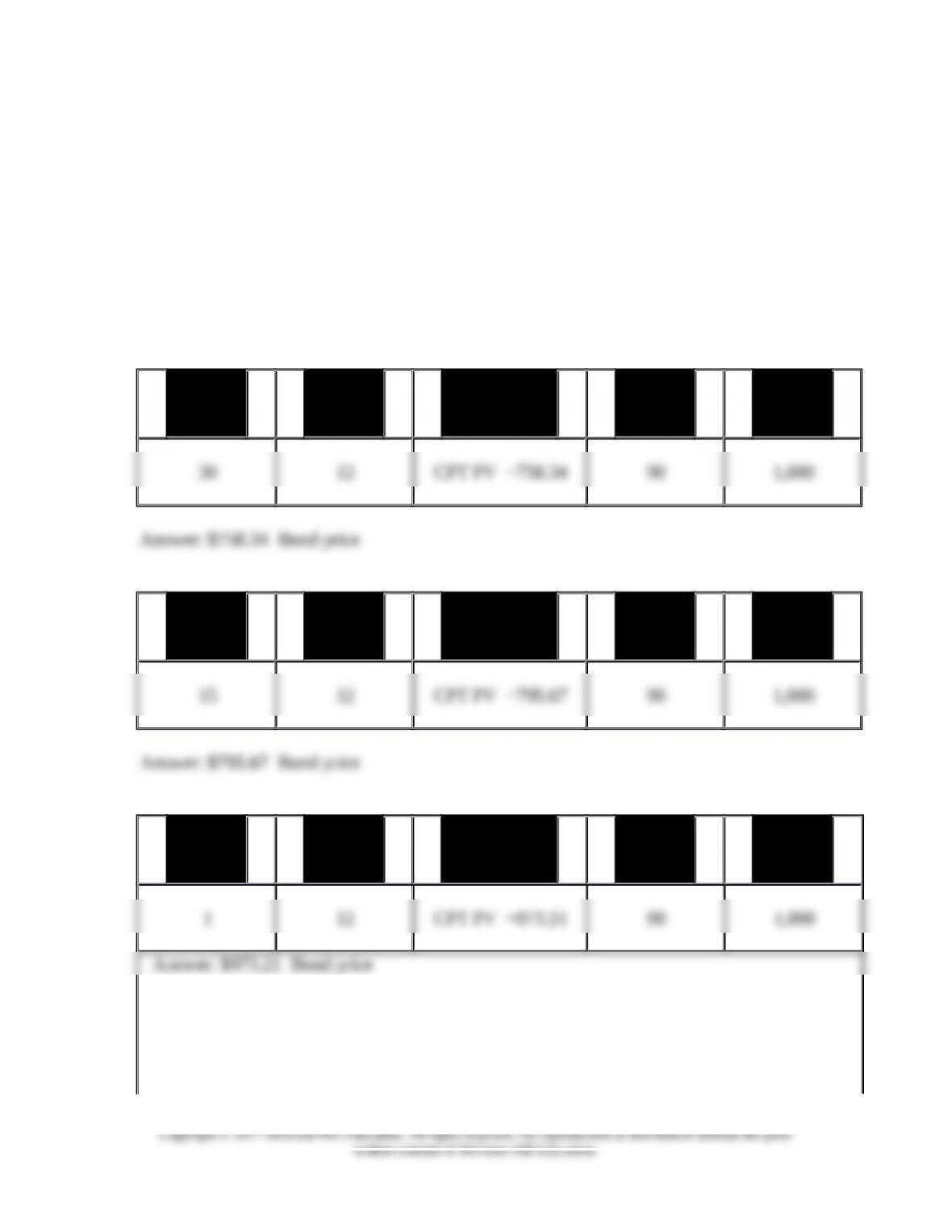
Calculator Solution:
(a) 30 years to maturity
N I/Y PV PMT FV
(b) 15 years to maturity
N I/Y PV PMT FV
(c) 1 year to maturity
N I/Y PV PMT FV
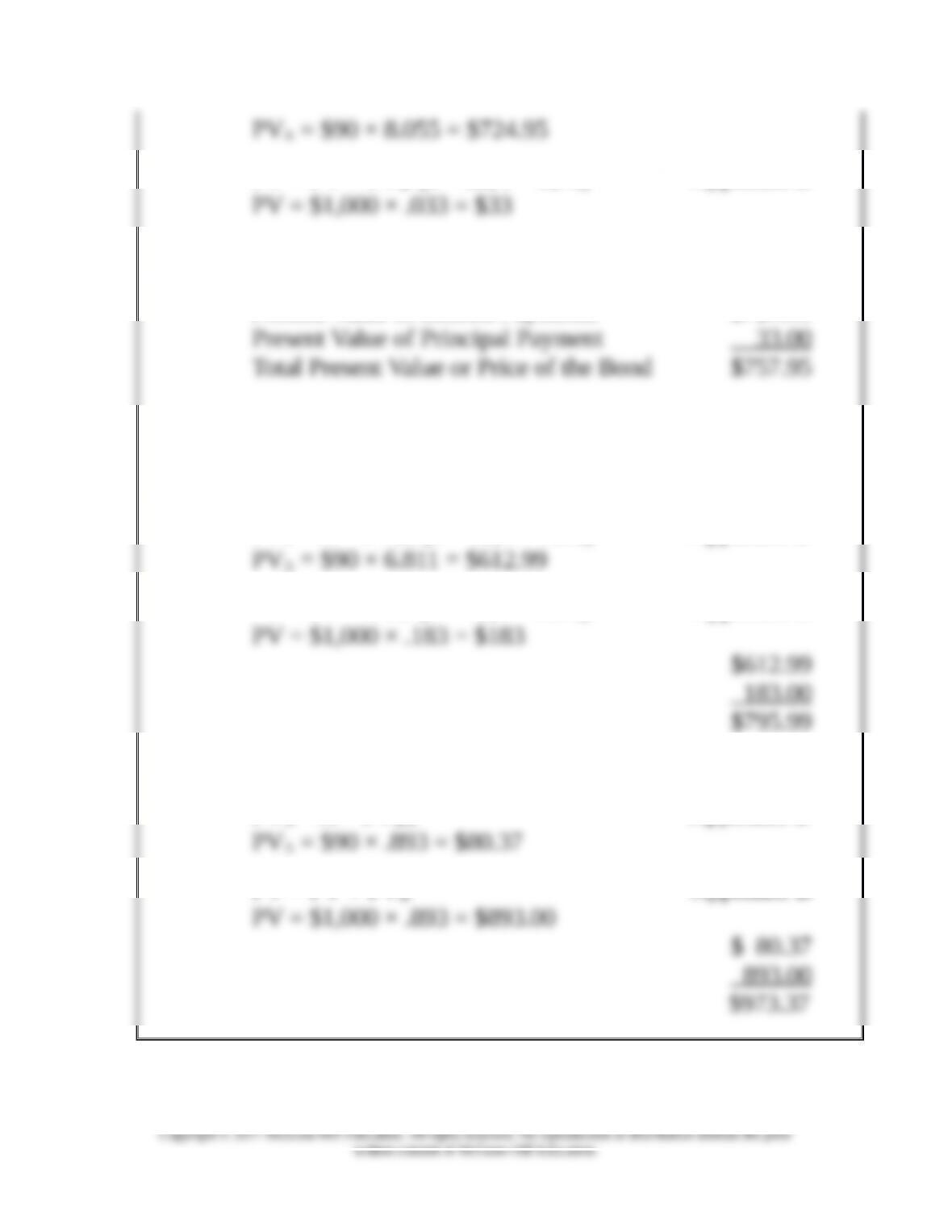
a. 30 years to maturity
Present Value of Interest Payments
PVA = A × PVIFA (n = 30, i = 12%) Appendix D
Chapter 10: Valuation and Rates of Return
PV = FV × PVIF (n = 30, i = 12%) Appendix B
Total Present Value
Present Value of Interest Payments $724.95
10-6. (Continued)
b. 15 years to maturity
PVA = A × PVIFA (n = 15, i = 12%) Appendix D
PV = FV × PVIF (n = 15, i = 12%) Appendix B
c. 1 year to maturity
PVA = A × PVIFA Appendix D
PV = FV × PVIF Appendix B
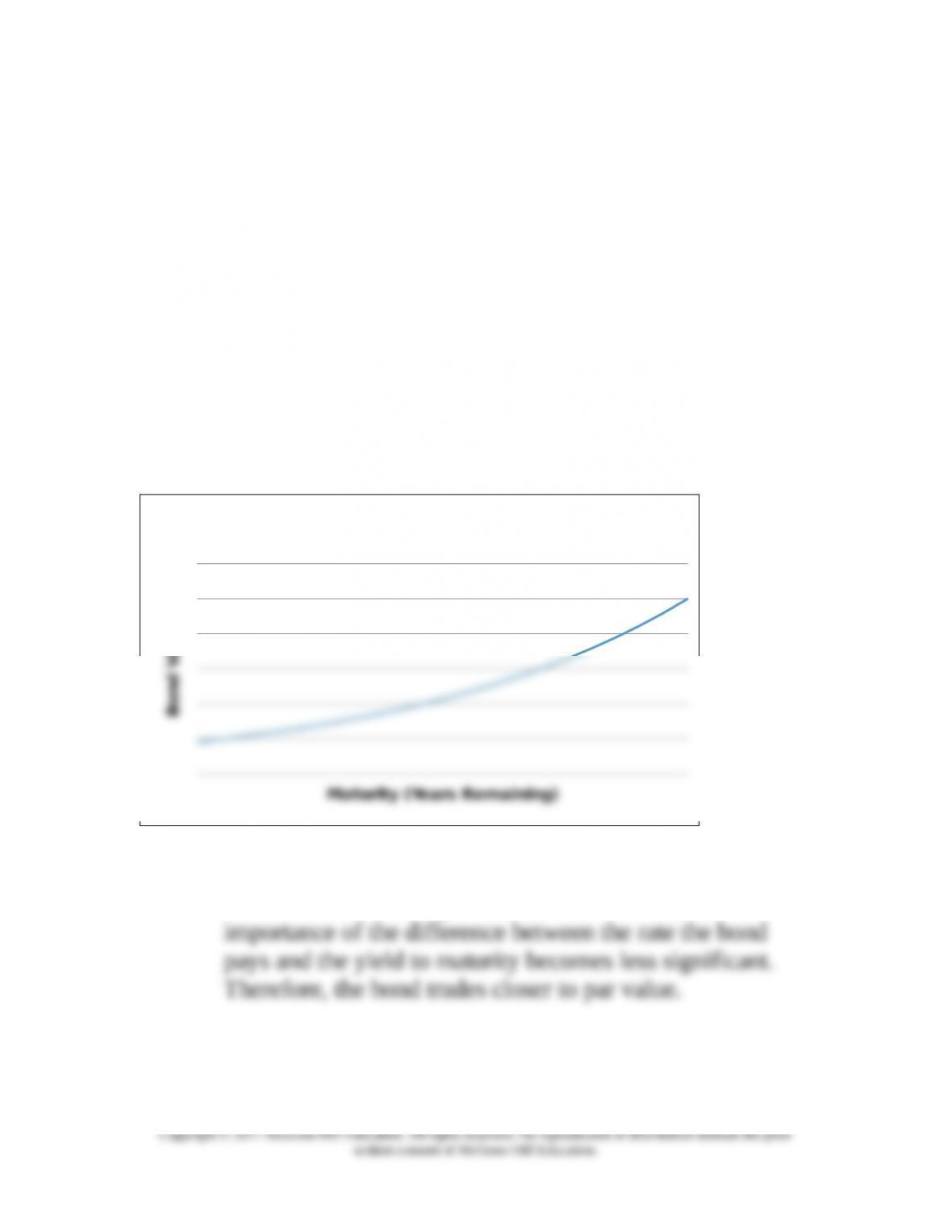
7. Bond maturity effect (LO10-3) Toxaway Telephone Company has a $1,000 par
value bond outstanding that pays 6 percent annual interest. If the yield to maturity is
Chapter 10: Valuation and Rates of Return
8 percent, and remains so over the remaining life of the bond, the bond will have
the following values over time:
Remaining
Maturity
Bond
Price
15
$795.
67
10
$830.
49
5
$891.
86
1
$973.
21
Graph the relationship in a manner similar to the bottom half of Figure 10-2. Also
explain why the pattern of price change takes place.
10-7. Solution:
Toxaway Telephone Company
6%Bond, $1,000 Par Value
Maturity (Years Remaining)
Bond Value
As the time to maturity becomes less and less, the
8. Go to Table 10-1, which is based on bonds paying 10 percent interest for 20 years.
Assume interest rates in the market (yield to maturity) decline from 11 percent to
8 percent:
Chapter 10: Valuation and Rates of Return
a.What is the bond price at 11 percent?
b. What is the bond price at 8 percent?
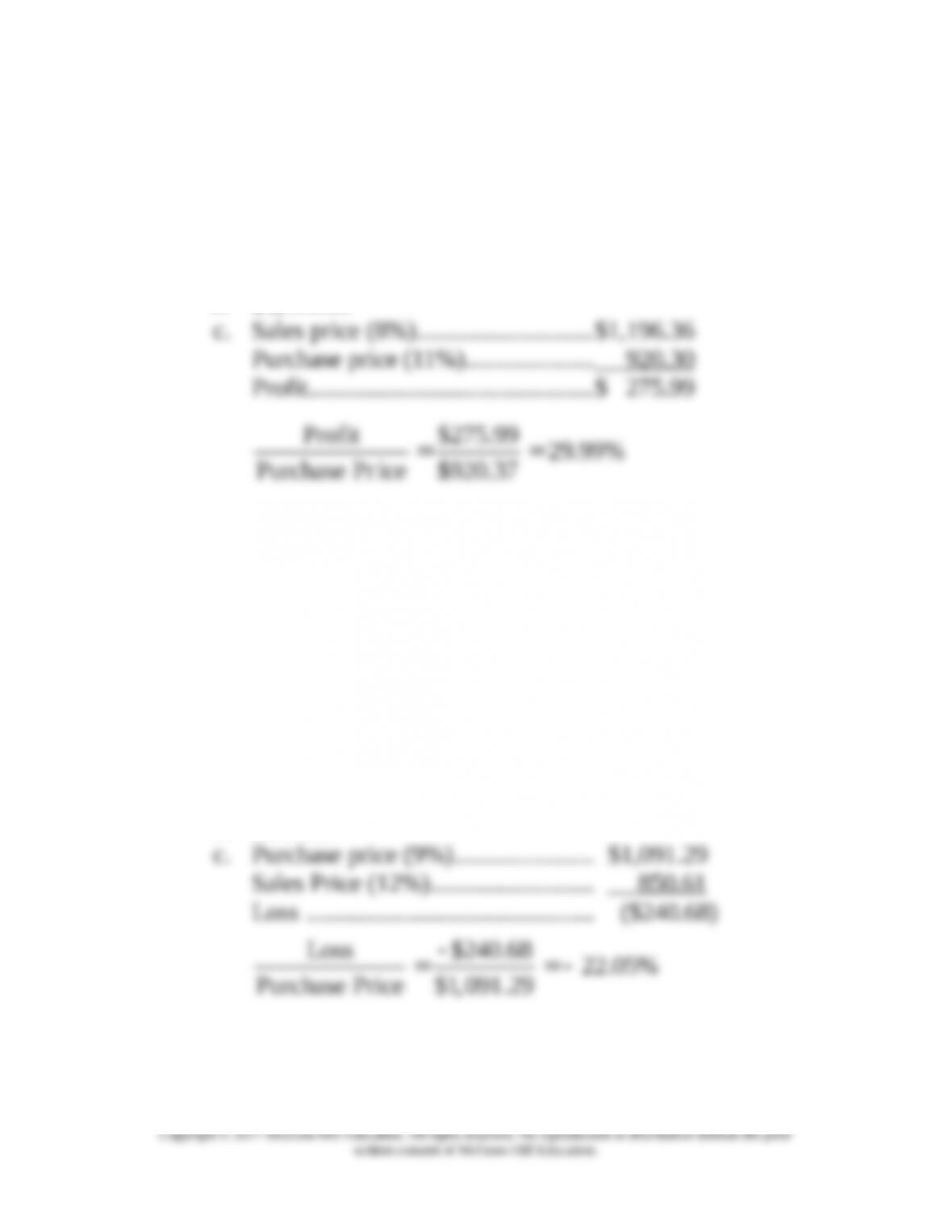
c. What would be your percentage return on investment if you bought when rates were
11 percent and sold when rates were 8 percent?
10-8. Solution:
a. $920.30
b. $1,196.80
Chapter 10: Valuation and Rates of Return
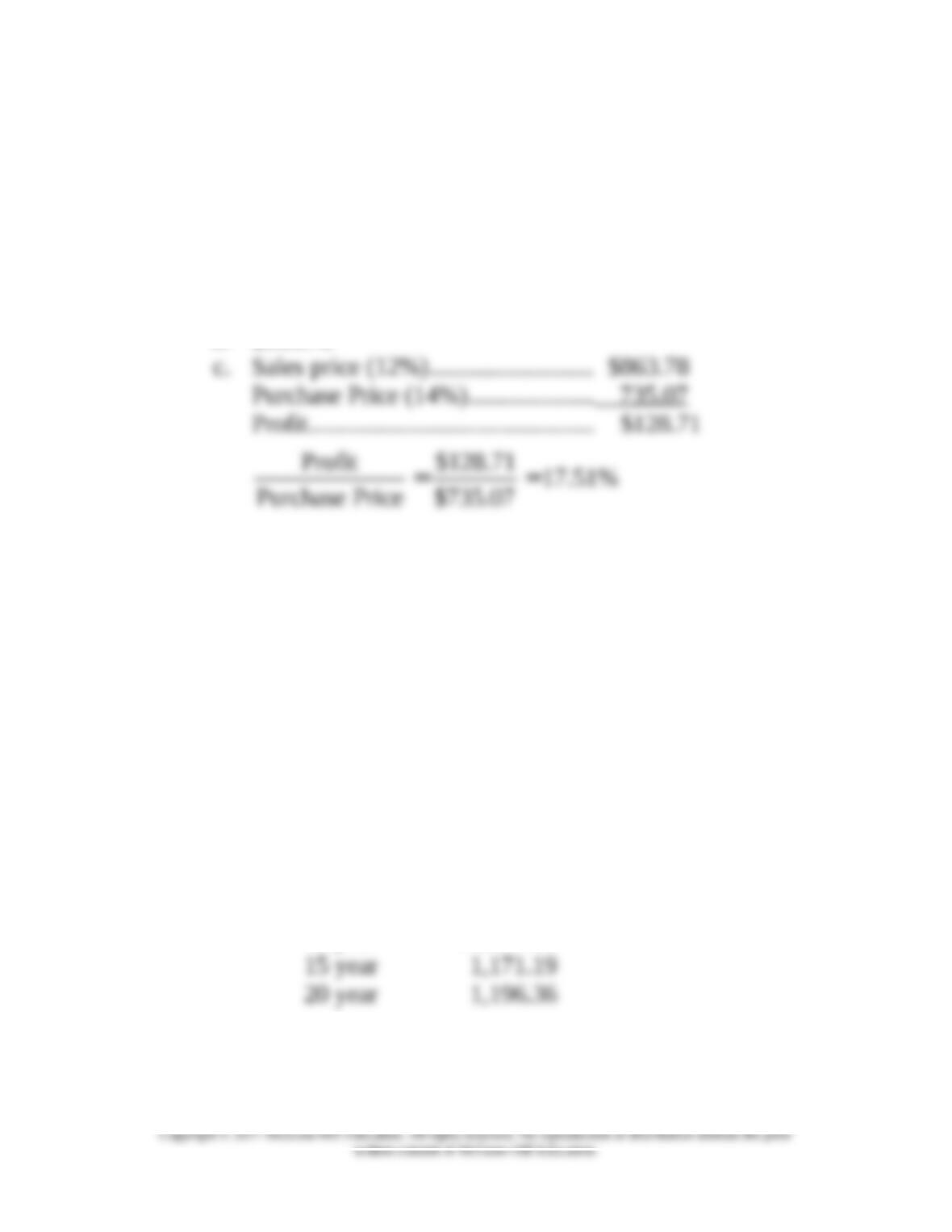
b. Assume five years have passed and interest rates in the market have gone down
to 12 percent. Now, using Table 10-2 for 15 years, what is the price of the bond?
c. What would your percentage return be if you bought the bonds when interest
rates in the market were 14 percent for 20 years and sold them 5 years later
when interest rates were 12 percent?
10-10. Solution:
a. $735.07
b. $863.78
Chapter 10: Valuation and Rates of Return
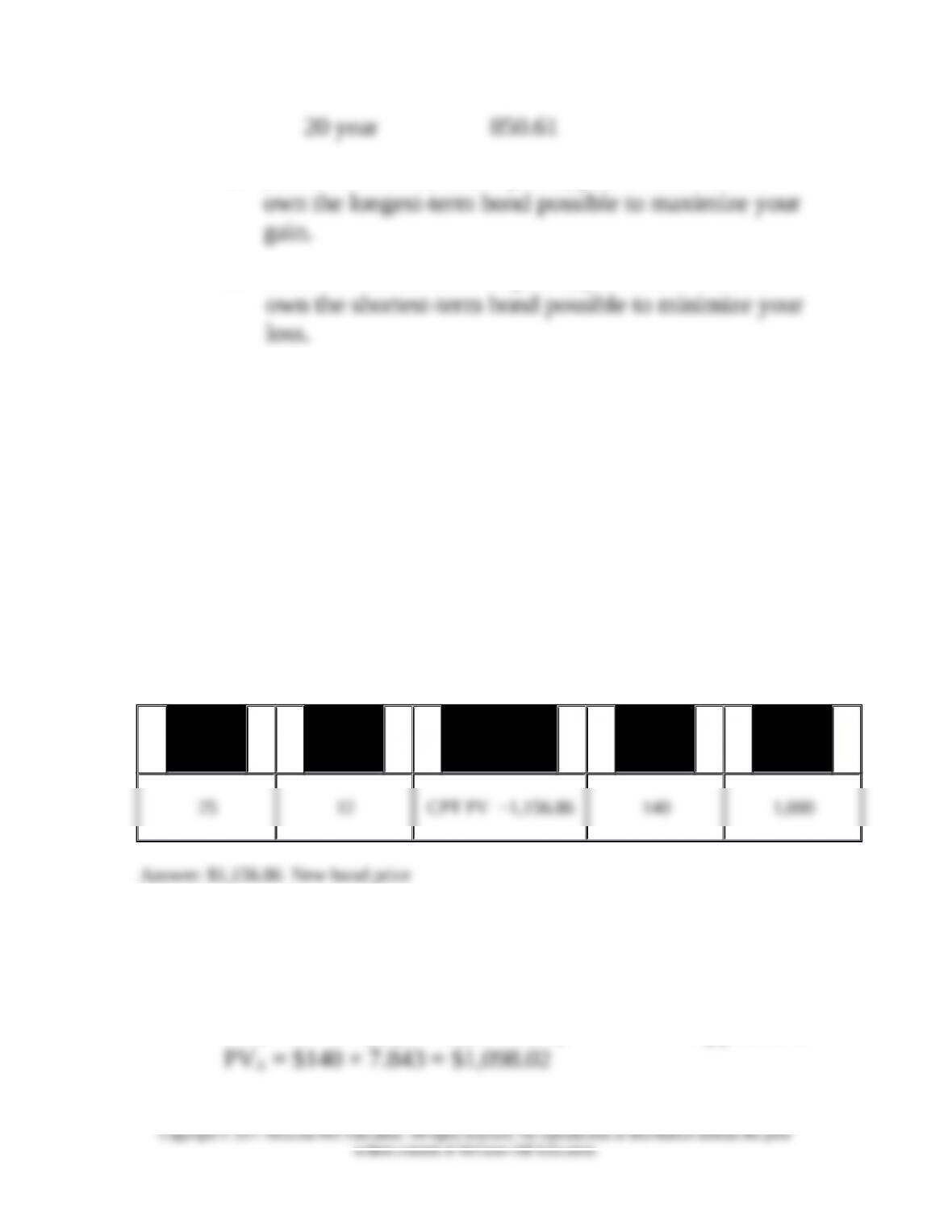
c. Based on information in part a, you would want to
d. Based on information in part b, you would want to
12. Jim Busby calls his broker to inquire about purchasing a bond of Disk Storage
Systems. His broker quotes a price of $1,180. Jim is concerned that the bond might
be overpriced based on the facts involved. The $1,000 par value bond pays
14 percent interest, and it has 25 years remaining until maturity. The current yield to
maturity on similar bonds is 12 percent. Compute the new price of the bond and
comment on whether you think it is overpriced in the marketplace.
10-12. Solution:
Jim Busby – Disk Storage Systems
Calculator Solution:
(a)
N I/Y PV PMT FV
(b)
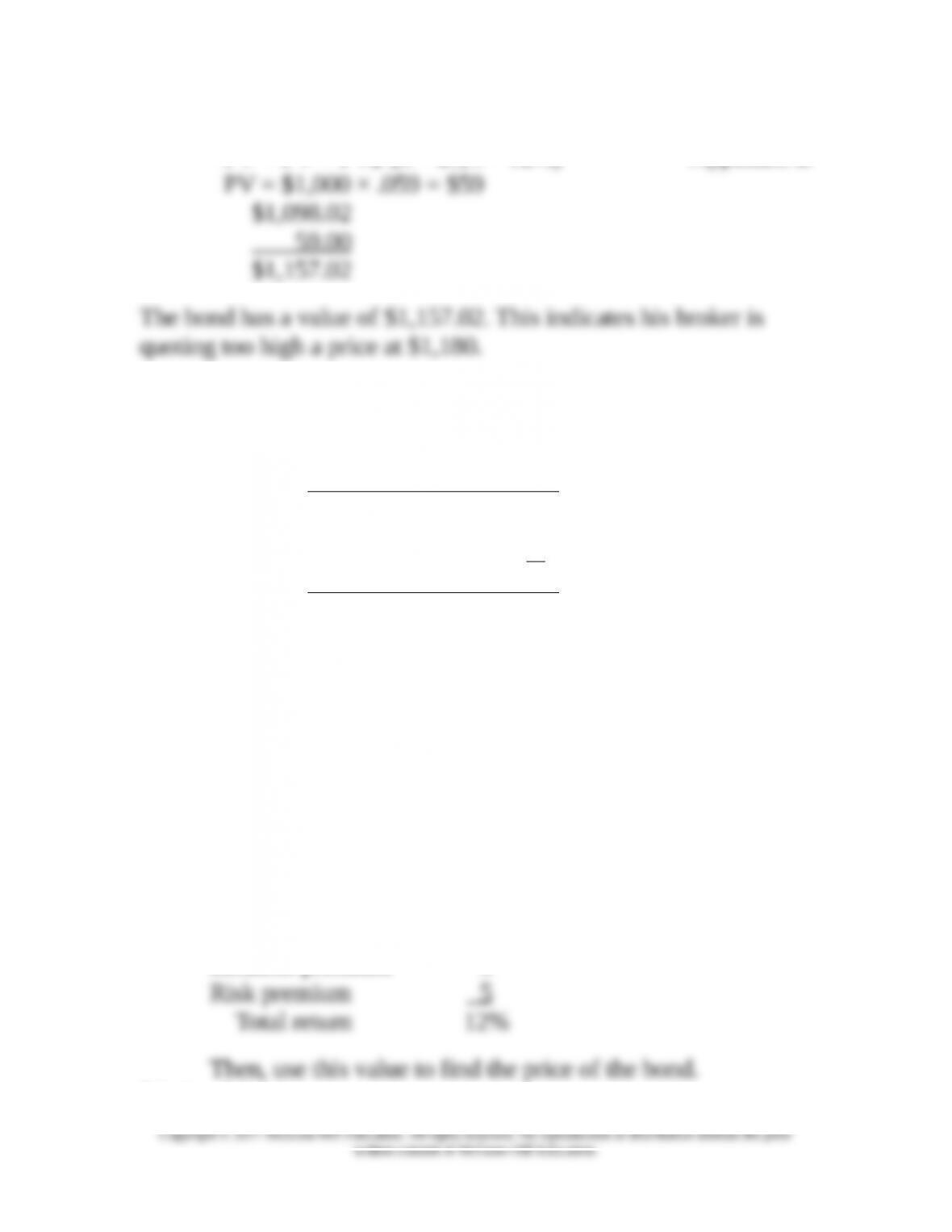
The bond has a value of $1,156.86. This indicates his broker is quoting a higher price at
$1,180.
Present Value of Interest Payments
PVA = A × PVIFA (n = 25, i = 12%) Appendix D
Chapter 10: Valuation and Rates of Return
Present Value of Principal Payment at Maturity
PV = FV × PVIF (n = 25, i = 12%) Appendix B
13. Effect of yield to maturity on bond price (LO10-3) Tom Cruise Lines Inc. issued
bonds five years ago at $1,000 per bond. These bonds had a 25-year life when
issued and the annual interest payment was then 15 percent. This return was in line
with the required returns by bondholders at that point as described next:
Real rate of return............ 4%
Inflation premium............ 6
Risk premium…………..….. 5
Total return………….…… 15%
Assume that five years later the inflation premium is only 3 percent and is
appropriately reflected in the required return (or yield to maturity) of the bonds.
The bonds have 20 years remaining until maturity. Compute the new price of the
bond.
10-13. Solution:
Tom Cruise Lines Inc.
First compute the new required rate of return (yield to
maturity).
Real rate of return 4%
Inflation premium 3
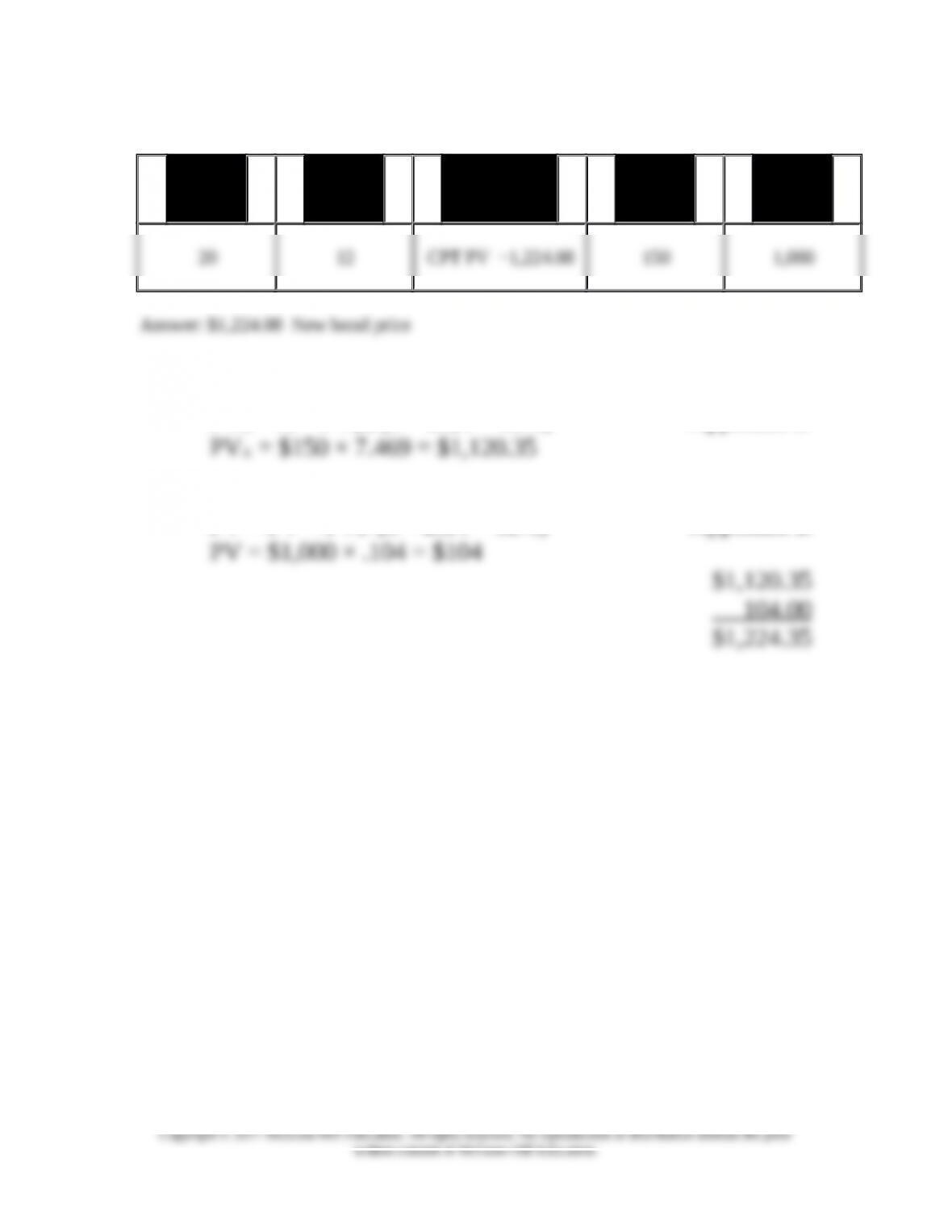
Calculator Solution:
Chapter 10: Valuation and Rates of Return
Present value of interest payments
N I/Y PV PMT FV
Present Value of Interest Payments
PVA = A × PVIFA (n = 20, i = 12%) Appendix D
Present Value of Principal Payment at Maturity
PV = FV × PVIF (n = 20, i = 12%) Appendix B
14. Analyzing bond price changes (LO10-3) Katie Pairy Fruits Inc. has a $1,000, 20-
year bond outstanding with a nominal yield of 15 percent (coupon equals 15% × $1,000 =
$150 per year). Assume that the current market-required interest rate on similar bonds is
now only 12 percent.
a. Compute the current price of the bond.
b.Find the present value of 3 percent × $1,000 (or $30) for 20 years at 12 percent.
The $30 is assumed to be an annual payment. Add this value to $1,000.
c.Explain why the answers in parts a and b are basically the same. (There is a
slight difference due to rounding in the tables.)