Chapter 10: Valuation and Rates of Return
Chapter 10
Valuation and Rates of Return
Discussion Questions
10-1. How is valuation of any financial asset related to future cash flows?
10-2. Why might investors demand a lower rate of return for an investment in
Microsoft as compared to United Airlines?
Because Microsoft has less risk than United Airlines, Microsoft has
10-3. What are the three factors that influence the required rate of return by
investors?
The three factors that influence the demanded rate of return are:
10-4. If inflationary expectations increase, what is likely to happen to yield to
maturity on bonds in the marketplace? What is also likely to happen to
the price of bonds?
10-5. Why is the remaining time to maturity an important factor in evaluating
the impact of a change in yield to maturity on bond prices?
The longer the time period remaining to maturity, the greater the impact
of a difference between the rate the bond is paying and the current yield
Chapter 10: Valuation and Rates of Return
10-6. What are the three adjustments that have to be made in going from annual
to semiannual bond analysis?
The three adjustments in going from annual to semiannual bond analysis
are:
10-7. Why is a change in required yield for preferred stock likely to have a
greater impact on price than a change in required yield for bonds?
The longer the life of an investment, the greater the impact of a change in
10-8. What type of dividend pattern for common stock is similar to the
dividend payment for preferred stock?
10-9. What two conditions must be met to go from Formula 10-7 to
Formula 10-8 in using the dividend valuation model?
( )
1
0
10-8
e
D
PK g
=–
10-10. What two components make up the required rate of return on common
stock?
The two components that make up the required rate of return on common
stock are:
10-11. What factors might influence a firm’s price-earnings ratio?
Chapter 10: Valuation and Rates of Return
The price-earnings ratio is influenced by the earnings and sales growth of
the firm, the risk (or volatility in performance), the debt-equity structure
10-12. How is the supernormal growth pattern likely to vary from the normal,
constant growth pattern?
A supernormal growth pattern is represented by very rapid growth in the
10-13. What approaches can be taken in valuing a firm’s stock when there is no
cash dividend payment?
In valuing a firm with no cash dividend, one approach is to assume that
at some point in the future a cash dividend will be paid. You can then
take the present value of future cash dividends.
Chapter 10
Problems
(For the first 20 bond problems, assume interest payments are on an annual basis.)
1. Bond value (LO10-3) The Lone Star Company has $1,000 par value bonds
outstanding at 10 percent interest. The bonds will mature in 20 years. Compute the
current price of the bonds if the present yield to maturity is
a. 6 percent.
b. 9 percent.
c. 13 percent.
10-1. Solution:
Loan Star Company
Chapter 10: Valuation and Rates of Return
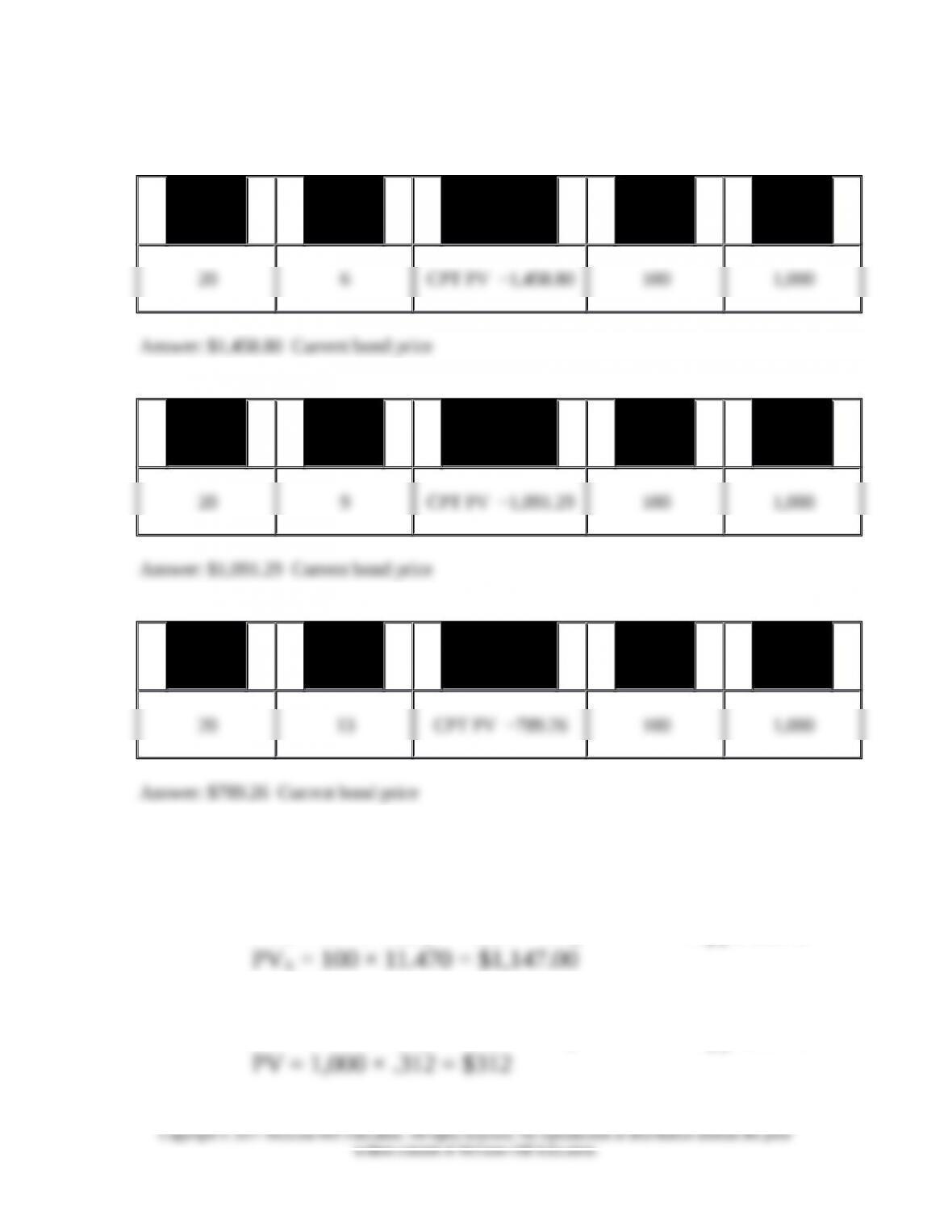
Calculator Solution:
(a) 6 percent yield to maturity
N I/Y PV PMT FV
(b) 9 percent yield to maturity
N I/Y PV PMT FV
(c) 13 percent yield to maturity
N I/Y PV PMT FV
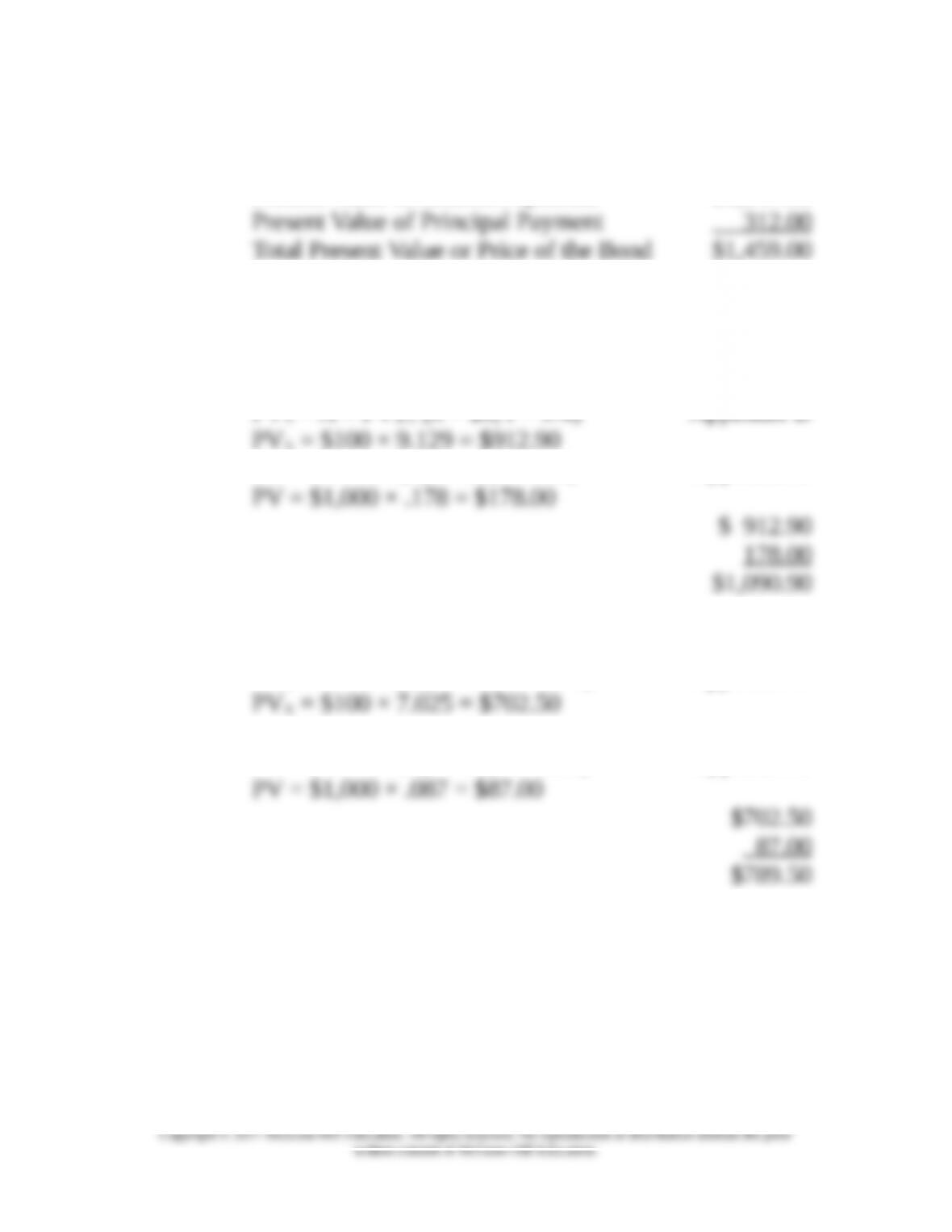
a. 6 percent yield to maturity
Present Value of Interest Payments
PVA = A × PVIFA (n = 20, i = 6%) Appendix D
Present Value of Principal Payment at Maturity
PV = FV × PVIF (n = 20, i = 6%) Appendix B
Chapter 10: Valuation and Rates of Return
Total Present Value
Present Value of Interest Payments $1,147.00
10-1. (Continued)
b. 9 percent yield to maturity
PVA = A × PVIFA (n = 20, i = 9%) Appendix D
PV = FV × PVIF (n = 20, i = 9%) Appendix B
c. 13 percent yield to maturity
PVA = A × PVIFA (n = 20, i = 13%) Appendix D
PV = FV × PVIF (n = 20, i = 13%) Appendix B
2. Midland Oil has $1,000 par value bonds outstanding at 8 percent interest. The bonds
will mature in 25 years. Compute the current price of the bonds if the present yield
to maturity is
a.7 percent.
b. 10 percent.
c. 13 percent.
Chapter 10: Valuation and Rates of Return
10-2. Solution:
Midland Oil
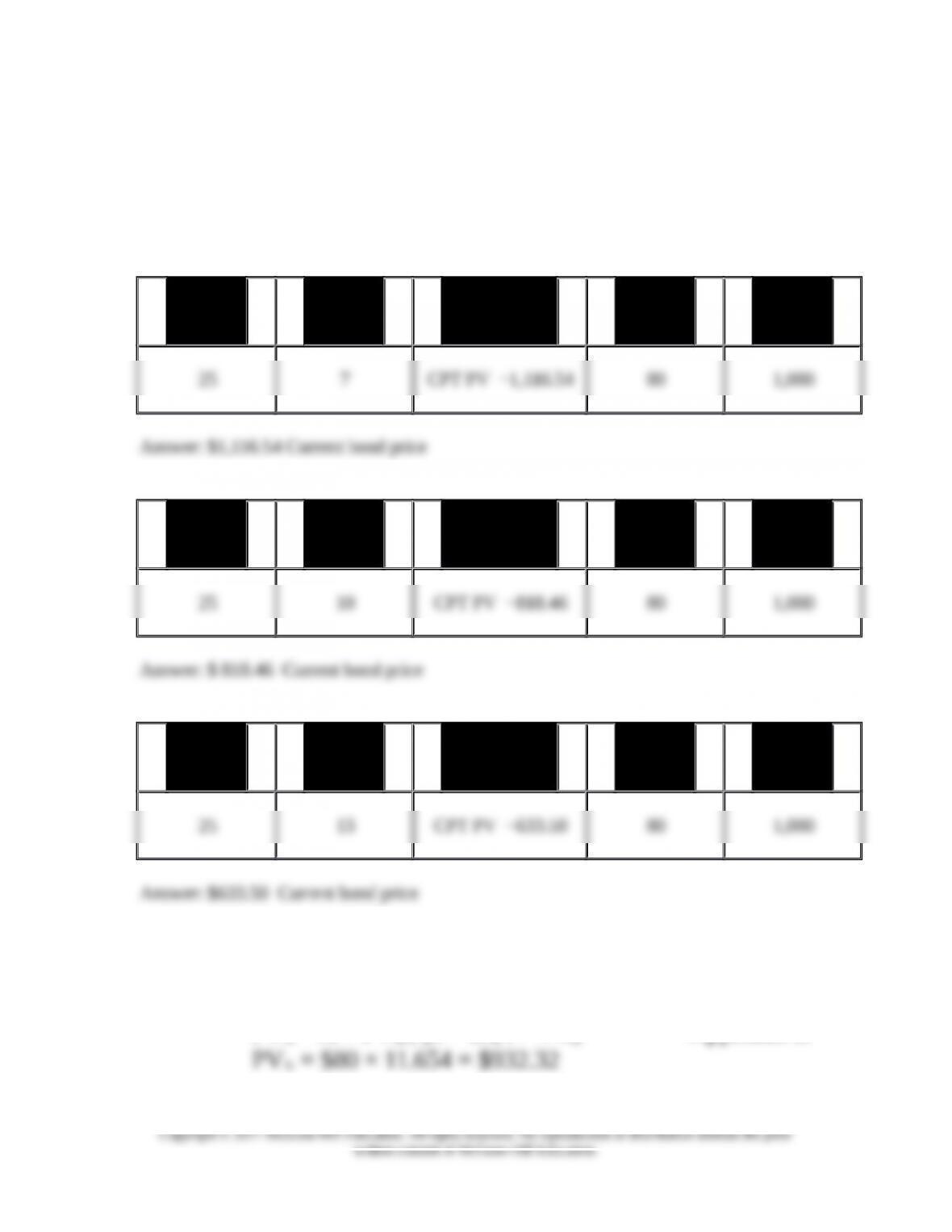
Calculator Solution:
(a) 7 percent yield to maturity
N I/Y PV PMT FV
(b) 10 percent yield to maturity
N I/Y PV PMT FV
(c) 13 percent yield to maturity
N I/Y PV PMT FV
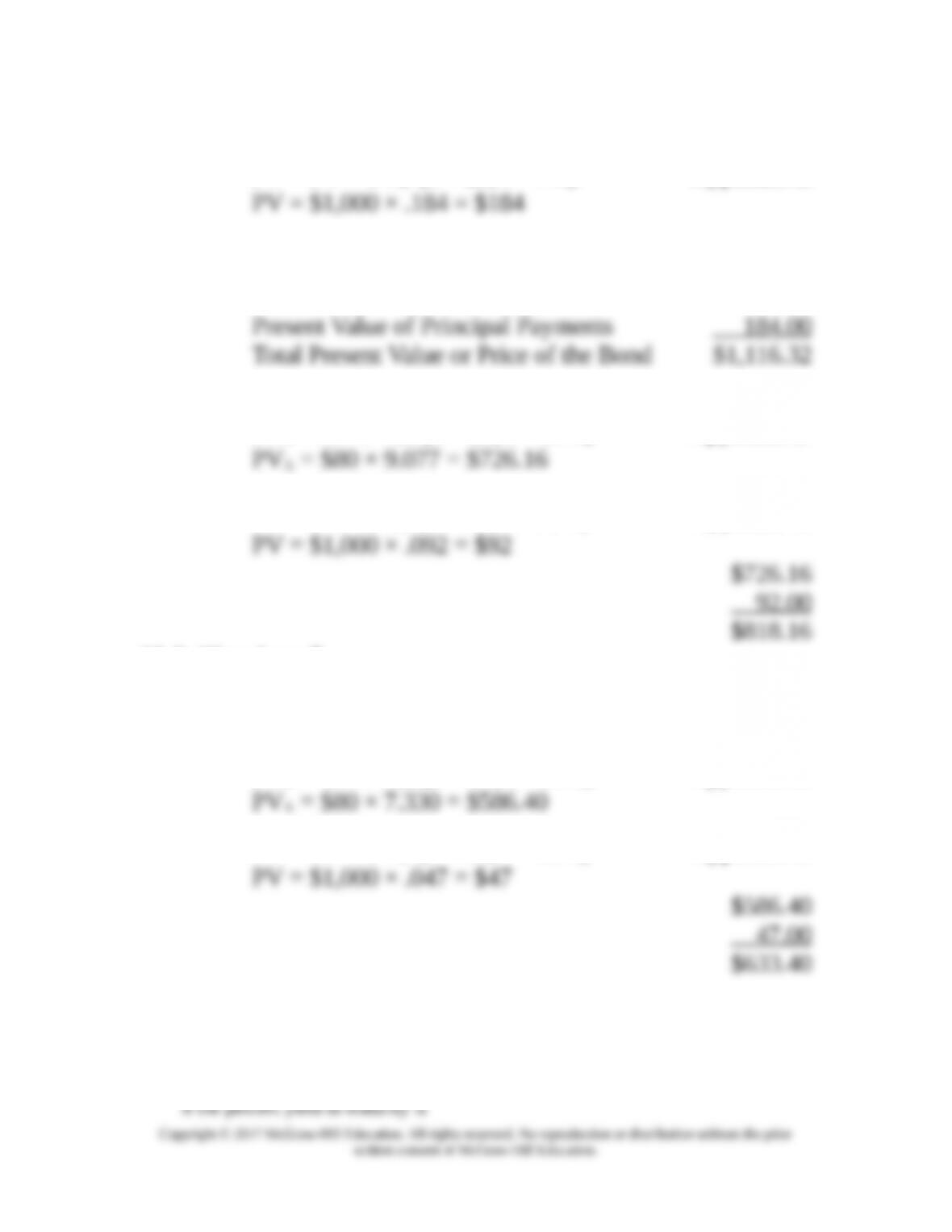
a. 7 percent yield to maturity
Present Value of Interest Payments
PVA = A × PVIFA (n = 25, i = 7%) Appendix D
Chapter 10: Valuation and Rates of Return
Present Value of Principal Payment at Maturity
PV = FV × PVIF (n = 25, i = 7%) Appendix B
Total Present Value
Present Value of Interest Payments $ 932.32
b. 10 percent yield to maturity
PVA = A × PVIFA (n = 25, i = 10%) Appendix D
PV = FV × PVIF (n = 25, i = 10%) Appendix B
10-2. (Continued)
c. 13 percent yield to maturity
PVA = A × PVIFA (n = 25, i = 13%) Appendix D
PV = FV × PVIF (n = 25, i = 13%) Appendix B
3. Exodus Limousine Company has $1,000 par value bonds outstanding at 10 percent
interest. The bonds will mature in 50 years. Compute the current price of the bonds
Chapter 10: Valuation and Rates of Return
a.5 percent.
b. 15 percent.
10-3. Solution:
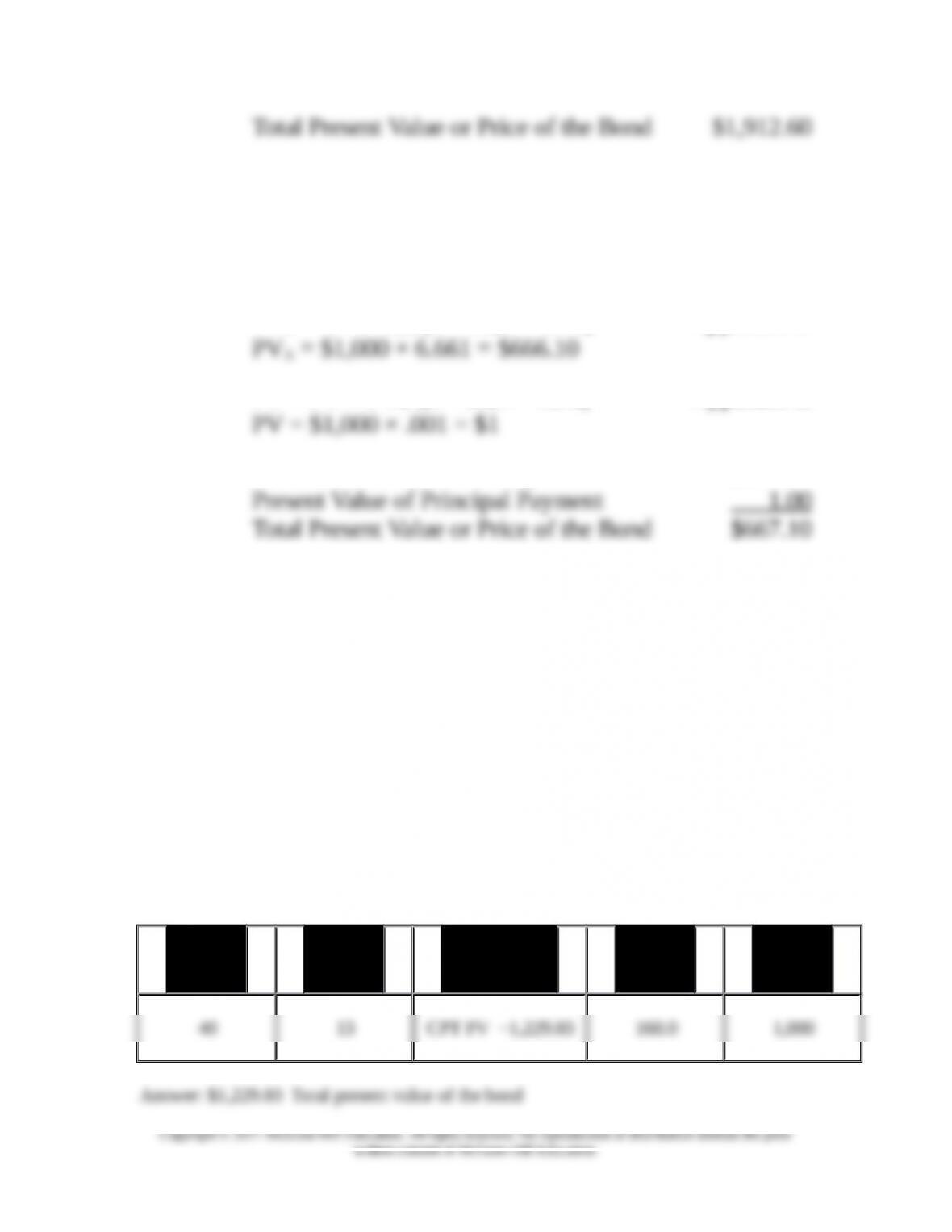
Exodus Limousine Company
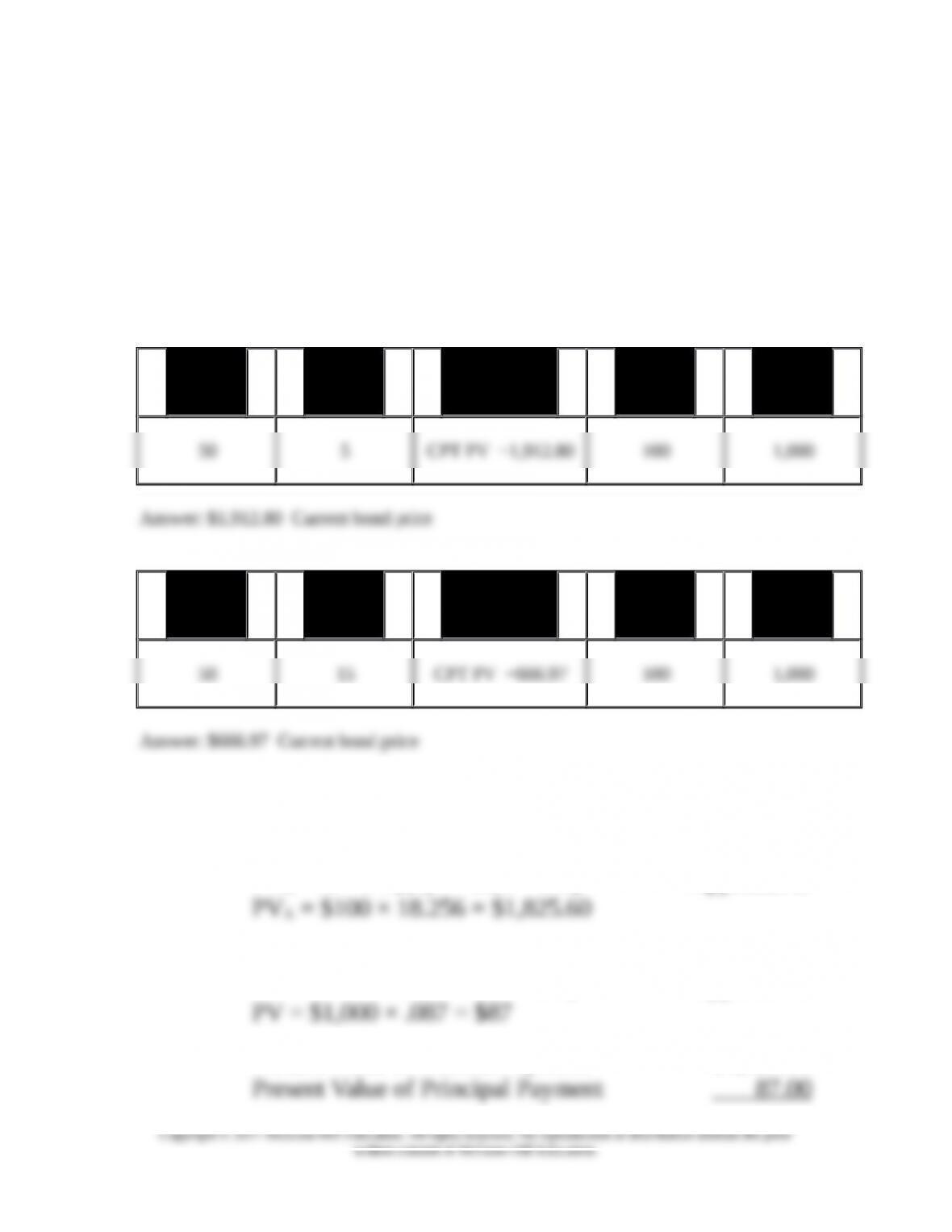
Calculator Solution:
(a) 5 percent yield to maturity
N I/Y PV PMT FV
(b) 15 percent yield to maturity
N I/Y PV PMT FV
a. 5 percent yield to maturity
Present Value of Interest Payments
PVA = A × PVIFA (n = 50, i = 5%) Appendix D
Present Value of Principal Payment
PV = FV × PVIF (n = 50, i = 5%) Appendix B
Present Value of Interest Payment $1,825.60
Chapter 10: Valuation and Rates of Return
10-3. (Continued)
b. 15 percent yield to maturity
Present Value of Interest Payments
PVA = A × PVIFA (n = 50, i = 15%) Appendix D
PV = FV × PVIF (n = 50, i = 15%) Appendix B
Present Value of Interest Payment $666.10
4. Bond value (LO10-3) Barry’s Steroids Company has $1,000 par value bonds
outstanding at 16 percent interest. The bonds will mature in 40 years. If the percent
yield to maturity is 13 percent, what percent of the total bond value does the
repayment of principal represent?
10-4. Solution:
Barry’s Steroids
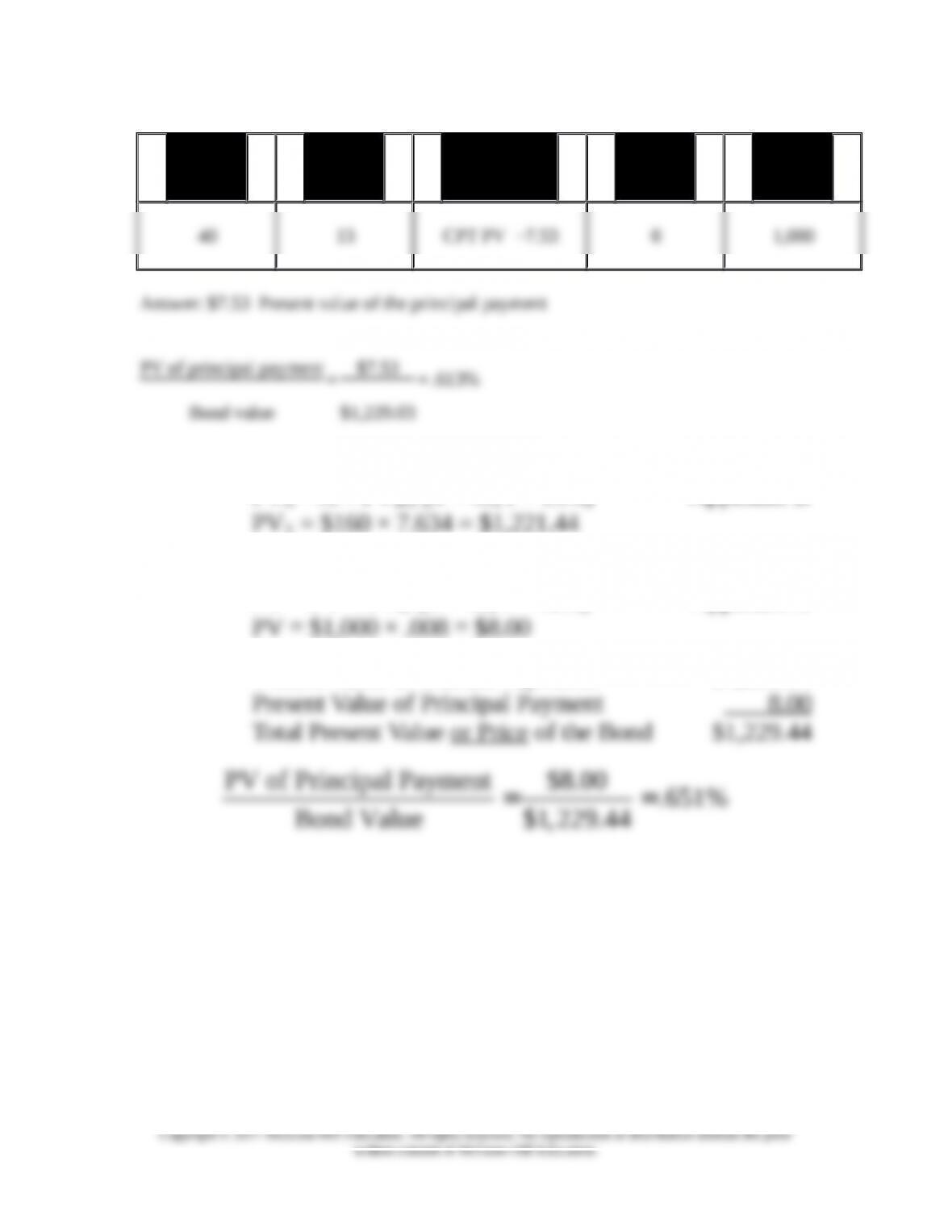
Calculator Solution:
13 percent yield to maturity
N I/Y PV PMT FV
Chapter 10: Valuation and Rates of Return
N I/Y PV PMT FV
Present Value of Interest Payments
PVA = A × PVIFA (n = 40, i = 13%) Appendix D
Present Value of Principal Payment
PV = FV × PVIF (n = 40, i = 13%) Appendix B
Present Value of Interest Payments $1,221.44