Warner Motor Oil Company Case 25
Bond Refunding
Purpose: The case gives the student a clear insight into the refunding process. The importance of the call
privilege is emphasized. Clearly, a refunding would not be feasible if the old issue had to be reacquired at
market value. The case also provides an example of when a positive net present value may not be
sufficient justification for taking action if the NPV is likely to be even larger in the future. There is also
an optional question which allows the student to compare accounting implications with cash flow and net
present value considerations. Normally, a refunding decision hurts accounting profits in the first year, and
increases them in all subsequent years.
Relation to Text: The case draws primarily on material from Chapter 16. However, the student should be
familiar with computing bond prices as presented in Chapter 10.
Complexity: The case is moderately complex. It should require 1 – 1½ hours.
Solutions
1. Price of Previously Issued Bonds
Present value of interest payments
PVA = A x PVIFA (n = 30, i = 5%) Appendix D
2. Market price…………………………………………………………………………………………..………..… $1,114.89
3. Refunding Analysis
Outflows
1. Payment of call premium
$30,000,000 x 8% x $2,400,000
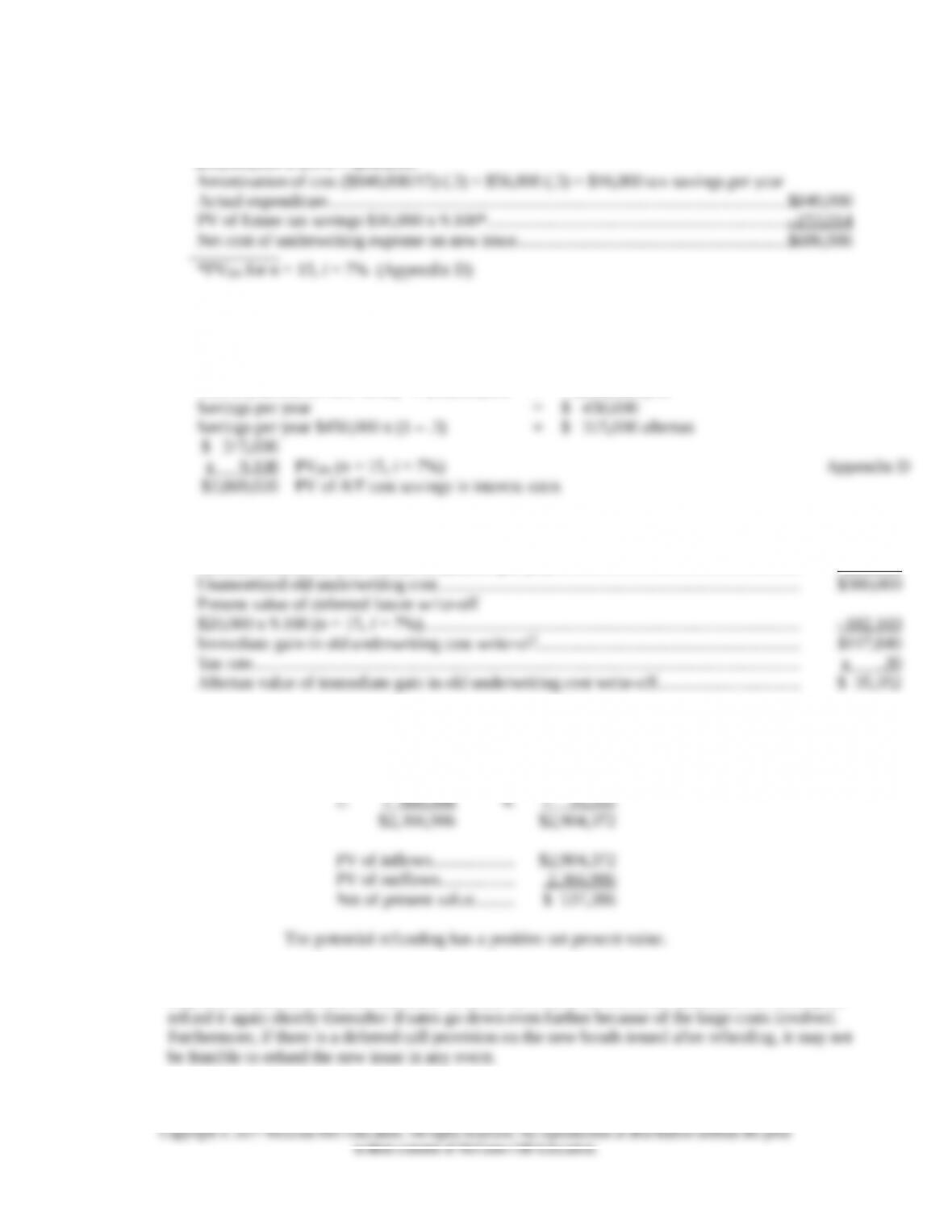
2. Underwriting cost on new issue
$30,000,000 x 2.8% = $840,000
Inflows
3. Cost savings in lower interest rates
11.5% (interest on old bond) x $30,000,000 = $3,450,000/year
10.0% (interest on new bond) x $30,000,000 = –3,000,000/year
4. Underwriting cost on old issue
Original amount………………………………………………………………………………………………….. $400,000
Amount written off over 5 years at $20,000 per year..……………….……….......................... –100,000
Summary
Outflows Inflows
1. $1,680,000 3. $2,869,020
4. Gina and Al must consider whether interest rates will go even lower. If this is likely to be the case,
they should wait to refund the old issue. It would be unwise to refund an issue, and then attempt to
5. With rates at 10.4 percent instead of 10 percent, the interest savings will be less.
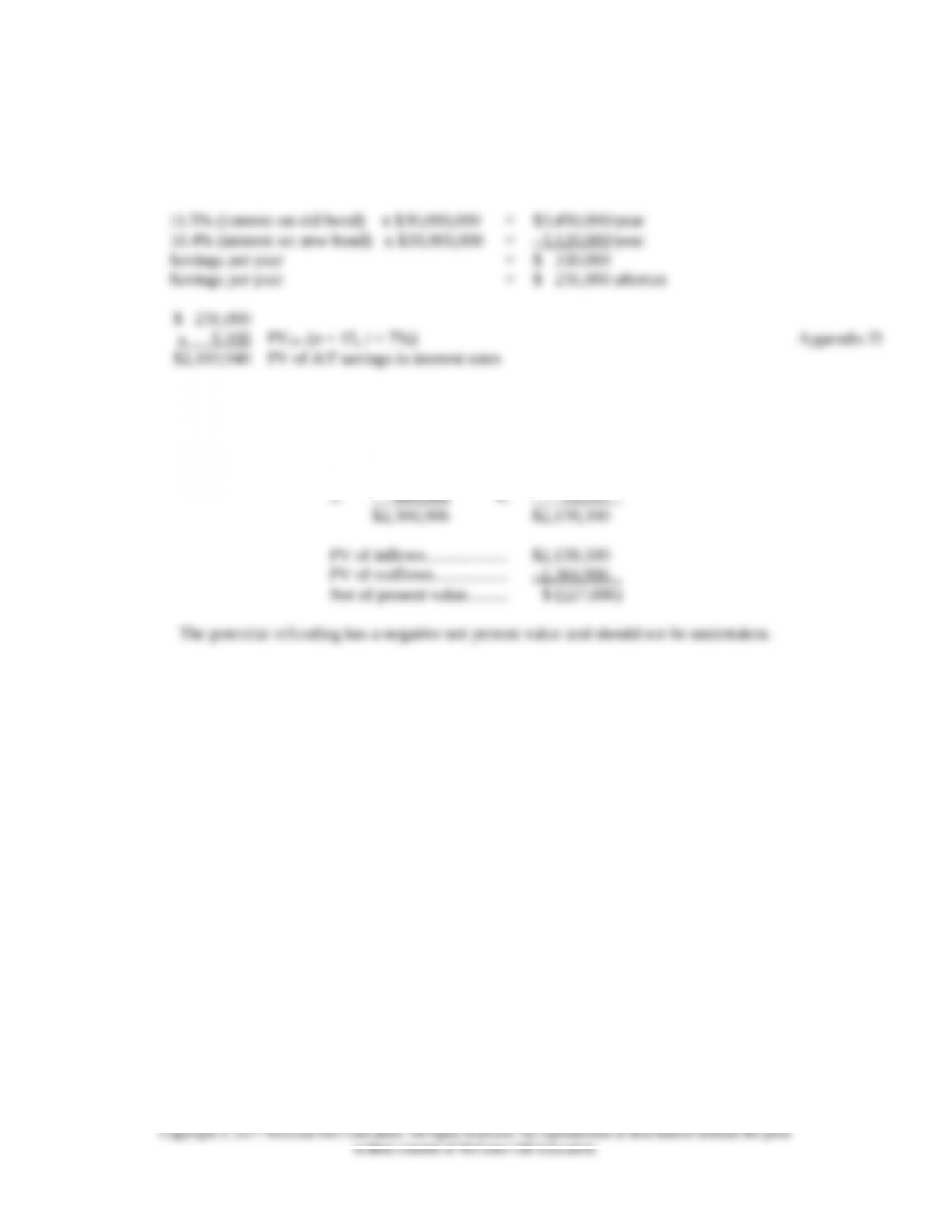
We need to recompute the interest savings from step 3.
Cost savings in lower interest rates:
We now plug this figure into our summary of outflows and inflows. All prior values are the same.
Summary
Outflows Inflows
1. $1,680,000 3. $2,103,948