
Phelps Toy Company Case 19
Capital Budgeting and Cash Flow
Purpose: The case gives the student a good opportunity to do cash flow analysis. The use of variable
discount rates based on project risk gives insight into how some corporations adjust for risk exposure.
Also, the use of an appropriate time horizon for analysis is highlighted. Some students may take a special
interest in the case because of the discussion of the profitable world of baseball card collecting.
Relation to the Text: Though the case is closely related to Chapter 12, it should probably follow after
Chapter 13 because of the risk dimensions in the discussion. Some instructors, however, may prefer to
gloss over the latter and present the case after Chapter 12.
Complexity: The case is relatively straightforward and should require approximately 1 hour.
Solutions
1. First determine the expected value of the first year’s sales.
Assumption Sales Probability
Expected
Value
Pessimistic…..…............… $1,100,000 x .25 = $ 275,000
Then project sales for the next 5 years.
Year 2..........…............ $2,500,000 x 1.20 = $3,000,000
Then determine operating expenses and EBDT for the 6 years.
Year Sales Operating expenses (.70) EBDT
Year 1….…………....... 2,500,000 – 1,750,000 = 750,000
Next determine the annual depreciation over the 6 years.
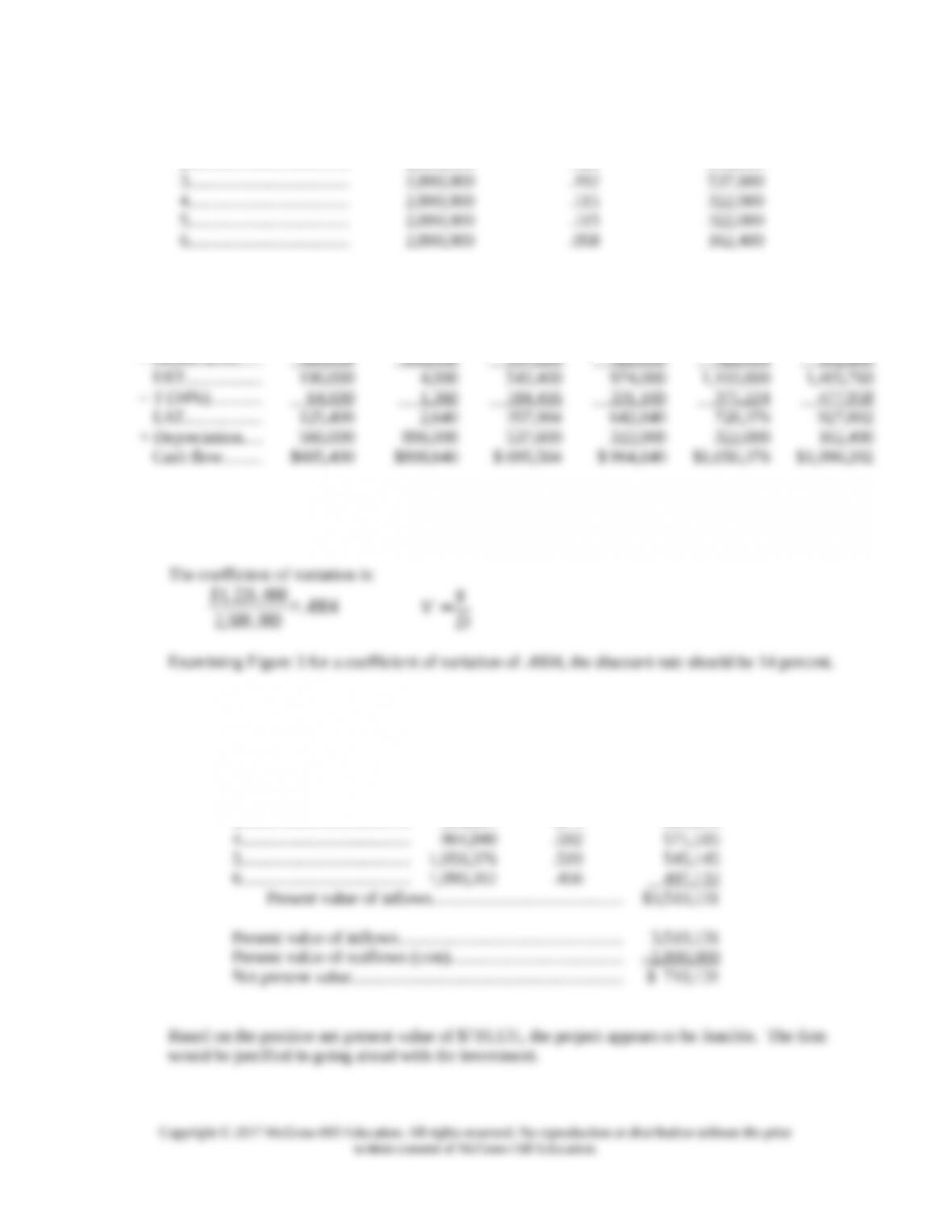
Year Depreciation Percentage Annual
Base Depreciation Depreciation
1…………………………….... $2,800,000 x .200 = $560,000
2…………………………….... 2,800,000 .320 896,000
Then combine the data into a table similar to Table 12-11.
Year 1 Year 2 Year 3 Year 4 Year 5 Year 6
EBDT…….…..... $750,000 $900,000 $1,080,000 $1,296,000 $1,425,600 $1,568,160
2. The discount rate will be based on the coefficient of variation of the first year’s sales.
The standard deviation was given as $1,226,000 and the expected value is $2,500,000.
3. We next determine net present value.
Year
Cash flow
(inflows)
Present Value
Factor (14%)
Present
Value
1………………………………... $ 685,400 .877 $ 601,096
2………………………………... 898,640 .769 691,054
3………………………………... 895,584 .675 604,519

4. A six year time horizon may be too short a time frame to fully assess the project. It assumes there
will be no cash flow from the seventh year on. While many firms utilize a time frame of 5-10 years