
Galaxy Systems, Inc.
Case 17
Divisional Cost of Capital
Purpose: The case combines risk analysis with discount rate considerations. To emphasize how many
multidivisional corporations operate, the case actually gets into the topic of divisional hurdle rates. The
student is able to see how different divisions in a corporation might have different required rates of return
based on their risk exposure. In this particular case, a key risk measure for the consideration is beta. The
student does not have to actually compute betas, only observe how they might be used. A simple
definition of beta is also included in the case. Calculations related to net present value and internal rate of
return are purposely simple to emphasize more conceptual items. Actually the IRRs can be found as
exact values from Appendix D after only one calculation.
There also is additional emphasis on how financial decisions are made in a corporate culture.
Relation to Text: The case should follow Chapter 13. It also draws on material from many of the capital
budgeting chapters.
Complexity: The overall case is moderately complex and should require 1 hour.
Solutions
1. Proposal A
a)
Investment (PV )
IRR Annuity ( )
$400,000
IRR 11%
A
A
b) NPV (10% discount rate for the auto airbags production division)
Cost $2,355,600
Present value of inflows = A x PVIFA
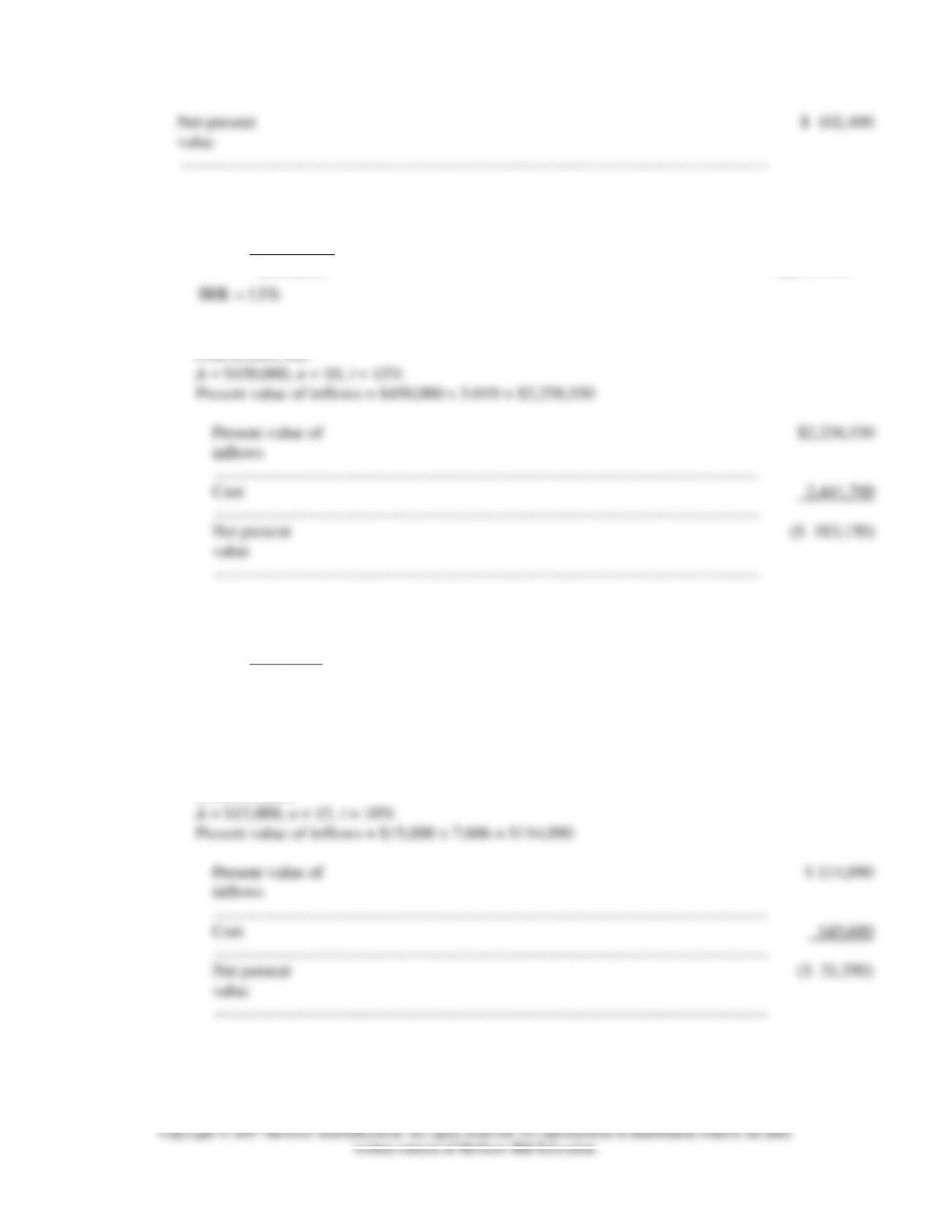
Present value of
inflows
Net present
value
Cost
Net present
value
………………………………………………………………………………………………………………………..
$ 102,400
Proposal B
a)
$2,441,700
IRR 5.426 10
$450,000
IRR 13%
n
Appendix D
b) NPV (15% discount rate for the aerospace division)
Copyright © 2017 McGraw-Hill Education. All rights reserved. No reproduction or distribution without the prior
written consent of McGraw-Hill Education.
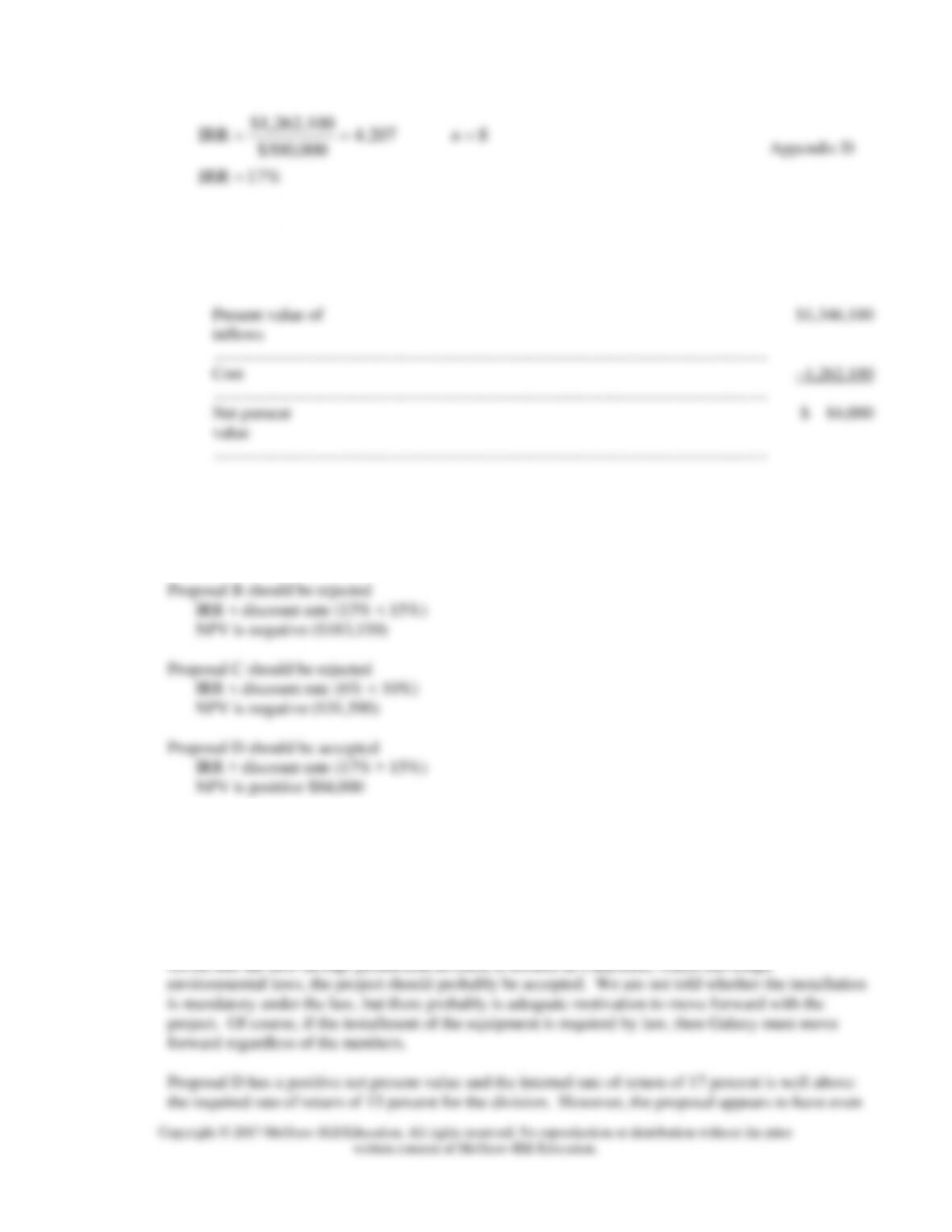
$1,262,100
IRR 4.207 8
$300,000
IRR 17%
n
Appendix D
b) NPV (15% discount rate for the aerospace division)
Cost $1,262,100
A = $300,000, n = 8, i = 15%
Present value of inflows = $300,000 x 4.487 = $1,346,100
2. Proposal A should be accepted
IRR > discount rate (11% > 10%)
NPV is positive $102,400
3. While the decisions related to Proposals A and B appear to be straightforward, Proposals C and D
require further discussion.
Proposal C has a negative net present value and the internal rate of return of 6% is well below the
required rate of return of 10%. Nevertheless, it calls for the development of special equipment to be
used in the disposal of environmentally harmful waste material created in the manufacturing process.

4. The $300,000 that has already been spent on the initial research for Proposal B (radar surveillance
equipment) is a sunk cost. The money has already been spent and should have no influence on
Further Overall Comments
Companies that use divisional required rates of return often do have difficulties in finding betas for firms
that produce products comparable to a division. That is, finding a “pure play” comparison is difficult.