Gilbert Enterprises Case 13
Stock Valuation
Purpose: This case gives the student an opportunity to examine valuation concepts from both a
theoretical dividend valuation model approach and a price-earnings ratio approach. Because an initial
period of supernormal growth is assumed, a review of Appendix 10C is necessary for the case.
However, this appendix is not difficult to follow. The case also makes strong use of ratios as part of
the comparative P/E ratio analysis and should help the student better appreciate how ratios influence
valuation.
Relation to Text: The case should follow Chapter 10.
Complexity: The overall case is moderately complex and should require 1 hour.
Solutions
1. There are two steps involved in using the valuation of a supernormal growth firm.
A. Find the present value of supernormal dividends.
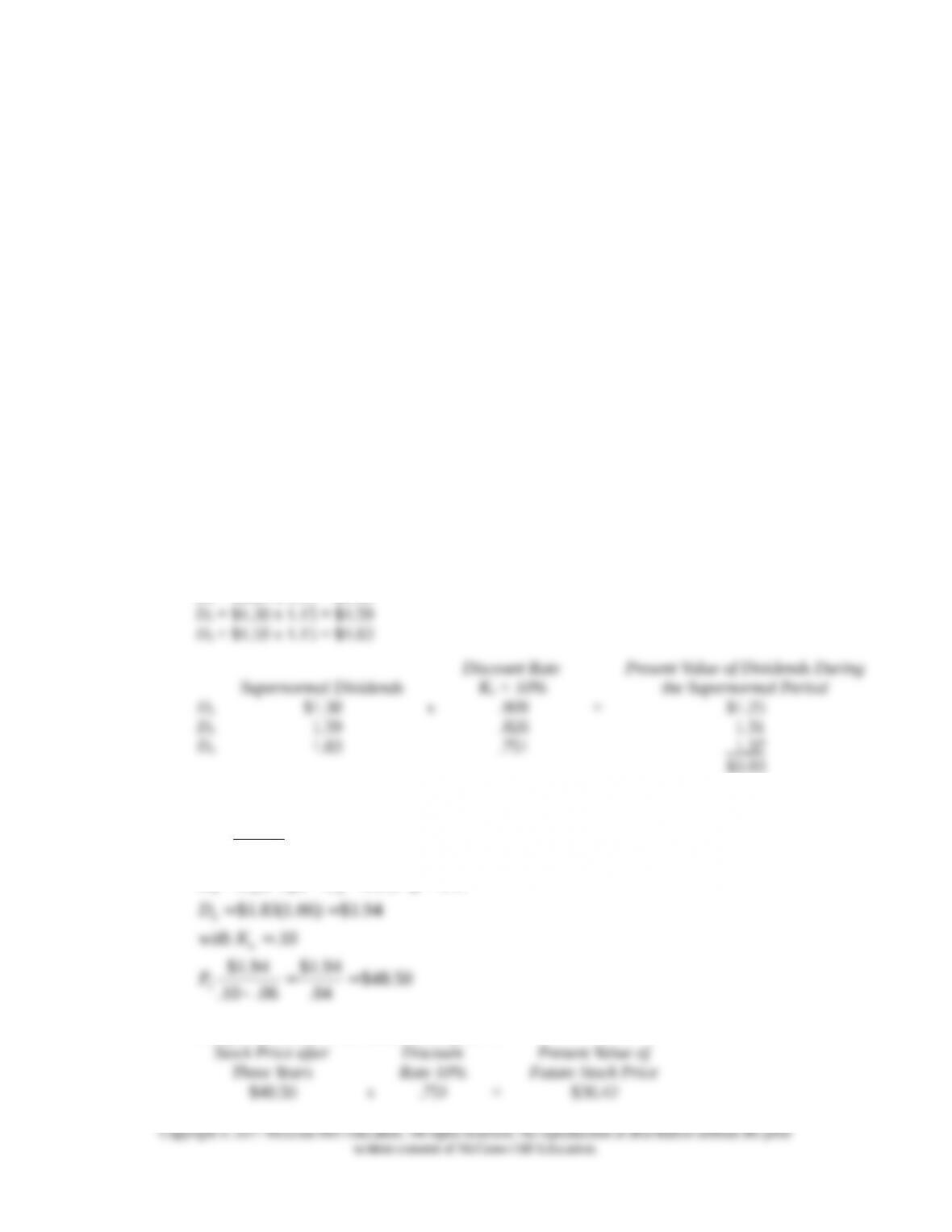
D0 = $1.20
D1 = $1.20 x 1.15 = $1.38
B. Find the present value of the future stock price.
4
3
4 3 3
4
3
(1 ) 1.83, 6%
$1.83(1.06) $1.94
with .10
$1.94 $1.94 $48.50
.10 .06 .04
e
e
D
PK g
D D g D g
D
K
P
=–
= + = =
= =
=
= =
–
The present value of the future stock price is:
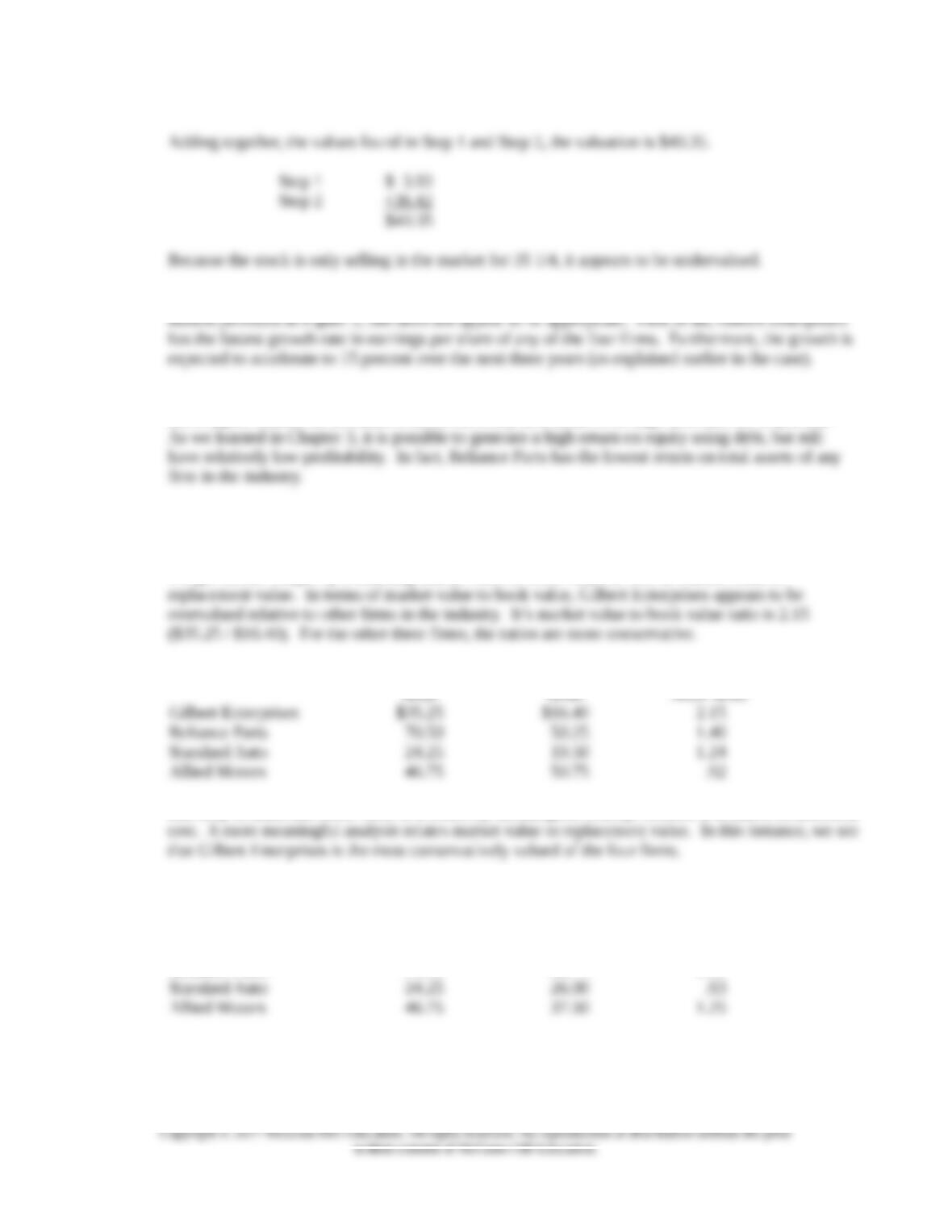
2. Gilbert Enterprises has the second lowest P/E ratio of the four firms. Based on the financial infor–
Gilbert Enterprises also has the second highest return on stockholder’s equity. Only Reliance Parts
has a higher return, but its return is achieved solely as a result of its high debt ratio of 68 percent.
In evaluating debt utilization as a separate item, Gilbert Enterprises once again looks attractive
with a debt to total assets ratio of 33 percent. Only Standard Auto has a lower ratio.
We get further insight by evaluating market value to book value as well as market value to
Market
Value
Book
Value
Market Value to
Book Value
But keep in mind that book value is a relatively meaningless concept because it is based on historical
Market
Value
Replacement
Value
Market Value to
Replacement
Value
Gilbert Enterprises $35.25 $43.50 .81
Reliance Parts 70.50 68.75 1.03
What about dividends? In terms of dividend yield, only Standard Auto provides a higher return to its
stockholders.
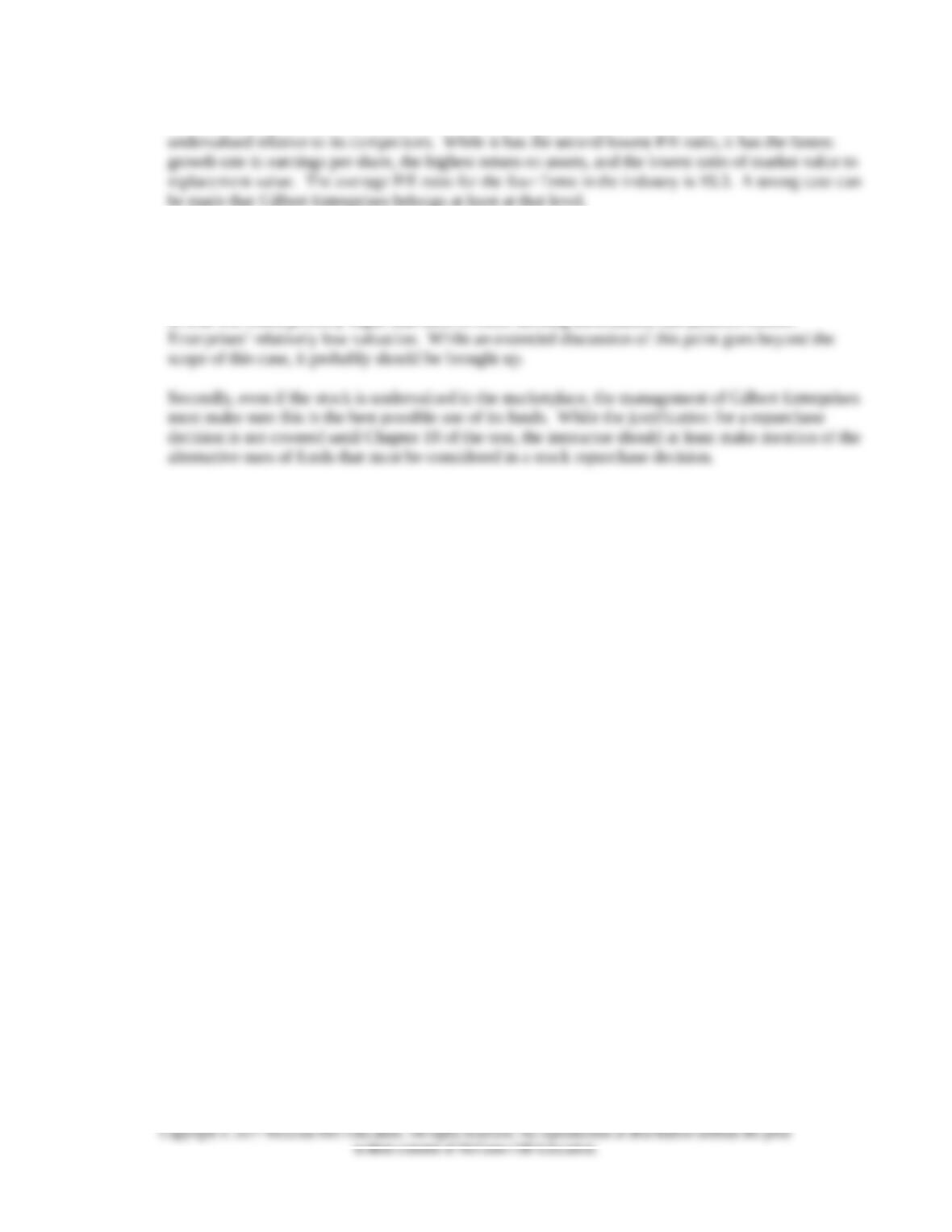
In summarizing the variables under consideration, it appears that Gilbert Enterprises may be
3. Since the answer to questions 1 and 2 indicate the firm may undervalued, Albert Roth should
seriously consider recommending that the firm repurchase part of its shares in the marketplace.
There are two possible caveats. One is that the market tends to be efficient in the pricing of securities
so that one could possibly argue that there is some missing information that justifies Gilbert