CHAPTER 24: ECONOMIC GROWTH, BUSINESS
CYCLES, AND UNEMPLOYMENT
Questions and Exercises
1. Classicals felt that if the wage level fell, the Depression would end. They saw
2. Classical economics supported laissez-faire policies because they believed
3. Keynesians are more likely to emphasize the fallacy of composition. The fallacy
of composition is the false assumption that what is true for a part will also be true
4. Classical economics grew in importance in the 1970s because Keynesians didn’t
5. Structural stagnation is neither a Keynesian nor a Classical theory. It includes
6. Potential output is the highest amount of output an economy can sustainably
produce and sell using existing production processes and resources. Potential
7. Economic growth is measured by increases in total output and increases in output
8. Growth has slowed in recent years in both Western Europe and the United States.
1
© 2017 by McGraw-Hill Education. This is proprietary material solely for authorized instructor use. Not authorized for sale or distribution in
any manner. This document may not be copied, scanned, duplicated, forwarded, distributed, or posted on a website, in whole or part.
9. From 1940 to 1970 the U.S. economy grew at a rate of about 2.5 percent per year,
which was lower than Western Europe and Japan but higher than many other
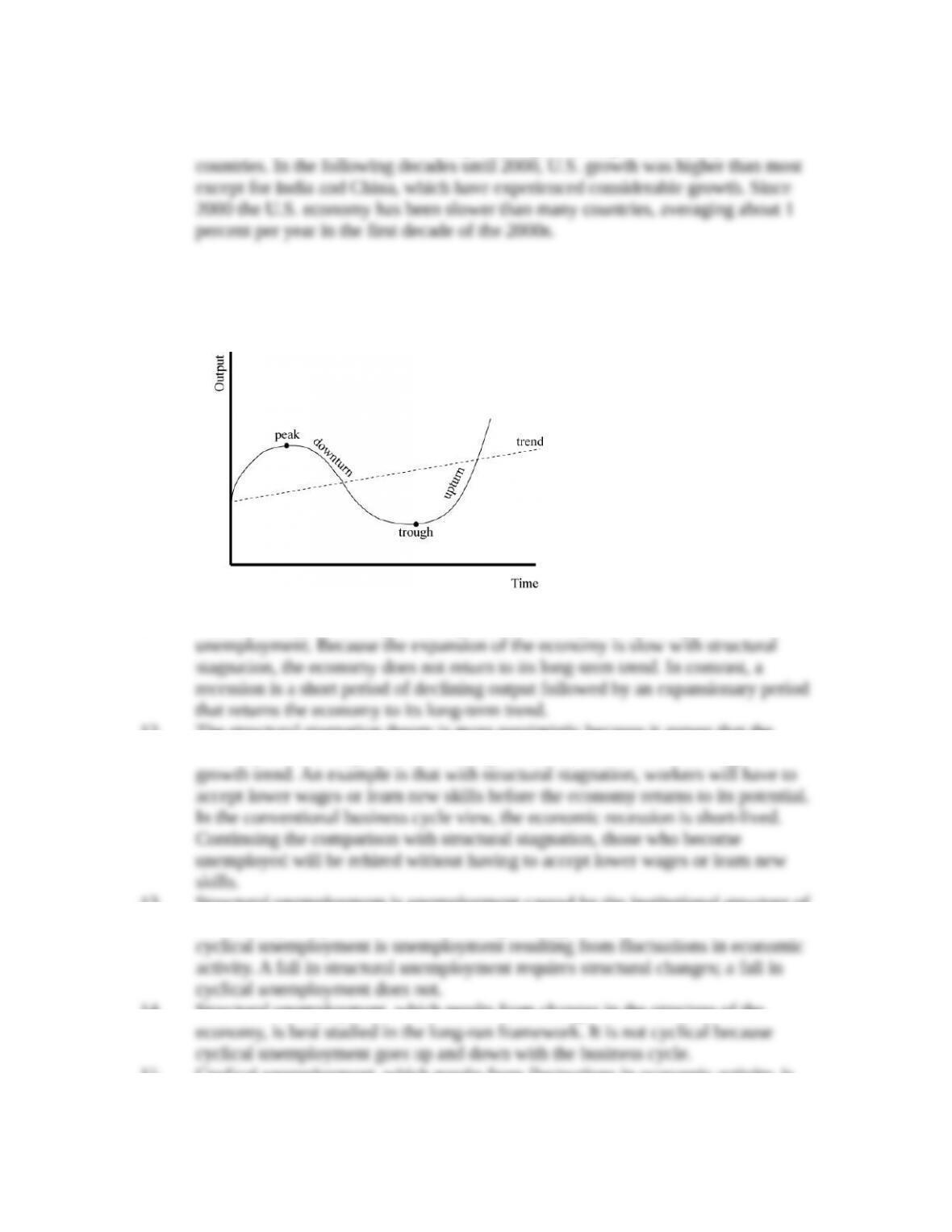
10. A representative business cycle is shown in the accompanying graph. Each of the
four phases—peak, downturn, trough, and upturn—is clearly labeled.
11. Structural stagnation is a period of protracted slow growth and high
12. The structural stagnation theory is more pessimistic because it argues that the
economy must undergo structural changes before it will return to its long-term
13. Structural unemployment is unemployment caused by the institutional structure of
an economy or by economic restructuring making some skills obsolete, whereas
14. Structural unemployment, which results from changes in the structure of the
15. Cyclical unemployment, which results from fluctuations in economic activity, is
best studied in the short-run framework. Cyclical unemployment goes up and
2
© 2017 by McGraw-Hill Education. This is proprietary material solely for authorized instructor use. Not authorized for sale or distribution in
any manner. This document may not be copied, scanned, duplicated, forwarded, distributed, or posted on a website, in whole or part.
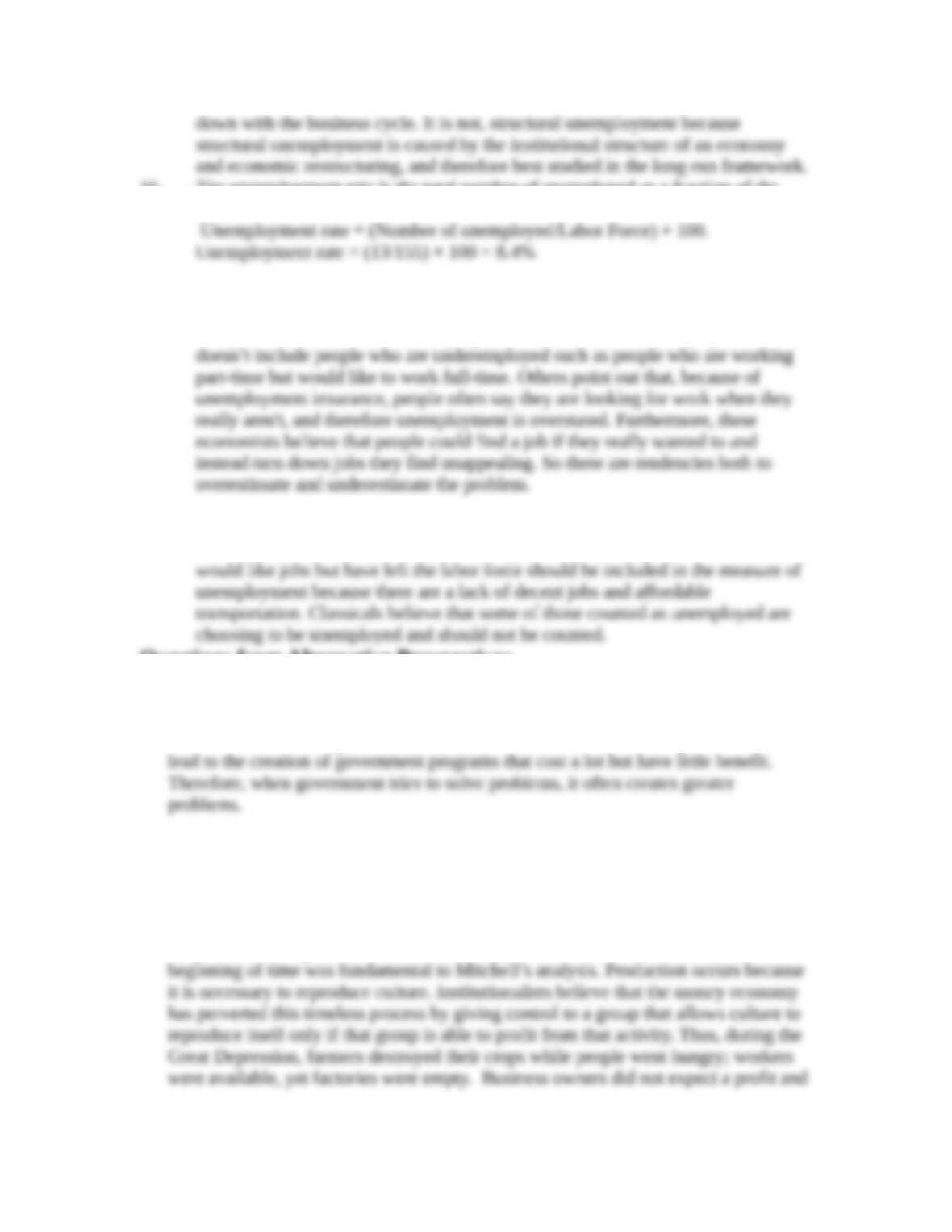
16. The unemployment rate is the total number of unemployed as a fraction of the
labor force.
17. Some economists argue that the standard unemployment rate underestimates
unemployment because people who have gotten frustrated and stopped trying to
find jobs are not counted as unemployed. Also, the standard unemployment rate
The official measure of unemployment is based on judgments about who should
be counted as unemployed. Keynesians argue that discouraged workers who
Questions from Alternative Perspectives
1. Austrian
Austrians believe that government’s attempts to deal with business cycles can often
2. Institutionalist
Institutionalists believe that this proposition is very reasonable. Firms’ focus on
making money and the financial issues can leave real issues secondary and can bring
about waves of pessimism and optimism. Institutionalists believe that the insight that
the production of goods is a normal daily aspect of life in all societies since the
3
© 2017 by McGraw-Hill Education. This is proprietary material solely for authorized instructor use. Not authorized for sale or distribution in
any manner. This document may not be copied, scanned, duplicated, forwarded, distributed, or posted on a website, in whole or part.
3. Post-Keynesian
a. Since the Great Depression, the government has been more active in the economy
b. These policies are definitely Keynesian.
c. Post-Keynesians believe that these policies are still relevant today, whereas
4. Radical
a. This is a judgment question, and judgments differ. Radical economists would
b. Radical economists believe that unemployment tends to hurt the people who are
c. Vickrey supported a plan put forward by Abba Lerner and the author of this
5. All
In natural science, there are controlled experiments which allow one to say when a
theory has failed and when it has not. In macroeconomics, controlled experiments are
Issues to Ponder
1. Deciding what is the purpose of life and therefore what constitutes a desired
lifestyle is a complicated issue. To the extent that work provides a sense of
self-worth and identity, complete idleness is not desirable. This, however, is a
4
© 2017 by McGraw-Hill Education. This is proprietary material solely for authorized instructor use. Not authorized for sale or distribution in
any manner. This document may not be copied, scanned, duplicated, forwarded, distributed, or posted on a website, in whole or part.
2. Reducing unemployment to 1.2 percent today is not likely for several reasons.
One is that a low inflation rate seems to be incompatible with low unemployment.
3. a. Possible explanations include Japanese cultural emphases on tradition, honor, and
loyalty. In Japan, firms are less willing to lay off workers in times of excess
b. It is impossible to say which is better. Each needs to be judged within the broader
c. The answer to this question depends on the distribution of layoffs and hires in
each of the economies. If layoffs in Japan were unavoidable and occurred among
5
© 2017 by McGraw-Hill Education. This is proprietary material solely for authorized instructor use. Not authorized for sale or distribution in
any manner. This document may not be copied, scanned, duplicated, forwarded, distributed, or posted on a website, in whole or part.