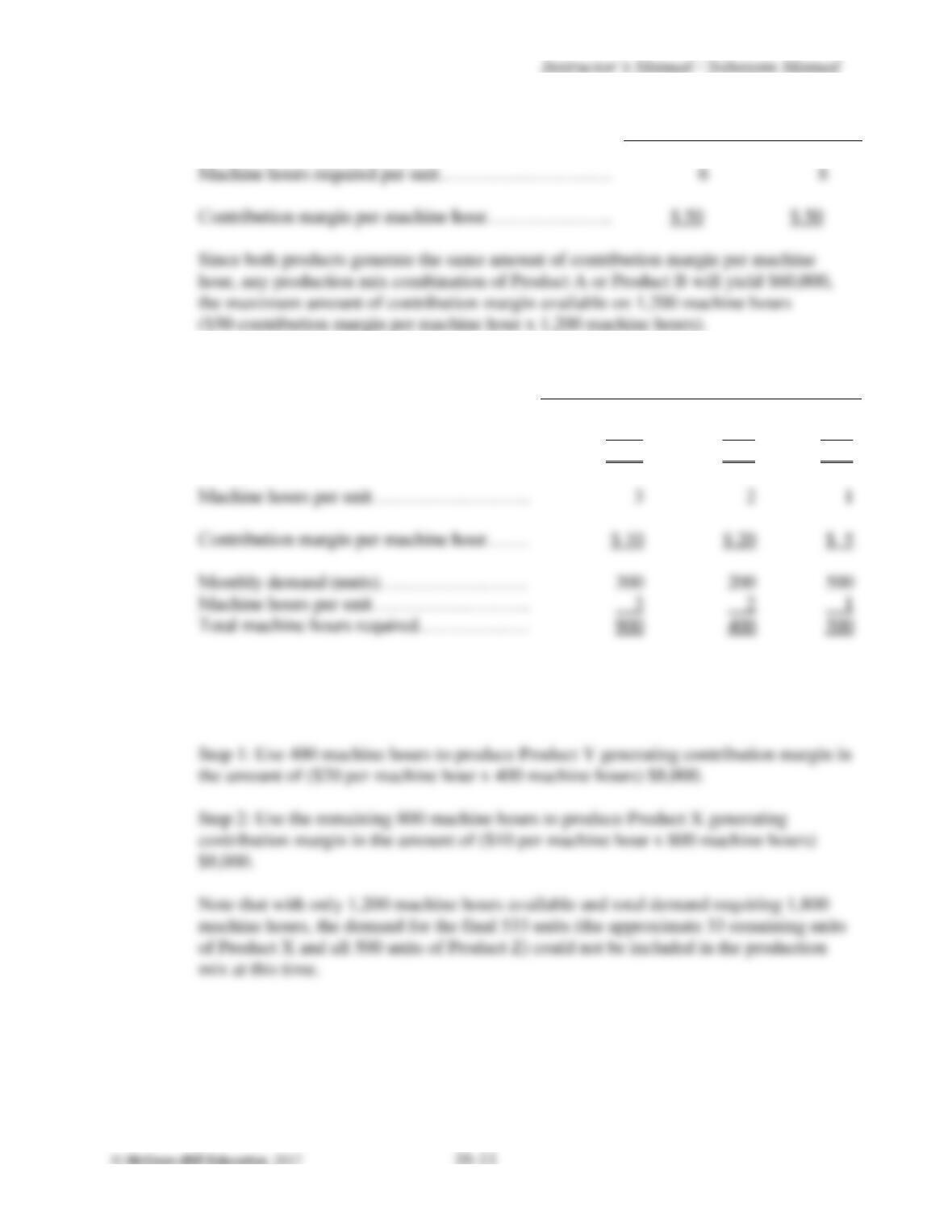
E16.17.
Product A
Product B
Contribution margin per unit…………………………..
$ 300
$ 400
Machine hours required per unit……………………….
6
8
Contribution margin per machine hour…………………
($50 contribution margin per machine hour x 1,200 machine hours).
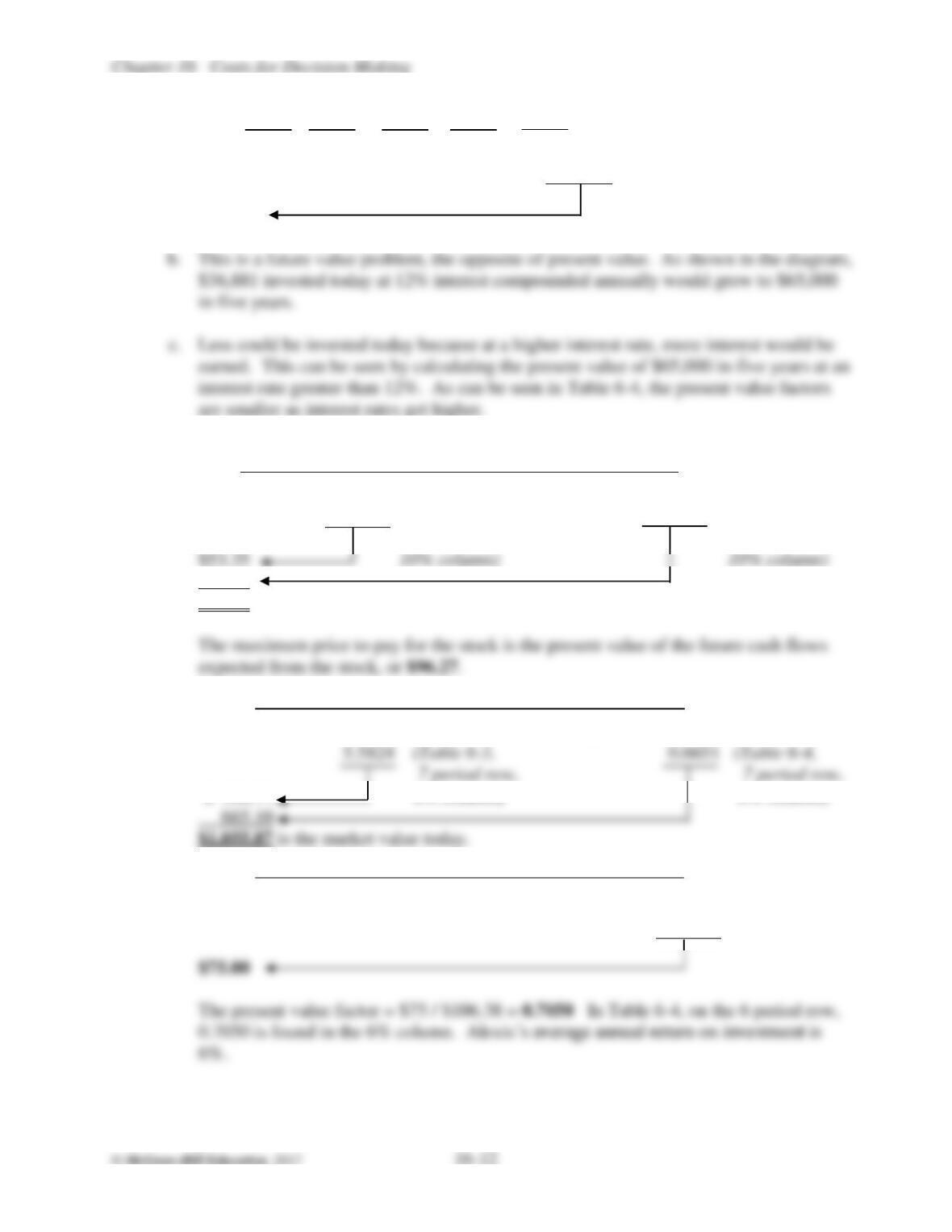
E16.18.
Product X
Product Y
Product Z
Selling price…………………………………
$100
$ 80
$ 25
Variable costs………………………………
70
40
20
Contribution margin per unit……………….
$ 30
$ 40
$ 5
Machine hours per unit……………………..
Contribution margin per machine hour…….
$ 20
Monthly demand (units)……………………
Machine hours per unit……………………..
Total machine hours required………………
To assign the 1,200 available machine hours to achieve the most profitable mix of
products, start by producing the product with the highest contribution per machine
hour, then the next highest, and so on.
E16.19.
a.
0 1 2 3 4 5
$65,000
0.5674 (Table 6-4, 5 period row,
12% column)
$36,881
in five years.
E16.20.
a.
0 8
Dividend = $10 per year Market price = $92
5.3349 (Table 6-5, 0.4665 (Table 6-4,
8 period row, 8 period row,
42.92
$96.27
b.
0 5
Interest = $ 70 per year Maturity value = $1,000
$ 390.77 6% column) 6% column)
c.
0 6
$106.38
???
E16.21.
a.
If the investment is too high, the net present value will be too low.
If the cost of capital is too low, the net present value will be too high.
c.
If the cash flows from the project are too high, the net present value will be too high.
d.
If the number of years over which the project will generate cash flows is too low, the
net present value will be too low.
E16.22.
a.
to provide for a margin of error in the estimates used in the capital budgeting
calculations, and to recognize the risk associated with proposed capital expenditures.
ROI of 9%, because that rate of return reflects the composite expectation of all
E16.23.
a.
b.
Because the net present value is negative, the internal rate of return on this project will
be lower than the cost of capital of 10%.
0 1 2 3 4 5 6 7 8
5.3349 (Table 6-5 0.4665 (Table 6-4
$(85,000) 8 period row, 8 period row,
E16.24.
a.
Investment in machinery and equipment………………………………
$(6,700,000)
Investment in working capital …………………………………………
(1,200,000)
Annual cash inflows, by year: …………………………………………
2016 = $2,000,000 * 0.9259 …………………………………………
1,851,800
2017 = 3,600,000 * 0.8573 …………………………………………
3,086,280
Salvage value = $1,000,000 * 0.7938 …………………………………
Release of working capital = $1,200,000 * 0.7938.……………………
Net present value ………………………………………………………
b.
the cost of capital which is 8%.
Because the net present value is positive, the internal rate of return will be higher than
E16.24.
(continued)
c.
Estimate:
Effect if estimate is less than actual:
Investment cost …………………
Actual NPV and ROI will be less than indicated.
Annual cash inflows ……………
Actual NPV and ROI will be more than indicated.
Cost of capital……………………
Actual NPV and ROI will be less than indicated.
E16.25.
a.
investment of $24,000). Therefore, the return on investment is greater than 20%.
The payback period should not carry much weight at all, because it does not recognize
the time value of money.
The net present value is positive $2,220 (present value of inflows of $26,220 less the
E16.26.
a.
The present value of an annuity = (Annuity amount * present value factor). If the
present value of the annuity equals the investment, the IRR will equal the discount rate.
b.
Annual net cash flow required…………………………………………
$600,000
Annual direct cash costs (50%) ……………………………………..…
300,000
Annual total revenues required…………………………………………
$900,000
Procedures capacity ……………………………………………………
Utilization factor ………………………………………………………
Number of procedures per year …………………………..……………
Fee per procedure ($900,000 / 6,000 procedures) ……………..………
P16.27.
a.
Relevant costs for the special sales order include the following:
Per Gallon
Raw materials.………………………….……………
$3.00
Direct labor ……………………………….…………
1.50
Variable overhead……………………………………
1.00
Distribution …………………………………………
1.50
Total relevant costs per gallon ………………………
$7.00
b.
Per Gallon
Sales price ……………………………………………
$8.00
Less: relevant costs ………………..…………………
7.00
Contribution margin per gallon………………………
$ 1.00
Daily sales in gallons…………………………………
Daily increase in operating income ….………………
P16.27.
(continued)
c.
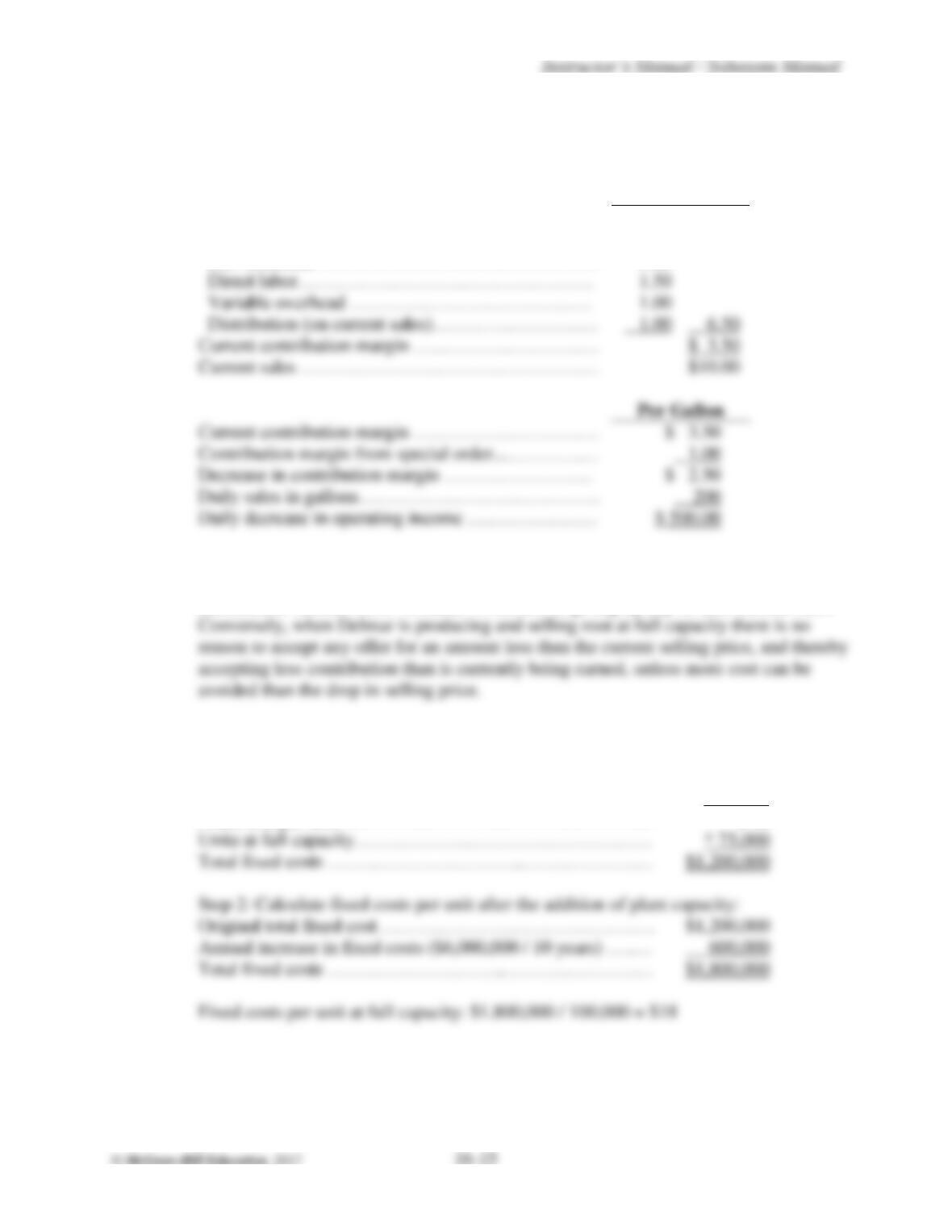
Since Delmar is now operating at full capacity, relevant costs for the special sales order
would include any forgone contribution margin (opportunity cost) on regular sales
given up by Delmar to fulfill the special sales order:
Per Gallon
Current sales …………………………………………
$10.00
Less variable costs……………………………………
Raw materials ………………………………………
3.00
Direct labor…………………………………………
1.50
Variable overhead …………………………………
1.00
Distribution (on current sales)………………………
6.50
Current contribution margin …………………………
$ 3.50
Current sales …………………………………………
$10.00
Per Gallon
Current contribution margin …………………………
Contribution margin from special order………………
Daily sales in gallons…………………………………
d.
When Delmar is operating under conditions of idle capacity, the only relevant costs
incurred in producing the gallons of root beer needed to fulfill the special order are the
incremental variable costs – Delmar would not be giving up any of their current sales.
P16.28.
a.
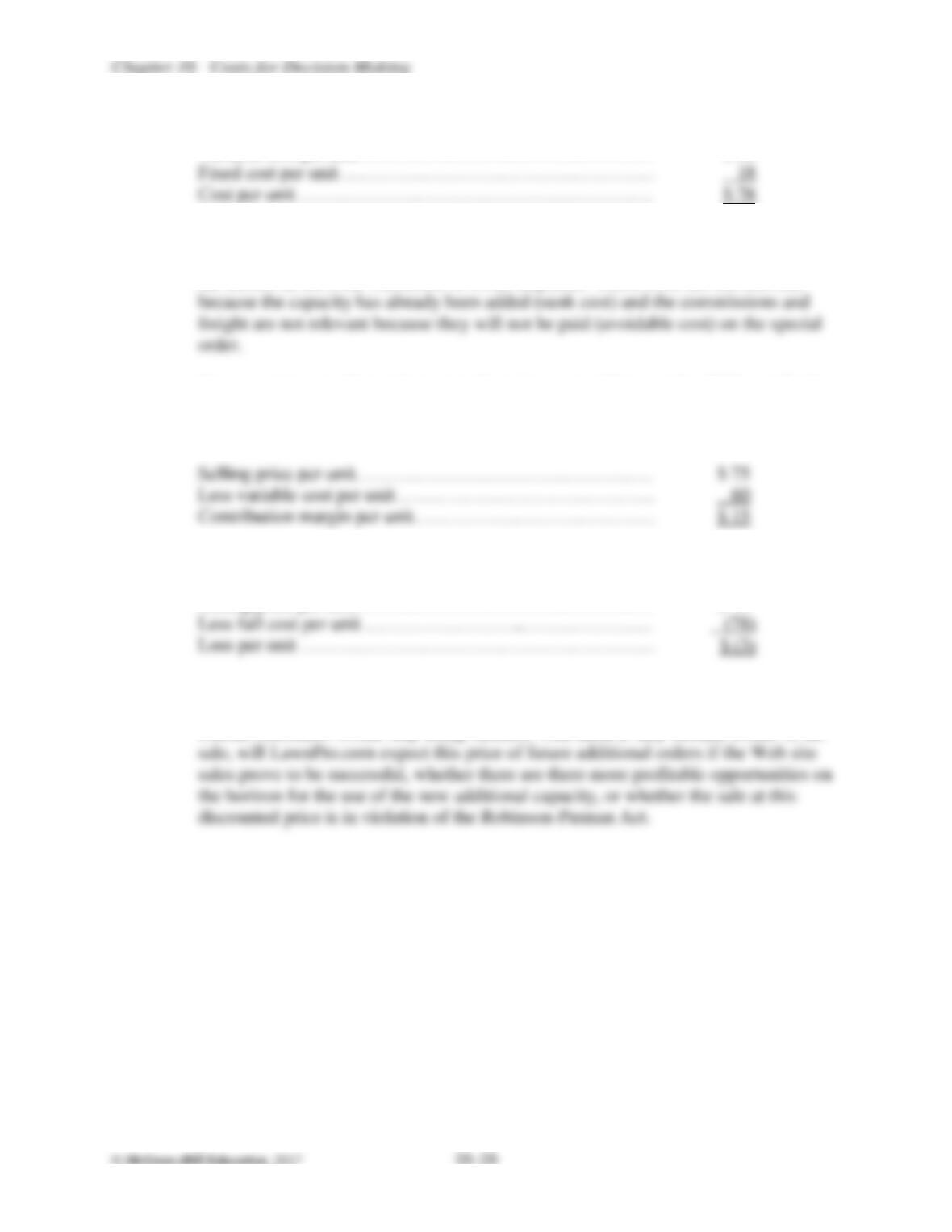
Step 1: Calculate total amount of fixed costs before the addition of plant capacity:
Current total cost per unit ……………………………………
$ 76
Less: Variable cost per unit ……………………….…………
60
Fixed cost per unit……………………………………………
$ 16
Units at full capacity…………………………………………
* 75,000
Total fixed costs …………………………..…………………
Original total fixed cost………………………………………
Annual increase in fixed costs ($6,000,000 / 10 years) …..…
Total fixed costs ………………………..……………………
Fixed costs per unit at full capacity: $1,800,000 / 100,000 = $18
P16.28.
(continued)
a.
Step 3: Calculate cost per unit after the addition of plant capacity:
Variable cost per unit ……………………………..…………
$ 60
Fixed cost per unit……………………………………………
18
Cost per unit …………………………………………………
$ 78
b.
because the capacity has already been added (sunk cost) and the commissions and
freight are not relevant because they will not be paid (avoidable cost) on the special
order.
Relevant costs associated with the special order from LawnPro.com would include
variable manufacturing costs per motor ($60) and the costs associated with storing
the motors in the PMI warehouse to await shipment. Fixed costs are not relevant
c.
Yes, assuming no other option currently exists to provide more than $15 contribution
margin per motor or that the costs associated with storing each motor in the PMI
warehouse will not exceed $15 per motor.
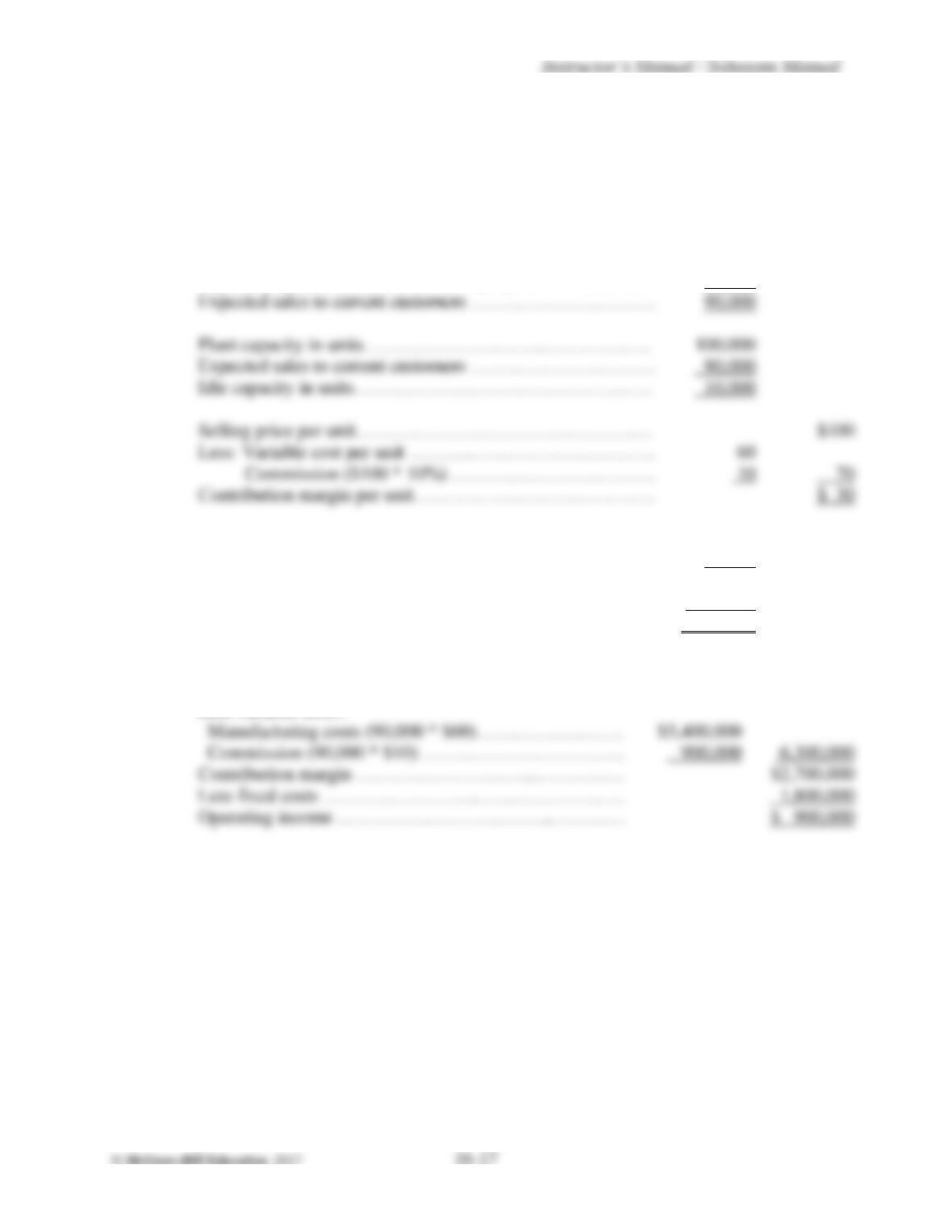
Selling price per unit…………………………………………
$ 75
Less variable cost per unit……………………………………
60
Contribution margin per unit…………………………………
$ 15
d.
No, because the full absorption cost per unit will indicate a loss on the sale.
Selling price per unit…………………………………………
$ 75
Less full cost per unit ……………………..…………………
Loss per unit …………………………………………………
e.
sale, will LawnPro.com expect this price of future additional orders if the Web site
sales prove to be successful, whether there are there more profitable opportunities on
the horizon for the use of the new additional capacity, or whether the sale at this
discounted price is in violation of the Robinson-Patman Act.
Key qualitative factors to consider would include whether PMI’s current customers
would expect the same $60 price if they became aware of the sale, whether PMI’s
current customers would stop doing business with them if they became aware of the
P16.28.
(continued)
f.
PMI will no longer have enough idle capacity to produce the motors needed to fulfill
the LawnPro.com special order without sacrificing sales to existing customers at the
normal selling price. Therefore, relevant costs, in addition to the relevant costs
described in part b, will now include an opportunity cost equal to the amount of
contribution foregone if PMI were to accept the special order:
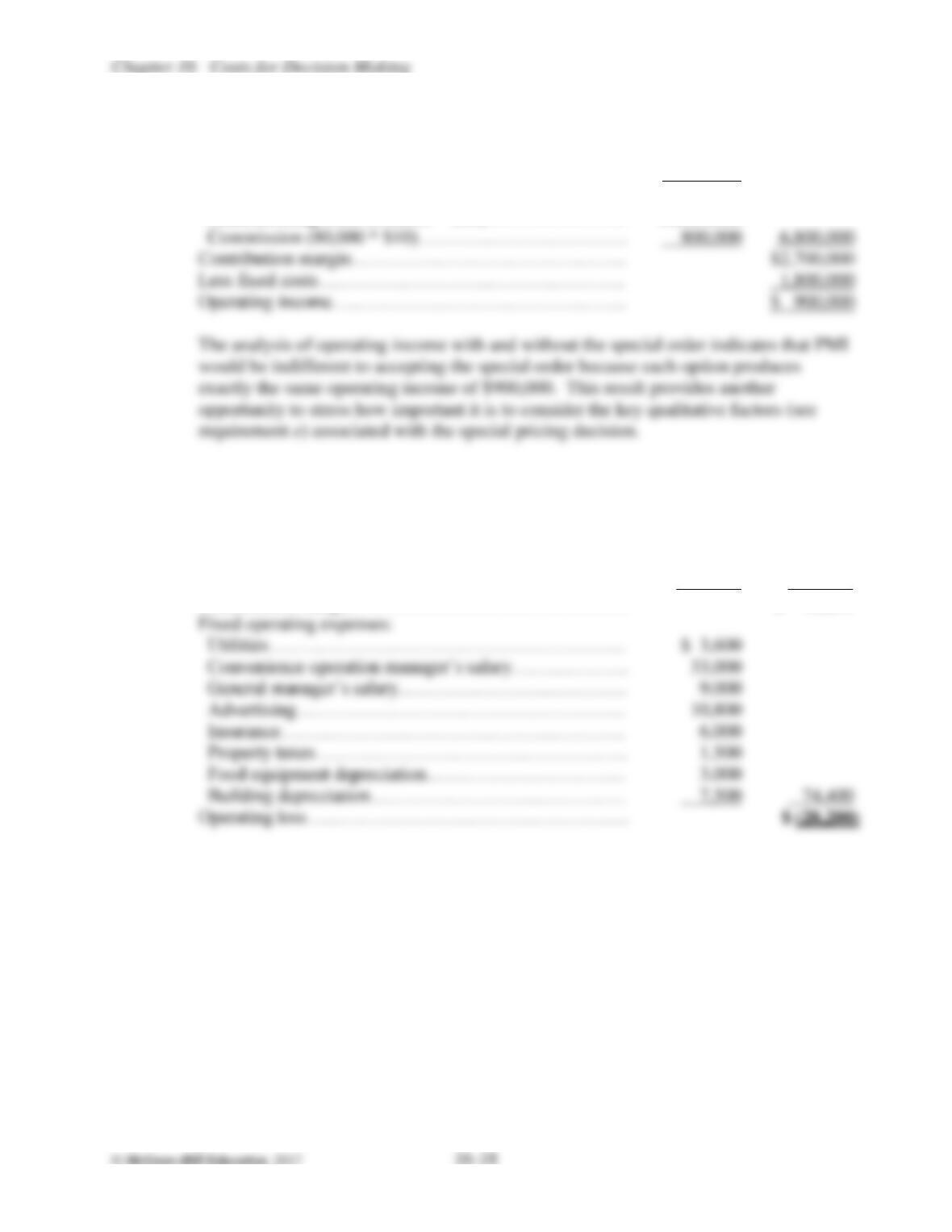
Current sales in units…………………………………………
75,000
Expected increase in sales (75,000 * 20%) ………….………
15,000
Expected sales to current customers …………………………
90,000
Plant capacity in units ……………………….………………
Expected sales to current customers …………………………
Idle capacity in units…………………………………………
Selling price per unit…………………………………………
Less: Variable cost per unit ……….…………………………
Commission ($100 * 10%) ……………………………
Contribution margin per unit…………………………………
Sales to LawnPro.com in units ………………………………
20,000
Idle capacity in units…………………………………………
10,000
Lost sales to existing customers in units ….…………………
10,000
Contribution margin per unit…………………………………
$ 30
Opportunity cost of lost sales …………………………………
$ 300,000
g.
Calculation of operating income without the special order:
Sales (90,000 * $100) ……………………………………
$9,000,000
Less variable costs:
Manufacturing costs (90,000 * $60)……………………
$5,400,000
Commission (90,000 * $10) ……………………………
Contribution margin ………………………..……………
$2,700,000
Less fixed costs …………………….……………………
1,800,000
Operating income ……………………………..…………
$ 900,000
P16.28.
(continued)
g.
Calculation of operating income with the special order:
Sales (80,000 * $100)…………………………………….
$8,000,000
(20,000 * $75)………………………………………
1,500,000
$9,500,000
Less variable costs:
Manufacturing costs (100,000 * $60)…………………..
$6,000,000
Commission (80,000 * $10)…………………………….
800,000
6,800,000
Contribution margin………………………………………
$2,700,000
Less fixed costs…………………………………………..
1,800,000
Operating income…………………………………………
$ 900,000
P16.29.
a.
Sales………………………………………………………
$ 120,000
Variable operating expenses:
Cost of sales (food, beverages, and snack items @ 40%)
48,000
Food service items (spoons, napkins, etc.).……………..
1,800
Wages for part time employees..………………………..
24,000
73,800
Contribution Margin.……………………………………..
$ 46,200
Fixed operating expenses:
Utilities….………………………………………………
Convenience operation manager’s salary……………….
General manager’s salary……………………………….
9,000
Advertising………………………………………………
Insurance………………………………………………..
6,000
Property taxes……………………………………………
1,500
Food equipment depreciation……………………………
3,000
Building depreciation……………………………………
74,400
Operating loss…..…………………………………………
P16.29.
(continued)
b.
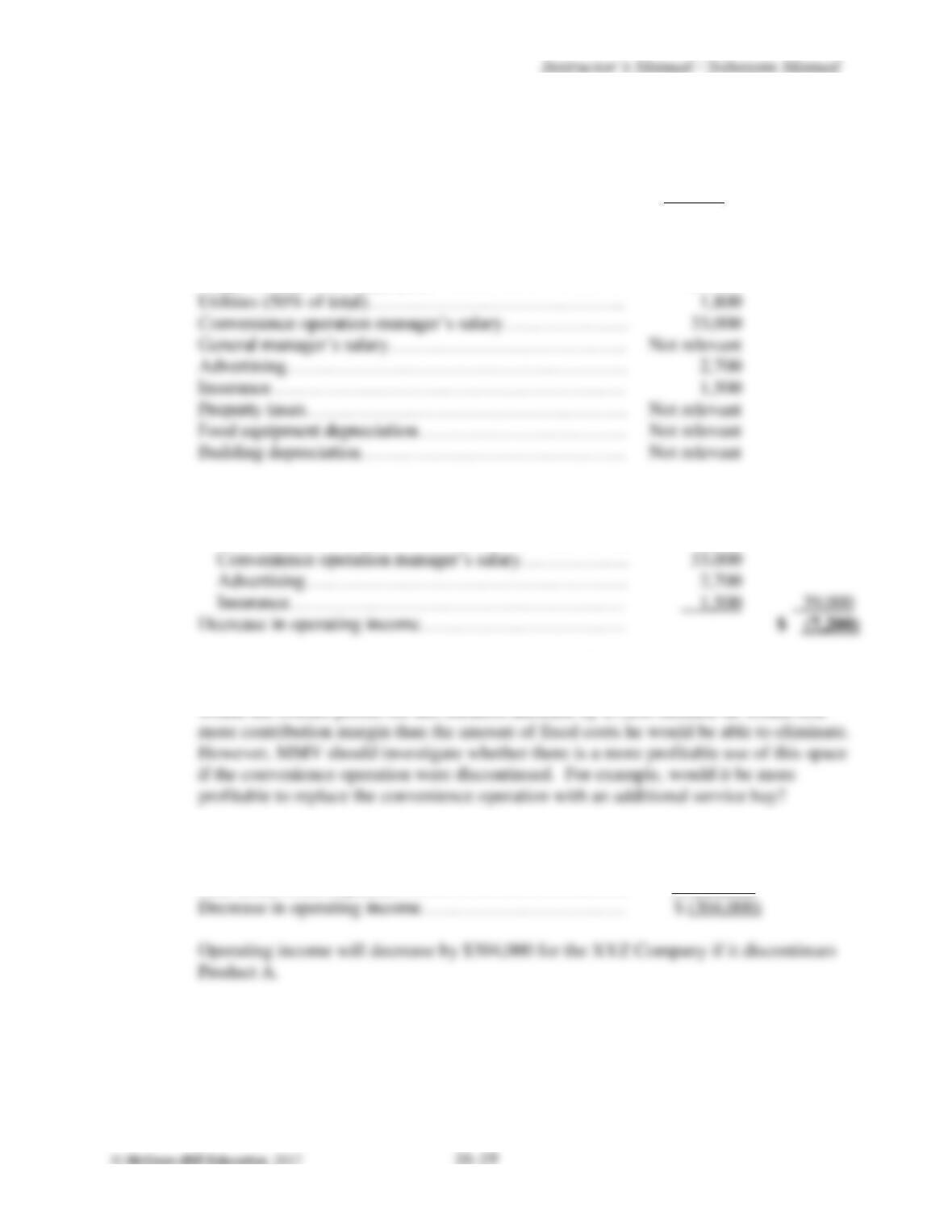
Note – relevant revenues and costs are those items that would be eliminated if the
segment is discontinued:
Relevant
Amount
Sales………………………………………………………
120,000
Cost of sales (food, beverages, and snack items @ 40%)..
48,000
Food service items (spoons, napkins, etc.)……………….
1,800
Wages for part time employees…………………………..
24,000
Utilities (50% of total)……………………………………
1,800
Convenience operation manager’s salary…………………
33,000
General manager’s salary…………………………………
Advertising……………………………………………….
2,700
Insurance…………………………………………………
1,500
Property taxes…………………………………………….
Food equipment depreciation…………………………….
Building depreciation…………………………………….
c.
Loss of contribution margin………………………………
$ (46,200)
Less direct fixed costs:
Utilities (50% of total)…………………………………
1,800
Convenience operation manager’s salary………………
33,000
Advertising…………………………………………….
2,700
Insurance………………………………………………
1,500
39,000
Decrease in operating income……………………………
d.
if the convenience operation were discontinued. For example, would it be more
profitable to replace the convenience operation with an additional service bay?
MMV should continue the convenience operation. The quantitative results of the
relevant cost analysis indicate that if MMV discontinued the convenience operation he
would see overall profits for this location decrease by $7,200 because he would lose
P16.30.
a.
Loss of contribution margin………………………………
$ (600,000)
Less direct fixed expenses………………………………..
296,000
Decrease in operating income……………………………
$ (304,000)
Operating income will decrease by $304,000 for the XYZ Company if it discontinues
Product A.
P16.30.
(continued)
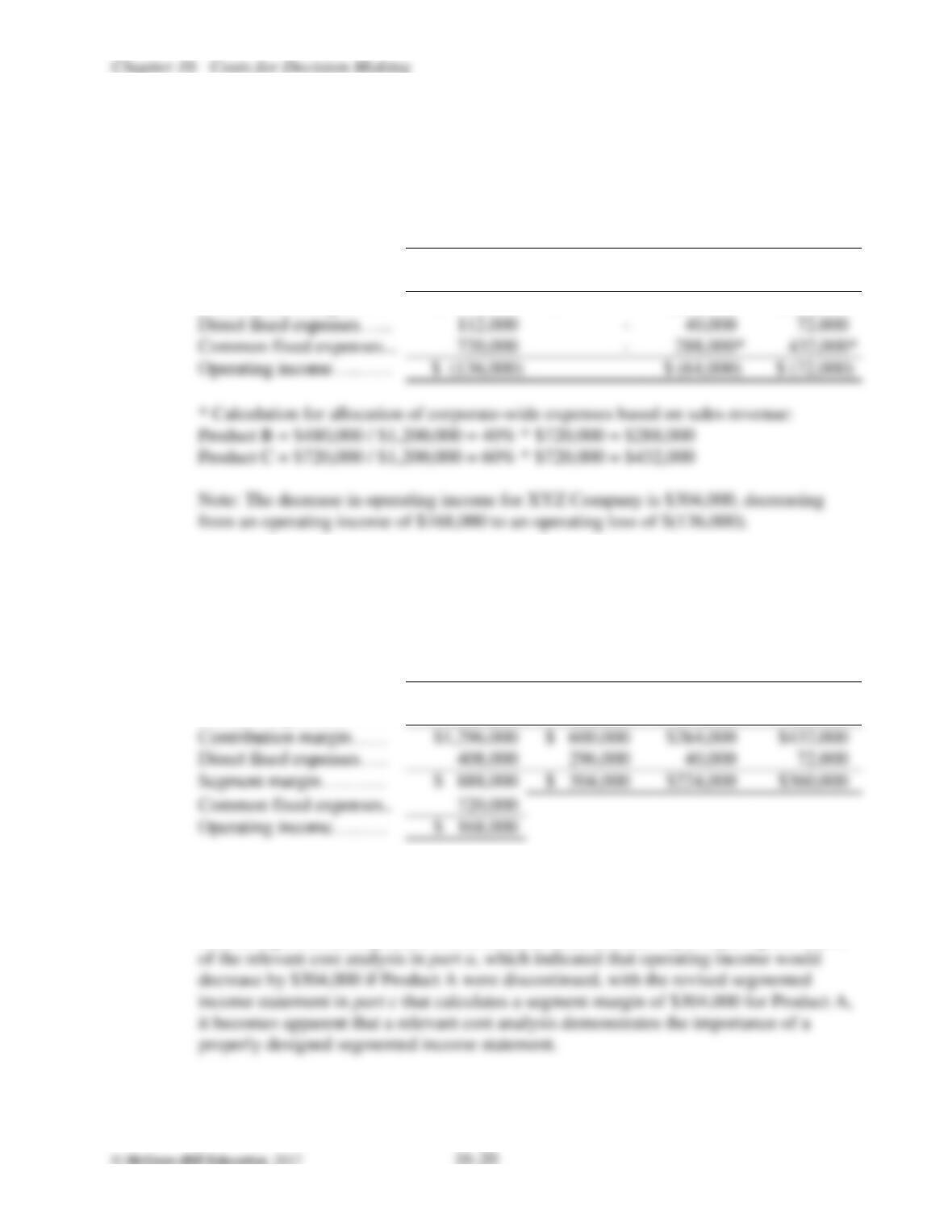
b.
XYZ COMPANY
Segmented Income Statement
For the Year Ended December 31, 2016
Total
Company
Product A
Product B
Product C
Sales………………….….
$1,200,000
$ –
$480,000
$720,000
Variable expenses…….…
504,000
–
216,000
288,000
Contribution margin….…
$ 696,000
$ –
$264,000
$432,000
Direct fixed expenses……
112,000
–
Common fixed expenses…
720,000
–
288,000*
Operating income….……
from an operating income of $168,000 to an operating loss of $(136,000).
c.
XYZ COMPANY
Segmented Income Statement
For the Year Ended December 31, 2016
Total
Company
Product A
Product B
Product C
Sales…………………….
$2,400,000
$1,200,000
$480,000
$720,000
Variable expenses………
1,104,000
600,000
216,000
288,000
Contribution margin……
$1,296,000
$ 600,000
$264,000
$432,000
Direct fixed expenses…..
408,000
296,000
Segment margin………..
$ 888,000
$ 304,000
$224,000
$360,000
Common fixed expenses..
720,000
Operating income………
$ 168,000
d.
As explained in Chapter 15, a key feature of this more appropriately designed
segmented income statement is that common fixed expenses have not been arbitrarily
allocated to the segments. This approach more clearly illustrates that when a segment
is covering its direct expenses, it should not be discontinued. By comparing the results