E14.16.
(continued)
Manufacturing overhead:
Overhead cost for 12 pads (16 direct labor hours * $16 per hour / 1,800 pads * 12)..
b.
The relevant cost would exclude the fixed manufacturing overhead, which is incurred
whether or not the extra pads are made.
P14.17.
July
August
September
Sales forecast …………………………………
$250,000
$220,000
$310,000
Cost of sales @ 54% …………………………
135,000
118,800
167,400
Purchases budget:
Beginning inventory …………………………
$410,000
$356,400
Purchases………………………………………
? .
? .
Cost of merchandise available for sale
Less: Ending inventory (300% * next
month’s cost of goods sold) ……………
Cost of goods sold ……………………………
(Cost of goods sold + Ending inventory) ……
$491,400
$621,000
P14.18.
a.
Cost of goods sold:
June………………………
Sales – Cost of goods sold = Gross profit, or
Cost of goods sold = Sales * (1 – gross profit ratio)
P14.18.
(continued)
b.
Purchases budget for May:
Jewelry
Watches
Beginning inventory (200% of current month’s CGS)
$ 99,200
$ 75,000
Add: Purchases………………………………………
? = 27,200
? = 26,250
Goods available for sale………………………………
Less: Ending inventory (200% of next month’s CGS)
Cost of goods sold ……………………………………
P14.19.
a.
September
October
Sales forecast …………………….………………………
$42,000
$54,000
Purchases budget…………………………………………
37,800
44,000
Operating expense budget ……….………………………
10,500
12,800
Beginning cash ……..……………………………………
$40,000
Cash receipts:
August 31 accounts receivable……………………………
20,000
September sales…………..………………………………
Total cash receipts…………………………………………
August 31 accounts payable and accrued expenses………
September purchases (75% * $37,800)…..………………
28,350
September operating expenses (75% * $10,500) ……..…
Total cash disbursements …………………………………
Ending cash………………………………………………
b.
PrimeTime Sportswear’s management should try to accelerate the collection of
accounts receivable, slow down the payment of accounts payable and accrued
P14.20.
a.
October
November
December
Sales forecast ……………………………
$54,000
$68,000
$59,000
Purchases budget…………………………
44,000
48,900
33,100
Operating expense budget …..……………
12,800
14,300
16,100
Beginning cash …………..………………
Cash receipts:
August 31 accounts receivable …..………
15,000
0
September sales …….……………………
21,000
18,900
October sales ………..……………………
27,000
November sales ….….……………………
0
Total cash receipts ….……………………
Cash disbursements:
September purchases …………….………
$ 9,450
$ 0
October purchases ……..…………………
33,000
11,000
November purchases …..…………………
0
36,675
September operating expenses ……………
October operating expenses ….…..………
November operating expenses ……………
Total cash disbursements …………………
Ending cash………………………………..
b.
December
January
February
Sales forecast …………………….………
$59,000
$59,000
$59,000
Purchases budget…………………………
33,100
33,100
33,100
Operating expense budget …………..……
16,100
16,100
16,100
Beginning cash……………………………
Cash receipts:
October sales ……………….……………
24,300
November sales …….……………………
34,000
30,600
December sales …………………….……
26,550
January sales …………………….………
Total cash receipts ………………………
P14.20.
(continued)
Cash disbursements:
December
January
February
November purchases ………..……………
$ 12,225
$ 0
$ 0
December purchases …..…………………
24,825
8,275
0
January purchases ……..…………………
0
24,825
8,275
February purchases …..…..………………
0
0
24,825
November operating expenses……………
0
December operating expenses……………
12,075
4,025
0
January operating expenses………………
0
12,075
4,025
February operating expenses ….…………
Total cash disbursements…………………
By reviewing the summarized cash budget results shown below for the six-month budget
period from September–February, it becomes clear that PrimeTime Sportswear must
obtain a seasonal bank loan during September to help finance the additional cost of
building up inventory levels to meet peak sales. Perhaps PrimeTime should apply for an
open line of credit. Obviously, it would not be possible to actually have a negative
balance in the cash account (as suggested by the budget results).
Sept.
Oct.
Nov.
Dec.
Jan.
Feb.
Beginning cash …………
$40,000
$ (225)
$(18,900)
$(34,600)
$(29,000)
$(18,100)
Total cash disbursements.
Ending cash ……………
$ (225)
$(18,900)
$(34,600)
$(29,000)
$(11,250)
return to levels in excess of cash disbursements.
Total cash receipts ……..
20,000
36,000
45,900
58,300
60,100
56,050
P14.21.
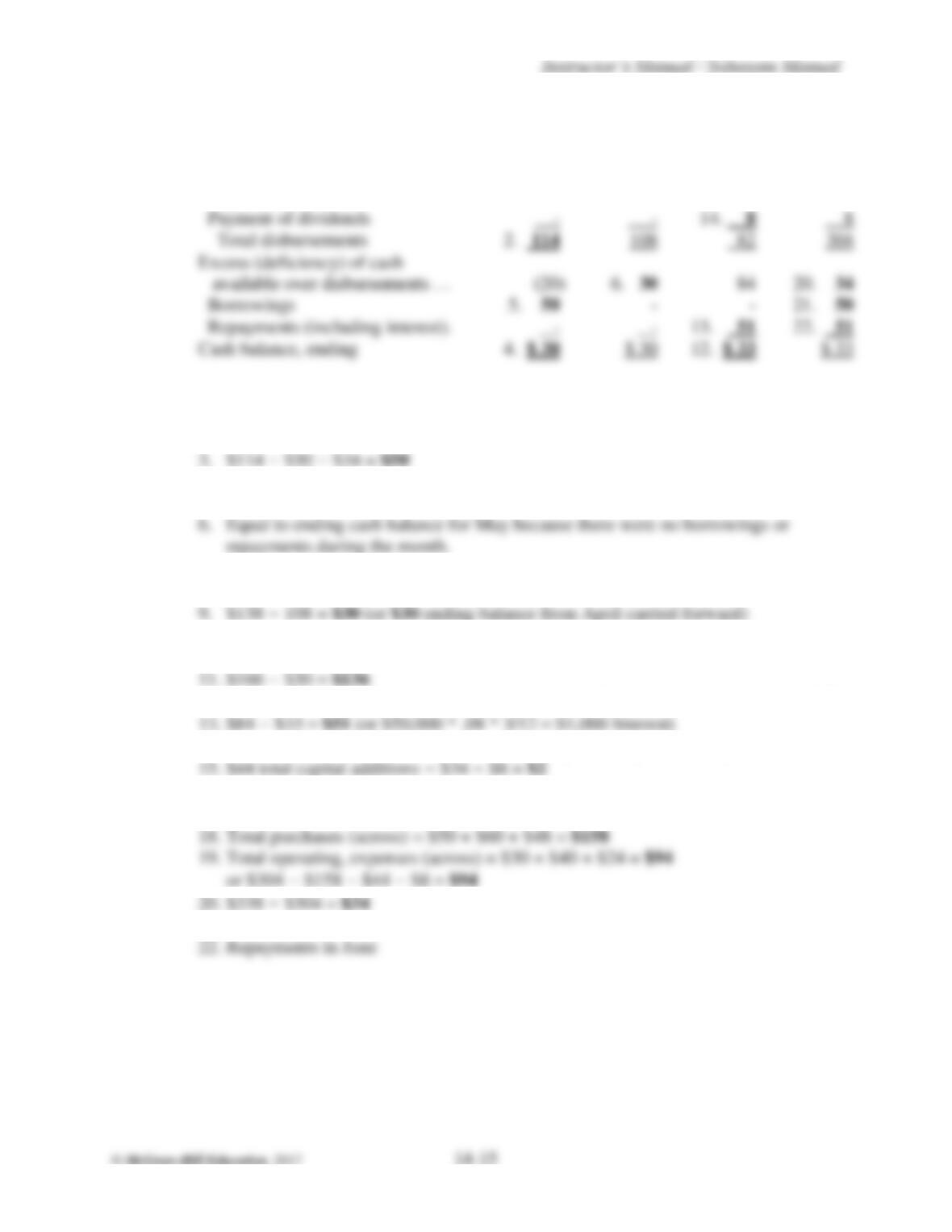
Answer (and one possible numbered sequence of solving the problem):
April
May
June
Total
Add collections from customers …
Total cash available……………
94
166
338
P14.21.
(continued)
April
May
June
Total
Less disbursements:
Purchase of inventory …………
3. 50
60
48
18. 158
Operating expenses
30
7. 40
16. 24
19. 94
Capital additions
34
8
15. 2
44
Payment of dividends
14. 8
Total disbursements
2. 114
Borrowings
5. 50
Repayments (including interest).
–
–
13. 51
Cash balance, ending
4. $ 30
12. $ 33
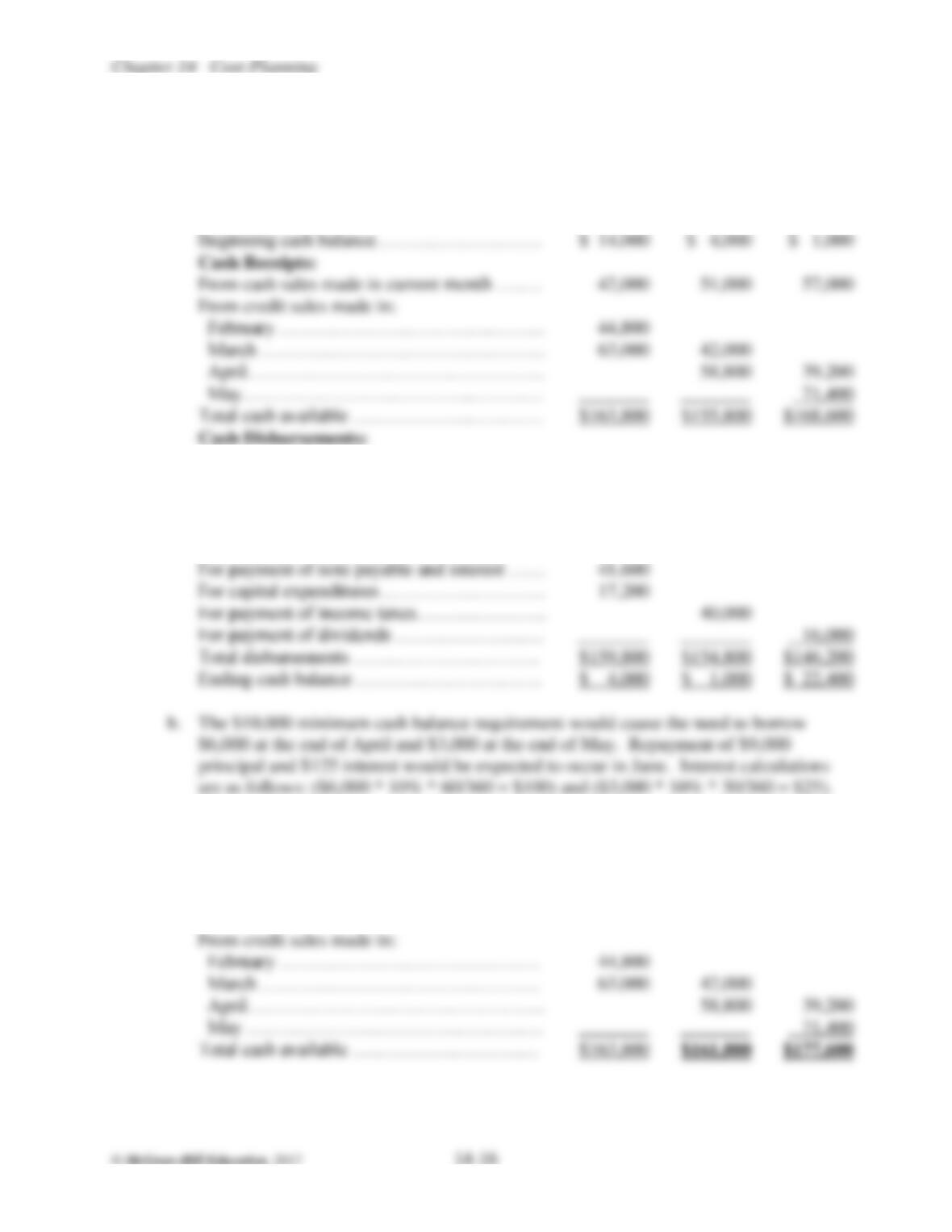
Solution approach:
1. $94 – $26 = $68
2. $94 + 20 (deficiency of cash available) = $114
4. Minimum month-end balance
5. $30 + 20 (deficiency of cash available) = $50
7. $108 – $60 – $8 = $40
8. $108 + $30 (excess of cash available) = $138
10. Ending cash balance from May is carried forward to beginning cash balance of
June = $30
12. Ending cash balance for the third quarter is the ending cash balance for June = $33
14. Total dividends = $8, and no dividends were paid in April and May
16. $82 – $48 – $2 – $8 = $24
17. $338 – $26 = $312
21. Borrowings from April
P14.22.
a.
SEATECH, INC.
Cash Budget
For the months of April, May, and June, 2016
April
May
June
From cash sales made in current month …..…
From credit sales made in:
February …………………………….………
March ……………………………….………
63,000
42,000
April…………………………………………
May……………………………….…………
For cost of goods sold/operating expenses incurred in:
March ………………………………………
$ 22,600
$
$
April…………………………………………
78,400
19,600
May …………………………………………
95,200
23,800
June …………………………………………
106,400
For payment of note payable and interest ……
41,600
For payment of income taxes…………………
40,000
Total disbursements …………………………
$159,800
$154,800
$146,200
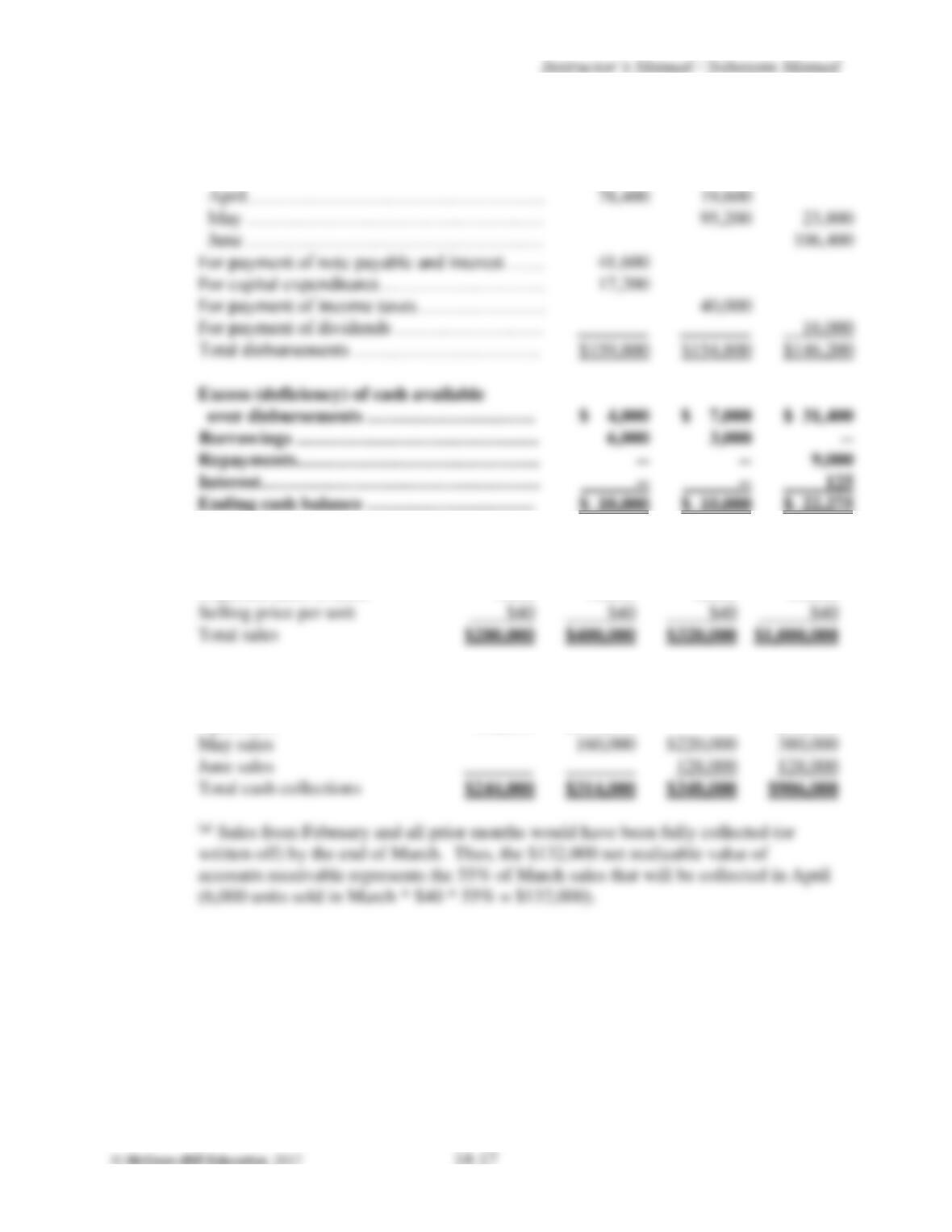
The monthly cash budgets would appear as follows (revisions shown in bold):
April
May
June
Beginning cash balance………………………
$ 14,000
$ 10,000
$ 10,000
Cash Receipts:
From cash sales made in current month ……
42,000
51,000
57,000
From credit sales made in:
February ……………………………………
44,800
March ………………………………………
April…………………………………………
58,800
39,200
May …………………………………………
Total cash available …………………………
$163,800
P14.22.
(continued)
April
May
June
Cash Disbursements:
For cost of goods sold/operating expenses incurred in:
March ………………………………………
$ 22,600
$
$
April…………………………………………
May …………………………………………
95,200
23,800
June …………………………………………
41,600
For capital expenditures………………………
40,000
$159,800
$154,800
$146,200
Excess (deficiency) of cash available
over disbursements ………………………
Ending cash balance ………………………
P14.23.
a.
April
May
June
Total
Expected sales in units
7,000
10,000
8,000
25,000
Selling price per unit
$40
Total sales
$1,000,000
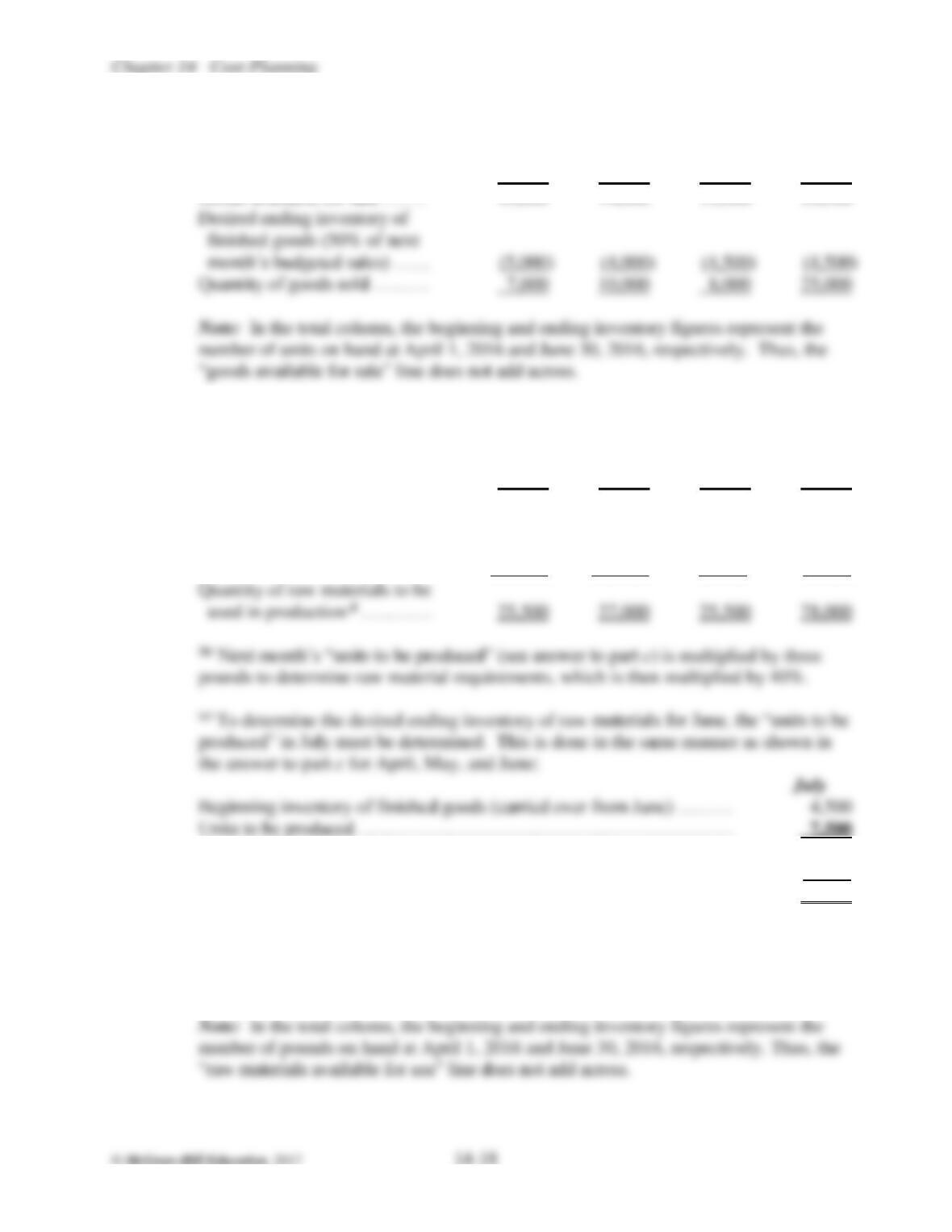
b.
Cash collections from:
April
May
June
Total
March sales
$132,000a
$132,000
April sales
112,000
$154,000
266,000
May sales
$220,000
June sales
128,000
128,000
Total cash collections
P14.23.
(continued)
April
May
June
Total
c.
Beginning inventory of
finished goods ……………
3,500
5,000
4,000
3,500
Units to be produced…………
8,500
9,000
8,500
26,000
Goods available for sale …….
12,000
14,000
12,500
29,500
Desired ending inventory of
finished goods (50% of next
month’s budgeted sales) ……
(4,500)
Quantity of goods sold ………
10,000
8,000
25,000
d.
April
May
June
Total
Beginning inventory of
raw materials …………………
10,200
10,800
10,200
10,200
Purchases of raw materials ……
26,100
26,400
24,300
76,800
Raw materials available for use.
36,300
37,200
34,500
87,000
Desired ending inventory of
raw materials (40% of next
month’s estimated usage)b ……
(10,800)
(10,200)
(9,000)c
(9,000)
Quantity of raw materials to be
used in production d …………
25,500
25,500
78,000
Beginning inventory of finished goods (carried over from June) ………
4,500
Units to be produced ……………………………………………………
Goods available for sale…………………………………………………
12,000
Desired ending inventory of finished goods (50% of August’s sales) …
(3,000)
Quantity of goods sold …………………………………………………
9,000
7,500 * 3 pounds * 40% = 9,000
(d) “Units to be produced” each month (see answer to part c) * 3 pounds per unit.
P14.23.
(continued)
e.
Cash payments for:
April
May
June
Total
March purchases …………….
$ 26,280e
$ 26,280
April purchases ………………
125,280
$ 31,320
156,600
158,400
June purchases ………………
116,640
P14.24.
a.
October
November
December
Total
Expected sales in units ………
12,000
14,000
20,000
46,000
Selling price per unit…………
Total sales ……………………
$1,200,000
$2,760,000
b.
Cash collections from:
October
November
December
Total
September sales………………
$499,200a
$ 499,200
October sales…………………
230,400
$460,800
691,200
November sales………………
806,400
384,000
Total cash collections ………
c.
October
November
December
Total
Beginning inventory of
finished goods………………
4,800
5,600
8,000
4,800
Units to be produced…………
12,800
16,400
15,600
44,800
Goods available for sale ……
17,600
22,000
23,600
49,600
Desired ending inventory of
finished goods (40% of next
month’s budgeted sales) ……
12,000
14,000
20,000
46,000