CHAPTER
13
Cost Accounting and Reporting
CHAPTER OUTLINE:
I. Cost Management
A. Value Chain Functions
II. Cost Accumulation and Assignment
A. Cost Objects
B. Cost Pools
C. Cost Assignment
III. Cost Classifications
A. Cost Relationship to Product or Activity
2. Indirect cost
B. Costs for Cost Accounting Purposes
1. Product costs
2. Period costs
IV. Cost Accounting Systems
A. Cost Accounting Systems – General
2. Cost of a unit of product
4. Statement of Cost of Goods Manufactured
5. Income Statement
B. Cost Accounting Systems – Job Order Costing, Process Costing, and Hybrid Costing
2. Activity-based management
Chapter 13 Cost Accounting and Reporting
TEACHING/LEARNING OBJECTIVES:
Primary: To have the student understand:
1. The relationship of cost accounting to financial accounting and managerial accounting.
3. The difference between direct and indirect costs and the process for pooling and assigning
indirect costs to cost objects. Specifically, the application of manufacturing overhead to jobs.
5. The process by which costs flow through a manufacturing environment.
Supporting: To have the student understand:
7. The inventory accounts of the manufacturing firm and how the value of the inventory is
determined.
9. The role of activity-based costing in the analysis and assignment of costs.
TEACHING OBSERVATIONS:
1. Students will generally understand how product costs are determined if they first have a solid
understanding of the direct vs. indirect cost classifications. Use several examples of different
2. Use the flow of cost model to emphasize the cost accumulation process. If students can
picture how costs flow through raw material, work in process, finished goods, and cost of
3. Spend time with Problems P13.20, P13.22, and/or Case C13.23 to help students understand
the elements of product cost, and the flow of costs in a manufacturing environment.
Instructor’s Manual / Solutions Manual
ASSIGNMENT OVERVIEW:
NO.
LEARNING
OBJECTIVES
DIFFICULTY &
TIME ESTIMATE
OTHER
COMMENTS
M13.1
3,4
Easy, 3-5 min.
Brief introduction to total manufacturing costs calculation.
M13.2
5,6
Easy, 5-7 min.
Straight-forward predetermined overhead rate and unit cost
determination.
M13.3
6
Med., 7-10 min.
Focus is on underapplied overhead and application relationships.
M13.4
7
Easy, 5-7 min.
Introduction to statement of cost of goods manufactured.
M13.5
8
Easy, 5-7 min.
Compares variable and absorption unit cost calculations.
M13.6
9
Med., 7-10 min.
Introduces and explores activity-based costing concepts.
E13.7
2
Easy, 3-5 min.
Introduces students to activities in the organizational value chain.
E13.8
2
Easy, 3-5 min.
See 13.7.
E13.9
3,4
Easy, 3-5 min.
Straight-forward.
E13.10
3,4
Easy, 3-5 min.
Good in-class exercise.
E13.11
4
Easy, 3-5 min.
Use as an opportunity to clarify cost terminology.
E13.12
4
Easy, 3-5 min.
Good in-class exercise.
E13.13
5
Med., 7-10 min.
Straight-forward product costing problem.
E13.14
5
Med., 7-10 min.
See 13.13. Good in-class demonstration problem.
E13.15
5,6
Med., 5-8 min.
Before working through the calculations, ask students: “Why
does manufacturing overhead need to be applied using a
predetermined annualized rate?”
E13.16
5,6
Med., 7-10 min.
See 13.15. Good in-class demonstration problem.
E13.17
5,6
Med., 5-8 min.
costing. Emphasize the cost-benefit trade-off of developing
more precise overhead application methods.
Use as a “warm up” problem before covering activity-based
E13.18
5,6
Med., 7-10 min.
Good homework assignment.
E13.19
8
Med., 7-10 min.
Students do not generally have trouble with the absorption
E13.20
8
Med., 7-10 min.
See 13.19. Straight-forward problem.
P13.21
9
Med., 10-12 min.
Emphasize the managerial benefits of using the ABC approach in
terms of cost planning and control.
P13.22
9
Med., 10-15 min.
Group learning problem. An easy way to get students to think
about the advantages/disadvantages of using the ABC approach.
P13.23
8
Med., 7-10 min.
See 13.19.
P13.24
8
Med., 7-10 min.
See 13.19.
P13.25
4,5,7
Med.-Hard,
Excel problem. Emphasize the flow of product costs through
P13.26
4,5,7
20-30 min.
Med.-Hard,
See 13.25. Good homework assignment.
P13.27
5,7
Med., 10-12 min.
Good in-class demonstration problem.
P13.28
4,5,7
Med.- Hard,
Excel problem. Good homework assignment.
20-30 min.
C13.29
4,5,7
Hard, 15-20 min.
Group learning problem.
C13.30
4,5,7
30-40 min.
Med.-Hard,
Group learning problem. Can also be used as a self-study /
C13.31
5,7
Med., 50-60 min.
Internet case. Good group assignment using Intel’s Annual
C13.32
9
Easy, 30-40 min.
companies implement and use ABC.
Internet case. Writing assignment that emphasizes how
Chapter 13 Cost Accounting and Reporting
SOLUTIONS:
M13.1.
Total manufacturing cost = (Direct materials + Direct labor + Manufacturing overhead)
Direct materials …….………………………………………….
$ 18,000
Direct labor………………………………..……………………
Manufacturing overhead:
Factory supplies………………………………………..………
Plant depreciation………………………………………………
Indirect labor……………………………………………………
M13.2.
Predetermined overhead application rate
= ($1,800,000 estimated total overhead cost / 720,000 estimated machine hours)
= $2.50 per machine hour
Total cost for 2,000,000 units produced:
Raw materials ……………………………………………………………
$1,450,000
Overhead (715,000 machine hours * $2.50 predetermined rate) ………..
Total manufacturing cost…………………………………………………
Cost per unit = ($5,520,000 total cost / 2,000,000 units produced)
= $2.76 per unit.
E13.3.
Actual overhead incurred …………………………………………..………
$88,000
Applied overhead (? direct labor hours * $4 per direct labor hour)…….…
(?)
Underapplied overhead ………….…………………………………………
Direct labor hours = Overhead applied / Overhead rate per direct labor hour
Direct labor hours = $76,000 / $4
M13.4.
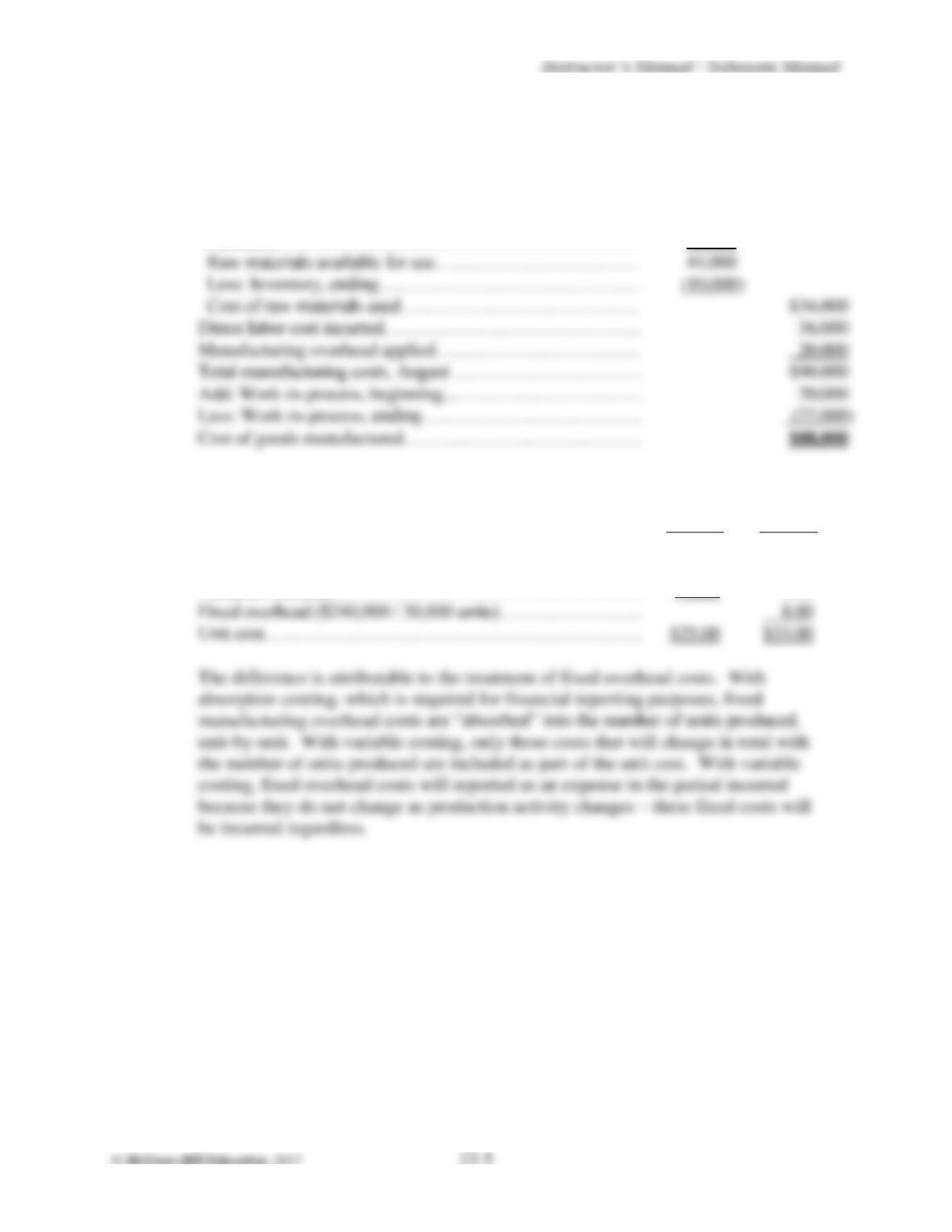
ABC Company
Statement of Cost of Goods Manufactured
Raw materials:
Inventory, beginning ………………………………………
$ 8,000
Purchases ……………….…………………………………
36,000
Raw materials available for use……………………………
Less: Inventory, ending….…………………………………
Cost of raw materials used…………………………………
Direct labor cost incurred……………………………………
36,000
Total manufacturing costs, August ………….………………
M13.5.
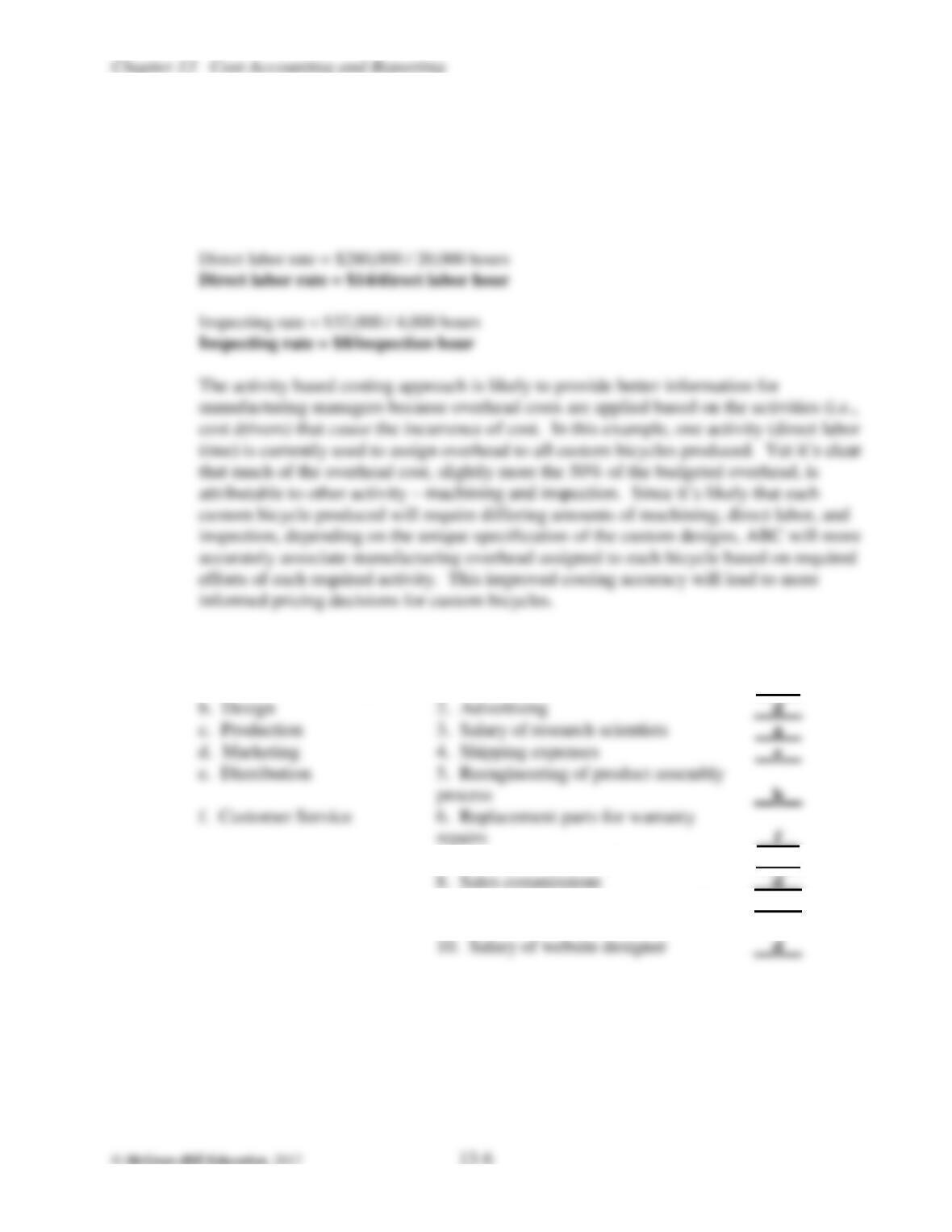
Variable
Costing
Absorption
Costing
Raw material ………...………………………………………
$ 7.00
$ 7.00
Direct labor…………………………………………………..
10.00
10.00
Variable overhead……………………………………………
8.00
8.00
Fixed overhead ($240,000 / 30,000 units)…………………...
Unit cost……………………………………………………..
M13.6.
Activity-based costing rates for each cost driver:
Activity costing rate = Budgeted cost / Budgeted activity
Machining rate = $250,000 / 10,000 hours
Machining rate = $25/machine hour
Direct labor rate = $280,000 / 20,000 hours
Inspecting rate = $32,000 / 4,000 hours
informed pricing decisions for custom bicycles.
E13.7.
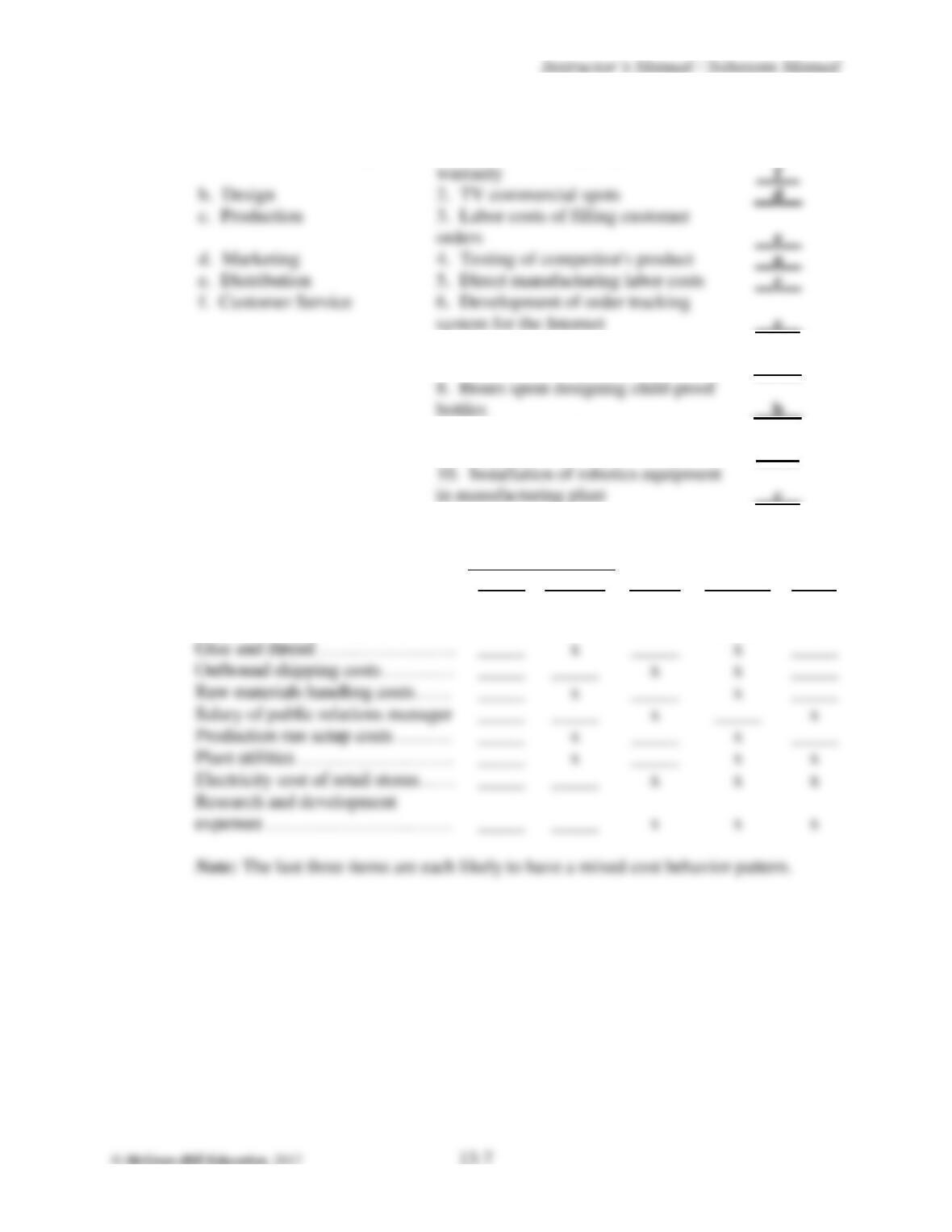
Business Function
Cost Item
Answer
a. Research & Development
1. Purchase of raw materials
__c__
process
7. Manufacturing supplies
__c__
9. Purchase of CAD (Computer Aided
Design) software
__b__
E13.8.
Business Function
Cost Item
Answer
a. Research & Development
warranty
b. Design
2. TV commercial spots
c. Production
3. Labor costs of filling customer
orders
__e__
d. Marketing
4. Testing of competitor’s product
e. Distribution
5. Direct manufacturing labor costs
f. Customer Service
6. Development of order tracking
system for the Internet
1. Labor time to repair products under
7. Printing cost of new product
brochures
__d__
8. Hours spent designing child-proof
bottles
__b__
9. Training costs for representatives
to staff the customer call center
__f__
10. Installation of robotics equipment
in manufacturing plant
__c__
E13.9.
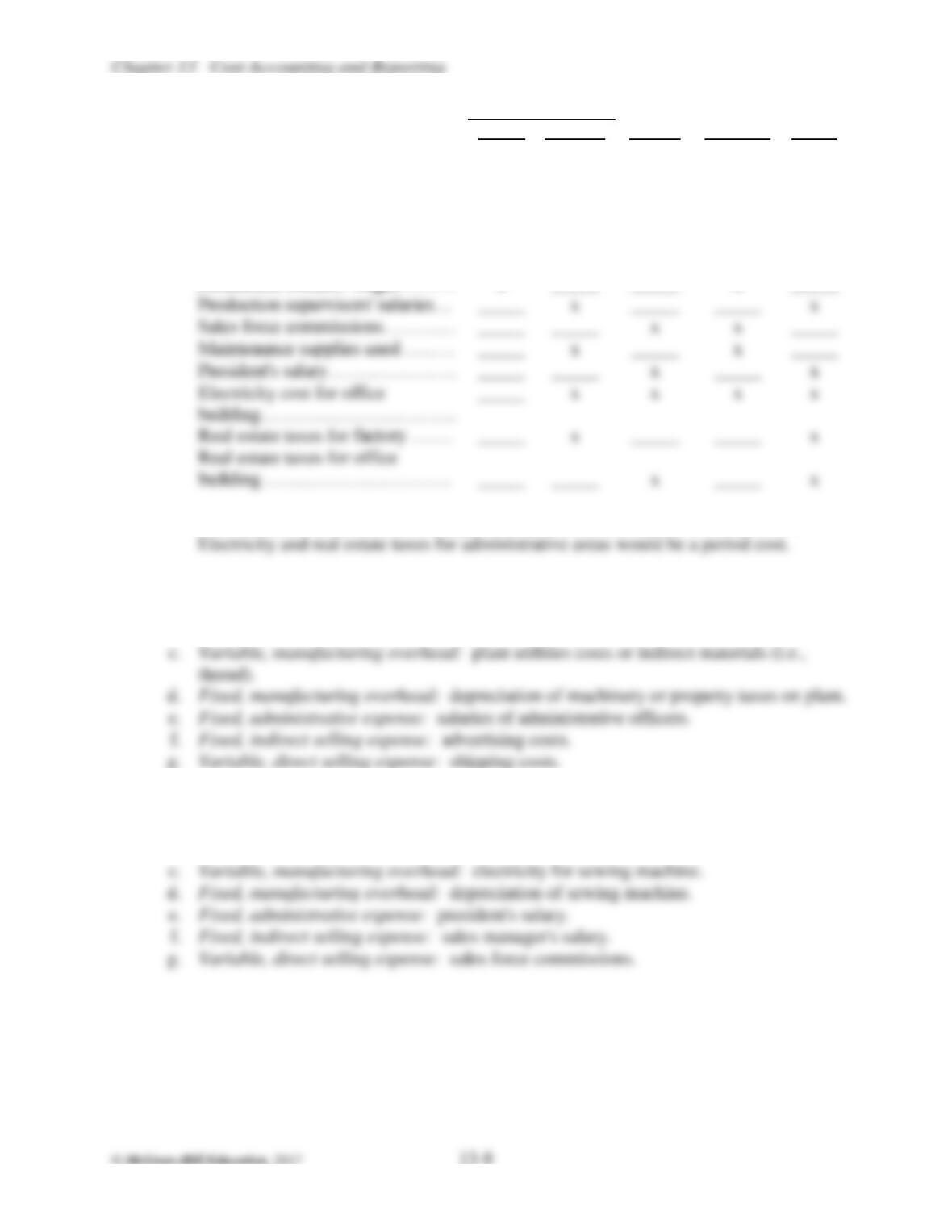
Product
Direct
Indirect
Period
Variable
Fixed
Wages of assembly-line workers…
x
_____
_____
x
_____
Depreciation–plant equipment …
_____
x
_____
_____
x
Glue and thread ………………….
_____
_____
x
_____
_____
_____
x
_____
_____
_____
x
_____
_____
_____
x
x
Research and development
E13.10.
Product
Direct
Indirect
Period
Variable
Fixed
Raw materials …………………
x
_____
_____
x
_____
Staples used to secure packed
boxes of product …………………
_____
x
_____
x
_____
Plant janitors’ wages …………….
_____
x
_____
x
x
Order processing clerks’ wages …
_____
_____
x
x
_____
Advertising expenses ……………
_____
_____
x
_____
x
Production workers’ wages………
x
_____
_____
x
_____
Production supervisors’ salaries…
_____
x
_____
_____
x
Sales force commissions…………
_____
_____
x
x
_____
Maintenance supplies used………
_____
x
_____
x
_____
President’s salary…………………
_____
_____
x
x
Electricity cost for office
Real estate taxes for factory …….
_____
x
_____
_____
x
Real estate taxes for office
Electricity and real estate taxes for administrative areas would be a period cost.
Note: Janitors’ wages and electricity probably have mixed cost behavior patterns.
E13.11.
a.
Raw material: cotton/ wool/ rayon used for jersey or material used for team emblems.
b.
Direct labor: wages of production-line machine operator.
thread).
d.
Fixed, manufacturing overhead: depreciation of machinery or property taxes on plant.
e.
Fixed, administrative expense: salaries of administrative officers.
Fixed, indirect selling expense: advertising costs.
Variable, direct selling expense: shipping costs.
E13.12.
a.
Raw material: fabric, zipper, shoulder straps.
b.
Direct labor: wages of sewing machine operator.
Variable, manufacturing overhead: electricity for sewing machine.
Fixed, manufacturing overhead: depreciation of sewing machine.
e.
Fixed, administrative expense: president’s salary.
Fixed, indirect selling expense: sales manager’s salary.
Variable, direct selling expense: sales force commissions.
E13.13.
a.
Predetermined overhead application rate
= ($408,750 estimated total overhead cost / 54,500 estimated direct labor hours)
= $7.50 per direct labor hour
Total manufacturing cost………………………………………………….
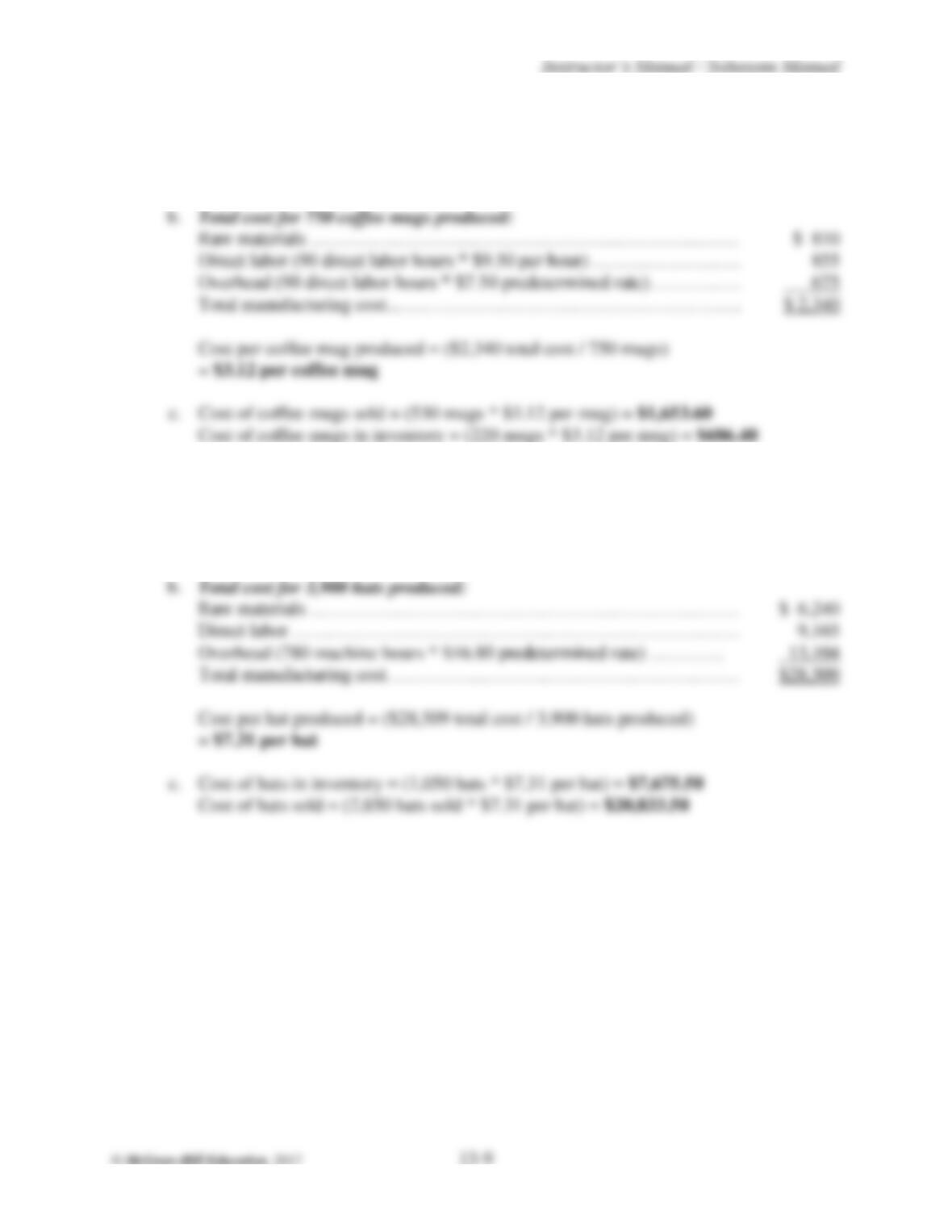
Cost per coffee mug produced = ($2,340 total cost / 750 mugs)
= $3.12 per coffee mug
E13.14.
a.
Predetermined overhead application rate
= ($359,520 estimated total overhead cost / 21,400 estimated machine hours)
= $16.80 per machine hour
Overhead (780 machine hours * $16.80 predetermined rate) …………
Cost per hat produced = ($28,509 total cost / 3,900 hats produced)
= $7.31 per hat
E13.15.
a.
9,000 machine hours * $12.70 per machine hour = $114,300 budgeted overhead
b.
Actual overhead incurred …………………………………………………
$121,650
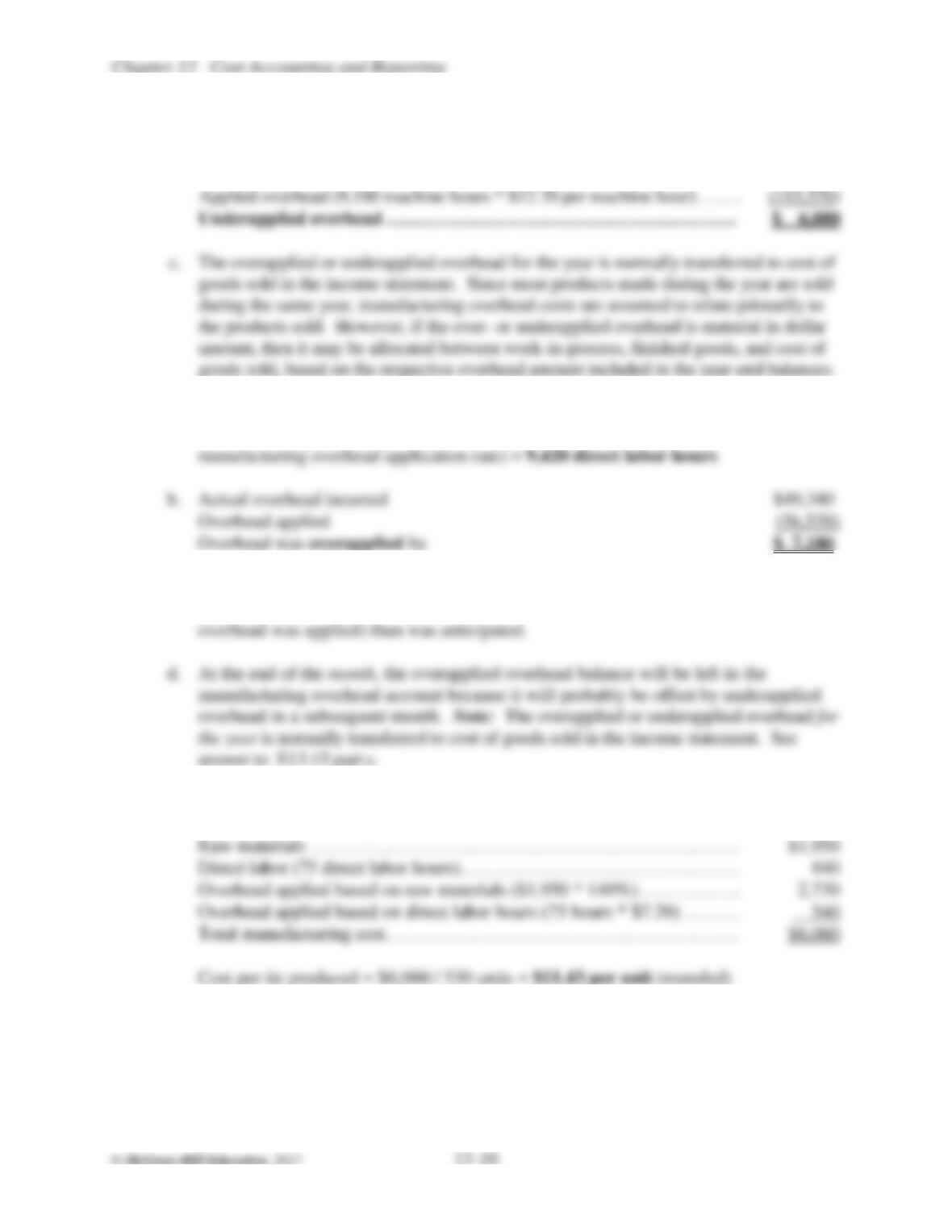
Applied overhead (9,100 machine hours * $12.70 per machine hour) …….
E13.16.
a.
Actual overhead incurred
Overhead applied
$56,520 overhead applied = (Direct labor hours used * $6.00 predetermined
c.
overhead in a subsequent month. Note: The overapplied or underapplied overhead for
1) Actual costs were less than anticipated when the predetermined overhead
application rate was calculated, and/or 2) more hours were worked (and thus more
E13.17.
Total cost for 530 ties produced:
Raw materials ……………………………………………………………
Overhead applied based on raw materials ($1,950 * 140%) …………….
Total manufacturing cost…………………………………………………
Cost per tie produced = $6,060 / 530 units = $11.43 per unit (rounded)